

If you are new to Bitcoin Cash, there is one idea I would keep in your head before getting into all the technical details:
BCH is an attempt to make Bitcoin-style digital cash practical directly on the base blockchain.
That sentence explains most of the decisions that came afterward.
Why larger blocks? To accommodate more transactions.
Why focus so heavily on low fees? Because cash becomes awkward if sending a few dollars costs a meaningful percentage of the payment.
Why develop mechanisms for zero-confirmation payments? Because a person buying coffee does not necessarily want to stand around waiting for a block.
Why introduce CashTokens? Because a payment network can become much more useful when the same blockchain can represent other digital assets.
And why has BCH remained controversial? Because the question it tries to answer is tied directly to one of Bitcoin’s oldest debates: should the base blockchain handle everyday payments at large scale, or should most everyday activity eventually move elsewhere?
That debate is what created Bitcoin Cash in the first place.
The Peer-to-Peer Electronic Cash System
Overview and Core Mission
Bitcoin Cash, usually abbreviated BCH, is a decentralized Layer-1 cryptocurrency that uses Proof-of-Work consensus and the SHA-256 hashing algorithm.
The network is descended directly from Bitcoin. According to the Bitcoin Cash Node documentation describing the network’s history, BCH became a separate currency from the Bitcoin chain on August 1, 2017, while retaining the shared transaction history that existed before the split.
That historical connection is important.
BCH did not appear as an unrelated altcoin designed from scratch.
Instead, it emerged because part of the Bitcoin community believed the Bitcoin protocol was moving in a direction that made ordinary on-chain payments increasingly difficult.
The BCH philosophy was comparatively straightforward:
If people want to use decentralized cryptocurrency as electronic cash, the base blockchain should have enough capacity to support that use.
That philosophy sounds obvious until you consider what happens when millions of people want to use the same blockchain.
Block space becomes scarce.
Users compete for inclusion.
Fees rise.
Transactions can sit in a mempool waiting for miners to include them.
For someone moving $10, that experience can feel very different from the experience of sending $10 through a conventional payment app.
BCH was created around the idea that the blockchain should scale its base-layer capacity rather than treating congestion as an unavoidable feature of the system.
BCH specifications at a glance
| Attribute | Bitcoin Cash |
|---|---|
| Ticker | BCH |
| Launch / fork date | August 1, 2017 |
| Fork block | 478,558 |
| Consensus | Proof-of-Work |
| Mining algorithm | SHA-256 |
| Maximum supply | 21 million BCH |
| Target block interval | Approximately 10 minutes |
| Historical block limit | Expanded to 32 MB |
| Current block-capacity model | Adaptive Blocksize Limit Algorithm |
| Native token functionality | CashTokens |
| Payment model | Direct Layer-1 transactions |
The historical fork point is well documented: contemporary coverage of the August 1, 2017 split recorded the Bitcoin Cash chain splitting at block height 478,558.
One detail deserves special attention if you are researching BCH today.
You will still find hundreds of articles describing Bitcoin Cash as a cryptocurrency with a 32 MB block-size limit.
That description is historically understandable, but it is now incomplete.
BCH activated the Adaptive Blocksize Limit Algorithm, or ABLA, in May 2024. The Bitcoin Cash Node v27 release announcement explains that the release implemented the consensus change for the May 15, 2024 network upgrade.
So if you are writing about BCH today, I would not simply say “BCH has 32 MB blocks.”
A more accurate description is:
BCH historically used a 32 MB block limit, while its current protocol uses an adaptive block-capacity mechanism.
That distinction matters because it shows how the network’s scaling philosophy has continued to evolve.
Why Bitcoin Cash is more than “Bitcoin with bigger blocks”
The easiest way to misunderstand BCH is to think the entire project can be reduced to one parameter: block size.
The block-size disagreement created the fork, but the network did not stop developing afterward.
Over time, BCH introduced:
- A different difficulty-adjustment algorithm.
- Improvements to transaction processing.
- Double-spend proof infrastructure.
- Expanded scripting capabilities.
- CashTokens.
- Adaptive block capacity.
- Additional protocol upgrades.
The Bitcoin Cash Node upgrade history shows that the network has gone through recurring scheduled upgrades, including CashTokens in May 2023 and later consensus changes.
That is why I think it is more useful to see BCH as a separate blockchain with Bitcoin ancestry rather than simply as “old Bitcoin.”
The DNA is shared.
The development direction is not.
The 2017 Hard Fork: Why Bitcoin Cash Was Created?

The block-size war
To understand BCH, you need to understand the problem that was being argued about in 2017.
Bitcoin blocks have finite capacity.
When demand is low, that capacity is not particularly difficult to manage.
When demand increases sharply, however, the available space becomes scarce.
Imagine a highway with a fixed number of lanes.
If only a few hundred cars are using it, everything flows.
If thousands of cars suddenly arrive, traffic appears.
Blockchain congestion works differently from road traffic, but the underlying economic problem is similar: when a scarce resource becomes highly demanded, users compete for access.
In Bitcoin, transaction fees became the mechanism through which users competed for block space.
The scaling debate therefore became a question of philosophy as much as engineering.
One side favored keeping the base blockchain relatively constrained and using other technologies to increase overall transaction capacity.
The other side wanted Bitcoin’s base layer itself to accommodate substantially more transactions.
Segregated Witness, or SegWit, became one of the central proposals in this debate.
SegWit changed Bitcoin’s transaction structure and helped establish the foundation for later technologies, including the Lightning Network.
The group that eventually created BCH rejected that approach as the primary answer to scaling and instead chose to increase the block capacity.
The result was the August 2017 hard fork.
As historical reporting from the day of the fork shows, the Bitcoin Cash chain began at block 478,558, followed by the first BCH block at 478,559.
That was the moment BCH became an independent blockchain.
Why the disagreement became so intense
The argument was never merely technical.
It involved a deeper disagreement over what Bitcoin was supposed to become.
Was Bitcoin primarily:
- A scarce digital monetary asset?
- A settlement network?
- A payment system?
- A peer-to-peer replacement for cash?
- Or a combination of all of these?
Different participants answered differently.
The BCH side generally placed greater emphasis on the “electronic cash” interpretation.
The Bitcoin Core ecosystem increasingly focused on a constrained base layer combined with additional scaling technologies.
Both approaches involve trade-offs.
A larger blockchain can process more transactions directly, but operating a node may require more resources as blockchain data grows.
A smaller base layer can make independent validation easier, but it may push more transaction activity into secondary systems.
There is no single engineering choice that eliminates every trade-off.
That is why the Bitcoin-versus-BCH discussion remains interesting even years after the original fork.
The people and organizations involved
Several well-known figures became associated with the BCH movement, including Roger Ver and Jihan Wu, while development progressed through projects such as Bitcoin ABC and later Bitcoin Cash Node.
But it would be misleading to describe any of these individuals as the “owner” of BCH.
Bitcoin Cash does not have a central company that owns the blockchain.
The network is maintained through independent node software, miners, developers, wallet providers, exchanges and users.
That distinction becomes particularly important when you compare BCH with cryptocurrencies that are strongly associated with a particular company or foundation.
Core Technical Features: BTC vs. BCH
Bitcoin and Bitcoin Cash compared
| Feature | Bitcoin (BTC) | Bitcoin Cash (BCH) |
|---|---|---|
| Primary narrative | Often described as digital gold | Often described as digital cash |
| Consensus | Proof-of-Work | Proof-of-Work |
| Mining algorithm | SHA-256 | SHA-256 |
| Maximum supply | 21 million | 21 million |
| Scaling philosophy | Constrained base layer + additional layers | Larger/adaptive on-chain capacity |
| Difficulty adjustment | Bitcoin’s difficulty-retarget system | ASERT |
| 0-conf infrastructure | Possible but not central to Bitcoin’s current narrative | Explicitly developed for BCH payments |
| Native token functionality | BTC itself plus external protocols | CashTokens |
| Upgrade history | Predominantly backward-compatible soft forks | Scheduled consensus upgrades including hard forks |
The differences become much easier to understand once you stop thinking about “which coin is better” and instead ask what each network is trying to optimize.
How larger blocks reduce fee pressure
Let’s make the block-size argument very practical.
Suppose a blockchain can fit only a small number of transactions into each block.
If demand suddenly doubles, somebody has to wait.
If users can attach fees, the users willing to pay more can compete for priority.
Now increase the amount of transaction data that each block can carry.
Suddenly, more users can fit into each block.
The pressure to outbid everyone else decreases.
That’s the economic reasoning behind BCH’s larger-block strategy.
Historically, BCH progressively expanded its block capacity, eventually reaching a 32 MB limit before adopting ABLA.
The current approach is more flexible.
According to the official BCH Node documentation for the 2024 upgrade, ABLA was introduced as a consensus change designed to make block capacity adaptive rather than permanently fixed at one ceiling.
That is an important modernization of the original BCH scaling concept.
Instead of saying:
“The block limit is always exactly X.”
the protocol can respond to changing utilization.
Are BCH transaction fees really below one cent?
Often, yes.
But this is one of those statements that should always be treated as a current network statistic rather than an eternal guarantee.
Transaction fees depend on:
- Network usage.
- BCH’s market price.
- Transaction size.
- Wallet fee policies.
- Miner behavior.
At the time of the latest available blockchain statistics, BitInfoCharts’ Bitcoin Cash data showed an average transaction fee of approximately $0.0068, with a median fee around $0.0012.
Those numbers can change.
But they illustrate the broader point: BCH is designed so that transaction fees can remain tiny even when the network is processing ordinary payment activity.
For a $10 transfer, a fee measured in fractions of a cent is almost irrelevant.
For a $10 transfer on a network where fees periodically reach several dollars, the economics are completely different.
This is why fees are not just a technical metric.
They determine whether a blockchain is practical for small payments.
ASERT: BCH’s difficulty-adjustment algorithm
Bitcoin Cash also differs from Bitcoin in how it adjusts mining difficulty.
In November 2020, BCH activated ASERT, short for Adaptive Exponentially Scheduled Target.
The official ASERT specification explains that the algorithm was designed to reduce periodic oscillations in mining difficulty and hash rate while keeping average block intervals close to the network’s 10-minute target.
Why was that necessary?
Because SHA-256 miners can potentially switch between different SHA-256 cryptocurrencies depending on profitability.
If the economics change, hash power can move.
A poorly designed difficulty system can react in ways that create unstable block production.
The BCH developers wanted something more responsive.
ASERT uses an exponentially weighted approach to adjust the target based on how actual block timing compares with the desired schedule.
The target block interval remains approximately 600 seconds.
That means the algorithm is effectively asking:
Are blocks arriving too quickly or too slowly compared with where we expect them to be?
Then it adjusts mining difficulty accordingly.
This is not something an everyday BCH user needs to calculate.
But it matters because predictable block production is part of a reliable payment network.
What are 0-conf transactions?
This is one of the most interesting BCH concepts if you care about retail payments.
A cryptocurrency transaction can be broadcast to the network before it is confirmed in a block.
A zero-confirmation transaction, or 0-conf transaction, is exactly that: the payment has been broadcast but has not yet received a block confirmation.
The obvious question is:
What prevents the sender from spending the same coins somewhere else?
That is the double-spend problem.
Bitcoin Cash developed Double Spend Proofs to provide rapid cryptographic evidence when two conflicting transactions attempt to spend the same UTXO.
The BCH Double Spend Proof specification explains that the mechanism allows participants to receive provable evidence that an unconfirmed output has been spent twice.
That can be useful for merchants.
Imagine you run a small café.
A customer pays $4 in BCH.
You do not necessarily want the customer to wait several minutes for a confirmation before receiving a coffee.
A payment system can instead evaluate the transaction, monitor the network and look for double-spend evidence.
But there is an important caveat.
0-conf does not magically become equivalent to a confirmed transaction.
The official specification itself notes limitations and recommends that merchants use additional risk management depending on the transaction type and circumstances.
So for a coffee?
Potentially practical.
For a $100,000 purchase?
You would probably want confirmations.
The correct lesson is not “0-conf is completely risk-free.”
The correct lesson is:
BCH has deliberately built infrastructure to make low-value, instant payment acceptance more practical.
The Modern BCH Ecosystem: CashTokens and Smart Contracts

The CashTokens upgrade
If you last researched Bitcoin Cash several years ago, this is the section I would pay the most attention to. BCH is no longer accurately described as only a cryptocurrency for sending BCH from one address to another.
The May 2023 upgrade introduced CashTokens, a native token system built into the BCH protocol.
The Bitcoin Cash upgrade documentation records CashTokens as CHIP-2022-02 and lists it among the consensus changes implemented in the May 15, 2023 upgrade. This was a substantial expansion of what BCH could represent. Developers can use the protocol to create native tokens that can represent different forms of digital ownership.
Depending on the application, that can include:
- Fungible tokens.
- Non-fungible tokens.
- Digital collectibles.
- Tokenized rights.
- Game assets.
- Stablecoin-style assets.
- Programmable financial instruments.
That does not turn BCH into Ethereum.
The underlying architecture remains different.
BCH still uses a UTXO model inherited from Bitcoin.
But CashTokens make that UTXO model considerably more expressive.
Why native tokens matter
Think about a concert ticket.
A normal website can tell you that you own ticket number 1842.
But the website’s database is ultimately controlled by the company operating the system.
A blockchain token can make ownership part of a publicly verifiable ledger.
Now replace the ticket with:
- A loyalty point.
- A membership certificate.
- A collectible.
- A game item.
- A tokenized financial claim.
The underlying idea is similar.
The blockchain becomes a shared database of ownership that does not depend on one company’s private database.
CashTokens bring that concept into BCH’s low-fee environment.
BCH and smart-contract functionality
It is important to use precise language here.
BCH does not offer smart contracts in exactly the same way Ethereum does.
Ethereum uses an account-based model and a general-purpose virtual machine.
BCH remains UTXO-based and uses Bitcoin-derived scripting mechanisms.
So when someone says “Bitcoin Cash has smart contracts,” the statement needs context.
What CashTokens did was introduce native token primitives that can be combined with BCH’s scripting environment to construct more sophisticated applications.
That is different from simply copying Ethereum’s architecture.
And arguably, that is part of what makes BCH interesting.
Instead of abandoning the UTXO model, BCH is trying to push it further.
On-chain applications and DeFi
This also creates the possibility of decentralized finance directly on the BCH base layer.
The advantage is obvious if fees remain tiny.
A financial application becomes much less intimidating when every interaction costs a fraction of a cent rather than several dollars.
But there is another side.
DeFi is not just about cheap transactions.
Developers also need:
- Wallet infrastructure.
- Liquidity.
- Reliable development tools.
- Oracles.
- Stable assets.
- User interfaces.
- Security auditing.
- Users.
That means CashTokens solve an important technical limitation, but they do not automatically create a massive application ecosystem.
Technology creates the possibility.
Adoption determines whether the possibility becomes useful.
Subsequent Forks: BCH vs. BSV vs. eCash
The 2018 Bitcoin SV split
The 2017 fork did not settle the debate permanently.
In 2018, the Bitcoin Cash community itself became divided over future protocol changes.
The dispute eventually produced another chain split.
One resulting network became known as Bitcoin SV, or BSV.
Contemporary reporting from CoinDesk’s coverage of the November 2018 Bitcoin Cash split documented the contentious hard fork that produced competing BCH and BSV chains.
Again, the important point for beginners is simple:
BCH and BSV are separate cryptocurrencies.
They share historical ancestry, but they are not interchangeable.
A BCH address, transaction or wallet network should not be casually treated as equivalent to BSV.
The 2020 split and eCash
The BCH ecosystem experienced another significant split in November 2020.
The resulting project eventually became eCash (XEC).
Bitcoin ABC’s documentation explicitly states that eCash and Bitcoin Cash became separate currencies through a blockchain split on November 15, 2020. (Bitcoin ABC’s explanation of the BCH/XEC split)
This history can be confusing because these projects share common ancestry.
The easiest mental model is:
Bitcoin → Bitcoin Cash → additional branches
But once a blockchain splits, each resulting network develops independently.
Consensus rules can diverge.
Monetary policies can diverge.
Software can diverge.
Communities can diverge.
Market prices can diverge.
So you should always verify the exact network you are using before moving funds.
Bitcoin Cash’s Monetary Model
One of the strongest links between BTC and BCH is the monetary supply.
BCH retains the 21-million maximum supply inherited from Bitcoin’s original monetary design.
New BCH enters circulation through Proof-of-Work mining.
The block subsidy is reduced periodically through halvings.
That gives BCH a familiar scarcity model:
There can never be more than 21 million BCH under the protocol’s monetary rules.
This is one of the reasons BCH can simultaneously be described as:
- Digital cash.
- A scarce digital asset.
- A Proof-of-Work cryptocurrency.
- A Bitcoin-derived monetary network.
The difference is not primarily the monetary policy.
The major difference is what the network is trying to make easy.
Bitcoin’s ecosystem increasingly emphasizes the idea of BTC as a scarce monetary asset and settlement layer.
BCH continues to emphasize frequent direct transactions.
That distinction is worth keeping in mind when you encounter claims that BCH is simply “another Bitcoin.”
It is not.
The supply architecture is closely related.
The economic priorities have diverged.
Why BCH Focuses So Much on Transaction Fees
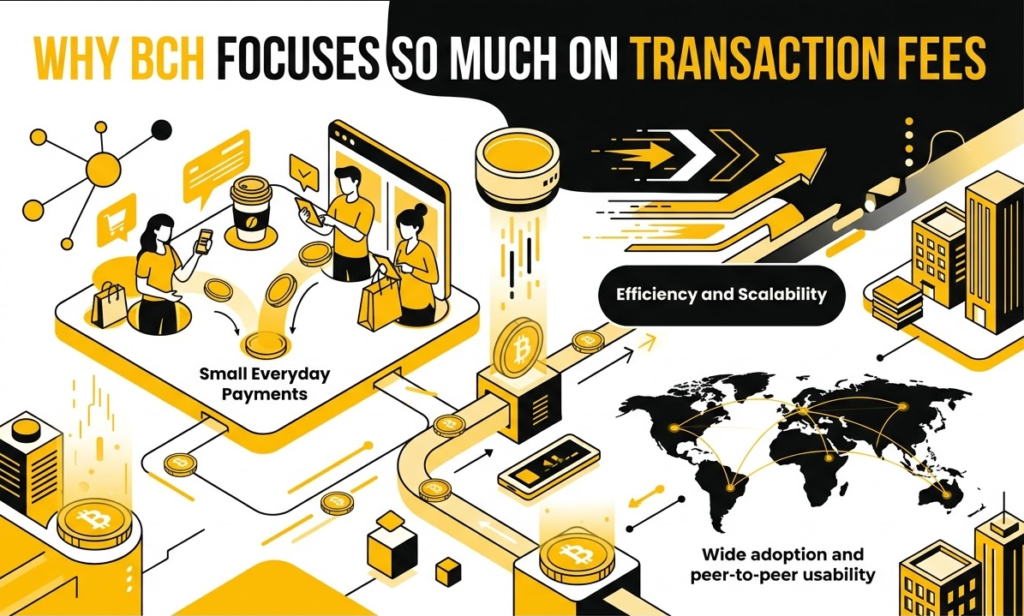
I think transaction fees are the easiest way to understand the BCH philosophy.
Imagine you want to send $2.
If the network fee is $0.001, you barely notice it.
If the network fee is $3, the payment model starts to break down.
The problem becomes even more obvious when you want to send tiny amounts repeatedly.
Microtransactions require extremely low marginal costs.
That is why BCH’s emphasis on abundant block capacity is not merely a technical obsession.
It is connected to the economics of payments.
A digital cash system needs to be cheap enough that users do not constantly calculate whether the transaction itself is worth making.
Recent BCH network data illustrates the intended outcome. Current Bitcoin Cash statistics from BitInfoCharts show average transaction fees in the sub-cent range, although actual fees naturally fluctuate over time.
The broader point is more important than the exact number.
BCH is deliberately designed around the assumption that transactions should be cheap enough for ordinary use.
The Strength and Weakness of the BCH Approach
A balanced look at BCH has to acknowledge the trade-offs.
What the design tries to achieve
- Very low transaction fees.
- Direct on-chain payments.
- Large or adaptive transaction capacity.
- Familiar Proof-of-Work security.
- A fixed 21-million supply.
- Native token functionality.
- Infrastructure for instant payment acceptance.
What the approach has to deal with
- Larger blockchain data requirements.
- The hardware and bandwidth requirements associated with high-capacity blocks.
- Competition from Bitcoin’s Layer-2 ecosystem.
- A comparatively smaller application ecosystem.
- Lower mainstream recognition than BTC.
- The ongoing debate over long-term node decentralization.
This is where the discussion becomes more interesting than a simple “BCH good” or “BCH bad” argument.
Scaling on-chain is not free.
Larger blocks require more data to propagate and validate.
But keeping blocks small is not free either.
If block space becomes scarce, transaction fees can rise and users may be pushed toward secondary networks.
Both approaches involve trade-offs.
BCH simply makes a different choice about where it wants to place the emphasis.
Is BCH Still “Digital Cash”?
That depends partly on what you mean by digital cash.
If by digital cash you mean:
“A decentralized asset that can be transferred directly from one person to another at very low cost.”
Then BCH clearly fits the description.
If, however, you mean:
“A cryptocurrency already used globally as commonly as national currencies.”
That is a much stronger claim, and the technology alone does not prove it.
Payment adoption requires merchants.
It requires wallets.
It requires liquidity.
It requires convenient exchanges.
It requires consumers to actually choose the asset.
And it requires businesses to be willing to accept it.
That is why I would separate technical suitability for payments from real-world payment adoption.
BCH is designed for the former.
The latter depends on the market.
FAQ
What is the main difference between Bitcoin and Bitcoin Cash?
Bitcoin and Bitcoin Cash share the same blockchain history up to the August 1, 2017 fork, but they have followed different technical and economic directions since then.
Bitcoin generally maintains a more constrained base layer and has developed additional scaling infrastructure such as the Lightning Network.
Bitcoin Cash has emphasized larger and increasingly adaptive on-chain capacity.
Both use Proof-of-Work and SHA-256.
Both have a 21-million maximum supply.
But their scaling philosophies are different.
If you want the simplest distinction:
BTC emphasizes a scarce base-layer monetary network with additional scaling layers, while BCH emphasizes inexpensive direct transactions on the base layer.
That is a simplification, but it is a useful starting point.
Does Bitcoin Cash still have 32 MB blocks?
Not in the simple fixed-limit sense often described in older articles.
BCH historically increased its block limit until reaching 32 MB.
However, the May 2024 network upgrade introduced ABLA, the Adaptive Blocksize Limit Algorithm.
The official BCH Node v27 documentation states that ABLA was implemented for the May 15, 2024 consensus upgrade.
So a modern description should say that BCH uses adaptive block capacity, while noting that 32 MB was the previous fixed block limit.
Are BCH transactions really less than one cent?
They can be, and recent network statistics show that they frequently are.
At the time of the latest available data, BitInfoCharts reported an average BCH transaction fee of about $0.0068.
But this is a network statistic, not a guaranteed permanent fee.
Your actual transaction cost can vary depending on:
- Network activity.
- Transaction size.
- BCH’s market price.
- Wallet fee settings.
The important point is that BCH is designed to keep transaction fees extremely low by providing substantial transaction capacity.
Can you create NFTs on Bitcoin Cash?
Yes.
The May 2023 CashTokens upgrade introduced native token functionality to BCH.
The BCH upgrade documentation identifies CashTokens as one of the consensus changes implemented in the May 15, 2023 upgrade.
CashTokens can be used to create tokenized assets, including NFT-like digital assets.
However, BCH’s implementation is not simply a clone of Ethereum’s NFT standards.
CashTokens are designed around BCH’s own UTXO and scripting architecture.
What are CashTokens?
CashTokens are native token primitives built into the Bitcoin Cash protocol.
They allow developers to create digital assets that exist directly within BCH transactions and outputs.
That can support:
- Fungible tokens.
- NFTs.
- Digital collectibles.
- Tokenized rights.
- Financial applications.
- Decentralized applications.
This was an important expansion because BCH was historically known primarily for payments.
CashTokens allow the same blockchain to support a wider range of applications.
Is Bitcoin Cash the same as Bitcoin SV?
No.
Bitcoin SV emerged from the November 2018 split within the Bitcoin Cash ecosystem.
The two networks share historical roots but are now independent blockchains.
Contemporary CoinDesk reporting on the 2018 split documents the contentious hard fork that produced competing chains.
Never send BCH to a BSV-only address or assume that wallets supporting one network automatically support the other.
What happened to Bitcoin Cash ABC?
Bitcoin Cash ABC followed a separate development path after the November 2020 split and became associated with eCash (XEC).
Bitcoin ABC’s documentation explains the November 15, 2020 blockchain split, after which BCH and eCash became separate currencies.
eCash therefore has historical roots in BCH but is not the same cryptocurrency.
How do 0-conf transactions work?
A 0-conf transaction is broadcast to the network but has not yet been included in a block.
BCH developed Double Spend Proofs to help nodes and merchants detect attempts to spend the same UTXO twice.
The official Double Spend Proof specification describes how cryptographic evidence can prove that two conflicting transactions attempted to spend the same output.
This can make instant retail payments more practical.
However, 0-conf should not be treated as identical to a confirmed transaction.
The same BCH specification explicitly discusses limitations and merchant risk management.
For low-value transactions, a merchant may decide the risk is acceptable.
For high-value transactions, waiting for confirmations remains the safer approach.
Does BCH use Proof-of-Stake?
No.
Bitcoin Cash uses Proof-of-Work.
Mining uses the SHA-256 algorithm, meaning BCH shares much of its mining ecosystem with Bitcoin.
Competitive mining therefore relies on specialized hardware rather than ordinary consumer computers.
Can you mine BCH on a laptop?
You can technically run mining software, but that does not mean it will be economically competitive.
BCH uses SHA-256 Proof-of-Work.
Modern competitive SHA-256 mining is dominated by specialized ASIC hardware.
So if you are considering BCH mining at home, the important question is not “Can my computer calculate SHA-256?”
It can.
The important question is:
Can it compete economically against specialized mining hardware?
For most ordinary computers, the answer is no.
What is BCH mainly used for?
BCH is designed primarily around peer-to-peer payments.
Common use cases include:
- Sending money directly between individuals.
- Merchant payments.
- Cross-border transfers.
- Small-value payments.
- Online payments.
- Holding a Bitcoin-derived scarce digital asset.
- Token applications built using CashTokens.
The network’s extremely low transaction costs are particularly relevant for smaller transfers.
Is Bitcoin Cash a stablecoin?
No.
BCH is a volatile cryptocurrency.
Its market price can move significantly relative to the US dollar and other fiat currencies.
The “cash” in Bitcoin Cash refers to its intended payment function, not price stability.
If you need a token designed to track $1, you are looking at the stablecoin category rather than BCH.
Final Thoughts: What Bitcoin Cash Is Really Trying to Be
The easiest way to understand Bitcoin Cash is to forget the tribal arguments for a moment.
Forget “BTC versus BCH.”
Forget which community is louder.
Forget the personalities.
Start with one practical question:
What should decentralized digital money feel like when you actually use it?
Bitcoin Cash has a very clear answer.
It should feel cheap.
It should be direct.
It should work without asking permission from a bank.
And, whenever practical, it should allow you to transact directly on the blockchain rather than forcing everyday payments onto another network.
That philosophy explains the 2017 fork.
It explains the emphasis on larger blocks.
It explains the move from the historical 32 MB limit toward adaptive block capacity through ABLA.
It explains the attention given to zero-confirmation payments and Double Spend Proofs.
And it explains why CashTokens are such an important development.
The network has not remained frozen in 2017.
Its protocol has continued to evolve through scheduled upgrades. The BCH upgrade history documents changes including CashTokens in 2023, while the 2024 ABLA implementation represents another significant step in its approach to scaling.
That is why the old one-line definition – “Bitcoin Cash is Bitcoin with 32 MB blocks” – no longer does the project justice.
A more useful definition is:
Bitcoin Cash is a Bitcoin-derived Proof-of-Work blockchain that prioritizes inexpensive, direct on-chain payments while continuing to expand its capacity and functionality.
It has the familiar 21-million supply.
It has SHA-256 mining.
It has Bitcoin’s UTXO roots.
But it has taken those foundations in a different direction.
And that difference is ultimately what BCH is about.
If you see Bitcoin primarily as a scarce digital monetary asset, BCH may look like a very different answer to the question of what a blockchain should be.
If you see cryptocurrency primarily as a way to transfer value from one person to another, the BCH design becomes easier to understand.
You do not have to believe that BCH will replace Bitcoin.
You do not even have to believe that on-chain scaling is the only way to build a successful payment network.
But if you want to understand why Bitcoin Cash exists – and why its developers are still working on it more than a decade after Bitcoin’s creation – this is the central idea to remember:
BCH is trying to make the blockchain itself usable as digital cash, not merely as the settlement layer underneath a separate payment ecosystem.
That is the bet Bitcoin Cash has made since 2017.
And with adaptive block capacity, CashTokens and continuing protocol development, it is a bet that the project is still actively pursuing today.