

The Enduring Legacy of “Digital Silver”
If you have spent enough time around crypto, you’ve probably heard the phrase “digital silver” attached to Litecoin.
It is an easy nickname to remember, but it can also make Litecoin sound simpler than it really is.
I think the better way to understand LTC is to forget the slogan for a moment and look at the design choices underneath it. Litecoin was created as a Bitcoin-derived network, but its creator deliberately changed several parameters to make the system feel lighter and faster for everyday transfers. Litecoin’s own historical account says Charlie Lee announced the project on October 9, 2011, with the genesis block mined shortly afterward; the network’s launch was built around Proof-of-Work, Scrypt, faster block production and an 84-million maximum supply. (Litecoin)
That philosophy still matters.
Bitcoin became associated increasingly with large-value settlement and long-term monetary scarcity. Litecoin, by contrast, has continued to position itself around the idea that digital money should be easy to move. You don’t necessarily need to care about smart contracts, NFTs or complicated DeFi strategies to understand the basic appeal: if I want to send value to you across the internet, I want the transaction to be relatively cheap, relatively fast and not dependent on a bank approving it.
That is the original Litecoin proposition.
Litecoin at a glance
| Attribute | Litecoin |
|---|---|
| Ticker | LTC |
| Creator | Charlie Lee |
| First announced | October 2011 |
| Consensus | Proof-of-Work |
| Mining algorithm | Scrypt |
| Target block time | About 2.5 minutes |
| Maximum supply | 84 million LTC |
| Smallest unit | 1 Litoshi = 0.00000001 LTC |
| Privacy layer | Optional MWEB |
| Smart-contract ecosystem | Emerging through projects such as LitVM |
The basic network characteristics are also reflected in recent SEC-filed descriptions of Litecoin, which identify its approximately 2.5-minute block generation time, 84-million supply cap, Scrypt algorithm and Proof-of-Work model.
Why Litecoin was created
Litecoin wasn’t designed from scratch as a completely unrelated blockchain. Charlie Lee started with Bitcoin’s architecture and then modified it.
That decision is important because it explains why Litecoin often feels familiar if you’ve already used Bitcoin. You still have blocks, transactions, UTXOs, miners, Proof-of-Work and a capped monetary supply. What changes are the parameters and some of the engineering choices around them.
Litecoin’s own historical material describes the project as a Bitcoin-based design with three particularly noticeable changes: Scrypt instead of SHA-256, roughly 2.5-minute blocks instead of 10-minute blocks, and four times Bitcoin’s eventual maximum coin supply. (Litecoin)
So when people call Litecoin “digital silver,” they’re really pointing toward a broader monetary analogy:
- Bitcoin → scarce, high-value digital asset
- Litecoin → more payment-oriented, lighter digital currency
- Both → decentralized Proof-of-Work networks with capped supply
The analogy isn’t a technical rule, of course. It’s a shorthand. But it has survived because Litecoin has remained one of the longest-running cryptocurrency networks rather than disappearing after a few years.
Technical Foundations: How Litecoin Differs from Bitcoin
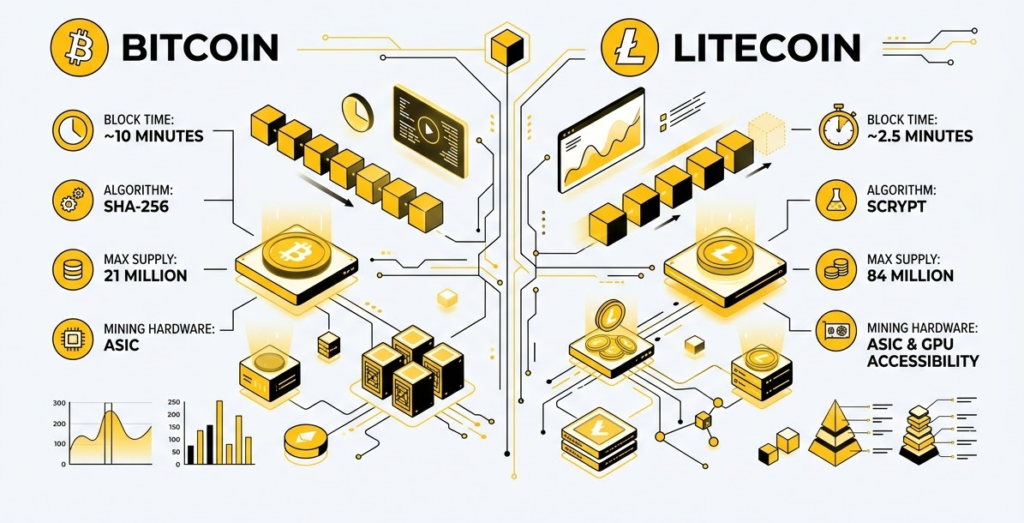
At first glance, Litecoin and Bitcoin can look almost interchangeable.
Both use Proof-of-Work. Both rely on miners. Both have transparent base-layer ledgers. Both use UTXO-based transaction accounting. Both have predetermined supply limits. And both are designed to operate without a central bank or company controlling the ledger.
The differences become much more interesting once you look beneath the surface.
Faster blocks and the Scrypt algorithm
Bitcoin targets a block roughly every ten minutes. Litecoin targets roughly one every 2.5 minutes, which means Litecoin’s network is designed to produce blocks around four times as frequently. This distinction is documented in both Litecoin’s own technical material and recent SEC filings describing LTC.
Why does that matter?
Imagine you’re standing at a checkout counter. You don’t want to stare at a screen for ten minutes wondering whether your payment is going to make it into the next block.
A shorter block interval doesn’t make a Litecoin payment magically irreversible the moment you press “send” – confirmations and settlement assumptions still matter – but it does reduce the average waiting time for blocks compared with Bitcoin.
That’s one reason Litecoin has historically been attractive for payment applications.
Then there’s Scrypt.
Bitcoin uses SHA-256 for its Proof-of-Work mining process, whereas Litecoin uses Scrypt. The Litecoin Foundation’s historical documentation explicitly describes this as one of the network’s fundamental differences from Bitcoin. (Litecoin)
Scrypt was chosen partly because Litecoin’s creators wanted a mining environment distinct from Bitcoin’s SHA-256 ecosystem. Over time, specialized Scrypt ASIC hardware emerged, so it would be misleading to describe Litecoin mining today as simply “CPU mining.” The important point is that Litecoin has its own mining hardware ecosystem and algorithmic identity, rather than simply competing for Bitcoin’s SHA-256 hash power.
This distinction is worth remembering because you will occasionally see outdated articles describing Litecoin as an ASIC-resistant coin. That description no longer captures the modern mining landscape.
Deflationary tokenomics and Litecoin’s halving cycles
Litecoin has a maximum supply of 84 million LTC, four times Bitcoin’s 21-million cap. The network achieves that limit through a programmed reduction in the block reward.
Litecoin’s reward began at 50 LTC per block and is designed to halve every 840,000 blocks, which historically corresponds to roughly four years given the network’s 2.5-minute block target. Litecoin’s own documentation explains the halving schedule and the eventual reduction of issuance toward zero. (Litecoin)
The mechanics are straightforward:
| Stage | Block reward |
|---|---|
| Initial reward | 50 LTC |
| First halving | 25 LTC |
| Second halving | 12.5 LTC |
| Third halving | 6.25 LTC |
| Later halvings | Continues decreasing |
The exact timing should be understood as approximate because blocks don’t arrive at perfectly regular intervals. Mining difficulty adjusts to keep the long-run block interval near the protocol target.
This is one of those areas where Litecoin looks remarkably similar to Bitcoin. Both networks use programmed monetary scarcity rather than relying on a central authority to decide how many new coins should exist.
For me, that’s one of Litecoin’s most interesting characteristics: after more than a decade, its monetary policy isn’t something a committee can casually rewrite. Any protocol change still depends on network consensus.
The Privacy Evolution: MimbleWimble Extension Blocks
Here’s where the “old payment coin” description starts to become incomplete.
Litecoin introduced MimbleWimble Extension Blocks, commonly shortened to MWEB, as an optional privacy and scalability layer. Litecoin’s own documentation describes MWEB as a permissionless opt-in layer combining MimbleWimble with the extension-block concept. (Litecoin)
The technical design is fascinating because Litecoin didn’t simply replace its transparent ledger with a privacy-only system.
Instead, MWEB exists alongside the canonical chain.
What is MWEB?
MWEB stands for MimbleWimble Extension Block.
The concept combines two ideas:
- MimbleWimble, a transaction and privacy protocol designed to reduce the amount of historical transaction data that needs to be retained.
- Extension Blocks, a mechanism that lets additional transaction rules operate alongside the canonical Litecoin chain.
The official Litecoin Improvement Proposal for MWEB describes the design as an opt-in system where users can move coins into an extension block and later move them back out through integrating transactions. (GitHub)
That “opt-in” part matters.
You don’t have to use MWEB simply because you’re using Litecoin. A user can continue using the transparent Litecoin chain, while another user can choose the MWEB functionality supported by compatible software.
The result is a more nuanced privacy model than you might expect from a payment-focused cryptocurrency.
What does MWEB actually hide?
On the MWEB side, transaction amounts are confidential rather than publicly exposed in the same way as ordinary Litecoin transactions.
The design also changes how transaction history is represented, allowing redundant information to be removed through MimbleWimble’s transaction-compression approach. Litecoin describes MWEB as providing both optional privacy and scalability benefits. (Litecoin)
That doesn’t mean “Litecoin is completely anonymous.”
That’s an important distinction.
If you move LTC between transparent and MWEB environments, the surrounding transaction activity can still provide information. Exchanges, wallet providers and other services may also have information about you outside the blockchain itself. Blockchain privacy is not the same thing as becoming invisible everywhere.
I would therefore describe MWEB as an optional confidential transaction layer, rather than promising absolute anonymity.
Why extension blocks are technically important
The extension-block approach is clever because it creates a way to add new transaction functionality without completely replacing the canonical chain’s existing consensus rules.
The Litecoin Improvement Proposal describes extension blocks as a side-chain-like structure running alongside canonical blocks, with miners committing to the additional block data while maintaining separate validation rules and UTXO sets. (GitHub)
That architecture gives Litecoin a useful development path.
Instead of saying, “We must redesign everything,” developers can add specialized functionality while maintaining compatibility with the broader network.
For users, however, the practical question is simpler: does my wallet support MWEB, and do I understand how moving funds between the transparent chain and MWEB works?
That’s the part you should care about before sending meaningful amounts.
Bringing DeFi to Litecoin: The LitVM Layer-2 Integration
For years, Litecoin was easy to categorize.
Payments? Yes.
Mining? Yes.
Smart contracts? Not really.
That last answer is becoming outdated.
The emergence of LitVM is an attempt to add a programmable execution environment around Litecoin without rewriting the Litecoin base protocol itself. According to LitVM’s official documentation, the project is designed as an EVM-compatible rollup using Arbitrum Orbit, zero-knowledge technology and BitcoinOS infrastructure for Litecoin asset bridging. (LitVM Docs)
There is an important caveat, though: LitVM should not be confused with a native smart-contract capability built directly into Litecoin Layer 1.
It is an additional execution layer.
That distinction matters when you’re comparing Litecoin with Ethereum, Solana or other smart-contract-first blockchains.
What is LitVM?
LitVM is being developed as an EVM-compatible rollup for Litecoin.
In practical terms, that means Ethereum developers can work with familiar tools and Solidity-based smart contracts while using an execution environment designed around Litecoin-related assets.
Its architecture combines several technologies rather than relying on Litecoin alone. The project’s documentation identifies:
- Arbitrum Nitro / Orbit for EVM-compatible execution.
- Succinct SP1 zkVM for validity proofs.
- Espresso for decentralized sequencing.
- BitcoinOS Grail Bridge for trustless Litecoin-to-LitVM asset movement.
- zkLTC as the native gas asset.
The project’s architecture documentation provides these technical details and distinguishes the various roles played by the rollup, proof system, sequencer and bridge. (LitVM Docs)
That is a much more sophisticated stack than simply “Litecoin now has smart contracts.”
How the Litecoin bridge works
According to LitVM’s documentation, its Grail Bridge is designed to move LTC into LitVM without relying on a traditional third-party custodian.
The documented flow is broadly:
LTC on Litecoin → locked LTC → ZK proof → zkLTC on LitVM
and in reverse:
zkLTC on LitVM → burn → proof verification → LTC released on Litecoin
LitVM describes zkLTC as a 1:1 representation of LTC backed by Litecoin-mainnet collateral and says the bridge is designed to use ZK proofs rather than a conventional multisignature custodian. (LitVM Docs)
That is the concept.
But because LitVM is a newer ecosystem, you should distinguish between architecture described by the project and mature, battle-tested adoption. A technical design can be impressive while still being early in real-world deployment.
What could LitVM unlock?
If the ecosystem develops successfully, Litecoin could become more than a payment network.
You could potentially see:
- LTC-based lending markets
- Decentralized exchanges
- Yield strategies
- Tokenized real-world assets
- Stablecoins
- NFT applications
- AI-integrated applications
- Cross-chain financial applications
LitVM itself lists yield markets, RWAs and AI-focused applications among its intended use cases. (LitVM)
The important phrase here is “intended use cases.”
You shouldn’t read those descriptions as proof that Litecoin already has an Ethereum-sized DeFi economy. The technology is an attempt to create that possibility.
EVM compatibility changes the developer equation
The biggest strategic advantage may actually be developer familiarity.
Ethereum’s EVM has become a standard environment for smart-contract development. If developers can deploy Solidity applications to an environment connected to Litecoin without learning an entirely new programming model, the barrier to experimentation becomes lower.
LitVM’s documentation explicitly says it is designed to be highly compatible with Ethereum’s smart-contract tooling and that Ethereum developers should need relatively little new knowledge to work with the system. (LitVM Docs)
That could be significant.
Litecoin already has a long-established user base and liquidity. What it has historically lacked is a broad programmable application layer. Projects like LitVM are trying to close that gap.
Real-World Adoption: Why Merchants Still Choose Litecoin

Technology alone doesn’t make a cryptocurrency useful.
People actually have to use it.
And this is where Litecoin has an advantage that newer projects can’t manufacture overnight: it has been used as a payment asset for years.
Payment processors have repeatedly included Litecoin among supported cryptocurrencies. For example, BitPay announced Litecoin support in 2021, and its subsequent reporting showed substantial growth in Litecoin payment activity during the period it analyzed. (BitPay)
More recently, CoinGate’s payment data provides a useful real-world look at Litecoin usage. Its report covering 2018 through August 2025 analyzed 638,983 Litecoin payments processed through its merchant ecosystem and reported that LTC represented 13.9% of payments on the platform during January–August 2025, placing it among the platform’s leading payment methods. (Best Bitcoin & Crypto Payment Processor)
That’s a useful data point because it moves the discussion away from vague claims such as “Litecoin is widely accepted.”
We can actually look at payment-processor data and ask what people are doing with it.
Why payment processors like LTC
A payment processor generally cares about practical things:
- How expensive is the transaction?
- How quickly can the payment be confirmed?
- How liquid is the asset?
- How easy is it to convert into fiat?
- How reliable is the network?
- Are customers actually using it?
Litecoin scores reasonably well on several of these characteristics.
Its 2.5-minute target block time and generally low transaction costs make it attractive for smaller transfers, while the network’s long operating history gives merchants something that newer blockchains simply don’t have yet: a track record.
CoinGate’s more recent data also showed that Litecoin remained among its top payment methods, with web hosting, proxy services and gaming among the major categories using LTC payments during 2025. (Best Bitcoin & Crypto Payment Processor)
That doesn’t mean Litecoin has replaced Visa, Mastercard or conventional banking.
It hasn’t.
But that’s not necessarily the right benchmark.
The more interesting question is whether Litecoin can occupy a useful niche for global, internet-native payments where users want to move value directly without relying on conventional banking hours or geographic boundaries.
For that use case, the design still makes sense.
Institutional Products and the Changing LTC Market
Another part of Litecoin’s story is the gradual development of regulated investment products and institutional access.
This is different from merchant adoption.
When someone pays a merchant in LTC, they’re using Litecoin as a payment asset. When an investment vehicle holds LTC, the investor is gaining financial exposure without necessarily interacting directly with the Litecoin network.
That distinction becomes increasingly important as cryptocurrency markets mature.
Recent SEC-filed documents describe Litecoin as a Proof-of-Work network with an 84-million maximum supply, approximately 2.5-minute blocks and Scrypt mining.
For investors evaluating a cryptocurrency through regulated financial products, those basic protocol characteristics are part of the asset’s underlying description.
At the same time, you shouldn’t confuse the existence of investment products with proof that Litecoin’s payment thesis has succeeded universally. Institutional access and everyday utility are two different measurements.
Litecoin vs Bitcoin: The Practical Difference
If you’re deciding whether to learn about BTC or LTC first, I would not frame the question as “Which one is better?”
The more useful question is: what job is each network trying to do?
| Feature | Litecoin | Bitcoin |
|---|---|---|
| Consensus | Proof-of-Work | Proof-of-Work |
| Mining | Scrypt | SHA-256 |
| Target block time | ~2.5 minutes | ~10 minutes |
| Maximum supply | 84 million LTC | 21 million BTC |
| Primary historical narrative | Payments / digital silver | Monetary asset / digital gold |
| Privacy feature | Optional MWEB | Base layer is transparent |
| Smart-contract expansion | Emerging through external layers such as LitVM | Expanding through multiple Layer-2 ecosystems |
| Smallest unit | Litoshi | Satoshi |
The basic numerical differences are documented by both Litecoin materials and SEC filings.
The biggest conceptual difference is therefore not simply speed.
It’s positioning.
Bitcoin has increasingly become associated with scarcity, monetary settlement and long-term value storage. Litecoin has maintained a stronger connection to everyday transaction utility.
Neither description tells the whole story, but it helps explain why both networks continue to exist despite sharing so much DNA.
Litecoin MWEB vs Ordinary Litecoin Transactions
If you’re new to MWEB, this is the distinction I would keep in mind.
A normal Litecoin transaction is publicly visible on the blockchain. Addresses and transaction amounts can be analyzed using blockchain explorers and other tools.
MWEB changes that model by allowing users to opt into confidential transactions through the extension-block system.
| Characteristic | Standard Litecoin | MWEB |
|---|---|---|
| Privacy | Transparent | Enhanced confidentiality |
| Amount visibility | Public | Confidential |
| Participation | Default Litecoin transaction model | Optional |
| Architecture | Main chain | Extension block |
| Historical data model | Conventional UTXO history | MimbleWimble-style transaction compression |
| Wallet support | Broad | Requires compatible MWEB functionality |
Litecoin’s MWEB documentation and the underlying LIP specifications describe the feature as an opt-in mechanism rather than a mandatory privacy layer. (Litecoin)
That’s also why you should be careful when reading headlines claiming “Litecoin is now anonymous.”
That’s too simplistic.
MWEB improves confidentiality for transactions using that system, but your overall privacy depends on how you acquire LTC, where you send it, what wallet you use, whether you move between transparent and MWEB environments, and what information third parties already possess.
Litecoin Fees and Transaction Speed
One of Litecoin’s strongest practical arguments is its relatively inexpensive transaction structure.
The network’s architecture was deliberately designed around faster blocks than Bitcoin, and recent SEC filings characterize Litecoin transactions as generally faster and lower-cost than Bitcoin transactions.
But I wouldn’t promise you a permanently fixed “sub-cent” transaction fee.
Crypto transaction fees vary with network conditions, transaction size, wallet behavior and market conditions. A claim such as “Litecoin always costs less than $0.01” is too absolute.
The better statement is that Litecoin has historically been designed to make ordinary transactions inexpensive, and payment processors have used that characteristic as part of the network’s value proposition.
If you’re sending a small amount internationally, that can matter much more than an impressive theoretical throughput number.
Litecoin’s Long-Term Development Direction

The interesting question now is whether Litecoin can preserve the simplicity that made it useful while gaining some of the programmability that newer blockchains offer.
That’s a difficult balancing act.
If Litecoin becomes too complicated, it risks losing the clean payment-oriented identity that made it recognizable in the first place. But if it never evolves, users may increasingly move toward ecosystems where the same asset can be traded, lent, collateralized, tokenized and used inside sophisticated applications.
MWEB was one answer to that problem.
LitVM represents another.
The difference is that MWEB extends Litecoin’s transaction and privacy capabilities, whereas LitVM attempts to create a separate programmable environment connected to Litecoin.
The official LitVM architecture currently describes a stack involving Arbitrum Orbit, Succinct SP1, Espresso sequencing and BitcoinOS bridging, with Litecoin positioned as a settlement and security component in the project’s longer-term roadmap. (LitVM Docs)
That is ambitious.
It also means you should evaluate LitVM separately from Litecoin’s mature Layer-1 network. Litecoin has been operating since 2011; LitVM is a much newer infrastructure project, and its documentation currently describes a phased mainnet rollout rather than an already-established production environment. (LitVM Docs)
Frequently Asked Questions
What is Litecoin (LTC) and why is it called digital silver?
Litecoin is a decentralized Proof-of-Work cryptocurrency created by Charlie Lee in 2011. Its architecture is closely related to Bitcoin, but it uses Scrypt mining, targets approximately 2.5-minute blocks and has an 84-million maximum supply. These characteristics are documented in Litecoin’s own historical materials and recent SEC filings. (Litecoin)
The “digital silver” nickname is essentially a monetary analogy: Bitcoin is often compared with digital gold, while Litecoin is positioned as a lighter, more transaction-oriented counterpart.
What is MWEB on Litecoin?
MWEB, or MimbleWimble Extension Blocks, is an optional privacy and scalability feature for Litecoin. It allows users to move LTC into an extension-block environment where MimbleWimble-based transaction mechanisms can provide confidential amounts and a more compressed transaction history. (Litecoin)
The key word is optional. Litecoin itself remains a transparent blockchain at the base layer.
Can you run smart contracts on Litecoin?
Not directly on Litecoin Layer 1 in the same way that you would deploy a Solidity contract on Ethereum.
However, newer infrastructure such as LitVM is being developed to provide an EVM-compatible programmable environment connected to Litecoin. LitVM’s documentation describes it as an Arbitrum Orbit-based rollup with ZK proving infrastructure and trustless Litecoin bridging. (LitVM Docs)
So the accurate answer is: Litecoin is gaining access to smart-contract functionality through an external Layer-2 ecosystem rather than through a fundamental redesign of its base protocol.
How do Litecoin transaction fees compare with Bitcoin?
Litecoin was designed for relatively inexpensive transactions, and its faster block target and network architecture have historically made it a low-cost payment option. SEC filings describing the Litecoin network also characterize LTC transactions as generally faster and lower-cost than Bitcoin transactions. (Ủy ban Chứng khoán và Giao dịch Mỹ)
Still, fees aren’t permanently fixed. Network conditions, transaction size and user behavior can affect what you actually pay.
What is the Litecoin halving schedule?
Litecoin’s maximum supply is 84 million LTC, and the block reward is programmed to halve every 840,000 blocks. With a target block time of approximately 2.5 minutes, that works out to roughly four years per halving cycle, although actual calendar dates can vary because blocks are not produced with perfect regularity. (Litecoin)
The purpose is straightforward: progressively reduce the rate at which new LTC enters circulation while maintaining a predictable monetary policy.
Is Litecoin still relevant if Bitcoin already exists?
That’s ultimately a question of use case rather than ideology.
Litecoin doesn’t need to replace Bitcoin to have a reason to exist. Its faster block target, different mining algorithm, lower-cost payment orientation and optional MWEB privacy give it a distinct technical profile. Payment-processor data also shows that LTC continues to be used for real-world payments; CoinGate’s 2025 data, for example, placed Litecoin among its top payment methods. (Best Bitcoin & Crypto Payment Processor)
The more interesting question going forward is whether Litecoin can combine that established payment identity with newer programmable infrastructure without sacrificing the qualities that made the network useful in the first place.
What is LitVM actually adding to Litecoin?
LitVM is attempting to provide an EVM-compatible application layer around Litecoin. Its architecture uses Arbitrum Orbit for execution, ZK technology for proofs, decentralized sequencing infrastructure and BitcoinOS-based bridging for Litecoin assets. (LitVM Docs)
In practical terms, the goal is to make things such as DeFi, tokenization and other Web3 applications possible within a Litecoin-connected ecosystem.
You should nevertheless treat LitVM as an emerging infrastructure project rather than assume that all of its planned capabilities are already mature, widely adopted Litecoin Layer-1 functionality.
The Bottom Line
Litecoin is easy to underestimate because its basic idea hasn’t changed dramatically since 2011.
And honestly, that’s part of the point.
While the cryptocurrency industry has gone through countless cycles of new chains, new consensus mechanisms, new tokens and increasingly complicated financial products, Litecoin has continued to do something remarkably straightforward: maintain a decentralized Proof-of-Work network designed around transferring value.
The fundamentals remain recognizable. Scrypt mining, approximately 2.5-minute blocks and an 84-million LTC supply cap distinguish Litecoin from Bitcoin while preserving the broad UTXO and Proof-of-Work philosophy that inspired it.
But Litecoin isn’t frozen in 2011.
MWEB gave the network an optional confidentiality layer through MimbleWimble Extension Blocks, creating a privacy-oriented capability without turning the entire base chain into a privacy-only system. (Litecoin)
And now projects such as LitVM are exploring an entirely different direction: connecting Litecoin’s established monetary network to EVM-compatible smart contracts, ZK proofs, DeFi and tokenized assets. (LitVM Docs)
That’s why I wouldn’t describe Litecoin simply as “old Bitcoin.”
It’s more useful to think of LTC as a long-running payment network that has gradually accumulated additional capabilities around a deliberately conservative base layer.
If you only want to send money, you can use Litecoin for exactly that.
If you care about transaction confidentiality, MWEB gives you another option.
And if the emerging LitVM ecosystem reaches the level of maturity its developers are targeting, Litecoin could eventually become the settlement foundation for a much broader programmable economy.
Whether that happens at scale is still an open question. The payment network itself, however, already has something that cannot be manufactured overnight: more than a decade of continuous history, a recognizable monetary policy, an established mining ecosystem and real-world payment usage. Litecoin’s own historical record and recent payment data support that longer-term picture. (Litecoin)
For you as a user, that’s probably the most useful way to look at LTC: not as Bitcoin’s replacement, and not simply as an old altcoin, but as a specialized Proof-of-Work monetary network that is gradually experimenting with what comes next.