
The Blockchain for Universal Usability and AI
If you have ever used crypto for more than a few minutes, you probably know the feeling: one wallet for Ethereum, another interface for Solana, a bridge for moving assets, a different network fee to worry about, and then another wallet address that looks like a random string of characters.
For experienced users, that friction is annoying. For someone completely new to Web3, it can be enough to make the whole industry feel unnecessarily complicated.
That is the problem NEAR Protocol has been trying to tackle.
At its core, NEAR is a Layer-1 blockchain designed to provide scalable smart-contract infrastructure while making blockchain applications easier to use. Its technical approach is built around sharding, while its more recent product direction places heavy emphasis on chain abstraction, cross-chain execution, and AI agents. NEAR’s own current documentation describes the network as horizontally scalable and highlights Nightshade, stateless validation, fast block production and Chain Signatures as core parts of its infrastructure. NEAR’s current blockchain overview
What I find interesting about NEAR is that its story has gradually changed.
Early discussions about the project were mostly about scalability and usability. Today, those ideas are still there, but they have been connected to a much bigger question: what happens when AI agents become economic actors that need to own assets, make decisions and transact across multiple blockchains?
That is where NEAR’s current strategy around chain abstraction and user-owned AI becomes particularly relevant.
The basic idea behind NEAR
You can think of NEAR as a blockchain infrastructure layer designed to make decentralized applications easier to scale and easier for ordinary people to use.
The protocol uses Proof-of-Stake rather than Bitcoin-style Proof-of-Work mining, and its scaling architecture is based on Nightshade sharding. NEAR’s technical materials describe Nightshade as its sharding design, with later versions incorporating stateless validation to divide both state and processing responsibilities across shards. NEAR’s technical papers on Nightshade and protocol design
The network also uses human-readable account names rather than forcing every user to interact exclusively with a hexadecimal address. An account such as alice.near is considerably easier to recognize than an address such as 0x71C..., particularly when you are trying to explain crypto to somebody who has never used it before.
That may sound like a small UX decision, but I think it points toward one of NEAR’s most important design philosophies: blockchain infrastructure should eventually become something users interact with without having to understand all of its machinery.
The same idea appears in NEAR’s current Chain Abstraction architecture. Instead of requiring users to manually choose networks, bridge tokens and manage multiple blockchain accounts, NEAR is building infrastructure that lets applications and agents interact with assets and services across different chains. NEAR describes Chain Abstraction as a way to eliminate much of the underlying blockchain complexity, with Chain Signatures allowing NEAR smart contracts to sign transactions on external networks through a multi-party computation system. NEAR’s Chain Abstraction overview
NEAR at a glance
| Attribute | NEAR |
|---|---|
| Ticker | NEAR |
| Network type | Layer-1 blockchain |
| Consensus | Proof of Stake |
| Scaling architecture | Nightshade sharding |
| Account model | Human-readable named accounts |
| Smart-contract languages | Rust and JavaScript/TypeScript |
| EVM ecosystem | Aurora |
| Cross-chain technology | Chain Signatures, Omnibridge and related infrastructure |
| Current strategic focus | Chain abstraction, cross-chain execution and AI infrastructure |
NEAR’s developer documentation currently highlights Rust and JavaScript as languages supported by its WebAssembly-based smart-contract environment, while its developer platform emphasizes human-readable accounts, scalable infrastructure and cross-chain functionality. NEAR’s developer platform documentation
The Core Technology: Nightshade Sharding Explained
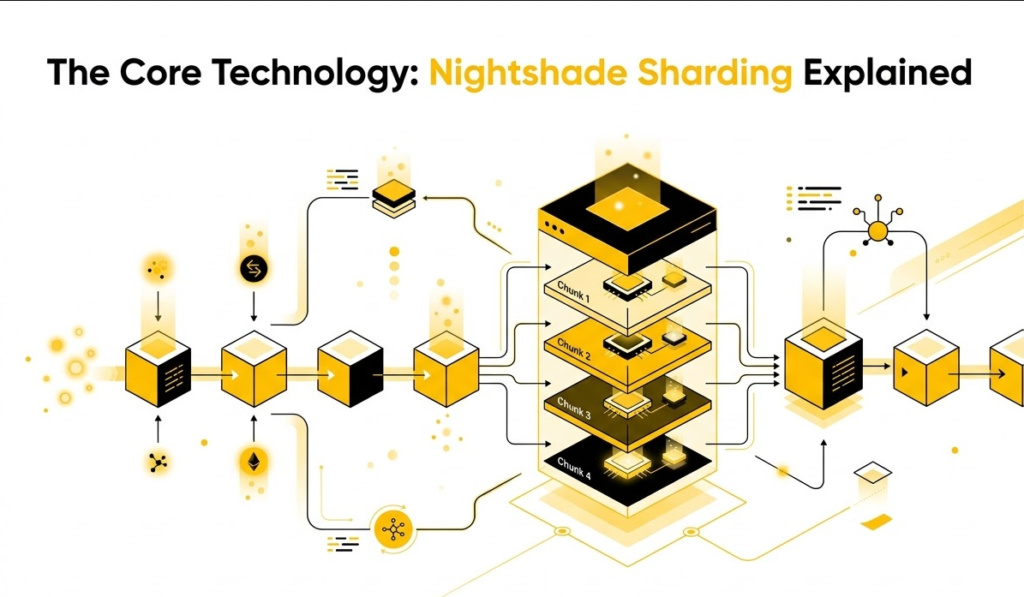
Sharding is one of those blockchain words that can sound intimidating until you reduce it to the underlying problem.
Imagine you have a restaurant with one kitchen and hundreds of customers arriving at the same time. Eventually, the kitchen becomes the bottleneck. Adding more customers does not magically create more cooking capacity.
A sharded blockchain takes a different approach: instead of forcing every part of the network to process everything, the workload can be distributed.
NEAR’s Nightshade architecture is designed around that principle.
How Nightshade works
NEAR describes Nightshade as its sharding design, with the architecture evolving over time to support more sophisticated forms of parallel processing and stateless validation. The project’s technical documentation explains that sharding allows the blockchain to scale horizontally by dividing network state and processing across multiple shards. NEAR’s Nightshade research and documentation
The important point is that Nightshade should not simply be imagined as a collection of completely independent blockchains sitting next to one another.
Instead, the network coordinates activity across shards as part of a broader protocol. This matters because one of the biggest headaches with sharding is not simply splitting the workload; it is making sure those pieces can still communicate correctly.
That is where NEAR’s architecture tries to strike a balance.
Rather than requiring every validator to maintain and process every piece of state in the same way, the network distributes responsibilities. The result is a design intended to increase capacity as additional shards are introduced.
NEAR’s current public materials describe its architecture as horizontally scalable and report a 600-millisecond block time, approximately 1.2-second finality and a theoretical scalability target of up to one million transactions per second. Those figures are claims made by NEAR about its current infrastructure and should be understood as network design and performance targets rather than a guarantee that every real-world application will sustain one million TPS. NEAR’s current network specifications
That distinction matters. In blockchain, headline TPS numbers are often quoted without explaining the conditions under which they were achieved.
Stateless validation
One of the more technically interesting developments in NEAR’s architecture is stateless validation.
Traditional blockchain validation can require validators to maintain substantial amounts of state locally. As a network grows, that can increase hardware requirements and potentially make participation harder for smaller operators.
NEAR’s research describes stateless validation as an architecture in which the state and processing workload are divided across shards, reducing the amount of state that certain validators need to maintain locally. NEAR’s research materials on Nightshade and stateless validation
For you as a normal user, this may sound like an implementation detail. It isn’t entirely.
If blockchain networks want to serve millions or eventually billions of users, the infrastructure has to scale without making participation increasingly dependent on extremely expensive hardware. Otherwise, decentralization can become harder to maintain even when transaction throughput improves.
That is why scaling architecture and validator accessibility are closely connected.
The Unfair Advantage: NEAR’s Convergence With Artificial Intelligence
This is where NEAR gets particularly unusual.
Most blockchain projects can talk about AI. It is easy to add “AI” to a roadmap, launch an AI-themed token or describe a chatbot as decentralized.
NEAR has a more direct historical connection to modern AI research.
Illia Polosukhin and the Transformer breakthrough
NEAR co-founder Illia Polosukhin was one of the co-authors of the 2017 research paper “Attention Is All You Need.”
That paper introduced the Transformer architecture, which became foundational to the modern generation of large language models and other AI systems. NEAR itself identifies Polosukhin as a co-author of the paper and connects his AI research background with the project’s current focus on user-owned AI. NEAR’s official AI and ecosystem overview
I would be careful, though, with the way this fact is presented.
It does not mean that NEAR created ChatGPT, nor does it mean that the Transformer architecture belongs to NEAR. The paper was an academic research collaboration involving multiple Google researchers, and the broader AI industry subsequently built on the Transformer architecture in many different ways.
What it does mean is that one of NEAR’s co-founders was directly involved in one of the most influential pieces of research underlying today’s generative-AI boom.
That gives NEAR’s AI narrative a somewhat different origin than the typical crypto project suddenly adding AI branding years after the fact.
User-owned AI
NEAR’s current AI strategy revolves around the idea that users should have more control over the intelligence and data they use.
The project’s AI materials describe a model of user-owned, verifiable AI, including infrastructure for private inference and confidential computing. NEAR AI currently describes its architecture as using Trusted Execution Environments to keep data encrypted and isolated while AI inference is performed. NEAR AI’s official architecture overview
The bigger idea is fascinating.
Imagine an AI agent that can do more than answer questions. It might manage a portfolio, purchase a service, rebalance assets, pay another agent or interact with a smart contract.
The moment an AI agent starts moving money, ordinary Web2 architecture becomes awkward.
Who owns the wallet?
Who controls the private key?
How does the agent interact with several blockchains?
How do you restrict what the agent is allowed to do?
And how do you stop the user from having to manually approve every single transaction?
These are precisely the kinds of problems that NEAR’s current combination of Chain Signatures, Chain Abstraction and AI infrastructure is intended to address.
NEAR’s current Chain Abstraction materials explicitly describe use cases involving AI-driven finance, autonomous transactions and cross-chain asset management, with Chain Signatures providing the underlying mechanism for external-chain transaction signing. NEAR’s Chain Abstraction documentation
User Experience and Chain Abstraction: Making Web3 Invisible
If there is one theme running through NEAR’s development philosophy, it is that users should not have to become blockchain engineers just to use an application.
Human-readable accounts
Let’s be honest: a hexadecimal wallet address is not exactly friendly.
You can copy and paste 0x71C... into a wallet, but you cannot easily look at it and know whether it belongs to your friend, your business or the application you are interacting with.
NEAR’s named-account system approaches this differently. Accounts can use human-readable names such as alice.near, making identity and account management easier to understand.
NEAR’s developer materials explicitly list human-readable accounts and simplified onboarding among the network’s developer-facing features. NEAR’s developer platform
That does not eliminate every usability problem, of course. Wallet security still matters, keys still matter and users still need to understand what they are authorizing.
But reducing unnecessary technical friction is valuable.
Chain Signatures
Chain Signatures take the idea much further.
In simple terms, Chain Signatures allow NEAR smart contracts to control cryptographic accounts on other blockchain networks. NEAR explains that its Chain Signatures system uses a multi-party computation network secured through NEAR validators, allowing cross-chain transactions to be signed without requiring a traditional bridge for every individual action. NEAR’s Chain Signatures documentation
Aurora’s technical documentation provides a more concrete view of the supported architecture, describing Chain Signatures as infrastructure that can allow accounts and smart contracts on virtual chains to execute transactions across networks including Bitcoin, Ethereum, BNB Chain, TRON, Polygon, Avalanche and Cosmos. Aurora’s Chain Signatures technical documentation
That is a significant conceptual shift.
Instead of thinking:
“I have an Ethereum wallet, a Bitcoin wallet and a NEAR wallet.”
You can start thinking:
“I have an account that can interact with assets and applications across several networks.”
That is what chain abstraction is ultimately trying to achieve.
Ecosystem and EVM Compatibility: Aurora and Rainbow Bridge
NEAR does not exist in isolation from Ethereum.
In fact, one of the most important pieces of its ecosystem is Aurora.
Aurora: Ethereum compatibility on NEAR
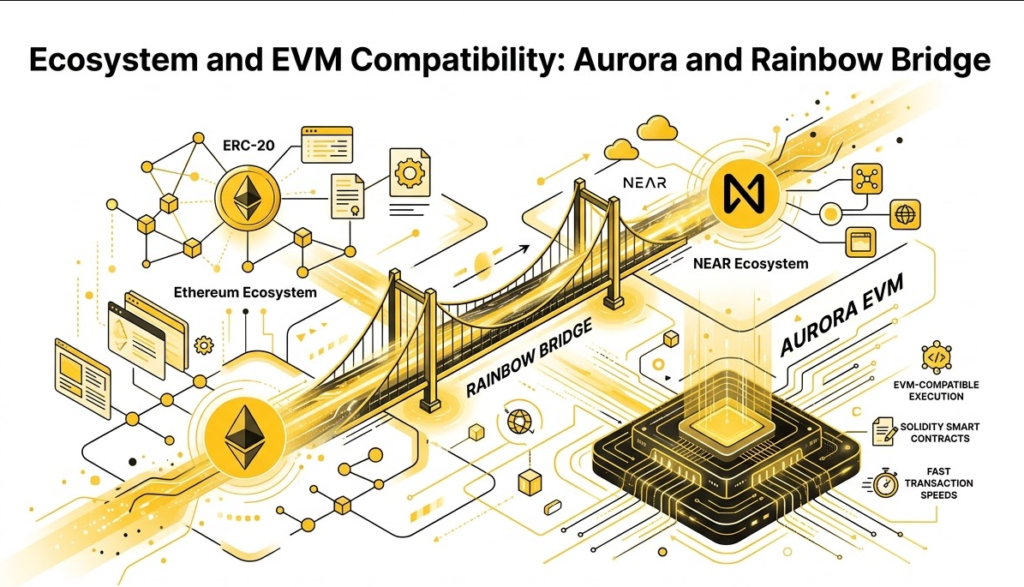
Aurora is an Ethereum Virtual Machine environment built on top of NEAR.
Aurora’s own documentation describes the Aurora Engine as an EVM implementation deployed as a smart contract on NEAR, allowing Ethereum-compatible applications to operate within the broader NEAR infrastructure. Aurora’s technical explanation of the EVM on NEAR
For Solidity developers, this is important because they do not necessarily need to abandon the Ethereum development environment completely.
The Aurora ecosystem provides an EVM-compatible environment, while NEAR supplies the underlying infrastructure.
Aurora’s current website describes the network as an EVM running on NEAR and provides tools for users and developers to bridge assets from Ethereum and interact with applications deployed on Aurora. Aurora’s official network overview
Rainbow Bridge
Then there is Rainbow Bridge.
The bridge was designed to connect Ethereum and NEAR without requiring users to trust a centralized intermediary. Aurora’s documentation describes Rainbow Bridge as a trustless, permissionless protocol capable of transferring assets and verifying information between Ethereum, NEAR and Aurora. Aurora’s Rainbow Bridge documentation
The underlying design is more interesting than simply “send token from A to B.”
The original NEAR description explains that the bridge uses light-client technology so that each side can verify information about the other chain rather than simply trusting a centralized operator. NEAR’s original Rainbow Bridge technical overview
This is a useful distinction when you compare Rainbow Bridge with custodial bridges.
A custodial bridge effectively says:
“Trust this entity to hold your assets.”
A trust-minimized bridge instead tries to say:
“Trust the cryptographic security assumptions of the connected blockchains.”
Neither model eliminates risk, but they are fundamentally different security philosophies.
Competitor Comparison: NEAR vs. Solana vs. Ethereum
| Feature | NEAR Protocol | Solana | Ethereum |
|---|---|---|---|
| Core scaling approach | Sharding | High-performance monolithic architecture | Base layer + Layer-2 ecosystem |
| Account experience | Human-readable named accounts | Public-key addresses | Hexadecimal addresses |
| Cross-chain execution | Chain Signatures and Chain Abstraction | Generally relies on bridges and ecosystem infrastructure | Bridges, rollups and interoperability protocols |
| Smart-contract environment | WebAssembly-based NEAR runtime | Solana runtime | EVM |
| EVM compatibility | Through Aurora | Not native | Native |
| AI strategy | User-owned AI and agent infrastructure | Primarily ecosystem/application driven | Primarily ecosystem/application driven |
The table should not be interpreted as a ranking. These networks make different architectural choices, and the better fit depends heavily on what you are actually trying to build or use.
Ethereum, for example, has an enormous developer ecosystem and a mature Layer-2 landscape. Solana focuses heavily on high-performance execution within a single network architecture. NEAR’s differentiating bet is more about combining sharding, usability and cross-chain abstraction.
That last part is becoming increasingly important because the future of Web3 may not consist of users picking one blockchain and staying there forever.
If liquidity, applications and users remain spread across dozens of networks, the infrastructure that makes those networks feel like one environment could become increasingly valuable.
FAQ
What is NEAR Protocol (NEAR)?
NEAR Protocol is a Layer-1 proof-of-stake blockchain designed around scalable smart-contract execution, sharding and user-friendly blockchain infrastructure. Its current architecture also places substantial emphasis on cross-chain execution, Chain Abstraction and AI-agent infrastructure. NEAR’s official protocol overview
The easiest way to think about NEAR is not simply as another Ethereum competitor. It is better understood as a blockchain platform attempting to solve several problems simultaneously: scaling, usability and interoperability.
What is Chain Abstraction on NEAR?
Chain Abstraction is NEAR’s approach to hiding blockchain-specific complexity from users and applications.
Through technologies such as Chain Signatures, NEAR smart contracts can initiate transactions on external networks, while NEAR’s broader abstraction stack is designed to let users and AI agents interact with assets across multiple blockchains without manually managing every underlying network. NEAR’s Chain Abstraction documentation
For you as a user, the practical goal is simple: fewer wallets, fewer network switches and less manual bridge management.
How is NEAR Protocol connected to artificial intelligence?
The connection begins with NEAR co-founder Illia Polosukhin, who co-authored the 2017 paper Attention Is All You Need, the research work that introduced the Transformer architecture. NEAR now uses that historical connection as part of a broader strategy around user-owned and decentralized AI infrastructure. NEAR’s official overview of its AI strategy
NEAR AI’s current infrastructure includes private inference and confidential computing, while the broader NEAR stack is designed to support autonomous agents that can interact with blockchain assets and applications. NEAR AI’s current infrastructure overview
What is Aurora in the NEAR ecosystem?
Aurora is an Ethereum Virtual Machine environment built on top of NEAR. It gives developers an Ethereum-compatible execution environment while using NEAR infrastructure underneath. Aurora’s official documentation
This means Ethereum developers can use familiar Solidity and EVM tooling without necessarily deploying directly onto Ethereum’s base layer.
Does NEAR use sharding?
Yes. Sharding is fundamental to NEAR’s architecture. The protocol’s Nightshade design divides state and processing across shards, allowing the network to scale horizontally as more resources are added. NEAR’s research materials describe Nightshade as the protocol’s core sharding architecture and later work incorporates stateless validation into that design. NEAR’s research and Nightshade materials
Can NEAR interact with Bitcoin and Ethereum?
Yes. Chain Signatures are specifically designed to let NEAR-based applications and smart contracts sign transactions on external networks. Current documentation describes support for major ecosystems including Bitcoin and Ethereum, while the broader system has expanded to additional chains. NEAR’s Chain Abstraction documentation
That capability is one of the main reasons NEAR’s current strategy is increasingly described in terms of chain abstraction rather than simply blockchain scalability.
Final Thoughts
When I look at NEAR, I think the most interesting question is not whether it can process more transactions than another Layer-1.
That comparison is useful, but it only tells part of the story.
The bigger bet is that users should not have to care which blockchain is underneath the application they are using.
Today, crypto still asks you to think about networks, gas tokens, bridges, wallet addresses and signing environments. You have to know whether an asset lives on Ethereum, whether you are connected to the right chain, whether you have enough gas and whether the bridge you are using is safe.
NEAR’s answer is to push those details into the infrastructure.
Nightshade addresses scaling. Human-readable accounts address usability. Aurora provides EVM compatibility. Rainbow Bridge connects Ethereum and NEAR. Chain Signatures extend NEAR’s ability to interact with external chains. And the project’s current AI strategy asks an even more ambitious question: what if autonomous software agents eventually need to own assets and transact across the entire blockchain ecosystem?
NEAR’s current documentation increasingly frames the network around precisely that convergence between cross-chain infrastructure and AI agents. Its 2026 roadmap, for example, describes the ecosystem as bringing together cross-chain financial infrastructure and autonomous AI agents, with NEAR Intents and NEAR AI forming two major parts of that strategy. NEAR’s current roadmap
Whether that vision ultimately becomes the dominant model for Web3 is something the market will decide over time. But the architectural direction is clear: NEAR is no longer presenting itself simply as another fast Layer-1.
It is trying to become the layer you do not have to think about.
And honestly, if Web3 ever becomes mainstream, that may be one of the more important problems for a blockchain to solve.