
The Protocol That Revolutionized DeFi
The Core Definition
If you’ve ever used a centralized crypto exchange, the first thing that may feel strange about Uniswap is what isn’t there.
There is no traditional order book sitting between you and another trader. You don’t have to deposit your tokens into an exchange-controlled account before trading, and you don’t need a company on the other side of the transaction to decide whether your order can be executed.
Instead, Uniswap uses smart contracts and liquidity pools.
You connect a compatible wallet, choose the asset you want to sell and the asset you want to receive, review the quoted price and transaction details, and then authorize the blockchain transaction. The underlying protocol handles the swap according to its programmed rules.
That sounds simple now, but it was a meaningful change in how people thought about cryptocurrency markets when Uniswap emerged.
Hayden Adams launched the first public version of Uniswap on Ethereum in November 2018. In his own account of the project’s beginnings, Adams described building an automated market maker after becoming interested in Ethereum and experimenting with the concept of programmable money. The original system was tiny compared with today’s DeFi infrastructure, but the basic idea was already there: create an exchange mechanism that could operate through smart contracts rather than a centralized matching engine. (Uniswap Labs)
Today, Uniswap is better understood as protocol infrastructure rather than simply a website where you exchange tokens. The Uniswap Labs interface is one way of accessing it, but the protocol itself consists of smart contracts that can be interacted with by wallets, applications, aggregators and developers.
That distinction matters.
When you hear someone say, “I traded on Uniswap,” they might mean they used the Uniswap website. Technically, however, the trade is taking place through decentralized protocol contracts deployed on supported blockchain networks.
Uniswap Labs itself describes the protocol as a decentralized exchange based on automated market makers, while also distinguishing the company and its products from the underlying protocol. (Uniswap Labs)
So, in plain English, I would describe Uniswap like this:
Uniswap is an open, smart-contract-based trading protocol that allows people to exchange digital assets without handing custody of those assets to a traditional centralized exchange.
That definition is much more useful than simply calling Uniswap “a crypto exchange,” because it explains why the protocol became such an important part of decentralized finance.
Key Entity Specs at a Glance
| Attribute | Details |
|---|---|
| Token | UNI |
| Founder | Hayden Adams |
| First public launch | November 2018 |
| Core mechanism | Automated Market Maker (AMM) |
| Original blockchain | Ethereum |
| Major versions | v1, v2, v3 and v4 |
| Important v3 innovation | Concentrated liquidity |
| Important v4 innovations | Hooks and singleton architecture |
| Related trading infrastructure | UniswapX |
| Dedicated L2 ecosystem | Unichain |
Uniswap’s evolution is particularly interesting because each major version addressed a limitation of the previous design rather than simply adding cosmetic features. Uniswap v1 established the basic AMM model, v2 expanded token-pair flexibility, v3 introduced concentrated liquidity, and v4 added a much more customizable architecture. Uniswap’s own documentation currently identifies four deployed protocol versions. (Uniswap Hỗ Trợ)
And if you’re wondering why that history matters, keep it in mind as we move through the article: Uniswap’s story is essentially the story of AMMs becoming increasingly programmable.
Evolution of the AMM: From v1 to Uniswap v3
Uniswap v1 & v2: The Constant Product Formula
The easiest way to understand early Uniswap is to forget the familiar exchange order book for a moment.
Imagine that instead of having thousands of buyers and sellers posting individual orders, there is a pool containing two assets. Traders interact with that pool, while liquidity providers contribute the assets that make trading possible.
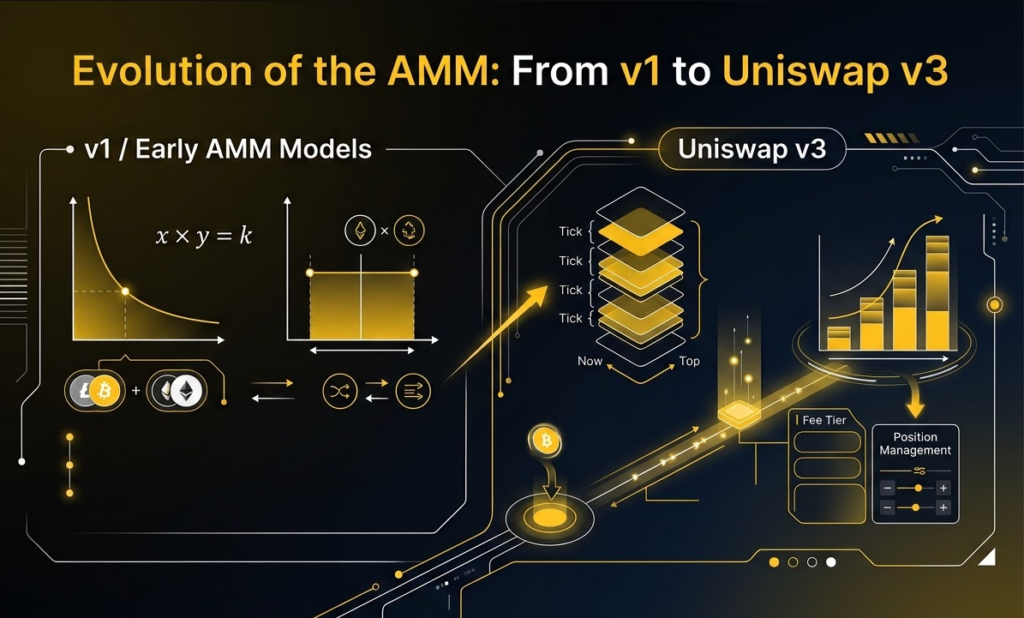
The classic Uniswap AMM model uses the constant-product relationship:
x × y = k
Here, x and y represent the quantities of the two assets in the pool, while k represents the invariant that the trading mechanism seeks to preserve.
You don’t need to become a mathematician to understand the practical consequence. If a trader removes one asset from the pool, the amount of the other asset required to maintain the relationship changes. As the pool becomes imbalanced by the trade, the effective price moves.
That is where the AMM gets its pricing behavior.
Uniswap v1 launched with a relatively simple structure in which ERC-20 tokens were paired with ETH. This made ETH an intermediary asset for trading between tokens.
The design was clever but not perfect. Suppose you wanted to trade Token A for Token B. The route would generally involve Token A/ETH and ETH/Token B. That created additional exposure to ETH for liquidity providers and could make certain markets less efficient.
Uniswap v2 changed that.
The v2 design allowed ERC-20 tokens to be paired directly with other ERC-20 tokens, which opened the door to much more flexible liquidity markets. Its architecture also introduced features including flash swaps and time-weighted average price oracles. These details are documented in the original Uniswap v2 technical whitepaper. (Uniswap Developers)
That shift might sound incremental, but it was actually important.
Instead of thinking about Uniswap as “an ETH exchange,” you could now think about it as a generalized liquidity infrastructure layer for Ethereum tokens.
That distinction helped set the stage for DeFi’s rapid expansion.
Uniswap v3: Concentrated Liquidity
Then came one of the biggest conceptual changes in the Uniswap story: concentrated liquidity.
Before v3, a liquidity provider essentially supplied capital across the full price curve. That meant a large portion of the capital could sit unused at prices far away from the current market.
Think about a stablecoin pair trading around $1.
If you provide liquidity across an enormous theoretical price range, most of your capital isn’t doing much at $1. It is sitting there waiting for a price that may never arrive.
Uniswap v3 changed this by allowing liquidity providers to choose specific price ranges.
So, instead of saying:
“I want my capital available everywhere.”
you could effectively say:
“I want my capital to work primarily between these two prices.”
That made liquidity considerably more capital-efficient in many situations, although it also introduced a new responsibility for LPs: managing their ranges.
If the market moves outside your selected range, your position may stop earning swap fees until you reposition it.
Uniswap’s own research describes v3 concentrated liquidity as a system where LPs can determine the price range in which their capital is deployed, with the ability to rebalance when the market moves outside that range. (Uniswap Labs)
This is one of those moments where Uniswap becomes more interesting than the phrase “decentralized exchange” suggests.
You’re no longer simply depositing assets into a pool.
You’re managing a programmable liquidity position.
The Cutting-Edge Architecture: Uniswap v4 Hooks & Singleton Contract
The Singleton Contract Architecture
If v3 made liquidity more efficient, v4 tried to make the entire pool architecture more flexible.
One of the major changes is the singleton architecture.
In earlier Uniswap versions, individual pools were represented through separate contracts. With v4, pools are managed through a central PoolManager architecture rather than requiring a completely separate deployed pool contract for every trading pair.
That matters because deploying and interacting with contracts has a cost on Ethereum and other EVM networks. When the architecture can handle multiple pools through a shared system, certain operations can be made more efficient.
But the bigger story isn’t simply lower gas.
It’s programmability.
The v4 design was built around the idea that developers shouldn’t have to wait for a completely new version of Uniswap every time they want to introduce a new type of pool behavior.
Instead, they can use hooks.
And this is where Uniswap starts to look less like a conventional exchange and more like a financial programming framework.
What Are Uniswap v4 Hooks?
A hook is essentially a customizable piece of logic that can interact with defined points in a pool’s lifecycle.
Imagine you want a pool to behave differently from the standard AMM model.
Perhaps you want:
- Dynamic fees that respond to market conditions.
- A custom liquidity-management strategy.
- An on-chain limit-order mechanism.
- Automated rebalancing.
- A specialized trading rule.
- Custom logic around liquidity deposits and withdrawals.
In a conventional exchange architecture, implementing these features could mean building a separate trading system.
With v4, developers can potentially build these behaviors around the pool using hooks.
That’s the part I find most important when thinking about v4: the pool itself becomes programmable.
The Uniswap v4 architecture is therefore not just an attempt to make swaps cheaper. It gives developers a framework in which the behavior surrounding liquidity can be customized.
This creates an interesting shift in DeFi development.
Instead of having one immutable AMM behavior that everyone must use, you can build different market structures around a common liquidity engine.
The result is a more modular ecosystem where the same underlying protocol can support very different trading experiences.
Scaling the Ecosystem: Unichain and UniswapX
Unichain: The Custom Ethereum L2
At some point, simply optimizing the DEX isn’t enough.
Ethereum itself has to scale.
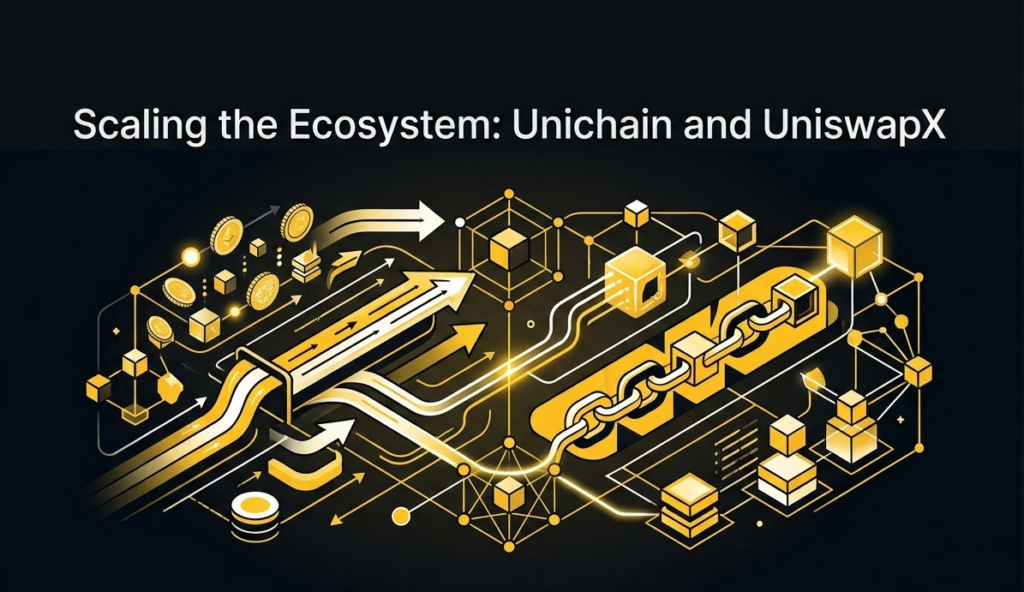
That’s part of the thinking behind Unichain, an Ethereum Layer-2 network developed around the needs of on-chain markets and liquidity.
The Unichain design is based on the OP Stack and was explicitly built to improve trading efficiency, transaction costs and cross-chain liquidity. Its whitepaper describes a system designed around fast state updates, MEV-aware block building and faster settlement mechanisms. (Uniswap Developers)
One particularly interesting feature is its Flashblocks architecture.
The Unichain whitepaper describes effective block times of roughly 200–250 milliseconds through splitting block production into multiple Flashblocks, allowing applications and users to receive faster state updates rather than waiting for a conventional full block interval. (Uniswap Developers)
Why should you care about a few hundred milliseconds?
Because trading is sensitive to timing.
If you’re providing liquidity or executing a swap, even relatively small delays can create opportunities for adverse execution, arbitrage and MEV.
The idea behind Unichain is therefore not simply “make Ethereum faster.”
It is closer to:
Build an execution environment specifically optimized for markets.
That distinction is important.
Unichain is part of a broader attempt to create an environment where liquidity can move efficiently while applications have more control over execution quality and MEV.
And because Unichain is built within the OP Stack ecosystem, it is also connected to the broader vision of interoperable Ethereum rollups rather than operating as an isolated blockchain.
UniswapX: Intent-Based Trading
UniswapX takes a different approach.
Instead of making the user manually figure out where the best liquidity exists, the system is designed to let external fillers compete to execute swaps.
This is often described as intent-based trading.
Here’s a simple way to think about it.
You don’t necessarily care which pool your transaction touches.
You care about one thing:
“I want to sell this much of Asset A and receive the best possible amount of Asset B.”
That is your intent.
UniswapX can then coordinate execution across different liquidity sources.
Its design uses Dutch auctions, where fillers compete to execute orders under specified conditions. The system was introduced as an open-source, permissionless protocol intended to aggregate liquidity beyond a single AMM. Uniswap’s announcement highlighted goals including improved pricing, gas-free swaps and MEV protection. (Uniswap Labs)
This is an important evolution from the earliest Uniswap model.
In v1, the core problem was:
“How can we trade tokens without an order book?”
With UniswapX, the problem becomes:
“How can we make the entire execution process more efficient for the person initiating the trade?”
That’s a much broader question.
And it suggests where decentralized trading may be heading: away from forcing users to understand every underlying pool and toward systems where users specify what they want while specialized infrastructure handles execution.
Tokenomics and Governance: The UNI Token and Fee Switch
Protocol Governance
It is easy to assume that because Uniswap has a token called UNI, UNI must simply be the “stock” of the exchange.
That’s not an accurate way to understand it.
UNI is fundamentally a governance token.
Uniswap governance allows UNI holders and participating delegates to have a role in decisions concerning the protocol. Uniswap’s own materials describe UNI as the governance token and distinguish protocol governance from the companies and organizations contributing to the ecosystem. (Uniswap Labs)
That governance can involve questions such as:
- Protocol parameters.
- Treasury decisions.
- Deployment decisions.
- Community funding.
- Governance infrastructure.
- Changes to the broader protocol ecosystem.
This is important because Uniswap isn’t simply one company deciding everything behind the scenes.
There are multiple entities involved in the ecosystem, including Uniswap Labs and the Uniswap Foundation, while governance is designed to involve the broader community.
Of course, governance does not magically eliminate concentration of influence. Large token holders can have substantial voting power, and voter participation can be uneven. That’s a broader challenge shared by many token-governed protocols.
So when you think about UNI, think governance first, not “a token that automatically represents trading revenue.”
The Governance Fee Switch Debate
The fee switch is one of the most interesting and complicated questions surrounding UNI.
At a high level, the debate revolves around what happens to value generated by the protocol.
Liquidity providers supply capital and generally receive trading fees according to the relevant pool’s configuration. UNI holders, meanwhile, govern the protocol and have an interest in the long-term sustainability of the ecosystem.
The question becomes:
Should some protocol-generated fees eventually be directed toward the protocol treasury or UNI-related governance mechanisms?
This sounds straightforward until you consider the economic trade-offs.
If more value is directed away from liquidity providers, LP incentives could change.
If liquidity providers receive everything, UNI holders may have less direct economic exposure to the success of the protocol.
That is why fee-switch discussions are not merely about turning a button on or off. They’re about how an entire decentralized financial system distributes economic value among the people who provide capital, govern the system and build around it.
The issue has continued to evolve over time. In late 2025, Uniswap Labs and the Uniswap Foundation published a UNIfication proposal that explicitly proposed activating protocol fees and changing the way incentives were aligned across the ecosystem. Because this is a governance proposal rather than a timeless protocol fact, you should treat the current status as something that can change through governance. (Uniswap Labs)
That distinction is worth emphasizing whenever you read about UNI tokenomics: governance decisions are dynamic.
Frequently Asked Questions
What Is Uniswap (UNI) and How Does It Work?
Uniswap is a decentralized trading protocol that uses automated market makers rather than a conventional centralized order book.
Users trade against liquidity pools containing token pairs. Liquidity providers deposit assets into those pools and, depending on the relevant Uniswap version and pool configuration, receive trading fees in exchange for supplying liquidity.
The important distinction is that Uniswap is a protocol, while UNI is its governance token.
You can interact with the Uniswap Protocol without treating UNI itself as the asset being exchanged. The protocol supports thousands of token markets across multiple blockchain environments, while UNI gives holders a role in governance. (Uniswap Labs)
What Are Uniswap v4 Hooks?
Uniswap v4 hooks are customizable smart-contract components that can execute logic at specific points in a liquidity pool’s lifecycle.
They allow developers to create specialized pool behavior rather than relying exclusively on the default AMM model.
Potential applications include dynamic fees, custom liquidity strategies, limit-order-style mechanisms and automated liquidity management.
The big idea is flexibility: instead of waiting for another major Uniswap version to introduce every possible trading feature, developers can use hooks to build specialized behavior around v4 pools.
Why Did Uniswap Build Unichain?
Unichain was designed as an Ethereum Layer-2 environment optimized for on-chain markets.
Its architecture focuses on faster transaction updates, lower-cost execution and mechanisms designed to improve the handling of MEV. The Unichain whitepaper describes an OP Stack-based rollup with Flashblocks and a validation network intended to support faster settlement and efficient movement of liquidity. (Uniswap Developers)
For you as a trader, the practical goal is fairly intuitive: less waiting, lower execution friction and an environment designed specifically around the demands of decentralized markets.
What Is the Purpose of the UNI Token?
UNI is the governance token associated with the Uniswap Protocol.
Its primary role is to allow participants to take part in governance decisions rather than functioning as a simple representation of every dollar traded through Uniswap.
UNI governance can influence areas such as treasury allocation, protocol parameters and ecosystem development. Uniswap’s official materials describe UNI holders as participants in the governance process responsible for stewarding the protocol. (Uniswap Labs)
The important takeaway is that Uniswap and UNI are not the same thing.
Uniswap is the protocol.
UNI is the governance asset associated with that protocol.
The Bigger Picture: Why Uniswap Still Matters
When I look at Uniswap’s evolution from 2018 to the current generation of DeFi infrastructure, the most interesting part isn’t any single feature.
It’s the direction of travel.
The first Uniswap was essentially an experiment: can you create a functional market without a centralized exchange operator?
Then v2 asked how that model could become more flexible.
v3 asked how liquidity itself could become more capital-efficient.
v4 asks how liquidity pools can become programmable.
UniswapX asks how trade execution can become more intelligent and less dependent on users manually navigating liquidity.
Unichain pushes the idea further by creating an execution environment specifically designed around on-chain markets.
You can see the progression:
| Stage | Core Question |
|---|---|
| Uniswap v1 | Can token trading work without an order book? |
| Uniswap v2 | Can any ERC-20 pair trade directly? |
| Uniswap v3 | Can liquidity become more capital-efficient? |
| Uniswap v4 | Can liquidity pools become programmable? |
| UniswapX | Can trade execution be optimized around user intent? |
| Unichain | Can an execution layer be designed specifically for markets? |
That is why I wouldn’t describe Uniswap simply as “a decentralized exchange.”
That description is technically understandable, but it undersells what the protocol has become.
Uniswap has evolved into a collection of trading and liquidity infrastructure built around a fairly radical premise: financial markets can be implemented as transparent software rather than being dependent on a centralized institution operating a private matching engine.
And you don’t have to agree that decentralized finance will replace traditional finance to appreciate what that change represents.
The interesting experiment is already happening.
A trader can hold assets in their own wallet, interact with a smart contract, access liquidity supplied by unrelated participants, execute a swap and settle the transaction on a public blockchain – all without opening a conventional brokerage account.
That is the fundamental idea behind Uniswap.
Everything else – concentrated liquidity, hooks, UniswapX, Unichain and the evolving governance system – is essentially the ecosystem trying to make that idea faster, more flexible and more useful at scale.