Introduction: Reimagining Wall Street Without the Middlemen
When people first hear the phrase decentralized finance, I think the easiest mistake is to imagine a futuristic version of a bank. That description is not entirely wrong, but it misses the more interesting part.
DeFi is less about building one giant decentralized bank and more about rebuilding individual financial functions as open, programmable software. Instead of asking a company to approve a loan, match a trade, custody an asset, or maintain a private database, a user can interact directly with blockchain-based applications whose rules are enforced by smart contracts.
That distinction is important because the technology changes who controls the infrastructure. Traditional finance normally has a chain of institutions sitting between you and the transaction: banks, brokers, custodians, clearing systems, payment processors, and other intermediaries. DeFi attempts to move parts of that stack into publicly accessible blockchain infrastructure.
Ethereum describes this model as an open financial system built around smart contracts, and its DeFi ecosystem includes applications covering exchanges, lending, stablecoins, derivatives, payments, and other financial services. The broader idea is not limited to Ethereum, either; DeFi applications also operate across networks such as Solana, Arbitrum, Base, Optimism, Avalanche, and many others.
The phrase open matters here. A DeFi application can potentially be accessed by anyone who has the required blockchain assets and a compatible wallet. There is no traditional branch manager deciding whether you are allowed to open an account, and there is usually no centralized customer-service department that can reverse a transaction after you sign it.
That freedom is powerful, but it comes with a trade-off: you are often much closer to the underlying risk.
If you lose your private key, interact with a malicious contract, misunderstand a liquidation threshold, or deposit money into a protocol containing a vulnerability, there may be no bank standing behind the transaction. DeFi gives users more control, but control and responsibility arrive together.
At a high level, the ecosystem can be summarized like this:
| Attribute | What it means in DeFi |
|---|---|
| Core value proposition | Permissionless access, transparency, composability, and non-custodial asset control |
| Underlying technology | Public blockchains and smart contracts |
| Major applications | DEXs, lending, borrowing, derivatives, stablecoins, staking, and asset management |
| Common measurement | Total Value Locked (TVL) |
| Major risks | Smart-contract bugs, oracle failures, liquidation, bridge exploits, market volatility, and liquidity risk |
If you are completely new to the space, I would keep one simple mental model in mind: DeFi is not a single product. It is an interconnected financial software ecosystem.
And that is where things start getting interesting.
How DeFi Works: Replacing Banks with Smart Contracts
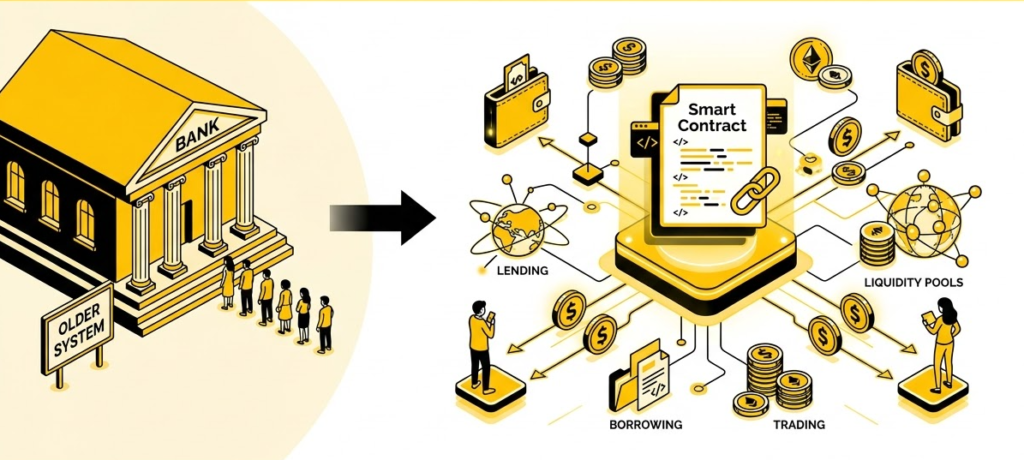
The easiest way to understand DeFi is to start with what happens in conventional finance.
Suppose you want to borrow money. In a traditional system, a bank might assess your identity, income, credit history, collateral, and repayment capacity. The bank then decides whether to approve the loan and under what conditions. The institution remains an intermediary throughout the process.
DeFi approaches the same problem differently.
Instead of relying primarily on an institution’s private assessment, a protocol can encode lending rules into smart contracts. The software can determine how much collateral is required, calculate interest, track a user’s position, and trigger liquidation when predefined conditions are reached.
Ethereum’s documentation defines a smart contract as a program that runs on the blockchain and stores both code and state at a blockchain address. Users interact with that contract by sending transactions that invoke its functions, allowing software to enforce predefined rules automatically. You can explore the underlying mechanics in Ethereum’s smart-contract documentation to see how these programs operate at the protocol level.
This is the foundation of DeFi.
From centralized trust to code-driven execution
Imagine depositing USDC into a decentralized lending protocol.
Your assets enter a smart-contract system rather than a conventional bank account. Another participant may deposit collateral and borrow USDC according to the protocol’s rules. Interest rates can adjust based on supply and demand, while the smart contract continuously tracks collateralization.
There is no employee manually approving each transaction.
The code handles it.
That does not mean there is no trust. This is one of those phrases in crypto that deserves a little nuance. You are reducing reliance on certain centralized intermediaries, but you are still trusting software, blockchain infrastructure, economic assumptions, governance mechanisms, and sometimes external data providers.
That is why I prefer the phrase “trust minimized” over simply saying “trustless.”
The system shifts the object of trust.
Instead of trusting a bank employee to process a transaction correctly, you might trust a smart contract to execute according to its code. Instead of trusting a broker’s internal database, you can verify blockchain transactions publicly.
Ethereum’s documentation also emphasizes that smart contracts are public and composable, meaning one contract can interact with another. That property becomes one of the defining characteristics of DeFi and is the foundation of what the industry often calls Money Legos. The concept is explained directly in Ethereum’s documentation on smart-contract composability, where contracts are described as reusable building blocks that can interact with one another.
Permissionless does not mean risk-free
One of the most attractive aspects of DeFi is accessibility.
You generally do not need to open a traditional brokerage account before interacting with a decentralized exchange. Instead, you connect a compatible self-custody wallet, approve the transaction, and interact directly with the protocol.
That can make financial infrastructure feel remarkably open.
But there is an important distinction between permissionless access and easy access.
The interface might look as simple as a conventional financial application, yet the underlying transaction could involve several smart contracts, token approvals, liquidity pools, price oracles, and automated execution mechanisms.
If you click “Confirm” without understanding what you are signing, the user experience can hide considerable technical complexity.
Ethereum’s documentation notes that interacting with smart contracts generally involves reading data or sending state-changing transactions, with the latter requiring a signed transaction and network fees. The distinction is explained in Ethereum’s guide to interacting with smart contracts.
So when you use DeFi, I would encourage you to think beyond the front-end website. The website is only the interface. The actual financial logic lives underneath it.
The Core Pillars of DeFi: Money Legos and Composability
The phrase Money Legos sounds playful, but it describes one of the most important characteristics of decentralized finance.
Imagine that you have a box of LEGO bricks. One brick can be useful by itself, but the real magic happens when you connect it to another brick. You can build something much more sophisticated without manufacturing every component from scratch.
DeFi protocols work in a similar way.
A decentralized exchange can provide token liquidity. A lending protocol can accept those tokens as collateral. A liquid staking protocol can issue a derivative representing staked assets. Another application can accept that derivative as collateral.
The result is a financial stack assembled from multiple independent components.
What is DeFi composability?
Composability means that protocols can interact with one another programmatically.
For example, imagine a simplified strategy where:
- You deposit ETH into a liquid staking protocol.
- You receive a liquid staking token representing your position.
- You deposit that token into a lending protocol.
- You borrow a stablecoin against it.
- You use the stablecoin to purchase another asset.
- That asset is deposited into another protocol.
From the user’s perspective, this might look like one sophisticated strategy. Underneath the surface, however, several independent smart-contract systems could be interacting.
This creates enormous flexibility.
It also creates layered risk.
If the first protocol fails, the second may be affected. If the token representing your position loses its expected value, your lending position could become unhealthy. If an oracle reports incorrect data, a liquidation mechanism might behave differently from what you expected.
That is why composability is simultaneously one of DeFi’s greatest strengths and one of its biggest sources of complexity.
Overcollateralization versus traditional credit scoring
Lending provides another excellent example of how DeFi changes the financial model.
Traditional lenders can make unsecured or partially secured loans because they have access to information about borrowers and can use legal systems to pursue repayment. DeFi protocols generally do not have that same relationship with borrowers.
Instead, many decentralized lending systems use overcollateralization.
Suppose you want to borrow $100 worth of stablecoins. A protocol might require you to lock substantially more than $100 worth of crypto as collateral.
The exact parameters vary by asset and protocol, so the $150 example should be treated as an illustration rather than a universal requirement. In Aave, for example, borrowing positions are explicitly described as overcollateralized, with collateral requirements and liquidation thresholds determined by the protocol’s risk parameters. You can see those mechanics in Aave’s official V3 documentation.
Why does this work?
Because the protocol does not need to ask, “Is this borrower trustworthy?”
It asks a different question:
“Is there enough collateral securing this debt?”
If the answer changes because the collateral price falls, the protocol can automatically respond.
Aave’s documentation explains that a position can become eligible for liquidation when its health factor falls below the relevant threshold, allowing external liquidators to repay debt in exchange for collateral. That automated risk-management process is detailed in Aave’s explanation of health factors and liquidations.
This is one of the clearest examples of how DeFi turns financial rules into software.
Decoding the Major Primitives and Sub-Sectors
DeFi is broad enough that trying to understand everything simultaneously can become overwhelming. I find it much easier to break the ecosystem into a handful of core primitives.
Automated Market Makers and decentralized exchanges
Decentralized exchanges, or DEXs, allow users to trade tokens without relying on a centralized exchange to maintain the order book and custody the assets.
One of the best-known examples is Uniswap.
Instead of matching buyers and sellers through a traditional centralized order book, Uniswap uses automated market makers, or AMMs, built around liquidity pools. Users can deposit assets into those pools, while traders swap against the available liquidity.
The mechanics differ between protocol versions, but the fundamental concept is straightforward: liquidity sits inside smart contracts, and an algorithm determines how trades interact with that liquidity.
Uniswap’s developer documentation describes its AMM as a collection of smart contracts that lets users swap tokens and provide liquidity directly onchain, while its explanation of liquidity pools shows how token reserves are used to facilitate permissionless trading.
In older AMM designs, you will often encounter the famous formula:
x × y = k
Here, x and y represent the reserves of two assets, while k represents an invariant under the simplified constant-product model.
The beauty of the model is that it allows trading without a traditional order book.
The downside is that liquidity providers face risks such as impermanent loss, price volatility, and smart-contract exposure.
Modern AMMs have become much more sophisticated. Uniswap v3 and v4, for example, allow liquidity providers to concentrate liquidity within specific price ranges, which can make capital more efficient but also requires more active management. The current documentation describes this concentrated-liquidity model in Uniswap’s liquidity overview.
Algorithmic lending and borrowing
Lending protocols form another major branch of DeFi.
Instead of depositing money into a bank and allowing the institution to decide how that capital is deployed, users can supply assets to a lending market governed by smart contracts.
Other users can borrow against collateral.
The basic relationship looks something like this:
Suppliers → Liquidity pool → Borrowers
Suppliers may earn interest, while borrowers pay interest for access to liquidity.
Aave’s documentation describes its liquidity pools as markets where suppliers provide assets and borrowers access those assets through overcollateralized positions. Interest rates adjust according to factors including utilization and protocol parameters, as explained in Aave’s liquidity-pool documentation.
The model creates an interesting financial marketplace because the price of borrowing can respond automatically to demand for liquidity.
When utilization rises, borrowing can become more expensive.
When liquidity is abundant, borrowing costs can fall.
You do not need a bank manager to manually update the rate.
The protocol’s rules handle the adjustment.
Liquid staking and yield strategies
Liquid staking sits at the intersection of blockchain infrastructure and DeFi.
Proof-of-stake networks require participants to lock assets or otherwise commit economic resources to help secure the network. Traditional staking can make those assets less flexible because they are tied to the validator or staking mechanism.
Liquid staking attempts to solve this capital-efficiency problem by issuing a token that represents the user’s staked position.
The user can then potentially use that token elsewhere in DeFi while the underlying position continues participating in staking.
This is another example of the Money Lego concept: staking infrastructure creates a financial asset that another protocol can potentially accept as collateral, liquidity, or an investment component.
Of course, the additional flexibility comes with additional dependencies. A liquid staking token introduces its own smart-contract, liquidity, market-price, and protocol risks.
Measuring Health and Risk: Total Value Locked and Security Pitfalls

One of the first numbers you will encounter when researching DeFi is TVL, or Total Value Locked.
TVL is useful because it gives you a rough idea of how much capital is currently held within a protocol or ecosystem. But it is important to understand exactly what the metric measures before treating it as a scorecard.
DefiLlama defines protocol TVL as the value of coins held in a protocol’s smart contracts, while chain TVL represents the combined TVL of protocols on that chain. Its methodology is explained in DefiLlama’s data definitions.
That distinction matters.
TVL does not automatically tell you:
- how many individual users a protocol has;
- whether those users are active;
- whether capital is concentrated among a small number of wallets;
- how profitable the protocol is;
- whether deposits are sustainable;
- how much leverage exists in the system;
- or whether the underlying smart contracts are secure.
A protocol can have significant TVL and still have serious structural risks.
TVL is a measurement, not a quality rating
Suppose Protocol A has $1 billion in TVL and Protocol B has $100 million.
It would be tempting to conclude that Protocol A is automatically safer or better.
That conclusion does not follow.
TVL measures capital, not security.
The capital could have arrived because of temporary token incentives. It could be concentrated in a handful of positions. It could be exposed to highly correlated assets. Or the protocol could contain a vulnerability that has not yet been discovered.
Even the broader market picture can change quickly as token prices move.
For that reason, I like to treat TVL as a starting point for research, not the final answer.
Current data can also move rapidly. For example, DefiLlama’s live Ethereum dashboard tracks TVL alongside metrics such as DEX volume, fees, stablecoin capitalization, and active addresses, illustrating why looking at multiple indicators is often more informative than focusing on one number alone. You can monitor those changing metrics through DefiLlama’s Ethereum DeFi dashboard.
Smart-contract exploits
The most obvious DeFi risk is code.
Smart contracts are powerful precisely because they can automatically control assets. But that also means a programming mistake can have financial consequences.
A traditional software bug might cause an application to crash.
A smart-contract vulnerability can potentially allow an attacker to manipulate the rules governing valuable assets.
Common issues include:
- Reentrancy vulnerabilities, where external calls can create unexpected execution flows.
- Access-control failures, allowing unauthorized users to perform privileged actions.
- Oracle manipulation, where incorrect external prices affect financial calculations.
- Logic errors, where the contract behaves differently from what developers intended.
- Economic exploits, where the code technically operates correctly but the surrounding incentive structure can be manipulated.
This is why security development practices matter so much.
Ethereum’s documentation specifically points developers toward established smart-contract libraries and security practices, while resources such as OpenZeppelin provide reusable implementations for common contract patterns. The role of reusable libraries is described in Ethereum’s smart-contract library documentation.
Audits can help identify vulnerabilities, but an audit should not be treated as a guarantee that a protocol is safe.
No audit can prove that every possible economic attack, implementation error, governance problem, or future integration risk has been eliminated.
Oracle failures
This is one of the more subtle risks.
A smart contract cannot simply open Google and check the current price of Bitcoin.
Blockchains are deterministic environments. Every validating node needs to reach the same result from the same inputs. If one node receives a different external data point, consensus becomes difficult.
That is where oracles enter the picture.
An oracle acts as a bridge between blockchain applications and information originating outside the blockchain. Price feeds are a particularly important example because lending markets, derivatives, stablecoins, and other DeFi applications often need reliable market data.
The architecture is therefore more complicated than:
Smart contract → financial decision
It is often closer to:
External market data → oracle infrastructure → blockchain → smart contract → financial action
Ethereum explicitly identifies the inability of smart contracts to directly retrieve off-chain information as a limitation and explains that oracles provide a mechanism for making external information available to contracts. The concept is covered in Ethereum’s smart-contract documentation on oracles.
This creates another layer of risk.
If an oracle provides inaccurate information, a perfectly functioning smart contract can still make an incorrect financial decision.
Flash loans and liquidation cascades
Flash loans are another concept that often sounds more dangerous than it actually is.
At a technical level, flash loans allow users to borrow assets without traditional collateral as long as the borrowed amount is returned within the same blockchain transaction. They are legitimate DeFi primitives and can be used for arbitrage, refinancing, collateral swaps, and other sophisticated operations.
The danger comes when the ability to temporarily access large amounts of liquidity is combined with weaknesses in a protocol’s pricing or accounting logic.
Market volatility creates another problem: liquidation cascades.
Imagine thousands of borrowers using volatile crypto assets as collateral. If prices suddenly fall, some positions may approach their liquidation thresholds. Automated liquidators begin closing those positions, which can create additional selling pressure.
That pressure can push prices lower.
More positions then become eligible for liquidation.
The cycle can reinforce itself.
This is why understanding collateral ratios and health factors is not optional if you plan to use DeFi lending markets. Aave, for example, explicitly explains that borrowers must maintain overcollateralized positions and that positions can be liquidated when their health factor falls below the relevant threshold. Those mechanics are documented in Aave’s borrowing and liquidation guide.
Understanding the DeFi “Money Lego” Effect
The most exciting part of DeFi is not necessarily any individual application.
It is what happens when applications can interact.
Imagine you have a tokenized asset that earns staking rewards. You deposit it into a lending market. You borrow a stablecoin. You use that stablecoin on a DEX. The DEX trade sends the resulting asset into another protocol.
None of these applications necessarily needs to understand your entire financial strategy.
They only need to expose interfaces that other contracts can call.
This is what makes DeFi feel more like an open financial operating system than a collection of isolated websites.
Ethereum’s smart-contract architecture is particularly suited to this model because deployed contracts can interact with other public contracts. Developers can therefore reuse existing financial infrastructure instead of rebuilding everything from scratch, a property described in Ethereum’s official explanation of smart-contract composability.
The result is an ecosystem where one protocol’s output can become another protocol’s input.
That sounds incredibly efficient.
It can also create something I would call risk composability.
If your strategy uses five protocols, your risk is not simply the average risk of those five protocols. Dependencies can interact in unexpected ways.
That is the part many beginner-friendly DeFi explanations leave out.
DeFi Versus Traditional Finance
It is useful to compare the two systems without assuming that one will automatically replace the other.
| Category | Traditional Finance | DeFi |
|---|---|---|
| Access | Usually requires an account or institutional relationship | Often permissionless |
| Custody | Frequently handled by intermediaries | Often self-custodial |
| Execution | Institutions and legal agreements | Smart contracts and blockchain transactions |
| Transparency | Much activity occurs through private systems | Many transactions are publicly verifiable |
| Operating hours | Can depend on market and institution | Blockchain protocols generally operate continuously |
| Identity | KYC and account verification are common | Wallet-based interaction can be pseudonymous |
| Credit | Credit scores and legal enforcement can support lending | Often relies on collateral and automated liquidation |
| Risk management | Institutions and regulators provide layers of oversight | Users, code, governance, and protocol mechanisms carry more responsibility |
The comparison is not completely binary.
Traditional financial institutions increasingly interact with blockchain infrastructure, while DeFi protocols sometimes incorporate centralized components such as custodial assets, professional market makers, centralized oracles, or governance organizations.
Likewise, not every blockchain application is equally decentralized.
The word DeFi therefore describes a spectrum of architecture rather than a magical switch that transforms an application into a completely decentralized financial institution.
Why DeFi Uses Stablecoins So Heavily
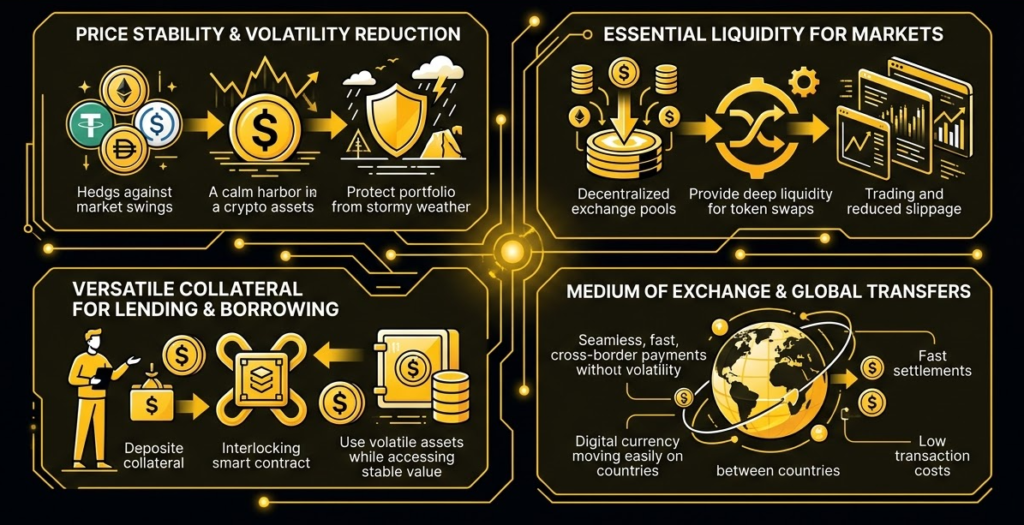
If you spend enough time exploring DeFi, you will quickly notice that stablecoins are everywhere.
That is not an accident.
Most crypto assets fluctuate substantially in price, which makes them inconvenient as units of account for financial contracts. A lending protocol denominating a loan in a highly volatile token introduces additional complexity for both borrowers and lenders.
Stablecoins can provide a relatively stable accounting unit for:
- lending and borrowing;
- decentralized exchanges;
- liquidity pools;
- payments;
- derivatives;
- yield strategies;
- collateral management.
From a DeFi perspective, stablecoins act almost like programmable digital cash.
They can move through smart contracts and become inputs or outputs for financial applications.
That makes them another important Lego brick in the ecosystem.
But stablecoins introduce their own risks, including collateral risk, issuer risk, governance risk, liquidity risk, and depegging. So even a strategy that appears to involve a “stable” asset is not automatically risk-free.
What Makes DeFi Different From Simply Using a Crypto Exchange?
If you are new to crypto, you might reasonably ask: Why bother with DeFi when centralized exchanges already let me trade tokens?
The difference is primarily about control and infrastructure.
On a centralized exchange, you generally deposit assets into an account controlled by the exchange. The exchange operates the matching engine, manages custody, and determines how users interact with the platform.
With a decentralized exchange, your assets can remain in your wallet until you authorize a transaction. The trade is executed through blockchain-based smart contracts.
Uniswap, for example, describes itself as an open-source, peer-to-peer protocol where users can swap tokens and provide liquidity without relying on a centralized intermediary. Its architecture and liquidity model are explained in Uniswap’s official protocol documentation.
That does not mean decentralized exchanges are automatically safer.
It means the trust model is different.
You exchange institutional custody risk for greater personal responsibility and smart-contract risk.
For experienced users, that trade-off can be attractive.
For beginners, it can be intimidating.
And honestly, both reactions are reasonable.
The Biggest Mistakes Beginners Make in DeFi
If I were explaining DeFi to someone using it for the first time, I would spend almost as much time talking about what not to do as explaining the technology itself.
Here are several mistakes worth avoiding.
Chasing the highest APY
An enormous yield is not automatically a gift.
High APYs can come from token emissions rather than sustainable economic activity. If a protocol pays users with newly created tokens, the nominal yield may look attractive while the token price simultaneously declines.
Always ask:
Where does this yield actually come from?
Is it trading fees?
Borrower interest?
Staking rewards?
Token emissions?
Subsidies?
A combination?
The answer tells you far more than the APY number alone.
Ignoring smart-contract approvals
Token approvals are a critical part of DeFi interaction.
When you approve a smart contract to spend tokens, you are granting it permission according to the approval parameters. A malicious or compromised contract can potentially become dangerous if it has excessive spending authority.
You should therefore pay attention to what you are signing rather than treating every wallet confirmation as a routine popup.
Ethereum’s documentation explains that writing to a smart contract involves signing a transaction that changes blockchain state, while reading contract data does not require a transaction or gas. The distinction is covered in Ethereum’s guide to interacting with contracts.
Assuming audited means guaranteed safe
An audit is useful.
It is not an insurance policy.
A project can pass an audit and later introduce a new contract, modify a configuration, integrate another protocol, or experience an economic attack that was outside the audit’s original scope.
Treat an audit as one piece of evidence.
Not a final verdict.
Forgetting gas and execution costs
A strategy can look profitable on paper while becoming unattractive after transaction fees, slippage, borrowing costs, bridge fees, and other execution expenses are included.
This is especially important when moving small amounts.
The headline yield is not your actual return.
Your actual result depends on the complete transaction path.
A Practical Framework for Evaluating a DeFi Protocol
Before depositing money into a new protocol, I would work through a simple checklist rather than relying on social-media hype.
Understand what the protocol actually does
Can you explain the product in one or two sentences?
If not, slow down.
A complicated interface does not necessarily mean sophisticated technology. Sometimes it simply means you have not yet understood the underlying mechanism.
Identify where the yield comes from
Ask whether the return is generated by genuine economic activity or primarily by incentives.
For example:
- Trading fees can represent genuine user activity.
- Borrowing interest can represent demand for capital.
- Staking rewards can compensate users for network security.
- Token emissions can subsidize participation.
- Temporary incentives may disappear when rewards end.
There is nothing inherently wrong with incentives. They can help bootstrap a network.
The important point is understanding them.
Check liquidity
A displayed balance is not the same thing as immediately available liquidity.
A protocol might report significant deposits while the actual liquidity available for your specific asset is much smaller.
This matters particularly when markets become stressed.
Examine the smart contracts
Look for verified source code, documentation, audits, bug-bounty programs, security disclosures, and a history of upgrades.
Ethereum provides extensive documentation around contract development, compilation, deployment, testing, and security, making its smart-contract developer resources a useful technical reference when you want to understand what sits beneath a DeFi interface.
Understand liquidation parameters
If you borrow, know exactly what happens when collateral falls.
You should understand:
- collateral factor;
- liquidation threshold;
- liquidation penalty;
- health factor;
- interest rate;
- oracle source;
- repayment mechanics.
Do not wait until your position is near liquidation to learn what these terms mean.
Frequently Asked Questions
What is DeFi in simple terms?
DeFi, or decentralized finance, is a blockchain-based financial ecosystem that uses smart contracts to provide services such as trading, lending, borrowing, staking, and asset management without relying entirely on traditional financial intermediaries.
Instead of a bank manually processing every financial action, software deployed on a blockchain can enforce predefined rules automatically. Ethereum’s official documentation describes smart contracts as programs that run on the blockchain and can automatically enforce rules through code, as explained in Ethereum’s introduction to smart contracts.
Do you need a bank account or ID to use DeFi?
Generally, DeFi protocols can be accessed without opening a conventional bank account, and many applications allow users to interact through self-custody wallets rather than traditional account systems.
However, that does not mean every blockchain service is completely anonymous or free from regulation. Centralized interfaces, fiat gateways, stablecoin issuers, and other service providers can impose identity checks depending on their jurisdiction and business model.
So the more accurate statement is that many DeFi protocols are permissionless at the blockchain level, while the surrounding ecosystem can still include regulated intermediaries.
What does “Money Legos” mean in DeFi?
“Money Legos” refers to composability: the ability of different blockchain protocols and smart contracts to interact with one another.
For example, a liquid staking token can become collateral in a lending protocol, borrowed stablecoins can be traded on a DEX, and the resulting asset can potentially enter another application.
Ethereum’s documentation highlights smart-contract composability as a core capability because contracts can interact with other public contracts and extend one another’s functionality. You can read more in Ethereum’s composability documentation.
Why do I need to overcollateralize loans in DeFi?
Many DeFi lending protocols require overcollateralization because they generally do not rely on traditional credit scores, legal identity, or centralized debt collection.
Instead, collateral provides an automated protection mechanism.
For example, Aave requires borrowers to maintain collateral above relevant thresholds, and positions can become eligible for liquidation when their health factor falls below the protocol’s requirements. The mechanism is described in Aave’s official V3 documentation.
The exact collateral requirement varies by asset and protocol, so you should always check the specific market parameters rather than assuming that one ratio applies everywhere.
The Bottom Line: DeFi Is an Open Financial Toolkit, Not a Risk-Free Bank
DeFi is best understood as a new way of assembling financial infrastructure.
Its most important innovation is not simply that you can swap one token for another without a bank. The deeper change is that financial functions can become programmable, composable, transparent, and accessible through open blockchain infrastructure.
A DEX can become a trading Lego.
A lending market can become a credit Lego.
A liquid staking protocol can turn locked network assets into reusable financial building blocks.
A stablecoin can function as programmable money.
Smart contracts connect these components together.
That composability creates possibilities that would be difficult to reproduce through conventional financial infrastructure. Developers can build on existing protocols rather than starting from zero, while users can potentially access financial strategies that would previously have required several separate intermediaries.
But there is a second side to the story.
DeFi does not eliminate risk.
It moves risk around.
You may have less reliance on a bank but more exposure to smart-contract vulnerabilities. You may gain permissionless access but become responsible for your own private keys. You may earn attractive yields, but those yields can disappear when incentives change. You may avoid traditional credit checks, but you may have to overcollateralize your loan and accept automatic liquidation if markets move against you.
That is why I would not approach DeFi simply by asking, “How much can I earn?”
A better question is:
“What exactly is generating this return, what assumptions does the protocol make, and what happens if those assumptions fail?”
Once you start thinking that way, DeFi becomes much easier to understand.
You stop seeing it as a collection of mysterious crypto websites promising yield and start seeing the underlying architecture: smart contracts, liquidity pools, collateral, oracles, incentives, governance, and composable financial primitives.
And that is really what decentralized finance is about.
Not removing every intermediary overnight.
Not guaranteeing effortless passive income.
Instead, DeFi is an attempt to turn parts of finance into open software that anyone can inspect, interact with, combine, and build upon. The technology is still evolving, and so are the risks, but the basic idea is remarkably simple: financial rules can be written as code, deployed on public infrastructure, and made accessible without requiring every participant to rely on the same traditional gatekeepers.