What is Base?
Before comparing networks or moving money, I think it’s worth getting one thing straight: Base is infrastructure. It helps applications run on-chain more cheaply, but it isn’t an investment thesis by itself.
You can use Base without buying a speculative token, and you don’t need to understand every part of the OP Stack before making your first transaction. Still, a basic grasp of how the network works can save you from some expensive mistakes.
Base’s core architecture at a glance
Base sits between the applications you interact with and Ethereum’s settlement layer. Here’s how I would break down its main components:
| Component | Its job | Why you should care
|
|---|---|---|
| Execution environment | Runs smart contracts and processes transactions | Determines how applications behave on Base |
| Sequencer | Orders transactions and helps produce L2 blocks | Affects transaction inclusion, responsiveness, and censorship considerations |
| OP Stack | Supplies the underlying rollup software framework | Gives developers familiar Ethereum-compatible tooling |
| Ethereum mainnet | Provides settlement and rollup data availability | Connects Base to Ethereum’s security model |
| ETH | Pays network gas fees | You need ETH on Base to transact |
| Bridge | Moves assets between networks | Determines transfer costs, timing, and trust assumptions |
The distinction between these components matters because users often collapse them into one idea: “Base is Coinbase’s blockchain.” That description is understandable, but it misses the architecture.
Coinbase incubated Base, while the network is built on open-source OP Stack technology and designed to operate as part of a broader Ethereum scaling ecosystem. Coinbase’s own Base overview describes both the company’s involvement and its intention to decentralize the network progressively.
I would also be careful with the phrase “100% EVM-equivalent.” Base aims for strong compatibility with Ethereum’s execution environment, so many Ethereum contracts and tools can be used with little modification. But compatibility is not a promise that every external service, RPC method, timing assumption, or chain-specific feature behaves identically. Developers should test their applications on the actual target network.
How Base keeps transaction costs down
Imagine you want to swap $20 worth of a token. On a busy network, the transaction fee can become a meaningful percentage of the amount you’re swapping. You might end up spending more on execution than you intended to spend on the trade itself.
Base tries to reduce that friction by processing transactions on its own L2 execution environment and batching the information that must be published to Ethereum. Instead of asking Ethereum mainnet to execute each Base transaction separately, the rollup shares certain costs across a batch of transactions.
Ethereum’s EIP-4844 specification introduced blob-carrying transactions, giving rollups a more suitable way to publish data to Ethereum. This can reduce the cost of data availability, although it doesn’t guarantee a fixed fee for every Base transaction.
Your final fee depends on several variables:
- The amount of computation your transaction requires.
- The cost of executing the transaction on Base.
- The current cost of publishing rollup data to Ethereum.
- The network’s fee rules and conditions at the time you transact.
This is why I wouldn’t promise you that Base is always 10, 50, or 100 times cheaper than Ethereum. Those ratios can appear in particular comparisons, but the result depends on the transaction and the time of measurement. A complex contract call on Base can still cost more than a simple transfer, and Ethereum’s fees can fall when demand is low.
If you’re a regular user, the practical rule is simple: check the actual quote before you confirm. If you’re a developer, benchmark representative transactions under different network conditions rather than using one attractive fee figure in a presentation.
What happens when you send a transaction?
Suppose you connect your wallet to a decentralized exchange and swap ETH for a token on Base. Your wallet prepares the transaction, signs it, and submits it to the network. The sequencer orders it, and the Base execution environment processes the relevant smart-contract logic.
Your wallet or the application may show a quick confirmation. Behind the scenes, however, the rollup continues to publish data and state commitments to Ethereum, where the protocol’s settlement and fault-proof mechanisms come into play.
That distinction is worth remembering. The transaction experience on Base can feel similar to using an ordinary web application, but the underlying system still has blockchain-specific stages and assumptions.
For most everyday transactions, you don’t need to track every settlement stage manually. But if you’re moving large amounts, building a financial application, or depending on a particular withdrawal deadline, the difference between an L2 confirmation and completion of the canonical withdrawal process becomes important.
The Superchain: why Base is connected to other OP Stack networks
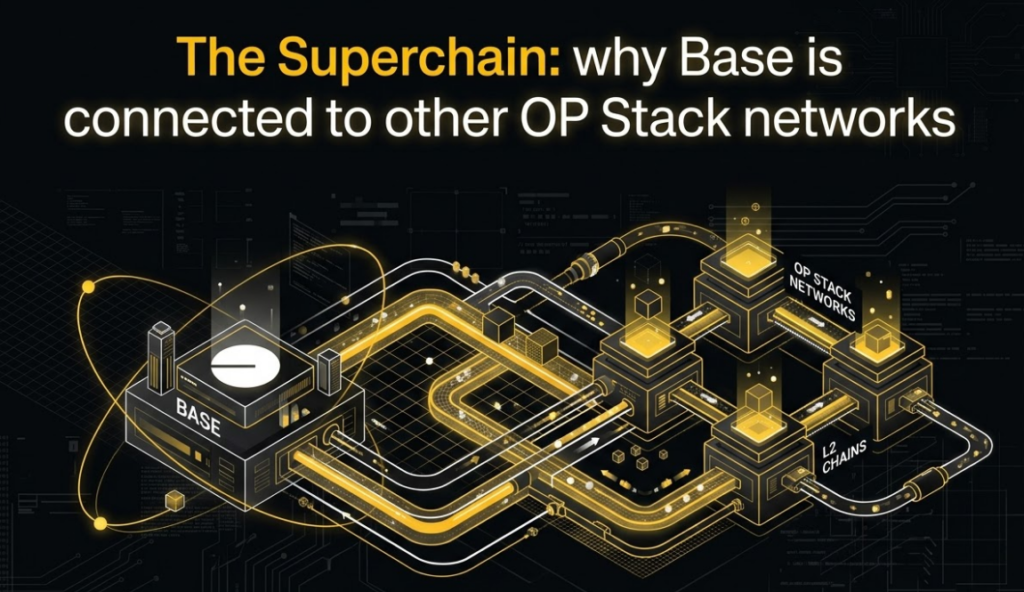
Base is associated with the Optimism Superchain, a broader effort to build a more interoperable ecosystem of OP Stack-based networks. The idea is to make it easier for developers to deploy compatible chains and for users to move between applications without dealing with a completely different technical environment every time.
Networks associated with this ecosystem include OP Mainnet, Base, Zora, Mode, World Chain, and others. The exact participants and interoperability capabilities can change as the ecosystem develops. The OP Stack specifications and Optimism developer documentation are better references for technical details than an old ecosystem infographic.
Why should this matter to you? Because multi-chain fragmentation can be annoying.
You might hold ETH on Base, USDC on another L2, and a token on Ethereum mainnet. Even if all three assets are familiar, moving between them may require different bridge interfaces, separate fees, and careful checks of token representations. An application that supports multiple networks can reduce some of this friction, but the underlying assets and transactions still need to be handled correctly.
The Superchain vision aims to make cross-chain communication and asset transfers more consistent. That doesn’t mean every chain already behaves like one seamless network. You still need to check supported routes, bridge contracts, destination addresses, and the security assumptions behind each transfer.
For developers, shared software components can reduce the work involved in launching a compatible chain. For users, the long-term benefit could be less visible complexity: fewer manual network switches and a smoother path between applications.
I would treat that as a promising direction, not a guarantee that bridging will become risk-free or that every asset will be universally interchangeable.
Base vs Arbitrum vs Optimism: which network should you choose?
If you’re deciding where to use DeFi or move stablecoins, Base, Arbitrum One, and OP Mainnet are natural options to compare. All three are Ethereum L2 networks, but they have different technology stacks, ecosystems, liquidity patterns, and organizational structures.
The main differences
| Attribute | Base | Arbitrum One | OP Mainnet
|
|---|---|---|---|
| Technology stack | OP Stack | Arbitrum Nitro | OP Stack |
| Gas asset | ETH | ETH | ETH |
| Official network token | No native Base gas token | ARB is a governance token | OP is a governance token |
| Main ecosystem connection | Coinbase and the Superchain | Arbitrum ecosystem | Optimism Collective and the Superchain |
| Typical strengths | Coinbase-related onboarding, consumer apps, DeFi | Established DeFi and trading applications | OP Stack ecosystem and Superchain development |
| What to check first | App quality, bridge route, token liquidity | Protocol availability and liquidity | App availability and ecosystem fit |
Base and OP Mainnet share the OP Stack foundation, but they are separate networks. Assets, balances, and contracts on one are not automatically identical to their counterparts on the other. Arbitrum uses a different rollup implementation, although it also aims to support Ethereum-compatible smart contracts.
So which one is better? I wouldn’t answer that without knowing what you’re trying to do.
If you want to use an application that has its best liquidity on Base, choosing Base makes sense. If the derivatives platform or lending market you rely on is stronger on Arbitrum, that may be the more practical choice. If your developer workflow or existing assets are centered on OP Mainnet, switching networks just because another chain has a lower headline fee may create unnecessary work.
How to interpret TVL without being misled
Total value locked, or TVL, is one of the most commonly used measures of DeFi activity. It estimates the value of assets deposited in protocols on a network. It’s useful, but it doesn’t tell the whole story.
The current DefiLlama Base dashboard, Arbitrum dashboard, and OP Mainnet dashboard show how differently the networks can rank by this measure. In the snapshots available during research for this article, Base had roughly $6.2 billion in DeFi TVL, Arbitrum about $1.36 billion, and OP Mainnet around $454 million. These figures are time-sensitive and can change materially; check the linked dashboards for the latest numbers before publishing or making a decision.
Even with current data, I wouldn’t use TVL alone to decide where to trade. A network can have a large amount of deposited capital but still have limited liquidity in a specific trading pair. Conversely, a smaller network may offer deep liquidity in the exact market you care about.
For a practical comparison, look at:
- Liquidity for your asset: Can you execute your intended trade without excessive price impact?
- Protocol risk: Has the application published audits, security information, and clear contract details?
- Bridge availability: Can you move assets to and from the network using a route you trust?
- Transaction costs: What is the current fee for your actual transaction?
- Operational reliability: Does the network and application behave consistently when demand rises?
TVL is a starting point, not a verdict.
The Coinbase advantage-and its limits
Coinbase gives Base a route to users that many independent blockchain projects would love to have. Its exchange, wallet products, and onboarding infrastructure can help users acquire crypto and move it on-chain. Coinbase’s official Base overview highlights this connection as part of the network’s appeal to both users and developers.
For you, the practical benefit may be a shorter path from a centralized exchange account to a Base application. If Coinbase supports direct withdrawals of your chosen asset to Base, you may not need to bridge from Ethereum mainnet first.
For developers, access to familiar onboarding tools and a large potential user base can make Base an appealing place to launch a consumer application.
But there’s a limit to what this advantage means. Coinbase’s involvement doesn’t automatically make every Base token legitimate, every dApp safe, or every bridge trustworthy. Independent applications can have their own owners, contract risks, and fee structures. A self-custodial transaction on Base is also different from a trade executed inside Coinbase’s centralized exchange.
My advice is to treat Coinbase as a useful gateway, not a blanket guarantee.
Does Base have a token? The truth about BASE airdrops
Let’s deal with this before anything else, because this is where users can lose money for no good reason.
Base does not currently have an official native network token that you need to purchase to use the chain or pay gas fees. Coinbase’s official Base information page says the company does not currently plan to issue a new network token and specifically warns users about fake Base tokens.
That statement is more useful than a rumor circulating on social media. It doesn’t let anyone predict every future decision with absolute certainty, but it tells you what the official position is according to the source available at the time of writing.
Why the Base token rumor keeps spreading
There are a few reasons people keep expecting a BASE token.
First, many crypto networks have launched governance tokens, so users assume Base will eventually follow the same pattern. Second, airdrop speculation attracts people who hope that interacting with applications today might qualify them for rewards later. Third, scammers know that users who are eager for a potential reward may rush through a wallet connection or transaction without checking what they’re approving.
You may see a website claiming that a Base token is already available, that a snapshot has been taken, or that you need to pay a small fee to claim your allocation. None of those claims should be treated as legitimate just because the website uses Base branding.
Here’s the distinction I want you to remember: speculation about a possible future token is not evidence that an official token or airdrop exists today.
If an official announcement ever changes the situation, verify it through Base or Coinbase’s authoritative channels. Until then, you don’t need to buy a token called BASE to use the network.
How to recognize a fake Base airdrop
Be especially cautious if a website or social account does any of the following:
- Claims you must connect your wallet immediately before an arbitrary deadline.
- Requests your seed phrase or private key.
- Asks you to pay an upfront fee to unlock a supposed reward.
- Tells you to approve an unlimited token allowance without explaining why.
- Uses a token symbol that looks official but provides no trustworthy contract information.
- Sends you to a claim page through an unsolicited direct message.
A wallet connection by itself doesn’t necessarily transfer your assets, but it can expose you to deceptive interfaces. The greater danger often comes when you sign a transaction, authorize token spending, or reveal your recovery credentials.
If you already hold a suspicious token in your wallet, don’t rush to interact with it. Simply receiving a token does not mean you must claim, swap, or approve it. Check the token’s contract and origin through trusted sources, and avoid using links embedded in the token’s description.
And don’t assume that every person who posts about an airdrop is deliberately scamming you. Some may genuinely believe the rumor. The point is that belief, engagement, and confident predictions do not replace official confirmation.
Is Base a Layer 1 blockchain or an Ethereum Layer 2?
Base is an Ethereum Layer 2 network, not a standalone Layer 1 blockchain like Solana or Avalanche.
The difference is more than a label. Base processes transactions in its own execution environment, while Ethereum provides the settlement and data-availability foundation used by the rollup architecture. A standalone Layer 1, by contrast, relies on its own base-layer consensus and validator architecture.
| Feature | Base | Standalone Layer 1
|
|---|---|---|
| Execution | Transactions run in an L2 environment | Transactions run on the chain’s base layer |
| Settlement | Uses Ethereum’s rollup settlement mechanisms | Uses the network’s own consensus and settlement model |
| Data availability | Rollup data is published to Ethereum | Depends on the chain’s own design |
| Gas currency | ETH | Varies by network |
| Cross-chain transfers | Require a supported bridge or transfer route | Require a supported bridge or transfer route when moving to another chain |
That doesn’t mean Base is simply Ethereum with a different interface. Base has its own blocks, transaction ordering, execution environment, application ecosystem, and operational dependencies. But it is designed to scale Ethereum rather than replace Ethereum’s base layer with an entirely independent consensus system.
This distinction becomes particularly important when you bridge assets. If you hold ETH on Base, your wallet is showing your balance in the Base network’s environment. That doesn’t mean the same balance is immediately available to spend on Ethereum mainnet.
To move it back, you need a supported transfer route. With the canonical optimistic rollup withdrawal process, funds can be subject to a dispute period of roughly seven days. Third-party services may provide faster transfers by using different mechanisms, but their trust assumptions and fees can differ.
For a small transfer, this may feel like a technical footnote. For someone who needs access to funds by a specific deadline, it matters a great deal.
Base’s sequencer: speed, control, and decentralization
Base’s sequencer helps order transactions and produce L2 blocks. It’s an important reason the network can offer a responsive user experience, but it also raises a question: how much control should one operator have over transaction ordering and inclusion?
Coinbase has described a plan to decentralize Base progressively. That direction is part of the project’s stated goals, as explained in its official Base overview. However, a roadmap is not the same thing as a completed technical milestone, so you should assess the current system rather than assume every part is already decentralized.
What sequencer centralization means for users
A centralized sequencer can create operational and censorship concerns. If the operator experiences an outage, transaction processing may be disrupted. If the operator has control over transaction ordering, users may also have less assurance about how transactions are included during periods of stress.
At the same time, centralized sequencing does not automatically mean the operator can arbitrarily steal every user’s funds. The rollup’s security also depends on Ethereum settlement, data publication, fault-proof mechanisms, and the permissions built into the system.
For a meaningful assessment, I’d ask three separate questions:
- Transaction ordering: Who decides which transactions enter a block and in what order?
- Fault proofs: What mechanisms allow invalid state proposals to be challenged?
- Upgrade permissions: Who can change critical contracts or upgrade the system, and what safeguards apply?
These questions address different kinds of control. A rollup can publish data to Ethereum while still relying on a centralized sequencer. It can also have a fault-proof system while retaining privileged upgrade permissions. You need to look at the full architecture rather than treating “secured by Ethereum” as a complete answer to every risk question.
The OP Stack specifications are a useful technical reference for the underlying framework. For Base-specific implementation details and updates, start with the Base documentation.
Does being part of the Superchain solve the problem?
Not by itself. The Superchain vision includes shared infrastructure and interoperability between compatible networks, but shared software does not automatically mean every chain has identical governance, sequencing, or upgrade controls.
If decentralization is a major factor in your decision, look for evidence of actual changes in operator arrangements and permissions. Don’t treat a planned milestone, a marketing slogan, or the presence of multiple OP Stack networks as proof that all centralization risks have disappeared.
Coinbase custody versus self-custody on Base

Base and Coinbase are closely connected, but you should never assume that using one is the same as using the other.
When you hold crypto in a centralized exchange account, the exchange generally controls the private keys associated with its custodial infrastructure. Your account balance represents your claim within that platform’s system. You typically rely on the exchange’s account security, withdrawal rules, and operational processes.
With a self-custodial wallet, you control the credentials or authorization mechanism that lets you approve on-chain transactions. That gives you more direct control, but it also makes you responsible for protecting access and understanding what you sign.
| Where your assets are | What controls them | Main consideration
|
|---|---|---|
| Coinbase exchange account | Coinbase’s custodial systems | Account access, withdrawal policies, and exchange-specific risks |
| Self-custodial wallet on Base | Your wallet’s keys or authorization mechanism | Protect access and verify each transaction |
| A DeFi protocol on Base | Smart contracts and your wallet’s authorization | Contract vulnerabilities, permissions, and protocol risks |
| A third-party bridge | The bridge’s contracts and operating model | Bridge security, liquidity, fees, and transfer assumptions |
If you withdraw ETH from Coinbase to Base, the assets move from the exchange’s custody system to an on-chain address on Base. From that point, what you can do with them depends on the wallet and the applications you choose to use.
That also means customer support generally cannot simply reverse a completed blockchain transaction because you sent it to the wrong address or signed a malicious approval. Recovery may be impossible, and the exact outcome depends on the situation.
For self-custody, I recommend starting with a small amount, learning the wallet’s recovery options, and checking every approval. If a decentralized application requests permission to spend a token, confirm the spender and the allowance amount. If a site asks for your recovery phrase, stop.
A more convenient wallet experience can reduce some of the friction, but it doesn’t remove the need for basic security habits.
How to bridge ETH to Base
You don’t need to be a blockchain developer to use Base. If you have a compatible wallet and some ETH, you can connect to the network and start exploring applications. The important part is choosing the right transfer route and checking the details before you send funds.
There are three common routes: withdraw directly from a centralized exchange, bridge ETH from Ethereum mainnet, or use a third-party bridge from another supported network.
I would choose based on where your assets are right now. If your ETH is already on Base, there’s no reason to bridge it again. If it’s on Coinbase and the exchange supports direct withdrawals to Base, that may be the simplest route. If your funds are on another L2, a third-party bridge may save you an unnecessary trip through Ethereum mainnet.
Phase 1: Set up your wallet
Configure Base Mainnet
Some wallets already support Base, so you may only need to select it from the network menu. If your wallet requires manual configuration, verify the details against the official Base documentation.
| Network setting | Base Mainnet value
|
|---|---|
| Network name | Base Mainnet |
| Chain ID | 8453 |
| Gas currency | ETH |
| Public RPC endpoint | https://mainnet.base.org |
| Block explorer | [Basescan](https://basescan.org/) |
The chain ID is particularly important because it helps your wallet identify the network. Base Mainnet uses decimal chain ID 8453, as documented in the Base JSON-RPC reference.
Follow these steps:
- Open your wallet and find the network selector or network-management settings.
- Search for Base Mainnet. If it’s already available, select it rather than adding a duplicate entry.
- If manual setup is necessary, enter the official network details and check the RPC endpoint carefully.
- Switch to Base and verify that the wallet shows the correct network and ETH balance.
- After sending or receiving funds, use Basescan to inspect the transaction if you need to confirm its status.
Don’t copy RPC settings from random social media posts or unsolicited messages. Use the wallet’s built-in network directory or official documentation whenever possible.
Consider a passkey-based smart wallet
If you’re new to crypto, managing a traditional wallet’s recovery phrase can feel like an unnecessary obstacle. Smart wallets can make onboarding easier by supporting alternative authorization methods, including passkeys.
Ethereum’s ERC-4337 specification describes an account-abstraction framework that enables smart-contract accounts and more flexible transaction handling. Coinbase’s Smart Wallet experience has also used passkeys to simplify wallet access; consult the current Coinbase Smart Wallet guidance for supported setup and recovery options.
A typical setup involves creating the wallet through its official interface, registering the supported authentication method, and reviewing recovery settings before depositing funds.
One important detail: a smart wallet doesn’t automatically make every transaction free. An application may sponsor gas for eligible actions, but that depends on its implementation and sponsorship rules. The network still processes the transaction, and someone must cover the cost.
Phase 2: Move ETH to Base
Option A: Withdraw directly from Coinbase
If your Coinbase account supports direct withdrawals to Base for the asset you want to transfer, this can be the most straightforward option.
- Sign in through the official Coinbase website or app.
- Open the send or withdrawal flow for the asset you want to move.
- Select Base as the destination network if Coinbase explicitly supports it for that asset.
- Enter your Base wallet address and carefully verify the destination details.
- Review the amount, network, withdrawal fee, and any minimum transfer requirements.
- Confirm the transaction and check the receiving wallet once the transfer has been processed.
Don’t assume every asset on Coinbase can be withdrawn to Base. Supported networks vary by asset and can change. Always check the final withdrawal screen.
Also, “low fee” doesn’t mean “free.” Exchange fees and network charges depend on the route and current conditions. The fee shown before you confirm is more useful than an estimate copied from an old article.
Option B: Bridge ETH from Ethereum mainnet
If your ETH is already in a self-custodial wallet on Ethereum mainnet, you can use the canonical bridge to deposit it to Base. Start from the official Base website or Base documentation to locate the current bridge interface.
The general process is:
- Open the official bridge interface and connect your wallet.
- Check that Ethereum mainnet is selected as the source network and Base is selected as the destination.
- Select ETH and enter the amount you want to deposit.
- Review the estimated amount received, transaction fee, and any additional costs.
- Confirm the transaction in your wallet after checking the details.
- Wait for the transfer to complete, then switch to Base and verify the resulting balance.
You need enough ETH on Ethereum mainnet to pay for the deposit transaction. Once the funds arrive, you’ll also need ETH on Base to pay for subsequent transactions there.
Don’t assume every deposit completes within a fixed number of minutes. Timing can vary with Ethereum congestion, bridge processing, and network conditions.
Withdrawals through the canonical optimistic rollup bridge work differently from deposits. The standard withdrawal process generally involves a dispute period of roughly seven days, along with other transaction steps. Check the current bridge documentation before relying on a specific completion time.
Option C: Use a third-party bridge
If your assets are on another Layer 2 network, a third-party bridge may provide a more direct route to Base.
Protocols such as Across, Hop Protocol, and Stargate Finance have offered cross-chain transfer services. Supported assets, networks, and routes can change, so verify the exact transfer you’re planning before proceeding.
Third-party bridges may use liquidity providers, relayers, pools, or other mechanisms to deliver assets on the destination chain. Some routes can be faster than the canonical withdrawal process, but speed alone doesn’t make a route safer or cheaper.
Before you use a bridge, check:
- Supported route: Is your exact source network, destination network, and asset supported?
- Expected output: How much will you receive after fees and any price impact?
- Security model: Which contracts, relayers, liquidity providers, or other components does the route rely on?
- Token representation: Will you receive native USDC, a bridged representation, or another version of the asset?
- Wallet permissions: Does the transaction request a token approval, and is the requested allowance appropriate?
- Destination address: Have you confirmed that the wallet address is correct for the receiving network?
I would also consider making a small test transfer if you’re using a bridge for the first time. It won’t eliminate smart-contract or bridge risk, but it can help you catch basic setup mistakes before moving a larger amount.
How to bridge USDC to Base
USDC transfers follow the same broad process, but you need to pay closer attention to the token’s origin and contract address.
A USDC ticker on one network doesn’t automatically mean the token is identical to every USDC representation on another network. Confirm whether the route transfers native USDC or a bridged version, and verify the supported asset through official documentation or a trusted block explorer.
If you’re withdrawing from an exchange, check that it supports Base withdrawals for that particular asset. If you’re using a bridge, inspect the amount you’ll receive and the contract permissions before confirming.
Keep a little ETH on Base after the transfer so you can pay for swaps, approvals, and other transactions. Holding USDC alone may not be enough to pay gas fees on Base.
Frequently asked questions about Base
What is Base, and how is it connected to Coinbase?
Base is an Ethereum Layer 2 optimistic rollup incubated by Coinbase and built on the open-source OP Stack. It offers an Ethereum-compatible environment for decentralized applications while giving developers access to tools and onboarding opportunities connected to Coinbase’s ecosystem. However, Base applications can be operated independently, so Coinbase’s involvement doesn’t guarantee that every token or dApp on the network is safe.
Does Base have its own native token?
Base does not currently have an official native network token for gas fees. It uses ETH to pay transaction costs, and Coinbase’s official Base information page states that the company does not currently plan to issue a new network token. Treat claims about an official BASE airdrop cautiously unless they’re confirmed through authoritative announcements.
What are the OP Stack and the Superchain?
The OP Stack is an open-source software framework used to build Ethereum Layer 2 networks, including Base and OP Mainnet. The Superchain is a broader ecosystem of compatible OP Stack-based networks working toward shared infrastructure and interoperability. Technical compatibility and cross-chain features vary, so assets are not automatically transferable between every participating chain.
How do Base transaction fees work?
Base charges gas fees in ETH. Costs depend on execution requirements, network conditions, and the cost of publishing rollup data to Ethereum. Ethereum’s EIP-4844 blob infrastructure helps reduce rollup data-publication costs, but fees still fluctuate, and no fixed fee ratio applies to every transaction.
How can I bridge ETH or USDC to Base?
You can withdraw supported assets from Coinbase directly to Base, deposit through the canonical bridge from Ethereum mainnet, or use a third-party bridge that supports your source network and destination asset. Verify the network, token contract, recipient address, and quoted fees before signing. For ETH deposits from Ethereum mainnet, you’ll need ETH to pay the L1 transaction fee, plus ETH on Base for later transactions.
Final thoughts: Is Base worth using in 2027?
If you’re interested in Ethereum applications but don’t want to pay mainnet execution fees for every action, Base is worth exploring. Its OP Stack foundation gives developers a familiar environment, while Coinbase’s involvement provides a useful route for onboarding users and connecting applications with existing crypto infrastructure.
The appeal isn’t hard to understand. You can transfer ETH, use DeFi protocols, swap tokens, interact with smart contracts, and explore consumer applications on a network where transactions are often less expensive than on Ethereum mainnet. Smart wallets can also reduce some of the friction that makes self-custody intimidating for newcomers.
But I wouldn’t treat Base as risk-free simply because Coinbase incubated it. You still need to evaluate the applications you use, the tokens you hold, the bridges you trust, and the network’s operational and governance arrangements. A familiar name can make the first transaction feel less intimidating, but it doesn’t remove smart-contract risk or protect you from phishing.
If you’re starting from scratch, here’s the approach I’d recommend:
- Understand the basics first. Base is an Ethereum L2, and ETH is its gas asset.
- Start with a small balance. Test your wallet and transfer route before moving a larger amount.
- Choose bridges based on more than speed. Compare fees, supported assets, and security assumptions.
- Ignore unverified airdrop promises. You don’t need to buy a supposed BASE token to use the network.
- Check every transaction. Verify the destination address, token contract, and permissions before signing.
For me, the most important distinction is between using Base as infrastructure and treating its popularity as an investment signal. Those are two different decisions. A network can be useful without its tokens being a good investment, and a growing ecosystem can still contain risky applications.
Base gives users and developers another way to participate in Ethereum’s ecosystem. Learn how it works, verify the details that matter, and choose applications based on your actual needs-not a rumor, a headline fee comparison, or the promise of a reward that nobody has officially confirmed.