

Decoding “Crypto Wallet Mining”
Search for “crypto wallet mining” today and you’ll quickly run into a problem: the term sounds much more precise than it actually is.
There is no universally recognized blockchain mechanism called wallet mining. In practice, websites, mobile apps, wallet interfaces, and marketing campaigns use the phrase to describe several completely different activities. Some are legitimate. Some are simply misleading. Others are outright scams designed to make you sign a transaction that gives another smart contract permission to move your tokens.
That distinction matters because the technical reality is fairly straightforward. Traditional Proof-of-Work mining requires computational work from specialized hardware. Bitcoin mining, for example, is built around machines performing enormous numbers of cryptographic calculations. A normal smartphone wallet does not suddenly become a Bitcoin miner because an application displays a “Mining” button.
At the same time, blockchain networks such as Ethereum use a completely different consensus model. Ethereum switched from Proof-of-Work to Proof-of-Stake in September 2022, replacing mining with validator-based consensus. The Ethereum Foundation explains that validators stake ETH and participate in checking and proposing blocks rather than competing through computational mining. (ethereum.org)
So when you see a wallet app promising that you can “mine” tokens simply by connecting your wallet, I would immediately slow down and ask a more useful question:
What exactly is the application asking my wallet to do?
That question will usually tell you more than the word “mining” ever will.
What can “crypto wallet mining” actually mean?
The phrase generally falls into several categories:
| Type | What is actually happening | Typical risk |
|---|---|---|
| PoS wallet staking | Tokens are delegated or staked to participate in network security | Low to medium |
| Cloud mining interface | Remote hardware performs the mining; the app displays results | Medium to high |
| Liquidity mining / yield farming | Tokens are supplied to DeFi protocols to earn variable rewards | Medium to high |
| Fake wallet mining DApp | User signs approvals or transactions that can expose tokens to a malicious contract | Extremely high |
| Cryptojacking malware | Malware secretly uses your device’s CPU/GPU for mining | High |
These activities can look surprisingly similar from a marketing perspective. A dashboard might show “hash rate,” “daily income,” “mining rewards,” or a rising balance. But the underlying mechanics can be completely different.
The hardware reality behind Proof-of-Work mining
Proof-of-Work is fundamentally a computation-and-energy competition. A miner runs specialized software and hardware that repeatedly performs hashing operations while attempting to satisfy the network’s current difficulty target.
That makes genuine PoW mining a poor fit for ordinary wallet applications.
Your phone can execute cryptographic operations, of course. Your browser can run JavaScript and WebAssembly. Your laptop can calculate hashes. None of that means it is economically competitive with dedicated mining hardware.
Bitcoin is the clearest example. Modern Bitcoin mining is dominated by ASICs specifically designed for the SHA-256 algorithm. A wallet application running on your phone cannot transform the phone into an industrial Bitcoin miner.
This distinction is important because some fraudulent applications exploit the average user’s mental shortcut:
wallet + mining button = mining cryptocurrency
Technically, that equation does not hold.
The Terminology Confusion: Mining, Staking, and Yield Farming
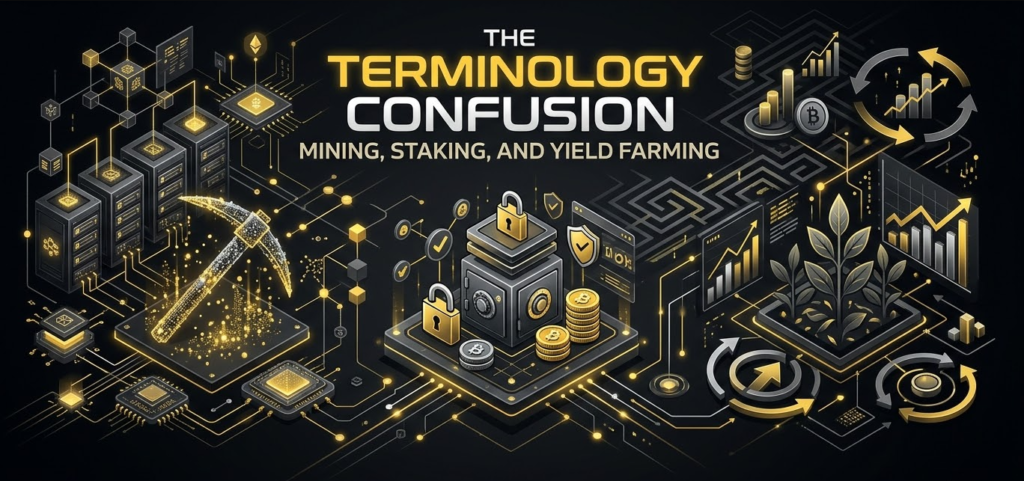
One of the easiest ways to understand wallet mining scams is to stop treating the word “mining” as proof of what is happening underneath.
In crypto marketing, “mining” is sometimes used loosely to describe almost any activity that produces a token reward.
That can include staking, liquidity mining, yield farming, cloud mining, and even referral-based reward systems.
Staking is not mining
Proof-of-Stake replaces computational competition with economic commitment.
Ethereum is a good example. A validator deposits ETH and runs validator software that participates in block proposal and attestation. The network can penalize dishonest behavior by destroying some of the validator’s stake. (ethereum.org)
From a user’s perspective, a wallet may make this process look incredibly simple:
- Select a token.
- Choose a validator or staking provider.
- Enter the amount.
- Confirm the transaction.
- Receive staking rewards according to the protocol or service’s rules.
That interface can resemble a “mining dashboard,” but it isn’t mining in the Proof-of-Work sense.
For example, Ethereum’s official staking documentation explains that users can participate through different staking arrangements, including home staking, delegated options, and pooled staking. The underlying mechanism remains Proof-of-Stake rather than computational mining. (ethereum.org)
The same principle applies elsewhere. A wallet may allow you to stake native assets such as SOL or other PoS tokens, but you are participating in network consensus rather than lending your phone’s processor to a mining pool.
Liquidity mining is another completely different thing
Liquidity mining usually refers to supplying assets to a DeFi protocol and receiving some form of reward.
Imagine you deposit USDC and another asset into a liquidity pool. The protocol may use those assets to facilitate swaps, loans, or another financial function. In exchange, you may receive trading fees, incentives, or a combination of both.
That is not Proof-of-Work mining either.
The word “mining” survived because early DeFi projects popularized the idea of “mining” protocol tokens by providing liquidity. The terminology stuck even though the underlying activity has almost nothing to do with SHA-256, ASICs, or block discovery.
Cloud mining adds another layer of confusion
Cloud mining is different again.
Here, a company or service claims to operate the physical mining equipment on your behalf. You purchase or rent some amount of hash power, and the remote infrastructure supposedly performs the mining.
A wallet or website might show:
- Hash rate
- Estimated daily rewards
- Contract duration
- Electricity deductions
- Mining balance
- Payout history
The important question is not whether the dashboard looks convincing. It is whether the operator actually controls the hardware, whether the economics are transparent, and whether you have a credible way to verify the claimed hash power.
This is where the risk of counterparty fraud becomes significant.
Types of Wallet Mining: Legitimate vs. Malicious
The safest way to evaluate a “wallet mining” opportunity is to classify what is happening technically before thinking about the promised return.
Wallet-integrated staking
This is probably the most legitimate scenario you will encounter when a wallet says you can “earn” by participating in a blockchain.
You hold a supported token and use the wallet interface to delegate or stake it. The network’s consensus mechanism determines the rewards, penalties, validator requirements, and other rules.
For Ethereum, for example, a user running a native validator traditionally needs 32 ETH, although pooled and delegated approaches allow people with smaller amounts to participate through third-party systems. Ethereum’s documentation explicitly distinguishes these options from direct solo validation. (ethereum.org)
The important difference is transparency.
You should be able to identify:
- Which blockchain is being secured.
- Which consensus mechanism is being used.
- Where your tokens are going.
- Who controls the validator.
- What rewards are generated.
- What penalties or lockups exist.
- What smart contracts are involved.
If an app cannot answer those basic questions, I would not treat its “mining” label as meaningful.
Mobile and cloud mining applications
A mobile application claiming to offer cloud mining may be legitimate in principle, but the phrase itself tells you very little.
If the actual hashing occurs on remote ASICs, your smartphone is simply acting as an interface. Your phone might display statistics, account balances, or payouts, but it is not performing the expensive mining computation itself.
That is very different from an app secretly consuming your phone’s CPU.
A suspicious application that causes:
- unusually high CPU usage,
- severe battery drain,
- persistent overheating,
- unexplained background network traffic,
- system slowdown,
deserves immediate investigation.
A legitimate wallet should not need to turn your everyday smartphone into a miniature industrial mining rig just to “earn passive income.”
Browser extensions and WebAssembly claims
Web browsers are capable of running computational workloads through JavaScript and WebAssembly, so technically a website can ask your browser to perform calculations.
That does not mean every browser-based “mining” feature is legitimate.
A website could theoretically use your CPU for a legitimate protocol task, but it could also hide a mining script behind a misleading interface. Worse, a malicious browser extension could combine resource abuse with credential theft, phishing, or wallet manipulation.
I would therefore treat claims about “lightweight mining inside your browser” with skepticism unless the project clearly documents the consensus mechanism, reward model, source code, and exact computation being performed.
There is a major difference between running a verified protocol client and letting an unknown website silently consume your CPU.
Fake “USDT Wallet Mining” DApps
This is where the phrase “crypto wallet mining” becomes particularly dangerous.
A common scam pattern presents itself as a passive-income opportunity involving USDT, “liquidity nodes,” “mining nodes,” or “stablecoin mining.”
The user is typically told something like:
Connect your wallet → activate mining → deposit USDT → earn daily rewards.
The dashboard then displays attractive numbers.
Sometimes the interface even shows a simulated mining rate, a growing balance, a countdown timer, referral bonuses, or an APY that looks impossibly generous.
The visual design can be convincing.
But the real transaction happening underneath may be the important part.
Instead of starting a mining process, you may be granting a smart contract permission to spend your tokens.
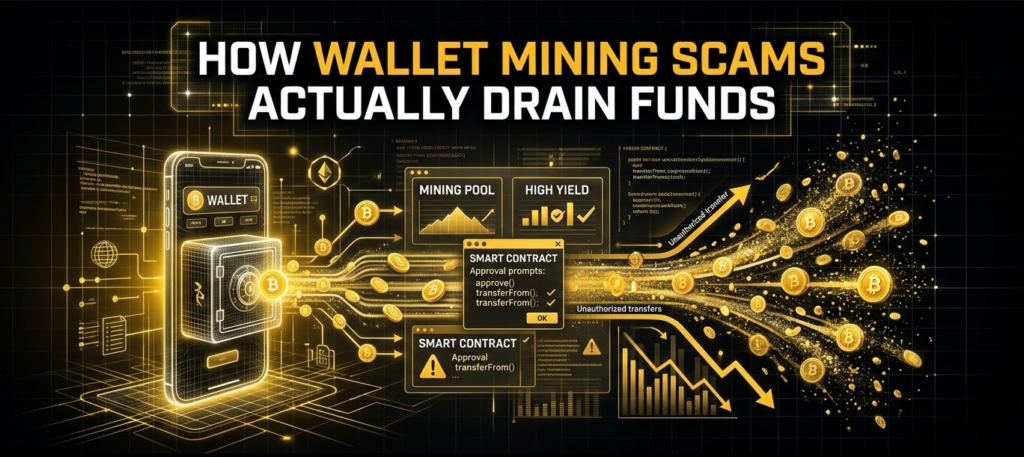
How Wallet Mining Scams Actually Drain Funds
The unlimited approval trap
This is one of the most important concepts you can understand if you use DeFi.
ERC-20 tokens generally use an approval mechanism that allows one address or smart contract-the spender-to move tokens on your behalf up to a specified allowance.
Conceptually, it looks like this:
Your Wallet
     |
     | approve()
     v
Malicious Contract
     |
     | transferFrom()
     v
Your Tokens
The crucial point is that the attacker does not necessarily need your seed phrase.
If you sign a malicious approval, you may have given the spender permission to move the approved token.
MetaMask’s documentation explains that token approvals allow DApps to access and move specified tokens, and that malicious or excessive approvals can become an attack vector. (MetaMask)
This is why a hardware wallet does not automatically save you from an approval scam.
Your hardware wallet can protect the private key extremely well. But if you personally authorize a malicious transaction, the blockchain will generally treat that authorization as valid.
approve() and transferFrom()
The mechanics are easier to understand with a simplified example.
Suppose your wallet contains:
10,000 USDT
A fake “USDT Mining” DApp asks you to approve a spender for:
Unlimited USDT
You confirm the transaction.
The scammer may now have the contractual permission necessary to call transferFrom() against your wallet, subject to the token’s implementation and the approval that was granted.
The attacker doesn’t need to log into your wallet.
They don’t necessarily need your password.
They don’t necessarily need your seed phrase.
They exploit the permission you already signed.
This is exactly why MetaMask recommends checking what a DApp is requesting and, where possible, using a limited spending cap rather than granting unlimited access. (Trung Tâm Hỗ Trợ MetaMask)
The fake APY dashboard
Another classic feature is a fake earnings interface.
You deposit $1,000.
The dashboard says:
Daily mining reward: $27.50
Tomorrow:
Balance: $1,027.50
The following day:
Balance: $1,055.75
At this point, you may feel that the system is working.
But the displayed number does not prove that the blockchain contains those funds.
A website can display almost any number it wants.
The scam becomes even more aggressive when you try to withdraw and suddenly encounter:
- “Gas fee” requirements
- “Verification” deposits
- “Tax” payments
- “Node activation” fees
- “Liquidity unlock” charges
- “Account upgrade” payments
You pay one fee.
Then another.
Then another.
This is often called an advance-fee scam layered on top of a fake DeFi interface.
If someone says you must send more crypto before you can withdraw crypto that supposedly already belongs to you, stop.
Do not keep paying simply because the dashboard says your balance is increasing.
Wallet Drainers vs. Cryptojacking Malware
These two threats are often confused because both can be described loosely as “wallet mining scams,” but technically they attack different parts of the system.
| Threat | Main target | How it works | Typical symptom |
|---|---|---|---|
| Wallet drainer | On-chain assets | Tricks user into signing malicious transactions or approvals | Tokens disappear |
| Cryptojacker | Device resources | Secretly uses CPU/GPU for mining | Heat, lag, battery drain |
| Phishing DApp | User authorization | Impersonates legitimate service | Suspicious wallet prompts |
| Seed-phrase malware | Private keys | Captures recovery phrase or wallet credentials | Complete wallet compromise |
A drainer attacks your blockchain permissions.
A cryptojacker attacks your hardware resources.
The difference matters because the remediation strategy is different.
Wallet drainers
A wallet drainer may be sophisticated enough that the victim sees nothing unusual until the transaction is complete.
The user might believe they are:
- activating a mining node,
- claiming an airdrop,
- verifying a wallet,
- unlocking staking rewards,
- minting an NFT,
- joining a whitelist.
But the transaction actually authorizes a transfer or another malicious action.
Cryptojacking malware
Cryptojacking is more traditional malware.
The attacker wants access to computational resources rather than immediate token transfers.
A malicious APK, executable, browser extension, or script may use your processor to perform mining calculations in the background.
The symptoms are often physical:
Your laptop suddenly runs hot.
Fans stay at high speed.
Battery life collapses.
Performance becomes terrible.
If the machine is normally quiet and suddenly behaves like it is rendering a 3D scene 24/7, investigate what is running.
Technical Comparison: What Are You Actually Using?
| Category | Real PoS Wallet Staking | Cloud Mining | Fake USDT Mining DApp | Cryptojacking Malware |
|---|---|---|---|---|
| Architecture | Blockchain validator/delegation | Remote mining infrastructure | Malicious or deceptive DApp | Malware/script |
| Local hardware usage | Usually minimal | Usually minimal | Minimal | Potentially very high |
| Main resource | Staked tokens | Purchased hash power | Wallet permissions | CPU/GPU |
| Private key exposure | Should remain protected | Depends on provider | Usually not required for drain | Potentially exposed |
| Main risk | Slashing/provider risk | Counterparty risk | Token theft | Device compromise |
| Typical warning | Clear protocol mechanics | Unverifiable mining claims | Suspicious approval | High unexplained CPU use |
| Verdict | Potentially legitimate | Requires extensive due diligence | Avoid | Remove immediately |
This table highlights an important idea: the word “mining” tells you almost nothing about the security model.
You need to identify the actual mechanism.
How to Detect a Fake Wallet Mining DApp
Before connecting your wallet, look at the offer itself.
A suspicious “mining” platform often combines several psychological triggers:
- Guaranteed daily returns.
- Extremely high APY.
- Countdown timers.
- “Limited node” availability.
- Referral commissions.
- Urgent deposit requirements.
- Celebrity or influencer endorsements.
- Fake security badges.
- Anonymous development teams.
- No verifiable smart contract source code.
- Requests for unlimited token approval.
One red flag alone doesn’t prove fraud.
Several together should make you walk away.
Be especially careful with stablecoin promises
USDT and other stablecoins are attractive targets because users often think of them as “cash-like” assets.
That makes a pitch such as “deposit USDT and earn guaranteed mining income” psychologically powerful.
But stablecoins don’t become mineable simply because a website calls the process mining.
Ask yourself:
What blockchain consensus process am I participating in?
If the answer is vague, the terminology is probably being used as marketing rather than technical description.
How to Revoke Smart Contract Approvals
If you already interacted with a suspicious DApp, don’t panic-but don’t ignore it either.
The first question is whether you actually granted an approval.
Disconnecting your wallet from the website is not the same thing as revoking token permissions. MetaMask explicitly explains this distinction: disconnecting removes the site’s connection to your wallet interface, while revoking an allowance prevents the approved spender from moving the relevant tokens under that permission. (MetaMask)
Step: Check your token approvals
For Ethereum and compatible networks, you can inspect approvals using tools such as Revoke.cash’s token approval checker or the approval tools available through major block explorers. Revoke.cash states that its checker lets users inspect the token, spender, approval amount, and other details before submitting a revocation transaction. (revoke.cash)
You should look for:
- Unknown spender addresses.
- Very large allowances.
- Unlimited allowances.
- Contracts you no longer use.
- Approvals associated with a site you don’t recognize.
- Recent approvals you don’t remember authorizing.
Step: Revoke suspicious permissions
Once you’ve identified an approval you don’t need, select the revoke function and confirm the blockchain transaction.
For an ERC-20 allowance, revocation generally means changing the allowance back to zero.
This itself is an on-chain transaction, so you’ll need enough native gas currency to submit it. MetaMask notes that revoking approvals requires a blockchain transaction and therefore incurs network fees. (MetaMask)
The key distinction is simple:
Disconnecting = removing the website connection.
Revoking = removing the contract’s token permission.
You may need to do both.
Step: Use limited approvals in the future
If a legitimate DApp asks you to approve 100 USDC for a transaction involving 50 USDC, a limited approval can reduce your potential exposure.
Unlimited approvals are convenient because you don’t need to approve the token repeatedly, and legitimate DeFi applications may use them. But convenience and security are not the same thing.
MetaMask specifically recommends considering limited spending caps because they can reduce potential losses if a DApp later becomes malicious or compromised. (MetaMask)
I prefer to think of an approval as a permission slip.
If the application only needs $100 of access, there is little reason to hand it a blank check.
What If the Wallet Has Already Been Drained?
This is where people often make a dangerous mistake.
They realize something is wrong, then search for a “wallet recovery” service that promises to retrieve the stolen tokens.
Be extremely careful.
Once a blockchain transaction has been confirmed and assets have been transferred away, revoking an approval does not reverse that transaction.
Revoke.cash explicitly states that its tool is preventative and cannot recover stolen assets. (revoke.cash)
If your seed phrase or private key has been compromised, the situation is even more serious.
In that case, revoking individual token approvals may not be enough because the attacker may have direct control over the account.
A compromised wallet should generally be treated as compromised permanently.
The safest response is usually to create a new wallet with a fresh recovery phrase and move remaining assets to it-provided doing so can be done safely without exposing the new wallet.
The “sweeper bot” warning
A particularly nasty scenario occurs when every time you send native gas currency into an address, it immediately disappears.
That can indicate that an attacker controls the private key and is automatically sweeping incoming funds.
In such a case, simply revoking approvals isn’t a solution. Revoke.cash likewise warns that if a wallet is compromised at the seed/private-key level, the user should abandon the wallet rather than treating approval revocation as a complete fix. (revoke.cash)
Don’t keep feeding money into a compromised address just to pay gas.
Cleaning a Compromised Device
If you suspect malware rather than a smart-contract approval scam, your response should move from blockchain hygiene to device security.
On a computer
Start by checking:
- Recently installed applications.
- Browser extensions.
- Unknown startup programs.
- CPU/GPU utilization.
- Unexpected network connections.
- Antivirus or endpoint-security alerts.
- Recently downloaded executables.
Remove suspicious extensions and applications, then perform a full security scan.
If you suspect that malware has captured passwords or recovery information, changing passwords from the same compromised machine may not be enough. Use a trusted device when possible.
On Android or other mobile devices
Be particularly cautious with APK files installed outside official app stores.
A fake “mining” application may request far more permissions than its supposed function requires.
A wallet mining application should not need access to your contacts, SMS messages, accessibility controls, or unrelated device functions merely to display blockchain rewards.
If an application behaves strangely, remove it and review the wallet activity separately.
Why Hardware Wallets Don’t Completely Solve This Problem
Hardware wallets are excellent for protecting private keys from many forms of malware.
But they cannot protect you from every mistake.
Imagine your hardware wallet displays:
Approve unlimited USDT spending
You press the physical confirmation button.
The hardware wallet has done its job.
It securely signed exactly what you asked it to sign.
The problem is that you asked it to authorize the malicious transaction.
This is why transaction awareness is becoming just as important as private-key protection.
A secure wallet plus careless signing can still result in a loss.
Conversely, a user who understands what they’re signing can dramatically reduce the attack surface even when using a normal software wallet.
A Safer Wallet-Mining Decision Framework
Whenever you see a new “wallet mining” opportunity, run through this checklist before connecting anything.
Identify the consensus mechanism
Ask:
Is this Proof-of-Work, Proof-of-Stake, liquidity provision, or something else?
If the project can’t explain its consensus mechanism clearly, stop there.
Identify where the money comes from
This question is incredibly useful.
If the platform promises 2% every day, where does that yield originate?
Possible legitimate answers could involve:
- Trading fees.
- Borrowing interest.
- Validator rewards.
- Protocol incentives.
- Real business revenue.
“AI mining liquidity nodes” is not an economic explanation.
Neither is “our algorithm generates guaranteed USDT.”
Inspect the transaction
Don’t judge the application by its dashboard.
Look at the actual wallet request.
If you expected to deposit $100 but the wallet asks you to approve unlimited USDT, that mismatch is your warning.
If you expected to stake but the transaction calls an unfamiliar contract, investigate before signing.
Check the spender
For token approvals, identify the address receiving permission.
Don’t assume that a familiar logo means the contract is legitimate.
Scammers routinely copy:
- Project names.
- Logos.
- Domain names.
- Social-media profiles.
- Interface designs.
- Contract labels.
The blockchain address matters.
Search independently
Never rely exclusively on links supplied by the DApp itself.
Open the official project’s website through a trusted source, verify the domain, check documentation, and compare contract addresses.
This extra minute can save you from an irreversible transaction.
Frequently Asked Questions
Is “crypto wallet mining” legitimate, or is it always a scam?
The phrase itself is neither legitimate nor fraudulent. It is simply ambiguous.
A wallet can legitimately provide access to Proof-of-Stake staking, and a wallet interface can connect users to legitimate DeFi or cloud-mining services. But a standard wallet does not magically turn a smartphone into a competitive Proof-of-Work mining machine.
The biggest warning sign is a DApp promising unusually high guaranteed returns for simply connecting a USDT wallet and activating a “mining” node.
How do USDT “wallet mining” DApps drain money without knowing my private key or seed phrase?
They can exploit token approvals.
When you approve a smart contract to spend your USDT, you may be granting that spender permission to move tokens from your wallet according to the allowance.
If the approval is unlimited, the potential exposure can be much larger than the amount you initially intended to use.
MetaMask explains that approvals can remain active after the original transaction and that malicious contracts can exploit excessive permissions. (MetaMask)
That’s why your seed phrase can remain perfectly secret while your tokens are still stolen.
Can you actually mine Bitcoin on a smartphone wallet app?
Not in any economically meaningful sense.
Bitcoin mining relies on Proof-of-Work and specialized hardware. A smartphone lacks the specialized computational capacity and energy efficiency needed to compete with dedicated Bitcoin mining infrastructure.
If an application claims your phone is directly mining meaningful amounts of Bitcoin without explaining the actual remote infrastructure behind the service, treat the claim skeptically.
Can you mine Ethereum through a wallet?
No. Ethereum no longer uses Proof-of-Work mining.
Ethereum switched to Proof-of-Stake in 2022, and validators now secure the network through staked ETH rather than mining hardware. (ethereum.org)
A wallet can help you stake ETH, but staking and mining are fundamentally different processes.
What is the difference between legitimate wallet staking and fake wallet mining?
Legitimate staking has a recognizable protocol-level mechanism.
You stake or delegate an asset, the blockchain has a defined validator system, and rewards follow publicly documented rules.
Fake wallet mining tends to rely on marketing claims rather than transparent consensus mechanics. The most dangerous versions ask users to connect a wallet, approve large token allowances, or deposit stablecoins in exchange for fixed daily returns.
If the primary explanation is “connect USDT and earn guaranteed mining income,” I would treat it as a security investigation rather than an investment opportunity.
How can I revoke smart contract approvals given to a fake wallet miner?
First, identify the network and the token you approved.
Then use a reputable approval-management tool such as Revoke.cash or the appropriate block explorer’s approval checker. Revoke.cash allows users to inspect active token permissions and submit revocation transactions, while MetaMask also documents approval-management options through its wallet ecosystem. (revoke.cash)
Find the suspicious spender and revoke the allowance.
Remember that revoking requires an on-chain transaction and therefore requires gas.
Also remember that revocation is preventative. If the attacker has already transferred your tokens, revoking the approval cannot reverse the completed transfer. (MetaMask)
Does crypto wallet mining malware slow down mobile devices or computers?
It can.
Cryptojacking malware uses your device’s computing resources without meaningful consent, potentially causing sustained CPU or GPU utilization, overheating, battery drain, fan noise, and system performance problems.
If the device becomes unusually hot or slow immediately after installing a supposed mining application, investigate the software rather than assuming the behavior is normal.
Does disconnecting a wallet from a DApp remove the risk?
Not necessarily.
Disconnecting a wallet from a website and revoking token approvals are two different things. An existing token allowance can remain active even after you disconnect the website interface.
MetaMask specifically recommends understanding this distinction, while Revoke.cash likewise notes that disconnecting alone does not remove existing approvals. (Trung Tâm Hỗ Trợ MetaMask)
If you suspect a malicious DApp, check the actual approvals.
Can a hardware wallet protect me from a fake mining DApp?
It protects your private key much better than a typical hot wallet, but it cannot make malicious transactions safe.
If you physically confirm a transaction granting a malicious contract permission to spend your tokens, the hardware wallet has faithfully performed its job.
Think of hardware security as protecting how a transaction is signed, not automatically determining whether the transaction itself is wise.
What is the safest approach when evaluating a “wallet mining” opportunity?
Ignore the marketing terminology and inspect the mechanism.
Ask four questions:
- What blockchain mechanism produces the reward?
- Where exactly are my funds held?
- What transaction am I signing?
- What permissions am I granting?
If the answers are transparent and independently verifiable, you can continue researching.
If the platform avoids technical explanations and focuses almost entirely on guaranteed returns, referral bonuses, urgency, or “activation” fees, walk away.
Final Thoughts: Don’t Let the Word “Mining” Make the Decision for You
The biggest lesson I would take from the whole “crypto wallet mining” category is surprisingly simple: don’t evaluate a crypto product by the name it gives itself. Evaluate the transaction underneath it.
A legitimate staking interface can look like a mining dashboard. A cloud-mining service can look like a wallet. A DeFi liquidity pool can call its rewards “mining.” And a malicious DApp can copy all of those visual elements while its real objective is simply to obtain permission to move your tokens.
That is why I would never connect a valuable wallet merely because a site promises passive USDT income.
First, identify the blockchain.
Then identify the consensus mechanism.
Then inspect the smart contract.
Then inspect the transaction.
And finally, look carefully at every permission your wallet asks you to approve.
The most dangerous crypto scams aren’t always the ones that ask for your seed phrase. Some of the most effective attacks simply convince you to authorize the wrong transaction yourself.
Once you understand that distinction, the phrase “crypto wallet mining” becomes much easier to decode. You stop asking, “Does this mining app look legitimate?” and start asking the much better question:
“What exactly am I authorizing on-chain?”
That is the mindset that can keep a promising-looking wallet opportunity from becoming an expensive lesson.
The article is structured with a single H1 and progressively lower headings, while the source links are embedded in the relevant sentences rather than isolated as standalone links.