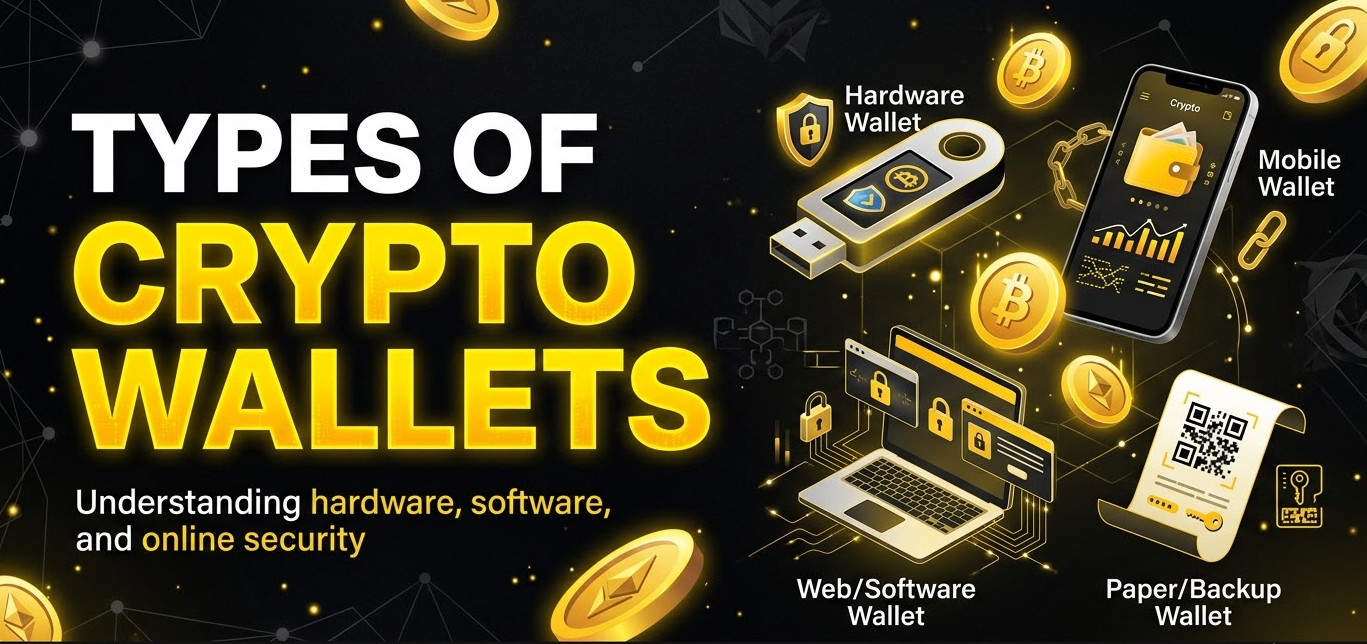
The important thing is that there isn’t one universally “best” crypto wallet. I’d choose very differently for a $200 trading balance than I would for a six-figure Bitcoin position or a company treasury. Once you understand the architecture behind each wallet type, that decision becomes much easier.
Introduction: Demystifying Crypto Wallet Architecture
When people first enter crypto, one of the easiest mistakes to make is assuming a wallet works like a physical wallet. You install an app, you see a balance, you receive some Bitcoin or USDT, and naturally it feels as though those assets are sitting somewhere inside the application.
They aren’t.
A crypto wallet is better understood as a cryptographic key-management system sitting between you and a blockchain. The blockchain maintains the ledger of balances and transactions, while your wallet manages the keys and signing mechanisms that prove you are authorized to move particular assets.
That distinction sounds technical, but it matters enormously when you’re deciding between a Coinbase account, a MetaMask extension, a Ledger device, a multisig vault, or a newer smart-contract wallet.
The “Coins Inside the Wallet” Fallacy
Your Bitcoin isn’t physically stored inside a Ledger. Your Ethereum isn’t sitting inside MetaMask. And if your phone breaks, the blockchain doesn’t suddenly lose your crypto.
What you actually need to protect is the authorization mechanism that controls those assets.
For a traditional wallet, that usually means a private key derived from a recovery phrase. The Bitcoin BIP39 standard, for example, defines mnemonic phrases that can be converted into a deterministic wallet seed and then used to derive wallet keys. The specification describes entropy, checksum generation, and conversion of the resulting mnemonic into a binary seed. (GitHub)
This is why losing a phone isn’t necessarily catastrophic. If your recovery material is safely backed up, you can restore the wallet on another compatible device.
Lose the recovery material, though, and the situation changes completely.
There is usually no “forgot password?” button waiting for you on the blockchain.
That is one of the defining differences between crypto custody and conventional online banking.
A wallet therefore performs several jobs at once:
- It generates or imports cryptographic keys.
- It derives public addresses from those keys.
- It creates and signs transactions.
- It communicates with blockchain nodes or infrastructure providers.
- It presents transaction information so you can approve or reject actions.
- It may provide additional security mechanisms such as multisig, MPC, passkeys, or hardware isolation.
Once you see wallets this way, the huge number of products on the market starts to make more sense.
You’re not really comparing “different places to store coins.” You’re comparing different ways of controlling cryptographic authority.
The Core Custody & Connectivity Matrix
One of the simplest ways to understand the major types of crypto wallets is to stop thinking about brand names and classify them using two questions:
Who controls the keys?
And:
How exposed are those keys to an online environment?
Those two dimensions give us a useful 2×2 framework.
Custodial vs. Self-Custodial Wallets
A custodial wallet means another organization controls the private keys on your behalf.
Centralized exchanges are the most familiar example. When you hold BTC on an exchange, you may see a Bitcoin balance in your account, but you aren’t necessarily holding the private keys corresponding to that balance yourself. The exchange manages the underlying custody infrastructure.
That can be convenient. You get password recovery, customer support, account controls, and often an easier fiat on-ramp.
But convenience comes with dependency.
If the custodian freezes an account, becomes insolvent, suffers a security incident, or is legally required to restrict access, you don’t have unilateral control over the funds.
This is where the old crypto phrase “not your keys, not your coins” comes from.
Self-custody flips that arrangement around. Your wallet controls the keys, and you become responsible for securing them.
That means greater sovereignty, but also greater responsibility.
If you lose your recovery phrase, nobody at an exchange can simply reset it for you. If you sign a malicious transaction, there may be no central fraud department capable of reversing it.
I think of self-custody as less like opening a bank account and more like becoming your own bank.
Hot vs. Cold Wallets
The second dimension is connectivity.
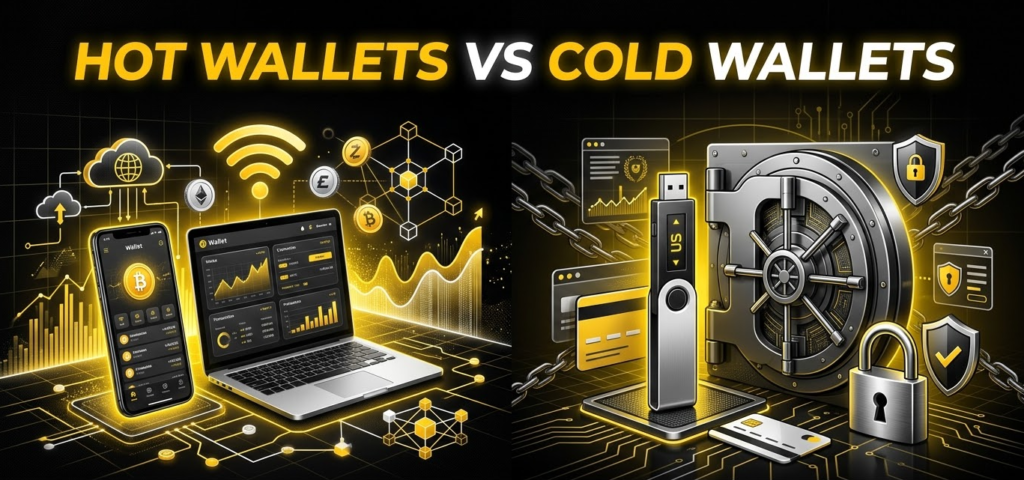
A hot wallet is connected to the internet during normal operation. Mobile wallets, desktop applications, and browser extensions generally fall into this category.
Hot wallets are incredibly useful when you actually use crypto. If you’re interacting with DeFi protocols, trading NFTs, moving tokens between chains, or experimenting with new applications, constantly disconnecting an offline device becomes inconvenient very quickly.
A cold wallet, by contrast, is designed to keep the signing environment isolated from ordinary online activity. Hardware wallets are the most common example, while air-gapped devices take that isolation even further.
Cold storage doesn’t magically make a transaction safe, though. The device can protect your private key while you are still tricked into signing something harmful.
That’s a subtle distinction that many beginners miss.
The 2×2 Custody-Connectivity Matrix
| Hot / Online | Cold / Offline | |
|---|---|---|
| Custodial | Centralized exchange accounts | Institutional offline custody systems |
| Self-custodial | MetaMask, Trust Wallet, Phantom and similar wallets | Ledger, Trezor, Keystone and other hardware/air-gapped signers |
This matrix is much more useful than simply asking, “Which crypto wallet is safest?”
A centralized exchange account can be extremely convenient but gives you less direct control. A self-custodial browser wallet gives you much more control but exposes you to phishing and malicious DApps. A hardware wallet reduces key exposure, but you still have to verify what you’re signing.
There are trade-offs everywhere.
Hot Wallets vs Cold Wallets
Hot Wallets: Online and Web3-Connected
Hot wallets are essentially the everyday tools of crypto.
Browser extensions such as MetaMask, Phantom, and Rabby are particularly popular with DeFi and Web3 users because they can interact directly with decentralized applications. You can connect to a decentralized exchange, approve a token, sign a swap, interact with an NFT marketplace, and move between protocols without leaving the browser environment.
That convenience is their superpower-and their biggest weakness.
The more applications you interact with, the more transaction requests you encounter. Some requests are harmless. Others can grant token allowances, transfer NFTs, change permissions, or interact with complicated smart contracts.
Mobile wallets take a similar approach but optimize the experience around a smartphone. They’re excellent for everyday payments, smaller balances, staking, and quick transactions.
Desktop wallets occupy an interesting middle ground. Applications such as Electrum and Sparrow can give experienced users much more control over node connectivity, transaction construction, UTXO selection, and privacy settings.
For someone who simply wants to buy $50 of Bitcoin and hold it for a few months, that may be unnecessary complexity.
For someone managing a serious Bitcoin stack, it can be exactly what they want.
Cold Wallets: Offline Security
Hardware wallets move the signing operation away from the general-purpose computer or phone.
The basic idea is straightforward. Your computer prepares a transaction, but the private key remains inside the hardware wallet. The hardware device reviews the transaction and creates the digital signature internally, after which the signed transaction can be returned to the connected computer for broadcasting.
This creates an important security boundary.
Even if your laptop is compromised, the attacker should not automatically be able to extract the hardware wallet’s private key.
But there is another problem: what if the computer lies about the transaction?
Imagine your screen says you’re sending $100 to your friend, but the actual transaction asks you to approve a malicious contract. If you simply click through without checking what the hardware device displays, the cold wallet hasn’t saved you from your own signature.
This is commonly discussed as blind signing. Hardware-wallet providers such as Ledger explicitly recommend verifying transaction details on the device’s trusted display rather than blindly approving data shown only on an internet-connected computer. (Ledger)
So the strongest cold-storage setup isn’t simply “buy hardware.”
It’s:
isolated key + trustworthy device display + careful transaction verification + properly protected recovery backup.
Air-Gapped Signers
Air-gapped wallets take the separation concept further by avoiding ordinary USB, Bluetooth, or network communication during signing.
Instead, some devices use QR codes or removable storage to move transaction data between the online computer and offline signer.
That sounds extreme until you think about what you’re protecting.
If your main concern is keeping the signing device as far away from an internet-connected environment as possible, eliminating wireless communication can be attractive.
The downside is usability. Every additional security boundary adds friction.
And friction matters because a security system that is too annoying to use can encourage people to bypass it.
Why Paper Wallets Are No Longer the Default Choice
Paper wallets used to be presented as an elegant form of cold storage: generate a private key, print it, and keep the paper offline.
In practice, the process introduces several ugly failure modes.
The computer used for generation could be compromised. The printer could retain or transmit data. The printed material can degrade. Someone can photograph it. And managing a raw private key safely during later spending can introduce additional mistakes.
Modern hardware wallets generally provide a cleaner security model because they can generate keys inside the device and keep signing operations within a controlled environment.
Physical backup still matters, though. That’s where steel recovery plates become useful: they are designed to protect recovery information from physical disasters such as fire or water far better than ordinary paper.
Cold Storage Does Not Mean “Scam-Proof”
Here’s a scenario worth remembering.
You connect your Ledger to a compromised DApp. The device asks you to approve a token contract. You confirm without reading the details.
The private key might remain perfectly protected.
You can still lose the tokens.
That is because there are two different attack surfaces:
Key theft and authorized misuse.
Cold wallets are exceptionally useful against the first. They cannot eliminate the second.
Categorization by Cryptographic Mechanics & Architecture
Connectivity is only one way to classify wallets. The deeper question is how the wallet actually represents ownership and authorization.
That’s where HD wallets, multisig, MPC, and smart-contract accounts enter the picture.
BIP39, HD Wallets and Traditional EOAs
The classic self-custodial wallet is built around a recovery phrase.
BIP39 defines a standardized mnemonic system that turns generated entropy into human-readable words, which can then be converted into a deterministic seed. That seed can support deterministic wallet derivation, meaning one recovery phrase can ultimately control many addresses. (GitHub)
This is extremely convenient.
Instead of backing up every private key individually, you protect one recovery secret.
The downside is equally obvious: that secret becomes enormously important.
Anyone who obtains the recovery phrase can potentially regenerate the wallet and control the assets associated with it.
On Ethereum, the traditional model is an Externally Owned Account, or EOA. An EOA is fundamentally controlled by a private key, and possession of that key determines who can authorize transactions.
It’s a beautifully simple system.
It is also unforgiving.
Multisignature Wallets
Multisig changes the model from “one key controls everything” to “multiple keys participate in authorization.”
A 2-of-3 multisig, for example, requires two of three independent signers to approve a transaction.
This is particularly useful for:
- Business treasury management.
- DAO funds.
- Family wealth structures.
- High-value Bitcoin storage.
- Organizations where no single employee should control the entire treasury.
The security benefit comes from eliminating one catastrophic single point of failure.
If one signer is compromised, the attacker still needs the required threshold of additional signers.
The cost is coordination. More people or devices need to participate, recovery becomes more complicated, and operational mistakes can become harder to troubleshoot.
For personal savings, multisig may be unnecessary.
For an organization holding substantial assets, it can be transformative.
MPC Wallets
Multi-Party Computation, or MPC, approaches key security differently.
Instead of creating a conventional private key and then splitting a copy of it among different people, MPC systems can distribute cryptographic computation across multiple parties or devices so that the signing process occurs without one complete private key necessarily existing in one place.
This can eliminate some of the awkwardness associated with seed phrases.
There is no piece of paper that you need to hide in a safe.
But don’t confuse “seedless” with “risk-free.”
MPC introduces different dependencies, including recovery architecture, device availability, provider infrastructure, authentication systems, and implementation quality.
The trade-off is often attractive for institutions and consumer wallets that want stronger recovery experiences without forcing every user to become a seed-phrase expert.
Smart Contract Wallets and Account Abstraction
Smart-contract wallets are arguably the most interesting architectural shift in the wallet ecosystem.
Instead of making a private key the entire definition of the account, a smart contract can define its own authorization rules.
Ethereum’s account-abstraction roadmap describes capabilities such as custom recovery rules, multiple backup keys, transaction batching, sponsored gas, and programmable security policies. (ethereum.org)
ERC-4337 provides one approach to this model without requiring a consensus-layer protocol change. It introduces UserOperation objects and infrastructure such as bundlers and an EntryPoint contract to process account-abstraction operations. (Ethereum Improvement Proposals)
In practical terms, this opens the door to wallets that feel much more like modern apps.
You might have:
- Social recovery through trusted guardians.
- Daily spending limits.
- Multiple approval levels.
- Gas sponsorship.
- Batch transactions.
- Passkey-based authentication.
- Recovery devices with different security levels.
This is a major conceptual departure from the traditional “protect these 12 words forever” model.
And honestly, that could be one of the most important improvements in crypto UX.
Technical Attribute Comparison: Crypto Wallet Taxonomy
| Wallet Type | Connection | Key Ownership | Recovery | Main Risk | Best Use |
|---|---|---|---|---|---|
| CEX Custodial | Hot | Third party | Account recovery | Custodian failure or restrictions | Trading and fiat on-ramp |
| Hot Software Wallet | Hot | Self-custodial | Seed phrase | Phishing, malware, wallet drainers | DeFi, NFTs, Web3 |
| Hardware Wallet | Cold | Self-custodial | Seed phrase | Malicious signing, physical loss | Long-term holdings |
| Air-Gapped Wallet | Cold | Self-custodial | Seed/backup system | Physical loss, operational mistakes | High-security storage |
| Multisig Vault | Warm/Cold | Multiple signers | Multiple independent keys | Coordination and signer loss | Treasuries and organizations |
| MPC Wallet | Warm/Hot | Distributed computation | Key-share recovery | Provider/infrastructure dependency | Institutions and seedless UX |
| Smart Contract Wallet | Warm/Hot | Programmable | Guardians/recovery logic | Smart-contract vulnerabilities | Modern Web3 onboarding |
One important correction to the table’s apparent hierarchy: “colder” doesn’t automatically mean “better.”
A hardware wallet that you use incorrectly can be less secure in practice than a well-configured hot wallet holding a small amount.
Security depends on architecture plus behavior.
Comparing the Best Crypto Wallet Storage Approaches
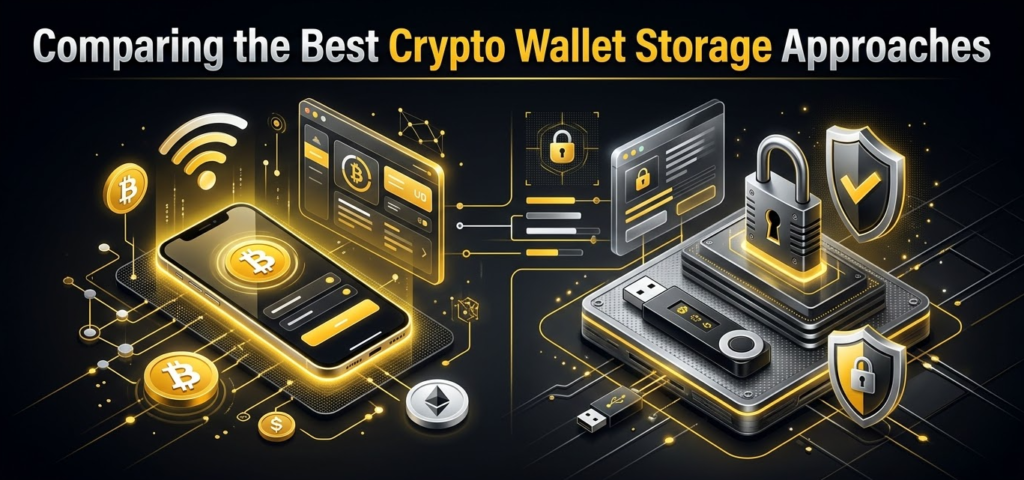
If I were choosing a wallet today, I wouldn’t begin with a brand.
I’d begin with the job.
For Active DeFi and Web3
Use a hot self-custodial wallet.
Keep only the amount you actually need for active operations there. Treat it like your spending account rather than your savings account.
The biggest mistake is putting your entire portfolio into the same browser extension you use to experiment with random DApps.
Your Web3 wallet should have a limited blast radius.
For Long-Term Bitcoin or Crypto Savings
A hardware wallet is generally the more sensible starting point.
You want private keys isolated from the everyday computing environment, a trustworthy screen for transaction verification, and a recovery process you understand before depositing significant funds.
Open-source options can provide an additional layer of transparency.
For example, Trezor states that the software used on its devices is open source and publicly auditable, while its current firmware documentation also describes reproducible-build procedures that allow users to build firmware and compare the resulting image with the official release. (Trezor)
Blockstream’s Jade takes another interesting approach. The company describes Jade as fully open source and uses a “virtual secure element” design involving a blind oracle rather than relying on a conventional closed secure element for the same purpose. (Blockstream)
BitBox02 is another example of a hardware wallet emphasizing open source and deterministic builds; its published specifications describe an open-source firmware model, reproducible builds, on-device transaction verification, and a combination of an MCU and secure chip. (BitBox)
For Bitcoin-focused users, those architectural differences can matter more than the logo printed on the device.
For Businesses and Shared Funds
Multisig is often a better fit than a single hardware wallet.
Suppose three executives need access to a treasury, but you don’t want any one person to have unilateral spending authority. A 2-of-3 or 3-of-5 arrangement creates a much stronger organizational security model.
The important part is planning recovery before something goes wrong.
What happens if one signer loses their device? What happens if an employee leaves? What happens if two devices are unavailable during an emergency?
Multisig security is as much about procedures as cryptography.
For Users Who Hate Seed Phrases
MPC and smart-contract wallets deserve a serious look.
The traditional seed phrase is secure when handled correctly, but let’s be honest: asking ordinary users to protect a sequence of words for ten or twenty years is not exactly a perfect consumer experience.
Account abstraction and MPC-based designs are trying to solve that usability problem without simply handing custody back to a centralized company.
Ethereum’s current account-abstraction documentation specifically highlights recovery mechanisms, multiple backup keys, flexible security rules, sponsored gas, and transaction batching as advantages of smart-contract accounts. (ethereum.org)
That’s the direction I expect wallet UX to keep moving.
A Practical Hot/Cold Split Strategy
You don’t have to choose one wallet.
In fact, you probably shouldn’t.
A practical setup for many users looks something like this:
Cold wallet = savings.
Hot wallet = spending and experimentation.
You can keep the majority of long-term holdings in cold storage while maintaining a much smaller balance in the hot wallet you connect to DApps.
The exact percentage isn’t a universal security rule. The often-repeated 80/20 or 90/10 split should be treated as a starting concept, not a law of crypto custody.
Your actual allocation should reflect how frequently you transact and how painful it would be to lose the hot-wallet balance.
If you interact with DeFi every day, you may need more liquidity available. If you simply buy Bitcoin once a month and hold it, you may barely need a hot wallet at all.
The principle is simple:
Don’t expose your entire fortune to the environment where you do your riskiest activities.
Safe Migration From an Exchange to Self-Custody
Moving assets from a centralized exchange into self-custody is not complicated, but rushing it is a terrible idea.
I’d use a staged process.
Initialize the Hardware Wallet
Buy the device from an official or trusted source and inspect the packaging before setup. Trezor, for example, recommends checking the device and packaging and installs firmware during setup rather than shipping the device with ordinary firmware already installed. Its current documentation also describes firmware-signature checks and authenticity verification. (Trezor)
Generate the wallet yourself.
Never accept a recovery phrase supplied by a seller, website, email, or support agent.
If someone already knows the words, the wallet is compromised before you even start.
Record the Recovery Phrase Offline
Write the recovery phrase down exactly as generated.
Do not:
- Screenshot it.
- Email it to yourself.
- Save it in Notes.
- Put it in Google Drive.
- Store it in a password manager unless you deliberately understand the security trade-offs.
- Photograph it with your phone.
For larger holdings, consider a durable metal backup.
The important thing is not merely making a backup. You need to know where it is, who can access it, and what happens if you become unavailable.
Verify the Receiving Address
Before sending a large amount, display the receiving address on the hardware device itself.
Don’t trust the address copied from the computer alone.
Hardware-wallet guidance emphasizes checking the address on the device’s trusted display, and also recommends using a small test transaction when moving funds. (Ledger)
This is one of those boring security habits that can save you from a very expensive mistake.
Send a Small Test Transaction
Withdraw a small amount first.
Wait for confirmation.
Check that the correct address received it.
Only after that should you transfer the remaining balance.
It adds a few minutes.
That’s cheap insurance.
Move the Remaining Funds
Once the test succeeds, perform the larger transfer.
For substantial holdings, I would also consider splitting the transfer rather than moving everything in one transaction. That gives you another opportunity to detect an error before the entire balance is exposed.
Seed Phrase & Key Protection
Your recovery phrase should be treated as the ultimate credential.
The blockchain doesn’t know whether the person using the seed phrase is you, your spouse, your employee, or a thief. Cryptographic authorization doesn’t care about intent.
That means your security model needs to account for both digital and physical threats.
For physical security, think about:
- Fire.
- Flooding.
- Theft.
- Accidental disposal.
- Unauthorized family access.
- Inheritance and estate planning.
For digital security, think about:
- Phishing.
- Malware.
- Clipboard hijacking.
- Fake wallet applications.
- Remote-access malware.
- Malicious browser extensions.
And there is another threat people tend to underestimate: social engineering.
A scammer doesn’t necessarily need to hack your wallet if they can convince you to reveal the recovery phrase yourself.
No legitimate wallet support representative needs your seed phrase.
Ever.
Open-Source and Transparent Wallets
For technically minded users, open source adds another useful dimension.
Trezor’s current documentation says its device software has historically been open source so the community can inspect, verify, and suggest improvements, while its reproducible-build documentation explains how users can independently rebuild firmware. (Trezor)
That distinction is important because “source code available” and “the exact binary you downloaded came from that source” are not identical claims.
A reproducible build attempts to close that gap.
The concept is simple:
Source code → deterministic build process → identical binary.
If independent parties can compile the same source under the documented environment and obtain the same output, confidence in the software supply chain increases.
BitBox02 similarly emphasizes open source and deterministic builds in its published security specifications. (BitBox)
Open source isn’t magic, however.
A public repository can still contain bugs. An application can depend on a centralized backend. A smart contract can be vulnerable. A developer can make a bad design decision.
Open source gives people the ability to inspect and verify.
It does not guarantee that somebody actually did.
That’s why I prefer the phrase “auditable security” over “automatically secure.”
Choosing the Right Wallet Combination
If you’re still unsure which wallet type fits you, here’s the practical version.
If You’re a Beginner
Start simple.
A reputable self-custodial mobile wallet can be fine for learning, provided you keep the balance modest and understand the recovery process.
Don’t put your life savings into your first wallet just because you’ve successfully sent $20.
Learn first.
If You’re an Active DeFi User
Use a dedicated hot wallet for Web3 activity.
Keep the long-term portfolio elsewhere.
I would also avoid connecting the same wallet to every DApp you encounter. Separate wallets or accounts can limit the damage if you accidentally approve something malicious.
If You’re a Long-Term Investor
A hardware wallet is the natural next step.
Focus less on flashy features and more on:
- Recovery standards.
- Transaction verification.
- Firmware security.
- Open-source transparency.
- Backup quality.
- Device authenticity.
- Long-term compatibility.
If You’re Managing a Treasury
Look at multisig or institutional MPC rather than relying on one seed phrase.
The objective is not merely preventing hackers from stealing the key. It’s also preventing one employee, one lost device, or one compromised account from becoming a single catastrophic failure point.
If You Want Better User Experience
Smart-contract wallets and account abstraction are worth watching closely.
Ethereum’s documentation highlights programmable authorization, recovery options, sponsored transactions, and batching as important benefits of the account-abstraction model. (ethereum.org)
This could make self-custody considerably easier for mainstream users.
The future wallet may not feel like a wallet at all.
It may simply feel like a secure account with programmable rules underneath.
Frequently Asked Questions
What is the fundamental difference between a hot wallet and a cold wallet?
A hot wallet operates in an online environment and is designed for convenience, frequent transactions, and interaction with blockchain applications. Browser extensions, mobile wallets, and many desktop wallets fall into this category.
A cold wallet is designed to isolate private-key operations from ordinary internet-connected devices. Hardware wallets and air-gapped signers are common examples. Cold storage generally reduces online attack exposure, but it doesn’t protect you from approving a malicious transaction yourself.
What does “Not your keys, not your coins” mean?
It means that control over cryptocurrency ultimately comes from control over the cryptographic keys authorized to move the assets.
With a custodial exchange, the exchange controls the underlying keys. With a self-custodial wallet, you control them.
The trade-off is responsibility. Self-custody removes dependence on the custodian, but it also removes the possibility of simply asking the custodian to restore access when you lose your credentials.
Do crypto wallets actually store cryptocurrencies?
No.
The assets remain represented on the relevant blockchain ledger. A wallet manages the keys and authorization mechanisms that allow you to control those assets.
That’s why you can restore a wallet on another compatible device using the appropriate recovery information.
How do hardware wallets sign transactions without exposing private keys?
A typical hardware-wallet architecture separates the signing environment from the connected computer.
The computer can prepare an unsigned transaction, while the hardware wallet performs the cryptographic signing operation internally. The resulting signature can then be returned to the computer for broadcasting.
The private key itself does not need to be transferred to the internet-connected machine.
However, you still need to inspect what you’re signing. Hardware wallets are not designed to prevent you from intentionally or accidentally authorizing a malicious transaction.
What is an MPC wallet?
An MPC wallet uses multi-party cryptographic computation so that authorization can be distributed among multiple parties, devices, or shares rather than depending on one conventional seed phrase.
This can improve recovery and remove some of the operational problems associated with seed phrases.
But MPC introduces its own trust and infrastructure assumptions, so it should not simply be treated as “a hardware wallet without the inconvenience.”
What is a smart-contract wallet?
A smart-contract wallet uses programmable blockchain logic to define how an account authorizes transactions.
Unlike a traditional EOA, which is fundamentally controlled by a private key, a smart-contract account can implement additional rules such as guardians, spending limits, multiple signers, transaction batching, and sponsored gas.
ERC-4337 is one major framework for enabling account abstraction without changing Ethereum’s consensus layer. (Ethereum Improvement Proposals)
Is a paper wallet still a safe cold-storage option?
For most users, I would not recommend it.
Paper wallets introduce risks around key generation, printers, physical degradation, raw private-key exposure, and transaction management. Modern hardware wallets provide a more controlled environment for key generation and signing, while steel backups can provide a more durable way to preserve recovery information.
The goal isn’t to make custody look old-school.
The goal is to reduce unnecessary failure points.
What happens if my hardware-wallet manufacturer shuts down?
Your assets do not automatically disappear because a wallet company stops operating.
What matters is whether you still possess the recovery material and whether the wallet uses standards that compatible software can restore.
This is one reason standardized recovery schemes matter. BIP39, for example, defines a widely used mnemonic mechanism for generating deterministic wallet seeds. (GitHub)
Still, don’t assume every wallet is interchangeable. Different chains, derivation paths, account formats, multisig policies, and proprietary recovery systems can create compatibility differences.
Before choosing a wallet for serious holdings, check the recovery path you would use if the manufacturer disappeared tomorrow.
Final Thoughts: The Best Crypto Wallet Is a Security Strategy
The crypto wallet market can look unnecessarily complicated because companies keep creating new categories: hot wallets, cold wallets, MPC wallets, multisig vaults, smart-contract accounts, passkey wallets, air-gapped signers and everything in between.
But the underlying questions remain surprisingly simple.
Who controls the keys?
Where are those keys exposed?
How is a transaction authorized?
How can access be recovered?
Once you answer those four questions, most wallet comparisons become much easier.
For everyday Web3 activity, a reputable hot wallet is usually the practical choice. For long-term savings, hardware-backed cold storage offers a stronger isolation model. For businesses and shared treasuries, multisig or MPC can eliminate dangerous single points of failure. And for the next generation of consumer wallets, account abstraction is pushing toward programmable security, social recovery, and much better usability.
I wouldn’t try to find one wallet that does everything.
I’d build a small ecosystem instead: a hot wallet for things I actively use, a cold wallet for assets I don’t need to touch, and additional security layers when the value or organizational complexity justifies them.
That’s the real lesson behind the different types of crypto wallets.
The wallet itself isn’t the security strategy.
You are.