If you are actually standing in Yerevan with AMD or USD and trying to turn it into USDT, BTC, or another crypto asset, the “best exchange” is not necessarily the exchange with the biggest global trading volume. Your practical priorities are different: Can you fund it with AMD? Can you cash out locally? Does the provider have a legitimate regulatory status? What happens if your bank transfer is delayed? And can you prove where your money came from if compliance questions arise?
That is why Yerevan deserves a slightly different approach from a typical “top crypto exchanges” list.
Armenia adopted its Law on Crypto-Assets in 2025, and the law became effective on July 4, 2025. The Central Bank of Armenia subsequently introduced the first package of crypto-asset regulations covering licensing, capital requirements, management registration and crypto-asset offering documents. (Arlis)
So, if I were comparing crypto options in Yerevan today, I would not simply rank Bybit, OKX, a local cash office and a Bitcoin ATM on one list. I would first separate them into local regulated service providers, global exchanges, P2P marketplaces, physical OTC businesses and crypto ATMs. They solve very different problems.
Crypto Exchange Options in Yerevan at a Glance
The Yerevan crypto market is best understood as a collection of different trading channels rather than a single exchange ecosystem. You can buy or sell through an online exchange, arrange a P2P transaction, use a physical crypto business, or use a crypto ATM for smaller transactions.
Here is the practical comparison:
| Channel / Platform Type | Operational Mechanism | Typical Fiat Route | Cost Profile | Best For |
|---|---|---|---|---|
| CBA-authorised local crypto-asset provider | Regulated local crypto-asset services | AMD and other supported banking/payment rails | Depends on provider | Users prioritising local regulatory oversight |
| Physical OTC desks | Face-to-face crypto/cash settlement | USD, AMD and potentially other currencies | Usually spread/commission based | Larger or immediate cash transactions |
| P2P platforms such as Bybit | Escrow-based peer-to-peer marketplace | AMD offers may be available depending on current market listings | Market spread + applicable P2P/payment costs | Online AMD/crypto trades |
| OKX / other global P2P marketplaces | Advertiser-based P2P trading | AMD availability depends on current listings and account eligibility | Market-dependent | Users comparing multiple P2P offers |
| Crypto ATMs / Cryptomats | Self-service crypto purchase | Physical cash, depending on machine | Generally higher than exchange order books | Convenience and small transactions |
| Traditional fintech/payment apps | Local digital payments | AMD | Payment-provider dependent | Funding ordinary local payments, not automatically crypto |
One important distinction is worth making immediately: a platform displaying AMD P2P advertisements is not automatically a locally licensed Armenian crypto-asset service provider. For example, Bybit’s own documentation confirms that its P2P marketplace allows users to trade using fiat currencies requested by advertisers, while its current P2P order-limit documentation lists AMD markets. (Bybit)
That makes Bybit potentially useful for AMD/USDT P2P trading, but you should not interpret its availability as proof that Bybit itself is licensed by the CBA as an Armenian crypto-asset service provider.
The same principle applies to OKX and Bitget. Availability of an AMD marketplace and local payment method is one question; Armenian regulatory authorisation is another.
The Armenian Crypto Regulatory & Financial Landscape

This is the section I would pay the most attention to if you are moving meaningful amounts of money in Yerevan.
Armenia’s crypto market is no longer operating in a regulatory vacuum. The country now has a dedicated Law on Crypto-Assets, with the CBA responsible for regulating and supervising crypto-asset activities. The official law states that it regulates public offerings, crypto-asset services and related activities in Armenia. (Arlis)
The CBA’s current crypto-asset service provider page goes even further: services involving crypto-assets may generally be provided by legal entities registered and licensed by the CBA, subject to the specific legal framework and applicable exceptions for certain licensed financial institutions. (cba.am)
This changes how I would evaluate a “best crypto exchange in Yerevan.”
I would not start with the lowest advertised spread. I would start with who is legally providing the service, which entity you are contracting with, what service is authorised, and whether the provider appears on the CBA’s regulatory information.
Central Bank of Armenia: The New Crypto-Asset Framework
The CBA published its first package of regulations governing crypto-asset service providers in January 2026. These included Regulation 7/01 on registration and licensing, Regulation 7/02 on minimum total capital, Regulation 7/05 on manager registration and Regulation 7/04 on crypto-asset offering documents. (cba.am)
The transition period is particularly important.
The CBA announced in September 2026 that businesses and individual entrepreneurs already providing crypto-asset services in Armenia when the law took effect can continue during the transitional period, but they must complete registration and licensing by January 31, 2027 if they want to continue providing those services. After that date, providing or offering crypto-asset services without the appropriate registration and licence will no longer be permitted. (cba.am)
That means the regulatory status you see today may not be the final status of a provider six months from now.
For you as a trader, this leads to a simple rule: check the CBA status immediately before making a significant transaction, rather than relying on an old blog post, Telegram recommendation or a Google Maps listing.
The CBA is already granting permissions to individual providers. For example, on September 8, 2026, the CBA authorised Meta-X Markets CJSC to provide a broad range of crypto-asset services, including custody, buying and selling crypto-assets for its own account and customers, order transmission, portfolio management, advice and crypto-asset transfers. (cba.am)
That is a much stronger signal of regulatory maturity than simply seeing a crypto exchange office on a street in Kentron.
Is Crypto Legal in Armenia?
The short answer to “is crypto legal in Armenia?” is yes, but that answer needs some nuance.
Armenia now expressly regulates crypto-assets and crypto-asset services rather than simply treating the sector as an unregulated grey area. The Law on Crypto-Assets became effective on July 4, 2025, and the CBA is responsible for supervision of crypto-asset activities. (Arlis)
However, “crypto is legal” does not mean every crypto business or every transaction is automatically authorised.
Think about it the same way you would think about financial services generally. The fact that buying and selling an asset is lawful does not mean every company advertising that service is licensed to provide it.
For Yerevan, this distinction is especially important because you can encounter:
- a locally regulated crypto-asset service provider;
- a foreign crypto exchange accessible from Armenia;
- an independent P2P advertiser;
- a physical currency/crypto business;
- a crypto ATM operator; or
- an informal person offering cash-for-USDT transactions.
Those are six very different compliance profiles.
The CBA and the Difference Between a Local Provider and a Global Exchange
This is where many crypto guides become misleading.
Suppose you see an advertisement saying:
“USDT/AMD available in Yerevan.”
That tells you something about liquidity, not necessarily something about regulatory authorisation.
Bybit currently has AMD P2P markets, including USDT/AMD, and its documentation explains that P2P users transact with advertisers using their requested fiat currency. (Bybit)
That can be useful if you have an Armenian bank account and want to trade online.
But if you want the highest level of local regulatory comfort, I would separately investigate whether the entity providing the service is registered/licensed by the CBA.
The CBA’s own Crypto-Asset Service Providers information is therefore more valuable than a generic “best exchange” article. (cba.am)
Banking & Payment Infrastructure in Yerevan
Armenia has a mature domestic payment infrastructure, but you should avoid assuming that every bank or payment method will permit every crypto-related transaction.
The ArCa national payment system is an important part of Armenia’s card and payment infrastructure. Its official information shows that ArCa supports card processing and other payment infrastructure, while ArcaPay enables instant bank-to-bank transfers using a recipient’s phone number. (arca.am)
ArCa’s ecosystem includes major Armenian banks such as Ameriabank, Evocabank, Inecobank, Converse Bank, ACBA Bank and others, although the participating bank list can change over time. (arca.am)
That matters because an Armenian crypto trader may interact with three separate layers:
Crypto platform → Armenian payment rail → bank account
or:
P2P advertiser → bank transfer → crypto release
or:
OTC provider → wallet transfer → physical cash
Each layer can have its own compliance checks.
Ameriabank, Inecobank and Other Local Banks
You will often see names such as Ameriabank, Inecobank and Evocabank mentioned when discussing bybit P2P AMD Ameriabank or similar searches.
The important point is that a bank’s participation in Armenia’s ordinary payment system does not automatically mean the bank endorses or guarantees a particular crypto P2P transaction.
If you use a P2P marketplace, check the actual payment method displayed on the live advertisement. More importantly, use an account in your own name when the platform requires it. Bybit, for example, explicitly states that the bank account name must match the registered account name for its P2P process. (Bybit)
That simple rule can save you from a surprisingly annoying compliance problem.
Critical Knowledge Gaps & Common Pitfalls for Traders in Yerevan

Physical OTC Cash Desks vs. Online Order Books
If you are carrying a meaningful amount of USD or AMD and want USDT immediately, an online exchange is not necessarily the easiest route.
An OTC desk can be attractive because you can negotiate the transaction, verify the settlement process and receive physical cash or crypto directly.
But the reverse is also true: a physical office does not automatically mean it is safer.
The first thing I would ask is:
Who operates the business, and what is its legal/regulatory status?
The second is:
What is the total price after the spread, commission and network fee?
A trader can easily focus on a quoted “1 USDT = X AMD” rate while missing the fact that the effective spread is materially worse.
USD Cash Settlement vs. AMD
USDT is designed to track the U.S. dollar, but your actual settlement currency matters.
If you are selling USDT for cash, you might be offered:
- USD cash;
- AMD cash;
- an AMD bank transfer;
- another supported currency.
USD cash can be attractive if you want to preserve dollar exposure. AMD can be more convenient if you are spending locally.
For a large trade, however, don’t assume the quoted rate is the same for every settlement method. Ask for the all-in amount you will actually receive before sending crypto.
For example, if you sell 10,000 USDT, the useful question is not “what is your USDT rate?”
It is:
“Exactly how many dollars or drams will I receive after every fee?”
That is the number that matters.
Direct Card Purchases Can Be More Expensive
Using a card to purchase crypto looks convenient, but convenience often comes with additional pricing layers.
Depending on the platform, you can encounter:
- card processing fees;
- exchange-rate spreads;
- payment gateway fees;
- crypto conversion spreads;
- bank charges.
P2P can sometimes be cheaper because the buyer and seller negotiate directly, although that introduces its own risks.
The key is not to assume that “P2P = free.” Bybit’s current documentation explicitly notes that P2P transaction fees can vary according to fiat currency, advertiser level and advertisement type, and payment providers can charge additional fees. (Bybit)
Crypto Legality Does Not Mean Every Transaction Is Bank-Friendly
This distinction is particularly important for newcomers.
A transaction can involve a lawful asset but still trigger a bank’s internal compliance review.
For example, if your account suddenly receives several large transfers from unrelated individuals because you are selling USDT through P2P, your bank may want to understand the source and purpose of the funds.
That does not automatically mean you have done anything wrong.
It means you should maintain documentation.
For larger transactions, keep:
- exchange order records;
- wallet transaction IDs;
- proof of the original source of funds;
- bank statements;
- invoices or contracts where relevant;
- screenshots or records showing the P2P order.
You may never need them. But if a question arises later, having the records is much better than trying to reconstruct everything six months afterward.
Do Not Confuse a Crypto ATM With a Regulated Exchange
A crypto ATM is essentially a convenience channel.
It can be useful when you need a small amount of crypto quickly, but you should investigate:
- operator identity;
- transaction limits;
- KYC requirements;
- supported assets;
- network;
- exchange rate;
- fees;
- whether the machine supports buying, selling, or both.
The operator Cryptomat, for example, currently lists Yerevan locations including Hotel National at 4/3 Amiryan Street, Royal Plaza Hotel on Martiros Saryan Street, Aygedzor Supermarket and Rio Mall. Its published instructions describe a cash-to-crypto workflow using a wallet QR code and a verified phone number. (Cryptomat)
That gives you something concrete to verify rather than relying on an outdated “Bitcoin ATM Yerevan” directory.
Best Ways to Exchange Crypto in Yerevan
Physical OTC Crypto Desks in Central Yerevan
For the search intent behind physical OTC crypto desk Yerevan, the biggest advantage is simple: face-to-face settlement.
Central Yerevan, particularly Kentron and areas around Republic Square, Northern Avenue, Amiryan Street and nearby commercial districts, has a concentration of financial and exchange businesses. There are also public listings for businesses advertising crypto exchange services.
But I would be careful with broad claims that every office in these areas is a regulated OTC crypto provider.
For example, online listings can show businesses using terms such as “Crypto Exchange” or “USDT Exchange,” but a listing itself is not evidence of CBA authorisation. Some listings may also contain negative customer reviews or complaints.
So, before visiting a physical desk, verify:
- The legal business name.
- Whether it appears in the CBA’s relevant regulatory information.
- The exact crypto asset and network supported.
- The cash currency.
- The all-in exchange rate.
- Whether KYC is required.
- Whether there are transaction limits.
- Whether you receive cash immediately or after additional checks.
This is especially important for large USDT-to-USD transactions.
Global P2P Platforms With AMD Support
For many users, online P2P is the most flexible option.
Bybit is a particularly relevant example because its current P2P infrastructure supports AMD-denominated advertisements for assets including USDT, BTC, ETH and USDC. The platform’s published limits currently show AMD/USDT orders with minimum and maximum fiat amounts that can vary over time. (Bybit)
Its P2P documentation also explains the basic escrow process: you select an advertisement, make the requested payment, confirm payment and receive the crypto after the seller releases it. (Bybit)
This is attractive when you want:
- AMD/USDT exposure;
- online rather than physical settlement;
- multiple sellers to compare;
- escrow mechanisms;
- flexible payment methods.
But there is an important caveat.
The platform’s P2P availability should not be interpreted as CBA licensing.
If local regulation is your primary concern, evaluate the Armenian legal entity and CBA authorisation separately from the global platform’s product availability.
OKX and Other P2P Markets
OKX is another global platform that has supported AMD P2P activity. Its 2026 P2P materials specifically referenced AMD alongside currencies such as KZT, UAH, AZN, GEL, KGS and others, including eligibility for certain merchants registered in Armenia. (OKX)
That makes OKX potentially useful for comparing P2P liquidity.
The advantage of comparing several platforms is that the best price can change dramatically depending on the time of day, payment method and order size.
If you need to buy 500 USDT, the best advertiser may be completely different from the best advertiser for 20,000 USDT.
Crypto ATMs and Cryptomats
If your priority is speed rather than price, a crypto ATM can be surprisingly convenient.
Cryptomat’s published Yerevan locations demonstrate that this is not merely a theoretical option. Its website currently lists multiple physical locations around the city and explains a simple wallet-QR-code and cash workflow. (Cryptomat)
The trade-off is cost.
Crypto ATMs generally need to cover machine operation, cash handling, liquidity and other operating costs, so you should never assume an ATM will match the price of a deep online order book.
Before inserting cash, look at the final amount of crypto you will receive, not merely the displayed exchange rate.
If the machine says you are buying 1,000 USDT-equivalent but the final wallet amount is materially lower after fees, that difference is your effective cost.
Local E-Wallets and Payment Applications
Armenia has a strong digital-payment ecosystem, with services such as Idram, Telcell and other payment platforms widely used for everyday transactions.
However, I would not automatically treat a local wallet as a cryptocurrency exchange.
There is an important distinction between:
moving AMD digitally
and
buying or selling crypto-assets.
Unless a wallet explicitly provides a regulated crypto-asset service or integrates with an authorised provider, its existence does not mean you can safely assume that you can use it as a crypto funding route.
The same principle applies to EasyPay and similar payment services.
Use the payment app for the services it officially supports, and verify any crypto integration separately.
How to Buy USDT With AMD in Yerevan
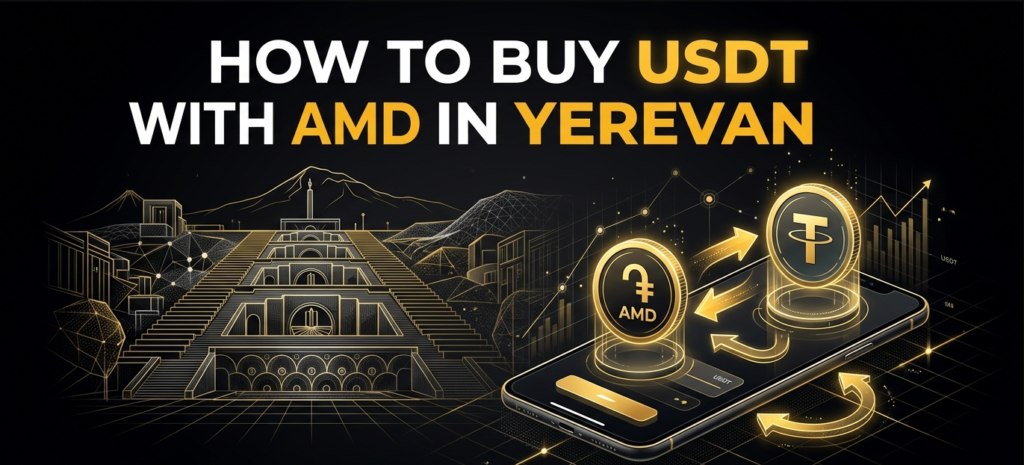
If your goal is simply to convert AMD into USDT, I would use a process like this rather than immediately sending money to the first advertiser you find.
Compare the Live AMD/USDT Market
Start with at least two P2P platforms if available to you.
Look at:
- price;
- available order size;
- payment method;
- advertiser completion history;
- number of completed orders;
- minimum/maximum limits;
- account verification requirements.
Don’t choose based on price alone.
A seller offering an unusually attractive rate but with a tiny order limit is less useful than a slightly more expensive seller who can actually execute your entire transaction.
Check the Payment Account
If the P2P transaction requires a bank transfer, verify the beneficiary information carefully.
The name should match the marketplace’s requirements.
Never let a seller pressure you into sending funds to an unrelated third party simply because “their main account is unavailable.”
That is one of the easiest ways for an otherwise straightforward P2P transaction to become a compliance nightmare.
Confirm the Network
USDT exists on multiple networks.
If the seller is sending USDT through one network and you expect another, you can create an expensive mistake.
Before sending or receiving, verify:
USDT + exact network + destination wallet
Do not rely solely on the word “USDT.”
Release and Verify the Crypto
After payment, follow the platform’s official release process.
Once the crypto arrives, verify:
- amount;
- asset;
- network;
- transaction ID;
- destination wallet.
For a larger transaction, wait until the blockchain transfer is properly visible and confirmed before considering the process complete.
How to Cash Out USDT to Physical USD or AMD in Yerevan
If your real search is buy USDT cash USD Yerevan in reverse – meaning you already hold USDT and want physical USD or AMD – the process is slightly different.
Locate a Verified Physical Provider
Start with a CBA-regulated provider where applicable, rather than choosing an anonymous Telegram contact.
If you are considering an independent OTC business, verify its legal identity and regulatory status before arranging the meeting.
Request an All-In Quote
Tell the desk:
- how much USDT you are selling;
- whether you want USD or AMD;
- the network you intend to use;
- whether you want cash or bank settlement.
Ask for the exact amount you will receive.
Do not calculate the fee from the headline exchange rate alone.
Confirm the Wallet and Network
If the desk gives you a QR code, make sure it corresponds to the agreed asset and network.
For example:
USDT on TRON/TRC-20 is not the same transfer route as USDT on Ethereum/ERC-20.
Sending an asset over the wrong network can result in a recovery problem or loss of funds.
Send a Small Test Amount When Appropriate
For a large first-time transaction, a small test transfer can make sense if the provider agrees.
It lets both sides verify that the address and network are correct before you transfer the full amount.
Receive and Count the Cash
If the transaction is settled physically, count the cash before leaving.
For substantial USD or AMD transactions, keep the receipt or other transaction documentation.
And if the transaction is large enough to create tax, AML or source-of-funds implications, retain the blockchain transaction record alongside the cash settlement record.
Physical OTC vs. P2P vs. Crypto ATM: Which One Should You Choose?
There is no universal winner.
I would choose based on the actual problem you are trying to solve.
| Your Priority | Best Channel | Why |
|---|---|---|
| Large USDT → physical USD | Verified OTC provider | Direct settlement and potentially better execution for larger trades |
| AMD → USDT online | P2P marketplace | Multiple advertisers and local-currency pricing |
| Small urgent crypto purchase | Crypto ATM | Convenient physical access |
| Lowest possible trading cost | Order-book exchange | More transparent market pricing |
| Local regulatory comfort | CBA-authorised provider | Stronger local regulatory framework |
| No desire to meet anyone | Online exchange/P2P | Entire transaction can be handled digitally |
| Need to compare several AMD offers | P2P | Easy to compare advertisers |
For me, the most important factor for a large transaction would be counterparty and regulatory quality, not whether the headline rate is 0.2% better.
Saving $20 while taking a completely unnecessary counterparty risk is not a bargain.
A Practical Yerevan Crypto Trading Checklist
Before buying or selling crypto in Yerevan, I recommend running through this checklist:
Regulatory Check
- Is the provider a legal entity?
- Is it authorised or registered with the CBA where required?
- Is the authorisation current?
- Does the authorisation cover the service being offered?
The CBA’s official crypto-asset service provider information is the right starting point. (cba.am)
Payment Check
- Does the bank account belong to the correct person?
- Does the payment method match the P2P advertisement?
- Are there third-party payment instructions?
- Will your bank accept the transaction?
Crypto Check
- Correct asset?
- Correct network?
- Correct wallet address?
- Correct amount?
- Transaction hash saved?
Price Check
Calculate:
Effective cost = exchange spread + platform fee + payment fee + network fee + cash/ATM markup
That gives you a much more realistic picture than comparing a single exchange-rate number.
Why the “Cheapest” Yerevan Crypto Exchange May Not Be the Best
This is one of those situations where I would resist the temptation to optimise for a single percentage.
Imagine three options:
Option A:
Very low advertised spread, but you need to use a foreign card and pay an additional conversion charge.
Option B:
Slightly higher P2P price, but you can pay directly in AMD from your own Armenian bank account.
Option C:
Higher ATM price, but you need only a small amount immediately.
Which is cheapest?
It depends on the final amount you receive.
The same principle applies to OTC trading. A desk quoting a 0.5% commission is not necessarily cheaper than one quoting 1%. One may simply be making more money through the exchange-rate spread.
That is why I would always ask for an all-in quote.
Frequently Asked Questions
Is cryptocurrency legal in Yerevan, Armenia?
Yes. Armenia has a dedicated legal framework for crypto-assets, and the Law on Crypto-Assets became effective on July 4, 2025. The CBA regulates and supervises crypto-asset activities, while crypto-asset services are subject to registration and licensing requirements under the new framework. (Arlis)
However, legal ownership or trading of crypto does not mean every individual exchange office, P2P advertiser or ATM is automatically authorised. Always verify the provider separately.
What is the best crypto exchange in Yerevan?
There is no single best option for everyone.
For local regulatory oversight, I would prioritise a CBA-authorised crypto-asset service provider.
For online AMD/USDT P2P trading, platforms such as Bybit currently show AMD P2P markets, while OKX has also supported AMD-denominated P2P activity. (Bybit)
For physical cash, a verified OTC provider may be more practical.
For small urgent purchases, a crypto ATM may be the easiest option.
Can I buy USDT with AMD in Yerevan?
Yes, AMD/USDT P2P markets are available on certain global platforms. Bybit’s current P2P documentation specifically lists AMD/USDT trading and provides AMD order limits. (Bybit)
Availability, payment methods, limits and advertiser pricing can change, so check the live marketplace before making a transaction.
Can I cash out USDT to USD in Yerevan?
Physical crypto-to-cash services exist in Yerevan, but you should verify the specific provider’s legal and regulatory status before sending crypto.
Do not assume that a business advertised online as an “OTC crypto exchange” is necessarily licensed by the CBA. The country’s regulatory framework is currently transitioning existing providers into the CBA registration and licensing regime, with the current transitional deadline running to January 31, 2027. (cba.am)
How do physical OTC crypto desks in Yerevan work?
A typical OTC transaction involves agreeing on the asset, amount, rate and settlement currency, then transferring crypto to the provider’s wallet in exchange for cash or another agreed payment method.
The exact procedure varies by provider.
For larger transactions, expect identity, source-of-funds or transaction-compliance questions. A legitimate compliance check should not automatically be viewed as a red flag.
Where can I find crypto ATMs in Yerevan?
Cryptomat currently lists several Yerevan locations, including Hotel National at 4/3 Amiryan Street, Royal Plaza Hotel, Aygedzor Supermarket and Rio Mall. Its website provides the machine-location information and describes the cash-to-crypto process. (Cryptomat)
Because ATM locations can change, verify the operator’s current location before travelling.
Is a crypto ATM cheaper than an exchange?
Usually, convenience comes at a price.
An ATM has physical operating and cash-handling costs, so its effective exchange rate can be less competitive than an online exchange or P2P marketplace.
If price is your main priority, compare the final crypto amount received rather than the advertised rate.
Can I use Ameriabank for crypto P2P trading?
Ameriabank participates in Armenia’s domestic payment infrastructure, including the ArCa ecosystem. (arca.am)
However, that does not mean every P2P crypto transaction is endorsed or guaranteed by the bank.
If a P2P platform displays Ameriabank as an available payment method, follow the platform’s current instructions and the bank’s applicable rules. Keep records of the transaction, particularly for larger transfers.
Does Armenia have a crypto tax regime?
Tax treatment of crypto activity is an area where you should avoid relying on simplistic claims such as “all crypto profits are taxed at X%.”
The Armenian tax authority, the State Revenue Committee (SRC), continues to develop and update tax administration, including work related to cryptocurrency taxation. In 2026, the SRC publicly referred to taxation of cryptocurrencies as one area involved in ongoing tax and customs reform work. (Src.am)
Your actual treatment can depend on your circumstances, the nature of the activity and whether you are trading as an individual or business. For substantial gains, professional Armenian tax advice is sensible.
Is Bybit licensed by the Central Bank of Armenia?
Do not assume that AMD P2P availability means CBA licensing.
Bybit currently offers AMD P2P markets, but the CBA licensing framework applies to entities providing crypto-asset services in Armenia. (Bybit)
If local regulatory status matters to you, verify the specific legal entity and authorisation rather than treating a global platform’s accessibility as proof of Armenian licensing.
Is OKX available for AMD P2P?
OKX has published P2P material referencing AMD markets and Armenia among the relevant jurisdictions for certain P2P merchants. (OKX)
However, P2P availability and CBA authorisation are separate questions.
Should I use a local OTC desk or P2P?
For a small online AMD-to-USDT transaction, I would generally compare P2P offers first.
For a large USDT-to-USD cash transaction where immediate physical settlement is important, a reputable and properly verified OTC provider may be more practical.
For regulatory certainty, prioritise a provider whose Armenian authorisation can be independently verified.
Final Conclusion: Navigating Crypto Exchanges in Yerevan
The best crypto exchange in Yerevan is ultimately the one that matches the way you actually want to move money.
If you need AMD → USDT online, a P2P marketplace can offer flexibility and local-currency pricing. Bybit currently has AMD P2P markets, while OKX has also supported AMD P2P activity, giving traders additional places to compare liquidity. (Bybit)
If you need USDT → physical USD or AMD, an OTC transaction can be more convenient than moving funds through several online payment layers. But I would be much more selective about the provider, especially for large amounts. A street address in Kentron is not a substitute for checking who actually operates the business.
If you need small, quick crypto purchases, Yerevan’s crypto ATM infrastructure provides another option, with operators such as Cryptomat publishing several locations around the city. (Cryptomat)
And if your priority is regulatory protection, Armenia’s new CBA framework should be your starting point. The country now has a dedicated Law on Crypto-Assets, formal licensing rules and an active transition toward a fully supervised crypto-asset service market. The CBA’s current deadline for legacy providers to complete registration and licensing is January 31, 2027. (Arlis)
That last point is probably the biggest change for anyone researching crypto in Yerevan today.
The market is becoming more formal, but it is still important to distinguish between a local regulated crypto-asset provider, a global exchange, a P2P advertiser, a physical OTC business and a crypto ATM. They may all help you buy or sell Bitcoin or USDT, but they do not carry the same regulatory, counterparty or banking risks.
So if I were choosing today, my order of priorities would be simple: verify the provider, compare the all-in price, confirm the payment route, check the blockchain network, and keep records of the transaction. Once those five things are clear, choosing between OTC, P2P and an ATM becomes much easier-and you are far less likely to discover an unpleasant surprise after the crypto has already left your wallet.