If you’re searching for the best crypto exchange in Malaysia, I would start with one question before looking at trading fees, mobile apps, coin selection, or fancy features:
Is the platform registered with the Securities Commission Malaysia?
That single check removes a surprising amount of confusion.
Malaysia does not treat every international crypto platform as though it automatically has the same regulatory standing. Digital-asset trading, issuance and safekeeping fall under the regulatory framework of the Securities Commission Malaysia (SC), which maintains a specific framework for Digital Asset Exchanges. The regulator’s current Digital Assets page lists five registered DAX operators: HATA Digital, Luno Malaysia, MX Global, SINEGY DAX and Kinetic DAX. (Securities Commission Malaysia)
This is where I would begin if I were choosing an exchange as a Malaysian investor.
The question isn’t simply, “Which exchange has the most coins?”
It is more useful to ask: Which platform gives me the right combination of Malaysian regulatory status, MYR funding, liquidity, fees, asset selection, security and usability?
For some investors, that answer may be Luno. For others, HATA may make more sense. A more experienced trader may prefer SINEGY, while someone focused on a relatively simple local trading experience could look at MX Global.
And if Shariah compliance is important to you, there’s another layer to the decision: you need to check the status of the individual digital asset, not simply assume that every asset available through a regulated exchange is Shariah-compliant.
This guide breaks down the Malaysian crypto market from exactly that perspective.
SC-Recognized Market Operators at a Glance
The Malaysian crypto market is built around the concept of a Recognized Market Operator for Digital Asset Exchanges (RMO-DAX).
The SC defines an RMO-DAX as an electronic platform that facilitates the trading of digital assets. The framework allows DAX operators to operate using an exchange model or a digital broker model. (Securities Commission Malaysia)
The SC’s current register names five DAX operators:
| Platform | Regulatory status | Main positioning | Who it may suit |
|---|---|---|---|
| Luno Malaysia | SC-registered RMO-DAX | Retail-focused crypto trading | Beginners and mainstream investors |
| HATA Digital | SC-registered RMO-DAX | Multi-asset trading and competitive pricing | Active and cost-conscious traders |
| MX Global | SC-registered RMO-DAX | Local MYR crypto trading | Investors wanting a straightforward Malaysian platform |
| SINEGY DAX | SC-registered RMO-DAX | Malaysian trading infrastructure and advanced tools | Experienced traders |
| Kinetic DAX | SC-registered RMO-DAX | Broader digital-asset market infrastructure | Institutional and professional users |
These are not simply names collected from crypto blogs. They are the operators currently displayed by the SC under its regulated digital-asset ecosystem. The same official page separately identifies regulated Initial Exchange Offering (IEO) operators and Digital Asset Custodians (DACs), which shows that Malaysia’s regulatory structure extends beyond exchanges alone. (Securities Commission Malaysia)
That distinction is useful.
A DAX is where digital assets are traded.
A DAC, meanwhile, provides custody services designed to safeguard digital assets.
The SC’s current regulated-player list includes CoKeeps, Gambit Custody and Jada Platform as Digital Asset Custodians, while Kapital DX and Pitch Platforms appear as IEO operators. (Securities Commission Malaysia)
My practical ranking
If you’re completely new to crypto, I would prioritize:
Luno → simplicity, accessibility and mainstream retail usability.
If you’re already comfortable with trading:
HATA → broader trading functionality and competitive pricing.
If you’re looking for more specialized trading infrastructure:
SINEGY → worth investigating for advanced users.
For a straightforward local-market approach:
MX Global → worth comparing for MYR spot trading.
And for institutional or professional use cases:
Kinetic DAX → worth considering within the broader regulated ecosystem.
These are not universal rankings. Your actual choice should depend on how you trade.
A person buying RM500 of Bitcoin every month has completely different requirements from someone running an active trading strategy.
The Malaysian Regulatory Framework: SC, BNM and LHDN
One of the easiest ways to get confused about Malaysian crypto regulation is to treat every government agency as though it does the same job.
It doesn’t.
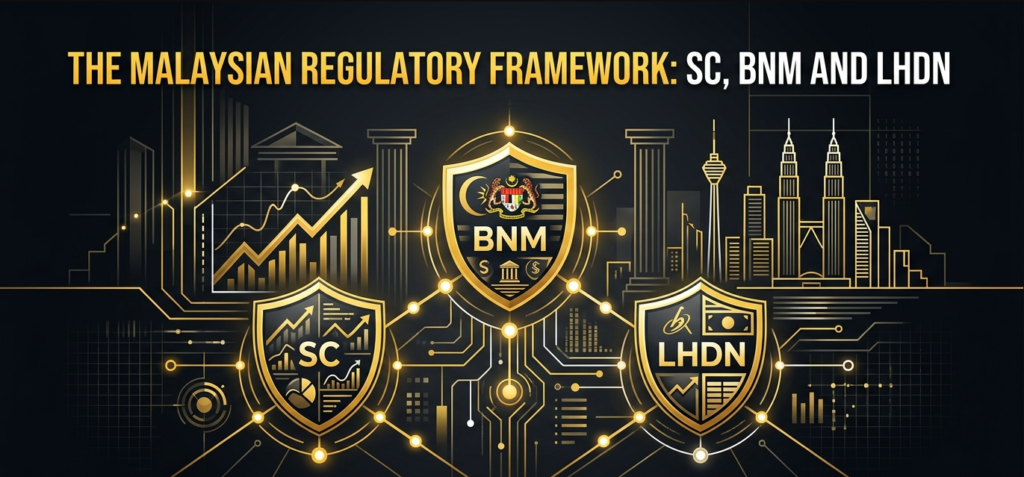
The Securities Commission Malaysia is the key regulator for digital assets as capital-market products and services. Bank Negara Malaysia (BNM) has an important role in the financial system and AML/CFT framework, while the Inland Revenue Board of Malaysia (LHDN) is responsible for taxation.
The SC’s current digital-assets framework explains that Malaysia regulates digital-asset trading, issuance and safekeeping through the Capital Markets & Services (Prescription of Securities) (Digital Currency and Digital Token) Order 2019 and associated guidelines. (Securities Commission Malaysia)
That is the foundation for understanding why the phrase SC-registered DAX matters so much.
Securities Commission Malaysia and RMO-DAX registration
The SC regulates the trading, issuance and safekeeping of digital assets in Malaysia. Its framework provides a specific regulatory category for DAX operators, allowing approved operators to facilitate digital-asset trading through recognised market infrastructure. (Securities Commission Malaysia)
In practical terms, this means you shouldn’t evaluate a Malaysian exchange purely as a piece of software.
You’re dealing with a financial-market operator inside a regulated framework.
That framework matters because the regulator imposes requirements around how these businesses operate, manage risks and protect customers.
For consumers, I think this is one of the most important distinctions between a locally registered exchange and an offshore platform.
A slick interface doesn’t tell you much about regulatory standing.
The SC register does.
Before entering your MyKad details, depositing money or transferring crypto, I would verify the company against the SC’s official list of regulated digital-asset players rather than relying on an advertisement, social-media profile or search-engine result. (Securities Commission Malaysia)
Bank Negara Malaysia and AML/CFT considerations
BNM’s role is slightly different.
Digital-asset businesses operate within Malaysia’s broader financial crime prevention environment, and AML/CFT obligations are an important reason regulated platforms collect customer information and monitor transactions.
The BNM AML/CFT framework specifically identifies digital-currency exchange services among the relevant reporting-institution categories. You can see the regulator’s treatment of digital-currency exchange activities in its AML/CFT reporting-institution framework. ([Source: BNM AML/CFT reporting institutions])
So if a Malaysian exchange asks you for identity documents, transaction information or additional verification, don’t automatically assume the platform is being unnecessarily difficult.
A regulated financial environment requires a certain amount of friction.
And honestly, I’d rather deal with a few extra verification steps than have an exchange operate with almost no idea who its customers are.
Is Crypto Trading Legal in Malaysia?
Yes, cryptocurrency trading exists within a regulated Malaysian framework, but that answer needs an important qualification.
The SC regulates digital assets, and investors should distinguish between trading digital assets through an SC-registered DAX and using an offshore platform that is not registered with the Malaysian regulator.
The SC’s own digital-assets framework confirms that the trading, issuance and safekeeping of digital assets are regulated activities in Malaysia. ([Source: SC Digital Assets regulatory framework])
So the better answer to the question “Is crypto trading legal in Malaysia?” is:
Yes, digital-asset trading is permitted within Malaysia’s regulatory framework, and investors should use DAX operators registered with the SC when they want to operate within that local framework.
That is more accurate than saying simply, “Crypto is legal.”
There is another important distinction here.
Regulated does not mean risk-free.
Bitcoin can still lose half its value.
A token can still perform terribly.
A user can still lose money through phishing.
An investor can still make a terrible trade.
The SC’s involvement gives you a regulatory framework; it does not turn crypto into a guaranteed investment.
Shariah-Compliant Crypto in Malaysia
This is where Malaysia’s crypto framework becomes particularly interesting.
If you’re a Muslim investor looking for Shariah compliant crypto in Malaysia, you don’t need to rely entirely on opinions from random crypto websites.
The SC has its own Shariah Advisory Council (SAC), and the regulator publishes the Shariah status of digital assets on its official digital-assets page. ([Source: SC list of tradeable digital assets and Shariah status])
The SAC has recognised certain digital assets as Shariah-compliant within the applicable Malaysian framework.
That does not mean every token in existence is halal.
It also doesn’t mean every crypto-related financial product is automatically Shariah-compliant.
The details matter.
Which cryptocurrencies are Shariah-compliant?
The SC’s current list identifies these assets as Shariah-compliant:
| Digital asset | Symbol | Shariah status |
|---|---|---|
| Bitcoin | BTC | Shariah-compliant |
| Ethereum | ETH | Shariah-compliant |
| Ripple | XRP | Shariah-compliant |
| Litecoin | LTC | Shariah-compliant |
| Bitcoin Cash | BCH | Shariah-compliant |
| Solana | SOL | Shariah-compliant |
| Cardano | ADA | Shariah-compliant |
| Chainlink | LINK | Shariah-compliant |
| Uniswap | UNI | Shariah-compliant |
| Polygon | MATIC | Shariah-compliant |
| Avalanche | AVAX | Shariah-compliant |
| Polkadot | DOT | Shariah-compliant |
| Cosmos | ATOM | Shariah-compliant |
| Worldcoin | WLD | Shariah-compliant |
| Stellar | XLM | Shariah-compliant |
The SC’s published table also contains additional assets such as Synthetix, Maker, Curve DAO, Aave, Near, Algorand, Hedera and The Graph, but it includes an important note about the regulatory treatment effective from 30 March 2026. DAX operators intending to offer Shariah-compliant digital currencies are required to obtain SAC endorsement under the revised requirements. ([Source: SC Digital Assets and Shariah status])
That is exactly why I would not use an old “top 20 halal crypto” article as your definitive source.
Crypto changes quickly.
Regulatory requirements change too.
If Shariah compliance is part of your investment decision, check the current SC list immediately before trading.
Does SC registration make an entire exchange Shariah-compliant?
No.
This distinction is easy to miss.
The exchange can be registered with the SC while individual assets have different Shariah classifications.
Think of it this way:
Regulated exchange ≠ every listed token is automatically Shariah-compliant.
The asset itself needs to be checked.
That is particularly important as new tokens are added to the market.
LHDN Crypto Tax Guide: Are Crypto Profits Taxable in Malaysia?

This is probably the most misunderstood part of Malaysian crypto investing.
You’ll often see people say:
“Malaysia doesn’t have capital gains tax, so crypto profits aren’t taxed.”
That’s too broad.
The tax treatment depends on the nature of the transaction and whether the activity is capital or revenue in nature.
LHDN’s Guidelines on Tax Treatment of Digital Currency Transactions explain that active digital-currency trading can potentially produce taxable business income, while the treatment of investment gains depends on the specific facts and circumstances. ([Source: LHDN Guidelines on Tax Treatment of Digital Currency Transactions])
The updated LHDN guidance published in 2025 continues to distinguish between investment activity and trading/business activity. ([Source: LHDN tax treatment of digital currency transactions])
That means your behaviour matters.
Imagine two people.
The first buys RM30,000 of Bitcoin and holds it for several years.
The second buys and sells Bitcoin, Ethereum, Solana and other assets every day, systematically trying to generate regular profits.
Calling both activities simply “crypto investing” hides a very important difference.
The second investor’s activity may have characteristics of a trading business.
What factors matter?
LHDN’s guidance considers factors surrounding the transaction and the nature of the activity.
Relevant considerations can include:
- Frequency of transactions
- Duration of holding
- Nature of the activity
- Intention behind the transactions
- Whether the activity is organised systematically
- Whether the activity resembles a business
- Source and nature of the income
The important takeaway is not that “day trading is always taxable” or “holding is always tax-free.”
It’s that you should not make a tax conclusion based on one characteristic alone.
If your crypto activity is substantial, systematic or business-like, professional Malaysian tax advice becomes much more useful than a generic internet article.
Keep records from day one
I strongly recommend keeping:
- Exchange statements
- MYR deposits
- MYR withdrawals
- Crypto purchases
- Crypto sales
- Trading fees
- Wallet transfers
- Dates and transaction IDs
- Cost basis information
- Records of business-related crypto receipts
You may never need all of it.
But if you do need it, you’ll be very glad you kept it.
Critical Knowledge Gaps and Common Pitfalls in Malaysian Crypto
Offshore P2P Trading vs. Regulated Malaysian DAXs
This is probably the biggest practical mistake I see people making.
They find an offshore platform offering more coins, lower fees and P2P trading, then assume that because the platform is popular internationally, it must be fine for Malaysian users.
That’s not how local regulation works.
The relevant question is whether the platform is authorised or registered to carry out the relevant regulated activity in Malaysia.
For example, the Malaysian Ministry of Finance stated in July 2026 that Binance remained unlicensed and unregistered to conduct regulated capital-market activities in Malaysia. The government also clarified that Binance’s removal from the SC Investor Alert List in 2024 did not constitute a licence or authorisation. ([Source: Fintech News Malaysia report on Binance’s Malaysian regulatory status])
This is an important correction to a common misconception.
Removed from the Investor Alert List does not mean licensed.
So if you’re comparing Binance with Luno or HATA, don’t put them into the same regulatory category.
They aren’t.
Why P2P transactions can create additional complications
P2P trading can involve transfers between people who are not directly connected to the exchange in the same way as a normal account deposit.
That creates additional counterparty and AML considerations.
Suppose you buy crypto from a stranger and the MYR payment comes from an unrelated third-party bank account.
You may have a perfectly innocent explanation.
But from a bank’s compliance perspective, an unexpected third-party transfer can be more complicated than a direct deposit into a regulated exchange account.
This is why I prefer a simple funding chain whenever possible:
Your Malaysian bank account → your verified DAX account → your crypto purchase.
It is cleaner.
It is easier to document.
And it makes your transaction history easier to understand.
FPX and DuitNow: Why MYR Funding Matters
One of the biggest advantages of a Malaysian DAX is the ability to work with local payment rails.
For someone who earns and spends Malaysian ringgit, converting MYR into crypto shouldn’t ideally require a complicated chain of foreign cards, P2P merchants and offshore transfers.
Local exchanges can provide more familiar funding options.
For example, Luno’s Malaysian fee documentation lists FPX Instant Transfer as a supported deposit method and publishes the applicable limits and charges for Malaysian customers. ([Source: Luno Malaysia fees and limits])
HATA likewise publishes information about FPX MYR deposits, including its current promotional treatment for qualifying deposits. ([Source: HATA FPX deposit information])
The exact fee, limit and processing time can change, so always check the live exchange page before transferring a significant amount.
Why local banking integration is more than convenience
Let’s say you’re investing RM1,000 every month.
You don’t necessarily need an exchange that supports 1,500 tokens, perpetual futures, dozens of derivatives markets and a complicated trading terminal.
What you probably want is:
Bank → MYR deposit → buy BTC/ETH → keep records → withdraw when needed.
The less unnecessary complexity in that workflow, the better.
That is one reason I consider MYR funding a core feature rather than an optional convenience.
Shariah Screening: Don’t Stop at the Exchange
If you’re building a Shariah-compliant crypto portfolio in Malaysia, your research should happen at two levels.
First:
Is the exchange operating within the SC’s regulatory framework?
Second:
Does the specific digital asset have the relevant Shariah status?
The SC’s current digital-assets page makes this distinction very clear by separately listing DAX operators and the tradeable digital assets together with their Shariah status. ([Source: SC Digital Assets])
That means you shouldn’t use a shortcut like:
“Luno is regulated, therefore everything on Luno is halal.”
That’s not the right way to approach it.
Instead, check the token.
This is especially important when dealing with newly listed assets because a token’s availability on a platform does not automatically tell you its Shariah classification.
Controlled Token Listings and Why Malaysian Exchanges Have Fewer Coins

If you come from an offshore exchange, a Malaysian DAX can initially feel surprisingly limited.
You might open the app and think:
Where are all the meme coins?
That’s actually part of the point.
The Malaysian regulated framework doesn’t treat every token as equally suitable for retail trading.
The SC’s digital-assets framework contains requirements around tradeable digital assets, and its revised framework includes treatment for restricted digital assets, including certain meme tokens and nascent utility tokens. ([Source: SC’s revised DAX framework and FAQ)
So a smaller token selection isn’t necessarily evidence that a Malaysian exchange is inferior.
It may reflect the fact that the platform is operating inside a more controlled regulatory environment.
There is a trade-off.
Offshore exchanges can give you enormous choice.
Regulated local exchanges can give you a more clearly defined local regulatory framework.
Which matters more depends on your priorities.
In-Depth Reviews of SC-Registered Digital Asset Exchanges
Luno Malaysia: Best Overall for Retail Beginners and MYR Liquidity
If a friend asked me, “I live in Malaysia and I’ve never bought crypto before. Where should I start?”, Luno would probably be one of the first names I’d mention.
Not because it is automatically the best exchange for every person.
It’s because the platform is relatively easy to understand.
Luno Malaysia is listed by the SC as a registered DAX operator, giving it a clear position inside Malaysia’s regulated digital-asset market. ([Source: SC registered DAX operators])
For Malaysian users, Luno also supports local MYR deposits through FPX, and its published fee schedule makes the maker/taker structure relatively easy to compare. ([Source: Luno Malaysia fees and limits])
Its lowest published exchange tier currently lists a 0.60% taker fee and 0.35% maker fee, with fees decreasing as 30-day trading volume increases. ([Source: Luno Malaysia Exchange fees])
That’s important if you’re an active trader.
But if you’re just buying a small amount every month, simplicity may matter more than saving a fraction of a percent.
Best for:
- Beginners
- Long-term investors
- Regular MYR buyers
- Users who value simplicity
- Mainstream BTC and ETH investors
Potential downside: High-volume traders should compare the complete fee schedule and execution costs with competing DAXs rather than assuming the retail-friendly interface automatically means the lowest cost.
HATA Digital: Best for Multi-Asset Trading and Competitive Fees
HATA is more interesting once you move beyond the most basic crypto-buying workflow.
The SC lists HATA Digital Sdn Bhd as a registered DAX operator. ([Source: SC regulated digital-asset players])
The platform positions itself around broader crypto access and competitive pricing, with Malaysian users able to fund accounts in MYR.
HATA’s own Malaysian materials also highlight FPX funding, including a current promotion involving fee-free FPX deposits above a stated threshold. ([Source: HATA FPX deposit promotion])
For active traders, that’s more relevant than it might initially appear.
Deposit costs are part of your actual trading cost.
If you regularly move large amounts into an exchange, a small funding fee can add up over time.
Best for:
- Active traders
- Multi-asset investors
- Cost-conscious users
- Investors who want more than a basic BTC-buying workflow
Potential downside: More functionality isn’t necessarily better for beginners. If your strategy is simply monthly BTC accumulation, you may not need the additional complexity.
MX Global: Best for Straightforward Local MYR Trading
MX Global is another SC-registered DAX and is worth considering if your main objective is straightforward local crypto trading.
Its published product information covers MYR trading and local deposit methods such as FPX. ([Source: MX Global products and fees])
The platform currently publishes fee information for several MYR spot pairs, with the exact fees depending on the relevant trading structure and user category. Because fee schedules can change, I would check the current page immediately before making a large deposit.
What makes MX Global interesting is precisely that it doesn’t need to be everything to everyone.
If your objective is simply:
MYR → BTC/ETH/SOL/XRP → hold or trade → MYR
a focused local platform can make a lot of sense.
Best for:
- Malaysian retail investors
- MYR spot trading
- Investors who prefer a focused platform
- Users who value local-market integration
SINEGY DAX: Best for Advanced Trading Workflows
SINEGY takes a somewhat different position.
It has a distinctly Malaysian identity and focuses heavily on digital-asset trading infrastructure. The company also publishes information around API-based trading and automated strategies through its platform documentation. ([Source: SINEGY trading API information])
That makes the platform more interesting for experienced users.
If you’ve never used an order book before, you probably won’t care much about an API.
If you’re developing systematic strategies, however, the API becomes much more relevant.
That’s why I wouldn’t rank exchanges purely from beginner to advanced.
Different users need different things.
Best for:
- Experienced traders
- API users
- Systematic trading
- Traders who want more advanced execution tools
Potential downside: The additional functionality may be unnecessary for a basic buy-and-hold investor.
Kinetic DAX: A More Institutional-Oriented Option
Kinetic DAX is the fifth DAX operator currently listed by the SC. ([Source: SC list of registered DAX operators])
Its position within the regulated ecosystem is particularly relevant when looking at the evolution of Malaysia’s digital-asset infrastructure beyond purely retail crypto trading.
For an ordinary beginner, it may not be the first platform I’d investigate.
For professional or institutional users, however, the broader regulated-market infrastructure matters more.
Best for:
- Institutional users
- Corporate participants
- Professional investors
- Investors interested in the wider regulated digital-asset ecosystem
Luno vs HATA Digital Malaysia: Which One Should You Choose?
This is probably the most useful head-to-head comparison for many Malaysian retail investors.
| Factor | Luno | HATA |
|---|---|---|
| SC registration | Yes | Yes |
| Beginner friendliness | Excellent | Very good |
| MYR funding | Strong | Strong |
| Trading focus | Retail + exchange | Broader trading ecosystem |
| Fee focus | Volume-based maker/taker structure | Competitive trading structure |
| Asset selection | Focused | Broader |
| Best for | Beginners and mainstream investors | Active and multi-asset traders |
Luno’s published Malaysian exchange schedule uses volume-based maker/taker pricing, while HATA emphasises competitive trading and local MYR access. ([Source: Luno Malaysia fees; HATA Malaysia])
If you’re completely new, I would lean toward Luno for simplicity.
If you’re already comfortable with order books, fees and active trading, HATA deserves a close comparison.
But don’t choose based on the advertised trading fee alone.
Your real cost can include:
- Maker/taker fees
- Spread
- Deposit fees
- Withdrawal fees
- Slippage
- Network fees
- FX conversion costs where applicable
A 0.1% cheaper trading fee isn’t necessarily a bargain if the actual execution price is worse.
How to Deposit MYR via FPX and Buy Crypto?

Register with an SC-registered exchange
Start by choosing an operator from the SC’s current DAX list rather than following an advertisement or social-media recommendation. The regulator currently lists HATA Digital, Luno Malaysia, MX Global, SINEGY DAX and Kinetic DAX. ([Source: SC regulated DAX list])
Complete eKYC
You’ll need to verify your identity.
That can involve:
- MyKad or another accepted identity document
- Personal information
- Selfie verification
- Address information
- Additional source-of-funds information where required
Don’t be surprised if verification takes more effort than opening a normal shopping account.
You’re entering a regulated financial environment.
Choose MYR deposit
Once your account is verified, open the MYR deposit section.
Depending on the platform, this can include FPX or other local bank-transfer methods.
Luno, for example, currently lists FPX Instant Transfer for Malaysian users, together with published deposit limits and fees. ([Source: Luno Malaysia deposit methods and fees])
Fund through your own bank account
Select your bank and authorise the transfer.
The exact banks and user interface can change, so follow the instructions displayed inside your verified account.
Don’t send money to a bank account someone gives you through Telegram.
Don’t trust a “support agent” who suddenly asks you to make a manual transfer.
Don’t use payment details copied from an unofficial social-media account.
The safest workflow is always to obtain the payment details directly from the authenticated exchange interface.
Choose the cryptocurrency
Once your MYR balance arrives, choose the asset.
If you’re looking for Shariah-compliant crypto, check the current SC list before placing the order. The SC currently identifies BTC, ETH, XRP, LTC, BCH, SOL, ADA, LINK, UNI, MATIC, AVAX, DOT, ATOM, WLD and XLM among the digital assets with Shariah-compliant status. ([Source: SC Shariah status of digital assets])
Choose market or limit order
A market order is designed to execute immediately against available liquidity.
A limit order allows you to specify the price at which you’re willing to buy or sell.
For a beginner making a small purchase, a market order can be easier.
For an experienced trader, a limit order may provide better control over execution.
But remember: a limit order isn’t guaranteed to fill.
That’s the trade-off.
How to Keep Your Malaysian Crypto Account Secure
Regulation can reduce certain risks, but it doesn’t protect you from yourself.
Your account security still matters enormously.
I recommend using:
- A unique password
- Two-factor authentication
- Device-level security
- A dedicated email account where appropriate
- Official exchange applications
- Withdrawal security features
- A bookmarked official exchange website
And please be suspicious of unsolicited messages.
If someone contacts you saying:
“I’m from Luno support.”
Don’t automatically believe them.
Open the official app yourself.
Go to the official website yourself.
Contact support through the official channel.
Crypto scams often work because people are rushed.
Someone tells you your account is frozen.
Someone says you must pay a tax before withdrawing.
Someone claims your wallet needs verification.
Someone promises guaranteed returns.
The moment somebody asks you to send crypto to “unlock” your account, stop.
Offshore Exchanges: Why More Coins Doesn’t Necessarily Mean Better
International exchanges can be extremely attractive.
They may offer:
- Hundreds or thousands of tokens
- Futures
- Options
- Perpetual contracts
- Advanced trading tools
- High-volume markets
- Automated strategies
If you’re an experienced trader, that can be genuinely useful.
But Malaysian regulatory status is a separate question.
A particularly important recent example is Binance.
In July 2026, Malaysia’s Ministry of Finance stated that Binance remained unlicensed and unregistered to conduct regulated capital-market activities in Malaysia. The same government response clarified that Binance’s removal from the SC Investor Alert List in 2024 did not amount to authorisation. ([Source: Fintech News Malaysia report on Binance’s regulatory position ; New Straits Times report])
That distinction is crucial.
Not being on an Investor Alert List is not the same thing as being SC-registered.
So if your priority is regulatory certainty within Malaysia, compare offshore exchanges separately from the five DAX operators on the SC register.
Why Local MYR On-Ramps Matter
For Malaysian investors, the ability to move MYR directly into a regulated exchange is more important than it may appear.
Suppose you’re investing RM1,000 per month.
You want the process to be boring:
MYR → exchange → BTC/ETH → records.
That’s actually a good thing.
You don’t need five intermediaries.
You don’t need a P2P merchant.
You don’t need a foreign card.
You don’t need to explain why money is moving between several unrelated bank accounts.
Local funding methods such as FPX can make the process considerably more straightforward. Luno’s current Malaysian documentation confirms FPX Instant Transfer support, while HATA also provides FPX funding for Malaysian users. ([Source: Luno Malaysia funding; HATA FPX funding])
This doesn’t mean every bank transaction will automatically pass without review.
AML monitoring still exists.
But you’re using a more transparent and documented route.
How Much Crypto Should You Keep on an Exchange?
There isn’t a universal number.
The answer depends on your portfolio size, trading frequency and custody preferences.
If you’re actively trading, you need some balance on the exchange.
If you’re holding a significant amount for years, you may want to investigate custody or self-custody instead.
The SC separately regulates Digital Asset Custodians, and its current regulated list includes CoKeeps, Gambit Custody and Jada Platform. ([Source: SC regulated Digital Asset Custodians])
Self-custody creates another set of responsibilities.
You control the private keys.
That’s powerful.
But if you lose your recovery phrase, there may be no customer-service department that can reverse the problem.
So don’t confuse “not your keys, not your coins” with “self-custody is always safer.”
Self-custody transfers responsibility to you.
For some investors, that’s exactly what they want.
For others, professional custody may be more appropriate.
Frequently Asked Questions
Is cryptocurrency trading legal in Malaysia?
Yes. Digital-asset trading operates within Malaysia’s regulatory framework, with the SC responsible for regulating digital-asset trading, issuance and safekeeping. Investors seeking the Malaysian regulatory framework should use DAX operators registered with the SC. ([Source: SC Digital Assets])
Which crypto exchanges are registered with the Securities Commission Malaysia?
The SC currently lists five DAX operators: HATA Digital, Luno Malaysia, MX Global, SINEGY DAX and Kinetic DAX. ([Source: SC list of regulated digital-asset players])
Is Luno regulated in Malaysia?
Yes. Luno Malaysia Sdn Bhd is included in the SC’s current list of registered Digital Asset Exchange operators. ([Source: SC Digital Assets])
Is HATA Digital regulated in Malaysia?
Yes. HATA Digital Sdn Bhd is included among the DAX operators listed by the SC. ([Source: SC Digital Assets])
What is the best crypto exchange in Malaysia for beginners?
Luno is a strong option for beginners because it combines local regulatory status, MYR funding and a relatively straightforward retail experience. HATA may be more attractive to users who care more about broader asset access and active trading.
Can I deposit Malaysian ringgit using FPX?
Yes. Malaysian DAX platforms support local MYR funding methods, including FPX. Luno currently publishes FPX Instant Transfer as a Malaysian deposit method, while HATA also provides FPX funding. ([Source: Luno Malaysia fees and limits; HATA FPX information])
Is Bitcoin Shariah-compliant in Malaysia?
Yes. The SC currently lists Bitcoin as Shariah-compliant, based on the determination of its Shariah Advisory Council. ([Source: SC Shariah status of Bitcoin and other digital assets])
Is Ethereum Shariah-compliant in Malaysia?
Yes. Ethereum is currently listed by the SC as Shariah-compliant. ([Source: SC Digital Assets])
Are all cryptocurrencies Shariah-compliant?
No. Shariah status is assessed on an asset-by-asset basis. The SC publishes the relevant digital-asset list and Shariah status, so investors should check the current classification of the specific token they intend to buy. ([Source: SC tradeable digital assets and Shariah status])
Are crypto profits taxable in Malaysia?
They can be. LHDN’s guidance indicates that active trading or business-like digital-currency activity can generate taxable income, while the treatment of investment gains depends on the circumstances. ([Source: LHDN digital-currency tax guidelines])
Is long-term crypto investing automatically tax-free?
No blanket statement should be made. Malaysian tax treatment depends on whether the relevant activity is capital or revenue in nature and on the facts surrounding the transactions. LHDN’s published guidance should be consulted when determining the appropriate tax treatment. ([Source: LHDN tax treatment of digital currency transactions])
Can Malaysians use Binance?
The important point is regulatory status. As of July 2026, Malaysia’s Ministry of Finance stated that Binance remained unlicensed and unregistered to conduct regulated capital-market activities in Malaysia. Its removal from the SC Investor Alert List in 2024 did not constitute a licence or authorisation. ([Source: Fintech News Malaysia])
Therefore, Binance should not be treated as equivalent to an SC-registered Malaysian DAX.
Why don’t Malaysian regulated exchanges offer every meme coin?
Because Malaysian DAXs operate within the SC’s regulated framework, which includes requirements governing digital-asset listings and treatment of certain restricted assets. The SC’s revised framework specifically addresses categories such as certain meme tokens and nascent utility tokens. ([Source: SC revised DAX framework and FAQ])
Are Malaysian crypto exchanges safe?
“Safe” is too absolute a word.
An SC-registered DAX gives investors a regulated Malaysian framework, but it cannot eliminate crypto-market volatility, hacking attempts, phishing, investment losses or operational risks.
You still need strong account security and sensible risk management.
Final Conclusion: Building a Secure, Compliant Crypto Portfolio in Malaysia
So, what is the best crypto exchange in Malaysia?
The honest answer is: it depends on what kind of investor you are.
For a beginner who wants a relatively simple way to buy crypto with Malaysian ringgit, Luno Malaysia is one of the strongest all-around choices.
For someone more focused on multi-asset trading and competitive costs, HATA Digital deserves a close look.
MX Global may appeal to investors who prefer straightforward local MYR trading, while SINEGY DAX is more interesting for experienced traders who want advanced trading infrastructure.
Kinetic DAX rounds out the current group of five SC-registered DAX operators and is particularly relevant when looking at Malaysia’s wider institutional digital-asset ecosystem. ([Source: SC official regulated digital-asset players])
But I wouldn’t start your decision with the trading fee.
I’d start with regulation.
Then look at:
- MYR deposit and withdrawal methods
- Maker and taker fees
- Trading spreads
- Liquidity for the pairs you actually use
- Supported digital assets
- Security controls
- Custody arrangements
- Shariah status where relevant
- Tax recordkeeping
- Customer support
- Withdrawal limits and procedures
The SC’s official digital-assets framework should be your first reference point when verifying whether an exchange is part of Malaysia’s regulated ecosystem. ([Source: Securities Commission Malaysia – Digital Assets])
If Shariah compliance matters to you, use the SC’s asset-level Shariah classifications rather than relying on generic crypto blogs. ([Source: SC list of tradeable digital assets and Shariah status])
And if you’re an active trader, don’t assume crypto profits are automatically tax-free. LHDN’s guidance makes clear that the nature of your trading activity matters, which is why maintaining proper records from the beginning is so important. ([Source: LHDN Guidelines on Digital Currency Transactions])
Finally, don’t let the word “regulated” create a false sense of security.
Regulation can reduce certain risks.
It cannot stop Bitcoin from falling 30%.
It cannot prevent you from sending crypto to the wrong wallet.
It cannot protect a weak password.
And it certainly cannot turn a speculative asset into a guaranteed investment.
The smartest approach for Malaysian investors is therefore fairly simple:
Start with an SC-registered DAX, use a clean MYR funding route such as FPX where available, verify the Shariah status of individual assets if relevant, maintain complete transaction records, and treat crypto as a high-risk investment rather than easy money.
That’s a much more useful definition of the best crypto exchange in Malaysia than simply choosing whichever platform has the longest list of coins.