Top SEC-Licensed Crypto Platforms in Thailand
If you are sitting in Bangkok and searching for the best crypto exchange in Thailand, I would start with one question before looking at fees, coin lists or promotional offers:
Is the company actually licensed to provide the service in Thailand?
That matters more here than it does in many other crypto markets because Thailand has built a specific regulatory framework around digital-asset businesses. The Thai Securities and Exchange Commission (SEC) maintains an official list of licensed operators, and that list distinguishes between exchanges, brokers and dealers. The current SEC database includes names such as Bitkub Online, Gulf Binance, Orbix Trade, Upbit Thailand and InnovestX, although InnovestX is listed under the digital-asset broker category rather than as a conventional exchange. You can verify the current status directly through the SEC Thailand digital-asset license database.
That distinction is important for an expat.
You don’t want to read a generic “top crypto exchanges in Thailand” list, download an app, deposit THB and only later discover that the company you chose is operating under a completely different legal structure.
For Bangkok users, my practical shortlist looks like this:
| Platform | Structure | Best For | THB Access | Expat Appeal |
|---|---|---|---|---|
| Bitkub | Licensed digital-asset exchange | Local liquidity and THB trading | Strong local banking integration | Good, but KYC can be document-heavy |
| Binance TH | Licensed exchange + broker | Global-style trading and broader crypto ecosystem | THB bank transfer/local rails | Strong if you meet local KYC requirements |
| Orbix | Licensed digital-asset exchange | KBank ecosystem users | Local banking integration | More naturally oriented toward Thai banking users |
| InnovestX | Licensed digital-asset broker | Crypto + traditional investments | Thai banking ecosystem | Potentially attractive for eligible residents |
| Upbit Thailand | Licensed digital-asset exchange | Users interested in Upbit’s ecosystem | Local THB infrastructure | Availability depends on eligibility and KYC |
I would not describe one of these as “the best” for everybody.
If you are a Thai resident who mainly wants BTC/THB and straightforward local transfers, Bitkub is a very natural starting point.
If you already understand crypto markets and want a platform that feels closer to the broader Binance ecosystem, Binance TH is more compelling.
If you already bank with KBank, Orbix deserves a closer look.
And if you want crypto sitting alongside traditional investments rather than maintaining a separate crypto-only relationship, InnovestX is an interesting alternative.
The important thing is that these are not interchangeable products. The SEC itself defines digital-asset businesses into categories including exchanges, brokers and dealers, so “licensed crypto platform” is a broader description than “exchange.” The regulator’s digital-asset business framework explains these categories.
Regulatory Framework: SEC Thailand, Taxes, and the Payment Rules
Thailand is one of those markets where the legal distinction between owning crypto, trading crypto, and using crypto as money matters enormously.
You can legally participate in the regulated digital-asset market, but that does not mean Bitcoin has become a replacement for the Thai baht.
That is the first thing I would explain to anyone moving to Bangkok who asks me, “Is crypto legal in Thailand?”
SEC Thailand Licensing & the Digital-Asset Business Framework
The Thai digital-asset framework is overseen primarily through the Securities and Exchange Commission (SEC), with licensing involving the Ministry of Finance.
Under the framework, digital-asset businesses can include:
- Digital-asset exchanges.
- Digital-asset brokers.
- Digital-asset dealers.
The SEC’s official definition describes a digital-asset exchange as a center or network established to facilitate the trading or exchange of digital assets, including systems that match orders or arrange counterparties. The regulator publishes the official Digital Asset Business Operators framework so users can verify what type of license a particular company holds.
This is more useful than relying on an exchange’s own marketing language.
For example, the current SEC license database lists BITKUB ONLINE CO., LTD., GULF BINANCE CO., LTD., ORBIX TRADE CO., LTD., UPBIT EXCHANGE (THAILAND) CO., LTD., and other operators among licensed digital-asset businesses. It separately lists INNOVESTX SECURITIES CO., LTD. as a licensed digital-asset broker for token products. The SEC licensee database is therefore the source I would use before opening an account.
The regulatory framework is also evolving.
In September 2026, the SEC announced new Travel Rule requirements for digital-asset transfers, designed to give licensed operators enough information to assess money-laundering risks and help prevent digital-asset services from being misused for money laundering and technology-related crimes. The SEC’s September 2026 Travel Rule announcement shows how seriously Thailand is tightening transaction monitoring.
That has a practical consequence for you.
Don’t assume that moving crypto into or out of a Thai exchange will always work exactly like moving crypto between two anonymous wallets. Licensed exchanges increasingly need to know who is sending assets, where the assets are coming from, and whether a transfer creates a compliance concern.
The Bank of Thailand and Crypto as a Means of Payment
This is where the phrase “crypto is legal in Thailand” needs a little nuance.
Crypto trading and investment are permitted within the regulated digital-asset framework, but the Bank of Thailand (BOT) has consistently discouraged the use of digital assets as a means of payment for goods and services.
The BOT has stated that digital assets are not legal tender and has warned about risks including volatility, cyber theft, money laundering and consumer protection. Its official guidance on digital assets as a means of payment explains the regulator’s position.
The joint BOT, SEC and Ministry of Finance framework has also focused on limiting the widespread use of digital assets for paying merchants because of potential effects on financial stability, payment-system stability and consumer protection. The agencies’ joint payment-policy statement explains the reasoning.
So don’t confuse these two ideas:
Buying Bitcoin as an investment: permitted through the regulated ecosystem.
Using Bitcoin instead of Thai baht to pay your rent, restaurant bill or ordinary merchant transaction: a very different regulatory issue.
For an expat, this distinction is particularly useful. You can live in Bangkok, trade BTC/THB on a licensed exchange and hold digital assets without treating Bitcoin as your everyday replacement for THB.
Thailand’s Crypto Tax Rules Are More Complicated Than “15% Tax”
The outline’s popular “15% withholding tax” description needs an important correction.
Thailand’s Revenue Code has provisions involving a 15% withholding rate on certain categories of assessable income from digital-asset transfers, particularly gains under the relevant tax provisions. The Revenue Department’s explanation of the underlying rules is available in its official withholding-tax provisions.
But that does not mean every Thai crypto exchange automatically removes 15% from every profitable trade.
Binance TH explicitly states that it does not currently withhold 15% on behalf of customers, because it does not have a system that calculates users’ profits and losses for withholding purposes. Instead, it tells customers that they are responsible for assessing their income and keeping appropriate records. The exchange explains this directly in its crypto tax guidance.
That’s a much more useful fact for an expat than simply repeating “Thailand charges 15%.”
You need to distinguish between:
- The tax rate specified in the Revenue Code for relevant income.
- Whether an exchange actually withholds that tax.
- Your personal income-tax position.
- Your Thai tax-residency status.
- The source and timing of the income.
- Any applicable exemptions or tax measures.
Thai tax residence is also more nuanced than simply saying “180 days means you pay 15%.”
The Revenue Department generally treats an individual who stays in Thailand for more than 180 days in a tax year as a Thai tax resident for relevant purposes. Its tax-residency and personal-income guidance provides the broader framework.
For substantial holdings or frequent trading, I would absolutely keep detailed transaction records and speak to a Thai tax professional rather than trying to reconstruct everything at year-end.
VAT and the Digital-Asset Tax Picture
There is another detail worth knowing.
Thailand has introduced VAT exemptions and other tax measures specifically for digital-asset transactions. The Revenue Department records Royal Decree No. 788, which provides a VAT exemption for transfers of cryptocurrency and certain utility tokens, while later measures expanded the scope of VAT relief for transactions conducted through licensed exchanges, brokers and dealers. The Revenue Department’s published tax-law archive records these measures.
This is one more reason why old articles about “Thai crypto tax” can be misleading.
The tax framework has changed several times, and the answer depends on what transaction you made, when you made it, which entity facilitated it, and what type of income or asset transfer was involved.
If you’re an expat with meaningful crypto activity, don’t rely on a one-line blog post saying “Thailand taxes crypto at 15%.”
Critical Knowledge Gaps & Pitfalls for Bangkok Traders
The Tourist Visa KYC Problem
This is one of the biggest practical issues for foreigners.
The mistake is assuming:
“I have a passport, I’m physically in Bangkok, so I can open any Thai exchange account.”
It doesn’t work that simply.
Bitkub’s published KYC documentation distinguishes between Thai customers and foreign customers, and its foreign-customer requirements can include a passport plus additional documents depending on whether the foreigner lives, works or operates a business in Thailand. The exchange’s current account-verification page lists passport and selfie requirements for foreign citizens, while its more detailed KYC documentation explains additional documentation for foreign residents and workers.
Bitkub’s published foreigner KYC examples have included:
- Passport.
- Thai yellow house registration where applicable.
- Work Permit.
- Non-Immigrant Visa or Smart Visa.
- Proof of nationality or other supporting documentation.
- Additional residence or employment evidence depending on circumstances.
You therefore shouldn’t promise an expat that a tourist visa will automatically qualify.
At the same time, I wouldn’t make the opposite mistake and say all tourists are categorically rejected.
Thailand has even developed a separate regulatory framework for a TouristDigiPay initiative that allows participating licensed digital-asset operators and e-money providers to serve certain foreign tourists under a specific approved structure. The SEC’s TouristDigiPay information describes the project and its KYC/CDD requirements.
So the practical rule is:
Check the exact product and eligibility category you’re applying for.
Don’t assume that being physically present in Bangkok is enough.
Global Binance vs. Binance TH
This distinction is absolutely critical.
Binance.com and Binance TH are not the same legal service.
Binance TH is operated by Gulf Binance Co., Ltd., a joint venture between Gulf’s relevant subsidiary and Binance AP Holdings. Binance TH states that it holds Thai digital-asset exchange and broker licenses and operates under SEC supervision. Its official company information identifies the Thai licenses and ownership structure.
The local platform was created precisely to provide regulated services within Thailand.
Binance TH also explicitly explained that Binance.com’s THB P2P functionality was being suspended because THB services needed to be provided through a locally licensed entity, directing users toward Binance TH instead. Its official Binance TH FAQ describes that transition.
So if you are a Bangkok resident and need THB deposits and withdrawals, don’t casually assume that your Binance.com account is equivalent to a Binance TH account.
The legal entity matters.
The supported payment rails matter.
Your KYC status matters.
And the products available to you can differ.
Don’t Assume NDID Works the Same Way for Foreigners
Thailand’s National Digital ID (NDID) system is designed around Thailand’s national digital-identity infrastructure.
For Thai citizens, digital identity can make onboarding dramatically easier.
Bitkub, for example, announced in 2026 that Thai customers can use the ThaID application for identity verification. Its ThaID verification announcement specifically describes the feature as being for Thai nationals.
That’s different from saying every foreign resident can simply open a Thai banking app, press NDID and instantly verify.
For an expat, expect the possibility of manual document checks.
You may need to provide your passport and supporting residence or immigration documentation depending on the exchange and your account profile.
This isn’t necessarily a bad thing.
It’s simply the reality of operating inside a regulated financial system.
Don’t Assume Thai Exchanges Cannot See Your Crypto Activity
Another common misconception is:
“If I move my crypto to a private wallet, the Thai Revenue Department can’t know about it.”
That’s an unnecessarily risky assumption.
Licensed exchanges perform KYC and maintain transaction records. Thai regulators are also strengthening digital-asset transaction monitoring.
The SEC’s 2026 KYC/CDD guidelines emphasize ongoing transaction scrutiny, source-of-funds assessment and enhanced due diligence when irregular behavior is detected. The SEC’s May 2026 KYC/CDD announcement explains the direction of those rules.
And the September 2026 Travel Rule requirements strengthen information collection around transfers.
Blockchain transactions themselves can also be publicly observable.
So I wouldn’t build your tax strategy around the assumption that “crypto is anonymous.”
It isn’t.
Top Crypto Exchanges in Bangkok
Bitkub: The Strong Domestic Choice for THB Trading
If your main goal is Thai-baht crypto trading, Bitkub is one of the first platforms I’d investigate.
The reason is simple: it was built around the Thai market rather than adapted to it afterward.
The SEC’s current license database lists Bitkub Online Co., Ltd. as a licensed digital-asset exchange. You can verify its status through the SEC’s official license listing.
Bitkub also supports THB markets directly.
Its current fee page lists a 0.25% trading fee for cryptocurrency buying and selling, with the same maker/taker rate shown for all cryptocurrencies on the published schedule. The Bitkub fee schedule is the place to check current charges.
That isn’t necessarily the lowest fee in Thailand.
But for a beginner, the total experience can matter more than shaving a few basis points from every transaction.
Why Bitkub Works Well for Locals
The strongest advantage is localization.
You’re dealing with:
- THB markets.
- Thai banking infrastructure.
- Thai-language support.
- Local regulatory compliance.
- A platform built specifically around Thai users.
For someone who receives a salary in baht and wants to buy BTC/THB, ETH/THB or other local pairs, that can be much more convenient than trying to move money through an international exchange.
Foreigners
Bitkub does support foreign customers, but you should expect more documentation than a Thai citizen.
Its current account page states that foreign citizens need a passport and selfie for the initial verification level, with additional documentation potentially required. The Bitkub account verification page provides the current requirements.
For foreign residents, Bitkub’s more detailed KYC guidance has historically listed documents such as a Work Permit, Non-Immigrant Visa, Smart Visa or Thai yellow house registration depending on the customer’s circumstances.
So if you’re an expat, prepare your documents before you start.
Best for: Thai residents and expats who prioritize local THB markets and domestic infrastructure.
Trade-off: The fee isn’t necessarily the lowest among all available platforms.
Binance TH: Global-Style Trading With Local Compliance
Binance TH is probably the most interesting choice if you want something that feels closer to a global crypto exchange while still operating through a Thai-licensed entity.
The legal operator is Gulf Binance Co., Ltd., which the SEC lists as a licensed digital-asset exchange and broker. The SEC’s current operator database confirms the company.
Binance TH itself says it is a joint venture between Gulf Edge and Binance AP Holdings, and that it received Thai digital-asset exchange and broker licenses in 2023. Its official Binance TH company profile provides the legal details.
Fees
Binance TH currently publishes a 0.25% standard fee for THB trading pairs and 0.10% for regular-user crypto-to-crypto trading pairs, inclusive of VAT. Its current spot-fee documentation explains the calculation.
For a Thai beginner, that makes the comparison with Bitkub quite interesting.
Both can show a 0.25% standard rate for THB trading, while Binance TH offers a different 0.10% rate on applicable crypto-to-crypto pairs.
The platform also operates a VIP structure for higher-volume users, so active traders can potentially move into lower rates. The Binance TH VIP schedule shows the current tiers.
THB Withdrawals
Binance TH’s published fee schedule currently lists a THB 20 bank-transfer withdrawal fee for withdrawals from 100 to 2,000,000 THB, with different treatment for larger withdrawals. The Binance TH fee page provides the current figures.
That kind of local fiat support is precisely why Binance TH can be more attractive to a Bangkok resident than simply using an offshore platform.
Best for: Experienced beginners who want a broader trading environment and lower fees on certain crypto pairs.
Trade-off: It is more complex than a pure beginner app, and you need to understand the difference between Binance TH and Binance.com.
Orbix: The KBank Ecosystem Play
Orbix is particularly interesting because of its relationship with Thailand’s banking sector.
The SEC’s current database lists Orbix Trade Co., Ltd. as a licensed digital-asset exchange, with its Bangkok address at K PLUS Building. The SEC license database provides the official company information.
For a KBank customer, the appeal is obvious.
Instead of thinking about crypto as something completely separate from your banking life, Orbix fits into a broader Thai financial ecosystem.
That can make the platform particularly attractive if:
- You already use KBank.
- Most of your money is in THB.
- You want domestic banking integration.
- You value local support and compliance.
- You don’t need the entire global crypto universe.
I would not automatically call Orbix the cheapest Thai exchange.
That’s not really its strongest selling point.
Its value is integration and familiarity.
If you already trust KBank and want a regulated way to enter the digital-asset market, that’s meaningful.
Best for: KBank customers and users who prioritize local financial integration.
Trade-off: Less compelling if your main goal is maximum international asset breadth or advanced global-market functionality.
InnovestX: The SCB Wealth-Management Approach
InnovestX is a different proposition again.
The SEC currently lists InnovestX Securities Co., Ltd. as a licensed digital-asset broker for token products. The regulator’s license database shows its SCB Park Plaza location in Bangkok.
That tells you something about the product’s positioning.
InnovestX isn’t simply trying to become another crypto-only exchange.
It sits inside a broader investment ecosystem connected with Siam Commercial Bank (SCB).
That can be attractive if your financial life already includes:
- Thai stocks.
- Global equities.
- Mutual funds.
- Traditional investment products.
- Digital assets.
For someone managing a diversified portfolio, having crypto alongside conventional investments can be more convenient than maintaining multiple specialized accounts.
I also like this approach for a particular type of beginner: the person who doesn’t necessarily identify as a “crypto trader.”
You might simply be an investor who wants 5% or 10% of your portfolio exposed to digital assets.
In that case, a broader wealth platform can make more sense than a derivatives-heavy crypto exchange.
Best for: Investors who want digital assets alongside traditional investments.
Trade-off: It isn’t the same type of exchange experience as Bitkub or Binance TH, so active crypto traders should compare the available instruments and execution model carefully.
Upbit Thailand: Korean Ecosystem, Thai Licensing
Upbit Thailand is another licensed exchange worth knowing about.
The SEC’s current digital-asset license database lists Upbit Exchange (Thailand) Co., Ltd. as a licensed digital-asset exchange, with its Bangkok office at PIER 111 Building. The SEC’s official operator listing confirms the entity.
The appeal is obvious for users who are already familiar with the Upbit ecosystem or interested in assets that have strong liquidity and attention in Asian markets.
However, I wouldn’t choose Upbit Thailand purely because “Upbit is big in Korea.”
Your actual decision should come down to:
- Thai-market liquidity.
- Supported assets.
- THB funding.
- Withdrawal options.
- Current fees.
- KYC eligibility.
- Your trading style.
The local license is the starting point, not the entire investment thesis.
The Thai Crypto Ecosystem
Think about Bangkok’s crypto infrastructure as a network rather than a single exchange.
                         ┌── Thai Banking System ──► THB Funding
                         │
                         │
[Bangkok Investor] ──────┼── SEC-Licensed Platform ──► Buy / Sell Crypto
                         │
                         │        ├── Bitkub
                         │        ├── Binance TH
                         │        ├── Orbix
                         │        └── Upbit Thailand
                         │
                         ├── Digital-Asset Broker ──► InnovestX
                         │
                         └── Security / Compliance
                                  ├── KYC / CDD
                                  ├── AMLO requirements
                                  ├── Travel Rule
                                  └── Transaction monitoring
Then add the two regulators that matter most to the everyday user:
SEC Thailand → digital-asset business regulation
Bank of Thailand → payment-system and financial-stability framework
That division is useful because it explains why Thailand can simultaneously allow crypto trading and discourage crypto payments.
The two policies aren’t contradictory.
They are regulating different activities.
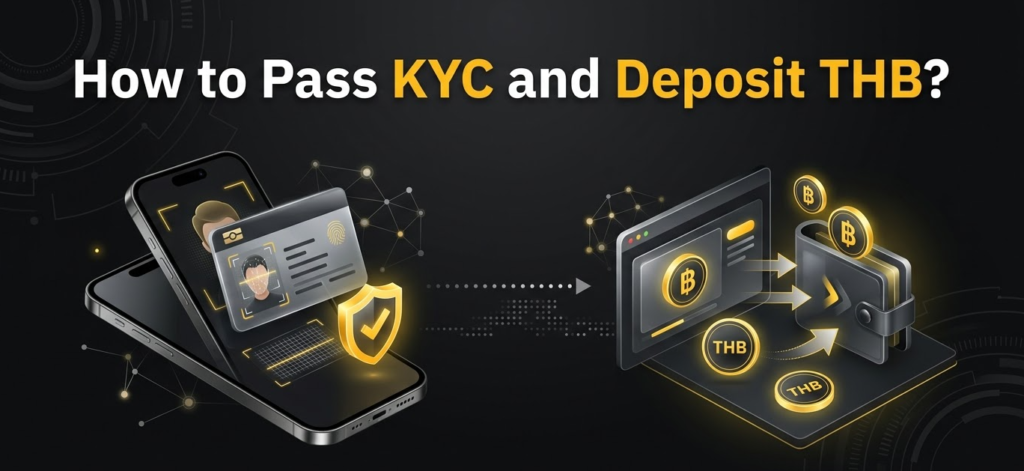
How to Pass KYC and Deposit THB?
Phase 1: Choose the Right Thai-Licensed Platform
Start by checking the SEC’s official database.
Don’t rely solely on Google results, Telegram groups or influencer recommendations.
The SEC Digital Asset Business Operator list is your first verification point.
For a beginner, narrow the choice to two or three platforms and compare:
- THB trading pairs.
- Trading fees.
- Fiat deposit options.
- Withdrawal fees.
- Supported assets.
- Foreign-user eligibility.
- Customer support.
- Account-security options.
Phase 2: Select the Correct Residency Status
During registration, make sure you correctly identify yourself as:
Thai citizen
or
Foreign citizen / resident
depending on the platform’s wording.
Don’t choose Thai-citizen verification just because you happen to be physically in Thailand.
Your nationality and residency status are compliance information, not a cosmetic setting.
Phase 3: Complete KYC as a Thai Citizen
For Thai citizens, digital identity can make the process much easier on platforms that support it.
Bitkub announced in August 2026 that Thai customers can use ThaID for identity verification. Its official ThaID announcement explains the new option.
Depending on the platform, Thai users may also be asked for:
- National ID.
- Selfie.
- Mobile number.
- Bank-account information.
- Additional information required for enhanced verification.
Phase 4: Complete KYC as a Foreigner
This is where I would slow down.
Have your documents ready before you start.
A foreign resident may be asked for:
- Passport.
- Selfie.
- Thai phone number.
- Residence information.
- Visa documentation.
- Work Permit where applicable.
- Additional proof of identity or address.
Bitkub’s current documentation confirms that foreign citizens need a passport and selfie at the initial verification level, while additional documents can be required. Its detailed foreigner KYC guidance provides examples of the documentation used for foreign customers who work or reside in Thailand.
Don’t assume that every exchange asks for exactly the same documents.
That’s one of the reasons I don’t recommend booking your entire Bangkok crypto strategy around a single platform before completing KYC.
Phase 5: Fund Your Account in THB
Once your account is approved, go to:
Wallet → Deposit → THB
The exact menu varies by exchange.
If PromptPay is available to your account, you’ll generally be given a payment instruction or QR flow.
The practical advantage is that PromptPay is already deeply embedded in Thai banking.
You don’t need to convert USD to THB through a complicated international payment chain just to buy Bitcoin.
But there’s one correction I’d make to the common “PromptPay is always free” claim:
Do not assume zero fees universally.
Payment methods, bank charges and exchange policies can change.
Check the fee displayed on the deposit screen immediately before sending the money.
Phase 6: Make Your First Crypto Purchase
Once THB arrives, start small.
Suppose you want to buy 2,000 THB of Bitcoin.
Before confirming, check:
- BTC price.
- THB amount.
- Trading fee.
- Amount of BTC received.
- Any applicable spread.
- Whether you are buying on the spot market.
Then confirm.
You don’t need leverage.
You don’t need futures.
You don’t need to start with ten different altcoins.
For a first transaction, your goal is simply to understand the entire cycle:
THB → BTC → portfolio → withdrawal → wallet
Once you’ve done that successfully, the platform starts making much more sense.
How Bangkok Expats Should Think About Crypto Banking
For an expat, the exchange itself is only half of the problem.
The other half is the relationship between:
Thai bank account → exchange account → crypto wallet → tax records
This is why I strongly recommend using accounts in your own name whenever the exchange requires it.
If you receive THB from an account belonging to someone else, you can create unnecessary compliance questions.
The safest operational habit is boring but effective:
Your bank account name should match your exchange identity wherever the platform requires that relationship.
Keep copies of:
- Deposit confirmations.
- Withdrawal confirmations.
- Exchange statements.
- Wallet transaction IDs.
- Purchase prices.
- Sale prices.
- THB conversion rates.
- Tax documents.
If you trade for several years, those records can become much more valuable than you expect.
What Makes the Lowest-Fee Crypto Exchange in Thailand Actually “Cheap”?
This is where many comparison articles go wrong.
Suppose Exchange A charges:
0.10% trading fee
while Exchange B charges:
0.25% trading fee
You might immediately choose Exchange A.
But what if Exchange A gives you a worse THB quote, charges more for deposits, charges more for withdrawals and has expensive fiat conversion?
The “cheapest” exchange isn’t necessarily the one with the smallest trading-fee number.
I would calculate your effective cost as:
Trading fee + spread + fiat funding cost + withdrawal fee + currency conversion cost
For example, Binance TH currently publishes a 0.25% fee for standard THB pairs and 0.10% for regular crypto-to-crypto pairs. Bitkub’s current published trading fee is 0.25%. You can compare the Binance TH fee schedule with the Bitkub trading-fee schedule.
That is a much more meaningful comparison than simply writing “Exchange A is cheaper.”
FAQ
Is cryptocurrency legal to trade in Bangkok?
Yes, cryptocurrency trading and investment are permitted within Thailand’s regulated digital-asset framework.
However, digital assets are not Thai legal tender, and the Bank of Thailand has consistently discouraged their use as a means of payment for goods and services. The Bank of Thailand’s official guidance explains this distinction.
The safest practical approach is to use a platform listed in the SEC’s official licensing database.
Which crypto exchanges are officially licensed in Thailand?
The SEC’s current database lists licensed digital-asset exchanges including:
- Bitkub Online.
- Gulf Binance.
- Orbix Trade.
- Upbit Exchange (Thailand).
- GMO-Z.COM Cryptonomics Thailand.
- Thai Digital Assets Exchange.
- Waan Exchange.
The SEC also lists other licensed digital-asset brokers, including InnovestX. Because licenses and business categories can change, verify the current status using the SEC’s official license database rather than relying on an old exchange list.
Is Bitkub or Binance TH better?
It depends on what you want.
Bitkub is particularly attractive if your focus is Thai-market liquidity, THB pairs and domestic user experience.
Binance TH is more attractive if you want a broader Binance-style trading environment and access to a larger ecosystem.
Binance TH’s current published fee for regular THB pairs is 0.25%, while Bitkub’s published cryptocurrency trading fee is also 0.25%, so the headline trading fee alone doesn’t settle the comparison.
Compare the actual assets, liquidity, payment methods and withdrawal costs that apply to you.
Can foreigners open a crypto exchange account in Bangkok?
Yes, foreigners can use eligible Thai digital-asset platforms, but KYC requirements can be more complicated than for Thai citizens.
Bitkub’s current account documentation accepts a passport and selfie for foreign customers at the initial verification level, while additional documents can be required depending on the customer’s circumstances. The Bitkub verification information provides the current requirements.
For foreign residents, expect that the exchange may request evidence relating to your Thai residence, immigration status or employment.
Can a tourist on a short-term visa use a Thai crypto exchange?
Don’t assume yes or no across the entire market.
Some Thai exchanges have detailed foreigner KYC requirements that can make ordinary tourist onboarding difficult, while Thailand has also introduced a specific TouristDigiPay framework for participating licensed operators serving certain foreign tourists.
The SEC’s TouristDigiPay documentation explains that participating operators must be licensed and must perform KYC/CDD under AMLO requirements.
So the correct answer is:
Eligibility depends on the specific service and your status.
What is the difference between Binance and Binance TH?
Binance.com is the global Binance platform, while Binance TH is the Thailand-focused platform operated by Gulf Binance Co., Ltd.
Binance TH holds Thai digital-asset licenses and operates under SEC supervision. The platform’s official company information explains the structure.
For THB services, this distinction is particularly important because Binance TH was established to provide those services through a locally licensed entity.
How do I deposit Thai baht into a crypto exchange?
Depending on the platform and your eligibility, you may be able to use:
- Thai bank transfer.
- PromptPay.
- Bank-linked payment methods.
- Other locally supported fiat channels.
The exact process varies by exchange.
Usually, you select THB Deposit, choose the supported payment method, follow the payment instructions and wait for the balance to arrive.
Always check the name of the receiving account and payment instructions carefully before transferring money.
Is PromptPay the cheapest way to buy crypto in Thailand?
PromptPay can be one of the most convenient local funding methods because it uses Thailand’s existing payment infrastructure.
But don’t assume it is universally free.
The exchange may have its own deposit rules, and your bank or payment provider can have separate conditions.
Always check the actual fee shown by the exchange when you initiate the deposit.
Do Thai crypto exchanges support foreigners?
Several do, but “supports foreigners” doesn’t mean “every foreigner is automatically eligible.”
KYC rules can depend on:
- Nationality.
- Thai residence.
- Visa type.
- Work status.
- Address.
- Source of funds.
- Account level.
- Regulatory requirements.
Bitkub explicitly documents foreign-customer verification, while SEC-licensed platforms have their own onboarding procedures.
Do I need a Thai bank account to trade crypto in Thailand?
Not necessarily for every form of crypto activity, but a Thai bank account can make the THB on-ramp substantially easier if you are a resident.
If your main objective is buying crypto with Thai baht, having access to Thai banking rails can simplify deposits and withdrawals.
For foreigners, however, the exact requirements depend on the exchange and account type.
Does Thailand charge a 15% tax on crypto profits?
The answer is more complicated than that.
Thailand’s Revenue Code contains a 15% withholding-tax provision for relevant categories of digital-asset income, but this should not be interpreted as “every crypto profit is automatically taxed at a flat 15% at the exchange.”
Binance TH explicitly says it does not currently withhold the 15% tax for customers and instead requires users to assess and report their own income. Its official tax guidance explains this position.
For a Thai tax resident with substantial trading activity, get professional tax advice.
Is crypto tax-free in Thailand?
No.
Thailand has introduced various tax exemptions and relief measures, including VAT exemptions for certain digital-asset transfers through regulated channels, but that does not mean crypto profits are universally tax-free.
The Revenue Department’s current tax-law archive shows the specific digital-asset tax measures that have been introduced.
Income-tax treatment is a separate question from VAT.
Can I use Bitcoin to pay for my apartment in Bangkok?
You should not treat Bitcoin as a normal replacement for THB when paying ordinary goods and services.
The Bank of Thailand has consistently stated that it does not support the widespread use of digital assets as a means of payment for goods and services. Its official payment guidance explains the regulatory concerns.
For rent, utilities and everyday expenses, use the payment method accepted by the landlord or service provider.
Is Binance TH cheaper than Bitkub?
For standard trading, both platforms currently publish a 0.25% rate for applicable THB trading, so the answer isn’t simply “Binance TH.”
Binance TH publishes 0.10% for regular crypto-to-crypto pairs, while Bitkub’s published cryptocurrency trading fee is 0.25%. Compare the specific market you’re trading, because liquidity and spread can matter just as much as the stated commission.
What is the safest crypto exchange in Bangkok?
There is no exchange that can honestly be described as completely risk-free.
For a Bangkok user, I would prioritize a platform whose legal status you can verify through the SEC, whose KYC and custody procedures are clear, and whose deposit and withdrawal processes are transparent.
Then add your own security:
- Strong password.
- Passkey or hardware security key where available.
- 2FA.
- Protected email account.
- Withdrawal-address checks.
- No sharing of OTPs.
- No remote-access software for “support.”
- No deposits to wallets supplied by strangers.
Regulation reduces some risks.
It does not eliminate the need for personal security.
Final Takeaways: Choosing the Best Crypto Exchange in Bangkok
Finding the best crypto exchange in Bangkok isn’t really about discovering one magical platform.
It’s about matching the exchange to the way you actually use money.
If you’re a Thai resident who wants straightforward THB trading and a deeply localized experience, Bitkub is an obvious candidate.
If you’re an experienced crypto user who wants a broader trading ecosystem while staying inside Thailand’s local regulatory framework, Binance TH is especially interesting.
If you already live inside the KBank ecosystem, Orbix can be worth exploring because its positioning is much more closely connected to traditional Thai banking.
If you’re building a broader investment portfolio and want crypto alongside stocks and other financial products, InnovestX offers a different model from a conventional crypto-only exchange.
And if you’re interested in the Upbit ecosystem, Upbit Thailand is another SEC-listed exchange worth comparing.
But I would make one thing non-negotiable:
Verify the legal entity before you deposit money.
The Thai SEC maintains an official database of licensed digital-asset businesses. Use it.
Then compare:
- THB funding: How easy is it to move baht in and out?
- KYC: Can you qualify as a foreign resident?
- Fees: What will you actually pay, not just the headline trading fee?
- Liquidity: Can you buy and sell your preferred assets efficiently?
- Security: Does the platform support strong authentication and appropriate custody controls?
- Tax records: Can you download complete transaction history?
- Withdrawals: Can you move your assets out without unreasonable friction?
- Regulation: Is the exact entity you are using listed by the SEC?
For locals, the answer may be as simple as choosing the exchange with the best THB liquidity and interface.
For expats, the equation is different.
Your visa, residence status, bank account, KYC documents and tax position can matter just as much as the exchange’s trading interface.
And that’s probably the biggest lesson I would take from the Bangkok crypto market in 2027:
The best exchange isn’t necessarily the one with the most coins or the lowest advertised fee. It’s the one you can legally use, fund easily, understand clearly, and operate safely for the long term.
Once you get those four things right, buying your first Bitcoin in Bangkok becomes much less complicated than it initially looks.