
Top Crypto Exchanges in the Country of Georgia Compared
If you are buying Bitcoin from Tbilisi, cashing out USDT in Batumi, or moving to Georgia as an expat, the exchange you choose affects more than the price of a coin. It determines how easily you can deposit GEL, how much you lose to fees and currency conversion, what identity checks you must complete, and how straightforward it is to withdraw your money.
For many residents, the most useful starting point is to compare a local platform with one international exchange. A Georgian-facing service may offer convenient GEL payments and local customer support. A global exchange may offer more trading pairs, deeper liquidity, and advanced order types, but its payment options and legal entity can differ by country.
One regulatory point matters before you compare brands: being available in Georgia is not the same as being registered with the NBG to provide virtual asset services in Georgia. The National Bank’s official Virtual Asset Service Providers (VASPs) page provides access to the register and explains the activities that fall within the VASP framework.
The NBG has also reminded the public that providing virtual asset services without the required registration or authorization can be unlawful. Its October 2025 warning about unregistered providers is worth reading before using an unfamiliar broker, cash desk, or kiosk.
Exchange comparison at a glance
The table below is a practical shortlist, not a guarantee that every service, payment method, or fee is available to every customer in 2027. Treat the fee figures as something to verify on the provider’s current pricing page rather than relying on old comparison articles.
| Platform or route | Regulatory position to verify | GEL funding and cash-out | Trading-cost considerations | Best suited to |
|---|---|---|---|---|
| Cryptal | Check its current NBG registration and the services covered by its registration | Publishes GEL funding methods, including bank transfer and selected local payment channels | Its published fee information has listed a 0.25% maker/taker trading fee; confirm the current schedule | Users who want a Georgian-facing exchange and local GEL rails |
| MyCoins.ge | Its website identifies it as an NBG-registered VASP; independently confirm the entity and registration details | Check current bank, card, and e-wallet options in the app | Retail quotes may include a spread; compare the final price before confirming | Casual buyers who prefer a straightforward local app |
| Binance | Confirm the legal entity and whether the intended service is available to Georgian residents | GEL availability may depend on the payment route, P2P market, and account | Spot fees, card conversion costs, and P2P prices can differ | Users who want broad market selection and global liquidity |
| Bybit | Verify current access, entity, and service eligibility for your residence | Check current GEL card or P2P options rather than assuming they are supported | Compare spot, derivatives, funding, and withdrawal costs separately | Experienced traders who need advanced tools |
| OKX | Confirm the applicable entity and local availability | Check whether GEL deposits or P2P payment methods are available to your account | Fees depend on product, tier, and order type | Traders seeking a broad set of digital-asset markets |
| WhiteBIT | Verify the entity and current authorization status for the services offered | Check available fiat rails and withdrawal routes | Compare trading fees, spreads, and fiat withdrawal costs | Users looking for another international trading venue |
| Physical OTC desk or crypto kiosk | Verify the operator’s NBG registration or other applicable authorization | May offer cash-based exchanges, subject to the operator’s terms | Quotes can include a substantial spread or service charge | Users who specifically need an in-person transaction |
For current local-platform pricing, start with Cryptal’s fees and limits and MyCoins’ official website. For international platforms, use the official website and account-specific terms rather than assuming that global products are available in Georgia.
Which exchange would I shortlist first?
If your priority is buying Bitcoin with GEL from a Georgian bank account, I would compare Cryptal and MyCoins first. Both are local-facing options, and their deposit methods and pricing can be checked without having to build your process around a foreign payment provider.
If you already use an international exchange and need a wider selection of trading pairs, compare the service available to your Georgian account with a local platform’s quote. You may find that the international exchange has a better price for one trade but a more expensive deposit or cash-out route.
Here is how I would decide:
- For recurring GEL purchases: Compare the actual GEL amount received after all deposit and trading charges.
- For active spot trading: Check liquidity, maker/taker fees, supported order types, and withdrawal costs.
- For advanced trading: Confirm that derivatives are available to your account and understand leverage and liquidation risks.
- For cash withdrawals: Ask for a complete quote in GEL or USD, including any commission and the rate used.
- For expats: Confirm passport verification, country-of-residence rules, and which payment methods accept your bank account.
There is no single platform that wins every category. The right choice is the one that fits your funding route and trading habits while making its legal status, fees, and withdrawal conditions clear.
Regulatory Framework: NBG VASP Registration and AML Standards
Regulatory Framework: NBG VASP Registration and AML Standards

Georgia-the country in the Caucasus, not the US state-has established a regulatory framework for virtual asset service providers. The National Bank of Georgia supervises VASPs, including registration and anti-money-laundering and counter-terrorist-financing obligations. For anyone choosing an exchange, this is more than a legal technicality: it helps you distinguish a provider operating under the local framework from an unverified business that simply advertises crypto services.
What is an NBG-registered VASP?
VASP stands for Virtual Asset Service Provider. The NBG’s framework covers a range of services, including exchanging virtual assets for fiat currency, exchanging one virtual asset for another, transferring virtual assets, safeguarding or administering them, and operating a virtual asset trading platform. The exact services a provider may offer depend on its registration and the applicable rules.
Georgia’s mandatory VASP registration framework came into force on January 1, 2023. The NBG describes its objectives and the obligations of providers in its official VASP supervision guidance and its announcement on the approval of the VASP registration rule.
Registration is not a blanket guarantee that customer funds are insured or that an exchange is free from operational risk. It means the provider is subject to the applicable regulatory framework for the registered services. You still need to evaluate its custody arrangements, account security, fee transparency, and withdrawal policies.
How to check the NBG register
Do not rely only on the exchange’s homepage, social media account, or an influencer’s recommendation. Verify the provider yourself.
- Open the NBG’s official VASP supervision page.
- Open the current register of registered providers.
- Search for the legal entity’s name, not just its brand.
- Compare the registration information with the company named in the platform’s terms and conditions.
- Confirm that the registration remains active and covers the service you intend to use.
- Check the provider’s registration document and any conditions or restrictions attached to it.
This final step is especially important in 2027. On September 8, 2026, the NBG announced amendments to the supervisory framework that specify the services for which a provider is registered and introduce additional requirements, including minimum supervisory capital for relevant activities. The amendments also set future compliance deadlines for some requirements. Read the NBG’s September 2026 regulatory update and check the current register rather than assuming that an older listing tells the whole story.
From January 1, 2026, providers have also been required to display or make easily available their individual NBG registration decision in the places where they provide virtual asset services. The NBG explains this change in its November 2025 announcement on registration transparency.
Does registration mean your money is protected?
No. Registration and consumer safeguards matter, but they do not eliminate the risks of using a crypto exchange.
An exchange may be subject to AML/CFT supervision and still experience a cyberattack, technical outage, liquidity problem, or insolvency. A provider’s registration also does not mean that the market price of Bitcoin or USDT is guaranteed to remain stable.
Before transferring a meaningful amount, look for clear answers to these questions:
- Who legally holds your fiat balance?
- Are crypto-assets held by the exchange itself or an external custodian?
- What happens to customer assets if the provider becomes insolvent?
- Does the exchange support withdrawals to a wallet you control?
- What are the withdrawal limits, processing times, and review procedures?
- Does the platform explain how it handles complaints and account restrictions?
For larger balances, consider whether you need to leave everything on an exchange. Self-custody can give you more direct control over your private keys, but it also means you are responsible for protecting your recovery phrase and using the correct wallet address and network.
Can an international exchange serve Georgian residents?
Possibly, but you should not treat a global brand as proof of local authorization. International exchanges can offer different services in different jurisdictions, and the legal entity that serves one customer may differ from the entity that serves another.
The NBG’s guidance identifies the types of activities that fall within the local VASP framework. The regulator has also warned against using unregistered providers offering virtual asset services in Georgia. Therefore, verify both the platform’s contractual entity and the relevant registration or authorization before relying on it for local services.
If an exchange is available through a website or app, that alone does not settle the question. Check the country-specific terms, identity-verification rules, payment options, and withdrawal conditions. If the provider cannot clearly identify the entity serving you, treat that as a reason to pause.
Crypto Tax in Georgia: Understanding the 0% Personal Tax Claim
Georgia is frequently discussed as a favorable destination for crypto investors and digital nomads. You may have seen claims that private individuals pay 0% tax on gains from selling cryptocurrency. That claim is based on Georgian tax guidance and the way virtual-asset transactions have been interpreted, but it should not be expanded into a promise that every crypto-related activity is tax-free for every person.
The difference matters if you are an expat, a full-time trader, a crypto entrepreneur, a miner, or someone running a company. Your tax residence, the nature of the activity, the source of income, and whether you operate personally or through a business can all affect the analysis.
What does Article 82 say?
Article 82 of the Georgian Tax Code lists categories of income earned by natural persons that are exempt from income tax. The article itself should not be read as a standalone sentence declaring that all cryptocurrency gains are tax-free. The commonly cited treatment of crypto comes from the wider tax framework and official interpretive guidance on virtual-asset transactions.
You can read the Georgian Tax Code on the official legislative website. For a discussion of how the Georgian tax authorities’ interpretation has been understood in relation to cryptocurrency, see this legal analysis of crypto taxation in Georgia.
The general position described in that analysis is that income received by an individual from the supply of crypto-assets may be exempt from personal income tax and that exchanging cryptocurrency for national or foreign fiat currency may be exempt from VAT under the relevant interpretation. However, the treatment of different crypto-related activities is not necessarily identical.
A careful way to understand the headline claim is this: private individuals may qualify for favorable tax treatment when disposing of crypto-assets, but you should confirm that the particular transaction and your personal circumstances fit the applicable rules.
Does the 0% treatment apply to expats?
A foreign passport does not automatically make someone a Georgian tax resident, and Georgian tax residency does not automatically resolve every tax question in their favor. You need to distinguish immigration status, tax residence, and the source and nature of your income.
Under Article 34 of the Georgian Tax Code, a natural person will generally be treated as a Georgian tax resident for the relevant tax year if they have been physically present in Georgia for at least 183 days during a continuous 12-month period ending in that tax year, subject to the statutory details and exceptions. The law also provides for residency in certain circumstances involving high-net-worth individuals.
You can review the residence provisions in the official Tax Code. The 183-day rule is a useful starting point, but do not assume it is the only test that can matter in a cross-border situation.
If you are an expat who holds crypto while living in Georgia, ask yourself:
- Are you a Georgian tax resident for the relevant period?
- Are you holding crypto as a private individual or conducting a business?
- Are your activities limited to buying, holding, and selling assets, or do they include mining, staking, lending, advisory work, or services?
- Do you remain tax resident in another country?
- Does your home country tax worldwide income or apply special rules to crypto disposals?
- Do you have a reporting obligation even if Georgia does not impose tax on the relevant gain?
This last point is easy to overlook. A favorable tax position in Georgia does not automatically remove a tax obligation in another country. If you moved during the tax year, the rules of both jurisdictions may need to be considered.
Crypto capital gains versus crypto-related business income
Buying Bitcoin with personal savings and selling it later is not the same activity as operating a trading company, providing crypto exchange services, or receiving payment for professional work in digital assets.
For individuals, the commonly cited exemption relates to the personal tax treatment of certain crypto-asset disposals. Other activities may have different rules. For example, mining services, employment income paid in crypto, business profits, and income from providing services cannot simply be assumed to fall under the same treatment as a private investor’s sale of crypto.
If you regularly trade on behalf of others, run a crypto-related business, or receive tokens as compensation, get advice that addresses the precise activity. The correct classification matters more than the fact that the payment or asset happens to involve cryptocurrency.
Personal tax treatment is not corporate tax treatment
One of the most common mistakes is assuming that a company registered in Georgia receives the same tax treatment as an individual holding crypto.
Georgia generally uses a distributed-profit model for corporate income tax. Article 98 of the Tax Code sets a 15% corporate profit tax rate for the general regime, with the relevant rules governing which distributions and transactions are taxable. See the official Tax Code provisions on corporate profit tax.
This does not mean that every company pays exactly 15% on every accounting profit as soon as it is earned. The tax base and timing depend on the statutory rules, including the treatment of distributed profits and certain deemed distributions. Special tax regimes may also apply where the business meets the requirements, but you should not assume that a Virtual Zone, Special IT, or other status automatically exempts crypto-related income.
If you are considering operating through a Georgian company, separate the following questions:
- Is the company conducting business or merely holding assets?
- What kind of income does it receive?
- Does the distributed-profit tax regime apply to the transaction?
- Does the company qualify for a special status, and does that status cover the relevant activity?
- Are there tax obligations in other jurisdictions?
A company structure can be useful for legitimate business reasons, but it should not be created on the assumption that it will turn every crypto transaction into tax-free income.
VAT and crypto transactions
The tax treatment of a private crypto sale and the VAT treatment of a business transaction are different questions. Legal analyses of Georgian crypto taxation have described a favorable VAT treatment for exchanges of cryptocurrency into fiat under the relevant interpretation. That does not mean every service involving crypto is automatically outside VAT.
For example, a business charging fees for professional services, software development, consulting, or another activity may have separate VAT questions even if it receives payment in crypto. The nature of the service and the identity and location of the customer can matter.
If your crypto activity is more complex than private investing, check the current guidance from the Georgian Revenue Service and seek professional advice. You can begin with the Revenue Service of Georgia, which publishes tax information and taxpayer services.
A practical tax-record checklist
Even when you expect a favorable tax outcome, keep records. Good documentation helps establish what happened, when it happened, and whether the activity was personal or business-related.
Keep:
- Exchange statements showing deposits, purchases, sales, and withdrawals.
- Wallet transaction records and relevant blockchain transaction IDs.
- The dates and values of crypto disposals.
- Bank records showing the source of fiat deposits and proceeds from cash-outs.
- Documents showing your tax residence and days spent in each country.
- Records of mining, staking, lending, or service income if relevant.
- Company records if the transactions took place through a legal entity.
A tax exemption is not a reason to discard the evidence needed to support it. If a bank, tax authority, or accountant asks how a large amount of GEL arrived in your account, transaction records and a clear explanation of the source of funds can save considerable time.
Banking Infrastructure: TBC Bank, Bank of Georgia, Liberty Bank, and GEL Funding
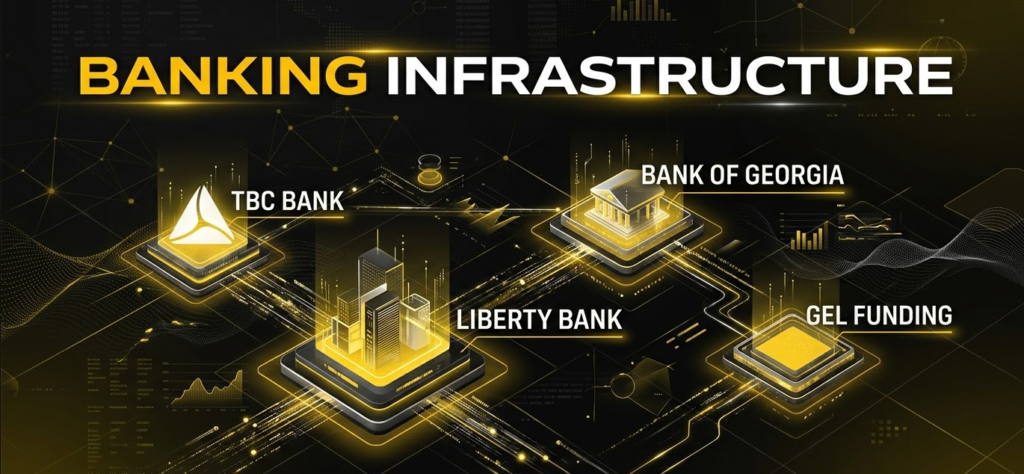
For many users, the practical question is simple: how do you move money between a Georgian bank account and a crypto exchange without paying unnecessary fees or triggering an avoidable delay?
The answer depends on the platform and payment method. A local exchange may support domestic bank transfers, open-banking payments, bank cards, or other local channels. An international exchange may instead offer card payments or P2P transactions, and those options can change over time.
Do not assume that a platform’s support for GEL means it has a direct integration with every Georgian bank. Verify the deposit and withdrawal methods displayed in your own account.
TBC Bank and Bank of Georgia
TBC Bank and Bank of Georgia are major commercial banks in Georgia. Their mobile and internet banking services make domestic transfers convenient, but the presence of a bank in a payment flow does not automatically mean that every crypto exchange has a direct integration with that bank.
When using a local platform, open its deposit page and check the exact method offered. Cryptal, for example, lists bank transfers and several local payment channels in its official fee and limit schedule. That page is more useful for understanding actual costs than a generic statement that the exchange supports “local banking.”
Before sending GEL, confirm:
- The beneficiary name and bank details.
- Whether the transfer must originate from an account in your own name.
- Whether a payment reference or account identifier is required.
- The minimum and maximum deposit amounts.
- Any transfer fee charged by the exchange or payment provider.
- How the exchange handles deposits from third parties.
For a first transfer, use a modest amount and wait until the exchange confirms receipt. If the transfer is delayed, contact the platform through its official support channel and keep the bank receipt.
Buy Bitcoin with GEL from a TBC Bank account
If your goal is to buy Bitcoin using GEL held at TBC Bank, you can usually approach the task through a platform that explicitly supports GEL deposits. The process is not identical on every exchange, so use the steps below as a checklist rather than assuming every screen will look the same.
- Choose a platform. Compare a local provider such as Cryptal or MyCoins with any international exchange you already use.
- Verify the legal entity. Check the NBG register and confirm that the provider is permitted to offer the service you need.
- Complete KYC. Submit your identity documents and any additional information requested.
- Open the GEL deposit section. Select the bank transfer, open-banking, or card method actually offered.
- Check the details. Confirm the beneficiary, reference code, amount limits, and fees.
- Make a small deposit. Use your TBC mobile banking app or the payment flow supplied by the exchange.
- Wait for confirmation. Do not place a trade until the funds appear as available in your exchange account.
- Compare the BTC quote. Check the final GEL cost, including trading fees and any spread.
- Place your order. Confirm the amount of Bitcoin you will receive before submitting the trade.
- Review custody options. If you intend to use a private wallet, check the supported withdrawal network and any verification requirements first.
The key is to compare the total cost, not just the deposit fee. A deposit that costs nothing can still be followed by an expensive instant-buy quote.
Bank cards versus bank transfers
Card deposits can be convenient because they are familiar and may be processed quickly. The downside is that card funding can involve a percentage-based charge or a less favorable conversion rate.
Cryptal’s published schedule, for example, lists different fees depending on the currency and payment method, including fees for selected card and wallet channels. Check the current fee table before deciding which method to use; do not assume the fee shown in an older article is still correct.
Bank transfers may be cheaper for some transactions, but processing time and account-reference requirements vary. If you are depositing a larger amount, compare the total charge and processing time for each available route.
Local payment services: eMoney.ge and UniPAY
Local e-wallets and payment aggregators can offer another way to move money, but availability is platform-specific. Do not assume that eMoney.ge or UniPAY is supported by every exchange or that a particular wallet can be used for both deposits and withdrawals.
Before using a payment service, verify three things:
- It is currently supported by the exchange for your account.
- The payment service permits the intended transaction under its own terms.
- The fee and exchange rate are shown clearly before you confirm.
If you cannot find the payment method in the exchange’s official deposit menu, do not rely on an old tutorial or a third party claiming to offer a shortcut. Use a supported route instead.
Cashing Out USDT or Bitcoin in Tbilisi and Batumi
If you need physical cash, the challenge is not simply selling crypto. You need a trustworthy route from the digital asset to GEL or USD, with a clear quote and a reliable way to receive the money.
Possible routes include selling through a local exchange and withdrawing to a bank account, using a registered provider that offers an eligible cash service, or visiting a physical OTC desk where such a service is legally offered. Availability can change by location, asset, amount, and customer-verification status.
I would not assume that every crypto ATM or cash desk advertised online is registered, currently operating, or suitable for a large transaction. Verify the operator before sending assets.
Option A: Sell crypto through a local exchange and withdraw to your bank
For many people, this is the most straightforward route. You transfer crypto to an exchange account, sell it for GEL, and withdraw the fiat balance to your own bank account using the supported method.
The process generally looks like this:
- Complete verification with the exchange.
- Confirm that the exchange supports the asset and network you intend to send.
- Deposit a small test amount if this is your first transfer.
- Sell the crypto for GEL at the available market price or through a limit order.
- Review the withdrawal fee and minimum amount.
- Withdraw GEL to your own verified bank account.
- Keep the transaction records and bank statement.
This route is often easier to document than a cash transaction because you have an exchange record and a bank record. However, it is not guaranteed to be the cheapest option, so compare the trading price, withdrawal charge, and any bank fees.
Option B: Use a physical OTC desk
An over-the-counter desk may arrange a direct transaction for customers who need a larger conversion or prefer in-person service. However, the service is not standardized: each operator can have different supported assets, minimum transaction sizes, verification requirements, operating hours, and pricing.
Before visiting an OTC desk in Tbilisi or Batumi, contact the operator through a verified channel and ask:
- What is the exact legal company name?
- Is the company registered with the NBG for the relevant virtual asset service?
- Which assets and networks does it accept?
- Does it pay out in GEL, USD, or both?
- What exchange rate and service fee will apply?
- What identification and source-of-funds documents are required?
- Is an appointment needed, and how will the cash handover work?
Ask for a complete quote before sending crypto. If the operator quotes a rate that seems unusually favorable, check it against the prevailing market price and ask how its commission is calculated.
For your own safety, avoid sending assets to an unknown wallet address based only on a chat message. Confirm the receiving address and transaction instructions through the provider’s official channel, and keep a record of the agreed amount and terms.
Option C: Crypto ATMs and kiosks
Crypto kiosks can be convenient for certain transactions, but their fees and limits can be materially different from those of an online exchange. Some kiosks primarily support buying crypto with cash, while others may offer selling or cash-out functionality. Never assume a machine supports USDT-to-cash conversion simply because it displays a crypto logo.
Before using a kiosk, confirm:
- It is currently operating at the advertised location.
- It supports the exact asset and network you hold.
- It can perform the direction of transaction you need-buying or selling.
- The operator’s legal identity and relevant registration.
- The quoted exchange rate, fees, and transaction limits.
- Whether identity verification is required.
I cannot responsibly provide a verified list of currently operating crypto cash-out machines in specific Tbilisi neighborhoods or in Batumi without confirming each location and operator. Treat location listings on maps or social media as leads to verify, not proof of authorization or current availability.
Why USDT cash-out deserves extra care
USDT is designed to track the US dollar, but it is not the same thing as a dollar bank deposit or a physical USD note. The price you receive when selling USDT depends on the venue, liquidity, payment method, and any premium or discount in the market.
If you want USD cash, ask whether the operator pays out actual USD banknotes and what rate it uses. If you want GEL, compare the quoted GEL amount with the prevailing USD/GEL or USDT/GEL rate. A service can advertise a “zero fee” transaction while building its revenue into the exchange rate.
For larger cash-outs, ask about source-of-funds documentation before you arrive. An exchange or bank may ask where the crypto came from, how it was acquired, or why a transaction is unusually large. Keeping purchase records, wallet histories, and exchange statements makes those questions easier to answer.
Critical Knowledge Gaps and Pitfalls for Crypto Traders in Georgia
Even a good exchange choice can become expensive if you misunderstand how local banking, tax, and compliance work. These are the mistakes I would try to avoid.
Confusing Georgia the country with Georgia the US state
Search results for “crypto in Georgia” can mix information about the Caucasus country with US federal and state rules. That can lead to completely irrelevant advice about the IRS, FinCEN, US state licensing, or US tax forms.
For this guide, the relevant authorities are the National Bank of Georgia and the Georgian Revenue Service. Start with the NBG’s VASP supervision page and the Georgian Revenue Service website rather than assuming that US rules apply.
If you are an American citizen or remain tax resident in the United States, however, US tax obligations may still matter even while you live in Georgia. Your location does not automatically remove tax obligations created by citizenship or tax residence elsewhere.
Ignoring GEL-to-USD conversion costs
A global exchange may show a low spot trading fee, but that figure does not include every cost involved in getting GEL onto the platform. If the funding route converts GEL into USD or EUR at an unfavorable rate, the currency conversion can cost more than the trade itself.
For example, imagine a payment route that gives you an effective exchange rate 2% worse than the rate you could otherwise obtain. On a GEL 5,000 deposit, that difference is GEL 100 before trading or withdrawal fees. This is an illustration of how conversion costs work, not a claim that every card processor charges a 2% markup.
To avoid unpleasant surprises:
- Compare the final GEL amount debited with the foreign-currency value credited.
- Check the exchange rate and card processing fee before confirming.
- Compare a card deposit with a domestic bank transfer if both are supported.
- Compare the actual purchase quote rather than only the displayed trading commission.
If you intend to buy crypto regularly, a small difference in the funding rate can compound into a meaningful cost over time.
Assuming all individual crypto gains are automatically tax-free
Georgia has a reputation for favorable personal crypto taxation, but “0% tax” should not be used as a universal promise. The tax treatment can depend on whether you are disposing of crypto as a private individual, providing services, mining, operating through a company, or earning compensation in digital assets.
The legal basis also matters. Article 82 of the Tax Code lists tax-exempt income categories, while the interpretation of crypto transactions involves the broader tax framework and relevant guidance. Read the Tax Code and the legal analysis of crypto taxation in Georgia, and get advice if your activity is more complex than ordinary personal investing.
Sending large transfers to an unverified broker
A broker may promise better rates, faster settlement, or no fees. If the provider’s legal identity and registration are unclear, those promises are not enough to justify transferring funds.
The NBG has warned that receiving virtual asset services from unregistered entities may expose customers to deception and financial loss. See its warning on unregistered virtual asset providers.
Before using a broker, confirm the legal entity, check the NBG register, ask for a written quote, and verify the receiving wallet through an official channel. If the provider refuses to identify itself or pressures you to act immediately, walk away.
Using P2P without checking the counterparty
Peer-to-peer trading can offer flexibility, but it also introduces counterparty risk. A seller may send fiat from an account that does not belong to them, provide false payment confirmation, or try to reverse a payment after you release crypto.
If you use an exchange’s P2P marketplace, keep the transaction inside the platform and follow its escrow and dispute procedures. Never release crypto because a buyer sends a screenshot claiming to show a transfer; verify that the funds have actually arrived and are available in your bank account.
Avoid third-party payments, unexplained overpayments, and requests to move the conversation to an unrelated messaging app. If a counterparty wants you to bypass the exchange’s normal process, consider it a warning sign.
Treating “zero fees” as zero cost
An exchange can charge no explicit deposit fee and still make money through a spread. A kiosk can advertise no commission while quoting a less favorable rate. A P2P seller can ask for a premium over the market price.
Compare the effective price: how much GEL you pay, how much crypto you receive, or how much fiat you get back after every charge. That is the number that matters.
Top Exchanges in Georgia
The following reviews focus on the use case each platform may fit. They are not a guarantee of current access, legal status, or fee levels. Confirm the current entity, service eligibility, and terms before opening or funding an account.
Cryptal: A local GEL-focused option
Cryptal is one of the first local-facing platforms I would investigate if I wanted to buy crypto using GEL. Its website publishes fee information for bank transfers, card payments, and other payment channels, making it possible to compare the costs of funding an account before depositing money.
The official Cryptal fees and limits page is particularly useful because it lists payment methods and charges by currency and asset. Its published information has included free bank-transfer deposits for certain fiat currencies and charges for selected card or wallet routes. These details can change, so use the current schedule rather than copying a fee from an old article.
Why it may suit you
- A Georgian-facing service with GEL funding options to investigate.
- Published fee information for multiple payment routes.
- A possible fit for users who prefer local support and local banking.
- A platform to compare when you want to buy or sell crypto without relying entirely on an international card processor.
What I would check first
Verify Cryptal’s current registration and the exact services covered by it in the NBG register. Then compare the total cost of a transaction, including trading fees, the quote or spread, deposit charges, and withdrawal fees.
Do not assume that every bank or card route is free, or that the advertised deposit method is available to every customer. If you intend to withdraw crypto to a private wallet, check the supported network and the fee shown before confirming.
My take: Cryptal deserves a close look for GEL-focused users, especially if local funding and clear payment instructions are priorities. Its value depends on the price you receive and the fees for your particular route, not just the convenience of the interface.
MyCoins.ge: A simple local buying and selling experience
MyCoins presents itself as a locally regulated virtual asset service provider. Its website identifies the company as registered with the NBG under registration number 0001-9004. You should still independently confirm the legal entity and current status through the NBG’s official VASP register, rather than relying solely on the company’s own statement.
MyCoins may appeal to users who prefer a mobile-oriented retail experience and do not need a professional order book. For occasional purchases, a simple buy-and-sell interface can be easier to use than a trading terminal with multiple order types.
Why it may suit you
- A local-facing app and retail-oriented interface.
- A starting point for comparing GEL funding options.
- An alternative to international exchanges for casual buying and selling.
- A platform whose registration details can be checked against the NBG register.
What I would check first
Start with the official MyCoins website and review the current deposit and withdrawal methods, the legal terms, and the price quoted for your intended transaction. A retail broker may incorporate its margin into the buy or sell price, so compare the final rate against another platform.
If you are moving a larger amount, ask about account limits, identity checks, source-of-funds requirements, and the documentation provided for transactions.
My take: MyCoins is worth considering if you want a straightforward local experience. The key comparison is the effective price and the ease of withdrawing your money, not simply whether the app makes the purchase process look quick.
Binance: Broad markets, but verify Georgian account access
Binance is known for its wide range of crypto markets and trading tools. It may appeal to users who want to trade multiple assets or already have an account and understand how its spot markets and P2P marketplace work.
However, a global Binance account should not be treated as proof that every payment route or product is available to Georgian residents. Services, legal entities, card funding options, and P2P counterparties can vary by location and account status.
Why it may suit you
- A broad selection of digital assets and spot markets.
- Tools for users who are comfortable with order books.
- P2P functionality where it is available to the account.
- A familiar option for people already using the platform internationally.
What I would check first
Confirm the legal entity and the current country-specific terms that apply to you. Check whether GEL deposits or withdrawals are available directly, whether the displayed P2P offers support your preferred bank, and what fees apply to the payment method.
For P2P trades, verify the counterparty’s payment instructions and never release crypto before you can confirm receipt of the fiat funds. Do not accept payment from an unrelated third party simply because the offered exchange rate looks attractive.
My take: Binance may suit traders who need broad market access, but the best route for a Georgian user depends on actual GEL availability and total costs. Compare it against a local exchange using the same amount and asset before deciding where to trade.
Bybit: Advanced tools for experienced traders
Bybit may be relevant if you need a trading-focused interface and advanced market tools. Yet if your goal is simply to buy Bitcoin with GEL and hold it, the additional complexity may not offer much practical benefit.
Access to derivatives and leveraged products is particularly important to verify. Do not assume that a product advertised on an international website is available to your account or permitted under the terms that apply in Georgia.
Why it may suit you
- A trading-oriented interface.
- Advanced tools for users who understand market and order mechanics.
- A possible alternative for users seeking international liquidity.
What I would check first
Visit the official Bybit website and confirm current account eligibility, legal terms, available fiat payment routes, and the relevant regulatory position. Compare spot fees separately from derivatives fees, funding payments, and withdrawal costs.
Leverage increases both potential gains and potential losses. If you are unfamiliar with liquidation, margin requirements, or funding rates, start with spot trading rather than using borrowed exposure.
My take: Bybit is most relevant if you genuinely need the available trading tools and have confirmed access from Georgia. For a straightforward GEL purchase, a local exchange may be easier to compare and manage.
OKX and WhiteBIT: Alternatives for global market access
OKX and WhiteBIT are additional platforms worth investigating if you want alternatives to Binance or Bybit. They may offer a broad selection of crypto markets, advanced interfaces, and different fee structures, but their local availability and payment routes should be checked individually.
Why they may suit you
- Additional venues for comparing spot-market liquidity and prices.
- Trading tools for more experienced users.
- A way to diversify your exchange access, provided you understand the risks of each account.
What I would check first
Use the official OKX website and WhiteBIT website to verify the current legal entity, account eligibility, supported payment methods, and withdrawal rules. Confirm whether the service you intend to use is covered by the provider’s relevant registration or authorization.
Do not assume that a global exchange has direct GEL order books just because GEL appears as a payment currency or a P2P settlement option. A payment method, a quoted currency, and a native spot market are three different things.
My take: These platforms are worth comparing if you need international trading features. If your priority is simply depositing GEL and withdrawing it to a Georgian bank account, verify the fiat rails first; the depth of the global market is not useful if funding and cash-out are awkward or expensive.
Entity Relationships and Regulatory Workflow
A typical crypto transaction in Georgia involves several separate parties. Understanding what each one does makes it easier to identify where a delay, fee, or compliance check may arise.
Trader or expat in Georgia
The user chooses a platform, completes identity verification, and decides whether to buy, sell, or transfer crypto.
NBG-registered VASP
The provider facilitates the virtual asset service within the scope of its registration and applicable rules. Users should confirm the legal entity and permitted services through the official NBG register.
Commercial banking infrastructure
TBC Bank, Bank of Georgia, or another supported payment provider may be involved in transferring GEL. The bank processes the fiat payment; it does not guarantee the value or safety of the crypto bought with that money.
Crypto wallet or trading account
The crypto may remain in the exchange account or be transferred to a self-custody wallet. Exchange custody and self-custody have different security and operational risks.
Georgian Revenue Service
The Revenue Service is the relevant tax authority for Georgian tax matters. The investor or business remains responsible for determining the applicable reporting obligations and retaining appropriate records.
This workflow is not a promise that every provider supports every bank or that every private crypto disposal is exempt from tax. Each relationship depends on the specific service, account, and transaction.
Buying and Cashing Out Crypto in Georgia

This checklist is designed for someone who wants to buy crypto with GEL, use a local bank, and potentially convert the asset back into fiat later. Exact menu names vary by exchange, but the core checks remain the same.
Phase One: Select a platform and complete verification
Choose the provider. Compare Cryptal and MyCoins for local GEL funding, and compare an international exchange if you need specific markets or trading tools.
Verify the registration. Open the NBG’s VASP supervision page, search the legal entity, and confirm that the relevant service is covered.
Read the terms. Check the account agreement, custody terms, deposit and withdrawal limits, and fee schedule.
Complete identity verification. Submit your Georgian ID or foreign passport if accepted, along with any additional documents the provider requests. Do not assume that every platform accepts every passport or country of residence.
Secure the account. Use a unique password and enable two-factor authentication. Protect the email account associated with the exchange as well.
Phase Two: Deposit GEL through a supported bank route
Open the deposit page. Choose GEL and review the payment methods actually available to your account.
Check the payment details. Confirm the beneficiary, bank details, reference code, limits, and charges before initiating the transfer.
Use your own bank account. If the exchange requires a matching account name, do not try to work around that requirement with a friend’s or relative’s account.
Make a small first deposit. Use TBC Bank, Bank of Georgia, or another supported route according to the exchange’s instructions. Wait for the funds to appear as available.
Compare the final price. Before buying BTC or USDT, review the quote and calculate the effective cost in GEL, including any spread and trading fee.
Place the order. Confirm the asset, amount, and total cost. If you use an order book, understand the difference between a market order and a limit order.
Phase Three: Cash out through a verified route
Choose how you want to receive fiat. If you want GEL in your bank account, check whether the exchange supports a GEL withdrawal to that account. If you need physical USD or GEL, confirm that a verified provider offers the exact cash service.
Check the receiving route. For a crypto transfer, confirm the asset, network, address, and minimum deposit. For a bank withdrawal, confirm the beneficiary details and expected processing time.
Test the process. When using a new wallet or withdrawal route, consider a small test transaction before sending a larger amount.
Review the cash-out quote. Confirm the rate, service fee, and amount you will receive. Do not rely on a “zero commission” claim without checking the effective rate.
Retain records. Save the exchange confirmation, blockchain transaction ID where relevant, and bank or cash receipt.
If you are using a physical OTC desk, confirm the legal entity and registration before sending any crypto. Arrange the transaction through an official channel and do not release assets based only on a screenshot of a payment.
Frequently Asked Questions
Which crypto exchange is best for buying crypto directly with Georgian lari (GEL)?
Cryptal and MyCoins are sensible local-facing platforms to compare first. Review their current GEL funding methods, the total price of the transaction, and their NBG registration details. Binance and other international exchanges may be useful for broader markets, but their GEL payment options depend on the account, payment route, and current service availability.
Is cryptocurrency legal in the country of Georgia?
Georgia has a regulatory framework for virtual asset service providers, including mandatory NBG registration for covered services. Crypto-assets are not legal tender, and the NBG states that payments using virtual assets are generally prohibited except for specified cases connected with permitted virtual asset services. See the NBG’s official VASP FAQ for the relevant rules.
Using crypto as an investment is not the same as operating an unregistered exchange or using crypto as ordinary payment for goods and services. Check the rules relevant to your activity.
Are cryptocurrency trading profits taxed in Georgia?
The commonly cited tax treatment is favorable for certain disposals of crypto-assets by private individuals, and legal analysis of the Georgian framework describes an exemption from personal income tax for income from the supply of crypto-assets under the relevant interpretation. But the headline “0% tax” should not be treated as a universal rule for businesses, mining, professional services, or every cross-border situation.
Read the Georgian Tax Code and the legal analysis of crypto taxation in Georgia, and seek professional advice if your activity is more complex than personal investing.
What is an NBG VASP registration, and why does it matter?
VASP means Virtual Asset Service Provider. The NBG’s framework covers activities such as exchanging, transferring, safeguarding, and administering virtual assets. Checking registration helps you determine whether a provider is operating under the applicable local framework for the service it offers.
Registration does not guarantee that an exchange cannot fail, that prices will remain stable, or that customer assets are insured. Confirm the provider’s current status and read its custody and withdrawal terms.
How can I transfer GEL from TBC Bank or Bank of Georgia to a crypto exchange?
First choose a platform that explicitly supports GEL funding for your account. Open its deposit page, select the supported bank transfer, open-banking, or card route, and follow the payment instructions. Check the beneficiary, reference code, fees, and account-name requirements before sending money.
Cryptal publishes details of supported methods and fees on its fees and limits page. Always use the current information displayed by the provider rather than relying on a general claim that a bank is “integrated.”
Can foreign expats and digital nomads open crypto accounts in Georgia?
Some local and international platforms accept foreign passports, but acceptance depends on the provider’s current onboarding rules, your country of residence, and the documents you can supply. Complete the platform’s KYC process and confirm that the service is available to your account before depositing funds.
Opening an exchange account does not automatically make you a Georgian tax resident. The 183-day rule and other residency provisions should be considered separately.
Where can I cash out USDT or Bitcoin into physical cash in Tbilisi or Batumi?
Possible routes include selling through a local exchange and withdrawing fiat to your bank account, or using a verified provider that offers a cash-based service. Some crypto kiosks and OTC desks may offer relevant services, but availability, supported assets, fees, and registration status must be checked individually.
Before sending crypto, verify the operator’s legal identity, current registration where required, exact exchange rate, fees, and cash payout procedure. I would not rely on an unverified social media listing or assume that every crypto ATM can sell USDT for cash.
Are GEL deposits always free on local crypto exchanges?
No. Some deposit methods may be free, while cards, payment aggregators, or other routes can involve charges. The trading price may also include a spread even if the deposit itself costs nothing. Check the current fee schedule and compare the final GEL cost of buying the asset.
Is it safe to use a P2P seller who offers a better exchange rate?
A better rate is not enough to establish that a counterparty is trustworthy. Keep trades within the exchange’s supported P2P process, verify that fiat funds have actually arrived, and do not release crypto based on screenshots or messages. Avoid third-party payments and any request to bypass the platform’s normal procedures.
Final Verdict: Choosing the Best Crypto Exchange in Georgia
For users in the Caucasus country of Georgia, the best exchange is the one that combines a verified regulatory position, a practical GEL funding route, transparent pricing, and withdrawals that work for your needs.
I would begin with Cryptal and MyCoins if local banking and a Georgian-facing interface are the main priorities. Their current terms and fees should be compared directly, and their registration details should be checked against the NBG’s official register. Binance, Bybit, OKX, and WhiteBIT may suit users who need international markets and advanced tools, but you should verify the legal entity, account eligibility, and GEL funding options rather than assuming that all global features are available locally.
For cash-outs in Tbilisi or Batumi, do not choose an OTC desk or kiosk solely because it advertises a favorable rate. Confirm that the provider is legitimate, understand the complete quote, and establish how you will receive and document the funds.
Finally, treat the 0% personal crypto tax claim as a starting point for research, not a blanket promise. Georgia’s tax framework can be favorable for certain private crypto disposals, but business activity, residency, and cross-border obligations may change the answer.
Before you fund an account, complete three checks: verify the provider with the NBG, compare the effective transaction cost in GEL, and understand the tax rules that apply to your situation. That simple routine is more useful than any ranking that declares one exchange the winner for every investor.