
Important: Crypto regulation and platform features change quickly. The comparisons below are based on the latest official information I could verify, rather than assuming every item in the supplied outline is still accurate in 2027.
Top BSP-Licensed Crypto Platforms at a Glance
If you are searching for the best crypto exchange in the Philippines, I would not start with the question, “Which exchange has the lowest advertised fee?”
I would start with something more practical: Where can I move Philippine pesos in and out easily, trade at a reasonable cost, and still have a locally regulated platform when something goes wrong?
That distinction matters.
A global offshore exchange might advertise a lower trading fee, more tokens, perpetual futures, or aggressive promotions. But for a Philippine user, those advantages can become less attractive if PHP deposits are awkward, local regulatory status is unclear, or you have no straightforward domestic channel for resolving a dispute.
For a local PHP-focused user, the shortlist looks more like this:
| Platform | Regulatory position | PHP funding / cash-out | Trading experience | Best for |
|---|---|---|---|---|
| Coins.ph / Coins Pro | BSP-regulated VASP | InstaPay, PESONet and other local channels | Professional order book through Coins Pro | Active traders and fee-conscious users |
| PDAX | BSP-regulated VASP | Local banks, e-wallets and payment channels | Order-book trading plus simple interface | Retail and larger PHP traders |
| Maya Crypto | BSP-licensed VASP | Directly from Maya Wallet | Simple in-app buy/sell | Beginners and Maya users |
| GCrypto | G-Xchange is BSP-regulated | Directly from GCash | Simple in-app crypto purchase | GCash users prioritizing convenience |
The BSP’s published VASP directory is worth checking before opening any account because it shows that the regulated market is broader than just these four names. The directory I could verify lists active non-bank VASPs including Coins.ph, Maya Philippines and PDAX, alongside other providers, as well as bank VASPs such as GoTyme Bank and UnionBank. (List of Virtual Asset Service Providers)
For most ordinary users, however, regulation is only the first filter. The next question is how you actually trade.
If you are buying ₱2,000 worth of Bitcoin once a month, paying a little extra for convenience may not bother you. If you are moving ₱500,000 or ₱1 million through an exchange repeatedly, the difference between an in-app conversion price and an order-book fee can become very meaningful.
That is why I would divide the market into two broad groups:
- Convenience platforms: Maya and GCrypto.
- Trading-focused platforms: Coins Pro and PDAX.
That simple distinction makes the decision much easier.
The Philippine Crypto Regulatory Landscape: BSP, SEC & BIR Rules
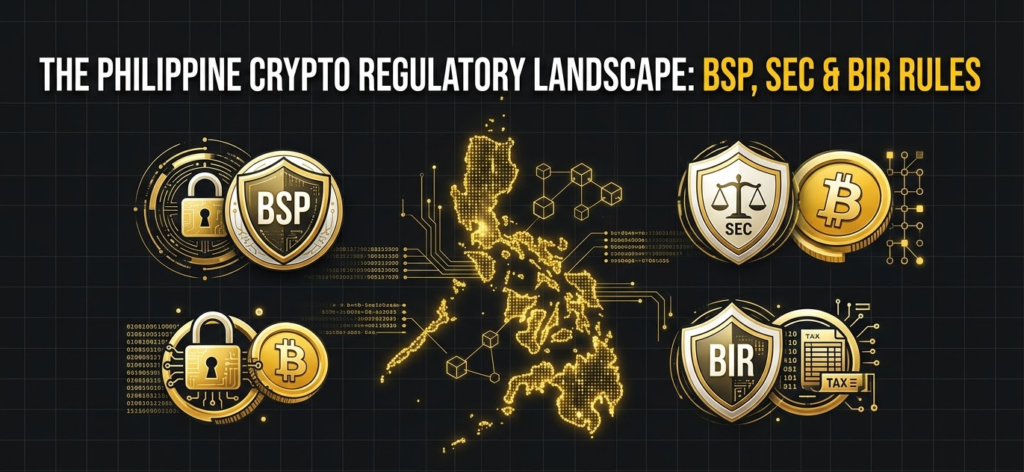
The Philippines does not treat cryptocurrency as an entirely unregulated financial activity. Instead, different government bodies can become relevant depending on what the business is actually doing.
For a normal user buying and selling virtual assets, the most important regulator to understand first is the Bangko Sentral ng Pilipinas (BSP).
Bangko Sentral ng Pilipinas VASP Framework
The BSP introduced its modern Virtual Asset Service Provider (VASP) framework through Circular No. 1108. The framework replaced the earlier virtual-currency-exchange approach and established requirements around registration, governance, risk management, consumer protection, cybersecurity and anti-money-laundering controls. (BSP Circular No. 1108)
This is an important distinction because “crypto exchange” is a consumer-friendly term, while VASP is the regulatory category you should actually look for.
The BSP framework covers activities such as virtual-asset exchange, transfer and certain custody-related services. A platform being included in the BSP’s VASP directory therefore gives you a much better regulatory starting point than simply seeing a “licensed” badge on an exchange’s website.
The BSP also provides a public BSP Verifier that allows users to check regulated institutions by category, including VASPs. That is one of the first places I would check before depositing meaningful money with a platform. (BSP Verifier)
There is another current detail that is easy to miss.
The BSP has maintained a moratorium on issuing new VASP licenses. A BSP Citizens’ Charter document explains that the regular application window was closed beginning September 1, 2022, and that the moratorium was subsequently extended under BSP Memorandum No. M-2025-031 beginning September 1, 2025, subject to reassessment. (BSP Citizens’ Charter)
So if you see a new exchange marketing itself as “BSP-approved,” don’t take that statement at face value. Verify the legal entity in the BSP directory.
What Does BSP Regulation Actually Mean for You?
BSP regulation does not mean that Bitcoin is guaranteed to appreciate, nor does it mean your crypto balance has the same protection as money in a conventional bank deposit.
Instead, regulation should be viewed as part of your counterparty-risk assessment.
A regulated VASP is expected to operate within a supervisory framework covering areas such as:
- KYC and customer identification
- AML/CFT controls
- governance and risk management
- cybersecurity
- operational controls
- consumer protection
- reporting and compliance obligations
That is valuable, but it is not a promise that you cannot lose money.
I think this is one of the most important distinctions for new users. “Regulated” and “risk-free” are completely different things.
Bitcoin can fall 30% while the exchange remains perfectly compliant.
SEC Enforcement and Unlicensed Offshore Exchange Risk
The Securities and Exchange Commission (SEC) Philippines becomes particularly relevant when an activity involves securities, investment solicitation or other products falling under securities regulation.
The SEC has repeatedly warned Filipinos about unregistered foreign online platforms, including cryptocurrency and virtual-asset exchanges. Its public advisory specifically lists digital-asset/cryptocurrency exchanges among online businesses that Filipinos should approach carefully when the entities lack appropriate Philippine registration. (SEC Advisory on Non-Registered Foreign Entities)
The SEC’s current advisory archive also shows continued enforcement activity against unauthorized crypto platforms in 2025 and 2026, including advisories concerning unregistered crypto platforms and crypto-asset service providers. (SEC Advisories)
That does not mean every foreign exchange is automatically illegal merely because it is headquartered outside the Philippines. What matters is whether the platform is authorized to offer the particular services it provides to Philippine users and how Philippine regulators classify those activities.
For you as a user, the practical lesson is simple: don’t confuse global availability with Philippine regulatory authorization.
BIR and Cryptocurrency Taxation
Tax treatment is where I would be particularly careful with simplistic articles claiming that “crypto is tax-free in the Philippines.”
There is no reliable basis for treating all crypto profits as automatically tax-exempt.
The BIR’s general tax framework applies to taxable income, and the current graduated individual income-tax schedule reaches 35% for taxable income above ₱8 million. The BIR’s current materials show the 2023-onward brackets, including 15%, 20%, 25%, 30% and 35% marginal rates depending on taxable income. (BIR Form 1701-MS)
At the same time, RMC No. 60-2020 is sometimes incorrectly presented online as a specific “crypto tax law.” It is actually a broader circular concerning persons conducting business transactions through electronic media and their tax-registration obligations. (BIR RMC No. 60-2020)
So I would not tell a reader, “The BIR taxes every Bitcoin sale at 35%.” That is far too simplistic.
The real tax question depends on the nature of the income, whether you are investing personally or carrying on a business, how transactions are characterized, and the applicable provisions of the Tax Code.
If your crypto activity has become substantial trading, a business, professional activity, or another income-producing operation, keep detailed records and speak with a Philippine tax professional rather than relying on a generic exchange blog.
Critical Knowledge Gaps & Common Pitfalls in Philippine Crypto
The biggest mistakes I see in crypto exchange comparisons usually aren’t about Bitcoin itself.
They’re about confusing one type of service with another.
BSP VASP Licensing vs. SEC Registration
A BSP VASP authorization and SEC registration are not interchangeable concepts.
The BSP framework is primarily concerned with virtual-asset service activities within its regulatory perimeter. The SEC, meanwhile, can have jurisdiction when an offering or activity involves securities, investment contracts or other products governed by securities laws.
So don’t assume:
“This platform is a BSP VASP, therefore every product it offers is automatically SEC-authorized.”
That conclusion doesn’t follow.
Similarly, an exchange’s corporate registration does not automatically make it a licensed crypto service provider.
The SEC has explicitly warned that corporate registration by itself does not necessarily give an entity the authority to solicit investments or conduct regulated activities. (SEC Investor Advisory)
In-App Wallet Swaps vs. Professional Order Books
This is one of the most useful practical distinctions for beginners.
Imagine you want to buy ₱100,000 of BTC.
On a simple wallet interface, you might see one button:
Buy Bitcoin → ₱100,000 → Confirm.
It is incredibly convenient.
But you usually don’t see the same transparent order-book mechanics that an active trader sees. The displayed price can incorporate liquidity-provider costs, transaction fees, spreads and other pricing components.
GCrypto explicitly says that the price shown to users already includes service and platform fees and that the price updates frequently. (GCrypto Buy and Sell Guide)
Maya similarly explains in its crypto terms that transaction pricing can include components such as transaction fees, hedging costs and FX costs. (Maya Crypto Terms and Conditions)
That is not necessarily “bad.” You’re paying for convenience.
The problem occurs when someone compares that all-in retail price with a professional exchange’s headline trading commission and assumes they’re equivalent.
They aren’t.
InstaPay vs. PESONet
For PHP transfers, understanding the payment rail can save you both money and frustration.
The BSP explains that InstaPay supports transfers of up to ₱50,000 per transaction, with transfers available almost immediately and around the clock. PESONet, by contrast, has no standard transaction ceiling imposed by the payment system itself and uses batch settlement rather than InstaPay’s near-instant model. Individual banks or participating institutions can still impose their own limits. (BSP InstaPay FAQ)
That means the simple rule is:
Need speed and you’re below the limit? InstaPay.
Moving a larger amount and don’t need instant settlement? Check PESONet.
PDAX’s current support documentation also shows different bank-transfer options with different limits, fees and processing times, illustrating why you should check the exact funding channel inside the exchange before making a transfer. (PDAX Bank Funding Options)
Offshore Exchange Exposure
A global exchange may offer:
- perpetual futures
- margin
- hundreds of tokens
- copy trading
- leveraged products
- sophisticated derivatives
That can look attractive compared with a regulated Philippine platform.
But there is a trade-off.
If the platform isn’t properly authorized for your market, you may face greater uncertainty around regulatory recourse, payment access, account restrictions or enforcement action.
The Philippine SEC has repeatedly warned users about unregistered foreign platforms and specifically notes the risk that funds sent to an unregistered foreign entity may be difficult to recover. (SEC Advisory on Foreign Online Platforms)
Personally, I would treat regulatory status as part of the product itself-not as boring legal fine print at the bottom of the homepage.
The BIR Tax Myth
Another common misconception is:
“Crypto isn’t taxed because Bitcoin isn’t Philippine money.”
That’s not a safe assumption.
Tax rules don’t depend solely on whether something is legal tender. Income generated from a commercial or income-producing activity can fall within the Philippine tax system even if the underlying asset isn’t fiat currency.
The correct approach is to maintain:
- transaction dates
- acquisition cost
- sale proceeds
- wallet transfers
- exchange statements
- trading fees
- conversion records
- PHP values at relevant transaction dates
This becomes especially important when you use multiple exchanges and self-custody wallets.
In-Depth Review of the Top BSP-Licensed Crypto Platforms

Coins.ph & Coins Pro: Best Overall for Low Fees & Local Liquidity
If I had to choose one platform from this list for a Philippine user who actually cares about trading costs, Coins Pro would be one of my first choices to investigate.
The reason is straightforward: Coins.ph combines the convenience of a Philippine crypto wallet with a separate professional trading environment.
The difference is significant.
The regular Coins.ph experience is designed for simplicity. Coins Pro is built around an actual order book where buyers and sellers interact through orders.
Its current published fee schedule is particularly competitive. At the entry tier, Coins Pro lists 0.10% maker and 0.15% taker fees for 30-day spot trading volume up to ₱500,000. Higher-volume tiers reduce those rates progressively, reaching 0.03% maker and 0.05% taker at the highest published volume tier. (Coins Pro Trading Fees)
That is a much more meaningful comparison than simply saying “low fees.”
The platform also supports PHP markets including BTC/PHP and ETH/PHP, alongside other crypto/PHP pairs. (Coins Pro Markets and Trading)
For an active trader, the structure makes sense:
PHP → exchange balance → order book → crypto → PHP
rather than:
PHP → convenience widget → quoted crypto price
Coins.ph also provides local cash-in and cash-out infrastructure. Its published support information shows InstaPay and PESONet options, while its cash-out schedule currently lists a ₱10 InstaPay cash-out fee and free individual PESONet cash-outs. (Coins.ph Cash-In and Cash-Out Fees)
There is another useful detail: Coins Pro’s current page says trading fees are calculated from 30-day spot trading volume and are separate from cash-in/cash-out charges. (Coins Pro Fee Schedule)
That separation makes it easier to calculate your actual trading cost.
Best for: active spot traders, cost-conscious investors and people who want a professional order book while keeping PHP rails.
Potential drawback: if you’re simply buying ₱1,000 of Bitcoin every few months, the extra trading interface may be unnecessary.
PDAX: Best for a Local Order-Book Alternative
PDAX is another major Philippine-focused option and is particularly interesting if you want an exchange designed around the local market rather than adapting a global platform to PHP.
PDAX describes itself as a Philippine cryptocurrency trading platform founded in 2017 and supervised by the BSP as a virtual-currency exchange. It supports buying and selling crypto directly in PHP. (PDAX Platform Overview)
The current platform also emphasizes multiple cash-in and cash-out methods, local payment partners, crypto deposits and withdrawals, and a range of PHP trading pairs. (PDAX Official Platform)
For trading mechanics, PDAX explicitly distinguishes maker and taker orders in its exchange rules. A limit order that sits on the order book can become a maker order, while an order that immediately matches existing liquidity can function as a taker order. (PDAX Exchange Rules)
That’s important because it gives you the same basic vocabulary used by professional exchanges.
PDAX is also worth considering for larger transfers. Its current support documentation lists options including InstaPay, PESONet, RTGS and direct bank-related channels, with different limits and processing times depending on the method. (PDAX Fiat and Crypto Withdrawal Options)
I wouldn’t automatically declare PDAX “better” than Coins Pro. The more useful question is which platform currently gives you the better combination of:
- trading pair liquidity
- fee tier
- PHP funding cost
- withdrawal cost
- execution quality
- account limits
- interface
Those things can change, so check the live fee schedule before a large trade.
Best for: Philippine users who want a local regulated exchange with order-book trading and multiple PHP funding options.
Maya Crypto: Best Integrated Digital Banking & Crypto App
If you already use Maya heavily, the appeal of Maya Crypto is obvious.
You don’t need to think like a professional trader.
You open the Maya app, go to Crypto, choose an asset, enter the amount, and confirm the transaction.
Maya currently says users can buy and sell major assets including BTC, ETH and SOL directly through the app, with purchases starting from ₱1. It also allows users to convert crypto back into cash in the Maya Wallet. (Maya Crypto)
More importantly from a regulatory perspective, Maya’s crypto terms explicitly state that Maya Philippines operates its virtual-asset platform under a BSP VASP license. (Maya Crypto Terms and Conditions)
That makes Maya a particularly natural choice for someone who doesn’t want to maintain a separate banking relationship with a crypto exchange.
But there’s a trade-off.
Convenience pricing is not the same thing as professional order-book pricing.
Maya explains that its crypto pricing can incorporate a base price from a liquidity provider plus transaction fees, hedging costs and FX costs. (Maya Crypto Pricing Terms)
So if you’re making small, occasional purchases, that’s probably acceptable.
If you’re making frequent large trades, I’d compare the actual quoted execution price against Coins Pro or PDAX before deciding.
Best for: beginners, mobile-first users and people who already keep PHP in Maya.
GCrypto: Best for Convenience and GCash Users
GCrypto is arguably the easiest option for the user who thinks:
“I already have GCash. I just want to buy some Bitcoin.”
That is precisely where the product shines.
GCash explains that you can access GCrypto inside the app, fund the GCrypto trading wallet using your GCash Wallet, select a cryptocurrency and enter either a PHP or crypto amount before confirming the purchase. (GCrypto Buy and Sell Guide)
G-Xchange, Inc. is also identified by GCash as regulated by the BSP. (GCrypto Fees)
Another useful detail is that GCash currently lists no fee for buying or selling within GCrypto, while crypto sending fees vary by coin and include network-related costs. (GCrypto Fees and Charges)
That wording is worth paying attention to.
“Buy fee: none” does not necessarily mean the transaction has zero economic cost. The price you receive can still incorporate the platform’s pricing structure.
GCash itself says the displayed GCrypto price already includes service and platform fees and is updated frequently. (GCrypto Pricing Information)
So don’t judge GCrypto solely by the word “free.”
For a casual investor, however, the convenience can be excellent.
Best for: GCash users, beginners, small recurring purchases and people who value simplicity more than advanced execution controls.
Coins.ph vs. PDAX vs. Maya vs. GCrypto: Which One Fits You?
Rather than declaring one universal winner, I would use this decision framework:
| Your priority | Best starting point |
|---|---|
| Lowest published spot trading fees | Coins Pro |
| Professional order-book trading | Coins Pro / PDAX |
| Simple mobile experience | Maya |
| Buying directly from an existing e-wallet | GCrypto |
| PHP-focused trading | Coins Pro / PDAX |
| Minimal setup for casual purchases | Maya / GCrypto |
| More active trading | Coins Pro / PDAX |
| Local regulated ecosystem | All four, subject to current regulatory status |
The most important thing is not to compare them as if they’re identical products.
Coins Pro is closer to a trading venue. Maya and GCrypto are closer to consumer financial apps with integrated crypto functionality.
That difference explains much of the fee variation you may see.
How to Deposit PHP via InstaPay and Buy Crypto?

If you’re wondering how to buy Bitcoin using GCash, or how to fund a Philippine exchange with PHP, the process is generally straightforward.
Choose a BSP-Regulated Platform
Start by verifying the provider in the BSP’s current VASP directory rather than relying on advertisements or social-media posts. The BSP publishes its VASP directory and provides a separate verifier for regulated institutions. (BSP VASP Directory)
For this guide, that could mean starting with Coins.ph, Coins Pro, PDAX, Maya or GCrypto.
Complete KYC
You’ll normally need to provide identity information and supporting documentation.
The exact requirements depend on the platform and your account type, but expect some combination of:
- full legal name
- date of birth
- residential information
- government-issued ID
- selfie or biometric verification
- source-of-funds information for higher limits
Don’t try to work around KYC requirements. A regulated financial platform is supposed to know who its customers are.
Fund Your PHP Balance
If you’re using Coins.ph or another exchange with a PHP wallet, select the available bank-transfer method.
For a smaller, urgent transfer, InstaPay can be convenient. BSP’s published FAQ says InstaPay allows up to ₱50,000 per transaction and operates almost instantaneously, 24/7. (BSP InstaPay FAQ)
If you are transferring more than that, check PESONet or another available bank-transfer method.
The important point is that ₱50,000 is an InstaPay per-transaction limit, not necessarily your exchange’s overall daily withdrawal or deposit limit.
Those are different things.
Use Your Bank or E-Wallet
Depending on the exchange, you may be able to initiate the transfer from a local bank or e-wallet.
For example, Coins.ph provides PHP cash-in functionality through local transfer channels, and its current support documentation confirms continued use of InstaPay and PESONet. (Coins.ph Funding Options)
Always double-check:
- recipient name
- account number
- reference number
- amount
- transfer channel
before pressing Send.
A mistaken bank transfer is not something you want to discover after the money has left your account.
Open the PHP Trading Pair
If you’re using a professional exchange such as Coins Pro or PDAX, look for a PHP pair such as:
BTC/PHP
You can then choose between a market order and a limit order, depending on what the platform supports.
A market order prioritizes immediate execution.
A limit order lets you specify the price at which you’re willing to trade and may enter the order book as a maker order.
For active traders, this distinction can materially affect total trading costs.
Review the Final Amount
Before confirming, don’t just look at the commission.
Look at:
PHP spent → crypto received → effective execution price
That final number is what actually matters.
If you spend ₱100,000 and receive ₱99,300 worth of effective BTC after all pricing components, the ₱700 difference is your real economic cost regardless of how attractive the headline fee looks.
What Makes a Good Philippine Crypto Exchange?
I would evaluate an exchange across six areas rather than relying on a single “best” ranking.
Regulation
Check the legal entity, not merely the brand name.
A mobile app might belong to one legal company while its crypto services are provided through another.
PHP Liquidity
This matters more than many beginners realize.
A platform can advertise a 0.10% fee and still give you poor execution if its order book is thin.
For a ₱2,000 purchase, that may not matter much.
For ₱2 million, it matters a lot.
Cash-In and Cash-Out
Look for:
- InstaPay
- PESONet
- direct bank transfer
- e-wallet support
- processing time
- cash-out fee
- transaction limits
Coins.ph, for example, currently lists ₱10 InstaPay cash-out and free individual PESONet cash-out, subject to its applicable conditions. (Coins.ph Cash-In and Cash-Out Fees)
Trading Fees
For order-book exchanges, compare:
- maker fee
- taker fee
- 30-day volume requirements
- minimum trading tier
- high-volume discounts
Coins Pro currently starts at 0.10% maker / 0.15% taker for its lowest 30-day spot-volume tier. (Coins Pro Trading Fees)
Spread
This is the number that can quietly hurt you.
If a platform charges no explicit trading commission but gives you a worse buy price and a worse sell price, you are still paying for the service.
Withdrawal Costs
Crypto withdrawals can involve:
- platform fees
- network fees
- blockchain congestion
- minimum withdrawal amounts
- different network options
Always confirm the exact withdrawal fee immediately before sending funds.
How to Buy Bitcoin Using GCash
For someone specifically searching how to buy Bitcoin using GCash, there are two fundamentally different approaches.
The Simple Route: GCrypto
This is the easiest.
Open GCash, access GCrypto, fund your trading wallet from GCash and select BTC. GCash’s official instructions describe this in-app process and explain that the displayed crypto price already incorporates the relevant service/platform pricing. (GCrypto Buy and Sell Guide)
This is the route I would recommend to a complete beginner who simply wants exposure to Bitcoin without learning order books.
The Trading-Focused Route
If you care more about execution cost, you can use GCash or another local payment channel to move PHP into a professional trading venue where available.
The exact transfer route depends on the exchange’s current supported funding channels.
The basic idea is:
GCash → PHP transfer rail → exchange PHP balance → BTC/PHP order book
The benefit is greater control over execution.
The downside is that you’re adding another step.
For small purchases, convenience can easily outweigh a relatively small fee difference. For repeated or larger purchases, the calculation changes.
Why “No Fee” Does Not Always Mean Free
This is probably the single most important lesson in this entire article.
Suppose Exchange A says:
Trading fee: 0%
Exchange B says:
Trading fee: 0.10%
It sounds obvious that Exchange A is cheaper.
But now imagine:
- Exchange A’s BTC quote = ₱6,000,000
- Exchange B’s BTC quote = ₱5,970,000
- Exchange B charges 0.10%
On a ₱100,000 purchase, the 0.10% commission is only ₱100.
A slightly worse execution price can cost substantially more.
That’s why professional traders tend to think in terms of all-in execution cost, not simply commission.
For retail users, the easiest mental model is:
Total cost = trading fee + spread + payment fee + withdrawal cost + FX cost where applicable.
Once you think that way, many supposedly “free” crypto services look very different.
How to Keep Your Crypto Costs Low in the Philippines
You don’t need to become a professional trader to reduce unnecessary fees.
A few habits can make a meaningful difference.
Use Bank Rails Instead of Expensive Payment Methods
Whenever possible, compare the cost of bank transfer, InstaPay or PESONet against card-based funding.
InstaPay can be particularly useful for speed, while PESONet can make more sense for larger transfers where immediate settlement isn’t necessary. BSP confirms that InstaPay has a ₱50,000 per-transaction ceiling while PESONet does not have a standard system-wide transaction limit. (BSP InstaPay FAQ)
Use an Order Book for Larger or Frequent Trades
If you’re making regular purchases, learn how limit orders work.
You don’t necessarily have to become a day trader. You simply need to understand that a professional order book can give you more visibility into:
- current bids
- current asks
- spread
- available liquidity
- order size
- execution price
Coins Pro and PDAX both provide order-book trading functionality. (Coins Pro Trading Platform) (PDAX Exchange Rules)
Don’t Withdraw Crypto Every Few Hours
This is another surprisingly common mistake.
If you’re buying ₱2,000 worth of BTC every week and withdrawing it immediately after every purchase, you may repeatedly pay network-related withdrawal costs.
Depending on your risk tolerance and custody strategy, it can be more economical to consolidate withdrawals rather than making many tiny transfers.
Of course, this introduces another consideration: leaving assets on an exchange creates custodial risk.
So the answer isn’t “never withdraw.”
It’s to balance security against transaction cost.
Compare Networks Carefully
When an exchange supports multiple blockchain networks for the same asset, don’t simply choose the first one you see.
Make sure:
- the receiving wallet supports the selected network;
- the asset is actually compatible;
- the exchange allows that network for withdrawals;
- the fee is acceptable.
Sending USDT over the wrong network can turn a cheap transaction into a recovery nightmare.
Keep Your Records
Even if you only buy Bitcoin occasionally, maintain a transaction history.
At minimum, keep:
- date
- asset
- quantity
- PHP value
- acquisition price
- sale price
- fees
- exchange
- wallet transaction ID
This becomes invaluable when you need to calculate your cost basis or explain your transactions to an accountant.
Frequently Asked Questions
Which crypto exchanges are officially licensed by the BSP in the Philippines?
The BSP’s published VASP directory includes Coins.ph, PDAX and Maya Philippines, among other active VASPs. The same directory also lists bank VASPs including GoTyme Bank and UnionBank. Because the regulatory roster can change, verify the provider against the latest BSP VASP directory before depositing money. (BSP VASP Directory)
Is cryptocurrency legal in the Philippines?
Yes. Cryptocurrency and virtual-asset activities are not generally prohibited in the Philippines. Instead, relevant businesses are subject to regulatory requirements, including the BSP’s VASP framework. Maya’s current crypto information also explicitly describes cryptocurrencies as legal in the Philippines and points users to BSP Circular No. 1108. (Maya Crypto)
Legal does not mean risk-free, however. Crypto remains highly volatile, and the legal status of a platform does not guarantee investment returns.
Is crypto tax-free in the Philippines?
You should not assume that crypto profits are tax-free.
The Philippines has general income-tax rules, and current individual graduated income-tax rates can reach 35% for taxable income above ₱8 million. (BIR Tax Schedule)
The exact treatment of cryptocurrency transactions can depend on whether you’re making personal investments, conducting a business, earning professional income, or engaging in another taxable activity. If your trading activity is substantial, obtain professional Philippine tax advice.
How do I buy Bitcoin using GCash?
The simplest method is GCrypto inside the GCash app. GCash’s official instructions say users can open GInvest → GCrypto, choose a cryptocurrency, enter a PHP or crypto amount and confirm the purchase. (GCrypto Buy and Sell Guide)
For more advanced trading, you can also investigate transferring PHP from GCash through supported local payment rails to an order-book exchange.
Is InstaPay instant?
InstaPay is designed for near-immediate transfers and operates 24/7, but actual processing can depend on the participating institution and transaction circumstances. BSP’s published FAQ states that InstaPay supports up to ₱50,000 per transaction. (BSP InstaPay FAQ)
Can I transfer more than ₱50,000?
Yes, potentially-but not through a single standard InstaPay transaction.
For larger transfers, check PESONet or the exchange’s other supported bank-transfer options. PESONet does not have a standard system-wide transaction ceiling in the same way InstaPay does, although your bank or exchange can impose its own limits. (BSP InstaPay and PESONet FAQ)
Which is better: Coins.ph or PDAX?
For active traders, I would compare Coins Pro and PDAX directly rather than choosing based on brand popularity.
Coins Pro currently publishes a competitive maker/taker schedule beginning at 0.10% / 0.15% and decreasing as 30-day trading volume increases. (Coins Pro Trading Fees)
PDAX also provides order-book functionality and local PHP funding options. (PDAX Exchange Rules)
Your actual choice should come down to current liquidity, trading pair availability, fees, PHP cash-in/cash-out costs and the interface you prefer.
Is Maya good for beginners?
Yes, particularly if you already use Maya.
Maya lets you buy and sell crypto directly from its app, starting from ₱1, and cash out to your Maya Wallet. (Maya Crypto)
The trade-off is that the experience is designed around convenience rather than professional order-book execution.
Is GCrypto good for active traders?
Probably not my first choice if you’re actively trading large amounts.
GCrypto is excellent at what it is designed to do: make crypto accessible inside GCash. The platform is much more attractive for convenience-focused users than for someone who needs detailed order-book control, sophisticated order types and professional execution analysis.
For that use case, I would compare Coins Pro and PDAX.
Are offshore crypto exchanges safe for Filipinos?
“Offshore” does not automatically mean “unsafe,” but lack of Philippine authorization creates additional regulatory and counterparty considerations.
The SEC has warned Filipinos about unregistered foreign online platforms, including cryptocurrency exchanges, and has emphasized the risks of dealing with entities that lack appropriate Philippine registration or licensing. (SEC Advisory on Foreign Online Platforms)
If your priority is straightforward local recourse and PHP integration, a BSP-regulated local platform is generally the cleaner starting point.
Conclusion: Navigating Regulated Crypto Trading in the Philippines
There isn’t one universal best crypto exchange in the Philippines.
The right platform depends heavily on how you actually use crypto.
If you are a serious spot trader, I would start by comparing Coins Pro and PDAX. Both provide the kind of order-book environment that makes more sense when trading frequency and execution cost become important. Coins Pro is particularly interesting because its currently published spot fee schedule starts at 0.10% maker / 0.15% taker and falls with higher 30-day volume. (Coins Pro Trading Fees)
If you’re a beginner who already lives inside a mobile banking ecosystem, Maya is compelling because crypto sits directly inside the same app you already use for PHP balances and everyday payments. (Maya Crypto)
If you’re a GCash user who simply wants to buy Bitcoin without opening another trading account, GCrypto is probably the most frictionless route. Its pricing is designed to be simple, although you should still evaluate the quoted price rather than assuming “no buy fee” means zero economic cost. (GCrypto Buy and Sell Guide)
And whichever platform you choose, I would keep one principle in mind:
Don’t choose a crypto exchange based on the headline fee alone.
Check the regulatory status first. Then look at the actual PHP deposit route, trading spread, maker/taker commission, withdrawal cost, account limits and execution quality. For larger amounts, those details can matter far more than a flashy “0% fee” banner.
Finally, remember that the Philippine regulatory landscape is still evolving. The BSP continues to maintain a controlled VASP licensing environment, while the SEC remains active against unauthorized crypto-related platforms. (BSP Citizens’ Charter)
For you as a trader, that means the safest habit is also one of the simplest: verify the legal entity, understand the total cost, use reputable PHP payment rails, and never treat regulatory licensing as a guarantee that the crypto investment itself is safe.
That approach may not sound as exciting as chasing the newest exchange promotion, but in my view, it is a much better way to build a crypto strategy that you can actually live with over the long term.