
Bitget referral code GPCETTG1 and fee discounts
When you look up a crypto exchange referral code, you usually want three things: a discount you can verify, a welcome reward worth the effort, and a signup process that does not leave you guessing about eligibility. The trouble is that promotional pages often put all three into one headline, even though each benefit may follow a different set of rules.
For GPCETTG1, I would separate the claims before making a decision. Bitget’s published documentation confirms that the exchange has referral programs, Rewards Center promotions, and a BGB-based spot-fee discount. However, the official material I found does not independently confirm that this exact code currently gives every new user a 20% lifetime kickback on both spot and futures trades.
Bitget’s Rewards Center guide describes a new-user welcome package worth up to 6,200 USDT. It breaks the headline amount into different tasks and rewards, including a challenge worth up to 6,000 USDT for qualifying deposits and trading within seven days. That is a promotional maximum, not a guaranteed cash bonus for every registration.
Bitget’s Trading Fees FAQ, published on August 20, 2026, lists standard spot fees of 0.1% for makers and takers, and standard futures fees of 0.02% for makers and 0.06% for takers. It also explains that actual rates can be lower depending on VIP level, BGB holdings, and active promotions.
Here is how those verified platform features compare with the claims associated with GPCETTG1.
| Metric | Standard account reference | What an optimized account may receive |
|---|---|---|
| Referral code | No code entered | GPCETTG1, if accepted by Bitget |
| Standard spot fee | 0.1% maker and taker | 0.08% when the eligible 20% BGB discount applies |
| Standard futures fee | 0.02% maker, 0.06% taker | Depends on the contract, account fee tier, and any confirmed referral benefit |
| Referral kickback | None from a referral relationship | The actual rate must be confirmed for this code |
| Rewards Center | No guarantee of a specific reward | Up to 6,200 USDT advertised for eligible new users |
| KYC | Required for core exchange services | Identity verification must be completed and approved |
| Code binding | Referral attribution depends on the registration process | Do not assume an existing account can be linked retroactively |
One distinction is especially important: a referrer’s commission rate is not automatically the same as the cashback rate received by the person using the code. Bitget’s affiliate program describes commissions paid to affiliates based on trading fees generated by referred users. A separate promotion may share some of that value with the invitee, but you need to confirm that the specific code does so.
How the BGB discount affects your spot trading fees?
You do not need to trust a referral-code advertisement to calculate the BGB discount. The underlying arithmetic is straightforward, and you can check the fee shown in your Bitget account after a trade.
The standard spot fee
Bitget’s spot trading fee guide lists a standard fee of 0.1% for both maker and taker trades. The exact rate shown to you may differ if your account has a different VIP level, a special fee arrangement, or a promotion.
Suppose you buy $1,000 worth of cryptocurrency and your applicable spot fee is 0.1%.
Your fee for that executed transaction would be $1 before discounts. If you later sell $1,000 worth at the same fee rate, that sale would generate another $1 fee. Fees are charged on executed trade value, so a buy and a later sell can both incur costs.
This is one reason I recommend checking the fee rate before estimating the cost of a trading strategy. A trader who turns over the same capital repeatedly may pay fees on a much larger total trading volume than the balance in the account suggests.
Enable Pay Fees with BGB
Bitget allows eligible users to pay certain spot fees using its native token, BGB. Its BGB fee-deduction guide explains that paying with BGB gives a 20% discount on eligible spot and spot-margin transaction fees.
Using the $1 fee from the example above:
The discounted cost is equivalent to 0.08% of the $1,000 trade.
| Item | Amount |
|---|---|
| Executed trade value | $1,000 |
| Standard spot fee at 0.1% | $1.00 |
| Discount from paying with BGB | 20% |
| Fee after the discount | $0.80 |
| Effective spot fee rate | 0.08% |
The discount is conditional. You need to enable the BGB fee-payment feature and hold enough BGB in the relevant account. Bitget explains that if the balance is insufficient, the fee may be charged in the original fee currency instead, without the BGB discount.
There is also a cost that a simple fee table cannot show: BGB itself has a market price. If you buy BGB specifically to pay fees, you take on price exposure. A 20% discount on a small trading fee may not compensate you for a large move in the token’s market value. I would compare the expected fee savings with the amount of BGB you need to hold, rather than buying a large balance simply to activate the feature.
Can the referral kickback and BGB discount produce a 0.064% spot fee?
The arithmetic in the proposed offer assumes that a 20% referral cashback is calculated on the fee remaining after the BGB discount. If that exact arrangement is confirmed by Bitget for GPCETTG1, the calculation would look like this:
-
Standard fee: 0.1%.
-
Fee after the BGB discount: 0.1% × 0.8 = 0.08%.
-
Hypothetical 20% cashback on the discounted fee: 0.08% × 0.2 = 0.016%.
-
Net effective fee after cashback: 0.08% − 0.016% = 0.064%.
For a $1,000 trade, that would mean a $0.80 fee after the BGB discount and a hypothetical $0.16 cashback, leaving a net cost of $0.64.
| Calculation | Amount |
|---|---|
| Trade value | $1,000 |
| Standard fee at 0.1% | $1.00 |
| Fee after 20% BGB discount | $0.80 |
| Hypothetical cashback at 20% of the discounted fee | $0.16 |
| Hypothetical net cost | $0.64 |
| Net effective rate | 0.064% |
| Total savings against the original $1 fee | 36% |
That 36% figure comes from applying two sequential 20% reductions, not adding them together. The second discount is applied to the already reduced amount, so the result is a 36% total reduction rather than 40%.
This is a conditional calculation, not a verified fee quote for GPCETTG1. I could verify the BGB spot discount in Bitget’s official documentation, but not the claim that this particular code grants a 20% lifetime kickback to invitees or that the kickback stacks on the BGB-discounted fee. Do not use 0.064% as your expected rate until Bitget confirms both conditions.
What about futures trading fees?
Futures require a separate calculation. Bitget’s Trading Fees FAQ lists standard futures fees of 0.02% for makers and 0.06% for takers. The BGB discount rules have changed over time and may depend on the product and current settings, so do not assume that a spot-fee discount applies to futures in exactly the same way.
The outline’s proposed 0.048% futures taker rate is mathematically equivalent to reducing 0.06% by 20%:
That arithmetic is correct, but it only describes what would happen if Bitget confirms a 20% discount on the applicable futures fee. It does not prove that referral code GPCETTG1 currently grants that benefit.
Remember, too, that a futures position may incur funding fees in addition to trading fees. If you use leverage, liquidation risk and market movements can dwarf the difference between two fee rates. A referral discount should be the last step in your cost calculation, not the reason you decide to open a leveraged position.
How to enter code GPCETTG1 and confirm the offer?
Referral codes are easy to copy and paste. Verifying what they actually unlock takes a little more care.
Bitget’s official Referral Program guide explains how users can access the program, generate referral links, and earn rewards when invitees complete eligible tasks. It also describes a task-based reward structure in which the invitee must register through the code or link and meet the promotion’s activity requirements.
That is not the same as a universal guarantee that every referral code gives the invitee an immediate trading-fee rebate. The reward may be a one-time incentive, a voucher, a fee discount, or another benefit specified in the current campaign.
Check the referral field before completing registration
If you want to try GPCETTG1, use Bitget’s official website or app. Do not enter your login credentials on a page that merely looks like Bitget.
Follow these steps:
-
Open the official Bitget signup page.
-
Locate the referral section. The field may be labelled “Referral Code (Optional),” although the exact interface can change.
-
Expand the section if it is collapsed.
-
Enter
GPCETTG1exactly as shown. -
Read any message displayed after the code is accepted.
-
Review the linked promotion terms, especially the cashback rate, reward type, expiry date, and regional conditions.
-
If the page does not confirm the expected benefit, stop and ask Bitget support before you complete signup.
I could not independently verify that the current registration form displays the exact message “Your commission kickback rate: 20%” for GPCETTG1. Treat that message as something to look for if the platform presents it, not as a guaranteed screen or an official quote for this code.
Verify your fees after signing in
Even if a referral code is accepted, you should not assume every product receives the same discount.
After completing registration and KYC:
-
Open the account’s fee information or fee schedule.
-
Check the rate shown for the spot pair you plan to trade.
-
Review the maker and taker rates separately for futures if you use that product.
-
Enable the BGB fee-payment option if you intend to use it and have enough BGB in the relevant account.
-
After an ordinary trade you already planned to make, inspect the trade details and fee history.
-
Check whether a referral rebate appears separately in your account, and confirm how Bitget calculates it.
Bitget’s official fee schedule notes that fees can vary by VIP level, trading pair, promotion, and region. The fee visible for your account and trade is a better basis for planning than a generic promotional table.
Understand the difference between an affiliate commission and your rebate
Bitget’s affiliate program allows approved affiliates to earn commissions from eligible trading fees generated by referred users. Its affiliate FAQ explains that rebates are calculated from actual transaction fees and that some activities, such as zero-fee trades or trades using certain rebate cards, may not generate the expected commission.
That information matters because a headline saying “20% kickback” can be ambiguous. It might refer to the invitee’s fee rebate, the affiliate’s share of commission, or a special promotion with different conditions. Before treating it as a saving on your own trading, make sure the terms explicitly describe a benefit paid to you as the invitee.
Unlocking the Bitget Rewards Center welcome package
Bitget’s Rewards Center is a real platform feature, but the maximum value shown in a campaign should not be confused with cash that every new user receives automatically.
The official Rewards Center guide describes a new-user welcome package worth up to 6,200 USDT. It says eligible users can complete deposit and trading tasks within seven days to earn up to 6,000 USDT in challenge rewards. It also describes a monitoring period and a short window in which users must manually claim rewards.
The details matter more than the headline. A package can contain multiple coupons or trading incentives with different conditions. You may have to complete several milestones to unlock the full advertised value, and the reward may not be paid as unrestricted USDT.
What the 6,200 USDT headline means
The phrase “up to 6,200 USDT” describes the maximum advertised package value for eligible users under the applicable campaign. It does not mean Bitget will credit 6,200 USDT to every new account for entering GPCETTG1.
The published Rewards Center guide breaks the offer into components, including:
-
A welcome package for eligible new users.
-
A possible reward for inviting a friend.
-
A deposit and trading-volume challenge that can offer up to 6,000 USDT in rewards.
-
Other task-based incentives available through the Rewards Center.
The live campaign may differ from the version described in an older support article. Before depositing funds, open the Rewards Center in your own account and check the exact terms currently displayed.
The seven-day deposit and trading challenge
The official Rewards Center guide says eligible new users can deposit and trade within seven days of registration to qualify for challenge rewards. The required deposit and volume milestones are defined by the campaign, so you should not assume that every deposit or every executed trade counts.
Before attempting a task, check:
-
Qualifying deposit: Which deposit methods and assets count? An internal transfer may be treated differently from an eligible external deposit.
-
Trading volume: Does the task require spot trading, futures trading, or a combination?
-
Minimum threshold: What amount of qualifying volume is required for each reward tier?
-
Eligible account: Does the promotion apply to your account type and residence?
-
Deadline: Does the seven-day period begin at signup, KYC approval, or another event defined in the terms?
-
Reward format: Is the reward cash, a fee voucher, futures trial funds, or another coupon?
Do not trade more than you otherwise would simply to unlock a higher tier. Trading volume can accumulate quickly when you buy and sell repeatedly, but each transaction can incur fees, and market prices can move against you. If the reward is a restricted voucher, its actual value may be much lower than its headline amount suggests.
The monitoring period and two-day claim window
Bitget’s published Rewards Center guide describes a three-day monitoring period after the promotional challenge ends. Once that period is over, eligible users have two days to manually claim the rewards in the Rewards Center. Unclaimed rewards expire, according to the guide.
That means completing the trading task may not be the final step. You may still need to return to the Rewards Center and claim the reward before the deadline.
I would handle the process like this:
| Stage | What to do |
|---|---|
| Registration | Record the date and confirm the referral terms shown |
| First seven days | Complete only eligible deposit and trading tasks that make sense for your plan |
| Monitoring period | Check the campaign page for status updates or additional conditions |
| Claim window | Return to Rewards Center after the stated monitoring period and claim eligible rewards |
| After claiming | Open the Coupons Center or reward details to review expiry and usage conditions |
The seven-day challenge, three-day monitoring period, and two-day claim window are documented in Bitget’s published Rewards Center guide, but promotions can change. Confirm the timeline shown in your account before relying on it.
Are the rewards cash, fee coupons, or futures trial funds?
Do not assign the same value to every reward type. A USDT cash reward, a spot fee coupon, and futures trial funds do not necessarily provide the same flexibility.
A useful way to evaluate them is to ask:
-
Can I withdraw the reward itself?
-
Does it only offset trading fees?
-
Must I use it on spot or futures?
-
Does it expire after a specific date?
-
Is a minimum trading volume required?
-
Are profits generated while using the reward subject to additional rules?
The answer should come from the terms attached to the actual reward. Avoid assuming that a voucher labelled with a USDT value is the same as a withdrawable USDT balance.
Critical platform rules: existing accounts, bonuses, KYC, and regional restrictions
Promotional mistakes are frustrating because they often happen before you have even made your first trade. These are the areas I would check before completing signup.
Can you add GPCETTG1 to an existing Bitget account?
The safest assumption is that you should enter a referral code during initial registration unless Bitget’s current rules explicitly allow a later binding.
The regular Bitget referral program describes invitees as users who register through a referral link or code. I did not find an official general policy guaranteeing that GPCETTG1 can be attached to any existing exchange account after signup.
One important distinction: some documentation that mentions adding an invitation code within seven days applies specifically to Bitget Wallet, not necessarily to the centralised Bitget exchange account. For example, the Bitget Wallet referral-code guide describes a seven-day binding rule for eligible new Wallet users. Do not apply that Wallet-specific rule to an exchange account without confirmation.
If you already have an exchange account:
-
Check your referral information and the terms for the promotion.
-
Contact official support if the account’s eligibility is unclear.
-
Do not create duplicate accounts to attempt to obtain a new-user reward. Bitget’s Terms of Use say an individual user may not hold more than one account.
-
Do not assume support can override a referral relationship or add the code retroactively.
Are welcome bonuses withdrawable?
The answer depends on the reward. Bitget’s Rewards Center may offer cash rewards, fee-rebate coupons, futures bonuses, or other incentives. Their usage and withdrawal rules can differ.
A trading voucher may offset a fee or provide a limited amount of trading credit without allowing you to withdraw the voucher’s face value. A direct cash reward may have a different treatment, and a reward can have a minimum claim threshold or other conditions.
Before you count a reward as cash, check its specific terms:
-
Whether the credited reward itself can be withdrawn.
-
Whether it must first be used for trading.
-
Whether profits generated with trial funds are withdrawable.
-
Whether the reward expires.
-
Whether a minimum balance or activity requirement applies.
-
Whether withdrawals are restricted while a reward is active.
I would not promise that 100% of profits generated from every Bitget bonus are immediately withdrawable. The actual reward terms govern that question. Bitget also requires identity verification for withdrawals, as explained in its identity-verification FAQ.
KYC is required for core exchange services
Bitget requires identity verification to access its core exchange features. Its KYC guide, published on October 8, 2026, says users who have not completed Level 1 verification cannot deposit, trade, withdraw, or use P2P services.
The verification process typically involves a government-issued identity document and facial verification. Depending on your circumstances, Bitget may request additional information.
To complete Level 1 KYC:
-
Open the official Bitget app or website.
-
Go to your profile and select Identity Verification.
-
Choose the country or region that issued your document.
-
Select an accepted document type.
-
Upload the required images and complete the facial liveness check.
-
Wait for Bitget to approve the application before assuming you can use all core services.
Use your own documents and provide accurate information. Do not try to bypass verification by changing your location or using someone else’s identity.
Geographic restrictions: check the rules for your residence
A referral code cannot override Bitget’s service restrictions. The exchange’s Terms of Use list prohibited countries and regions, including the United States, Canada, Singapore, Germany, France, Austria, Hong Kong, and other jurisdictions. Bitget may update this list, and product or promotion availability can be narrower than general platform availability.
The outline for this article mentions the United Kingdom and Mainland China among restricted locations. However, I would not present that exact list as exhaustive or assume that every product has the same rules without checking the current terms. Bitget’s restrictions can vary by jurisdiction, product, and applicable law.
Before signing up, confirm that the exchange is available to residents of your country and that the particular referral or welcome-reward campaign accepts users there. If you live in Germany, for example, Bitget’s published prohibited-country list includes Germany, so you should not assume you are eligible to register for this promotion.
Set up protection before moving funds
A referral reward is not a substitute for account security. Once you have registered and completed KYC, spend a few minutes securing the account before depositing meaningful funds.
Enable two-factor authentication
Use an authenticator app or another supported two-factor authentication method. This adds a second step beyond your password and can help protect your account if your credentials are exposed.
Keep recovery codes somewhere secure and separate from your everyday login device. If you lose access to your authenticator, account recovery can take time.
Set an anti-phishing code
If Bitget offers an anti-phishing code for your account, set one and learn how it appears in official communications. It can help you identify certain fake emails that imitate the exchange. It does not prove that every message containing a code is safe, so continue to check the sender and avoid unexpected login links.
Review withdrawal-address controls
If address whitelisting is available for your account, consider enabling it after checking how Bitget’s security delays and address rules work. A whitelist can help reduce the risk of an attacker withdrawing to an unfamiliar address, but it may also affect how quickly you can move funds.
Never share your password, one-time codes, recovery codes, or private keys with anyone claiming to help you claim a bonus. Bitget support should not need your password or authenticator code.
What the Bitget Protection Fund does and does not mean
Bitget maintains a Protection Fund as an additional layer of security. In a September 30, 2026 announcement, the company said the fund had been replenished to more than $300 million after a September 24 security incident. The announcement described the fund as having been established in 2022 with 5,500 BTC and said the estimated financial impact of the incident was about $388 million.
That is a material platform update, but it should be read carefully. A protection fund is not the same thing as a government deposit guarantee, and it does not eliminate exchange, cybersecurity, operational, or market risk. The announcement describes Bitget’s fund and its response to a specific incident; it should not be treated as a guarantee that every loss will automatically be reimbursed.
For users, the practical takeaway is to check the exchange’s current security disclosures, keep account access protected, and avoid leaving more funds on a trading platform than your own risk plan allows.
Entity relationship and fee-optimization map
The following map separates the referral code from the other systems that determine whether you receive a discount or reward. It is a conceptual guide, not proof that GPCETTG1 currently unlocks every listed benefit.
Bitget referral code GPCETTG1
        |
        +--> Referral attribution
        |       |
        |       +--> Must be accepted by the signup flow
        |       +--> Exact invitee cashback rate needs confirmation
        |
        +--> Rewards Center
        |       |
        |       +--> Welcome package advertised up to 6,200 USDT
        |       +--> Task and deadline conditions apply
        |
        +--> BGB fee-payment option
        |       |
        |       +--> 20% discount on eligible spot fees
        |       +--> Requires the feature to be enabled and sufficient BGB
        |
        +--> Identity verification
        |       |
        |       +--> Level 1 KYC required for core exchange services
        |
        +--> Regional and product eligibility
                |
                +--> Terms and promotion rules determine access
                +--> A referral code cannot override restrictions
The key relationship is that referral attribution, BGB fee payment, Rewards Center tasks, KYC, and regional eligibility are separate. A code may identify the source of your registration, but the current promotion terms determine which rewards you can claim.
Step-by-step guide: apply GPCETTG1 and activate eligible discounts
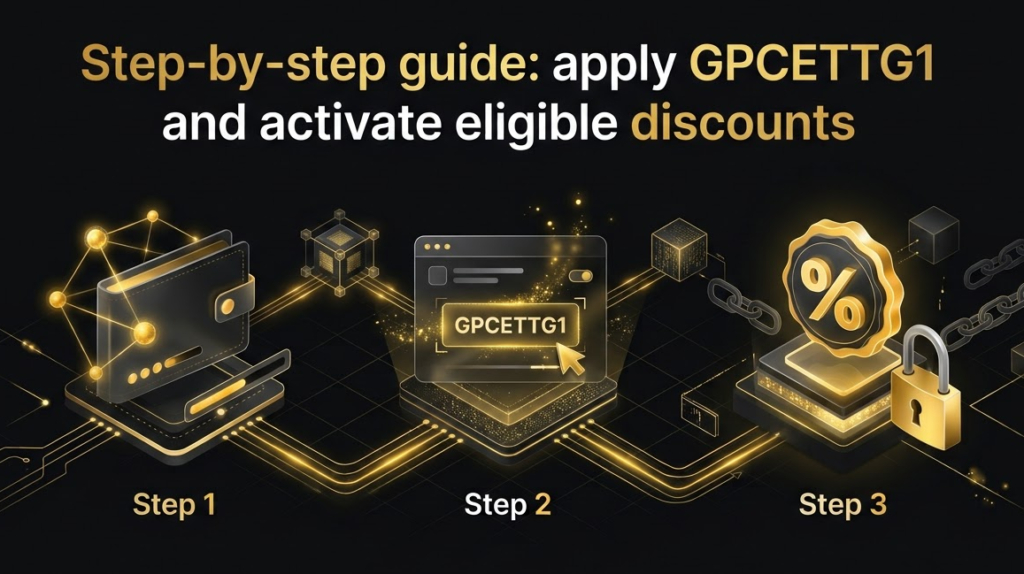
If Bitget supports your location and you are opening a new account, use this checklist to avoid common onboarding mistakes.
Phase one: registration and referral verification
Open Bitget‘s official website or app. Start from the exchange’s own domain rather than a shortened URL from an unknown source.
Expand the referral field. If the signup page displays “Referral Code (Optional),” open it before submitting your registration details.
Enter GPCETTG1. Check that the code is accepted. If a cashback rate or reward description appears, read it instead of relying on the text of the article that directed you to the code.
Check the campaign conditions. Look for eligibility, reward type, expiry date, minimum deposit or volume, and any exclusions.
Finish signup only when the terms are clear. If the expected offer does not appear, contact official support. Do not assume the discount will be added later.
Phase two: complete Level 1 KYC
Open Identity Verification. Select the verification section from your account profile.
Choose your document details. Select the correct issuing country or region and the document type accepted by Bitget.
Submit the document and face check. Follow the instructions for the document images and facial liveness verification.
Wait for approval. Deposits, trading, withdrawals, and other core functions may remain unavailable until verification is complete.
Phase three: secure the account
Enable two-factor authentication. Choose a supported method and keep recovery details secure.
Set an anti-phishing code if available. Learn how to check it in legitimate Bitget communications.
Review withdrawal security. Check whether withdrawal-address whitelisting is available and whether any security delay applies.
Keep login details private. Never share one-time codes or recovery information to obtain a promotional reward.
Phase four: activate the BGB spot-fee discount
Check the current fee schedule. Confirm the rate for the trading pair you intend to use.
Hold sufficient BGB if you choose to use the feature. Consider the token’s price volatility before buying BGB purely for fee savings.
Enable the fee-payment option. Use the setting available in your account, which may be labelled “Use BGB to offset fees” or similar.
Verify the deduction. Check your trading history after an ordinary trade. If your BGB balance is insufficient, the discount may not apply.
Phase five: claim Rewards Center vouchers
Open the Rewards Center. Read the live new-user tasks and reward descriptions.
Complete qualifying actions within the deadline. The published campaign guide describes a seven-day deposit and trading challenge, but use the timing shown in your account if it differs.
Wait for the monitoring period to finish. The published guide describes a three-day monitoring period after the challenge ends.
Claim eligible rewards within the window. The guide says users then have two days to manually claim the rewards before they expire.
Check the Coupons Center. Review the reward type, expiry date, and withdrawal conditions before treating the displayed USDT value as cash.
Frequently asked questions
What is the active Bitget referral code for 2026?
The code discussed in this guide is GPCETTG1. I could not independently verify that it currently guarantees a 20% lifetime spot and futures kickback. Enter it through Bitget’s official signup flow and check the exact benefits the platform confirms.
Can I add GPCETTG1 to an existing Bitget exchange account?
Do not assume you can. Bitget’s referral program describes invitees as users who register through a referral link or code, and I found no general guarantee that this particular code can be added retroactively to an existing exchange account. Ask official support about your specific account before making changes.
How do I get the lowest possible spot fees on Bitget?
Check your actual fee tier and trading pair first. Bitget’s BGB fee-payment feature offers a 20% discount on eligible spot fees. A further reduction from referral cashback is possible only if Bitget confirms that the specific offer applies and can be combined with the BGB discount.
Are Bitget Rewards Center welcome bonuses withdrawable?
It depends on the reward. A direct cash reward may have different conditions from a fee coupon or futures trial fund. Check the individual reward’s terms to see whether the reward itself is withdrawable, what activity is required, and whether there is a minimum claim threshold.
What is the deadline for claiming the Bitget 6,200 USDT welcome package?
Bitget’s published Rewards Center guide describes a seven-day deposit and trading challenge, followed by a three-day monitoring period and a two-day manual claim window. Confirm the current campaign’s dates and rules in your own Rewards Center, because promotional conditions can change.
Does Bitget require KYC?
Yes. Bitget requires Level 1 identity verification to use core exchange services such as deposits, trading, and withdrawals. The process generally requires an accepted government-issued identity document and facial verification.
Does the 20% BGB discount apply to futures?
Do not assume so. Bitget’s official BGB fee-deduction guide specifically describes the 20% discount for spot and spot-margin fees. Product-specific rules can change, so check the current futures fee schedule and your account settings before calculating any futures discount.
Can I use the referral cashback and BGB discount together?
The math can produce a 0.064% net spot fee if a 20% referral cashback is applied to the fee remaining after the 20% BGB discount. However, I could not verify that GPCETTG1 provides this cashback or that the two benefits stack. Treat 0.064% as a hypothetical calculation until Bitget confirms the terms.
Is Bitget available in every country?
No. Bitget’s Terms of Use list prohibited countries and regions, and some products or campaigns may have additional restrictions. Check the current terms for your residence before registering or depositing funds. A referral code cannot override local restrictions.
Is the 20% kickback guaranteed for life?
I could not verify a lifetime kickback guarantee for GPCETTG1. Bitget has affiliate and referral programs with their own commission and reward rules, but the invitee’s actual cashback depends on the offer tied to the code. Rely on the rate and conditions shown by Bitget rather than a third-party headline.
Final verdict
GPCETTG1 is worth considering only if Bitget accepts it and confirms the offer you expect. The exchange does have a Rewards Center package advertised at up to 6,200 USDT, standard spot fees of 0.1%, and a 20% BGB discount on eligible spot fees. Those features are supported by Bitget’s own documentation.
What I could not independently verify is the most aggressive part of the headline: that this exact code currently grants a 20% lifetime kickback on both spot and futures trading, and that the kickback can be stacked with the BGB discount to produce a 0.064% net spot fee. The arithmetic is correct under those assumptions, but the assumptions still need confirmation.
My advice is to verify the code on the official signup page, complete KYC only if Bitget is available in your jurisdiction, and review the Rewards Center terms before moving funds. Treat vouchers according to their actual withdrawal conditions, and do not trade extra volume just to chase a promotional maximum. A useful referral offer should reduce costs on trades you already intended to make, not persuade you to take risks you otherwise would have avoided.



