Digital Asset Custody & the Real Security Problem
Crypto security gets talked about as if it were mainly a hardware problem: buy a good hardware wallet, put your coins on it, and you’re done.
I wish it were that simple.
A hardware wallet can dramatically reduce your exposure to remote attacks, but it cannot stop you from handing your recovery phrase to a fake support agent. It cannot make a malicious smart-contract approval safe. And it certainly cannot prevent you from signing a transaction you never bothered to read.
That is the uncomfortable part of self-custody. You remove the need to trust an exchange with your assets, but you take on a different responsibility: you become the final security layer.
Ethereum’s own security guidance makes the trade-off clear. Self-custody removes the counterparty risk associated with leaving assets on an exchange, but it also makes you responsible for phishing, malicious transactions, exposed recovery phrases and other operational mistakes. (ethereum.org)
So when someone asks me, “What’s the safest crypto wallet?”, I think the better question is:
What security architecture gives me the smallest possible blast radius when something goes wrong?
That distinction changes everything.
A secure wallet setup is not just one device. It is a system involving key isolation, physical backups, transaction verification, permission management, wallet separation and, for more advanced users, programmable controls such as multisig or account abstraction.
In this guide, I’ll walk through that system from the ground up.
The Self-Custody Security Paradigm
A self-custodial wallet is fundamentally a cryptographic key-management system. It doesn’t need to “hold” your coins in the traditional sense. Your assets remain represented by blockchain state, while the wallet manages the keys required to authorize changes to that state.
That means your security ultimately revolves around one thing:
Who can produce a valid signature?
If an attacker obtains the private key controlling an address, the blockchain generally cannot distinguish that attacker from you. There is no bank employee who can reverse the transaction because you were tricked.
This is why your recovery phrase is so important. Ethereum.org describes a recovery phrase as the master key to the wallet: anyone who possesses it can access the associated accounts and move their assets. (ethereum.org)
And there is an important philosophical difference here.
With a centralized exchange, you are protecting an account.
With self-custody, you are protecting authorization credentials.
The first can usually be reset. The second generally cannot.
That is why self-custody can be both more liberating and more unforgiving.
Crypto Wallet Architecture: Comparing Defense Levels
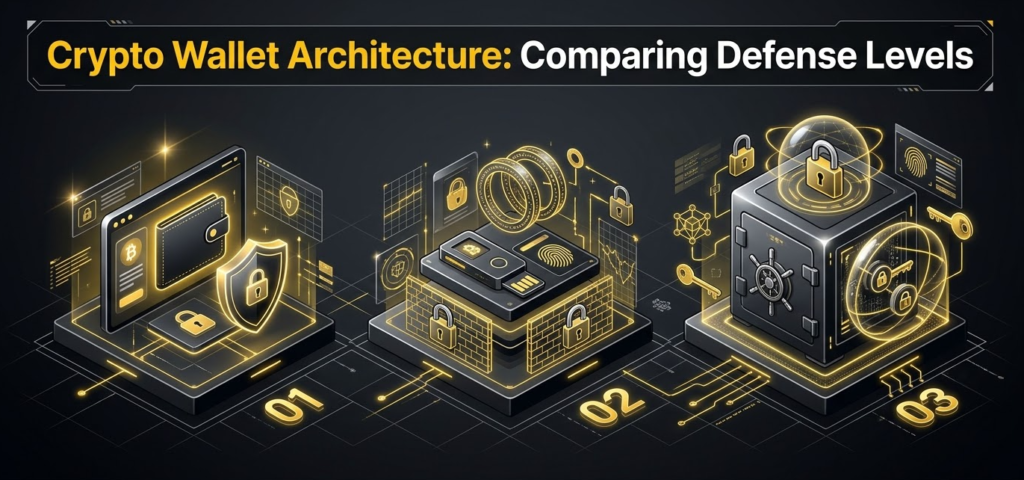
There isn’t one universal “best” wallet architecture. The right setup depends on how much you hold, how frequently you transact, how many decentralized applications you use and how much complexity you’re comfortable managing.
I like to think about wallet security in layers.
At the basic level, you have a software wallet. Then you can isolate keys with hardware. Above that, you can distribute authorization with multisig or MPC. Finally, smart-account architectures can make the authorization rules themselves programmable.
Hardware Cold Wallets & Air-Gapped Key Isolation
For most individual users holding meaningful amounts of cryptocurrency, a hardware wallet is one of the most sensible upgrades from a standard browser wallet.
The core idea is simple: the private key should not be exposed to your everyday computer or phone.
Your laptop might have malware. Your browser could have a malicious extension. You might accidentally install a fake wallet. A phishing site could manipulate the information shown on your screen.
A hardware wallet creates a boundary between those environments and the cryptographic signer.
Ethereum.org specifically recommends hardware wallets for storing private keys because the keys remain offline and local to the device, substantially reducing exposure to remote compromise. (ethereum.org)
Some modern devices go further with dedicated secure hardware and trusted displays. But don’t interpret “hardware wallet” as a magic security shield.
The device can protect the key while you’re using it. It cannot protect you from authorizing something malicious.
That’s where transaction verification becomes critical.
Multisig: Don’t Put Everything Behind One Key
If your holdings are large enough that losing one key would be catastrophic, you can go beyond a single hardware wallet.
A multisignature wallet might require, for example, 2-of-3 approvals:
- Signer A
- Signer B
- Signer C
Any two can authorize a transaction.
If one device is stolen, the attacker still doesn’t have enough authority. If one signer loses access, the remaining signers can potentially recover control depending on the configuration.
This is particularly useful for:
- Family wealth
- DAO treasuries
- Startup funds
- Protocol treasuries
- Investment groups
- Corporate crypto holdings
Platforms such as Safe are built around this model. Safe describes its wallet as a self-custody smart-account infrastructure with multisig controls, transaction simulation, spending limits and role-based access. (Safe)
The important thing is that multisig does not eliminate risk. It distributes risk.
That’s a much more realistic way to think about security.
MPC: Distributing Cryptographic Authority
Multi-Party Computation, or MPC, takes a different technical approach.
Instead of having several independent private keys approve an on-chain multisig contract, MPC systems use threshold cryptography to allow multiple parties or devices to participate in producing a signature without reconstructing the complete private key in one place.
This architecture is especially common in institutional custody and enterprise environments.
The benefit is that the blockchain can often see a normal single-signature transaction, while the authorization process behind that signature is distributed.
For an individual user, MPC may not be necessary. But for companies, funds and teams, the ability to distribute signing authority while maintaining a familiar transaction format can be extremely useful.
Account Abstraction: Making Security Programmable
Traditional Ethereum accounts are heavily tied to private-key signatures. If the key is compromised, the attacker effectively becomes the owner.
Account abstraction changes that model.
With smart accounts, authorization can be expressed as programmable logic. You can potentially build rules around:
- Spending limits
- Multiple signers
- Social recovery
- Session keys
- Transaction batching
- Trusted addresses
- Sponsored gas
- Custom validation logic
Ethereum’s account-abstraction roadmap explains that smart accounts can introduce backup keys, multiple approval requirements and restrictions such as trusted-address rules. (ethereum.org)
ERC-4337 provides one important implementation path. Rather than requiring every interaction to behave like a traditional Ethereum transaction from an externally owned account, it introduces UserOperation objects that bundlers can package and submit through the EntryPoint contract. (Ethereum Improvement Proposals)
For users, the practical implication is interesting: your wallet can increasingly behave less like a single password-protected vault and more like a programmable security policy.
That’s where wallet security is heading.
Protecting Your Secret Recovery Phrase
If there is one part of your wallet setup where you should be obsessive, it’s your recovery phrase.
A recovery phrase is not something you casually “back up.”
It is the backup.
Depending on the wallet standard, it may contain 12 or 24 words under BIP-39. These words represent the underlying cryptographic material from which wallet keys and addresses can be derived. Trezor’s documentation, for example, explains that its BIP-39 backups use 12 or 24 words and should be kept offline and protected from loss or damage. (Trezor)
If someone gets the phrase, the device itself may become irrelevant.
If you lose the phrase and lose access to the wallet, there may be nobody who can rescue you.
The Physical Backup Gold Standard
For a serious long-term wallet, I would avoid paper as the only backup.
Paper is cheap, but it burns, gets wet, fades and can be destroyed by accident.
A metal backup is considerably more resilient.
The basic approach is:
- Generate the wallet on a trusted device.
- Write the recovery words down carefully.
- Verify every word and its order.
- Transfer the backup to an appropriate metal storage medium.
- Store it somewhere physically secure.
- Keep the backup away from the hardware wallet itself.
You don’t need to make your backup look like a Hollywood spy movie. The goal is simply to make sure a fire, flood, hardware failure or accidental disposal doesn’t destroy your only recovery path.
Trezor explicitly advises keeping wallet backups offline, private and protected from damage or loss, and warns against digital copies. (Trezor)
Never Put Your Seed Phrase in the Cloud
This is one of the easiest mistakes to avoid.
Don’t:
- Screenshot it.
- Photograph it.
- Email it to yourself.
- Put it in Google Drive.
- Store it in iCloud.
- Save it in Notes.
- Paste it into a chat.
- Upload it to an online form.
- Send it to “support.”
- Store it as an unencrypted text file.
Why?
Because your phone and computer are designed to synchronize information.
A screenshot can automatically become a cloud backup. A photograph can appear on another device. A compromised account can expose years of supposedly private information.
Ethereum.org specifically warns against screenshots because they can synchronize recovery phrases or private keys to cloud providers. (ethereum.org)
Trezor gives similar guidance, explicitly warning users not to keep digital copies such as screenshots, photographs, emails or cloud-storage copies. (Trezor)
The safest seed phrase is one that has never touched an internet-connected system.
The 25th Word: Passphrase Protection
A BIP-39 passphrase is often casually called a “25th word,” although technically it doesn’t have to be a single word and it isn’t literally part of the original 24-word mnemonic.
Think of it as an additional secret layered on top of your wallet backup.
A passphrase generates a different wallet from the same underlying recovery phrase. Trezor describes it as a user-chosen string that extends the wallet backup and deterministically creates a separate hidden wallet. (Trezor)
This can be extremely powerful.
Imagine an attacker discovers your 24-word backup. Without the passphrase, the attacker may only access the standard wallet rather than the passphrase-protected wallet containing your main holdings.
But there is a catch that you should take very seriously:
If you forget the passphrase, the wallet cannot magically recover it for you.
Trezor explicitly warns that a passphrase wallet cannot be recovered if the passphrase is forgotten or misplaced. (Trezor)
So a passphrase is not free security. It is additional security purchased with additional operational responsibility.
Neutralizing Attack Vectors: Drainers, Blind Signing & Phishing
This is where many users misunderstand hardware wallets.
They think:
“My private key is on a hardware wallet, so I can’t get drained.”
Unfortunately, that’s not true.
A hardware wallet protects your key.
It doesn’t automatically protect you from signing a transaction that gives someone permission to use your assets.
Token Approvals vs. Private Key Hacks
Suppose you connect your wallet to a malicious DeFi website.
The site asks you to approve an ERC-20 token allowance.
You click through without checking.
Depending on the contract and approval structure, you may have granted the contract permission to move tokens from your wallet.
The attacker doesn’t necessarily need your seed phrase.
They may simply exploit the permission you voluntarily signed.
This is why wallet security isn’t just about keeping private keys secret. You also need to understand what you’re authorizing.
A useful mental model is:
Private key = authority to sign.
Token approval = permission you’ve already granted to another contract.
Those are different attack surfaces.
Clear Signing vs. Blind Signing
Blind signing is one of the most dangerous habits in Web3.
You might see a transaction containing an incomprehensible hexadecimal payload. You don’t know what the contract is going to do, but you click “Confirm” because the website told you that the transaction is required.
That’s essentially signing a document without reading it.
Clear signing tries to solve this by presenting the transaction in human-readable form on a trusted signing display.
Ledger describes clear signing as a process that lets users verify the action, recipient and amount before approving a transaction. (Ledger)
This distinction matters because your computer’s screen isn’t necessarily trustworthy.
If malware controls your browser, the website can display one thing while the underlying transaction asks you to authorize something else.
A trusted hardware display provides another verification boundary.
The security principle is beautifully simple:
What you see should be what you sign.
Ledger’s developer documentation describes this as the central purpose of clear signing: the user should be able to understand the transaction parameters before providing consent. (Ledger Developer Portal)
Transaction Simulation Is Useful, But It Isn’t Magic
Transaction simulation tools can provide another layer of defense.
They attempt to predict what will happen if the transaction executes. A simulation might show that a transaction will transfer your USDC, mint an NFT, or modify an allowance.
That’s extremely useful.
But I wouldn’t treat simulation as a replacement for human verification.
Simulation is a prediction of execution.
Clear signing is about understanding authorization.
Those are complementary defenses, not substitutes for one another. Ledger’s current documentation makes a similar distinction, noting that simulation can help identify outcomes while clear signing focuses on presenting the transaction’s actual intent to the user. (Ledger Developer Portal)
Phishing: The Old Attack That Still Works
Crypto phishing doesn’t need to be technically sophisticated.
An attacker can create a fake:
- Wallet website
- Airdrop page
- NFT mint
- Exchange login
- Customer-support account
- Hardware-wallet update page
- DeFi dashboard
The goal is usually to make you do something voluntarily.
That’s why “I would never give my seed phrase to a hacker” isn’t enough.
The real question is:
Could you be manipulated into giving it to a website you believe is legitimate?
Ethereum’s security guidance warns that phishing pages may imitate legitimate sites and ask users to enter recovery phrases, reset passwords or send funds. (ethereum.org)
The safest approach is boring:
- Bookmark important wallet and exchange websites.
- Don’t follow financial links from random DMs.
- Verify domains character by character.
- Never enter a seed phrase into a website.
- Treat urgent security warnings with suspicion.
- Never trust a person simply because they claim to be “support.”
No legitimate wallet support representative needs your recovery phrase.
Social Engineering & On-Chain Scams
Some attacks don’t compromise your device at all.
They compromise your attention.
Address Poisoning
Address poisoning is a good example.
A scammer may create an address that resembles yours and send a tiny or zero-value transaction to you. Later, you look at your transaction history and accidentally copy the scammer’s address because the beginning and ending characters look familiar.
This works because humans are bad at visually comparing long hexadecimal strings.
The solution is simple but important:
Never copy an address from transaction history without verifying it.
For significant transfers, compare the complete address and use an address book or trusted contact list whenever possible.
Clipboard Malware
Clipboard malware takes advantage of another common behavior: copying an address and pasting it.
The malware silently replaces the copied address with one controlled by the attacker.
You press paste.
You don’t notice.
The transaction goes somewhere else.
This is why checking the destination address on your signing device matters, especially for high-value transfers.
Fake Airdrops and Malicious Mints
A free NFT or token can be surprisingly expensive.
A malicious mint can ask you to sign an approval or interact with a contract that performs something completely different from what the marketing page suggests.
When the transaction is unclear, don’t sign it.
You don’t lose anything by walking away from an airdrop.
You can lose everything by approving the wrong transaction.
A Practical Wallet Security Model
One of the biggest improvements you can make is to stop using one wallet for everything.
I prefer a tiered wallet structure because it limits the blast radius of mistakes.
Primary Cold Vault
This wallet holds your long-term assets.
Use it rarely.
Ideally:
- Hardware protected
- Minimal dApp interaction
- No random NFT minting
- No experimental DeFi
- No unknown approvals
- Strong physical backup
- Optional passphrase protection
Think of it like a bank vault.
You don’t take the vault to the coffee shop.
Daily Hot Wallet
This is your operational wallet.
You might use it for:
- DeFi
- DEX trading
- NFTs
- Staking
- Web3 applications
- Smaller transfers
Keep only the amount you’re comfortable exposing to a connected environment.
If the wallet gets drained, your primary holdings remain isolated.
Burner Wallet
A burner wallet is disposable.
You use it for interactions where you don’t fully trust the environment or where you want maximum separation from your primary identity.
For example, you might use one for:
- Experimental dApps
- NFT mints
- Unknown contracts
- New protocols
- Short-term farming
- Airdrop interactions
The important part is not the wallet software.
It’s the separation of risk.
If your burner wallet gets compromised, it shouldn’t contain enough value to change your financial life.
Step-by-Step Crypto Wallet Security Protocol
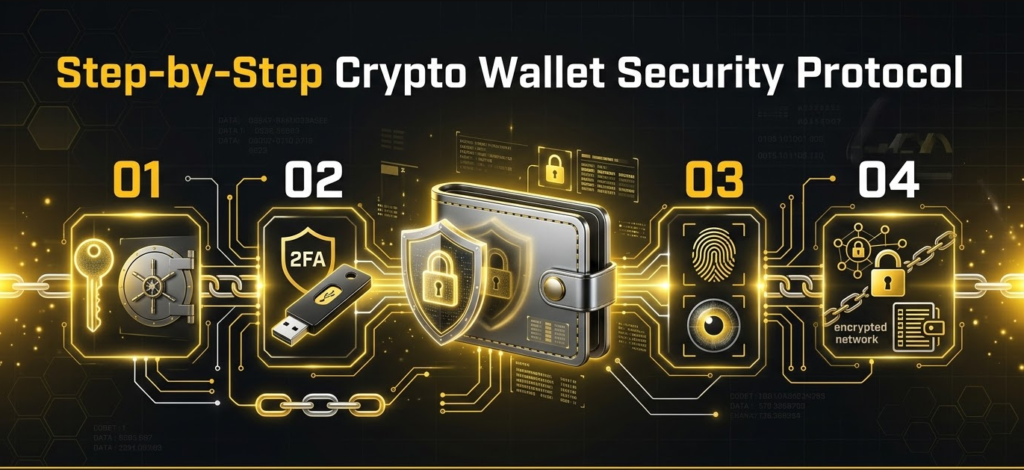
If I were setting up a serious self-custody environment from scratch, this is the sequence I’d follow.
Step 1: Establish a Cold Vault
Choose a reputable hardware wallet and initialize it using the manufacturer’s official process.
Do not buy a device from a random marketplace if you cannot confidently establish its provenance.
Generate the wallet directly on the device.
Write the recovery phrase down offline.
Never type it into your computer.
Then verify that the backup works according to the manufacturer’s recovery procedure before transferring significant funds.
Ethereum.org notes that a recovery phrase can restore a wallet on compatible wallet software, which is precisely why it must be protected as carefully as the assets themselves. (ethereum.org)
Step 2: Create a Durable Physical Backup
For serious holdings, use a durable offline medium rather than relying on paper alone.
The important properties are:
- Offline
- Fire resistant
- Water resistant
- Private
- Difficult to lose
- Difficult for unauthorized people to access
Don’t keep your backup next to your hardware wallet.
If someone steals both, your physical security model has failed.
Step 3: Consider a Passphrase
If you understand the operational consequences, consider using a BIP-39 passphrase to create a separate hidden wallet.
But don’t use a complicated passphrase that you cannot reliably recover.
The worst possible security setup is one where you successfully protect your crypto from hackers and then accidentally lock yourself out.
Step 4: Create a Separate Hot Wallet
Use another wallet for routine Web3 activity.
Fund it with only what you need.
This wallet can be connected to decentralized applications without putting your entire net worth within reach of every contract you interact with.
Step 5: Add Transaction Verification
Where possible, use wallets and signing devices that support human-readable transaction verification.
Clear signing should show you things such as:
- What contract you’re interacting with
- What action you’re authorizing
- Which asset is involved
- How much is being transferred
- Who receives the funds
Ledger’s current Clear Signing documentation explains that the standard is designed to turn encoded blockchain data into transaction information a human can review before signing. (Ledger Developer Portal)
Step 6: Review Token Approvals
Don’t assume an old approval is harmless simply because you stopped using the dApp months ago.
Review your active permissions periodically.
For Ethereum-compatible networks, tools such as Revoke.cash can help users inspect and revoke token approvals.
Remember, revoking an allowance itself requires an on-chain transaction, so you will generally need the relevant network’s native token to pay the network fee.
Step 7: Use Wallet Separation
At minimum, consider:
| Wallet | Purpose | Typical Exposure |
|---|---|---|
| Cold Vault | Long-term holdings | Very low |
| Hot Wallet | Everyday Web3 | Medium |
| Burner Wallet | Experimental/unknown dApps | High |
This is one of the simplest security improvements you can make because it doesn’t depend on predicting every future scam.
You are simply making sure that one mistake doesn’t automatically become a catastrophic one.
Hardware Wallet vs. Hot Wallet vs. Multisig vs. MPC
There is no single winner for every situation.
| Security Architecture | Key Isolation Mechanism | Recovery Resiliency | Main Vulnerability | Best Use |
|---|---|---|---|---|
| Hardware Cold Wallet | Offline hardware signer | Recovery phrase / optional passphrase | User signing mistakes, physical loss | Long-term holdings |
| Software Hot Wallet | Device-based key storage | Seed phrase | Malware, phishing, malicious dApps | Everyday Web3 |
| Multisig | Multiple independent signers | Multiple keys | Contract/configuration risks | Shared treasury |
| MPC Wallet | Distributed threshold shares | Provider-dependent recovery | Infrastructure/provider dependency | Institutions and teams |
| Smart Account | Programmable contract logic | Guardians / backup keys | Smart-contract vulnerabilities | Advanced Web3 security |
For an individual investor, a hardware wallet plus sensible wallet separation is often enough.
For a family office or company, I’d start thinking about multisig or institutional MPC much earlier.
For a DAO, multisig governance may be more important than whether any individual signer owns a particular hardware device.
The architecture should match the threat model.
Account Abstraction and the Future of Wallet Security
One of the most interesting developments in wallet security is that we are gradually moving away from the idea that a wallet must be controlled by exactly one private key.
Account abstraction allows developers to define custom validation and execution logic.
That opens the door to features such as:
- Social recovery
- Spending limits
- Multiple authorization methods
- Session keys
- Transaction batching
- Sponsored gas
- Alternative fee payment
- Automated security policies
ERC-4337 introduced a framework for account abstraction using UserOperation objects and bundlers without requiring Ethereum’s consensus layer to be fundamentally changed. (Ethereum Improvement Proposals)
Ethereum.org also highlights the ability of smart accounts to support backup keys, multiple signers, trusted-address restrictions and more flexible gas management. (ethereum.org)
This matters because the traditional seed phrase model has a brutal weakness:
one secret can represent enormous financial authority.
Programmable accounts can split that authority into rules.
For example, imagine your wallet allows you to spend up to $500 per day with one key, but requires two guardians for a $50,000 transfer.
That is a very different security model from “whoever has my seed phrase controls everything.”
And I think that distinction will become increasingly important as Web3 becomes more mainstream.
Why “More Security” Can Sometimes Mean Less Security
There’s a trap here.
People often keep adding security features without thinking about whether they can actually operate the resulting system.
You can create:
- Multiple backups
- Multiple passphrases
- Multiple wallets
- Multiple devices
- Multisig signers
- Complex inheritance plans
…and eventually forget how the whole thing works.
That isn’t security.
That’s operational fragility.
A security system is only useful if you can reliably recover from:
- Device loss
- Fire
- Death
- Forgotten credentials
- Family disputes
- Employee departure
- Key compromise
- Hardware failure
For a high-value setup, document the recovery process without documenting the actual secrets.
A trusted successor should eventually be able to understand how the system works without having a public document containing everything needed to immediately steal the assets.
Security Checklist Before You Move Serious Funds
Before sending a meaningful amount of crypto into a new wallet, I would check the following:
Device Security
- Hardware wallet initialized correctly
- Firmware obtained from the official vendor
- PIN enabled
- Device physically protected
- Computer and phone updated
- Suspicious browser extensions removed
Recovery Security
- Recovery phrase written offline
- Word order verified
- Backup physically protected
- No digital copy exists
- No cloud synchronization
- No photograph exists
- Passphrase documented through a separate recovery plan if used
Transaction Security
- Recipient address independently verified
- Correct blockchain network selected
- Amount checked on the hardware device
- Contract interaction understood
- Clear signing available where possible
- Blind signing avoided whenever practical
Wallet Hygiene
- Long-term assets separated from dApp activity
- Old token approvals reviewed
- Burner wallet used for risky experiments
- Unknown NFTs and tokens not interacted with
- Important wallet addresses bookmarked or saved safely
Recovery Planning
- You know how to restore the wallet
- You have tested the recovery process appropriately
- You know where your backup is
- A trusted contingency plan exists for major holdings
- You understand what happens if your hardware device disappears
What to Do If You Think Your Wallet Has Been Compromised
Speed matters.
If you believe your seed phrase has been exposed, don’t spend hours trying to determine whether the attacker actually has it.
Assume the secret is compromised.
Create a new wallet using a clean environment and move legitimate assets to the new wallet.
If you have an active token-drainer situation, prioritize the assets that can still be transferred safely and avoid interacting with suspicious contracts.
If the problem is an approval rather than a compromised private key, revoke the malicious or unnecessary allowance as soon as possible.
And if the wallet has already been drained, don’t send more money to anyone promising they can “recover” it.
Recovery scammers frequently target victims after an initial theft because they know the victim is desperate.
Ethereum.org’s security guidance is blunt on this point: without the relevant recovery phrase or private keys, self-custodied funds generally cannot be recovered through customer support. (ethereum.org)
That’s painful, but understanding it can prevent a second loss.
A Better Mental Model for Crypto Wallet Security
I don’t think the best way to understand wallet security is as a competition between Ledger, Trezor, MetaMask, Safe or another brand.
The product matters, but the architecture matters more.
Think about security as five layers:
Layer 1 – Key isolation
Keep private keys away from internet-connected systems whenever possible.
Layer 2 – Backup protection
Make the recovery mechanism durable, private and recoverable.
Layer 3 – Transaction verification
Never sign something you don’t understand.
Layer 4 – Permission management
Review what smart contracts are allowed to do.
Layer 5 – Risk segmentation
Don’t expose your entire portfolio to the same wallet and the same applications.
If one layer fails, the others should limit the damage.
That’s what good security looks like.
Not perfection.
Containment.
Frequently Asked Questions
What is the single most effective way to secure crypto holdings from remote online attacks?
For long-term holdings, one of the strongest practical approaches is to keep the majority of assets in an offline hardware wallet and minimize its interaction with internet-connected applications. For shared or institutional funds, a properly configured multisig can provide another major layer by eliminating reliance on a single signer.
Ethereum.org recommends hardware wallets because they keep private keys offline, while multisig architectures can distribute transaction authority across multiple independent keys. (ethereum.org)
The important point is that a hardware wallet isn’t enough by itself. You still need to verify what you’re signing.
How should a 12- or 24-word recovery phrase be backed up safely?
Keep it offline, private and physically protected.
For serious holdings, a durable metal backup can provide stronger protection against fire, water and physical deterioration than ordinary paper. Never store the phrase in screenshots, cloud storage, email or other internet-connected systems.
Trezor explicitly recommends offline storage and warns users not to maintain digital copies of wallet backups. (Trezor)
What is blind signing?
Blind signing means approving a transaction when you cannot meaningfully understand what the transaction will do.
Instead of seeing something like “Send 500 USDC to this address,” you might see opaque transaction data or an incomprehensible hexadecimal payload.
That creates an obvious problem: you can’t confidently verify your authorization.
Clear signing addresses this by translating transaction information into human-readable details on a trusted signing display. (Ledger)
Does a hardware wallet protect me from crypto drainers?
Not automatically.
A hardware wallet protects your private key from many forms of remote extraction, but you can still authorize a malicious transaction yourself.
If you sign a malicious token approval, NFT transfer or contract interaction, the hardware device may faithfully execute your instruction.
The security lesson is important:
Hardware security protects the key. Transaction verification protects the decision.
You need both.
What are token allowances and why should I revoke them?
A token allowance gives a smart contract permission to spend certain tokens on your behalf.
For example, when you approve a DEX to spend your USDC, you’re creating an authorization relationship between your wallet and that contract.
If the contract later becomes compromised or malicious, an existing allowance can become dangerous.
Regularly reviewing and revoking unnecessary permissions reduces that attack surface.
What is an address-poisoning attack?
Address poisoning is a scam where an attacker creates an address resembling yours and sends a tiny or zero-value transaction to it.
The attacker hopes you’ll later copy their address from your transaction history rather than your genuine address.
The simplest defense is to verify the entire destination address, especially before high-value transfers.
For large transactions, I strongly prefer using a verified address book or another trusted source rather than copying an address from transaction history.
What is the “25th word” on a hardware wallet?
The “25th word” is a common nickname for a BIP-39 passphrase.
Technically, it isn’t limited to one word. It is an additional user-selected string that modifies the wallet derivation process and can create a separate hidden wallet.
Trezor describes passphrases as an optional extension to the wallet backup that deterministically generates a different wallet. (Trezor)
The trade-off is crucial: if you forget the passphrase, the wallet cannot simply recover it for you.
Should I use one wallet for everything?
For meaningful holdings, I wouldn’t.
A better approach is to separate:
- Cold wallet: long-term wealth
- Hot wallet: normal Web3 activity
- Burner wallet: experimental or higher-risk interactions
This doesn’t make you invulnerable, but it dramatically reduces the consequences of a single bad interaction.
Are multisig wallets safer than hardware wallets?
They’re solving different problems.
A hardware wallet protects a private key by isolating it from an internet-connected environment.
A multisig distributes authority among multiple independent keys.
You can combine them.
For example, a 2-of-3 multisig could have three independent hardware signers. An attacker would then need to compromise enough separate authorization points to move the funds.
Safe’s documentation describes multisig as a threshold-based system in which multiple owners must approve before a transaction executes. (Safe Knowledge Base)
Does account abstraction eliminate seed phrases?
Not necessarily.
Account abstraction can reduce reliance on a single traditional private-key authorization model by allowing programmable validation, recovery and transaction rules.
Ethereum’s documentation describes smart accounts as a way to add backup keys, multiple approvals, trusted-address restrictions and other custom security logic. (ethereum.org)
So the direction is not simply “seed phrases disappear.”
It’s more like:
wallet security becomes programmable.
Final Thoughts: The Safest Wallet Is a Security System
If you take only one idea from this guide, make it this:
Crypto security isn’t about finding a magical wallet that can never be hacked. It’s about designing a system where one mistake doesn’t destroy everything.
Use hardware isolation for valuable long-term holdings. Keep recovery phrases offline. Consider a passphrase only if you understand its recovery implications. Use a separate wallet for everyday Web3 activity. Treat every smart-contract approval as a real authorization rather than a harmless button click.
And perhaps most importantly, stop thinking of the hardware wallet as the security system.
It’s one component of it.
The strongest setup combines key isolation, resilient backups, transaction verification, permission hygiene and asset segregation. For organizations or very large portfolios, multisig, MPC or programmable smart accounts can push that model further by distributing authority instead of putting everything behind one secret.
Modern wallet infrastructure is already moving in that direction. Ethereum’s account-abstraction work is making programmable authorization increasingly practical, while standards such as ERC-7730 are improving how users understand what they’re signing. (ethereum.org)
Ultimately, self-custody gives you something traditional finance rarely does: direct control.
But direct control comes with direct responsibility.
If you build your wallet setup around that reality rather than assuming a device or brand will save you, you’re already thinking about crypto security the right way.