Bybit Global vs Bybit EU: Feature comparison
If you have landed on this comparison, there is a good chance you have already noticed something confusing: Bybit has more than one website, and the platform you can use may depend on your country of residence.
That distinction matters more than it might appear.
Bybit Global and Bybit EU share the Bybit brand, but they are not simply two interfaces connected to the same account and product catalog. They operate through different legal entities, have different regulatory permissions, and may offer different trading products, fees, payment services, and account features.
For someone living outside the EEA, Bybit Global may be the relevant platform, subject to local restrictions. For an eligible EEA resident, Bybit EU is the dedicated European platform.
Here is the high-level comparison.
| Feature | Bybit Global | Bybit EU |
|---|---|---|
| Operating entity | Bybit’s international operating entities, including Bybit Fintech Limited | Bybit EU GmbH |
| Regulatory model | International platform with jurisdiction-specific restrictions and entities | Austrian MiCA-authorized crypto-asset service provider |
| Main audience | Eligible users outside restricted jurisdictions | Eligible residents of supported EEA markets |
| Standard crypto spot fees | Regular-user baseline: 0.10% maker / 0.10% taker | VIP 0: 0.10% maker / 0.25% taker |
| Crypto perpetual Futures | Available for eligible users and markets | Do not assume Global Futures are available through EU |
| Options | Available in supported markets and accounts | Product availability differs; check the EU platform’s current catalog |
| Leverage | Instrument- and account-specific | Product and risk restrictions differ from Global |
| Unified Trading Account | Available in supported Global markets | EU account features and supported products differ |
| Fiat payments | Methods vary by location and payment provider | European payment services are supported through separately authorized entities and available methods |
| Bybit Card FX fee | Depends on the relevant card product and card terms | Published FX fee: 0.5% on top of Mastercard’s rate |
| EEA access | Some Global services are being progressively limited for EEA residents | Dedicated regulated platform for eligible EEA residents |
| Client asset safeguards | Depend on the relevant entity, product, and applicable terms | MiCA safeguarding and segregation obligations apply to the authorized entity |
The most important sources are Bybit’s Global fee schedule, the Bybit EU VIP fee schedule, and the Austrian Financial Market Authority’s authorization notice for Bybit EU GmbH.
One thing I would avoid is treating the Global platform as the “better” version and EU as the “restricted” version. That framing misses the point. Bybit EU is designed to serve a different regulatory market. A product being available on Global does not mean it is available to an EEA resident, and a Global account does not grant permission to use services that are restricted in your country.
International platform vs MiCA-authorized European entity

The biggest difference between Bybit Global and Bybit EU is not a trading interface or a fee tier. It is the legal and regulatory structure behind the service.
That affects who can open an account, which products are offered, how client assets are handled, and what happens when the platform changes its regional access rules.
Bybit EU GmbH: Austrian FMA authorization and MiCA
Bybit EU GmbH is headquartered in Vienna, Austria. The Austrian Financial Market Authority (FMA) granted the company authorization as a crypto-asset service provider under the EU Markets in Crypto-Assets Regulation, commonly known as MiCA or MiCAR.
The FMA’s May 30, 2025 authorization notice identifies the crypto-asset services Bybit EU GmbH is authorized to provide, including:
- Custody and administration of crypto-assets on behalf of clients.
- Exchange of crypto-assets for funds.
- Exchange of crypto-assets for other crypto-assets.
- Placing of crypto-assets.
- Transfer services for crypto-assets on behalf of clients.
This is more specific than saying that Bybit EU is “regulated in Europe.” The authorization covers particular crypto-asset services under a defined regulatory framework.
Bybit announced that it had passported its MiCA authorization across 29 EEA countries. The French financial regulator, AMF, also lists Bybit EU GmbH as licensed under MiCA and authorized to provide crypto-asset services in France under the free provision of services.
You can verify this through the AMF’s Bybit EU listing.
There is a qualification worth remembering: Bybit’s own regional notice says Malta residents are not included in the current Bybit EU service rollout because the relevant license has not been passported there and the platform does not actively offer services to Malta residents.
So, although the EEA has 30 countries, it is inaccurate to describe Bybit EU as automatically available to every EEA resident without exception.
What MiCA authorization actually means
MiCA establishes a regulatory framework for crypto-asset issuers and service providers within the EU. For an authorized crypto-asset service provider, that framework includes obligations around conduct, transparency, custody, and safeguarding.
For users, this creates a more clearly defined regulatory environment than relying on an offshore exchange entity that is not authorized to provide the same services in their home country.
But there is a distinction between regulatory safeguards and a guarantee against loss.
A MiCA authorization does not mean every asset is insured like a bank deposit. It does not guarantee that a token’s price will recover, that a withdrawal can never be delayed, or that a platform cannot experience an operational incident.
It also does not automatically authorize every crypto product the wider Bybit group offers globally. The authorized services and the actual product catalog must be considered separately.
Bybit EU’s own MiCA explanation describes its authorization and safeguarding obligations, while also making clear that the platform serves eligible EEA residents and that service availability is subject to legal and regulatory requirements.
Bybit Payments GmbH: a separate payment-services authorization
Another important development is the authorization of Bybit Payments GmbH, a separate Austrian entity.
On August 4, 2026, Austria’s FMA granted Bybit Payments GmbH an Electronic Money Institution (EMI) license. The regulator’s official notice states that the company is authorized to issue electronic money and provide specified payment services.
Bybit’s own announcement explains that the two entities have distinct regulatory permissions:
- Bybit EU GmbH: MiCA authorization for crypto-asset services.
- Bybit Payments GmbH: EMI authorization for electronic money and payment services.
That separation matters because crypto custody and exchange services are not the same thing as issuing electronic money or processing payment services.
For a European customer, the EMI license may support the platform’s payment and fiat-service offering. But do not assume that it means every bank transfer, card feature, or fiat currency is available to every customer. Payment methods, currencies, and account eligibility still depend on the service and region.
Bybit Global: a separate international platform
Bybit Global operates through its international entities and offers products for users in eligible jurisdictions.
The Global platform may include derivatives products, options, and other trading services that are not offered through Bybit EU. The exact availability depends on the account, location, and product.
Global access should not be interpreted as permission to use the platform from a restricted jurisdiction.
This distinction has become especially relevant for EEA residents. On June 29, 2026, Bybit published an important notice for EEA users stating that access to certain Global services would be progressively limited as part of its regulatory alignment efforts.
The notice says affected users would receive communications about timelines for managing existing positions and balances, and that access to their custodied assets would remain available for remediation.
This is not the same as saying that every EEA resident was instantly blocked from every Global service on that date. It does mean that EEA residents should pay close attention to official account notices and should not assume Global access will remain unchanged.
Global 0.10% spot fees vs EU maker/taker rates
Fees are one of the most visible differences between Bybit Global and Bybit EU.
At first glance, the Global platform looks cheaper for spot trading because its regular-user spot rate is 0.10% maker and 0.10% taker. Bybit EU’s VIP 0 fee schedule lists 0.10% maker and 0.25% taker.
That creates a real difference for market orders and other taker executions.
However, the full fee picture includes VIP levels, product type, order execution, payment method, and regional variation. The fee displayed in your verified account is the one you should use when calculating your actual costs.
Global spot trading: the standard 0.10% baseline
Bybit Global’s regular-user spot rate is listed at:
- Maker: 0.10%
- Taker: 0.10%
The fee is charged on the filled amount. Unfilled or cancelled parts of an order do not incur a trading fee.
Bybit’s official Global fee schedule lists the baseline rates, but it also provides lower rates for higher VIP tiers and different products. Some special trading zones and instruments use different fees.
For example, if you buy $10,000 worth of crypto through a regular-user spot market order at a 0.10% taker rate, the trading fee would be $10.
That is a simple baseline calculation:
$10,000 × 0.10% = $10
If you are trading frequently, the fee adds up. If you trade through a VIP account, the actual rate may be lower.
Bybit EU spot trading: 0.10% maker and 0.25% taker at VIP 0
Bybit EU’s published VIP schedule lists the following baseline rates for VIP 0:
| VIP 0 spot execution | Fee rate |
|---|---|
| Maker | 0.10% |
| Taker | 0.25% |
The maker rate is not 0.25% for all VIP 0 users. The distinction between maker and taker matters.
A limit order that rests in the order book and later executes as a maker may incur the maker fee. An order that immediately matches existing liquidity may incur the taker fee.
Bybit EU’s VIP Program fee schedule describes the rates and VIP tiers. The EU maker/taker explanation also provides examples of how the fee is calculated.
For a $10,000 taker trade at 0.25%, the fee would be:
$10,000 × 0.25% = $25
That is $15 more than the Global baseline on the same notional amount.
This is a useful comparison if you are a regular spot trader who mainly uses market orders. If you use maker orders, the baseline fee difference is smaller because both platforms list a 0.10% maker rate for the relevant standard account schedule.
A practical fee comparison
| Order notional | Bybit Global spot taker at 0.10% | Bybit EU spot taker at 0.25% |
|---|---|---|
| $1,000 | $1 | $2.50 |
| $10,000 | $10 | $25 |
| $50,000 | $50 | $125 |
| $100,000 | $100 | $250 |
These figures are illustrative. They assume the stated baseline rate applies, and they exclude spreads, slippage, conversion costs, deposit fees, and any other charges.
For a trader placing small, occasional spot orders, the difference may be modest. For someone turning over $100,000 in spot notional every day, it becomes a recurring cost worth evaluating.
But here is the part I would not overlook: you cannot use Global’s lower fee as a reason to access Global if you are not eligible to use it. Regional compliance comes before fee optimization.
Why are Bybit EU fees different?
The outline suggests that compliance overhead and European banking rails explain the 2.5x taker fee. That is plausible as a business hypothesis, but it is not something I would state as a verified cause without a direct statement from Bybit.
The more accurate description is that Bybit EU has a separate fee schedule from Bybit Global. The platforms operate through different legal entities and serve different markets.
Their fees may reflect different commercial and operational conditions, but a precise explanation for the difference should not be invented.
If you want to know whether the EU fee is acceptable for your trading style, calculate your expected trading volume and compare the actual fee schedule. That will tell you more than guessing why the platform chose a particular rate.
Bybit Card comparison: 0.5% EU FX fee and the Global card
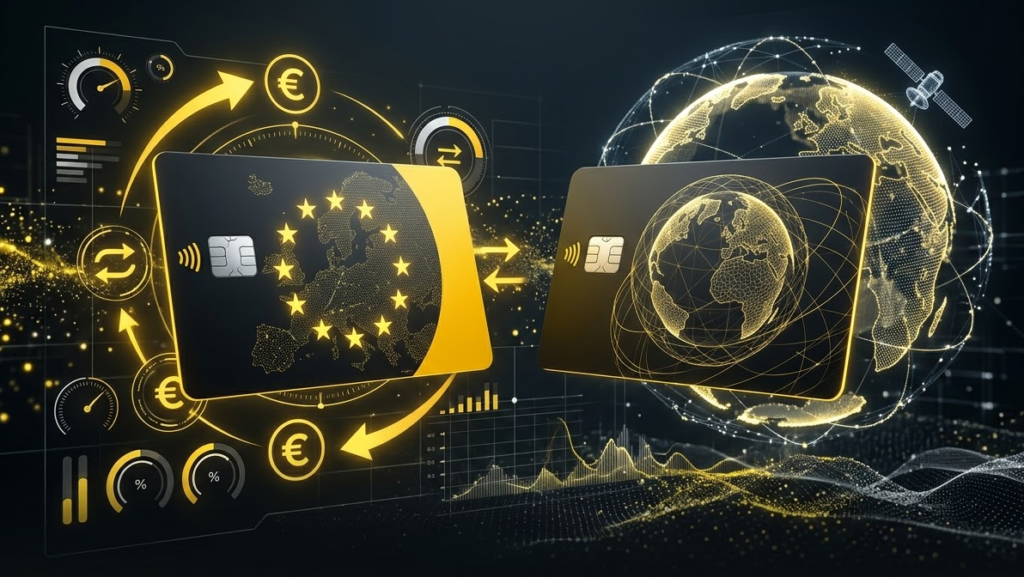
The Bybit EU Card is another area where the EU platform has a clearly published fee advantage for foreign-currency spending.
The EU card fee schedule lists a 0.5% foreign exchange fee on top of Mastercard’s exchange rate. It also lists a 0.9% crypto conversion fee when transactions are funded with non-fiat assets in the Bybit EU Funding Account.
Those are two separate costs.
If you pay in a currency different from the card’s denomination, the FX fee may apply. If your payment is funded by crypto that must be converted to fiat, the crypto conversion fee may also apply.
Bybit EU’s Card fees and spending limits provides the current fee schedule and examples.
What does 0.5% FX mean in practice?
Imagine your Bybit EU Card is denominated in EUR and you spend the equivalent of €100 in a foreign currency.
A 0.5% FX fee would be:
€100 × 0.5% = €0.50
The final amount also depends on Mastercard’s exchange rate and any merchant or ATM fees. The FX fee is not the same as the exchange rate itself.
If you are paying with crypto rather than EUR balance, the 0.9% crypto conversion fee may also apply. That makes it important to distinguish between spending fiat already held in the Funding Account and spending that triggers crypto conversion.
Is the Global card always more expensive?
The outline’s proposed Global Card FX range of 1.5%–7.0% should not be used as a universal comparison. Global card fees can vary by card product, issuing region, currency, and the current card terms.
Bybit Global’s published card terms for EEA and Switzerland, for example, list a 0.5% foreign exchange fee above Mastercard’s rate, along with other charges such as crypto exchange fees and ATM withdrawal fees. That means the EU card’s 0.5% FX fee is not automatically a unique advantage over every Global card product.
The better comparison is the exact card available to your account:
- What is the card’s denomination?
- What is the FX fee?
- Is there a separate crypto conversion fee?
- Are ATM withdrawals charged?
- Does the card have an issuance, replacement, or inactivity fee?
- Does the bank or ATM operator add its own fee?
The official Bybit EEA cardholder terms list card-specific fees and limits. Always check the version that applies to your card.
Global derivatives vs EU spot trading
The product catalog is another major difference.
Bybit Global has offered a broader derivatives environment, including perpetual Futures and options in eligible markets. Bybit EU’s product offering is narrower and is shaped by the scope of its authorization and regional requirements.
That does not mean the EU platform is simply a stripped-down Global account. It is a separate platform with its own product catalog, fee structure, payment services, and account features.
Bybit Global: Unified Trading Account and derivatives
Bybit Global’s Unified Trading Account (UTA) supports multiple products within a unified account framework. Depending on the user’s region and account configuration, the product set may include spot, margin, perpetual Futures, options, and other instruments.
This can be convenient if you manage different types of positions. You may be able to use eligible collateral across supported products rather than moving funds between separate account structures.
But UTA is not a guarantee that all assets are eligible collateral or that all positions share the same margin rules. The supported products, collateral haircuts, margin modes, and risk controls matter.
The Global platform also lists options in supported markets. Options can be useful for hedging, volatility strategies, and defined-risk structures, but they are more complex than buying spot or opening a perpetual position.
If you use options, review the contract type, settlement method, expiry, underlying asset, and margin requirements. Do not assume that a feature available on Bybit Global will be available through Bybit EU.
Bybit EU: curated spot products and fiat services
Bybit EU focuses on crypto-asset services within the scope of its MiCA authorization, with a spot trading catalog and payment-related services for eligible users.
Its Spot Trading FAQ explains the spot market and the fee applied to executed orders. The platform’s product catalog should be checked directly because asset availability can change.
The outline describes Bybit EU as offering around 100+ curated spot assets and MiCA-compliant stablecoin pairs. I would treat those as catalog claims that require a current platform check rather than permanent specifications.
The key distinction is that Bybit EU does not automatically inherit the Global platform’s full derivatives suite. If you need perpetual Futures, options, or a particular margin feature, check the EU product interface and the applicable terms before moving funds.
Why derivatives restrictions need careful wording
It is tempting to say that MiCA or ESMA rules simply ban all high-leverage derivatives for EEA retail traders. That would be too broad.
MiCA is the EU’s crypto-asset framework, but derivatives may also fall under other financial-services rules, and product access depends on the specific instrument, entity, authorization, and client category.
The practical advice is more direct: do not assume that a Global derivatives product is available on Bybit EU. Check the actual EU platform catalog and official announcements.
For many users, this is the main product trade-off. If you are a spot investor, Bybit EU may offer the services you need. If you rely on Global derivatives products, the EU platform may not be a substitute.
Regional access and account routing
If you live in the EEA, account routing is not a minor technical issue. It is part of the platform’s compliance structure.
Bybit’s June 29, 2026 notice says certain Global services for EEA residents will be progressively limited. The announcement also states that affected users will receive communications about timelines and managing existing positions and balances.
This means you should not assume that you can continue using Bybit Global indefinitely just because you already have an account.
Can EEA residents trade on Bybit Global?
The answer depends on the service, the user’s circumstances, and the implementation of Bybit’s regional restrictions.
Bybit has identified the EEA countries in scope of its Global service-limitation notice and has stated that the regulated European platform is Bybit EU. Malta residents are excluded from the current Bybit EU service rollout according to the notice.
If you are an EEA resident:
- Read any account-routing or migration notice sent by Bybit.
- Check which services remain available on Global.
- Confirm whether you are eligible to open or use Bybit EU.
- Do not open a new Global account using false residency information.
- Do not use a VPN to conceal your location or bypass a restriction.
A VPN does not change your legal residency or create eligibility for a service.
Why trying to bypass the restriction can backfire
Users sometimes assume that if the website is accessible, the platform permits them to trade. That is not a safe assumption.
An exchange may use identity verification, proof of address, payment information, IP checks, and other compliance processes. If the account information does not match the user’s actual circumstances, the exchange may restrict access or require additional verification.
The risk is not simply being unable to open a new position. You may also face complications managing existing balances or completing account migration.
If you are affected by regional restrictions, follow the exchange’s official process. If you have funds or open positions, read the notice carefully and contact support if the instructions are unclear.
Asset custody and safeguarding
Bybit EU’s MiCA authorization includes custody and administration of crypto-assets on behalf of clients. MiCA also imposes safeguarding obligations on authorized crypto-asset service providers.
That is relevant to client asset protection, but the term “ring-fencing” should not be interpreted as a blanket guarantee that every asset is protected against every possible loss.
Safeguarding and segregation are legal and operational requirements. They do not eliminate:
- Market risk from the crypto asset itself.
- Blockchain or smart-contract risks.
- Operational outages or delays.
- Cybersecurity incidents.
- Legal disputes or insolvency risks.
- Losses resulting from a user’s own wallet or account-security mistakes.
A regulated entity is subject to specific obligations. It is still important to understand the service terms and the nature of the asset you hold.
How to evaluate the reserve and custody disclosures
When comparing Bybit Global and Bybit EU, look for documentation that answers:
- Which entity holds or administers the assets?
- Which assets are included in the reserve report?
- Are client liabilities calculated and disclosed?
- Is there a cryptographic verification mechanism?
- Does the report explain its scope and limitations?
- What happens to assets if a service is discontinued or an account is migrated?
Bybit Global’s 2025 cold-storage incident is a reminder that technical security controls can fail. Bybit said it restored the backing of customer assets, but that does not make future incidents impossible.
Likewise, Bybit EU’s MiCA authorization should not be confused with deposit insurance. A crypto-asset balance is not automatically covered by the same protection that may apply to an eligible bank deposit.
Bybit EU migration guide

If Bybit has instructed you to migrate to Bybit EU, the process should be handled through the official account-routing or migration flow.
Do not assume that a Global account and an EU account share the same balance, wallet address, product settings, or access rights. Follow the instructions shown to your account.
Phase 1: verify your Bybit EU account
- Access the EU portal: Navigate to Bybit EU or follow the official migration prompt provided in your Global account.
- Complete identity verification: Submit the required identity information and follow the verification process.
- Verify your address: If proof of address is requested, provide an accepted document that meets the platform’s requirements.
- Review eligibility: Confirm that Bybit EU is available to your country of residence and that the products you need are supported.
- Check account status: Make sure you can access the EU account and see the relevant deposit and trading functions before moving funds.
The verification method and documents can vary. Use the requirements displayed in your account rather than assuming a particular provider or document list applies to everyone.
Phase 2: transfer supported crypto assets
If the official migration flow supports an internal transfer, use it as instructed. If you need to make an on-chain transfer, use the following checklist.
- Open the Bybit EU deposit page.
- Select the asset you intend to receive.
- Choose a supported network.
- Copy the deposit address.
- Check whether the asset requires a memo or tag.
- Open the corresponding withdrawal page on Bybit Global.
- Select the same asset and network.
- Paste the address and verify it carefully.
- Review the minimum withdrawal, fee, and confirmation requirements.
- Send a small test amount if appropriate.
- Confirm the deposit has arrived before transferring the remaining balance.
The network must match exactly. A token may exist on multiple chains, but sending it to an unsupported network can result in a failed or unrecoverable transfer.
Phase 3: set up EUR payment services
If you plan to use Bybit EU’s fiat services, review the available payment methods in your account.
Bybit Payments GmbH received an Austrian EMI authorization in August 2026, but that does not mean every payment feature is automatically available to every user. Check the supported currencies, payment rails, bank-account eligibility, fees, and withdrawal limits.
For SEPA transfers, confirm the beneficiary details and any reference or payment identifier required by the platform. Use a bank account in your own name where required by the service terms.
Phase 4: review positions and product availability
Before completing a migration, check what happens to any Global products that are not available on Bybit EU.
If you have open derivatives positions, do not assume they can be transferred as positions. You may need to manage or close them according to the exchange’s official timeline.
Review:
- Open positions and their liquidation risk.
- Funding payments and pending fees.
- Assets that are not supported on Bybit EU.
- Withdrawal restrictions or deadlines.
- Any account-specific migration instructions.
If you are unsure how a position or balance will be handled, contact Bybit support before taking action. Avoid making a rushed decision based on an assumption that the EU account is an identical replacement for Global.
Which platform should you choose?
The answer depends on your residence and the products you need.
| User profile | What to consider |
|---|---|
| EEA resident who mainly buys and holds spot crypto | Bybit EU’s regulated service scope, supported assets, fees, and EUR payment methods |
| EEA resident currently using Global | Official migration notices, product limitations, and handling of existing balances or positions |
| Non-EEA user who is eligible for Global | Global’s product catalog, fee schedule, derivatives availability, and local rules |
| Frequent spot trader | Maker/taker fees, VIP tiers, spreads, and actual execution costs |
| Derivatives trader | Product availability, margin requirements, funding, leverage, and regional eligibility |
| Card user | Exact card terms, FX rate, crypto conversion fee, and ATM charges |
If you are an EEA resident, the first decision is whether Bybit EU is available to you and whether it supports the services you need. If it does, the comparison becomes a question of fees, asset availability, payment methods, and platform functionality.
If you are outside the EEA and eligible for Bybit Global, you should compare the Global platform’s current products and terms with the alternatives available in your jurisdiction. Do not use an EEA-specific comparison to assume Global access is lawful or available everywhere.
Frequently asked questions
Why are there two separate platforms, Bybit Global and Bybit EU?
Bybit EU was established to provide crypto-asset services to eligible European users through a separate Austrian entity authorized under MiCA. Bybit Global serves eligible users in other jurisdictions through its international platform and entities. The two platforms have different legal permissions, products, and fee schedules.
Is Bybit EU licensed by Austria’s FMA?
Yes. The Austrian FMA granted Bybit EU GmbH authorization as a crypto-asset service provider under MiCA in May 2025. The authorization covers specific services, including custody, exchange, placing, and transfer services for crypto-assets.
Does Bybit EU have the same fees as Bybit Global?
No. Bybit Global’s regular-user crypto spot baseline is 0.10% maker and 0.10% taker. Bybit EU’s VIP 0 schedule lists 0.10% maker and 0.25% taker for spot trading. Actual rates may vary by VIP level, product, region, and account.
Can EEA residents continue trading on Bybit Global?
Bybit has announced that certain Global services for EEA residents will be progressively limited. Affected users should follow official notices and check the services available to their accounts. Do not assume Global access will remain unchanged.
Does Bybit EU offer 125x Futures leverage?
Do not assume that Bybit EU offers the same Futures products or leverage as Bybit Global. Product availability and leverage depend on the platform, instrument, account, and jurisdiction. Check the actual Bybit EU product catalog.
Is Bybit EU’s card FX fee 0.5%?
Bybit EU’s published card fee schedule lists a 0.5% foreign exchange fee on top of Mastercard’s exchange rate. A separate 0.9% crypto conversion fee may apply when the card transaction is funded with non-fiat assets. Other charges may apply, including ATM operator fees.
Are Bybit EU funds protected like bank deposits?
No. MiCA authorization imposes safeguarding and other obligations on the authorized crypto-asset service provider, but crypto assets are not automatically covered by bank deposit insurance. Users still face market, operational, custody, and other risks.
Can I transfer my Bybit Global balance to Bybit EU?
The process depends on the migration instructions and the assets or products in your account. Use the official migration flow where available. If you need an on-chain transfer, verify the supported asset, network, deposit address, and memo or tag before sending.
Does Bybit Payments GmbH have an EMI license?
Yes. Austria’s FMA granted Bybit Payments GmbH an Electronic Money Institution license on August 4, 2026. The entity is separate from Bybit EU GmbH, which holds the MiCA authorization for crypto-asset services.
Should I choose Bybit Global or Bybit EU?
Choose the platform that is available to you legally and supports the products you actually need. For eligible EEA residents, Bybit EU is the dedicated European platform. For users outside the EEA, Bybit Global may be relevant, subject to local restrictions and account eligibility.
Final verdict
Bybit Global and Bybit EU share a brand, but they serve different regulatory markets and should be compared as separate platforms.
Bybit Global has a broader international derivatives environment for eligible users, with a regular-user spot fee baseline of 0.10% and standard crypto Futures rates of 0.020% maker and 0.055% taker. Bybit EU operates through an Austrian MiCA-authorized entity, with a different product catalog, regional eligibility requirements, and VIP 0 spot fees of 0.10% maker and 0.25% taker.
For eligible EEA residents, the practical question is not simply whether Global is cheaper. It is whether the service is available to you, what products you can legally use, and how to handle any existing Global account or positions under Bybit’s regional notices.
For card users, Bybit EU’s published 0.5% FX fee is worth comparing against the exact card terms available to your account. For traders who need derivatives, check the EU platform’s actual product scope before moving assets.
The safest way to make the decision is to start with your jurisdiction, verify your platform eligibility, and then compare the fees and features that apply to your account. A lower headline fee is useful, but only when it belongs to a service you are allowed to use and a product you actually need.