

Stablecoins are often described as the boring part of crypto.
I think that is one of the biggest misunderstandings about them.
Bitcoin gets the headlines. Ethereum gets the developers. Memecoins get the attention. Stablecoins quietly sit underneath a huge portion of the market, moving dollars between exchanges, wallets, DeFi protocols, businesses and users in countries where accessing U.S. dollars through the traditional banking system is not always easy.
So, what is a stablecoin?
A stablecoin is a crypto-asset designed to maintain a relatively stable value against another asset, most commonly a fiat currency such as the U.S. dollar. The most familiar examples are USDT and USDC, which aim to maintain a value close to $1. Other models, including crypto-collateralized and synthetic stablecoins, use very different mechanisms to achieve a similar goal.
That distinction matters because “stablecoin” does not mean “risk-free digital dollar.”
A token can be designed to track $1 and still carry issuer risk, reserve risk, smart-contract risk, liquidity risk, regulatory risk or derivatives risk. Once you understand how the peg is actually maintained, stablecoins become much easier to evaluate.
The Bridge Between Traditional Cash and Web3
If you have ever moved money between a bank account and a crypto exchange, you have probably already encountered the basic problem stablecoins were built to solve.
Traditional money lives inside banking systems.
Crypto lives on blockchains.
The two systems can interact, but they do not naturally speak the same language. A bank transfer can take time, operate only during certain banking processes, involve intermediaries and depend on the rules of the financial institutions involved. A blockchain transaction can be sent globally at any time, but sending Bitcoin or ETH creates another problem: their prices move constantly.
That is where stablecoins fit.
You can think of them as a bridge between the familiar stability of fiat money and the programmability of blockchain networks. Instead of holding $1 inside a bank account, you might hold a token designed to represent roughly $1 on Ethereum, Tron, Solana, Base or another blockchain.
The difference is subtle but powerful.
A dollar in a bank account is part of the traditional financial system. A dollar-denominated stablecoin is a blockchain-based asset that can be transferred, traded, lent, borrowed, programmed and integrated into decentralized applications.
That makes stablecoins much more than a temporary parking place between crypto trades.
The core definition: What is a stablecoin?
In plain English, a stablecoin is a crypto-asset that tries to keep its value stable relative to a reference asset.
The reference is usually a fiat currency.
For example:
- USDT: Designed to track the U.S. dollar.
- USDC: Designed to track the U.S. dollar.
- EURC: Designed to track the euro.
- DAI: A decentralized stablecoin designed to maintain a value around $1.
- USDe: Ethena’s synthetic dollar, which uses crypto collateral and hedging positions rather than simply holding an equivalent amount of dollars in a bank account.
The word “tries” is important.
Stablecoins are designed to maintain a peg, but the peg is not a magical property. It depends on a mechanism working correctly.
If an issuer has credible reserves, users trust the redemption process and market liquidity is healthy, a fiat-backed stablecoin can trade extremely close to $1. If something goes wrong, the token can trade above or below its intended value.
That is what people mean by de-pegging.
A stablecoin is therefore better understood as a system for maintaining price stability rather than simply a cryptocurrency that “is worth one dollar.”
Stablecoins at a glance
The stablecoin market is already enormous. DefiLlama’s current stablecoin dashboard puts total stablecoin market capitalization at roughly $306 billion, with USDT accounting for around 60% of the market. At the same snapshot, USDT had a market cap of roughly $184 billion while USDC was around $74 billion. DefiLlama’s stablecoin data is useful here because the numbers move constantly, so I would treat any market-cap figure as a snapshot rather than a permanent statistic.
| Attribute | Current picture |
|---|---|
| Primary purpose | Reduce crypto price volatility and provide blockchain-based money |
| Total market capitalization | About $306 billion at the latest DefiLlama snapshot |
| Dominant asset | Tether USDT |
| Major regulated-style dollar stablecoin | USD Coin USDC |
| Synthetic dollar example | Ethena USDe |
| Major blockchain environments | Ethereum, Tron, Solana, Base and other networks |
| Main uses | Trading, settlement, remittances, DeFi, payments and liquidity |
| Main risks | Reserve, issuer, regulatory, smart-contract, liquidity and de-pegging risks |
The market is also becoming more diverse.
USDT and USDC still dominate, but synthetic and decentralized models are attracting capital. DefiLlama currently values USDe at roughly $4.9 billion, which makes it large enough that its design deserves to be understood rather than dismissed as an experimental side project. Current USDe market data shows just how different the newer generation of stable assets has become.
And this is where stablecoins stop being boring.
How Do Stablecoins Actually Maintain Their Value?
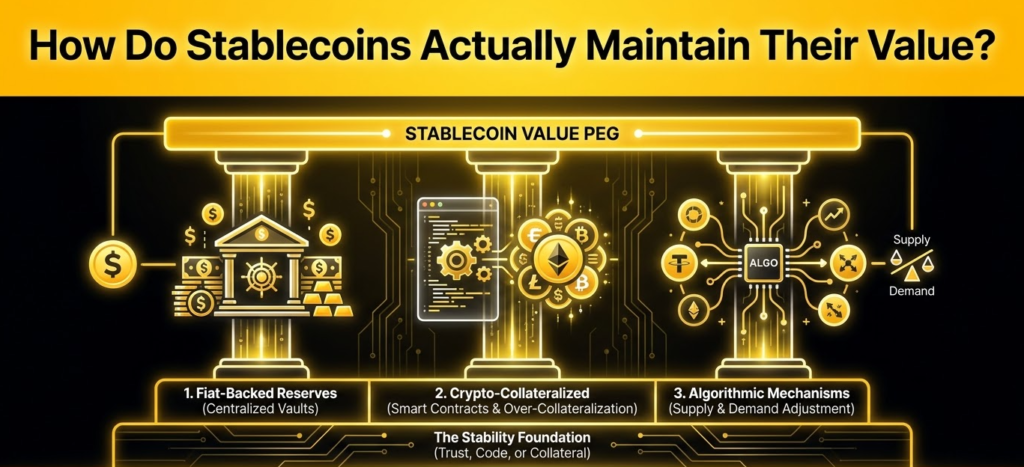
The phrase “stablecoin” hides a lot of engineering.
Two tokens can both trade around $1 while relying on completely different mechanisms to achieve that stability.
One might be backed by short-term U.S. government securities. Another might be backed by ETH locked inside a smart contract. A third might use derivatives to hedge crypto exposure and capture funding rates.
The user sees $1.
Underneath the hood, the systems are very different.
Fiat-collateralized stablecoins: The heavyweights
This is the model most people encounter first.
A company issues tokens and claims that those tokens are backed by reserves. In a simplified example, imagine an issuer receives $100 million from customers and creates 100 million stablecoins. The issuer then holds eligible reserve assets that are intended to support those tokens.
The exact reserve composition matters.
“Backed by dollars” does not necessarily mean every dollar sits as physical cash inside a bank account. Modern reserve structures can include cash, deposits and highly liquid short-term government securities.
Circle, the issuer of USDC, says USDC is backed 100% by highly liquid cash and cash-equivalent assets. Circle also publishes reserve information and says a Big Four accounting firm provides monthly third-party assurance over the reserves. Its USDC transparency page provides current reserve information and explains the structure in more detail.
Tether makes a similar broad claim for USDT. Its official transparency page states that Tether tokens are pegged 1-to-1 with their corresponding fiat currency and backed by Tether’s reserves, while circulation information is typically refreshed daily.
The basic economic loop looks like this:
User gives issuer money → issuer issues stablecoins → stablecoins circulate → user redeems → issuer destroys or removes the redeemed tokens from circulation.
That redemption mechanism is extremely important.
If I can reliably exchange 1 USDC for $1, then the token has a strong economic anchor around $1. If the token falls to $0.98 on a secondary market while direct redemption remains credible, arbitrageurs may have an incentive to buy the discounted token and redeem it for $1.
The same principle works in the opposite direction.
If demand pushes a stablecoin above $1, new supply can potentially enter the market through issuance and redemption mechanisms, depending on how the issuer and market structure operate.
This is why redemption matters just as much as reserves.
A reserve can exist on paper, but users also need confidence that they can actually access the value supporting the token.
Crypto-collateralized stablecoins: Why over-collateralization exists
The decentralized model works differently.
Instead of trusting a company to hold dollars in a bank account, users lock crypto assets into smart contracts and borrow or mint stablecoins against them.
DAI is the classic example.
Imagine you have $150 worth of ETH but want to hold $100 worth of dollar exposure without selling your ETH. A decentralized protocol can allow you to lock the ETH as collateral and generate a stablecoin against it.
Why $150 of collateral for $100 of stablecoins?
Because ETH is volatile.
If ETH falls 20%, your $150 collateral becomes $120. There is still enough value to support the $100 debt. If ETH falls far enough, the system can liquidate the collateral before the position becomes dangerously undercollateralized.
The older MakerDAO whitepaper illustrates this concept with an example in which $150 worth of ETH collateral supports $100 of DAI debt. The over-collateralization and liquidation mechanism are designed to keep the outstanding DAI adequately collateralized even if the underlying crypto asset falls sharply. MakerDAO’s original DAI documentation explains the mechanics in detail.
This creates a different trust model.
You are relying less on a company and more on smart contracts, collateral ratios, price oracles, liquidation mechanisms and governance.
That sounds more decentralized.
It is.
But decentralization does not remove risk.
It moves the risk somewhere else.
Synthetic and delta-neutral stablecoins: The modern evolution
This is the category I think deserves the most attention because it is easy to misunderstand.
Ethena’s USDe is not the same thing as USDC or USDT.
Ethena explicitly describes USDe as a synthetic dollar backed by crypto assets and corresponding short futures positions. The system uses delta hedging, meaning it holds spot crypto assets while taking offsetting short derivative positions to reduce the directional exposure to the underlying crypto market. Ethena’s documentation explains that USDe uses Bitcoin, Ethereum and other approved assets alongside perpetual and deliverable futures positions.
The concept sounds complicated, but the basic intuition is fairly simple.
Suppose the protocol holds $100 of ETH.
If ETH rises, the protocol’s spot ETH position becomes more valuable. But the short futures position loses value in roughly the opposite direction.
If ETH falls, the spot position loses value while the short position can gain.
The objective is not to predict whether ETH will rise or fall.
It is to hedge away much of the directional exposure.
That is why the term delta-neutral matters.
The protocol is trying to make the value of the overall position less dependent on whether the underlying crypto market goes up or down.
There is another component that makes USDe interesting: yield.
Ethena says its protocol revenue comes from several sources, including staked ETH yield, perpetual futures funding rates or futures basis, and rewards generated from liquid stable assets. Ethena’s FAQ explains how those sources contribute to the protocol’s economics.
This is fundamentally different from earning interest on a bank deposit.
And that difference becomes very important when you start comparing stablecoin yields.
The Yield Illusion: Where Does the Interest Come From?
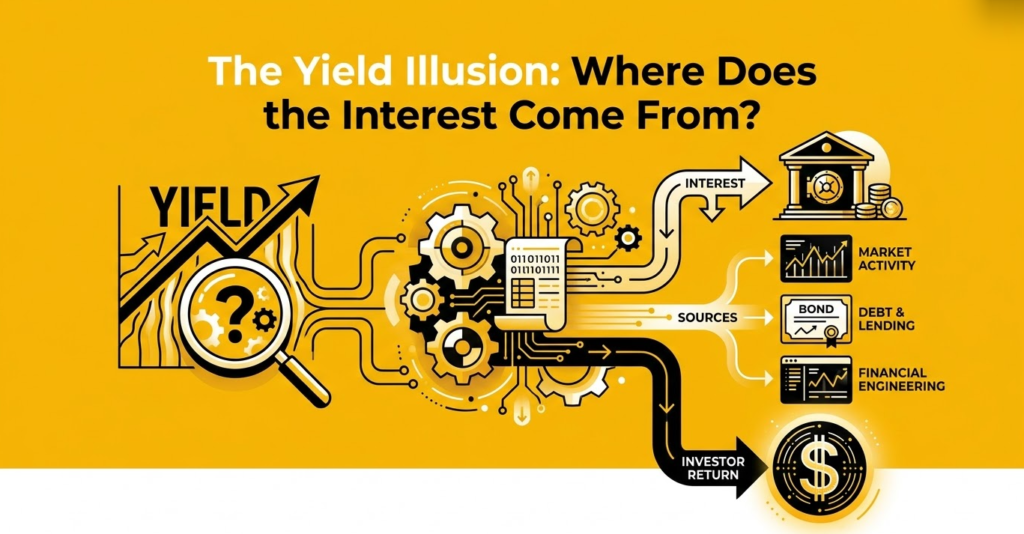
This is probably the biggest stablecoin knowledge gap I see.
Someone sees two tokens trading at approximately $1.
One pays no yield.
The other offers 8%, 10% or even higher returns.
The natural question is:
Why would I hold the one paying nothing?
The answer is that you are not comparing the same risk.
Traditional stablecoins versus yield-bearing stablecoins
Holding USDC is basically a bet on the stability and redeemability of USDC.
You are not automatically entitled to the interest Circle earns on its reserve assets simply because you hold USDC.
The issuer may generate income from those reserves, but that does not mean the token itself becomes an interest-bearing asset.
Now compare that with something like USDS, sUSDe or another yield-oriented product.
The yield can come from completely different sources.
It may come from:
- U.S. Treasury exposure.
- DeFi lending.
- Trading fees.
- Protocol incentives.
- Staking rewards.
- Futures funding rates.
- Basis trades.
- Liquidity provision.
- Structured strategies.
These sources carry different risks.
A Treasury-backed yield product may have relatively straightforward interest-rate and issuer risks. A DeFi lending strategy introduces smart-contract and liquidity risks. A synthetic dollar earning funding income introduces derivatives, exchange, counterparty and funding-rate risks.
The headline APY is only the final number.
I always want to know what is underneath it.
Why yield is never “free money”
Imagine somebody offers you 12% annual yield on a dollar-denominated asset while a comparable short-term U.S. Treasury yields much less.
There is usually a reason.
Maybe the protocol is taking smart-contract risk.
Maybe it is using leverage.
Maybe the yield comes from incentives that can disappear.
Maybe the strategy depends on favorable derivatives funding rates.
Maybe the asset is exposed to a centralized exchange or custodian.
Maybe the yield is real but temporary.
That does not automatically make the product bad.
It simply means the yield is compensation for something.
Ethena is a good example because its own documentation is unusually clear that USDe is different from fiat-backed stablecoins. The protocol earns from staked ETH, futures funding and basis, and liquid-stable rewards. If funding rates become unfavorable, the economics can change. Ethena’s documentation explains those revenue sources directly.
That is why I would never compare “USDC at 0%” with “USDe at 8%” as if they were two savings accounts.
They are two different risk packages.
The DeFi yield layer
You can also take a plain stablecoin such as USDC and deploy it into DeFi.
Aave is one of the clearest examples.
Users can supply stablecoins to lending markets and earn interest from borrowers. Aave describes stablecoins as a core part of its lending and borrowing ecosystem, and its current platform includes markets built specifically around stablecoin liquidity. Aave’s stablecoin overview explains how stablecoins are used for supplying, borrowing and earning interest within DeFi.
The important part is that the yield comes from the protocol’s lending market.
It does not magically appear because USDC itself became a yield-bearing token.
That distinction becomes even more important as DeFi products become easier to package for ordinary users. In July 2026, Aave introduced Stable Vaults, which package variable on-chain lending strategies into products that can offer users more predictable stablecoin rates.
That is an interesting evolution.
DeFi is increasingly trying to hide the complexity from the end user.
But as an investor, I would still want to know what the vault is doing underneath.
A smoother interface does not eliminate the underlying risk.
The 2026 Regulatory Reality: MiCA and Geofencing
Stablecoins have become too important for regulators to ignore.
That is particularly obvious in Europe.
The EU’s Markets in Crypto-Assets Regulation, better known as MiCA, creates specific categories and requirements for stablecoin-like crypto-assets. If you use stablecoins regularly, this is not just regulatory trivia. It can affect which assets you can buy, which exchange lists them and whether certain yield products are available in your region.
Electronic Money Tokens and Asset-Referenced Tokens
MiCA separates stablecoin-style crypto-assets into two major categories.
An Electronic Money Token, or EMT, is a crypto-asset that attempts to maintain a stable value by referencing the value of one official currency.
An Asset-Referenced Token, or ART, references another value, right or combination of assets, potentially including one or more official currencies.
Those definitions come directly from Article 3 of MiCA on EUR-Lex.
This distinction matters because the regulatory requirements are different.
A dollar stablecoin referencing only the U.S. dollar fits into the e-money-token framework under MiCA, while an asset that references multiple currencies or other assets can fall into the ART category.
For users, the practical consequence is that “stablecoin” is no longer one regulatory bucket in Europe.
There are legal categories underneath the marketing term.
The prohibition on interest
One of the most important details is also one of the easiest to overlook.
MiCA prohibits issuers of EMTs from granting interest to holders, and crypto-asset service providers cannot grant interest when providing services related to EMTs. The rules also define certain rewards or benefits linked to the length of time a holder keeps the token as interest. ESMA’s MiCA Article 50 guidance sets this out directly.
MiCA also contains a similar prohibition for asset-referenced tokens. Article 40 of the regulation states that issuers and crypto-asset service providers should not grant interest on ARTs.
This is one reason stablecoin yield products and ordinary stablecoins need to be separated in your head.
A token can remain a perfectly useful digital dollar while the EU regulatory framework limits how issuers or platforms can attach interest-like benefits to simply holding it.
Geofencing and a fragmented market
This is where regulation starts affecting ordinary users.
You might hold a stablecoin in Asia and see no problem buying, selling or using it.
A user in Europe may see a different interface, different available assets or different yield products.
That does not necessarily mean the stablecoin suddenly became unsafe.
It may mean the issuer or exchange has decided that the asset or product does not fit the regulatory requirements of that jurisdiction.
The result is a more fragmented global stablecoin market.
The same token can have different availability depending on where you live.
That trend is likely to continue.
I would therefore avoid thinking about stablecoin regulation as a simple question of whether governments “ban” stablecoins. The reality is more nuanced. Regulators are defining which issuers can operate, which reserve assets qualify, how redemption must work, what disclosures are required and whether interest-like incentives can be offered.
For you as a user, that can eventually matter more than the headline regulation itself.
The practical question is:
Can I legally access, redeem and use this particular stablecoin where I live?
Real-World Utility: Why People Actually Use Stablecoins
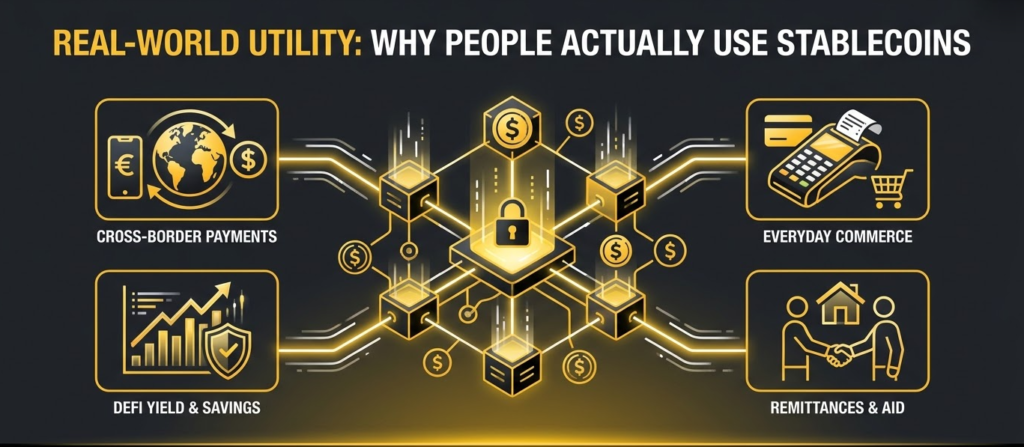
Stablecoins are often discussed from the perspective of traders.
That misses a large part of the story.
For millions of people, the appeal is much simpler.
They want dollars.
Stablecoins as digital dollars in emerging markets
Imagine you live in a country where your local currency is losing value quickly, foreign-currency access is restricted, or international payments are expensive and slow.
A digital dollar becomes much more interesting.
You do not necessarily care about Ethereum’s roadmap.
You care that 1 USDT is designed to remain close to $1.
You care that you can receive it on your phone.
You care that you can send it to another person without waiting for a traditional bank transfer.
Nigeria is a particularly useful example because there is now detailed research on this behavior. In June 2026, the IMF reported that stablecoins had become a meaningful cross-border payment channel in Nigeria, noting that the country received about $59 billion in crypto-asset inflows between July 2023 and June 2024.
The IMF also linked growing stablecoin demand to the depreciation of the naira, high inflation and constrained foreign-exchange access. Stablecoins are being used by households, small businesses and importers for cross-border transfers and payments to overseas suppliers.
That is much more practical than the typical crypto narrative about “number go up.”
People are using stablecoins because traditional money does not always work equally well for everyone.
The inflation hedge question
This is where the phrase crypto inflation hedge needs some caution.
Stablecoins are not a hedge against inflation in the same way that a productive asset, inflation-linked bond or scarce commodity might be.
A U.S. dollar stablecoin protects you from the price volatility of the dollar-denominated crypto market, but it does not protect you from inflation in the United States.
If the dollar loses purchasing power, USDT and USDC still represent dollars.
However, for somebody holding a rapidly depreciating local currency, moving part of their savings into a dollar-linked stablecoin can reduce exposure to local-currency depreciation.
That is a different claim.
Nigeria offers strong evidence of this behavior. The IMF’s 2026 analysis found that stablecoins accounted for more than 65% of Nigeria’s crypto inflows in 2024, with USDT and USDC dominating dollar-denominated stablecoin activity. It described this growing use as a form of “digital dollarization.” The IMF’s Nigeria analysis is worth reading if you want the macroeconomic side of this story.
Similar patterns have appeared across Latin America, the Middle East and other emerging markets. Chainalysis has previously found that Latin America and Sub-Saharan Africa were among the fastest-growing regions for stablecoin transfers, while Türkiye showed particularly high stablecoin activity relative to GDP. Chainalysis’s stablecoin research provides a useful regional breakdown.
The key point is simple:
For someone whose local currency is unstable, a dollar stablecoin can be useful even if they have zero interest in crypto speculation.
Stablecoins are the engine inside DeFi
Now we get to the crypto-native side.
Stablecoins are everywhere in decentralized finance because DeFi needs something relatively stable to price against.
If you provide liquidity to a trading pool, you often need a stable asset on one side.
If you borrow against ETH, you may want to borrow a stablecoin rather than another volatile asset.
If you move between crypto positions, you can sell into USDC or USDT without immediately converting back to a bank account.
If you use a lending protocol, stablecoins can become both supplied assets and borrowed liabilities.
Aave describes stablecoins as a central part of its lending infrastructure, and its own research has noted that stablecoins make up a major share of borrowing activity on the protocol. Aave’s stablecoin infrastructure analysis reported that stablecoins represented more than half of borrowing on Aave while accounting for a smaller share of total deposits.
This is one reason stablecoin market capitalization is such an interesting metric.
When the stablecoin supply grows, it can represent more than people simply holding digital dollars.
It can represent more liquidity available for trading, lending, borrowing and settlement across the crypto economy.
Cross-border B2B payments
There is another use case that I think deserves much more attention: business settlement.
Suppose a company in Vietnam needs to pay a supplier in another country.
The traditional process may involve banks, correspondent banking relationships, currency conversion, compliance checks and settlement windows.
Stablecoins can compress parts of that process into blockchain transactions.
That does not mean businesses can ignore regulation.
They cannot.
KYC, AML requirements, accounting treatment, tax rules and local restrictions still matter.
But the underlying settlement technology can be significantly faster and more programmable.
That is why stablecoins are increasingly interesting to financial institutions and payment companies, not just crypto traders. Chainalysis has documented growing institutional interest in stablecoins for payments, settlement and liquidity management, while traditional financial companies have increasingly experimented with stablecoin payment rails.
The irony is that one of crypto’s most useful innovations may end up being the least exciting one.
A digital dollar that simply moves money better can be incredibly valuable.
The Hidden Risks: What Could Possibly Go Wrong?
The word “stable” creates a psychological problem.
It makes people feel safe.
That can be dangerous.
A stablecoin is stable relative to its reference asset. It is not necessarily stable in every other sense.
Audits vs. attestations
This is one of the most important details to understand if you hold fiat-backed stablecoins.
You will often see issuers talking about attestations.
An attestation is not automatically the same thing as a full financial audit.
An attestation generally provides assurance over a defined set of information according to a particular reporting framework. For a stablecoin reserve report, that can mean an accounting firm verifies whether the issuer’s reported reserve assets exceeded the amount of tokens in circulation at a specific reporting date.
Circle, for example, says a Big Four accounting firm provides monthly third-party assurance over USDC reserves. It also publishes reserve information more frequently. Circle’s transparency documentation explains that the monthly reports are prepared under AICPA attestation standards.
That is useful information.
But you should not interpret the word “attestation” as “an accounting firm has continuously audited every aspect of this company’s business.”
Those are different things.
I think this distinction matters because stablecoin users often reduce the entire reserve question to one sentence:
“It’s audited.”
That is too simplistic.
You should instead ask:
- What assets back the tokens?
- Who legally owns those assets?
- Where are they held?
- How liquid are they?
- How frequently is reserve information published?
- Who provides assurance?
- What exactly does the assurance cover?
- What are the redemption terms?
- What happens under market stress?
Those questions tell you much more.
De-pegging
The most obvious stablecoin risk is losing the peg.
A token designed to trade at $1 can trade at $0.98, $0.90 or lower if confidence collapses.
This can happen for different reasons.
A centralized stablecoin may face concerns about reserves or redemption.
A decentralized stablecoin may suffer from falling collateral values, oracle failures or liquidity problems.
A synthetic stablecoin can face problems with derivatives markets, counterparties, funding rates or extreme market conditions.
The exact mechanism matters.
This is why I would never say “stablecoins cannot lose their peg.”
They absolutely can.
The real question is how quickly the system can restore the peg and whether holders have a credible path to redemption.
Centralization and wallet freezing
There is another risk that surprises newcomers.
Some major stablecoins are centralized.
If a company controls token issuance and redemption, it may also have the ability to freeze specific addresses under certain circumstances.
This is not hypothetical.
Stablecoin issuers have historically cooperated with law enforcement and frozen addresses associated with hacks, sanctions or illicit activity. In September 2026, for example, Reuters reported on a U.S. Senate investigation into USDT’s use by Iranian-linked entities, while Tether said it had cooperated with authorities and frozen substantial amounts of Iran-linked USDT.
From a compliance perspective, this can be a feature.
From a censorship-resistance perspective, it is a limitation.
That trade-off is important.
If you hold USDC or USDT, you are not holding an asset with exactly the same censorship properties as native ETH or BTC. You are holding a token issued or administered through an identifiable organization.
For many users, that is perfectly acceptable.
For others, it is precisely the reason they prefer decentralized alternatives.
Smart-contract exploits
Decentralized stablecoins introduce another category of risk.
Smart contracts can contain bugs.
Oracles can fail.
Governance systems can be attacked.
Collateral can become illiquid.
Liquidations can behave unexpectedly during extreme market conditions.
The fact that code is public does not mean the code is automatically safe.
This is particularly relevant for yield-bearing stablecoin strategies. Every additional layer creates another place where something can break.
You might start with a stablecoin.
Then deposit it into a lending protocol.
Then use a vault.
Then the vault interacts with another protocol.
Then the yield depends on a derivatives strategy.
At that point, the phrase “I’m just holding a dollar” has become misleading.
You may be holding a complex chain of smart-contract and financial exposures that happens to be denominated in dollars.
Algorithmic stablecoins and the lesson of failure
Algorithmic stablecoins deserve their own warning.
The idea is attractive: instead of holding traditional reserves, an algorithm controls supply and demand to keep the price stable.
In theory, the system can maintain a peg through incentives.
In practice, maintaining confidence during a severe sell-off is extremely difficult.
Once users believe the system is failing, they can rush to exit at the same time. That can create a feedback loop in which falling prices create more selling, more selling creates more instability, and the mechanism designed to restore the peg becomes overwhelmed.
That is why I would never judge a stablecoin solely by its normal-day performance.
Anyone can look stable when the market is calm.
The real test is what happens during stress.
Frequently Asked Questions
What is a stablecoin in simple terms?
A stablecoin is a cryptocurrency designed to keep its value relatively stable against another asset, usually the U.S. dollar.
The best-known examples are USDT and USDC, which aim to maintain a value close to $1. Other stablecoins use different models, including crypto collateral and derivatives.
The important part is that “stable” describes the target behavior, not a guarantee that the token can never lose its peg.
What is the difference between USDT and USDC?
USDT is issued by Tether, while USDC is issued by Circle.
Both are designed to maintain a 1:1 relationship with the U.S. dollar, but their reserve structures, corporate structures, reporting practices, distribution and regulatory positioning differ.
Tether says its tokens are backed by reserves and publishes circulation and reserve information through its transparency portal. Circle says USDC is backed by highly liquid cash and cash-equivalent assets and publishes reserve information and monthly third-party assurance through its USDC transparency page.
If you are choosing between them, I would look beyond the $1 price and examine liquidity on the chains you actually use, redemption options, regulatory availability, reserve disclosures and your own tolerance for issuer risk.
Can a stablecoin lose its peg?
Yes.
A stablecoin can trade below or above its intended reference value.
The causes depend on the design. Fiat-backed stablecoins can face reserve, redemption or confidence issues. Crypto-backed stablecoins can be affected by collateral crashes, liquidations and oracle problems. Synthetic stablecoins can be exposed to derivatives, funding rates, counterparties and market liquidity.
A strong stablecoin design reduces these risks.
It does not eliminate them.
How do stablecoins differ from CBDCs?
Stablecoins are generally issued by private companies or decentralized protocols and operate on blockchain networks.
A CBDC, or central bank digital currency, is issued directly by a country’s central bank.
The distinction is therefore both technological and institutional.
A stablecoin represents a private or protocol-based claim designed to track a currency. A CBDC would be a form of central-bank money issued under the authority of the monetary system itself.
Are stablecoins actually backed by dollars?
Not necessarily in the literal sense of one physical dollar sitting in a bank account for every token.
Major fiat-backed stablecoins can use a combination of cash, bank deposits, U.S. Treasury securities and other highly liquid reserve assets.
Circle, for example, says USDC is backed by highly liquid cash and cash-equivalent assets, while Tether says its tokens are backed by Tether’s reserves.
So the more accurate question is not “Is there one dollar in a bank account for every token?”
It is:
What exactly is in the reserve, who controls it, and how can holders redeem the token?
Why do stablecoins offer yield if they are supposed to be worth $1?
The stablecoin itself may not offer yield.
The yield can come from a separate protocol or product that puts the stablecoin to work.
For example, lending protocols can pay interest because borrowers pay to access liquidity. Synthetic dollars such as USDe can generate revenue from strategies involving staked assets, futures funding and basis trades.
That means a yield-bearing stablecoin can carry significantly different risks from a basic fiat-backed stablecoin.
A higher APY is not a free upgrade.
It usually means you are taking additional risk somewhere.
Can stablecoins protect you from inflation?
They can protect against local-currency depreciation, but that is different from being a perfect inflation hedge.
If you live in a country where the local currency is losing value against the U.S. dollar, holding a dollar-linked stablecoin can provide exposure to the dollar instead of the local currency.
But if U.S. inflation reduces the purchasing power of the dollar, your stablecoin still represents dollars.
So I would describe stablecoins as a convenient form of digital dollar exposure rather than a universal inflation hedge.
Why are stablecoins so important to DeFi?
Stablecoins give DeFi a relatively stable unit of account and a liquid asset for trading, lending and borrowing.
Instead of borrowing volatile ETH to fund a transaction, a user can borrow USDC. Instead of pricing a liquidity pool entirely around volatile assets, protocols can use stablecoin pairs. Instead of returning to a bank after selling a crypto position, traders can hold USDT or USDC on-chain.
Aave is a good example. Its lending markets use stablecoins extensively, and the protocol describes itself as a major venue for stablecoin lending and borrowing across DeFi.
That makes stablecoins something closer to financial infrastructure than a simple crypto trading instrument.
Is USDe the same as USDC or USDT?
No.
Ethena explicitly describes USDe as a synthetic dollar rather than a fiat-backed stablecoin like USDC or USDT.
USDe uses crypto assets and offsetting derivatives positions to target a stable dollar value. Its economics can also generate revenue from futures funding rates, basis and other sources.
That makes USDe an interesting innovation, but it also means its risk profile is fundamentally different.
If you understand only one thing about USDe, understand this:
USDe’s stability does not come from simply holding $1 of cash or Treasury assets for every token.
Does MiCA regulate stablecoins in Europe?
Yes.
MiCA creates specific regulatory categories for stablecoin-like assets, including Electronic Money Tokens and Asset-Referenced Tokens.
The regulation defines an EMT as a crypto-asset that attempts to maintain a stable value by referencing one official currency, while an ART references another value, right or combination of assets, including official currencies.
MiCA also imposes reserve, governance, disclosure, redemption and other requirements, with additional requirements for significant tokens.
The full framework is available through EUR-Lex’s official MiCA regulation.
Are stablecoins safer than Bitcoin or Ethereum?
That depends on what risk you mean.
A dollar stablecoin is usually much less volatile in price than BTC or ETH. But it introduces other risks that native cryptocurrencies do not have in the same way.
You may have issuer risk, reserve risk, censorship risk, regulatory risk, smart-contract risk or redemption risk.
Bitcoin and ETH can fall dramatically in dollar terms, but you are not relying on a private issuer promising to redeem each token for $1.
So I would not describe stablecoins as simply “safer crypto.”
They are a different type of risk.
Conclusion: Stablecoins Are Crypto’s Digital Cash Layer
The easiest way to understand stablecoins is to stop thinking of them as boring versions of Bitcoin.
They are solving a different problem.
Bitcoin introduced a native digital asset that does not need a central issuer. Ethereum created programmable blockchain infrastructure. Stablecoins bring something else to the table: a way to represent relatively stable units of value directly on-chain.
That simple idea has become remarkably powerful.
A stablecoin can move across borders, settle trades, provide liquidity, serve as collateral, power a lending market or give someone in an emerging economy access to a dollar-denominated asset through a smartphone.
At the same time, the word “stable” can create false confidence.
USDT and USDC rely on centralized issuers and reserve structures. DAI and similar systems rely on collateral, smart contracts and liquidation mechanisms. USDe relies on a much more complex combination of crypto assets and derivatives.
Same goal.
Very different machines underneath.
That is the part I would keep in mind whenever you evaluate a stablecoin. Do not stop at the $1 price. Ask what keeps it there, what happens if confidence disappears, where the reserves or collateral actually sit, how redemption works, where the yield comes from and which regulations apply to you.
Once you start asking those questions, stablecoins become much easier to understand.
And you also start seeing why they may be one of the most important pieces of infrastructure in the entire crypto economy.