Introduction: Defining Digital Asset Infrastructure
If you are new to crypto, one of the first decisions you eventually face is surprisingly simple: Should I keep my crypto on an exchange, or move it to my own wallet?
It sounds like a basic question, but the answer gets much more interesting once you understand what is actually happening behind the screen.
When you open a centralized exchange such as Coinbase, Kraken, or another trading platform, you usually see a familiar interface. You have a Bitcoin balance, an Ethereum balance, perhaps some stablecoins, and buttons that let you buy, sell, send, or receive assets. It feels very much like online banking.
A self-custodial wallet feels different. You install an application such as MetaMask, connect a hardware wallet, or create an account on another Web3 wallet. Suddenly, there is no customer-service representative who can reset your account in the traditional sense. There is no company sitting between you and the blockchain.
That difference is the heart of the crypto wallet vs. exchange debate.
A non-custodial wallet is essentially a cryptographic key-management interface. It helps you generate, protect, and use the private keys that authorize blockchain transactions. The wallet itself does not contain a pile of Bitcoin or Ethereum. Your assets are represented by records on the relevant blockchain, while your keys give you the ability to authorize changes to those records. Even hardware-wallet providers explain the distinction this way: the crypto is not physically inside the device; the device protects the keys that control the corresponding blockchain assets. (Ledger)
A centralized exchange, by contrast, combines several functions in one platform. It provides a trading venue, order matching, fiat on- and off-ramps, account management, and custody. You normally log in with an email address, password, and additional security controls, rather than signing every action with a private key.
That makes an exchange incredibly convenient.
It also introduces a relationship that does not exist in the same way with self-custody: you are trusting another organization to safeguard and make available your assets.
This is where the old crypto expression “not your keys, not your coins” comes from. It is not merely a slogan about ideology. It describes a real technical distinction in who possesses the cryptographic authority to move assets.
And once you understand that distinction, the choice between a wallet and an exchange becomes much easier to evaluate.
Where Is Your Crypto Actually Stored?

Wallets Do Not Literally Store Your Crypto
Let’s clear up one of the most persistent misconceptions first.
Your Bitcoin does not sit inside MetaMask.
Your Ethereum does not physically sit inside a Ledger.
Your Solana does not disappear into your phone when you open a Solana wallet.
What you actually have is a cryptographic relationship between keys and blockchain state.
When someone sends BTC to your Bitcoin address, the Bitcoin network records that transaction in its ledger. Your wallet does not receive a physical digital coin and place it inside an internal storage compartment.
Instead, your wallet manages the cryptographic credentials required to authorize transactions involving assets associated with your addresses.
This distinction becomes especially obvious with hardware wallets.
A hardware wallet can be disconnected from your computer and placed in a drawer for months. The blockchain does not care. Your assets remain where they were recorded on-chain. The device’s important job is protecting the private keys and allowing you to sign transactions when you deliberately want to move funds.
Ledger describes this architecture directly: the assets remain on the blockchain while the hardware device protects the private keys used to control them. (Ledger)
So when you say:
“I have Bitcoin in my wallet.”
the technically precise interpretation is closer to:
“I control the private keys that authorize transactions involving Bitcoin associated with my blockchain addresses.”
That sounds more complicated, but it explains almost everything that follows.
Exchange Balances Are a Different Animal
Now compare that with a centralized exchange.
Suppose you deposit 1 BTC into an exchange. The exchange gives you an account balance showing 1 BTC.
From your perspective, it looks like you own one Bitcoin.
But the technical custody arrangement can be very different from holding BTC in a self-custodial wallet.
The exchange generally controls the blockchain keys associated with its wallets. Customer balances are maintained through the exchange’s internal systems, while the exchange manages deposits and withdrawals through its blockchain infrastructure.
This is why your exchange balance can change without a blockchain transaction appearing every time you trade.
Imagine that you buy 0.2 BTC from another customer on the exchange. You might expect a Bitcoin transaction to occur immediately. Usually, it doesn’t. The exchange can simply update its internal accounting records: one customer has less BTC, another has more.
The blockchain only becomes relevant when assets actually move between the exchange’s controlled addresses and an external address.
This is one of the biggest differences between a crypto wallet and an exchange.
A wallet primarily gives you direct control over blockchain credentials.
An exchange gives you access to a centralized financial platform whose internal ledger can represent your claims or balances while the platform controls the underlying custody infrastructure.
That distinction also explains why you can trade instantly on an exchange without paying blockchain gas for every individual trade.
Key Technical Differences: Crypto Wallet vs. Centralized Exchange
Custody and Private Key Ownership
The cleanest way to compare the two models is to ask one question:
Who can produce the cryptographic signature required to move the assets?
With a self-custodial wallet, the answer is you.
Your wallet generates or imports the relevant private keys, and you are responsible for protecting them. MetaMask, for example, explicitly describes its standard wallet model as self-custodial and states that the company does not possess the user’s Secret Recovery Phrase. ( MetaMask)
With a centralized exchange, the exchange controls the private keys associated with the custodial wallets.
That means you don’t personally sign a Bitcoin transaction every time you withdraw BTC from your exchange account. Instead, you request a withdrawal, and the exchange’s infrastructure ultimately authorizes the blockchain transaction.
This creates two very different risk profiles.
Self-custody gives you control, but also responsibility.
Exchange custody gives you convenience, but also counterparty exposure.
Neither statement is inherently good or bad. The right choice depends on what you are doing.
If I am actively trading several times a day, moving funds between markets, or converting fiat into crypto, keeping some funds on an exchange can be practical. If I’m holding an amount that I don’t intend to trade for years, I may care much more about eliminating dependence on an exchange’s continued operation.
Identity Verification and KYC
Another major difference is identity.
A self-custodial wallet can generally be created without submitting a government ID, selfie, or proof of address. The wallet itself is simply software or hardware interacting with a blockchain.
That does not mean everything you do with that wallet is anonymous.
Blockchains are generally public ledgers, and many transactions can be analyzed. Furthermore, the moment you interact with a centralized exchange, fiat gateway, regulated service, or other identity-linked platform, your blockchain activity may become associated with your verified identity.
Centralized exchanges operate differently because they are businesses providing financial services in regulated environments. Depending on the jurisdiction and product, customers may need to complete identity verification before depositing, trading, or withdrawing significant amounts.
This creates a trade-off that I think is worth remembering:
- Self-custody: more direct control and permissionless blockchain access.
- Centralized exchange: more identity checks, but often better fiat connectivity and account recovery.
- DEX: direct blockchain trading without depositing assets into a traditional exchange account.
- Hybrid approach: use an exchange for liquidity and fiat operations, then move long-term holdings into self-custody.
For many people, the last option is actually the most practical.
Fund Recovery and Operational Security
This is where self-custody becomes very different from normal financial applications.
If you forget your banking password, you can usually contact your bank.
If you lose access to an exchange account, you may have identity verification, email recovery, 2FA recovery procedures, or customer support.
A self-custodial wallet generally does not work that way.
Your Secret Recovery Phrase is effectively the master recovery credential for the wallet.
MetaMask states that its Secret Recovery Phrase is used to generate and recover accounts, and that losing the phrase can mean losing access to the associated assets. (MetaMask)
Trezor similarly describes its wallet backup as the information that allows users to restore access if the physical device is lost, damaged, or reset. (Trezor)
This is why self-custody demands a different mindset.
You are not simply creating an account.
You are taking responsibility for the credential that controls the account.
That is powerful, but it means you need a serious backup strategy.
Security and Risk Analysis: Self-Custody vs. Exchange Storage
Centralized Exchange Risks: Counterparty Failure and Bankruptcy
The strongest argument for self-custody is not necessarily that exchanges are always easier to hack.
It is that you are introducing a counterparty into the ownership chain.
When your assets are held by an exchange, you depend on that company’s:
- Cybersecurity.
- Internal controls.
- Liquidity.
- Solvency.
- Withdrawal infrastructure.
- Regulatory compliance.
- Custody arrangements.
- Business continuity.
- Terms of service.
Most of the time, you don’t think about any of this.
Then something goes wrong.
The collapse of FTX is an obvious historical example. U.S. regulators described the FTX structure as involving commingled customer funds and alleged that more than $10 billion in customer assets were misappropriated. (CFTC)
The resulting bankruptcy demonstrated why the legal distinction between “I have an account balance” and “I directly control the blockchain asset” matters.
FTX’s bankruptcy process eventually produced a plan that was approved by the court and could distribute billions of dollars to customers, but the process also illustrated how complicated crypto bankruptcy can become. Reuters reported that the approved plan could return up to $16.5 billion to customers, while claims and recovery calculations were affected by the structure of the bankruptcy and the valuation of digital assets. (Reuters)
This is an important nuance: it would be inaccurate to say every exchange customer automatically becomes an unsecured creditor in every bankruptcy.
The actual legal treatment depends on the exchange’s contractual terms, jurisdiction, custody structure, segregation of assets, and the particular bankruptcy proceeding. The SEC’s current regulatory work also highlights how asset segregation and the legal characterization of customer crypto can materially affect bankruptcy protection. (SEC)
So the more accurate lesson is:
When you leave crypto with a centralized platform, you introduce counterparty and legal-structure risk that does not exist in exactly the same form when you control the private keys yourself.
That is the risk self-custody is designed to remove.
Self-Custody Risks: You Become the Security Department
But there is another side to this story.
Self-custody doesn’t eliminate risk.
It changes who is responsible for managing it.
A self-custodial wallet can protect you from an exchange collapse, but it cannot protect you from giving your seed phrase to a scammer.
It cannot undo a malicious transaction you signed.
It cannot necessarily reverse an unauthorized transfer.
And it cannot magically recover a lost recovery phrase.
MetaMask explicitly warns that whoever obtains the Secret Recovery Phrase can control the associated accounts and that the company cannot retrieve the phrase for users who lose it. (MetaMask)
This creates a fascinating security trade-off.
With an exchange, the major risks include:
- Exchange insolvency.
- Custodian compromise.
- Account takeover.
- Withdrawal freezes.
- Regulatory restrictions.
- Platform operational failures.
With self-custody, the major risks include:
- Seed phrase theft.
- Phishing.
- Malware.
- Fake wallet applications.
- Malicious smart contracts.
- Accidental transfers to the wrong address.
- Lost backups.
- Poor operational security.
In other words, self-custody removes one category of trust but increases the importance of personal operational security.
That is why experienced users often separate their crypto into different security layers.
For example, I wouldn’t necessarily treat the wallet I use to experiment with new DeFi applications as the same wallet where I keep my long-term savings.
One wallet can be your everyday spending and Web3 interaction account.
Another can be your long-term cold-storage vault.
That separation limits the damage if something goes wrong.
Exchange Model vs. Self-Custody Model
The architecture can be simplified like this:
Exchange Model:

[User]
   ↓
[Login Credentials + 2FA]
   ↓
[CEX Internal Database]
   ↓
[Exchange-Controlled Wallet Infrastructure]
   ↓
[Blockchain]


Self-Custody Model:

[User]
   ↓
[Private Key / Recovery Phrase]
   ↓
[Wallet Interface]
   ↓
[Blockchain Address]
   ↓
[Blockchain Ledger]
The important difference isn’t the application on your screen.
It is where the ultimate signing authority sits.
The Hybrid Middle Ground: DEXs and Smart Contract Wallets
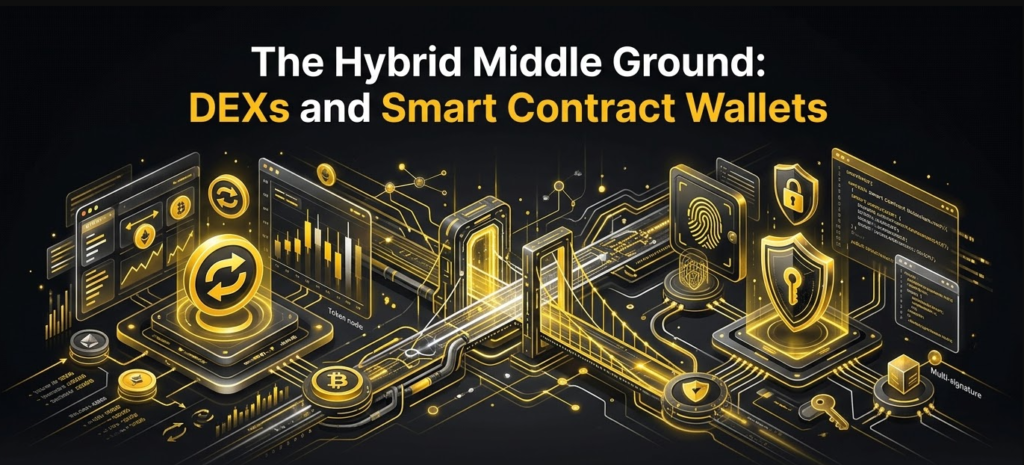
The choice doesn’t have to be:
Exchange OR wallet.
Modern crypto infrastructure increasingly sits somewhere between those two extremes.
Trading Without Giving Up Custody
Decentralized exchanges are a good example.
When you use a DEX such as Uniswap, you can interact with a smart contract directly from your self-custodial wallet.
You don’t necessarily deposit your assets into an exchange-controlled account first.
Instead, your wallet signs a transaction authorizing the smart contract to execute the swap according to the protocol’s rules.
That means you can have something resembling an exchange experience while retaining control of your private keys.
This is one of the reasons Web3 wallets are more than simple “storage apps.”
They have increasingly become interfaces for interacting with decentralized financial infrastructure.
You can connect a wallet, approve a token, swap assets, provide liquidity, stake tokens, interact with NFTs, and use decentralized applications without handing your private keys to each application.
The key distinction remains: the application can request signatures, but it should never receive your private key or Secret Recovery Phrase.
Smart Contract Wallets and Account Abstraction
The wallet architecture itself is also changing.
Traditional Ethereum externally owned accounts, or EOAs, rely heavily on a private key controlling an address.
Smart contract wallets take a different approach. Instead of treating a single private key as the entire security model, the account can implement programmable rules.
That can enable features such as:
- Multiple authorized signers.
- Social recovery.
- Spending limits.
- Session keys.
- Transaction batching.
- Sponsored gas.
- More sophisticated authorization policies.
Account Abstraction developments around ERC-4337 have pushed this model further by allowing smart contract accounts and supporting infrastructure to provide more flexible transaction experiences.
This matters because the old mental model of:
“My wallet is one private key written on a piece of paper.”
is gradually becoming less universal.
For beginners, however, the fundamental principle remains the same: understand who can authorize a transaction and under what conditions.
How to Move Crypto From an Exchange to a Personal Wallet
If you decide that self-custody makes sense for at least part of your portfolio, the actual transfer is straightforward-but the details matter enormously.
A single wrong network or address can turn a simple withdrawal into a very expensive mistake.
Step One: Set Up a Reputable Wallet
You can choose between a software wallet and a hardware wallet depending on your security needs.
Software wallets are convenient because they are immediately available on your phone or computer. Hardware wallets introduce a dedicated signing device and keep sensitive keys away from the everyday operating environment.
For long-term holdings, hardware-based self-custody can provide a stronger security boundary. Ledger, for example, describes its hardware architecture as keeping private keys inside a Secure Element and requiring physical confirmation before transactions are signed. (Ledger)
If you use a standard recovery-phrase wallet, write the recovery phrase down offline.
Do not:
- Take a screenshot of it.
- Store it in your email.
- Put it in a cloud document.
- Send it to yourself in a chat.
- Enter it into a website.
- Give it to “support.”
- Photograph it and leave the image in your phone’s gallery.
MetaMask specifically warns users not to store recovery phrases in easily compromised digital locations and emphasizes that support personnel will not ask for the phrase. (MetaMask)
Step Two: Copy the Correct Receiving Address
Once the wallet is ready, open the receiving screen and copy the appropriate address.
Now comes the part where you need to slow down.
Do not assume that every address is interchangeable.
Bitcoin, Ethereum, Solana, and other networks use different address formats and transaction systems.
Even within an ecosystem, exchanges may support several networks for the same token.
For example, a stablecoin deposit may be available through Ethereum, an Ethereum Layer-2 network, Solana, Polygon, or another supported chain.
If you send an asset through the wrong network, recovery may be difficult or impossible.
Before confirming the withdrawal, check:
- Asset.
- Blockchain network.
- Receiving address.
- Memo/tag requirement, if applicable.
- Minimum deposit amount.
- Exchange withdrawal requirements.
- Wallet compatibility.
This is one of those moments when being impatient can be surprisingly expensive.
Step Three: Initiate the Exchange Withdrawal
Go to the withdrawal or send section of your exchange.
Paste your wallet’s receiving address rather than manually typing it.
Then compare the first and last several characters.
For larger transfers, I strongly recommend sending a small test transaction first if the network and fees make that practical.
Once the test arrives correctly, you can send the remaining balance.
Complete the exchange’s security requirements, such as 2FA or withdrawal confirmation.
After the transaction is broadcast, use the relevant blockchain explorer to monitor it.
At that point, the exchange is no longer the central authority over the asset. Once the blockchain transaction settles and the funds reach your self-custodial address, control returns to the private keys associated with your wallet.
Step Four: Verify the Funds in Your Wallet
Don’t rely solely on the wallet application’s portfolio display.
If you’re dealing with a meaningful amount, verify the transaction on a reputable block explorer.
You should be able to identify:
- The sending address.
- The receiving address.
- The asset.
- The transaction hash.
- The amount.
- The network.
- The confirmation status.
The blockchain is the underlying source of truth.
The wallet application is an interface for reading and interacting with that state.
Why “Safer” Depends on What You Are Trying to Protect
People often ask:
“Is crypto safer on an exchange or in a wallet?”
I don’t think there is one universal answer.
A better question is:
Safer against what?
If your biggest concern is exchange bankruptcy, self-custody has a major advantage because your assets aren’t dependent on that exchange remaining solvent.
If your biggest concern is accidentally losing your recovery phrase, a centralized platform may feel safer because there are account recovery processes.
If your biggest concern is phishing, both models can be attacked-but the attack surface looks different.
If you trade every day, keeping some liquidity on an exchange may be operationally sensible.
If you’re holding Bitcoin for ten years, keeping everything on an exchange simply because it’s convenient may not make much sense.
Think of it like this:
| Risk / Requirement | Self-Custodial Wallet | Centralized Exchange |
|---|---|---|
| Private key control | User | Exchange |
| Exchange bankruptcy exposure | Lower | Higher |
| Personal recovery burden | High | Lower |
| Trading convenience | Moderate | High |
| Fiat on/off-ramp | Usually indirect | Usually integrated |
| Web3 / DApp access | Excellent | Limited or platform-dependent |
| KYC dependence | Usually none at wallet level | Usually significant |
| Seed phrase responsibility | User | Generally not applicable |
| Counterparty dependence | Low at wallet layer | High |
| Best for active trading | Moderate | Strong |
| Best for long-term self-custody | Strong | Weaker |
| Risk of user error | High | Moderate |
| Risk of platform failure | Low | Higher |
This is why many experienced users don’t choose one model exclusively.
They use different custody layers for different purposes.
A Practical Portfolio Architecture
You don’t need to turn your crypto setup into a complicated institutional custody system.
For an individual investor, a simple structure can already make a big difference.
Trading Wallet
Keep only the amount you actively need for trading or DeFi.
This wallet can be connected to Web3 applications regularly.
Because it is exposed to more interactions, you should assume it carries more operational risk.
Long-Term Wallet
Keep long-term holdings separate from your active Web3 wallet.
A hardware wallet can be useful here because the private keys can remain isolated from your everyday computer or phone. Ledger describes this architecture as separating the app used for connectivity from the hardware signer responsible for key storage and transaction approval. (Ledger)
Exchange Account
Use the exchange as a liquidity and trading venue rather than automatically treating it as your permanent vault.
You can maintain enough balance for your normal trading activity while moving excess long-term holdings elsewhere.
Emergency Backup
Your recovery strategy should be considered part of your wallet architecture, not an afterthought.
For a recovery-phrase wallet, the phrase should be protected against both:
- Digital theft.
- Physical destruction or loss.
Trezor’s documentation, for example, emphasizes keeping wallet backups offline and protected from damage and loss. (Trezor)
For larger portfolios, some users go further with geographically separated backups, multisignature setups, or other advanced recovery mechanisms.
What “Not Your Keys, Not Your Coins” Really Means

The phrase is often repeated so casually that it can lose its meaning.
Here’s what it actually tells you.
Suppose you have 5 ETH displayed in an exchange account.
You don’t possess the private key controlling the exchange’s Ethereum address.
Instead, you possess an account relationship with the exchange. The exchange recognizes that its internal ledger attributes 5 ETH to you.
Now compare that with 5 ETH held at an address controlled by your own private key.
You can sign the transaction yourself.
You don’t need the exchange to approve the withdrawal.
You don’t need customer support.
You don’t need the company to remain solvent.
You don’t need the platform’s website to remain online.
That is the practical meaning of self-custody.
But there’s an important second half that people sometimes forget:
“Not your keys, not your coins” does not mean “self-custody means no risk.”
Self-custody means you become the custodian.
If someone gets your recovery phrase, they effectively get the keys.
If you approve a malicious transaction, the blockchain may execute it regardless of whether you later realize it was a scam.
If you lose your recovery information, there may be nobody to call.
So the real lesson is not simply “move everything off exchanges.”
The lesson is:
Understand exactly who controls the keys behind every balance you own.
Exchange Bankruptcy Is More Complicated Than It Looks
One of the biggest mistakes in crypto discussions is treating every centralized exchange as if it has exactly the same legal structure.
It doesn’t.
Customer asset treatment can depend on contracts, segregation arrangements, local law, the type of service being provided, and the precise structure of the insolvency.
The SEC has continued to emphasize the importance of custody, segregation, and protections around client assets. In October 2026, the SEC proposed a framework specifically addressing custody of crypto assets by investment advisers and regulated funds, including provisions intended to help protect client assets from claims arising from an adviser’s insolvency. (SEC)
That regulatory discussion is important because it highlights something many retail investors overlook:
“An exchange holds my crypto” is not a sufficient description of the legal relationship.
You need to know what the platform’s terms say, how assets are held, what protections apply, and what happens if the platform becomes insolvent.
This is especially important for institutions, funds, and businesses.
For a retail user with a relatively small trading balance, keeping some funds on a reputable regulated exchange may be reasonable.
For a company holding millions of dollars of digital assets, custody structure becomes a much more serious legal and governance question.
DEXs: The Exchange Experience Without Traditional Custody
A decentralized exchange provides an interesting middle ground.
Instead of depositing your tokens into a centralized trading account, you interact with smart contracts from your wallet.
For example, you can connect a self-custodial wallet to a DEX, select the token pair, review the transaction, and sign it.
The DEX’s smart contracts execute the trade.
Your private key never needs to be handed to the DEX.
This is one reason DEXs have become an important part of the broader Web3 architecture.
But again, there is a catch.
You are trading one type of risk for another.
A centralized exchange introduces counterparty risk.
A DEX introduces smart-contract risk, liquidity risk, slippage, oracle or routing risks, and user-signing risk.
So the question isn’t:
“Which system has zero risk?”
There isn’t one.
The better question is:
“Which risks do I understand well enough to manage?”
That is a much more useful way to think about crypto security.
Hardware Wallets: When Convenience Should Take a Back Seat
If you’re holding an amount that would genuinely hurt to lose, hardware wallets deserve serious consideration.
A hardware wallet creates a physical boundary between your private keys and your internet-connected computer.
The wallet application can prepare the transaction, but the dedicated hardware device is responsible for signing it.
Modern hardware wallets can also display transaction information on the device itself, giving you an opportunity to verify important details before approving.
Ledger’s current documentation describes this separation: the companion application handles connectivity and portfolio functions, while the hardware signer keeps private keys offline and confirms transactions. (Ledger)
This doesn’t make hardware wallets invincible.
A sophisticated attacker may still try to manipulate what you see on your computer before you sign.
A fake device can be dangerous.
A stolen recovery phrase can bypass the security of the hardware device entirely.
And you can still approve the wrong transaction if you aren’t paying attention.
The hardware is a security layer, not a substitute for judgment.
A Better Way to Decide: Match Custody to Purpose
Instead of asking whether exchanges or wallets are “better,” I recommend dividing your assets according to what you actually need them for.
Keep More on an Exchange When:
- You actively trade.
- You need immediate market liquidity.
- You regularly convert fiat to crypto.
- You use exchange-specific trading products.
- The amount is limited to what you are comfortable exposing to counterparty risk.
Prefer Self-Custody When:
- You are holding for the long term.
- You don’t need frequent trading access.
- You want direct blockchain control.
- You regularly use DeFi or Web3 applications.
- You want to reduce dependence on a centralized company.
Consider Hardware Self-Custody When:
- Your portfolio is financially significant to you.
- You rarely need to move your long-term holdings.
- You want private keys isolated from your everyday devices.
- You are comfortable taking responsibility for backups.
The important thing is to avoid extremes.
Keeping 100% of your assets on an exchange because “the exchange has better security” creates one type of concentration risk.
Keeping 100% in one self-custodial wallet with one recovery phrase creates another.
Good custody design is often about reducing single points of failure.
Feature Comparison Matrix
| Feature / Attribute | Self-Custodial Crypto Wallet | Centralized Crypto Exchange |
|---|---|---|
| Private Key Custody | User-controlled | Platform-controlled |
| Primary Function | Key management, blockchain access, DApp interaction | Trading, custody, order matching, fiat services |
| KYC / AML | Usually not required to create the wallet | Generally required for regulated exchange services |
| Account Recovery | Recovery phrase or wallet-specific recovery mechanism | Password, email, 2FA and identity-based recovery |
| Exchange Bankruptcy Exposure | Low at the wallet layer | Present |
| User Responsibility | High | Lower |
| Trading Convenience | Moderate | High |
| Fiat On/Off-Ramp | Usually requires a third party | Usually integrated |
| DApp Access | Excellent | Limited or indirect |
| Web3 Compatibility | Excellent | Depends on platform |
| Long-Term Storage | Strong when properly secured | Depends heavily on custodian |
| Seed Phrase Risk | Significant | Generally not applicable to the customer |
| Counterparty Risk | Lower | Higher |
| Smart Contract Risk | Relevant when using DApps | Relevant when exchange interacts with on-chain protocols |
| Best Use Case | Self-custody and Web3 | Trading and liquidity |
Frequently Asked Questions
What is the fundamental difference between a crypto wallet and a crypto exchange?
A crypto wallet primarily manages the cryptographic keys that allow you to interact with blockchain assets. A centralized exchange combines trading, custody, account management, and often fiat services into one platform.
The most important difference is who controls the private keys. With a self-custodial wallet, you control them. With a custodial exchange, the platform controls them on your behalf.
Who actually owns the cryptocurrency when it is held on an exchange versus in a personal wallet?
The answer depends partly on the exchange’s legal and contractual structure, so it is too simplistic to say that an exchange customer always legally “owns nothing.”
From a technical custody perspective, however, the exchange controls the private keys associated with its blockchain wallets, while your account balance is maintained in the exchange’s internal systems.
With self-custody, your private keys directly authorize transactions involving your blockchain address.
That difference is what gives self-custody its distinctive form of ownership and control.
What does “Not Your Keys, Not Your Coins” mean?
It means that the person or organization controlling the private key has the technical ability to authorize transactions from the corresponding blockchain address.
If an exchange controls the keys, you depend on that exchange to honor your balance and process withdrawals.
If you control the keys, you can authorize transactions directly.
The phrase is therefore best understood as a statement about control, rather than a complete description of every jurisdiction’s property law.
Is crypto safer on an exchange or in a wallet?
For long-term holdings, properly implemented self-custody can reduce counterparty and exchange insolvency risk.
However, self-custody introduces significant operational responsibility. Losing a recovery phrase, signing a malicious transaction, or exposing private keys can result in irreversible loss.
For active trading, a reputable exchange may be more convenient because it provides liquidity, order books, fiat connectivity, and account recovery mechanisms.
A balanced strategy often uses both.
What happens if a crypto exchange goes bankrupt?
The outcome depends on the exchange’s legal structure, user agreement, jurisdiction, asset segregation, and the bankruptcy proceedings.
Customer assets may receive specific treatment, but customers can also face freezes, lengthy proceedings, valuation disputes, and uncertainty about recovery.
The FTX bankruptcy demonstrated how complicated these issues can become, while ongoing U.S. regulatory discussions continue to emphasize the importance of segregation and custody protections. (SEC)
So you should never assume that an exchange balance is equivalent to holding coins in a personally controlled blockchain address.
What happens if I lose my wallet’s recovery phrase?
If you lose your recovery phrase and have no other valid recovery mechanism, you may permanently lose access to the accounts derived from it.
MetaMask explicitly states that it cannot recover a user’s Secret Recovery Phrase and that losing the phrase can mean losing control of the associated assets. (MetaMask)
This is one of the biggest responsibilities of self-custody.
Your recovery phrase should be treated as extremely sensitive information.
Can you buy, sell, or swap crypto inside a wallet?
Yes.
Modern wallets increasingly integrate buying, selling, swapping, staking, and DApp connectivity.
You can also connect a self-custodial wallet to decentralized exchanges and other Web3 applications.
The important distinction is that the wallet interface may facilitate the transaction without becoming the custodian of your assets.
What is the difference between a custodial exchange wallet and a non-custodial Web3 wallet?
A custodial wallet is controlled by a third party. The company manages the private keys and provides you with an account through which you can access your balance.
A non-custodial wallet places key control with the user.
MetaMask’s documentation describes its traditional wallet model as self-custodial and explains that the user’s Secret Recovery Phrase is the foundation for controlling and recovering the wallet. (MetaMask)
How do I transfer crypto from a centralized exchange to a personal wallet?
The general process is:
- Create and secure your self-custodial wallet.
- Copy the correct receiving address.
- Select the same blockchain network on the exchange.
- Enter the amount.
- Carefully verify the destination address and network.
- Complete the exchange’s security checks.
- Submit the withdrawal.
- Monitor the transaction on the blockchain.
- Confirm that the funds arrived at your wallet.
For a large transfer, sending a small test amount first can be a sensible operational precaution.
Do I need a hardware wallet?
Not necessarily.
A software wallet can be perfectly appropriate for smaller amounts, everyday transactions, and Web3 experimentation.
A hardware wallet becomes more attractive when the amount you’re protecting is significant enough that you want a stronger separation between your private keys and your internet-connected devices.
The right question isn’t whether hardware wallets are universally necessary.
It’s whether the additional security layer is worth the cost and operational complexity for the amount you hold.
Can I use an exchange and a self-custodial wallet at the same time?
Absolutely-and many users do.
In fact, using both can make more sense than forcing yourself into one model.
You might keep a trading balance on an exchange, move long-term holdings to cold storage, and maintain a smaller hot wallet for DeFi.
That gives each environment a specific job rather than asking one wallet or exchange account to do everything.
Final Thoughts: The Real Difference Is Control
The difference between a crypto wallet and an exchange ultimately comes down to one word: control.
An exchange gives you a convenient financial platform. You can trade quickly, convert fiat, access liquidity, and benefit from professional infrastructure. For active traders, that convenience is genuinely valuable.
A self-custodial wallet gives you something different: direct control over the cryptographic credentials that authorize your blockchain assets.
That control comes with a price.
You become responsible for your recovery phrase. You have to recognize phishing attempts. You need to verify addresses and networks. You need to understand smart-contract approvals. And if you make a serious mistake, there may be no customer-service department capable of reversing it.
That’s why I don’t think the smartest crypto strategy is simply “never use exchanges.”
A better approach is to understand what each system is good at.
Use exchanges when you need liquidity, trading infrastructure, or fiat access.
Use self-custody when you want direct control and reduced dependence on a third party.
Use hardware wallets when the value of your long-term holdings justifies stronger key isolation.
And most importantly, don’t confuse a convenient interface with ownership.
The app on your screen is not what ultimately controls your crypto.
The cryptographic authority behind that interface does.
Once you understand that, the wallet-versus-exchange question becomes much less confusing-and you can build a custody setup around your actual needs instead of following crypto slogans blindly.