Centralized Staking via Binance Infrastructure
Ethereum staking sounds intimidating when you first look at the native version.
You hear “32 ETH,” validator clients, execution clients, consensus clients, withdrawal credentials, uptime, slashing, and suddenly a relatively simple idea – earning rewards for helping secure Ethereum – starts looking like a full-time infrastructure project.
And honestly, if you’re just holding a few ETH, running your own validator probably isn’t what you had in mind.
This is where Binance’s ETH staking service comes into the picture. Instead of asking you to buy hardware, maintain a node, monitor validator performance, and deal with Ethereum’s validator infrastructure yourself, Binance packages much of that complexity into a managed staking product. You deposit ETH, Binance handles the validator operations, and you receive a tokenized representation of your staked position.
The current Binance ETH staking page says users can stake from as little as 0.0001 ETH, while native Ethereum validation requires at least 32 ETH. Binance also states that it operates the validator infrastructure associated with its staking service. (Binance)
That distinction is important because Binance staking isn’t the same thing as running your own Ethereum validator.
You’re essentially choosing convenience and managed infrastructure over direct control.
And that trade-off runs through almost every part of this guide.
If you want the simplest possible way to stake ETH, Binance can make sense. If you care deeply about self-custody, minimizing counterparty exposure, and retaining every bit of protocol reward, solo staking or a decentralized staking protocol may be more attractive.
There isn’t one universally “best” option. It depends on what you’re optimizing for.
Managed cryptographic validation
Ethereum is secured by Proof-of-Stake. Validators deposit ETH and participate in the consensus process by proposing blocks, attesting to blocks proposed by others, and following the network’s rules.
A native validator requires 32 ETH. Ethereum’s own documentation confirms that users running their own validator need at least 32 ETH, while staking pools can allow participation with much smaller amounts. (ethereum.org)
Binance changes the user experience by pooling ETH from customers and operating the validator infrastructure itself.
From your perspective, the workflow becomes much simpler:
Your ETH → Binance staking infrastructure → Ethereum validators → staking rewards → your Binance account/WBETH
You don’t need to configure Geth or Nethermind. You don’t need to maintain Lighthouse, Prysm, Teku, or another consensus client. You don’t need to worry about keeping a validator machine online 24/7.
That’s the attraction.
But there’s an important flip side: you are trusting Binance as the custodian and infrastructure provider.
Your ETH isn’t being staked through a personal validator under your own private-key architecture. You’re using a centralized service.
Why Binance makes staking easier
The biggest advantage is the removal of technical and capital barriers.
With native Ethereum staking, you need:
- 32 ETH for a validator.
- Dedicated validator infrastructure.
- An execution client.
- A consensus client.
- Reliable internet and power.
- Key management.
- Monitoring and maintenance.
- An understanding of validator penalties and exits.
Binance abstracts most of that away.
You can therefore approach ETH staking much more like using a savings product than operating blockchain infrastructure.
That’s particularly attractive for someone who owns 0.5 ETH, 2 ETH, or 10 ETH and wants staking exposure without waiting until they accumulate 32 ETH.
One detail is worth emphasizing, though: don’t assume the minimum shown in an old Binance article is still the current minimum. Product parameters change. Binance’s current ETH staking page currently advertises staking from 0.0001 ETH, while older guides may quote 0.001 ETH or another amount. Always check the live staking interface before depositing. (Binance)
Availability and KYC matter
Binance isn’t a universal product available under identical conditions everywhere.
You’ll generally need to complete identity verification and comply with the rules applicable to your country or region. Product availability can also differ by jurisdiction.
For example, Binance has stated that U.S. residents cannot access the global Binance.com platform and are directed toward the separate Binance.US ecosystem instead. (Binance)
So before you build your staking strategy around Binance, check whether ETH Staking, WBETH, and any relevant On-Chain Yield products are actually available to you.
That sounds obvious, but it’s an easy detail to overlook when reading a global crypto guide.
Binance ETH Staking Product Ecosystem & Architecture

Binance’s staking ecosystem has evolved beyond simply depositing ETH and waiting for rewards.
Today, it’s useful to think of the ecosystem as several layers:
- ETH Staking: the basic managed staking product.
- WBETH: the liquid, value-accruing representation of the staked position.
- Spot trading: a way to gain or exit exposure to WBETH without waiting for a protocol redemption.
- DeFi: external applications that support WBETH.
- On-Chain Yields / EigenLayer: additional opportunities to restake WBETH and potentially earn extra rewards.
Each layer adds flexibility, but every additional layer also introduces another risk surface.
Binance Flexible ETH Staking
At the simplest level, you stake ETH through Binance’s ETH Staking interface.
Binance operates validators on the Ethereum network and handles the infrastructure needed to participate in Proof-of-Stake. The exchange then passes staking rewards to users after its applicable fee. Binance currently describes its standard ETH staking fee as 10% of staking rewards, with the fee applied before the remaining rewards are distributed. (Binance)
That distinction matters.
The 10% is not 10% of your ETH deposit.
It’s a commission on the staking rewards.
Suppose, purely as an illustration, that your ETH position generates 0.1 ETH in gross staking rewards.
A 10% commission on those rewards would be:
0.1 ETH × 10% = 0.01 ETH
You would therefore retain approximately:
0.1 ETH − 0.01 ETH = 0.09 ETH
Your actual return will vary because Ethereum’s staking rewards are dynamic.
This is why you should focus on the net reward rate displayed by Binance, rather than looking only at Ethereum’s theoretical validator yield.
BETH vs. WBETH: the distinction that confuses many beginners
If you’ve been around Binance for a while, you’ll probably encounter both BETH and WBETH.
They aren’t interchangeable concepts.
BETH was Binance’s earlier staking representation. Binance historically distributed staking rewards to users holding BETH, while WBETH was introduced as a more flexible, transferable version that could be used outside the core staking interface.
Binance introduced WBETH in April 2023 and designed it so that accumulated staking rewards are reflected through the token’s conversion value rather than by constantly increasing the number of tokens in your wallet. (Binance)
That makes WBETH a non-rebasing liquid staking token.
Imagine you start with:
10 WBETH
You don’t necessarily wake up tomorrow and see:
10.002 WBETH
Instead, you might still see:
10 WBETH
while each WBETH represents progressively more underlying ETH because staking rewards have accumulated.
Binance explains that the WBETH conversion rate is dynamic and is updated daily based on ETH staking rewards. Its support documentation specifies a daily conversion-rate update at 00:00 UTC. (Binance)
That’s a subtle but important difference.
Why WBETH is useful
The whole point of WBETH is that your staking position doesn’t have to sit idle.
Binance says WBETH can be traded, transferred, used as collateral in supported Binance products, and used in external DeFi applications. (Binance)
That gives you several possible strategies.
You could:
- Hold WBETH and let the underlying staking value accumulate.
- Trade WBETH against ETH or USDT.
- Use WBETH as supported collateral.
- Move WBETH into compatible DeFi protocols.
- Use supported restaking products.
This is where liquid staking becomes more interesting than simple “deposit ETH and wait.”
Your staking position becomes a composable financial asset.
Of course, composability cuts both ways. Every smart contract, protocol, bridge, or external platform you add potentially creates another source of risk.
Binance On-Chain Yields and EigenLayer Restaking
Restaking is one of the more advanced ways to use a staked ETH position.
The basic idea is straightforward: instead of using your staked ETH only to secure Ethereum, you use the economic value of that already-staked ETH to help secure additional services.
EigenLayer popularized this model on Ethereum. Binance’s own explanation describes restaking as using already-staked crypto to support additional services or networks in exchange for potential additional rewards. (Binance)
Binance has offered an EigenLayer WBETH product through its On-Chain Yields ecosystem. Binance says users can stake WBETH from supported accounts into EigenLayer and receive additional rewards while continuing to benefit from WBETH’s underlying ETH staking value accrual. (Binance)
In simplified form:
ETH → Binance staking → WBETH → EigenLayer restaking → additional reward opportunity
That’s attractive on paper.
But I wouldn’t treat “double yield” as free money.
Restaking means you’re stacking another layer of economic and smart-contract exposure onto an already-staked asset.
Your risk stack can potentially include:
- Ethereum validator risk.
- Binance custody risk.
- WBETH liquidity risk.
- EigenLayer smart-contract risk.
- AVS/operator risk.
- Additional slashing conditions.
- Market volatility.
The additional reward exists precisely because you’re taking on additional exposure.
Binance’s own documentation also emphasizes that restaking products have additional risks and that availability, subscription limits, terms, and rewards can vary. (Binance)
Economics, Net Yield & Security Framework
Where ETH staking rewards actually come from
When you stake ETH, the yield isn’t appearing out of nowhere.
Ethereum staking rewards have multiple components.
At a high level, validators can earn:
- Consensus-layer rewards for participating correctly in Ethereum’s Proof-of-Stake consensus.
- Execution-layer rewards associated with transaction activity.
- Priority fees paid by users.
- MEV-related rewards when applicable.
Ethereum’s staking documentation notes that validators can earn both consensus rewards and fees/MEV when they propose blocks. (ethereum.org)
This matters when you’re comparing staking APYs.
An exchange may advertise an APY that looks attractive today, but Ethereum staking yield isn’t a fixed bank interest rate.
It changes with network conditions, the amount of ETH participating in staking, validator performance, and execution-layer activity.
So when someone says:
“Ethereum staking pays X%.”
I would immediately ask:
Gross or net? Current or historical? Protocol yield or product yield?
Those questions matter.
Binance’s approximately 10% commission
Binance’s official ETH staking FAQ says the standard fee is 10% of staking rewards, with the fee applied before reward distribution. (Binance)
That makes the calculation fairly easy.
If Ethereum’s underlying staking process generates 4% gross annual rewards, a simplified calculation after a 10% reward commission would be:
4% × 90% = 3.6% net
This is only an illustration. Actual APY can move, and the displayed product rate may differ from the simplified calculation.
The important point is that Binance’s commission applies to the reward, not your original principal.
That’s much less expensive than paying 10% of your entire ETH balance every year.
Still, over many years, fees compound into a meaningful difference.
If you’re holding ETH for five or ten years, you should compare Binance’s convenience against the cost of outsourcing validator infrastructure.
WBETH’s value-accruing mechanism
This is probably the most important technical concept to understand if you’re using Binance staking.
WBETH doesn’t need to increase in quantity for you to receive staking rewards.
Instead, the WBETH-to-ETH conversion ratio increases.
Binance explains that WBETH accumulates ETH staking rewards through its conversion rate, and that the rate is updated daily. (Binance)
Think of it this way:
| Time | WBETH balance | Approximate value per WBETH |
|---|---|---|
| Start | 10 WBETH | 1.00 ETH |
| Later | 10 WBETH | 1.02 ETH |
| Later still | 10 WBETH | 1.05 ETH |
The numbers above are purely illustrative, not a forecast.
Your wallet still contains 10 WBETH, but those 10 tokens represent progressively more underlying ETH as rewards accumulate.
This structure is particularly convenient for DeFi because your token balance remains stable while the economic value of each token changes.
Slashing protection and what it actually means
One reason some people prefer centralized staking is that they don’t want to personally manage validator infrastructure.
Binance states that it operates the validators and assumes certain on-chain penalty risks associated with its ETH staking service. Its ETH staking documentation specifically discusses slashing and infrastructure-related penalties. (Binance)
That’s useful, but you should be careful with the word “protected.”
Slashing coverage for Binance’s staking infrastructure does not mean your entire WBETH position is insured against every possible loss.
For example, if you move WBETH into an external DeFi protocol and that protocol is hacked, Binance’s validator-related protection doesn’t magically cover the smart-contract exploit.
Likewise, if WBETH trades away from its expected value because of market liquidity, that’s a market risk rather than a validator slashing event.
This distinction becomes increasingly important as you move deeper into DeFi.
Redemption Workflows, Liquidity & Advanced Restaking

One of the biggest improvements to Ethereum staking since the network’s Shanghai/Capella upgrade is that staked ETH can now be withdrawn.
Ethereum’s official documentation confirms that staking withdrawals were enabled with the Shanghai/Capella upgrade on April 12, 2023. (ethereum.org)
That doesn’t mean every staking product gives you instant ETH liquidity.
The actual redemption process depends on how you’ve chosen to stake.
Standard Binance redemption
If you redeem WBETH through Binance’s staking interface, the request is processed according to Binance’s redemption system and the underlying Ethereum staking withdrawal process.
Binance’s current staking documentation explains that users can submit a redemption request and that the expected distribution date is shown on the platform. (Binance)
The exact waiting period isn’t something I would hard-code into a guide because Ethereum’s queue conditions and Binance’s processing parameters can change.
This is one place where a static article can become misleading very quickly.
Instead, check the expected redemption date displayed in your Binance account immediately before confirming.
The faster route: sell WBETH
There’s another option that many users overlook.
If your goal isn’t specifically to redeem your underlying ETH through Binance’s staking system, you can potentially sell WBETH on the spot market.
Binance has supported WBETH/ETH and WBETH/USDT spot markets, allowing users to trade the token without waiting for the staking redemption process. (Binance)
This creates an important distinction:
Redemption means you’re asking the staking system to return underlying ETH.
Trading means you’re selling your liquid staking token to another market participant.
The second route can provide much faster liquidity, but you’re now exposed to the market price of WBETH.
If WBETH is trading below the value implied by its underlying conversion rate, selling immediately could mean accepting a discount.
So “instant liquidity” doesn’t mean “free liquidity.”
Why WBETH can trade differently from its underlying value
WBETH has an underlying staking value, but it also has a market price.
Those aren’t necessarily identical at every moment.
Suppose the theoretical underlying value of one WBETH is 1.05 ETH.
If market participants are urgently selling WBETH, the market price could temporarily be lower.
That doesn’t automatically mean the staking mechanism failed. It can simply reflect supply, demand, liquidity, market sentiment, or trading conditions.
This is one of the biggest conceptual differences between redeeming a staking token and selling a staking token.
When you redeem through the staking mechanism, you’re interacting with the underlying redemption process.
When you sell on a market, you’re accepting whatever price the market offers.
Binance itself explains that WBETH can be traded on spot markets and that accumulated staking rewards are incorporated into its conversion rate rather than paid out as separate daily tokens. (Binance)
BETH and WBETH: What Changed?
If you’re reading an older Binance guide, you may find instructions telling you to “unwrap WBETH.”
That wording can now be misleading.
Binance has updated its ETH staking flow so that newer ETH staking users receive WBETH directly, while legacy BETH holders have separate conversion and redemption paths. Binance has also stated that WBETH unwrapping is no longer supported in the old sense and that users can redeem WBETH directly for ETH through the staking interface. (Binance)
This is a good example of why crypto tutorials age quickly.
The underlying concept remains useful, but the buttons and workflows can change.
So if your Binance interface doesn’t look exactly like the screenshots from an older article, don’t assume you’re doing something wrong. Product interfaces and staking mechanics are periodically redesigned.
Step-by-Step Actionable Execution Guides
Guide 1: How to stake ETH on Binance
The basic process is straightforward, although the exact menu names can change as Binance updates its interface.
Step 1 – Log in to Binance
Use the official Binance website or app and complete any required security verification.
Make sure you’re using the legitimate Binance domain or official mobile application. Crypto staking isn’t the place to follow a random Google ad or an unfamiliar Telegram link.
Step 2 – Open ETH Staking
Navigate to the Binance Earn section and locate Ethereum staking.
The current Binance ETH staking page explains that users can participate without running their own validator and that staking can be performed with a very small ETH amount compared with the 32 ETH required for native validation. (Binance)
Step 3 – Enter the ETH amount
Enter the amount you want to stake.
Binance’s current documentation advertises a minimum of 0.0001 ETH, although product availability and limits can vary, so use the amount shown in your live account rather than relying on an old article. (Binance)
Step 4 – Review the rate
Before confirming, look at:
- Current estimated APY/APR.
- Applicable fees.
- Expected reward conditions.
- The WBETH conversion information.
- Any regional restrictions or product terms.
This is the screen where I recommend slowing down.
You don’t need to understand every technical detail of Ethereum to stake ETH, but you should know exactly what you’re buying into.
Step 5 – Confirm
Confirm the staking transaction.
If the current product flow issues WBETH directly, Binance credits the corresponding WBETH to your account. Binance’s current ETH staking materials describe WBETH as the tokenized representation of staked ETH and its accumulated rewards. (Binance)
Guide 2: How to redeem WBETH for ETH
If you want your underlying ETH back, Binance provides a redemption path through the ETH Staking interface.
A typical flow is:
Earn → ETH Staking → Redeem
Then:
- Select WBETH.
- Enter the amount.
- Review the expected ETH distribution date.
- Confirm the redemption request.
Binance’s support documentation describes the redemption process and says the resulting ETH is returned to the Spot Wallet after the applicable waiting period. (Binance)
One important point: once you’ve submitted a redemption request, Binance’s documentation says the request cannot be canceled.
So don’t click Redeem casually if you think you might want to keep your WBETH exposure.
Guide 3: How to get immediate liquidity from WBETH
If you don’t want to wait for redemption, you can potentially sell WBETH on the spot market.
The general route is:
Trade → Spot → WBETH/ETH
Then choose the amount of WBETH you want to sell.
Binance has documented WBETH/ETH and WBETH/USDT spot markets as available use cases for WBETH. (Binance)
This is faster because you’re selling an already-liquid token rather than waiting for the underlying Ethereum staking withdrawal process.
But remember the trade-off:
Speed comes with market-price risk.
Check the order book and execution price before selling a large position. A market order can experience slippage, especially during volatile conditions or periods of thinner liquidity.
Guide 4: How to use WBETH for EigenLayer restaking
For eligible users, Binance has also offered WBETH restaking through its On-Chain Yields products.
A typical flow is:
Earn → On-Chain Yields → EigenLayer
From there, the interface may allow you to:
- Select the WBETH amount.
- Choose an available product or subscription term.
- Review the projected reward structure.
- Confirm the deposit.
Binance’s official announcement for its EigenLayer WBETH product states that WBETH continues accumulating its normal ETH staking value while users may receive additional rewards through the EigenLayer product. (Binance)
But don’t confuse this with simply earning a higher Ethereum staking APY.
You’re entering a different risk category.
Restaking effectively asks the same economic stake to support additional services. Binance’s explanation of EigenLayer describes the model as extending the security of staked ETH to additional modules or services. (Binance)
The potential reward is higher because the economic commitment is doing more work.
That’s the trade.
How Binance Staking Compares With Other ETH Staking Options
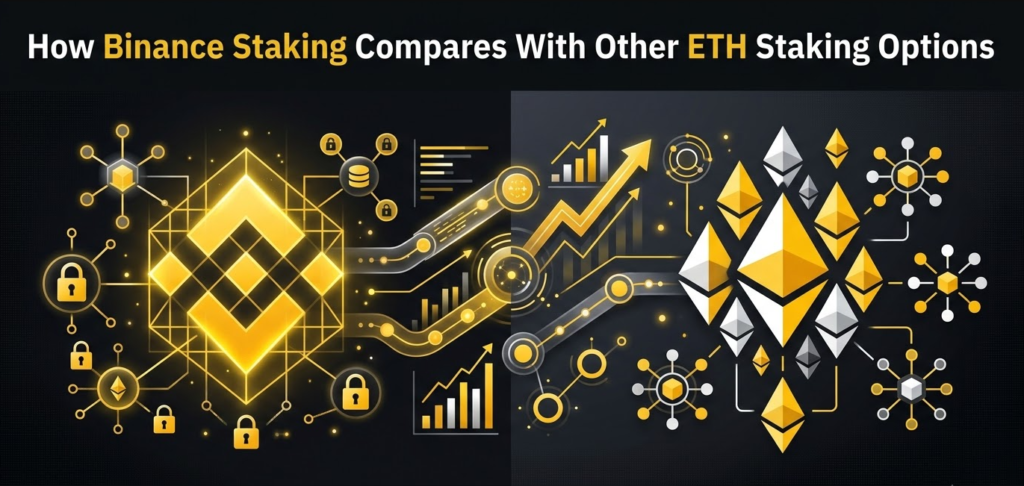
If you are trying to choose the “best” way to stake Ethereum, I wouldn’t start by asking which platform has the highest APY.
I’d start with five questions:
- Who controls the keys?
- How much does the service charge?
- How quickly can I exit?
- What can go wrong beyond Ethereum itself?
- How much technical work am I willing to do?
Here’s a practical comparison:
| Feature | Binance ETH Staking | Binance EigenLayer WBETH | Binance Web3 / DeFi | Lido | Solo Validator |
|---|---|---|---|---|---|
| Minimum | Very low; current Binance page says 0.0001 ETH | Product-dependent | Protocol-dependent | No native 32 ETH requirement | 32 ETH |
| Custody | Custodial | Custodial/product-specific | Self-custodial where applicable | Smart-contract based | Self-custodial |
| Main asset | WBETH | WBETH | Depends on protocol | stETH | Native ETH |
| Technical work | Very low | Low | Medium | Low | High |
| Staking rewards | Yes | Yes + additional product rewards | Protocol-dependent | Yes | Yes |
| Additional restaking | Available through supported products | Yes | Protocol-dependent | Via supported integrations | Optional |
| Liquidity | WBETH trading/redemption | Product-specific | Depends on protocol | DEX/withdrawal options | Exit process |
| Main advantage | Convenience | Additional yield opportunity | Self-custody flexibility | DeFi composability | Maximum control |
| Main risk | Custody/counterparty | Stacked protocol risks | Smart contracts | Smart contracts/depeg | Operational/slashing risk |
The key takeaway isn’t that Binance is better or worse.
It’s that Binance moves complexity away from you and toward the platform.
If you want to run infrastructure yourself, you keep more control but accept more responsibility.
If you want one-click staking, Binance handles much more of the operational burden but becomes part of your risk model.
Binance vs. Lido vs. Solo Staking: Which One Makes Sense?
Binance is attractive when convenience matters most
I’d look at Binance first if you:
- Already keep ETH on Binance.
- Don’t want to operate a validator.
- Have significantly less than 32 ETH.
- Prefer a familiar centralized interface.
- Want WBETH liquidity.
- Want access to Binance’s broader Earn ecosystem.
The biggest selling point isn’t necessarily the highest yield.
It’s simplicity.
You don’t have to become an Ethereum infrastructure operator just to earn staking rewards.
Lido is more appealing when DeFi composability matters
A decentralized liquid staking protocol can make more sense if your priority is keeping your staking position within the on-chain ecosystem.
Instead of trusting an exchange to custody the position, you interact with a smart-contract protocol and receive a liquid staking token.
That brings a different risk profile.
You’re trading centralized counterparty exposure for smart-contract, governance, validator-operator, and market risks.
Solo staking is the control-maximizing option
If you have 32 ETH and genuinely want to participate directly in Ethereum’s consensus layer, solo staking is the purest form of Ethereum staking.
You control the infrastructure.
You control the validator keys.
You control the withdrawal address.
You don’t pay a centralized platform commission on your staking rewards.
But you also own the problems.
A validator that goes offline can incur penalties. Poor key management can be catastrophic. Incorrect infrastructure configuration can create serious risks.
Ethereum’s own documentation emphasizes that validators are responsible for proposing blocks, attesting to the chain, and following consensus rules, with penalties used to discourage dishonest behavior. (ethereum.org)
So solo staking isn’t “free yield.”
It’s a small infrastructure business.
Binance Staking Security: What You Should Actually Worry About
When people ask, “Is Binance ETH staking safe?”, I think the question is slightly incomplete.
A better question is:
Safe from what?
There are several different risks.
Ethereum protocol risk
Ethereum itself has validator-level risks, including penalties and slashing.
Binance operates the validators rather than you, which means you aren’t personally managing validator uptime.
Custodial risk
Your Binance account is still a centralized account.
That introduces risks that don’t exist in the same form with a self-custodial wallet:
- Account freezes.
- Withdrawal restrictions.
- Platform insolvency.
- Regulatory restrictions.
- Operational failures.
- Cybersecurity incidents.
That’s the fundamental trade-off of centralized staking.
WBETH market risk
WBETH is liquid, but liquidity doesn’t guarantee a fixed market price.
If you sell WBETH on a secondary market, you receive the market price available at that moment.
DeFi smart-contract risk
The moment you take WBETH and move it into an external protocol, you’ve expanded your risk surface.
For example, Binance documents WBETH’s use with external DeFi protocols and restaking systems. (Binance)
If the external protocol is exploited, that loss isn’t necessarily related to Binance’s staking infrastructure.
This is why I prefer to think of crypto risk as layers.
ETH staking risk is one layer.
Binance custody risk is another.
WBETH liquidity risk is another.
EigenLayer or DeFi smart-contract risk is another.
Adding yield often means adding layers.
What Happens If Ethereum’s Staking Queue Gets Long?
This is another area where you should avoid assuming a fixed number of days.
Ethereum has an exit mechanism and queue system, and the waiting period can change depending on network demand.
The Ethereum Foundation explains that validators exiting staking must wait according to the network’s withdrawal and exit mechanisms, while withdrawals are processed continuously according to protocol rules. (ethereum.org)
For a Binance user, there is another layer because Binance has its own redemption processing and available liquidity.
That’s why I wouldn’t promise readers:
“Binance unstaking always takes exactly X days.”
That’s too rigid for a live blockchain product.
The more accurate advice is:
Check the expected distribution date shown by Binance when you submit the redemption request.
If you need liquidity before that date, consider whether selling WBETH on the spot market is preferable – and compare the market price against the underlying value before doing it.
A Practical Strategy for Different Types of ETH Holders
If you have less than 1 ETH
You probably don’t need to overcomplicate this.
If you’re already comfortable with Binance custody and want simple staking exposure, Binance’s pooled staking structure is convenient.
The amount is too small to justify building validator infrastructure, and the technical overhead of solo staking would be disproportionate.
If you have 5–10 ETH
Now the decision becomes more interesting.
You should compare:
Binance convenience vs. decentralized liquid staking vs. self-custody.
At this level, I’d pay more attention to custody than I would with a tiny experimental balance.
You may also want to divide your holdings rather than putting everything into one system.
For example:
- Some ETH on a self-custodial cold wallet.
- Some in liquid staking.
- A smaller amount on a centralized exchange for trading liquidity.
That’s not a recommendation to follow blindly; it’s simply an example of how investors can reduce dependence on a single failure point.
If you have 32 ETH or more
At this point, solo staking becomes a genuine option.
You can operate your own validator rather than paying a centralized provider a percentage of your rewards.
But the question changes from:
“Can I stake?”
to:
“Do I want to operate a validator?”
If the answer is no, managed staking can still be rational.
The fee is essentially what you’re paying for infrastructure, operations, convenience, and risk management.
Binance Staking and the Difference Between APR and Your Actual Return
One of the easiest mistakes to make is treating the displayed APY as guaranteed income.
It isn’t.
Binance itself warns that APR is an estimate and that actual rewards can differ because the rate changes over time. (Binance)
Suppose Binance displays an annualized staking rate of 3%.
That doesn’t mean:
100 ETH → exactly 103 ETH one year later.
Your actual result depends on:
- The staking rate over time.
- The amount you stake.
- The applicable Binance commission.
- The period your assets remain staked.
- Any redemption or trading costs.
- The ETH price if you’re measuring your return in dollars.
And this last point is often forgotten.
You can earn more ETH while losing money in USD terms if ETH’s market price falls significantly.
Staking yield is not a hedge against ETH price volatility.
You’re still holding an ETH-denominated asset.
Common Mistakes Beginners Make When Staking ETH on Binance
Mistake: Looking only at APY
A higher APY isn’t automatically better.
Compare the net yield and the risk attached to achieving it.
Mistake: Assuming WBETH is identical to ETH
WBETH represents a staked ETH position, but it is a separate token with its own market mechanics.
Understand the difference between its conversion value and the price at which you can actually trade it.
Mistake: Assuming liquidity means guaranteed 1:1 redemption
You may be able to trade WBETH quickly, but market price and redemption are different mechanisms.
Mistake: Forgetting custody risk
Staking through Binance means trusting Binance.
That isn’t necessarily bad. It’s simply the architecture you’ve chosen.
Mistake: Moving WBETH into random DeFi protocols for “extra APY”
This is probably the most dangerous one.
Every additional protocol can introduce:
- Smart-contract vulnerabilities.
- Oracle failures.
- Liquidity problems.
- Governance attacks.
- Economic exploits.
- Depeg risk.
If the extra yield is 2% but the strategy introduces a meaningful possibility of permanent capital loss, the trade may not be worth it.
Binance ETH Staking Ecosystem: At a Glance
| Product | What You Hold | Main Purpose | Liquidity | Main Risk |
|---|---|---|---|---|
| ETH Staking | WBETH / staking position | Earn Ethereum staking rewards | Moderate to high | Custody |
| WBETH | Liquid staking token | Hold, trade, use in DeFi | High, market-dependent | Depeg/liquidity |
| WBETH Spot | WBETH | Trade for ETH/USDT | Immediate market liquidity | Price/slippage |
| WBETH DeFi | WBETH | Additional yield strategies | Protocol-dependent | Smart contracts |
| EigenLayer WBETH | Restaked WBETH position | Additional restaking rewards | Product-dependent | Stacked risks |
| Solo Validator | Native staked ETH | Direct Ethereum validation | Exit-based | Technical/operational |
Frequently Asked Questions
How do you stake Ethereum on Binance?
You generally log into Binance, open Earn, select ETH Staking, enter the amount of ETH you want to stake, review the current reward rate and terms, and confirm the transaction. Binance handles the validator infrastructure and issues WBETH as the tokenized representation for current ETH staking flows. (Binance)
The exact interface can change, so follow the options displayed in your current Binance account rather than relying on screenshots from an old guide.
What is the minimum ETH required to stake on Binance?
Binance’s current ETH staking page states that users can stake from 0.0001 ETH. This is substantially below the 32 ETH required to run a native Ethereum validator. (Binance)
Because minimums can change by product and jurisdiction, check the live Binance interface before making a deposit.
What fee does Binance charge for ETH staking?
Binance’s official ETH staking documentation states that its standard fee is 10% of staking rewards, rather than 10% of your entire staked balance. The fee is applied before the remaining staking rewards are distributed. (Binance)
For example, if your gross staking reward were 1 ETH, a 10% reward commission would leave approximately 0.9 ETH before considering any other factors.
What is WBETH?
WBETH stands for Wrapped Beacon ETH. It is a liquid staking token representing staked ETH and accumulated staking rewards.
Unlike a rebasing token whose balance changes as rewards accrue, WBETH uses a value-accruing model. The amount of WBETH you hold can remain unchanged while its conversion value relative to ETH increases over time. Binance describes WBETH as tradable and transferable and says it can be used across Binance products and supported external DeFi applications. (Binance)
What is the difference between BETH and WBETH?
BETH is Binance’s legacy ETH staking token, while WBETH is the more flexible wrapped representation designed for trading, transfers, collateral use, and DeFi.
Binance has stated that newer ETH staking users receive WBETH directly, while legacy BETH holders can still follow separate redemption or conversion procedures. (Binance)
Does WBETH earn staking rewards automatically?
Yes, the staking rewards are reflected through the WBETH conversion rate rather than being deposited into your wallet as additional WBETH units.
Binance states that the WBETH conversion rate is updated daily based on the ETH staking APR, with its documentation specifying a daily update at 00:00 UTC. (Binance)
How do you redeem WBETH for ETH?
Binance’s documented process is to go to the ETH Staking page, select Redeem, enter the amount of WBETH, and confirm the request. The resulting ETH is returned to your Spot Wallet after the applicable waiting period. (Binance)
The expected distribution date should be checked before confirming because redemption timing can change.
Can you sell WBETH instead of redeeming it?
Yes. Binance has documented WBETH spot trading pairs including WBETH/ETH and WBETH/USDT. (Binance)
Selling WBETH can provide much faster liquidity than waiting for the staking redemption process, but you become exposed to the current market price, spreads, and possible slippage.
What is Binance EigenLayer WBETH staking?
It is a restaking product in which eligible users commit WBETH to an EigenLayer-based strategy through Binance’s On-Chain Yields ecosystem.
Binance says the WBETH continues to accumulate its underlying ETH staking value while participants can potentially receive additional EigenLayer-related rewards. (Binance)
The important catch is that restaking adds another layer of risk. Additional rewards aren’t free; you’re using the same economic stake to support additional services.
Is Binance ETH staking safe?
It can be a convenient way to access Ethereum staking, but “safe” depends on what risks you’re comparing.
Binance removes much of the operational burden associated with running your own validator and states that it assumes certain infrastructure-related penalty risks. (Binance)
However, Binance staking remains custodial. You’re exposed to exchange, account, regulatory, and platform risks that wouldn’t exist in exactly the same form with a self-custodial validator.
And if you move WBETH into external DeFi, you add smart-contract and market risks on top.
Can U.S. residents stake ETH on Binance.com?
U.S. residents cannot use the global Binance.com platform in the same way as users in supported international jurisdictions. Binance has explicitly stated that its global platform is not accessible to U.S. residents and that separate regional services apply. (Binance)
Product availability also varies by jurisdiction, so users should verify the applicable Binance service rather than trying to bypass geographic restrictions.
Is Binance better than solo staking?
Not necessarily.
It’s better for convenience.
Solo staking is better for direct control.
With Binance, you outsource validator infrastructure and accept a reward commission and custodial relationship.
With solo staking, you retain control and avoid the centralized staking commission, but you take responsibility for hardware, uptime, validator keys, upgrades, monitoring, and operational security.
For someone with 32 ETH who enjoys running infrastructure, solo staking can be compelling. For someone who simply wants ETH staking exposure without becoming a validator operator, Binance can be much easier.
Final Thoughts: Is Binance ETH Staking Worth It?
If you strip away all the crypto jargon, Binance ETH staking is essentially a trade:
You give up some control and some staking rewards in exchange for simplicity.
That’s the real proposition.
You don’t need 32 ETH. You don’t need a dedicated validator machine. You don’t need to learn Ethereum client architecture. You don’t need to monitor a node every day.
Instead, Binance handles the infrastructure and you receive exposure to staking rewards through its managed system and WBETH.
For many beginners, that’s a perfectly reasonable trade.
The part I wouldn’t ignore is what happens after you receive WBETH.
That’s where the product becomes much more interesting – and potentially more complicated.
You can hold it. You can trade it. You can use it as collateral where supported. You can move it into DeFi. You can potentially restake it through supported EigenLayer products.
Every one of those choices changes your risk profile.
If you simply want ETH staking without technical headaches, standard Binance ETH Staking is probably the cleanest place to start.
If liquidity is important, understand WBETH thoroughly before using it.
If you’re chasing additional yield through EigenLayer, recognize that you’re no longer making a simple staking decision – you’re making a stacked-risk DeFi decision.
And if you have enough ETH, technical knowledge, and patience to operate your own validator, compare the long-term economics of solo staking against Binance’s convenience fee.
Ultimately, the best staking strategy isn’t necessarily the one with the highest advertised APY.
It’s the one whose custody model, fees, liquidity, technical complexity, and risks you actually understand.
That’s the difference between simply clicking “Stake” and genuinely knowing what you’re doing with your ETH.
Product terms, fees, minimums, regional eligibility, redemption times, and available staking/restaking products can change. Always verify the current terms shown in your Binance account before committing funds.