
Ethereum Proof-of-Stake After The Merge and Shapella
If you held ETH before Ethereum moved to Proof-of-Stake, staking may have seemed like something reserved for technically sophisticated users with servers, command lines, and a very large ETH balance. That picture has changed quite a bit.
Today, you can stake a small amount of ETH through a liquid staking protocol in a few minutes, or you can run your own validator if you have the full 32 ETH and are comfortable operating Ethereum infrastructure. Between those two extremes are staking-as-a-service providers, distributed validator technology, centralized exchanges, and newer restaking systems.
The important thing is that these methods are not equivalent.
They all expose you to Ethereum staking rewards, but they distribute custody, operational responsibility, liquidity, fees, smart-contract risk, and technical complexity very differently. If you simply choose the option advertising the highest APY, you can easily end up taking risks you never intended to take.
I think the easiest way to understand Ethereum staking is to stop thinking about it as a single product. It is really a spectrum of ways to contribute ETH to Ethereum’s Proof-of-Stake security while receiving rewards in return.
Ethereum now uses Proof-of-Stake rather than Proof-of-Work. Validators put ETH at risk and participate in proposing and attesting to blocks; dishonest behavior can result in penalties or slashing. The official Ethereum documentation explains the mechanism in detail in its Proof-of-Stake overview.
That transition happened through The Merge, which was completed on September 15, 2022. The Merge combined Ethereum’s existing execution layer with the Beacon Chain’s Proof-of-Stake consensus layer and eliminated Proof-of-Work block production. Ethereum’s own Staking Launchpad notes that the transition reduced the network’s energy consumption by more than 99.9%.
Then came another major milestone.
The Merge vs. Shapella: Why the Difference Matters
The Merge brought Proof-of-Stake to Ethereum, but it did not immediately give validators a normal withdrawal mechanism.
That arrived with the Shanghai/Capella upgrade in 2023. At the protocol level, EIP-4895 introduced a system-level mechanism that pushes eligible validator withdrawals from the Beacon Chain to Ethereum’s execution layer. The specification is described in the official EIP-4895 documentation.
This distinction matters because you may still see old articles claiming that staked ETH is permanently locked. That is no longer correct.
Ethereum staking now supports withdrawals, although the mechanics depend on your validator credentials and whether you are making a partial withdrawal or fully exiting. The current Ethereum documentation explains that validators with withdrawal credentials can receive eligible funds at their designated execution-layer address.
And Ethereum has continued evolving since Shanghai/Capella. After the Pectra upgrade, validators can use 0x01 withdrawal credentials for standard withdrawals or 0x02 credentials for compounding validators, with the latter supporting an effective balance up to 2,048 ETH.
So when someone asks me, “How do I stake Ethereum after the Merge?” my answer is simple: first decide which staking architecture fits you. The ETH reward is only one part of the decision.
The 5 Core Ethereum Staking Models
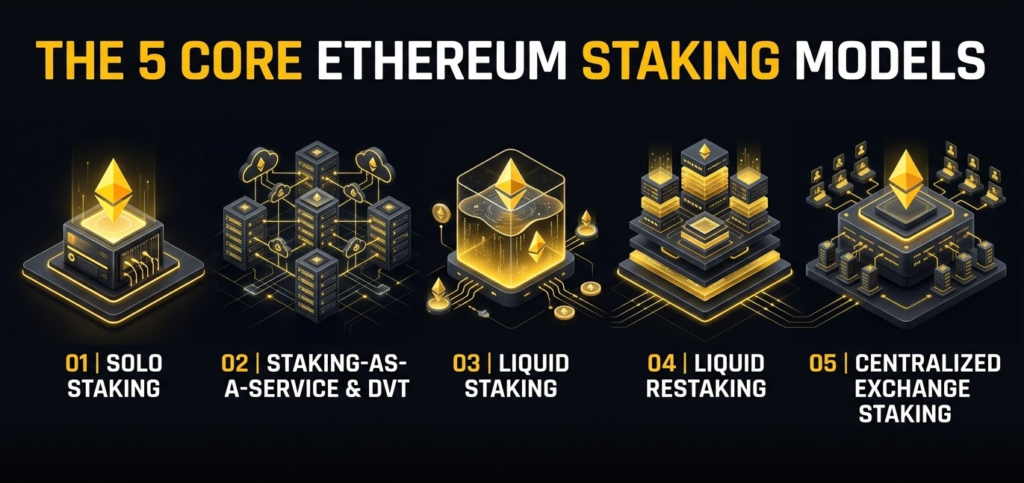
There is no universal “best” Ethereum staking method. The best choice depends heavily on whether you value control, simplicity, liquidity, or additional yield.
Solo Staking: The Gold Standard for Control
Solo staking is the closest thing to the original Ethereum staking vision.
You deposit ETH, operate your own infrastructure, run your validator, and keep control over your keys. There is no liquid staking protocol sitting between you and Ethereum, and there is no centralized exchange controlling the validator on your behalf.
The traditional requirement for activating a validator is 32 ETH. Ethereum’s documentation confirms that a validator is added to a consensus client by depositing 32 ETH into the deposit contract.
But 32 ETH is only the financial requirement. There is also an operational requirement.
A proper Ethereum validator setup involves:
- An execution client, such as Geth, Nethermind or Besu.
- A consensus client, such as Lighthouse, Prysm or Teku.
- The validator software responsible for attestations and block proposals.
- Reliable internet connectivity.
- Persistent uptime.
- Secure key management.
- Monitoring and maintenance.
Ethereum’s current node architecture specifically separates the execution client from the consensus client, with the validator software operating alongside the consensus client.
This is why I would not describe solo staking as “passive income.” It is closer to running a tiny piece of financial infrastructure.
You can automate a lot of the boring work, but you are still responsible when something breaks.
A power outage, corrupted database, client bug, bad configuration, or poorly handled validator key can turn what looked like an easy yield strategy into an expensive technical problem.
For someone who enjoys running servers and wants maximum control, though, solo staking is hard to beat.
Staking-as-a-Service and Distributed Validator Technology
Staking-as-a-service is the middle ground.
You still meet the native validator requirement, but instead of running the infrastructure yourself, a professional provider operates the validator environment.
This dramatically reduces the technical burden. You don’t have to maintain a server, monitor clients around the clock, or deal with every software update yourself.
The trade-off is obvious: you introduce a service provider into the architecture.
This makes the exact custody arrangement extremely important. A reputable service can allow you to retain control of withdrawal credentials while outsourcing operational infrastructure, but you should never assume every provider uses the same model.
Distributed Validator Technology, or DVT, adds another interesting layer.
Instead of relying on one physical machine or one operator, a validator can be coordinated across multiple independent operators. If one machine fails, the remaining participants can potentially keep the validator functioning.
This is particularly useful because validator infrastructure has historically had a simple weakness: a single machine going offline can create downtime penalties.
DVT attempts to make the validator itself more resilient.
For larger stakers, this can be a meaningful improvement over putting an entire validator behind one server in one location.
Liquid Staking: The Easy Option for Less Than 32 ETH
Liquid staking changed the accessibility of Ethereum staking.
You don’t need 32 ETH. Instead, you deposit ETH into a liquid staking protocol and receive a token representing your claim on the staked ETH and its accumulated rewards.
Common examples include stETH from Lido and rETH from Rocket Pool.
The important detail is that these tokens remain usable.
Instead of having ETH sitting inside a validator that you cannot freely move, you receive an on-chain representation that can potentially be transferred, traded, or used in DeFi.
Ethereum.org describes LSTs as ERC-20 tokens representing claims on staked ETH and explains that they can be held or traded while the underlying ETH remains staked.
There are different accounting models.
With a rebasing token such as stETH, your token balance can increase as staking rewards accrue. With an exchange-rate model such as rETH, the token balance may remain constant while each token represents an increasing amount of ETH.
That sounds complicated at first, but the practical difference is fairly simple: the token is your liquid representation of a staking position.
The convenience is substantial.
The risk is also different from solo staking.
You now depend on the protocol’s smart contracts, governance, validator operators, liquidity mechanisms and token economics. Your ETH is no longer exposed only to Ethereum’s own consensus rules.
That is the trade-off you make for liquidity.
Liquid Restaking: More Yield, More Layers of Risk
Restaking takes the idea one step further.
Instead of using staked ETH only to secure Ethereum, restaking protocols allow staked assets to support additional systems or Actively Validated Services.
This is where EigenLayer and liquid restaking tokens entered the picture.
You may see assets such as eETH or ezETH discussed in this category. The attraction is straightforward: rather than earning only Ethereum staking rewards, users can potentially earn additional rewards from the additional services their capital helps secure.
But I would be careful with the phrase “higher yield.”
Higher yield doesn’t magically appear. It generally comes with additional obligations or risks.
With restaking, you can stack:
- Ethereum staking risk.
- Liquid staking protocol risk.
- Smart contract risk.
- Middleware or AVS risk.
- Additional slashing conditions.
- Liquidity and de-pegging risk.
So a 6% or 8% headline yield should never be compared directly with a 3% staking yield as though the two investments have identical risk.
They don’t.
Centralized Exchange Staking
Exchange staking is the easiest option for beginners.
You already have an account, your ETH is already there, and the exchange handles most of the technical infrastructure.
There is no server to configure and no validator client to maintain.
The downside is custody.
You are trusting a centralized company with your assets and staking operation. That introduces counterparty risk, withdrawal restrictions, platform risk and potentially higher commissions.
For someone who actively trades ETH and wants a simple way to earn some staking rewards on idle holdings, exchange staking can make sense.
For someone specifically interested in self-custody and minimizing third-party dependencies, it is usually not the first choice.
Ethereum Staking Economics: Where the Yield Actually Comes From
One of the biggest mistakes I see in staking discussions is treating “staking APY” as one single source of income.
It isn’t.
Ethereum validator rewards can come from different parts of the protocol.
Consensus-Layer Rewards
The consensus layer rewards validators for doing their jobs correctly.
That includes activities such as attestations and block proposals.
The basic idea is straightforward: Ethereum needs validators to participate honestly and consistently, so the protocol provides economic incentives for doing so.
The official Ethereum documentation explains that Proof-of-Stake uses rewards and penalties around staked ETH to encourage validators to act honestly and participate correctly.
If your validator performs reliably, you earn rewards. If it goes offline, you can lose some rewards and potentially incur penalties. If you engage in slashable behavior, the consequences can be much more serious.
Execution-Layer Rewards
There is another source of validator revenue that comes from Ethereum’s execution layer.
When users submit transactions, they pay gas. Ethereum’s current fee structure separates the base fee from the priority fee: the base fee is burned, while tips are paid to the validator.
Block proposals can also involve MEV, or Maximal Extractable Value.
This means validator revenue can vary substantially depending on network activity and the economic value of the blocks a validator proposes.
That’s why staking APY should not be treated as a fixed interest rate.
What Is Ethereum’s Staking APY?
Be careful with articles that casually state that Ethereum staking “pays 3%–5% APY” as though this were guaranteed.
It isn’t.
At the time of writing, Ethereum’s official Staking Launchpad displayed a current validator APR of approximately 2.64%, alongside more than 40.8 million ETH staked and more than 900,000 validators. Those numbers change continuously, so the official Ethereum Staking Launchpad statistics are a better reference for current figures than a static article.
The important point is not the exact number on any particular day.
The important point is that Ethereum staking yield is dynamic.
As the amount of ETH participating in staking changes, protocol-level rewards change as well. Execution-layer income can also move dramatically depending on transaction activity and MEV conditions.
So if someone promises you a “guaranteed Ethereum staking APY,” I would immediately ask what exactly is being guaranteed.
Validator Keys: The Part You Should Understand Before Staking
The key architecture behind Ethereum staking is more nuanced than simply “I have a wallet.”
A validator has different kinds of credentials with different responsibilities.
Validator Signing Keys
Your validator signing key is used by the validator to perform actions such as attestations and block proposals.
Because the validator needs to use this key repeatedly, it is generally treated as an operational or “hot” key.
That makes security critical.
If you accidentally run two validator instances with the same validator signing key, you can potentially create conflicting messages and trigger slashing conditions.
This is one reason validator infrastructure needs careful operational discipline.
Withdrawal Credentials
Withdrawal credentials serve a different purpose.
They specify where eligible validator funds can ultimately be withdrawn.
Ethereum’s current documentation distinguishes 0x01 credentials, which use an execution-layer withdrawal address, from 0x02 credentials introduced for compounding validators after Pectra.
This is an important evolution from older Ethereum staking guides.
If you’re setting up a new validator today, don’t blindly follow a guide written before the Pectra upgrade. The credential architecture has changed.
What Happens When a Validator Goes Offline?
Going offline is not automatically the same thing as getting slashed.
This distinction matters.
If your validator simply stops participating because your server loses power, you can generally suffer inactivity-related penalties and missed rewards. That’s bad, but it is fundamentally different from intentionally or accidentally signing conflicting messages.
Slashing is designed to punish specific forms of provably malicious or conflicting validator behavior.
That is why redundancy must be designed carefully. Running backup infrastructure sounds sensible until the backup accidentally starts signing with the same validator key at the same time as the primary.
In staking, “more servers” is not automatically “more security.”
Sometimes it can create a new failure mode.
Restaking and the Risk of Risk Stacking
Restaking deserves special attention because it can make an otherwise simple staking position much more complicated.
Imagine the risk structure like this:
ETH → Ethereum validator → liquid staking token → restaking protocol → AVS
Each additional layer can introduce another dependency.
This doesn’t mean restaking is inherently bad. It means you should understand what you are actually earning.
For example, if you hold an LRT, you may have exposure not only to Ethereum validator performance but also to the smart contracts that issue the LRT, the middleware coordinating restaking, the underlying assets, and the systems being secured.
The higher potential yield is compensation for taking on additional complexity.
I would therefore avoid comparing staking products solely by APY. A better comparison is:
Net expected return + liquidity + custody + smart-contract risk + operational risk + exit conditions.
That gives you a much more realistic picture.
How to Stake Ethereum With Liquid Staking

If you have less than 32 ETH and don’t want to operate infrastructure, liquid staking is usually the easiest place to start.
Connect Your Wallet
Use a self-custodial wallet such as MetaMask or Rabby and connect it to the official staking protocol interface.
Before connecting, verify the website carefully. Fake staking websites are a common phishing vector, and the fact that a website looks professional tells you almost nothing.
Bookmark the official domain rather than relying on random search advertisements or links sent through social media.
Deposit ETH
Choose the amount of ETH you want to stake.
Remember that the transaction itself requires gas, so don’t send your entire ETH balance if you need ETH available for transaction fees.
The protocol will ask your wallet to approve and sign the staking transaction.
Read the transaction before confirming it.
Receive the Liquid Staking Token
After the transaction completes, you’ll receive the protocol’s liquid staking token.
For example, depending on the protocol, that might be stETH or rETH.
At this point you have not created a traditional Ethereum validator yourself. Instead, you hold a token representing a claim on ETH being staked by the protocol.
Ethereum’s official documentation makes this distinction explicit: holding an LST is not the same thing as directly being an Ethereum protocol staker.
Decide What to Do With the LST
You can generally:
- Hold the LST.
- Trade it.
- Use it in supported DeFi protocols.
- Redeem it through the staking protocol where supported.
But don’t assume liquidity is identical to ETH.
During stressed market conditions, an LST can trade below the value of the ETH it represents. Ethereum.org specifically notes that secondary-market prices can deviate from the underlying ETH value.
That’s the subtle risk many beginners miss.
“Liquid” doesn’t necessarily mean “always worth exactly 1 ETH.”
How to Run a Native 32 ETH Ethereum Validator
Solo staking is much more technical, but it gives you the highest degree of direct control.
Prepare the Hardware
A dedicated machine is preferable to a laptop you use for everything else.
A typical setup may include:
- A modern CPU.
- At least 32 GB RAM.
- Fast SSD storage.
- Stable broadband internet.
- Reliable power.
- UPS battery backup.
- Secure physical access.
The exact hardware requirements evolve, so I would always check the current Ethereum documentation before buying equipment rather than blindly copying specifications from an old blog post.
Choose an Execution Client and Consensus Client
Ethereum’s architecture requires two major clients.
The execution client processes transactions and manages execution-layer state.
The consensus client handles Proof-of-Stake consensus, blocks and attestations.
Ethereum’s current node architecture documentation explains how these clients work together and lists multiple client implementations.
You should also understand client diversity rather than simply installing the most popular software without considering network-level concentration.
Generate Validator Keys
For a native validator, use the official Ethereum staking workflow.
The Ethereum Foundation’s Staking Launchpad provides the validator setup path and emphasizes that users should understand the responsibilities before making a deposit.
This is not the place to download a random “staking software package” from a Telegram group.
Your validator keys are extremely valuable.
Configure Withdrawal Credentials
Pay particular attention to the withdrawal address.
Current Ethereum staking documentation explains that withdrawal credentials determine where validator withdrawals go and that these credentials play a central role in enabling withdrawals.
For new validators, understand whether you’re configuring a standard 0x01 validator or a 0x02 compounding validator.
Do not assume that a tutorial published before Pectra describes today’s validator model accurately.
Deposit 32 ETH
Once your infrastructure and keys are ready, you can complete the deposit process through the official staking workflow.
Ethereum’s documentation recommends practicing on a testnet before committing real ETH, which is excellent advice even for experienced users.
I would take that recommendation seriously.
A few hours of testnet practice can save you from making a permanent mistake with real money.
How Ethereum Validator Withdrawals Work Today
One of the biggest improvements to Ethereum staking is that withdrawals are now part of the protocol.
For a standard 0x01 validator, eligible rewards above the effective 32 ETH balance can be automatically withdrawn to the configured execution address. Full withdrawals become available after the validator exits.
The current Ethereum withdrawal documentation explains that these withdrawals are handled through validator sweeps rather than ordinary user-signed Ethereum transactions.
That also means you don’t manually send a normal Ethereum transaction every time a staking reward becomes withdrawable.
For 0x02 compounding validators, rewards can instead remain part of the validator’s effective balance, subject to the protocol’s limits. The current Ethereum Launchpad documentation describes compounding balances up to 2,048 ETH.
If you’re reading an old article saying “Ethereum staking rewards can never be withdrawn,” throw it away.
That information is obsolete.
Ethereum Staking Model Comparison
| Attribute | Solo Staking | Staking-as-a-Service | Liquid Staking | Liquid Restaking | Exchange Staking |
|---|---|---|---|---|---|
| Minimum | 32 ETH | Usually 32 ETH | No native 32 ETH requirement | Usually no 32 ETH requirement | Usually no 32 ETH requirement |
| Technical work | High | Low–Medium | Low | Low | Very low |
| Key control | Highest | Depends on provider | Protocol-based | Protocol-based | Custodial |
| Liquidity | Lower | Lower | High | High | Platform-dependent |
| Main risk | Operational failure | Provider dependency | Smart contracts/de-peg | Stacked protocol risk | Counterparty risk |
| Yield sources | Consensus + execution | Consensus + execution | Validator rewards minus fees | Staking + additional rewards | Validator rewards minus fees |
| Best for | Technical ETH holders | Larger holders wanting less maintenance | Most users under 32 ETH | Advanced DeFi users | Convenience-focused users |
There is no winner in every category.
If you have 10 ETH, solo staking is not an option for one validator because you don’t meet the native 32 ETH requirement. Liquid staking gives you access to staking without requiring that full amount.
If you have 32 ETH and enjoy infrastructure, solo staking becomes much more attractive.
If you have 32 ETH but don’t want to maintain a server, staking-as-a-service may be more appropriate.
And if you are chasing additional DeFi yield, restaking may be interesting-but only if you understand the extra risks.
The Best Way to Stake Ethereum Depends on You

If I had to simplify the entire decision into a few scenarios, I’d approach it like this:
You have less than 32 ETH and want simplicity:
Liquid staking is probably the cleanest starting point.
You have 32 ETH or more and want maximum control:
Solo staking is the strongest fit, assuming you can operate the infrastructure safely.
You have 32 ETH but don’t want to run hardware:
Consider staking-as-a-service, but carefully investigate key custody and operator architecture.
You want liquidity for DeFi:
Liquid staking gives you a tokenized position you can potentially trade or deploy elsewhere.
You want extra yield and understand complex DeFi risks:
Restaking may be worth researching, but don’t treat the additional APY as free money.
You value convenience above self-custody:
Exchange staking is the simplest route, although you’re accepting centralized custody.
Common Ethereum Staking Mistakes to Avoid
Chasing the Highest APY
A higher advertised APY isn’t automatically a better investment.
If one strategy earns 3% with relatively straightforward staking exposure and another advertises substantially more but adds several smart-contract and slashing dependencies, the numbers are not directly comparable.
Look at the risk-adjusted return.
Ignoring Withdrawal Architecture
Especially with solo staking, don’t treat validator signing keys and withdrawal credentials as the same thing.
They have different purposes.
Ethereum’s current withdrawal system makes the withdrawal address a critical part of validator setup, so you should understand it before depositing.
Running Redundant Validators Incorrectly
Redundancy sounds good, but duplicate signing is dangerous.
If you operate the same validator key from two active systems without proper coordination, you can create conflicting attestations or proposals.
In other words, don’t build a “backup” that accidentally becomes a second validator.
Forgetting About Smart-Contract Risk
Liquid staking removes the need to operate your own validator, but it doesn’t remove risk.
It moves some of that risk.
You now depend on contracts, governance, operators and liquidity.
That can be a very reasonable trade-off, but it is still a trade-off.
Treating Staking as Guaranteed Interest
ETH staking rewards are variable.
Ethereum’s official Launchpad currently shows a live validator APR rather than a permanently fixed APY, and the displayed figure changes as network conditions change.
Think of staking as participation in a protocol with variable rewards, not a bank deposit.
Frequently Asked Questions
What is the minimum amount of ETH needed to stake?
For native Ethereum validator staking, the traditional validator deposit requirement is 32 ETH. Ethereum’s current validator documentation still describes 32 ETH as the amount required to add a validator to a consensus client.
However, you can stake less than 32 ETH through liquid staking protocols, staking pools or centralized exchanges.
How did The Merge change Ethereum staking?
The Merge moved Ethereum from Proof-of-Work to Proof-of-Stake and made validators responsible for securing the network. The transition occurred on September 15, 2022.
The Merge itself did not introduce normal validator withdrawals. Those came later through the Shanghai/Capella upgrade and EIP-4895.
Can I withdraw staked ETH today?
Yes. Ethereum supports validator withdrawals.
The exact process depends on the validator’s withdrawal credentials and whether you’re making a partial withdrawal or fully exiting. Current Ethereum documentation explains the differences between 0x01 and 0x02 validators.
For liquid staking tokens, the process depends on the specific protocol. You may redeem through the protocol or sell the token on a secondary market.
What is the current Ethereum staking APY?
There is no permanently fixed APY.
At the time of writing, the official Ethereum Staking Launchpad displayed approximately 2.64% APR for validators. Because staking participation and execution-layer rewards change continuously, you should check the live Ethereum statistics before making a decision.
Is liquid staking safer than solo staking?
Not necessarily. It is safer from one perspective and riskier from another.
Liquid staking eliminates much of the operational burden of running a validator yourself, but introduces smart-contract, governance, liquidity and protocol risks.
Solo staking gives you direct control but puts infrastructure and key-management responsibility on you.
What are stETH and rETH?
They are liquid staking tokens.
When you deposit ETH into a compatible liquid staking protocol, you can receive a token representing your staking position. Ethereum.org explains that LSTs can represent claims on staked ETH and accumulated rewards while remaining transferable or tradable.
stETH uses a rebasing-style design, while rETH uses an exchange-rate model.
What is a 0x01 withdrawal credential?
A 0x01 credential is a validator withdrawal credential associated with an execution-layer withdrawal address.
It allows eligible validator funds to be withdrawn to that address under Ethereum’s withdrawal mechanism. The current Ethereum documentation explains that rewards above the standard effective balance can be automatically swept for Type 1 validators.
What is a 0x02 withdrawal credential?
A 0x02 credential is associated with Ethereum’s newer compounding validator model introduced through Pectra.
Unlike the standard 32 ETH effective-balance model, a Type 2 validator can compound rewards into its validator balance, up to an effective balance of 2,048 ETH under the current rules.
What is Distributed Validator Technology?
Distributed Validator Technology, or DVT, distributes validator operations across multiple independent infrastructure participants.
The goal is to reduce dependence on a single machine or operator. If one participant goes offline, the remaining participants may be able to continue producing the required validator signatures.
For professional staking infrastructure, DVT can therefore improve resilience while introducing its own technical architecture and dependencies.
Does staking ETH guarantee a profit?
No.
You can earn protocol rewards, but ETH itself can rise or fall in market value. You can also face validator penalties, smart-contract vulnerabilities, liquidity problems, provider fees, or other risks depending on the staking method.
A 4% staking reward does not protect you from a 30% decline in the market price of ETH.
That is why I would always separate two questions:
“How much ETH can this strategy earn?”
and
“What could cause me to lose money?”
The second question is often more important.
Final Thoughts: Staking Is a Choice About Control
Ethereum staking has become much more flexible since The Merge.
You no longer have to think of staking as “deposit 32 ETH and run a server.” Today, the ecosystem spans solo validators, professional infrastructure providers, DVT, liquid staking, restaking and centralized exchange products.
That flexibility is useful, but it also makes the decision more complicated.
If you want the highest level of direct control and have the technical ability to operate infrastructure, solo staking remains the purest form of Ethereum staking.
If you have less than 32 ETH or simply want an easier experience, liquid staking is usually the most accessible option.
If you want someone else to handle the infrastructure, staking-as-a-service can remove a lot of operational headaches, although you need to understand exactly who controls which keys.
And if you’re considering restaking, don’t stop at the headline APY. Look underneath it. Understand what additional systems you’re securing, what contracts you’re trusting, and what conditions could create losses.
The good news is that Ethereum’s staking architecture is considerably more mature than it was immediately after the Merge. Withdrawals are enabled, validator infrastructure is more developed, and the ecosystem now offers multiple ways to participate.
But the fundamental rule hasn’t changed: your staking strategy should match your ability to manage its risks.
The highest yield isn’t necessarily the best yield.
The easiest option isn’t necessarily the safest.
And the most technically sophisticated setup isn’t necessarily the right one for you.
If you understand those three points before staking, you’re already making a much better decision than someone who simply clicks “Stake” because the number next to APY looks attractive.