What Is a DApp?
If you have ever connected a wallet to Uniswap, deposited assets into a lending protocol, voted on a DAO proposal, or traded an NFT through a Web3 marketplace, you have already used a DApp, even if the interface felt almost identical to a normal website. You still open a browser, click buttons, read charts, browse menus, and approve actions through a familiar interface. The difference is what happens behind that interface: instead of relying entirely on a company’s private backend to determine what happens next, a DApp can push critical application logic into smart contracts running on a blockchain.
Ethereum’s own technical introduction to DApps defines a decentralized application as an application built on a decentralized network that combines a smart contract with a frontend user interface, while specifically contrasting its decentralized backend with the centralized servers used by conventional applications. (ethereum.org) That definition is useful because it avoids one of the most common misconceptions around Web3 software: a DApp is not simply a website with a “Connect Wallet” button, and it is certainly not required to have every single component decentralized.
The more practical definition is this: a DApp is an application that uses blockchain infrastructure, usually smart contracts, for important parts of its backend logic, state, ownership, settlement, or coordination. The frontend can still be built with React or another familiar framework, the website can still be hosted on a conventional cloud provider, and the application can still rely on indexing services or off-chain storage. What changes is that at least some of the application’s most important rules are moved from a company-controlled server into an environment where users and independent network participants can verify and execute those rules.
That distinction matters because the word “decentralized” is often treated as if it were binary. In reality, it is much more useful to think about decentralization as a property of individual layers. A DApp might have decentralized smart contracts but a centralized frontend, a decentralized asset registry but centralized image storage, or permissionless blockchain settlement while relying on a small number of RPC providers for normal users to reach the network. Once you start looking at DApps layer by layer, the technology becomes much easier to understand and the marketing language becomes much easier to filter.
Decentralized Application Meaning: What Actually Changes?
The strongest argument for DApps is not that blockchain makes software magically better. It is that blockchain can change who controls the application’s state and rules.
Take a traditional marketplace as a simple example. The company typically controls the user accounts, balances, transaction records, product listings, database, API, and moderation system. If the company freezes your account, changes its rules, removes a listing, or shuts down the service, there may be little you can do because the underlying application state lives inside infrastructure controlled by that company.
A DApp can move some of those responsibilities into smart contracts. Instead of asking a private backend whether a particular transaction is allowed, the user can submit a transaction to a contract whose rules are executed by the blockchain network. If the transaction satisfies the contract’s conditions, the state can change according to those rules without requiring an employee or private server to approve the operation.
That creates several potential advantages, although each comes with trade-offs.
Censorship resistance
If critical application logic lives on a public blockchain and there is no centralized administrator with arbitrary control over that logic, it can be considerably harder for one party to stop valid interactions. Ethereum’s DApp documentation specifically describes DApps as operating on an open public network where no single person or group has control over the underlying platform. (ethereum.org)
But there is an important qualification here. A smart contract can remain operational while the website used to access it disappears, a domain gets suspended, or an RPC provider becomes unavailable. So a DApp can have censorship-resistant backend logic without providing censorship-resistant access at every layer.
Public auditability
Another major difference is visibility. A conventional application’s backend code and database are generally private, while public smart contracts can be inspected and, when their source code is verified, analyzed by developers, researchers, and users.
Ethereum describes smart contracts as accessible and transparent in a way that resembles open APIs, which is also what makes composability possible. (ethereum.org) A developer can interact with an existing contract rather than asking the original company for permission to access its backend, which creates a very different software ecosystem from the closed APIs that dominate much of Web2.
Permissionless access
A public blockchain can also remove some traditional account barriers. Depending on the application, you may not need to create a username, wait for an account to be approved, or hand over an email address before interacting with a protocol.
That does not mean every DApp is permissionless. Some applications add KYC requirements, allowlists, geographic restrictions, or centralized authentication, while others may limit what their frontend allows you to do. The important distinction is that permissionless interaction can exist at the protocol layer even when the user-facing application introduces additional restrictions.
User-controlled assets
The other major difference is ownership. In a traditional application, your account balance or inventory often exists inside a company’s database, which means the company ultimately controls the database that defines your account. In a blockchain application, assets can instead be controlled by cryptographic keys and smart contracts, allowing users to hold and transfer assets without asking the original application for permission.
This is one of the most powerful ideas behind Web3, but it is also where the responsibility shifts dramatically. If you control your own wallet, there may be no traditional customer-support team that can reset your account after you lose the credentials that control it. DApps therefore exchange some forms of institutional dependence for a greater degree of user responsibility.
Web2 vs Web3 Apps: The Architecture Difference
The easiest way to see what changes is to compare the architecture of a conventional application with a typical DApp.
| Architectural layer | Web2 traditional app | Web3 DApp |
|---|---|---|
| Frontend | Website or mobile application | Website, mobile application, or wallet interface |
| Backend logic | Company-controlled servers | Smart contracts plus off-chain services |
| Main state | Private database | Blockchain state plus external data |
| Authentication | Password, OAuth, email, social login | Wallet signatures, SIWE, account abstraction, or hybrid login |
| Payments | Banks, cards, payment processors | Blockchain transactions and tokens |
| Identity | Platform-controlled account | Often wallet-based identity |
| Data visibility | Mostly private | Blockchain state is generally public |
| Infrastructure | Cloud servers and APIs | Blockchain nodes, RPCs, indexers, storage, hosting |
| Upgrade control | Company engineering team | Admin keys, multisigs, DAO governance, timelocks, or immutable contracts |
| Account recovery | Password reset and support | Usually wallet-based recovery or self-custody mechanisms |
There is one correction worth making to the simplified diagrams you often see in Web3 explainers: a DApp does not necessarily replace a private database with the blockchain. Real applications usually use a hybrid architecture because blockchains are excellent for verifiable shared state but are not automatically the best place to store every piece of information an application needs.
A social DApp, for example, might keep ownership or identity-related state on-chain while using separate infrastructure for search, feeds, notifications, images, analytics, or caching. A DeFi application may put financial balances and settlement rules on-chain while keeping interface preferences and other non-critical information off-chain. The goal is therefore not to put everything on a blockchain; the goal is to put the parts that benefit from blockchain guarantees into the appropriate layer.
How Do DApps Work?
A simplified DApp architecture looks like this:
User → Frontend → Wallet/RPC → Smart Contract → Blockchain
That diagram is useful for beginners, but production applications are usually more complicated. The frontend may also communicate with an indexer, API, database, decentralized storage provider, analytics system, or other off-chain service, which means the complete architecture looks more like a collection of interconnected components than a single decentralized machine.
Ethereum’s developer documentation makes this distinction clear by describing DApps as frontend interfaces connected to smart-contract backends while also providing guidance for building frontends, working with accounts and transactions, and using decentralized storage such as IPFS. (ethereum.org)
Once you understand the individual layers, the entire system becomes much less mysterious.
The Frontend Layer
The frontend is the part you see in your browser, and there is nothing inherently decentralized about the technologies used to build it. A DApp can use React, Next.js, JavaScript, TypeScript, HTML, CSS, or essentially the same development stack you would use for a conventional Web2 product.
What makes the frontend a Web3 frontend is the way it communicates with blockchain infrastructure. Instead of sending every important request to a private backend API, the application can use libraries and wallet integrations to read blockchain state, prepare contract calls, request signatures, and submit transactions.
For example, when you open a decentralized exchange, the page might retrieve token balances from the blockchain, query indexed historical activity through another service, calculate a proposed trade in the browser, and then ask your wallet to sign the final transaction. The interface is still ordinary software, but the application logic is distributed across several layers with different trust assumptions.
This is why the frontend should not be confused with the DApp itself. A frontend is an interface. The decentralized part may live somewhere underneath it.
The Wallet Layer
A Web3 wallet is more than a place to view your crypto balances. It also acts as a cryptographic signing interface that lets you prove control of an address and authorize blockchain transactions without handing the private key to the application.
Suppose you want to swap one token for another. The DApp prepares the transaction, your wallet displays the relevant request, and you approve it if everything looks correct. The wallet then signs the transaction with the key controlling your address, after which the signed transaction can be submitted to the blockchain.
That creates a fundamentally different authentication model from the traditional username-and-password approach. Instead of asking a company to confirm that you know a secret stored in its account system, the DApp can verify that you control a cryptographic key capable of producing a valid signature for a particular address.
This sounds simple, but it has an important consequence: your wallet becomes part of the application’s security boundary. A malicious website cannot simply read your private key through a normal wallet connection, but it can attempt to trick you into authorizing a transaction or permission that has financial consequences.
The RPC Layer
Your browser also needs a way to communicate with blockchain nodes, and that is where RPC infrastructure enters the picture.
RPC stands for Remote Procedure Call. In practical terms, an RPC endpoint gives applications a way to request blockchain information or submit signed transactions without operating their own node infrastructure for every user interaction.
A DApp may use RPC calls to ask for the latest block, read a wallet balance, execute a read-only smart-contract call, estimate transaction requirements, or broadcast a signed transaction. This layer is easy to overlook because users rarely see it, but it can become an important infrastructure dependency.
The result is one of the first examples of the “decentralization illusion”: the blockchain can be decentralized even when the way a particular DApp accesses that blockchain is concentrated in a small number of service providers.
That does not automatically make the DApp poorly designed. Using reliable infrastructure is often practical and sensible. It simply means you should distinguish the decentralization of the underlying network from the decentralization of the application stack.
The Smart Contract Layer
This is the layer that gives a DApp its defining Web3 characteristics.
A smart contract is code deployed to a blockchain. Ethereum’s documentation describes smart contracts as programs that live on the blockchain and execute according to their programmed logic, effectively serving as the backend of a DApp. (ethereum.org)
Imagine a decentralized exchange. Its contracts can contain the rules for swapping assets, updating liquidity pools, calculating fees, and transferring tokens. A lending protocol can use contracts to manage deposits, collateral, borrowing, interest calculations, and liquidations.
The important part is that the application does not have to rely entirely on a private server to decide whether these actions are valid. The contract defines the rules, and the blockchain network provides the execution and consensus environment.
This is also where the phrase “code is law” comes from, although I would be careful with it. Smart-contract code can determine what happens at the protocol level, but the real system may still have upgrade keys, governance mechanisms, external oracles, off-chain interfaces, and legal arrangements that sit outside the code.
Smart Contracts as Open APIs
One of the most powerful properties of DApps is composability.
Ethereum explicitly compares smart contracts to open APIs because other applications can interact with them without needing the original developer to expose a conventional private API. (ethereum.org)
That means a developer building a portfolio dashboard does not necessarily need to recreate an entire decentralized exchange. They can read the exchange’s public contract state, build an interface around it, and potentially combine it with other protocols.
The same idea applies to lending markets, stablecoins, NFT contracts, governance systems, identity protocols, and other blockchain primitives. Over time, this creates something closer to an open software ecosystem where applications can become infrastructure for other applications.
That composability is one of the areas where Web3 architecture can genuinely feel different from conventional software development.
The Data Storage and Indexing Layer
Here is where many simplified DApp explanations become misleading.
A blockchain is not a general-purpose replacement for every database and storage system. Large images, videos, profiles, historical analytics, search indexes, and other application data are often better handled outside the blockchain, while the chain stores the information that benefits most from public verification and shared state.
This produces a hybrid model:
Blockchain: ownership, balances, transactions, critical state and settlement.
Decentralized storage: media and other content that benefits from content addressing.
Indexer: structured access to blockchain history.
Database/API: application-specific information that does not need to be fully on-chain.
That architecture may sound less “pure” than putting everything on-chain, but it is far more practical.
IPFS and the Off-Chain Storage Question
IPFS is commonly used by Web3 applications because it uses content addressing rather than relying solely on a conventional location-based URL.
The official IPFS best-practices guide for NFT data recommends using IPFS URIs as canonical references and explains that CIDs uniquely identify content. It also warns that persistence still needs to be planned, because the continued availability of IPFS content depends on nodes or pinning infrastructure continuing to provide the data. (IPFS Docs)
That last point is worth emphasizing because “stored on IPFS” is sometimes treated as synonymous with “permanent.”
It is not.
An IPFS CID gives you content-addressed integrity, meaning the identifier is tied to the content rather than simply pointing to whichever file happens to sit at a particular server URL. But someone still needs to keep that content available on the network.
This is why the IPFS documentation recommends planning for persistence and explains the role of pinning services or self-managed infrastructure. (IPFS Docs)
For a DApp developer, this creates a sensible division of responsibilities: blockchain state can prove ownership or settlement, while IPFS can provide verifiable references to larger data without forcing every byte onto the blockchain.
Why DApps Need Indexers
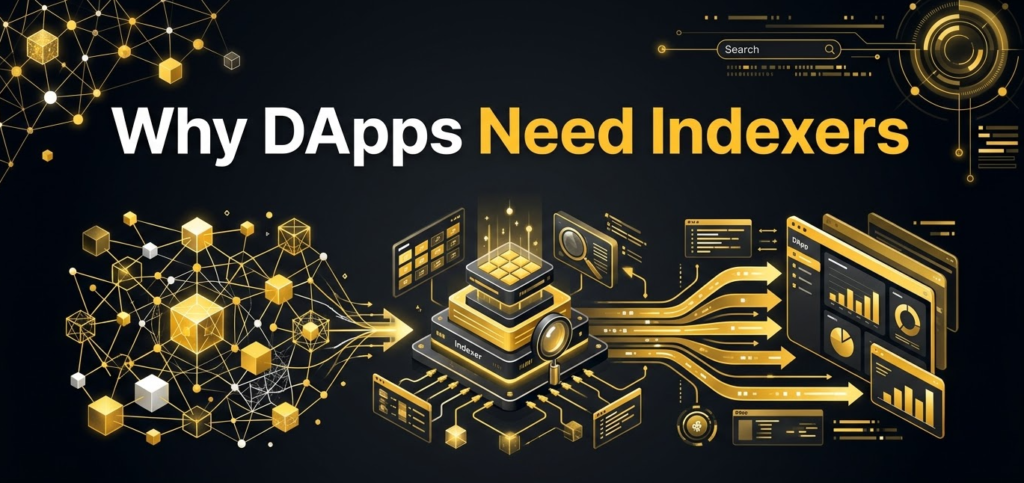
Raw blockchain data is public, but public does not automatically mean convenient.
Imagine a DApp that wants to show every interaction a wallet has ever had with a protocol, group those transactions by token, calculate historical balances, and display the result in a dashboard. Reconstructing all of that directly from raw blocks every time a user opens the page would be inefficient and unnecessarily expensive.
Indexers solve this problem by processing blockchain data into structures that applications can query more easily.
That creates another subtle trade-off. The blockchain may remain the underlying source of truth while the user interface depends on a particular indexing service to make that data fast and usable. If the indexer fails, the underlying blockchain can still be perfectly healthy while the application interface shows incomplete data or stops functioning correctly.
Again, the important lesson is not that indexers are bad. It is that decentralization at the blockchain layer does not automatically eliminate infrastructure dependencies at the application layer.
Sign-In With Ethereum: How Web3 Authentication Works
One of the most interesting differences between Web2 and Web3 applications is authentication.
Instead of creating an account with an email address and password, a DApp can ask you to prove control of a wallet address by signing a structured message.
The standard for this is Sign-In with Ethereum, or SIWE, defined by EIP-4361, which specifies a standardized message format for Ethereum accounts authenticating with off-chain services. The specification includes security-related fields such as a nonce and session information so that applications can verify the signature in a structured way. (Ethereum Improvement Proposals)
The basic handshake works like this:
- The DApp generates a sign-in message.
- The message identifies the intended domain and wallet address.
- A nonce helps prevent replay of an old authentication message.
- Your wallet displays the message.
- You sign it without revealing your private key.
- The application verifies the signature against your public address.
- The DApp can establish an authenticated session.
The distinction between a signature and a transaction is important. A SIWE authentication message is intended to prove control of an account; it is not inherently a request to transfer your assets. That said, you should still read wallet prompts carefully because malicious sites can attempt to disguise dangerous actions as harmless-looking signature requests.
The “Decentralization Illusion” and the Hidden Trade-Offs
The more DApps you use, the more obvious one uncomfortable truth becomes: decentralization is usually partial rather than absolute.
A DApp can have smart contracts running on a decentralized blockchain while depending on centralized infrastructure everywhere around them. The frontend might be hosted on a cloud provider, the domain might be controlled by a single organization, the RPC connection might come from one provider, the indexer might be operated by another company, and an upgrade key might still give a small group significant control over the contract.
That does not make the DApp fake.
It means you need to evaluate its architecture rather than its marketing.
Frontend and RPC Centralization
You will sometimes see articles claim that 95% or more of DApp frontends are centralized.
I would avoid presenting that as a hard industry statistic unless the author provides a transparent dataset and a defensible definition of “centralized frontend.” There are too many edge cases: a frontend could be stored on IPFS but accessed through a centralized gateway, hosted through a CDN while its source is open, or served from decentralized storage while still relying on centralized RPC infrastructure.
Ethereum’s own DApp documentation acknowledges that a frontend can be hosted on decentralized storage such as IPFS, which reinforces the point that frontend hosting is a separate architectural decision from smart-contract decentralization. (ethereum.org)
The more defensible conclusion is that many production DApps still depend on centralized services for at least part of their frontend, RPC, indexing, analytics, or storage stack.
If the main website disappears, the smart contract may continue to exist. But most users are not going to reconstruct a frontend manually, find the correct contract address, and interact with it through raw blockchain calls. The protocol can therefore remain alive while the practical user experience becomes inaccessible.
The Off-Chain Storage Paradox
Why don’t DApps simply store everything on-chain?
Because blockchains are shared infrastructure, and every additional byte of state has consequences for storage, execution, network propagation, and node requirements. Storing a large image or video directly on a blockchain can be far less practical than storing a verifiable reference to that content somewhere else.
This is why hybrid storage is so common.
An NFT, for example, might keep ownership and token identity on-chain while its metadata points to an IPFS URI. A gaming DApp might keep asset ownership and important state on-chain while storing large textures, video, or other content outside the blockchain.
The important distinction is that off-chain does not automatically mean centralized. IPFS and other systems can provide decentralized or content-addressed storage, although they come with their own persistence and infrastructure assumptions.
Immutability vs. Upgradability
Immutability sounds like an obvious advantage of smart contracts until you imagine discovering a serious bug after deployment.
Ethereum’s DApp documentation describes deployed smart contracts as code that cannot simply be changed once deployed. That immutability is valuable because users can reason about the rules without expecting a company to silently rewrite them later. (ethereum.org)
But software often needs bug fixes.
This creates a genuine tension between immutability and maintainability.
OpenZeppelin’s documentation explains this trade-off directly: smart contracts are designed to be immutable, while software development often requires the ability to patch bugs and improve functionality. Its proxy upgrade pattern allows a proxy to remain at a stable address while forwarding calls to an implementation contract that can be replaced through an authorized mechanism. (OpenZeppelin Docs)
That means a DApp can be upgradeable without changing the address users interact with.
It also means someone has to possess the authority to perform that upgrade.
And that authority becomes part of the application’s trust model.
Proxy Contracts, Timelocks and Multisigs
Proxy contracts are useful because they separate the contract users interact with from the implementation containing the logic. OpenZeppelin’s current documentation describes patterns such as Transparent and UUPS proxies and notes that upgradeability requires careful handling of Solidity, storage, and EVM mechanics. (OpenZeppelin Docs)
From a user’s perspective, the technical pattern is less important than three practical questions:
Who can upgrade it?
How many people must approve an upgrade?
Is there a delay before the upgrade becomes active?
A protocol controlled by one administrator has a very different risk profile from one controlled by a properly secured multisig with a timelock. OpenZeppelin’s upgrade tooling explicitly supports governance through mechanisms such as multisig wallets, while the broader proxy documentation makes clear that the upgrade authority remains an important part of the system’s security model. (OpenZeppelin Docs)
This is why “immutable” and “upgradeable” should never be treated as simple good-versus-bad labels. An immutable contract may be difficult to fix after a serious bug, while an upgradeable contract may be easier to maintain but introduces additional governance assumptions.
User Experience Friction
This is probably the most obvious difference for ordinary users.
Web2 applications have spent years hiding infrastructure complexity. You enter a password, click a button, and the server handles the rest.
A DApp may ask you to connect a wallet, switch networks, approve a token, sign a transaction, wait for confirmation, and then repeat the process for another operation. If you use multiple networks, you may also need to keep the appropriate native asset available for gas, while a wrong address or irreversible transaction can create a problem that customer support cannot simply undo.
The trade-off is real: Web3 exposes more of the infrastructure because the user is also closer to the ownership and settlement layer.
That can be empowering, but it can also be frustrating.
Why DApps Can Be More Expensive or Slower Than Regular Apps
A centralized application can update its private database without asking thousands of independent nodes to agree on the result.
A blockchain transaction is different. The network must process the transaction according to its consensus and execution rules, and users generally pay for the computational resources required by state-changing operations.
That creates two forms of friction.
The first is cost. A user may have to pay gas for an action that would cost nothing in a conventional application.
The second is latency. A transaction may need to be broadcast, included in a block, and confirmed before the application considers the action final.
Layer-2 networks can reduce transaction costs and improve throughput for many applications, but the fundamental trade-off remains: blockchain applications exchange some centralized efficiency for shared verification and a different trust model.
The DApp Ecosystem
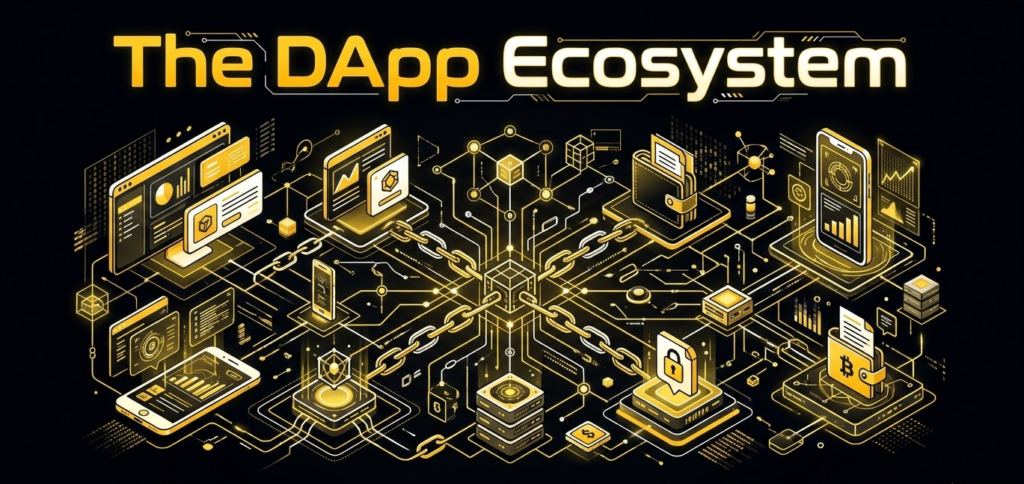
DApps have expanded well beyond the original image of decentralized exchanges and token swaps. Today, the architecture is used across financial protocols, digital assets, gaming, social applications, physical infrastructure networks, governance systems, identity tools, and other categories.
| Category | Typical use | Examples |
|---|---|---|
| DeFi | Trading, lending, borrowing, derivatives | Uniswap, Aave |
| NFT | Minting, collecting, trading | OpenSea, Blur |
| Gaming | On-chain assets and economies | Blockchain games |
| SocialFi | Decentralized identity and social graphs | Farcaster, Lens |
| DePIN | Coordinating physical infrastructure | Helium, Render |
| DAO governance | Proposals, voting, execution | Snapshot, Tally |
| Identity | Wallet-based authentication and credentials | SIWE, ENS |
| Prediction markets | Permissionless event-based markets | Blockchain prediction protocols |
DeFi DApps
DeFi is probably the clearest demonstration of what DApps can do.
A decentralized exchange can encode trading and liquidity rules into smart contracts, while a lending protocol can use contracts to manage collateral, borrowing, interest, and liquidation. Instead of relying entirely on a centralized operator to maintain the financial database and execute every transaction, the protocol moves critical financial state into blockchain infrastructure.
Aave is a useful example because its documentation describes its protocol as a non-custodial liquidity system built around smart contracts. Users supply assets, borrowers provide collateral, and the protocol’s contracts handle the relevant operations.
The benefit is transparency and composability.
The downside is that smart-contract risk becomes financial risk.
A vulnerability is no longer simply an engineering bug. It can potentially affect real assets.
NFT Marketplaces and Digital Collectibles
NFT marketplaces use DApp architecture to connect user interfaces with blockchain-based ownership and trading.
The marketplace can provide discovery, search, collection pages, bidding, and other user-facing features, while the blockchain records token ownership and settlement.
This separation has an interesting consequence: the marketplace itself is not necessarily the owner of the NFTs it displays.
If one interface disappears, the underlying tokens can remain on the blockchain and potentially be accessed through another application.
That is one of the strongest examples of composability in Web3.
GameFi and Blockchain Gaming
Traditional games generally store inventory and player progression in a centralized database.
Blockchain games can move some of those assets onto public networks, giving players the ability to hold, transfer, and trade them outside the original game’s database.
But there is an important caveat that is often lost in marketing.
A token does not automatically become useful in another game.
Interoperability requires another application to understand the asset’s format and meaning. A sword NFT may technically belong to you, but another game does not have to recognize that sword as a usable item.
Blockchain provides an ownership primitive.
Developers still need to build the actual utility around it.
SocialFi and Decentralized Social
Decentralized social applications attempt to separate parts of social identity and social graphs from one company’s private database.
The idea is appealing because traditional social platforms often control the relationship between your identity, followers, content, and audience. A protocol-based approach can make it possible for multiple applications to build interfaces around a shared social layer.
Farcaster is one example of this architecture, where the protocol provides underlying infrastructure that different clients can use.
The same caveat applies here as elsewhere: the protocol can be decentralized while the particular client you use remains centralized.
That is not necessarily a contradiction. It is simply another example of layered architecture.
DePIN
DePIN, short for Decentralized Physical Infrastructure Networks, applies blockchain-based incentives to physical resources such as wireless networks, storage, compute, mapping, or other infrastructure.
The blockchain does not physically decentralize a GPU or wireless antenna. Instead, it can provide a coordination and incentive layer around independently operated resources.
That distinction matters because DePIN is often easier to understand as an economic coordination system than as a purely blockchain-native application.
DAO Governance DApps
DAOs need interfaces where users can create proposals, vote, delegate voting power, review governance history, and execute approved decisions.
Snapshot is commonly used for governance signaling, while systems such as Tally provide interfaces and infrastructure around on-chain governance.
The important architectural distinction is between governance interface and governance execution. A website may display a vote, while a smart contract ultimately determines whether the resulting decision is executed.
That separation is another example of how a DApp can combine conventional web infrastructure with blockchain-based execution.
How to Interact With DApps Safely
You do not need to understand Solidity to use DApps safely, but you do need to treat your wallet differently from a normal login account.
The first rule is straightforward: never give your seed phrase or private key to a website. A legitimate DApp does not need your private key to connect your wallet, authenticate you, or ask you to sign a normal transaction.
The second rule is to verify the application before connecting. Check the official domain, documentation, contract addresses, supported network, and official communication channels rather than trusting a link simply because the website looks familiar.
Wallet Connection vs. Token Approval
One of the most important security distinctions for beginners is the difference between connecting a wallet and granting a token allowance.
Connecting a wallet allows an application to interact with your public address and request certain wallet actions. A token approval is different because it can authorize a smart contract to move specific tokens on your behalf.
MetaMask’s official guidance explicitly explains that token allowances are different from simply connecting your wallet to a DApp and warns that malicious or compromised contracts can potentially abuse approvals. (Trung Tâm Hỗ Trợ MetaMask)
That is why you should never treat every wallet popup as an ordinary login confirmation.
Before approving a token allowance, ask yourself what contract you are approving, which token it can access, and whether the allowance is limited or effectively unlimited.
Review Old Token Approvals
If you use DeFi frequently, your wallet can accumulate a long list of token allowances.
MetaMask explains that disconnecting a DApp is not the same as revoking an approval. Disconnecting changes the wallet’s connection relationship with the DApp, while revoking an allowance removes the smart contract’s permission to move the relevant tokens. (Trung Tâm Hỗ Trợ MetaMask)
This is a small operational habit that is worth developing.
Review old approvals periodically, especially if you experiment with new protocols frequently. MetaMask also notes that revoking an approval is itself an on-chain transaction, so you will generally need to pay gas to remove the permission. (Trung Tâm Hỗ Trợ MetaMask)
Read What You Are Signing
One of the most dangerous habits in Web3 is clicking Sign without reading what the wallet is actually asking you to authorize.
Some signatures are harmless authentication messages.
Others can authorize transactions or permissions with real financial consequences.
SIWE is designed to create a structured authentication message that gives users and wallets more context about what they are signing. EIP-4361 specifically aims to provide a machine-readable format that improves consent and authentication experiences. (Ethereum Improvement Proposals)
If a website suddenly asks you to sign something that does not match the action you intended to perform, stop and investigate it.
What Is a DApp in Simple Terms?
A DApp is an application that uses blockchain infrastructure, especially smart contracts, for important parts of its backend logic. Unlike a conventional application whose backend typically runs on centralized servers, a DApp can execute critical logic through a decentralized blockchain network.
How Do I Log Into a DApp Without an Email or Password?
Many DApps use wallet-based authentication. Instead of entering a password, you prove control of a wallet address by signing a message that the application can verify.
The Sign-In with Ethereum standard, defined in EIP-4361, provides a structured format for this process, including security fields such as a nonce and session information. (Ethereum Improvement Proposals)
Are DApps 100% Decentralized?
No. A DApp can have decentralized smart contracts while still depending on centralized hosting, RPC providers, indexing services, domains, databases, analytics, or upgrade authorities.
The right question is not simply whether a DApp is decentralized, but which parts of the application are decentralized and which are not.
Why Are DApps Sometimes Slower or More Expensive Than Regular Apps?
Blockchain transactions require network resources, and state-changing operations can require gas fees. Transactions also need to be propagated, included in blocks, and confirmed before the application can treat them as final.
A centralized application can often update its private database without those additional steps.
Can a DApp Steal Funds From My Crypto Wallet?
A DApp cannot normally access your private key simply because you connect your wallet, but malicious applications can try to trick you into signing transactions or granting dangerous token approvals.
MetaMask specifically warns that token approvals can allow smart contracts to move approved assets and that unlimited allowances can become dangerous if a malicious or compromised contract is able to exploit them. (Trung Tâm Hỗ Trợ MetaMask)
Does a DApp Store Everything on the Blockchain?
Usually not. Critical ownership and application state may live on-chain, while large media, metadata, profiles, historical data, and other application information can live in decentralized storage, databases, or indexing systems.
IPFS is one example: its official documentation recommends using content-addressed IPFS URIs for NFT data while also emphasizing that developers need a persistence strategy to keep the underlying content available. (IPFS Docs)
Can a DApp Still Work If Its Website Goes Down?
Potentially. If the underlying smart contracts remain deployed and accessible, users may be able to interact with them through another frontend, wallet, block explorer, or custom software.
The practical problem is that most users depend on the original interface, so a frontend outage can make an otherwise functioning protocol difficult to use.
Are Smart Contracts Always Immutable?
No. Some contracts are designed to be immutable, while others use upgradeable architectures.
OpenZeppelin’s documentation explains that proxy patterns allow users to interact with a stable proxy address while the underlying implementation can be replaced through an authorized upgrade process. (OpenZeppelin Docs)
That means you should always investigate who controls the upgrade authority before assuming a DApp is truly immutable.
What Is the Difference Between a DApp and a Smart Contract?
A smart contract is the blockchain-based program, while a DApp is the broader application built around that program.
A DApp can include a frontend, wallet integration, smart contracts, RPC infrastructure, indexing, storage, APIs, analytics, and authentication. The smart contract is often the core backend component, but it is only one part of the complete application.
What Are the Biggest Risks of Using DApps?
The main risks include smart-contract vulnerabilities, malicious approvals, phishing, compromised admin keys, upgrade authority abuse, oracle failures, RPC outages, frontend attacks, and irreversible user mistakes.
The word “decentralized” should therefore never be treated as a synonym for “safe.” Decentralization changes the trust model, but it does not remove technical or financial risk.
Final Thoughts: DApps Are About Architecture, Not Hype
The easiest way to understand DApps is to ignore the marketing for a moment and look at the architecture.
A DApp is not simply a website with a wallet button. It is an application where blockchain infrastructure becomes part of the application’s trust, execution, ownership, settlement, or coordination model, usually through smart contracts.
That distinction is important because a DApp can be genuinely decentralized at one layer and surprisingly centralized at another. The smart contracts may run on a public blockchain while the frontend depends on conventional hosting, the application may use IPFS for media while relying on centralized indexing, and the contracts may be publicly auditable while an upgrade key gives a small group the ability to change their behavior.
None of these facts automatically make a DApp fraudulent or pointless.
In many cases, hybrid architecture is simply the practical answer. Putting financial settlement or asset ownership on-chain can provide guarantees that are difficult to reproduce with a private database, while keeping search, media, analytics, and other heavy workloads outside the blockchain makes the application considerably cheaper and easier to use.
The important thing is to understand the trade-off rather than accepting “decentralized” as a complete description.
When I evaluate a DApp, I would therefore ask a much more specific set of questions: Where does the critical logic run? Who controls the upgrade keys? Where is the data stored? Which RPC and indexing services does the frontend depend on? What happens if the company disappears? And what permissions am I actually giving my wallet?
Those questions tell you much more about a DApp than its homepage ever will.
Once you start looking at Web3 applications this way, the technology becomes much less mysterious. You can separate genuinely decentralized components from conventional infrastructure, understand where the trust assumptions sit, and make a much more informed decision about whether a DApp is actually solving a problem that needs blockchain technology in the first place.