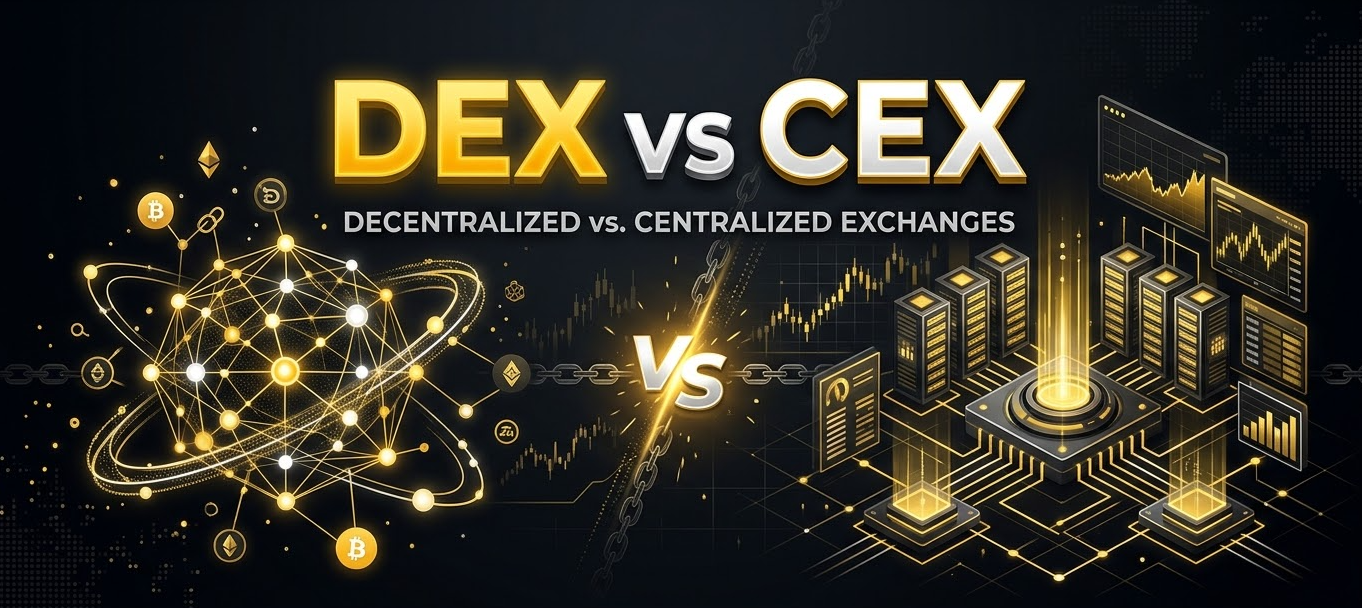
The Two Doorways Into the Crypto Market
When someone asks me whether they should use a centralized exchange or a decentralized exchange, I usually don’t start with trading fees or the number of coins listed. Those things matter, but there is a much bigger question sitting underneath all of them:
Who actually controls your money while you trade?
With a centralized exchange, or CEX, you normally create an account, deposit assets or fiat, and trade through a company-operated platform. The exchange maintains your account balance and generally controls the wallets holding the deposited crypto. You can trade, withdraw, convert currencies, use derivatives where available, and manage your portfolio through a familiar interface, but you are trusting the exchange to safeguard and return your assets.
A decentralized exchange, or DEX, works differently. You connect a self-custody wallet and interact with blockchain-based smart contracts. Your assets generally stay in your wallet until you approve and execute a transaction. Instead of handing your funds to a company before trading, you interact with a protocol that executes according to its programmed rules.
That distinction sounds simple. In practice, it changes the entire experience.
I can buy Bitcoin on a CEX, leave it there, and recover my account if I forget a password. I can also potentially have my account restricted, face a withdrawal delay, or become exposed to the financial and operational health of the company.
On a DEX, I can trade directly from my own wallet without depositing funds into a centralized exchange account. But if I approve a malicious contract or send tokens to the wrong address, there may be nobody who can undo the transaction for me.
This is why I don’t think of DEX vs. CEX as a simple battle between “old finance” and “Web3.”
It is really a choice between different forms of convenience, control, and risk.
Key Differences at a Glance
| Feature | Centralized Exchange (CEX) | Decentralized Exchange (DEX) |
|---|---|---|
| Custody | Exchange generally controls deposited assets | You control assets through your wallet |
| Trading model | Usually central order books | AMMs, liquidity pools, order books, RFQ or intent-based systems |
| Identity | KYC is common and often required | Core protocols can be permissionless, but interfaces and related services may impose restrictions |
| Fiat access | Usually much easier | Often depends on third-party fiat on-ramps |
| Settlement | Trades can settle internally before withdrawal | Trades generally settle through blockchain transactions |
| Main security risk | Counterparty failure, insolvency, fraud, freezes or exchange hacks | Smart-contract exploits, malicious tokens, phishing and wallet compromise |
| Privacy | Trading account is associated with your identity | Wallet activity is generally pseudonymous but publicly visible |
| Asset selection | Usually curated by the exchange | Permissionless protocols can expose users to a much wider range of tokens |
| User experience | Familiar account-based interface | Wallet-based and more technical |
| Transaction costs | Trading fees and possible withdrawal costs | Network fees, protocol fees, slippage and price impact |
| Account recovery | Password and account recovery mechanisms may exist | Lost private keys or recovery phrases generally cannot be reset by a third party |
One point here deserves extra attention: permissionless does not mean “completely unrestricted.”
A DEX smart contract can be open to anyone while the website used to access it applies geographic restrictions. A wallet can have its own policies. A fiat provider can require KYC. A routing service can block certain addresses.
Uniswap itself illustrates this distinction. The underlying protocol is designed as an open, decentralized protocol, while Uniswap Labs has separately operated interfaces and services with their own compliance considerations. Its documentation explains that the protocol itself is permissionless and self-custodial, while third-party crypto purchases through the Uniswap interface can require KYC. (Uniswap’s explanation of how its protocol works)
That difference between protocol, interface, and service provider becomes increasingly important as DeFi matures.
Centralized Exchanges: The Wall Street of Crypto

How CEXs Work: Order Books and Market Makers
If you’ve ever traded stocks, forex, or other financial products through a brokerage platform, a centralized crypto exchange will probably feel familiar very quickly.
You choose a trading pair such as BTC/USDT, ETH/USD, or SOL/USDC. You then place a market order, limit order, or another supported order type.
Underneath that interface is typically a central limit order book.
An order book contains bids from buyers and asks from sellers. The highest bid represents what buyers are currently willing to pay, while the lowest ask represents what sellers are willing to accept. The difference between the two is the spread.
Coinbase explains this structure clearly in its description of crypto order books, including how bids, asks, spreads and available quantities interact when a market order moves through multiple price levels. (Coinbase’s explanation of how crypto order books work)
Coinbase’s current trading rules also explicitly describe Coinbase Markets as a central order book trading platform where users can place different order types across supported digital-asset and fiat pairs. (Coinbase Exchange Trading Rules)
This structure is one reason CEX trading can feel extremely fast.
Your trade does not necessarily need to become a blockchain transaction every time you buy or sell. If you buy BTC on a CEX and then sell it five minutes later without withdrawing it, the exchange can update its internal accounting system without broadcasting two separate Bitcoin transactions to the network.
That is a major advantage.
It is also part of the trust assumption.
You are trusting the exchange to maintain an accurate internal ledger, manage customer assets properly, process withdrawals, protect its infrastructure, and remain operational.
Makers, takers and market liquidity
Professional market makers are another important part of the CEX ecosystem.
A market maker may continuously place buy and sell orders around the current market price. The objective is generally to provide liquidity while earning the spread, incentives, or other forms of compensation.
For you as a trader, the result can be tighter spreads and better execution, especially on heavily traded pairs.
The deeper the order book, the more liquidity is available around the current price. That generally means a large order has a better chance of being filled without moving the market dramatically.
This matters far more once you move beyond small trades.
If you’re buying $100 worth of BTC, a slightly different execution price may barely register.
If you’re trying to execute a $500,000 trade in a thin market, the structure of the order book suddenly becomes a major part of the trade itself.
That’s one reason major CEXs remain useful even as decentralized trading infrastructure becomes more sophisticated.
The Fiat Gateway and Why KYC Exists
For many people, the first interaction with crypto isn’t a wallet.
It’s a bank account.
You have dollars, euros, pounds, Vietnamese dong, or another traditional currency. You want Bitcoin, Ether, USDT, or another digital asset. You need somewhere to convert one into the other.
CEXs are particularly good at this.
They can connect crypto trading with traditional payment infrastructure, depending on the countries and payment methods they support. You may be able to use a bank transfer, debit card, credit card, or another payment method to buy crypto.
The exchange also needs to know who you are in many jurisdictions.
That’s where KYC, or Know Your Customer, enters the picture.
Coinbase states that identity verification is required at account creation for legal, compliance, and fraud-prevention reasons, and that accounts have limited functionality until verification is completed. (Coinbase’s current identity-verification requirements)
That makes the CEX experience quite different from simply installing a Web3 wallet.
You submit identification documents.
You provide personal information.
You may need to verify your address or tax information depending on your jurisdiction.
The exact requirements vary by country and platform, but the basic idea is the same: a CEX is a business providing financial services, so it operates within a much more conventional compliance framework.
And this is one of the reasons CEXs remain the easiest starting point for people entering crypto from the traditional financial system.
You don’t have to understand blockchain addresses before buying your first $50 of Bitcoin.
You don’t need to know what gas is.
You don’t need to understand token approvals.
You can simply create an account, complete verification, deposit fiat, and trade.
That convenience has real value.
Decentralized Exchanges: The Web3 Frontier

Removing the Middleman With Smart Contracts
The first time you use a DEX properly, the experience can feel completely different.
There is no traditional brokerage account.
You don’t necessarily create a username and password.
Instead, you connect a wallet.
That wallet could be MetaMask, Phantom, Rabby, a hardware wallet, or another compatible self-custody solution.
Your wallet holds the private keys needed to authorize transactions. When you interact with a DEX, the wallet asks you to approve a transaction or signature.
The important part is what happens next.
The DEX doesn’t need to take your tokens into a corporate account before allowing you to trade. Your wallet authorizes a blockchain transaction that interacts with the protocol’s smart contracts.
If the transaction succeeds, the blockchain records the resulting token movements.
This is the basic self-custody model.
Uniswap describes its protocol as an open-source, decentralized and self-custodial protocol in which smart contracts facilitate token swaps and liquidity provision directly on-chain. (Uniswap’s protocol documentation)
The important phrase here is self-custody.
You don’t hand your funds to the DEX first.
But there’s a trade-off that new users often underestimate:
Self-custody removes one class of risk while giving you much more responsibility.
If you send funds to the wrong address, the transaction generally can’t simply be reversed.
If you approve a malicious contract, an attacker may gain the ability to move assets.
If you lose your wallet’s recovery credentials, there may be no centralized support team capable of restoring access.
So a DEX doesn’t eliminate trust.
It changes where the trust sits.
Automated Market Makers and Liquidity Pools
The biggest conceptual jump from a CEX to a traditional DEX is the move from order books to liquidity pools.
Instead of asking:
“Who is willing to sell me this token?”
an automated market maker, or AMM, asks something closer to:
“What price should this trade receive based on the current state of the liquidity pool?”
A basic AMM pool contains reserves of two tokens.
For example, imagine a pool containing ETH and USDC.
You want to buy ETH using USDC.
Instead of matching you against one particular seller, the protocol executes the swap against the pool.
After the trade, the pool contains more USDC and less ETH.
That change in reserves affects the next available price.
The exact mathematics depend on the AMM design, but the classic Uniswap v2 model uses the constant-product relationship x * y = k. Uniswap’s documentation explains how the reserves of the two tokens determine the pool’s pricing and how liquidity providers deposit token pairs into pools in exchange for a share of the liquidity and applicable fees. (Uniswap’s liquidity-pool explanation)
This is one of the most important innovations behind decentralized trading.
You don’t necessarily need a traditional market-making company sitting between every buyer and seller.
Users can provide liquidity.
Smart contracts can execute trades.
Arbitrageurs can help keep prices aligned across different markets.
The market becomes much more composable.
But the trade-off is that liquidity itself becomes part of the risk model.
A pool with deep liquidity can handle trades relatively efficiently.
A pool with very little liquidity can produce huge price impact.
That’s why I never look at a DEX token’s displayed price in isolation.
If a token is trading at $1, that doesn’t automatically mean you can buy $100,000 worth at approximately $1.
You need to know how much liquidity is actually available around that price.
Uniswap itself warns that low-liquidity pools can produce poor swap outcomes and potential losses. (Uniswap on liquidity and swap outcomes)
Beyond the Basics: Hidden Realities and the 2026 Meta
The “100% Decentralized” Myth
This is one of the most misleading ideas in crypto.
Someone says:
“It’s a DEX, so there is no company, no restrictions and nobody can control anything.”
That’s too simplistic.
A DEX ecosystem can have several different layers.
- Smart-contract layer: The blockchain contracts that actually execute the protocol.
- Interface layer: The website or application you use to interact with those contracts.
- Infrastructure layer: RPC providers, indexers, routing systems, analytics services and other supporting infrastructure.
- Fiat layer: Third-party providers that convert traditional currency into crypto.
- Wallet layer: The software through which you sign transactions.
These layers can have different ownership and governance structures.
The smart contract might be permissionless while the website applies restrictions.
A wallet might warn about a token.
A fiat provider might require KYC.
A routing service might refuse certain transactions.
This is why I prefer the phrase “permissionless protocol” over “completely unrestricted exchange.”
Uniswap’s own documentation makes an important distinction here. The protocol is designed to be decentralized, open-source and permissionless, but services built around the protocol can have their own requirements. For example, when users purchase crypto through third-party providers integrated with the Uniswap interface, those providers can require identity verification. (Uniswap’s KYC explanation)
The practical lesson is simple:
Don’t judge decentralization by the logo on the website.
Look at which layer you’re actually interacting with.
Hidden Costs: Gas, Slippage and MEV
People sometimes tell me they prefer DEXs because “there are no fees.”
That isn’t really how it works.
A DEX can eliminate certain types of centralized platform fees, but trading still has costs.
Gas fees
Your swap usually requires a blockchain transaction.
That transaction consumes network resources, so you may need to pay a network fee.
The exact cost depends heavily on the blockchain and its current activity.
Trading on a low-cost chain can feel almost free.
Trading during congestion on an expensive network can feel very different.
Slippage and price impact
Slippage is another major issue.
Suppose you want to buy $50,000 of a token, but the pool has very little liquidity.
Your trade itself can move the pool price as it executes.
You may start with one expected price and receive a significantly worse average price by the time the entire transaction is completed.
Coinbase’s explanation of order-book slippage describes the broader concept clearly: when there isn’t enough liquidity at the current price, an order can be filled across progressively worse prices. The same basic liquidity problem exists in different forms across DEX markets. (Coinbase’s explanation of slippage and order books)
This is why “the token is currently worth $0.20” isn’t enough information.
You need to ask:
How much can I actually buy or sell at around $0.20?
Those are two very different questions.
MEV
Then there is MEV, or maximal extractable value.
Ethereum defines MEV as value that can be extracted by influencing the inclusion, exclusion or ordering of transactions within blocks. The ecosystem includes searchers, validators and specialized infrastructure that identify and compete for these opportunities. (Ethereum’s MEV documentation)
One well-known example is the sandwich attack.
A trader submits a DEX swap.
A bot detects the transaction.
The bot places one transaction before it and another after it.
The user’s trade moves the price, allowing the bot to potentially profit from that movement.
Ethereum’s documentation specifically identifies sandwich trading as a negative form of MEV because it can increase slippage and worsen execution for users. (Ethereum on MEV and sandwich trading)
This doesn’t mean every DEX trade gets sandwiched.
It means on-chain markets operate in an environment where transaction ordering itself can have economic value.
That is a completely different market structure from clicking “Buy” on a centralized exchange.
The Rise of Intent-Based Swapping
This is where decentralized trading is getting particularly interesting.
Traditional DEX interaction often requires you to specify the transaction itself.
Intent-based systems move some of that complexity elsewhere.
Instead of telling the system exactly how to execute your trade, you express the outcome you want.
For example:
“I want to sell 10 ETH and receive at least X USDC.”
The infrastructure can then search for an execution path that satisfies those conditions.
CoW Protocol is one prominent example. Its documentation describes a system based around trade intents, batch auctions and solver competition, with solvers searching for execution opportunities across available liquidity. (CoW Protocol documentation)
Jupiter has become another important example on Solana, particularly because it operates as a major routing and aggregation layer across the Solana trading ecosystem.
The broader shift matters because DEX trading is no longer simply:
AMM + liquidity pool + swap button.
Modern decentralized trading can involve:
- AMMs
- DEX aggregators
- order-book exchanges
- RFQ systems
- intent-based execution
- solver networks
- private transaction routing
- cross-protocol liquidity
This is one reason I would be careful with old explanations of DEXs.
The category has evolved significantly.
Security Showdown: Counterparty vs. Code
CEX Risks: The Counterparty Threat
The phrase “not your keys, not your coins” became popular because it describes a genuine custody issue.
If your crypto is sitting on a centralized exchange, you are relying on that company.
That doesn’t automatically mean the exchange is unsafe.
It means the exchange becomes part of your security model.
The company could experience:
- Insolvency: It may not be able to meet customer obligations.
- Internal fraud: Employees or executives could misuse funds.
- Security breaches: Attackers could compromise infrastructure.
- Withdrawal restrictions: Customers may temporarily or permanently lose access to withdrawals.
- Regulatory intervention: Authorities can impose restrictions on a platform.
- Operational failures: The platform may become unavailable when markets are moving quickly.
The collapse of FTX remains the clearest modern reminder of counterparty risk. The SEC’s 2022 complaint alleged that FTX and related entities misused customer assets and diverted funds to Alameda Research. (SEC’s FTX enforcement announcement)
The lesson isn’t:
“All CEXs are FTX.”
That would be an unreasonable conclusion.
The lesson is:
Custody creates counterparty risk.
And counterparty risk needs to be evaluated separately from whether the exchange’s trading interface looks professional.
When I evaluate a centralized exchange, these are the questions I care about:
| Question | Why it matters |
|---|---|
| Who controls the company? | Ownership affects governance and accountability |
| Where does it operate? | Jurisdiction affects regulation and customer protections |
| How are customer assets held? | Custody structure affects loss and insolvency risk |
| How transparent is the platform? | Transparency helps you assess operational risk |
| How are withdrawals handled? | Your ability to retrieve funds matters more than the interface |
| What security controls exist? | Account and infrastructure security can affect customer assets |
| What happens during a crisis? | Stress reveals how a platform actually behaves |
I would also avoid treating proof-of-reserves as a complete answer.
Knowing that an exchange controls certain assets doesn’t automatically tell you everything about its liabilities, corporate structure or legal obligations.
The deeper question is always:
What exactly am I trusting this company to do?
DEX Risks: The Code Vulnerability
DEXs reduce many forms of centralized counterparty exposure.
But they don’t eliminate risk.
They change it.
A smart contract can contain a vulnerability.
A token can be malicious.
A protocol can have an administrative function you didn’t understand.
A phishing website can imitate a legitimate DEX.
A wallet signature can authorize an action you didn’t intend.
And because blockchain transactions are generally irreversible, a mistake can be permanent.
This is where self-custody becomes both powerful and unforgiving.
You have control.
That means you also have responsibility.
I treat a self-custody wallet much more like a financial instrument than a normal browser extension.
Don’t connect your main wallet to every new DeFi application you discover.
Don’t sign a transaction simply because the website says “Confirm.”
Don’t assume a token is legitimate because it has the correct-looking logo.
And don’t keep your entire portfolio in the same wallet you use for experimental DeFi activity.
A practical wallet setup can look something like this:
| Wallet | Typical role | Practical approach |
|---|---|---|
| Hardware wallet | Long-term holdings | Keep online exposure low |
| Main hot wallet | Regular DeFi | Hold only what you actively need |
| Trading wallet | DEX activity | Separate speculative capital |
| Burner wallet | Testing unfamiliar apps | Keep the balance small |
This doesn’t make you invincible.
It simply limits the damage when something goes wrong.
That’s an important difference.
Good security isn’t about creating a system where nothing can ever go wrong.
It’s about making sure one mistake doesn’t destroy everything.
The Verdict: Which One Should You Use?

I don’t think there is a universal winner.
A CEX and a DEX solve different problems.
The better choice depends on what you’re trying to accomplish and how comfortable you are with the risks involved.
When to Use a CEX
A CEX usually makes more sense if you are entering crypto from traditional finance or want a familiar trading environment.
It’s particularly useful for:
- Fiat onboarding: Convert traditional currency into crypto.
- Simple spot trading: Buy established assets through a familiar interface.
- Deep liquidity: Trade major pairs with substantial market depth.
- Advanced trading: Access derivatives or other trading products where legally available.
- Account recovery: Password and account-recovery systems can be useful for less technical users.
- Centralized records: Keep a consolidated history of trades, deposits and withdrawals.
- Convenience: Avoid signing a blockchain transaction for every internal trade.
There is a psychological advantage too.
If you’re still learning how wallets, gas and blockchain addresses work, a CEX reduces the number of things you need to understand simultaneously.
You can learn how markets work before taking on full self-custody.
I don’t think that’s a weakness.
It’s actually a reasonable progression for many people.
The important part is understanding that the convenience comes from handing some responsibilities to someone else.
When to Use a DEX
A DEX becomes much more useful once you understand wallets, networks, transaction fees and token approvals.
It can be a better fit if you want:
- Self-custody: Keep direct control over your assets.
- Permissionless protocol access: Interact with supported markets without opening a traditional exchange account.
- Long-tail assets: Access tokens that may not be listed on major centralized platforms.
- On-chain liquidity: Trade directly against decentralized liquidity sources.
- Liquidity provision: Deposit assets into eligible pools and potentially earn fees.
- DeFi composability: Connect trading with lending, derivatives, staking and other protocols.
- Wallet-native execution: Trade without first depositing funds into a centralized exchange account.
But there is one warning I would put in bold:
Access does not equal quality.
A DEX can make a brand-new token tradable within minutes.
That is both the feature and the problem.
If a token suddenly appears with a huge percentage gain, you should not interpret “I can buy it” as “this is a good investment.”
Before trading an unfamiliar asset, I would check its contract, liquidity, holder concentration, trading volume, contract permissions, token distribution and the actual reason people might want to own it.
A DEX gives you access.
It doesn’t give you judgment.
How I Think About DEX vs. CEX in Practice
I don’t see this as a permanent choice between two competing systems.
For many serious crypto users, the most practical setup is actually CEX + DEX, with each handling a different part of the workflow.
A typical workflow might look like this:
- Step 1: Move fiat into a CEX.
- Step 2: Buy BTC, ETH, USDT or another supported asset.
- Step 3: Withdraw the amount you want to self-custody.
- Step 4: Move only the required trading capital into a dedicated hot wallet.
- Step 5: Use a DEX when you need specific on-chain liquidity or access to a token.
- Step 6: Keep longer-term holdings separated from experimental DeFi activity.
This approach gives you the convenience of centralized infrastructure without making the exchange the permanent home of everything you own.
There is another way I like to frame it.
A CEX gives you convenience in exchange for custody.
A DEX gives you control in exchange for responsibility.
Neither side of that trade is free.
If you use a CEX, you need to evaluate the company.
If you use a DEX, you need to evaluate the protocol, token, liquidity, wallet connection and transaction.
And if you use both, you need to understand exactly where responsibility changes hands.
That’s the part I would focus on much more than arguments about which model is “better.”
FAQ
What is the main difference between a DEX and a CEX?
The biggest difference is custody.
A centralized exchange, or CEX, normally holds your crypto on your behalf. You trade through an account maintained by the company, while the exchange manages the underlying wallets until you withdraw your assets.
A decentralized exchange, or DEX, allows you to trade directly from a self-custody wallet through blockchain-based smart contracts.
So the CEX model asks you to trust the exchange, while the DEX model gives you more direct control and therefore more responsibility.
Do I need to verify my identity to use a DEX?
Not necessarily at the protocol level.
Many DEX smart contracts are permissionless, meaning you can interact with them through a compatible wallet without creating a traditional account.
However, that does not mean every DEX-related service is KYC-free.
For example, when buying crypto through third-party providers integrated into the Uniswap interface, users may be required to complete KYC. Uniswap explains that the exact documents and requirements depend on the provider and the user’s country. (Uniswap’s current KYC explanation)
So I would avoid saying “DEXs never require KYC.”
The more accurate statement is that many DEX protocols can be accessed without traditional account-based KYC, while surrounding services may have their own compliance requirements.
How do decentralized exchanges match trades without an order book?
Many DEXs use an Automated Market Maker, or AMM.
Instead of matching your order against a specific seller, an AMM lets you trade against liquidity stored inside a smart-contract pool.
Liquidity providers deposit assets into those pools, while the protocol uses mathematical rules to determine the exchange rate.
Uniswap’s documentation describes this model as a replacement for the traditional order-book structure, with liquidity pools and smart contracts handling swaps. (How Uniswap AMMs work)
However, AMMs aren’t the only DEX architecture.
Some decentralized exchanges use order books, RFQ systems, aggregators, or intent-based execution.
Which is safer, a CEX or a DEX?
There is no universal answer.
A CEX exposes you to counterparty risk. The exchange could experience insolvency, fraud, operational failures, withdrawal restrictions or a security breach.
A DEX reduces some forms of counterparty exposure but introduces technical and self-custody risks. Smart contracts can contain vulnerabilities, tokens can be malicious, phishing sites can steal wallet permissions, and users can lose funds through their own mistakes.
The safest choice depends on which risks you understand and how well you manage them.
Can I buy crypto with fiat on a DEX?
Usually, not directly through the core DEX protocol.
A DEX generally expects you to already have crypto on a supported blockchain.
If you have USD, EUR, VND or another fiat currency, you normally need an exchange, bank, payment provider or third-party fiat on-ramp to convert that money into crypto first.
Some DEX interfaces integrate third-party purchasing services, which can make the process feel like a single application, but the fiat conversion is still being handled by another service. Uniswap’s documentation, for example, explains that its integrated crypto-purchase providers can have their own KYC requirements. (Uniswap’s explanation of third-party crypto purchases)
Are DEX fees cheaper than CEX fees?
Not necessarily.
A CEX can charge trading fees, withdrawal fees or other platform-specific costs.
A DEX can involve blockchain gas, protocol fees, aggregator fees, slippage and price impact.
On a low-cost blockchain, a DEX swap can be extremely cheap. On a congested network or a low-liquidity pair, the total cost can be much higher than expected.
I prefer to look at total execution cost rather than comparing one advertised fee against another.
What is slippage on a DEX?
Slippage is the difference between the price you expect and the price at which your trade actually executes.
It can happen because the market moves while your transaction is waiting, but it can also happen because your own trade changes the available liquidity.
This becomes particularly important in low-liquidity pools.
A token can display a price of $0.20 while simultaneously being impossible to buy or sell at anything close to $0.20 in meaningful size.
The displayed price is one number.
The executable price is what actually matters.
What is MEV and how can it affect DEX traders?
MEV stands for maximal extractable value.
Ethereum defines it as value that can be extracted by influencing which transactions enter a block, which are excluded, and the order in which transactions execute. (Ethereum’s MEV documentation)
One well-known example is a sandwich attack, where a searcher places transactions around a user’s swap to profit from the price movement created by that trade.
For the user, this can mean greater slippage and worse execution.
MEV isn’t always harmful. Arbitrage and liquidations can perform useful economic functions in DeFi. The problem is that some forms of MEV directly extract value from ordinary traders.
What does “not your keys, not your coins” mean?
It means that if another company controls the private keys for the wallet holding your crypto, you don’t have direct control over those assets.
On a CEX, you normally see a balance in your account, but the exchange controls the underlying wallets.
With self-custody, you control the private keys or recovery credentials.
That gives you more direct ownership, but it also means you become responsible for protecting those credentials and approving transactions carefully.
Should I use a CEX or DEX as a beginner?
If you’re completely new to crypto, I would usually start with the simpler part of the ecosystem.
A reputable CEX can be easier for converting fiat into crypto, understanding basic trading and learning how deposits and withdrawals work.
Once you understand wallets, blockchain networks, gas, token approvals and transaction signing, you can gradually explore DEXs.
You don’t have to choose one forever.
In fact, learning how both systems work gives you a much better understanding of crypto than treating either one as the “correct” option.
Final Thoughts: The Real Difference Is Where the Risk Lives
The DEX-versus-CEX debate is often presented as a fight between traditional finance and Web3.
I think that’s too simplistic.
A CEX is built around institutional convenience. Someone else manages custody, matching, infrastructure and much of the operational complexity. You get a smoother experience, but you also accept the risk of trusting that institution.
A DEX is built around user-controlled execution. Your wallet signs the transaction, smart contracts handle the trade, and the blockchain provides settlement. You gain more control and access, but you also inherit risks that a CEX normally absorbs for you.
Neither model eliminates trust.
It simply moves the trust.
With a CEX, you ask:
Can I trust this company with my assets?
With a DEX, you ask:
Can I trust this code, this token, this liquidity, this wallet connection and myself?
Those are very different questions.
And that’s why I don’t think the goal should be finding one exchange model that wins forever.
Use a CEX when convenience, fiat access, deep liquidity and familiar account management matter most.
Use a DEX when self-custody, permissionless markets, on-chain liquidity and direct control matter more.
Just remember that every convenience has a trade-off, and every form of freedom comes with responsibility.
Once you understand where that trade-off sits, DEX vs. CEX becomes much easier to understand, evaluate and use intelligently.