
Bridging Wall Street and Blockchain Rails
If you have spent enough time around crypto, you have probably noticed a strange contradiction.
Blockchain was originally sold as a way to remove intermediaries from finance. Yet some of the most interesting blockchain applications now involve assets that come with plenty of intermediaries: government bonds, regulated investment funds, private credit, property, commodities, and institutional securities.
That is where Real-World Assets, usually shortened to RWAs, come into the picture.
At the simplest level, an RWA is a traditional or physical asset whose ownership, economic interest, or claim is represented using blockchain-based tokens. The underlying asset might be a U.S. Treasury bill sitting with a regulated custodian, a money-market fund, a private credit loan, a gold reserve, or an interest in a property. Instead of representing that asset exclusively through conventional databases and paperwork, part of its lifecycle is brought onto a programmable digital ledger.
The Bank for International Settlements’ explanation of tokenisation captures the broader idea well: tokenisation involves recording claims on real or financial assets on a programmable platform, potentially bringing messaging, reconciliation, and asset transfer closer together. (Bank for International Settlements)
That sounds technical, but you can think about it in a much more practical way.
Imagine that you own a financial claim today. Your ownership might be recorded by a fund administrator, a broker, a custodian, and a central securities infrastructure. Moving that claim can involve several systems communicating with one another. Tokenization attempts to turn at least part of that process into programmable digital infrastructure.
This does not mean the blockchain becomes the asset itself.
That distinction is crucial.
A token representing a Treasury fund is not literally a U.S. Treasury bill sitting inside your crypto wallet. Instead, the token represents a legally and economically defined claim associated with an underlying pool of assets. The exact rights depend on the issuer and legal structure.
The U.S. Securities and Exchange Commission has explicitly emphasized this point in its discussion of tokenized securities: representing a security as a crypto asset does not fundamentally change the nature of the underlying security or eliminate the securities laws that apply to it. (SEC)
So when I look at the RWA sector, I don’t see it simply as “putting stocks and bonds on Ethereum.” I see it as an attempt to connect two financial worlds that historically operated on very different rails.
One side has regulated assets, legal ownership, custodians, compliance procedures, and institutional capital.
The other has public blockchains, smart contracts, programmable settlement, global wallets, and 24/7 transaction infrastructure.
RWAs sit somewhere between those two worlds.
The RWA landscape at a glance
| Attribute | What it means |
|---|---|
| Core concept | Representing traditional or physical assets through blockchain-based tokens |
| Common assets | U.S. Treasuries, money-market funds, private credit, commodities, real estate |
| Main benefit | Programmable ownership and settlement with potentially broader interoperability |
| Key infrastructure | Custodians, legal entities, fund administrators, token contracts, oracles |
| DeFi connection | Tokenized assets can potentially become collateral or liquidity instruments |
| Major risk | The blockchain may be decentralized while the underlying asset remains dependent on centralized institutions |
| Important metric | Distributed value / represented value, depending on the data provider and methodology |
And this last point is easy to underestimate.
An RWA can be technologically sophisticated while remaining legally centralized.
That is not necessarily a flaw. It is simply the reality of bringing regulated assets into an environment that was originally designed around permissionless digital assets.
How RWA Tokenization Works: The Anatomy of a Hybrid Asset
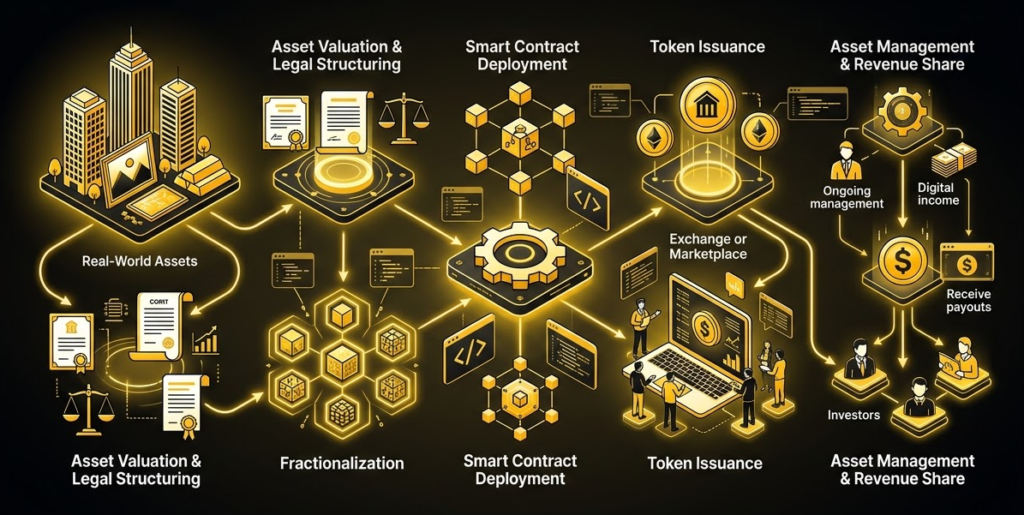
The easiest mistake to make with RWAs is imagining tokenization as a single technical transaction.
In reality, it is usually a chain of legal, financial, technical, and operational relationships.
Suppose a company wants to tokenize exposure to short-term U.S. government securities. The company cannot simply deploy an ERC-20 smart contract and declare that every token represents a Treasury bill.
Someone needs to own the underlying securities.
Someone needs to custody them.
Someone needs to maintain records.
Someone needs to define redemption rights.
And, depending on the jurisdiction and investor base, someone needs to deal with securities regulation, KYC/AML requirements, tax reporting, and restrictions on who can hold or transfer the instrument.
This is why RWA infrastructure often looks more like traditional finance wrapped in blockchain technology than like a completely new financial system.
Moving physical value on-chain
A typical tokenization structure can be thought of as several layers:
- Underlying asset: The Treasury, property, gold, loan, fund share, or other real-world asset.
- Custody: A regulated or trusted institution holds or administers the underlying asset.
- Legal structure: An entity or contractual framework defines the rights associated with ownership.
- Token contract: Blockchain-based tokens represent the defined economic or ownership claim.
- Compliance layer: Eligibility, transfer restrictions, identity checks, or other controls may govern who can interact with the token.
- Settlement layer: The blockchain provides the infrastructure for recording and transferring the token.
The technology can therefore make ownership and transfer more programmable, but it cannot eliminate the legal relationship underneath.
The SEC’s 2026 statement on tokenized securities describes two broad models: securities can be tokenized by or on behalf of their original issuers, or a third party can create a tokenized representation while holding securities issued by someone else. (Ủy ban Chứng khoán và Giao dịch Mỹ)
That distinction becomes extremely important when you start evaluating RWA projects.
Two tokens might both claim to represent “Treasuries,” but their legal rights, custody arrangements, redemption procedures, and investor eligibility could be completely different.
Why legal wrappers and SPVs matter
This is where the Special Purpose Vehicle, or SPV, enters the conversation.
An SPV is a separate legal entity created for a particular purpose. In an RWA structure, it can serve as the legal container connecting the blockchain representation with the underlying asset or cash flows.
Think about it this way: the blockchain knows that wallet 0xABC... owns 10,000 tokens. A court, however, does not automatically treat those tokens as ownership of a building, bond, or private loan simply because the smart contract says so.
There needs to be a legal bridge between the token and the asset.
That bridge might be a fund, trust, SPV, contractual claim, security entitlement, or another legally recognized structure.
This is one reason serious RWA analysis requires more than looking at the smart contract.
I would always want to know:
- Who legally owns the underlying asset?
- Who holds it in custody?
- What exactly does the token holder own?
- Can the token be redeemed?
- Who is allowed to redeem it?
- What happens if the issuer becomes insolvent?
- Which jurisdiction governs the arrangement?
- What happens if the blockchain stops operating?
- What happens if the token contract is exploited?
These questions aren’t glamorous, but they are where much of the real risk lives.
The Core Sectors Driving the RWA Boom
The RWA category is broad, but not every asset class is moving on-chain at the same speed.
There is a clear reason for that.
The best early candidates are assets that already have standardized ownership, predictable cash flows, strong institutional demand, and relatively straightforward valuation. Short-term government securities fit that profile almost perfectly.
Tokenized U.S. Treasuries and government debt
Tokenized U.S. Treasuries have become one of the most visible parts of the RWA market because they combine traditional financial credibility with the programmable features of blockchain infrastructure.
As of late September 2026, the RWA.xyz dashboard tracked approximately $14.96 billion in distributed value across tokenized U.S. Treasury funds, with 25 assets and more than 83,000 holders. (Rwa XYZ)
That figure moves constantly, and you should be careful about treating any single dashboard number as permanent. Different providers also use different definitions of “tokenized Treasury.”
Still, the direction is difficult to ignore.
Treasury products are attractive because they can potentially provide something crypto markets have historically struggled to offer natively: relatively conservative dollar-denominated yield without requiring every investor interaction to happen through the traditional brokerage stack.
The BIS has highlighted government securities as particularly important in tokenization because they already play major roles as savings instruments, collateral, and pricing references throughout financial markets. Its 2025 analysis also noted that tokenized government bond issuance was still early but had already reached billions of dollars in issuance. (Bank for International Settlements)
A tokenized Treasury product can therefore act as a kind of bridge asset.
You can imagine a fund that owns short-term government securities, issues blockchain-based representations of fund shares, and then allows eligible holders to transfer those representations through supported blockchain infrastructure.
That is very different from creating a synthetic token that merely tracks Treasury prices.
The underlying legal and financial claim matters.
Franklin Templeton and the BENJI model
One of the clearest examples comes from Franklin Templeton’s Franklin OnChain U.S. Government Money Fund, represented by the BENJI token.
Franklin Templeton describes BENJI as a blockchain-based representation of shares in its money-market fund, with the fund’s transfer agent maintaining the official record of share ownership. The platform also supports blockchain-based transaction activity and peer-to-peer transfers for eligible shareholders. (Franklin Templeton Digital Assets)
That is an important distinction.
The blockchain is not replacing the underlying fund.
It is becoming part of the fund’s operating infrastructure.
Franklin Templeton has continued expanding the model, and in 2026 it described BENJI as the first U.S.-registered money-market fund to use a public blockchain as its system of record, noting that the tokenized fund category has grown into a multi-billion-dollar market. (United States)
To me, this is one of the more interesting RWA developments because it demonstrates a realistic path toward institutional blockchain adoption.
Instead of asking Wall Street to abandon its existing financial structures overnight, tokenization lets institutions gradually move selected processes onto programmable rails.
Private credit and corporate debt
Government debt is only one side of the RWA story.
Private credit may ultimately prove even more interesting because blockchain-based infrastructure can potentially connect investors with lending markets that have historically been difficult to access.
Private credit involves loans made to businesses or other borrowers outside traditional public bond markets. Tokenization can represent claims on those loans, allowing certain investors to interact with them through digital platforms.
The economics are attractive for a simple reason: borrowers need capital, while investors are searching for yield.
But private credit introduces more complexity than Treasuries.
A Treasury is ultimately backed by a sovereign issuer. A private loan depends on a particular borrower.
That means RWA credit products require careful underwriting, servicing, legal enforcement, collateral management, and default procedures.
Blockchain can automate parts of the process, but it cannot make a weak borrower creditworthy.
This is an important theme throughout the entire RWA sector: tokenization can improve financial plumbing, but it cannot eliminate fundamental economic risk.
Tokenized commodities
Commodities are another natural candidate.
Gold is particularly intuitive because tokenized gold products can connect blockchain liquidity with physical bullion held by custodians.
The token becomes a digital representation of a claim associated with physical metal rather than requiring every holder to personally store bars.
The interesting part is not simply that gold becomes transferable through blockchain. Gold was already transferable through established financial systems.
The potential advantage is that a tokenized commodity can become programmable.
It can potentially move through smart contracts, interact with collateral systems, or become part of a larger digital financial application.
But again, you have to look through the token.
If the issuer claims that each token is backed by physical gold, your real questions become: Who owns the gold? Where is it stored? Is it audited? What happens during insolvency? Can holders redeem it?
The blockchain does not answer those questions automatically.
Tokenized real estate
Real estate presents an even more interesting use case because property ownership is historically fragmented, paperwork-heavy, and relatively illiquid.
Tokenization can potentially divide economic exposure to a property into smaller digital units and make certain ownership or cash-flow claims easier to transfer.
The BIS has examined this area directly. Its 2025–2026 working paper on tokenized real estate found evidence that tokenization may help address liquidity gaps in some property markets, while also emphasizing that outcomes depend on institutional features such as buyback mechanisms and the solvency of the platforms involved. (Bank for International Settlements)
That last part matters.
Fractionalization sounds fantastic until you ask who provides liquidity when everyone wants to sell at the same time.
A token can trade 24/7.
The building cannot.
The distinction between blockchain liquidity and underlying-asset liquidity is one of the most important concepts to understand before getting excited about tokenized real estate.
Unleashing Utility: Bringing RWAs into DeFi Composability

Tokenization becomes much more interesting when an asset stops being a static representation and starts becoming usable inside other financial systems.
Imagine holding a tokenized Treasury fund.
In traditional finance, you might simply hold the fund and receive its economic return.
On-chain, the same asset could potentially become collateral.
That changes the design space.
From static storage to dynamic collateral
Suppose you hold $100,000 worth of an eligible tokenized Treasury product.
Instead of selling it, a DeFi protocol could potentially recognize that token as collateral and let you borrow stablecoins against it.
You now have several financial actions happening in the same digital environment:
Treasury exposure → tokenized representation → collateral → stablecoin borrowing → additional financial activity.
This is where the idea of DeFi composability becomes relevant.
The RWA doesn’t have to remain isolated.
It can become another building block in the broader on-chain economy.
Aave is already developing infrastructure specifically for this intersection. Its Aave Horizon initiative is designed to allow qualified participants to supply permissioned tokenized RWAs as collateral while accessing permissionless stablecoin liquidity, creating a bridge between regulated assets and decentralized liquidity. (aave.com)
Aave’s documentation also shows why this area is different from ordinary DeFi. Its RWA-specific token infrastructure can impose restrictions such as non-transferability for certain end users, while authorized administrators may retain controlled transfer or recovery capabilities. (aave.com)
That tells you something important about the future of RWA DeFi.
Institutional adoption probably will not look exactly like today’s permissionless crypto protocols.
Instead, we are likely to see hybrid architectures where:
- the collateral is permissioned,
- the stablecoin liquidity can remain permissionless,
- compliance happens at the asset layer,
- smart contracts handle collateral mechanics,
- and institutions retain legally necessary administrative controls.
It is less philosophically pure than “everything is permissionless.”
But it may be much more practical.
Yield layering and programmable finance
Once tokenized assets can interact with DeFi protocols, entirely new strategies become possible.
A tokenized Treasury can potentially produce underlying yield while also functioning as collateral. A credit token might generate loan interest while being used in another financial structure. A tokenized fund could potentially become part of a liquidity pool or automated strategy, depending on its transfer restrictions.
This is where people often start throwing around phrases like “yield stacking.”
You should be careful with that language.
Every additional layer introduces another dependency.
If you have:
Underlying Treasury → Token issuer → DeFi wrapper → Lending protocol → Stablecoin strategy
you have not created free money.
You have created a chain of contracts and counterparties.
Each layer can introduce smart-contract risk, liquidity risk, operational risk, or legal risk.
The yield may increase because the structure takes on additional risk. That is not necessarily bad, but it should always be visible.
Institutional Adoption and the Changing Market Rails
The RWA story becomes considerably more credible when you stop looking only at crypto-native startups.
Traditional financial institutions are increasingly experimenting with tokenized funds, securities, deposits, collateral, and settlement infrastructure.
Franklin Templeton’s BENJI is one example. BlackRock’s BUIDL fund, issued through Securitize, is another widely watched example of institutional tokenization.
The significance is not merely that large financial firms are “entering crypto.”
It is that they are experimenting with blockchain as financial market infrastructure.
That distinction is subtle but important.
A bank does not necessarily need to become a DeFi protocol.
An asset manager does not necessarily need to issue a speculative token.
Instead, institutions can use blockchain to experiment with:
- digital issuance,
- automated settlement,
- transfer records,
- collateral mobility,
- programmable compliance,
- fund administration,
- and 24/7 transaction infrastructure.
The BIS has made a similar argument, describing tokenization as a potential way to integrate messaging, reconciliation, and asset transfer into more unified programmable infrastructure. (Bank for International Settlements)
There are already examples of institutions testing this direction beyond simple token issuance. In 2026, Ondo announced a cross-border, cross-bank redemption pilot involving Kinexys by J.P. Morgan, Mastercard, and Ripple, describing a framework for near-real-time settlement involving tokenized U.S. Treasury exposure. (Ondo Finance)
This is the kind of development I find more meaningful than another token launch.
Why?
Because it demonstrates the potential for tokenization to address an actual financial workflow.
The long-term question is not whether a Treasury bill can have a blockchain token.
Of course it can.
The bigger question is whether blockchain-based representations can make issuance, collateral movement, settlement, and redemption materially better.
That is where the economic case for RWAs will ultimately be decided.
Managing Risks: Off-Chain Counterparties and Legal Complexities
The phrase “real-world assets” sounds reassuring because it implies something tangible.
But tangibility can actually introduce another category of risk.
Native crypto assets live entirely inside blockchain infrastructure. If you own a native token, the blockchain itself is the primary system that determines ownership.
An RWA is different.
The token may live on-chain, while the thing it represents lives somewhere else.
That creates a bridge.
And bridges create failure points.
The illusion of pure trustlessness
Suppose you hold a token representing a share of a fund.
The blockchain may guarantee that you control the private key associated with the token.
But who guarantees that the fund still holds the underlying assets?
That is a different question.
You may need to trust:
- the fund manager,
- the custodian,
- the administrator,
- the legal entity,
- auditors,
- the token issuer,
- oracle providers,
- and the jurisdiction in which the structure operates.
The SEC has been particularly clear that tokenization does not erase the legal character of an underlying security. Its 2025 statement on tokenized securities stressed that blockchain technology can change how securities are distributed and traded, but tokenized securities remain subject to applicable securities laws. (Ủy ban Chứng khoán và Giao dịch Mỹ)
That means the RWA investor’s risk model should be broader than the typical crypto checklist.
You cannot stop at:
“Has the smart contract been audited?”
You also need:
“What happens if the issuer fails?”
Redemption is the reality check
One of the biggest misconceptions around RWA markets is that blockchain transferability automatically equals instant liquidity.
It doesn’t.
A token might move between wallets in seconds, but redeeming that token for the underlying asset could require:
- identity verification,
- investor eligibility checks,
- business-day processing,
- banking rails,
- fund administrator approval,
- redemption windows,
- minimum redemption amounts,
- or other contractual procedures.
Franklin Templeton’s own materials, for example, explain that BENJI represents shares in the underlying fund and that eligibility varies by jurisdiction and blockchain network. Its prospectus also specifies different minimum investments across supported networks, demonstrating that blockchain availability does not mean identical access conditions everywhere. (United States)
This distinction becomes particularly important during market stress.
Imagine a tokenized Treasury product trading on-chain while its redemption mechanism operates through traditional financial infrastructure.
If demand to exit suddenly overwhelms available liquidity, the token can experience market-price pressure even though the underlying assets remain relatively stable.
That is not necessarily a contradiction.
It is a liquidity mismatch.
Smart-contract and operational risk
Then there is the blockchain itself.
A tokenized asset may depend on a smart contract. If that contract contains a vulnerability, the representation can potentially be compromised even when the underlying asset is perfectly safe.
This creates two separate questions:
Is the underlying asset safe?
and
Is the digital representation safe?
You need both answers.
The institutional RWA sector is increasingly addressing this through audited contracts, permissioned transfer systems, controlled minting and redemption processes, and specialized infrastructure. Franklin Templeton, for instance, states that its BENJI platform uses third-party audited smart-contract security practices while also warning investors about blockchain, regulatory, custody, issuance, redemption, and record-keeping risks. (Franklin Templeton Digital Assets)
The lesson is straightforward: tokenization reduces some forms of friction, but it does not eliminate the need for risk management.
What Makes an RWA Project Worth Paying Attention To?

If you are evaluating an RWA project rather than simply learning the concept, I would start with the boring questions.
They are usually the most useful ones.
Look through the token
Never stop at the token contract.
Find the legal documents and identify what the token actually represents.
Does it represent:
- direct ownership?
- a fund share?
- a debt claim?
- a beneficial interest?
- a contractual redemption right?
- exposure to an SPV?
Those are very different things.
Examine the custody structure
Ask who actually holds the underlying asset.
For Treasuries, that might mean determining which custodian or fund structure holds the securities. For gold, it could mean identifying the vault and audit arrangements. For private credit, you need to understand who originates, services, and enforces the loans.
Check the redemption mechanism
A token is only as useful as your ability to realize its economic value.
You should know:
- who can redeem,
- what can be redeemed,
- minimum redemption size,
- redemption timing,
- fees,
- KYC requirements,
- supported jurisdictions,
- and what happens during exceptional market conditions.
Understand transfer restrictions
Many RWA products are not freely transferable to every wallet.
That may be intentional.
Regulated securities frequently require eligibility controls, and RWA platforms can implement those restrictions directly in smart contracts.
Aave’s RWA documentation provides a good example of this design philosophy, with specialized RWA tokens incorporating restrictions and administrative controls to meet compliance requirements. (aave.com)
So if you see the phrase “on-chain,” don’t automatically interpret it as “permissionless.”
Those are different concepts.
Separate yield from risk
A token offering a 10% yield is not automatically better than one offering 4%.
Ask where the yield comes from.
Is it:
- government bond income?
- corporate lending?
- protocol incentives?
- token emissions?
- leverage?
- trading fees?
- a combination of several mechanisms?
The source of yield matters more than the headline percentage.
Why RWAs Could Become a Major Part of Crypto
There is a bigger philosophical shift happening underneath all of this.
For years, the dominant crypto narrative was about creating a completely parallel financial system.
RWAs suggest another possibility: blockchain becomes the settlement and coordination layer for parts of the existing financial system.
Those two ideas are not mutually exclusive.
You can have Bitcoin, stablecoins, DeFi-native assets, NFTs, and permissionless protocols operating alongside tokenized Treasury funds, regulated securities, private credit, and institutional collateral.
In fact, the most powerful future may come from the interaction between them.
Imagine a world where a tokenized Treasury fund can serve as collateral in a lending protocol, where a regulated stablecoin can settle against it, where an institutional wallet can interact with the same infrastructure as a DeFi application, and where the entire transaction history is represented on programmable rails.
That sounds ambitious, but the building blocks are already appearing.
The BIS has argued that tokenization could reshape financial-market infrastructure by allowing assets and money to operate on programmable platforms, while also emphasizing that governance and risk management remain essential. (Bank for International Settlements)
This is why I think it is a mistake to judge RWAs only by today’s token counts.
The bigger opportunity is infrastructure.
Tokenization can potentially make financial assets:
- more programmable,
- easier to integrate with software,
- easier to use as collateral,
- more interoperable across digital systems,
- and potentially faster to settle.
But none of these benefits are guaranteed.
The economics have to work.
The legal structure has to work.
And, perhaps most importantly, institutions need a reason to change the systems they already use.
The RWA Stack: A Simple Mental Model
If you want one framework to remember, think of the RWA ecosystem as a stack rather than a single technology.
| Layer | Main function |
|---|---|
| Physical / financial asset | Treasury, fund, loan, property, commodity, security |
| Custody | Holds or administers the underlying asset |
| Legal structure | Defines ownership and investor rights |
| Tokenization platform | Converts the economic claim into blockchain-based representation |
| Smart contract | Controls issuance, transfer, redemption, or other programmable functions |
| Blockchain | Records and settles token transactions |
| Oracle / data layer | Connects external information to on-chain applications |
| DeFi applications | Uses tokenized assets for lending, collateral, liquidity, or other strategies |
| Investor / user interface | Provides access through wallets, apps, exchanges, or institutional systems |
This model also makes it easier to identify risk.
A failure at the custody layer is different from a smart-contract exploit.
A legal dispute is different from a blockchain outage.
A liquidity problem is different from an oracle failure.
And an investor can be exposed to several of these risks simultaneously.
FAQ
What are Real-World Assets (RWAs) in crypto?
Real-World Assets are traditional financial or physical assets represented through blockchain-based tokens. Examples include U.S. Treasury securities, money-market funds, private credit, commodities, and real estate.
The important point is that tokenization represents an economic or legal claim connected to the underlying asset. It does not necessarily mean the physical asset itself has somehow become decentralized.
How do tokenized U.S. Treasuries work?
A tokenized Treasury product generally combines traditional financial infrastructure with blockchain-based representation. The underlying government securities may be held by a fund or custodian, while blockchain tokens represent shares or defined economic claims associated with that structure.
For example, Franklin Templeton’s BENJI token represents shares in the Franklin OnChain U.S. Government Money Fund, while the fund’s transfer agent maintains the official ownership record. (Franklin Templeton Digital Assets)
The exact rights, eligibility requirements, redemption process, and transfer restrictions depend on the product.
Are RWA tokens completely decentralized and trustless?
No.
This is probably the single most important misconception to avoid.
A blockchain can make the token transfer transparent and programmable, but the underlying asset may still depend on centralized custodians, legal entities, administrators, issuers, courts, and regulators.
That is particularly important for securities, where the legal rights attached to the token determine what investors actually own. The SEC has specifically emphasized that tokenization does not remove the underlying security from securities-law treatment. (Ủy ban Chứng khoán và Giao dịch Mỹ)
How are RWA tokens used in DeFi?
Depending on the product and its transfer restrictions, RWA tokens can potentially be used as collateral, deposited into lending markets, traded through digital venues, or incorporated into other financial applications.
Aave Horizon, for example, is designed to allow qualified participants to supply permissioned tokenized RWAs as collateral while accessing permissionless stablecoin liquidity. (aave.com)
This creates an interesting hybrid model in which the asset itself can remain compliant while the surrounding financial liquidity becomes more programmable.
Are tokenized Treasuries safer than ordinary crypto assets?
Not automatically.
They may have fundamentally different risk characteristics because their underlying assets can include government securities or regulated funds, but you still need to consider issuer risk, custody, legal structure, redemption mechanics, smart-contract risk, and market liquidity.
In other words, the Treasury may be conservative while the tokenization wrapper is not.
Can RWAs be used as collateral?
Yes, although eligibility depends heavily on the specific asset and protocol.
Some RWA systems are explicitly designed around collateralization. Aave’s Horizon market, for instance, supports permissioned tokenized RWAs as collateral for borrowing from stablecoin liquidity pools. (aave.com)
This is one of the most important reasons tokenization matters for DeFi: an asset that previously sat inside a traditional financial system can potentially become a programmable component of a broader digital economy.
What is an SPV in RWA tokenization?
A Special Purpose Vehicle is a separate legal entity established for a defined purpose. In RWA structures, an SPV can help hold assets or rights and create a legal connection between those assets and investors.
The blockchain token alone cannot determine how a court treats an underlying property, loan, or security. The SPV and associated legal documents help establish that relationship.
Why are tokenized Treasuries growing so quickly?
Treasuries combine several characteristics that make them attractive candidates for tokenization: standardized instruments, predictable cash flows, strong institutional demand, and an established role as collateral and liquidity assets.
RWA.xyz’s Treasury dashboard recently showed approximately $14.96 billion in distributed value across tokenized U.S. Treasury funds, illustrating how far the category has moved beyond the experimental stage. (Rwa XYZ)
The more interesting question now is whether those tokens become deeply integrated into lending, collateral, payments, and institutional settlement.
Final Thoughts: RWAs Are Less About Tokens Than Financial Infrastructure
If you strip away the crypto terminology, the RWA thesis is surprisingly simple.
Traditional financial assets already have enormous economic value. Blockchain developers are trying to make some of that value programmable.
The token is only the visible part.
Behind it sits a much larger machine involving custody, law, compliance, asset management, smart contracts, settlement infrastructure, and eventually DeFi applications.
That is why I would not evaluate an RWA project by asking only, “What blockchain is this on?”
A better set of questions is:
What do I actually own? Who holds the underlying asset? What legal rights do I have? How can I redeem? Who controls the infrastructure? And what happens if something goes wrong?
Once you start asking those questions, the RWA sector becomes much easier to understand.
You also begin to see why tokenized Treasuries have become such an important starting point. They offer a relatively straightforward bridge between conventional finance and blockchain infrastructure, and current market data already shows billions of dollars of tokenized government-debt exposure circulating on-chain. (Rwa XYZ)
But Treasuries are only the beginning.
Private credit could bring lending markets on-chain. Tokenized commodities could make physical assets more programmable. Real estate could gain new forms of fractional ownership and liquidity. Institutional collateral could move across digital rails rather than through disconnected legacy systems.
The biggest opportunity is therefore not simply “putting Wall Street on Ethereum.”
It is creating financial infrastructure where traditional assets, blockchain networks, smart contracts, and digital liquidity can finally interact in the same programmable environment.
That is the real promise of Real-World Assets.
And if the infrastructure matures, you may eventually stop thinking of RWAs as a special category at all. They could simply become one of the normal ways financial assets are issued, owned, transferred, and used in a digitally native economy.
Tôi đã ưu tiên nguồn chính thống/primary sources cho các claim quan trọng: BIS cho khái niệm tokenization và tác động hạ tầng, SEC cho khung pháp lý tokenized securities, Franklin Templeton cho BENJI, Aave cho RWA collateral, và RWA.xyz cho số liệu thị trường. Các link đều được đặt ngay trong câu có claim, không tạo thành một dòng “Source” đứng riêng.