

Bybit vs Kraken feature comparison
If you are deciding between Bybit and Kraken, start with the features you will use regularly rather than the biggest number in either platform’s marketing.
| Feature | Bybit | Kraken |
|---|---|---|
| Main focus | Crypto trading, derivatives, copy trading | Crypto trading, professional order books, and eligible regional financial services |
| Spot trading | Available, with fees based on account tier and market | Available through Kraken Pro and other interfaces |
| Derivatives | Perpetual contracts, futures, and options in eligible regions | Futures and other derivatives where permitted |
| Account architecture | Unified Trading Account (UTA) | Product-specific trading and funding arrangements |
| Copy trading | Available for eligible products and regions | Product availability varies |
| Fee model | Maker/taker rates, VIP tiers, and applicable discounts | Maker/taker rates with volume-based tiers |
| Security controls | 2FA, withdrawal controls, proof-of-reserves information | 2FA, Global Settings Lock, Master Key, and other controls |
| Fiat access | Varies by country and payment method | Varies by country and payment method |
| Traditional financial products | Not universally available | Some products available through regulated subsidiaries in eligible regions |
| Regional access | Restricted in certain jurisdictions | Also subject to regional restrictions |
The important detail is that a platform’s global feature list is not the same as the products available to your account. Your country, verification status, account type, and local regulations can change the comparison significantly.
Bybit vs Kraken fees in 2026
Trading fees are easy to compare badly.
You might see one exchange advertise a flat rate and another show a tiered schedule, then conclude the first is cheaper. But the fee you actually pay depends on the order type, the trading pair, whether you add or remove liquidity, your account tier, and any discount that applies.
I recommend checking the current fee page for both exchanges immediately before you trade. A fee table from a previous year may no longer match the rate in your account.
Spot trading: Bybit’s baseline vs Kraken Pro tiers
Bybit publishes a fee schedule with regular-user rates and lower rates for qualifying VIP accounts. Kraken Pro also uses maker/taker pricing, with rates that can decrease as your qualifying trading volume or assets on platform increase.
The Bybit fee schedule shows the exchange’s current spot and other product fee categories. Kraken’s official fee schedule explains how its cross-platform fee tiers are determined, including the role of trading volume and assets on platform.
Here is a simple example to make the difference easier to understand.
Suppose you buy $2,000 worth of Bitcoin using a market order. If your applicable taker fee is 0.10%, the trading fee would be:
$2,000 × 0.10% = $2
That is the fee for one executed trade. If you later sell the same amount, you may pay another trading fee. Your total cost is not necessarily $2 for the whole round trip.
Now compare that with Kraken Pro. The fee depends on your applicable tier and the pair you are trading. Kraken’s fee schedule can start at a higher entry-level taker rate than Bybit’s regular spot rate, but users who qualify for lower tiers may pay less.
The practical question is not simply “Which exchange has the lowest advertised fee?” It is:
- What maker/taker rate applies to my account?
- Am I using a market order or a limit order that adds liquidity?
- Does my trading volume qualify for a lower tier?
- Does the trading pair have a different rate?
- Am I using Kraken Pro or a convenience-buy interface?
Kraken Pro vs the standard Kraken app
This distinction matters.
Kraken’s standard app and instant-buy experiences are designed to make buying and selling accessible. Kraken Pro is built around an order book, where you can place limit orders and view maker/taker fees.
If you are making frequent trades, you should compare the final execution cost in Kraken Pro with the price and fees presented by the standard interface.
A market order is not automatically the best choice just because it is easy. A limit order may help you control the execution price, although it may not fill. And if a limit order executes immediately, it can still be treated as a taker order.
Perpetual futures pricing: similar rates, different products
Bybit and Kraken both use maker/taker pricing for derivatives, but their products and eligibility rules differ.
Kraken’s derivatives fee schedule lists a standard starting rate of 0.0200% maker and 0.0500% taker for Kraken Derivatives, with lower rates at qualifying volume levels. The schedule was updated on October 8, 2026.
Bybit’s applicable rate depends on the product, account tier, and market. Its official fee schedule should be used to confirm the current rate before placing an order.
For example, if your taker fee were 0.055%, a $10,000 notional trade would produce a fee of:
$10,000 × 0.055% = $5.50
At a 0.050% rate, the same notional trade would cost $5.00.
That $0.50 difference may not look significant on a single trade. But if you trade frequently, use larger notional values, or open and close positions repeatedly, costs add up.
And trading fees are only part of the picture. Perpetual contracts can also involve funding payments, liquidation fees, slippage, and other costs. A low taker fee does not make a leveraged position inexpensive or safe.
Does Bybit’s MNT discount make it cheaper?
Bybit offers MNT-based trading fee discounts for eligible products and accounts. The official MNT fee-discount guide describes a 25% discount on eligible spot fees and a 10% discount on eligible futures fees.
However, the discount is not universal. It does not apply to every product or account type, and some orders, including copy-trading follower orders, are excluded. The option must also be enabled for the relevant product.
If you are comparing fees, check whether the rate you are looking at already includes the MNT discount. Do not apply the discount twice in your calculations.
Account infrastructure and trading tools

Bybit Unified Trading Account (UTA)
Bybit’s Unified Trading Account brings supported assets and trading products into a more integrated account structure.
For traders who use multiple crypto products, UTA can make account management and margin handling more convenient. Supported assets can be used within the account’s margin framework, subject to the platform’s collateral rules and risk settings.
That convenience comes with an important trade-off: cross-margin trading can expose more of your eligible account balance to the risk of a position.
If a position moves against you, the platform’s margin and liquidation rules determine what happens. You should understand the difference between isolated and cross margin, collateral haircuts, and the account’s risk parameters before relying on a shared balance.
Bybit also offers copy trading for eligible products. Copy trading can save time for people who do not want to manage every trade manually, but it does not remove the risk of losses. A master trader’s historical performance is not a guarantee of future results, and followers may experience different execution prices or outcomes.
Kraken Pro architecture
Kraken Pro offers a professional trading interface with order-book trading, charting, and maker/taker fees. For traders who mainly buy and sell spot crypto, it can provide the controls they need without requiring them to use derivatives.
Kraken also offers other financial services in eligible regions. Product access can differ by country, account type, and regulatory status, so it is better to check the specific product page than assume every Kraken user can access every service.
The broader point is that Kraken’s platform is not solely a crypto derivatives venue. Depending on your location, it may provide a path to additional financial products through separate regulated entities.
Security track record, solvency, and regulatory status
Security is one of the most important parts of an exchange comparison, but it is also where marketing language can become misleading.
An exchange may publish proof-of-reserves information, use cold storage, or offer advanced account controls. Those are useful signals. They do not mean that every possible operational, custody, regulatory, or market risk has disappeared.
Kraken’s security controls
Kraken has operated since 2011 and provides a range of security controls, including two-factor authentication, withdrawal protections, and Global Settings Lock (GSL).
GSL is designed to make unauthorized changes to sensitive account settings more difficult. Kraken also offers a Master Key as part of its account-security framework.
These features are worth enabling, especially if you keep funds on an exchange. But security controls protect against specific risks; they do not guarantee that an account can never be compromised.
Kraken’s history and controls may make it attractive to users who prioritize account security and a more established operating record. Still, you should not interpret “safer” as “risk-free.”
Bybit’s 2025 security incident
On February 21, 2025, Bybit experienced a major security incident involving an Ethereum cold wallet. Bybit reported losses of approximately $1.46 billion.
The incident was widely reported, including by the Associated Press. Bybit’s own incident timeline and FAQ describes the event and the company’s response.
Bybit stated that it remained solvent and that customer assets were backed 1:1. That statement is relevant to understanding how the exchange responded, but it should not be treated as proof that a similar event could never happen again.
The right lesson is not that Bybit is automatically unsafe or that its incident no longer matters. It is that users should evaluate both the incident and the platform’s subsequent controls, reserve information, operational practices, and transparency.
Proof of reserves: useful, but not a complete audit
Both exchanges have published reserve-related information. Proof of reserves can help users understand whether an exchange reports holding assets corresponding to certain customer liabilities.
But proof of reserves is not a universal guarantee of solvency. It may not reveal every liability, off-platform obligation, operational weakness, or legal risk. The methodology, snapshot date, assets covered, and verification process matter.
If you use either platform, review the current reserve information and its scope rather than relying on a headline percentage.
US and UK access: do not assume the same products are available
The outline’s claim that Kraken is “fully legal” for all US and UK users and products is too broad.
Kraken’s services vary by jurisdiction and product. Some services are provided through separate entities with their own regulatory permissions. For example, US futures access is subject to specific eligibility and regulatory requirements.
Bybit also restricts access in certain jurisdictions. Its official restricted-jurisdiction disclaimer should be checked before creating an account or attempting to use a service.
Do not use a VPN to bypass an exchange’s geographic restrictions. A VPN does not change your legal eligibility. It can also create account-verification and withdrawal problems if your actual residence or identity conflicts with the platform’s requirements.
Common pitfalls that can lead to account restrictions

Trying to access Bybit from a restricted region
If Bybit does not support your jurisdiction, do not try to get around the restriction by using a VPN or false identity information.
Exchanges may request identity verification, review account activity, or restrict services when eligibility cannot be established. Even if a website loads, that does not mean you are permitted to use its products.
Check the current restricted-region list and local rules first.
Confusing Kraken’s standard app with Kraken Pro
If you are comparing trading fees, make sure you are comparing equivalent services.
Kraken Pro uses professional order-book trading and a maker/taker fee schedule. A standard app purchase may include a different price structure, convenience fees, or spread-related costs.
For frequent trading, check the order-book interface and fee schedule before placing an order.
Assuming Kraken Futures are available to every US user
Kraken’s crypto spot services and its futures services do not have identical availability.
US clients may have access to certain regulated futures products through eligible services, but that does not mean every perpetual contract or international derivatives product is available. Product-specific restrictions apply.
Before depositing money for a particular strategy, verify that the exact contract is available to your account.
Which platform should you choose?
Use your actual trading needs as the deciding factor.
| Your priority | Platform to consider | Why |
|---|---|---|
| Crypto derivatives and copy trading | Bybit, if eligible in your region | Derivatives-focused tools and integrated copy trading |
| Professional spot trading | Kraken Pro or Bybit | Compare your actual maker/taker fee and order-book conditions |
| Security controls and established exchange history | Kraken | Long operating history and account-security features |
| US access to eligible financial products | Kraken, depending on product and state | Services are offered through eligible regulated entities |
| A unified crypto account structure | Bybit | UTA integrates supported trading assets and products |
| Simple, occasional crypto purchases | Compare both | Convenience, spread, payment method, and total cost matter |
Neither exchange is the right choice for everyone. If you only buy crypto occasionally, the difference between a few basis points may matter less than the deposit method, withdrawal costs, available trading pairs, and whether the service is supported where you live.
If you actively trade derivatives, the comparison becomes more technical. You should look at fees, liquidity for your specific contract, funding rates, margin rules, leverage limits, and liquidation mechanics.
How to transfer crypto from Kraken to Bybit
Only do this if both platforms support your account and the transfer is permitted in your region. Before transferring, confirm that the asset and network are supported on both sides.
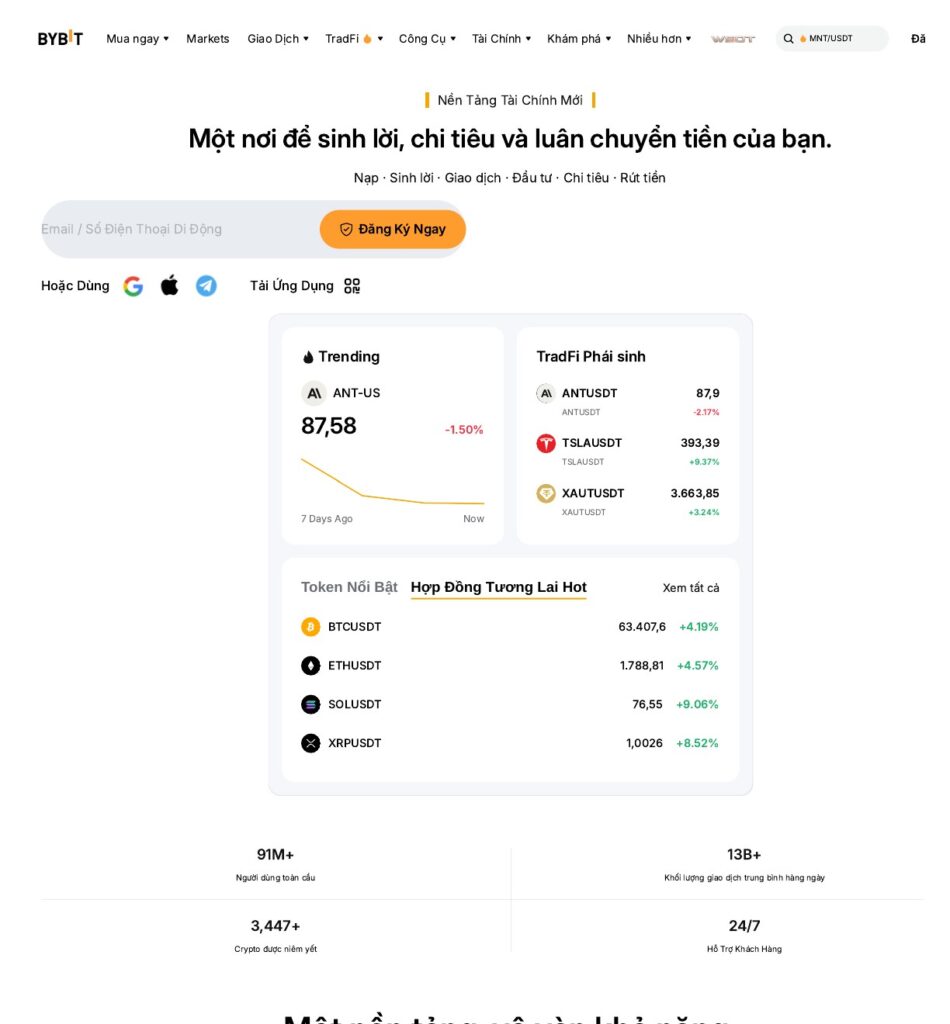
Phase 1: Generate a deposit address on Bybit
- Sign in to your eligible Bybit account.
- Open Assets and select Deposit.
- Choose the asset you want to receive, such as USDT, BTC, or ETH.
- Select a network supported by both Bybit and the sending platform.
- Copy the deposit address.
- Check whether the deposit requires a memo or tag. Some assets, including XRP, may require one.
Do not select a network based only on its name or fee. The network selected on the sending platform must match the network selected for the deposit.
Phase 2: Withdraw from Kraken
- Sign in to Kraken.
- Open Funding and choose Withdraw.
- Select the asset you are sending.
- Add the Bybit deposit address if it is not already saved.
- Carefully compare the address, network, and any required memo/tag.
- Confirm the withdrawal using the authentication method requested by Kraken.
For a new address, Kraken may require additional confirmation steps, such as email approval.
Phase 3: Confirm the transfer
After submitting the withdrawal:
- Check the transaction status in Kraken.
- If available, open the transaction ID in the relevant blockchain explorer.
- Wait for the required network confirmations.
- Confirm that the deposit appears in the correct Bybit account.
If the deposit does not arrive, do not immediately send another transfer. Check the transaction status, the network, the address, the memo/tag, and the exchange’s deposit confirmation requirements.
Start with a small test transfer when the amount is significant. It costs extra in network fees, but it can help you confirm that the address and network are correct before moving the rest.
Frequently asked questions
Which platform has lower trading fees: Bybit or Kraken?
It depends on your account tier, product, trading pair, and order type. Bybit’s regular spot rates can be competitive, while Kraken Pro’s rates decrease through qualifying tiers. For derivatives, compare the current product-specific schedule in your account.
Can US residents use Bybit or Kraken?
Bybit restricts access in certain jurisdictions, including the United States. Kraken offers services to US customers where eligible, but not every product is available to every user. Check the current eligibility requirements for the exact service you want to use.
Is Kraken safer than Bybit?
Kraken has a long operating history and a range of security controls. Bybit experienced a major security incident in 2025 and stated that it covered the loss while maintaining customer asset backing. These facts are relevant, but they do not provide a guarantee of future safety for either platform.
Does Bybit offer better derivatives and copy trading?
Bybit is strongly oriented toward crypto derivatives and offers copy trading for eligible products. Kraken also offers derivatives where permitted, but the product lineup and geographic access differ. Check contract availability and account eligibility before deciding.
Which exchange has more supported assets?
Asset counts change frequently and may include different categories, such as spot coins, derivatives contracts, tokenized products, or region-specific listings. Compare the specific assets and markets you plan to trade rather than relying only on a headline count.
Should I use Kraken Pro instead of the standard Kraken app?
If you trade frequently and want order-book execution, maker/taker pricing, and more order controls, Kraken Pro is worth considering. If you only make occasional purchases, compare the total cost and convenience of the standard app with the Pro interface.
Can I transfer crypto from Kraken to Bybit?
Yes, if both platforms support the asset and network for your account and the transfer is permitted in your jurisdiction. Verify the deposit address, network, and memo/tag before submitting the withdrawal.
Does a low trading fee mean an exchange is cheaper overall?
Not necessarily. Deposit and withdrawal fees, spreads, slippage, funding payments, liquidation costs, and the product you use can all affect the total cost.
Should I keep all my crypto on an exchange?
That depends on your trading needs and risk tolerance. Exchange accounts provide convenient access to trading, but they also introduce custody and platform risk. Consider your own security practices and whether you need to keep the assets on an exchange at all.
What should I check before opening an account?
Confirm that the exchange supports your country and the product you want to use. Review identity-verification requirements, current fees, deposit and withdrawal methods, security controls, and the platform’s terms before funding the account.
Final verdict
Bybit and Kraken serve overlapping but different needs.
Bybit is worth considering if you want a crypto-focused trading environment with derivatives, copy trading, and a unified account structure, and if its services are available to you. Kraken is worth considering if you prioritize professional spot trading, security controls, and eligible regional access to additional financial products.
My recommendation is simple: choose based on the products you can legally access and the costs you will actually pay—not on the largest asset count, the highest leverage, or a headline security claim.
Before you deposit, check the current fee schedule, the availability of your preferred market, the exchange’s geographic restrictions, and the withdrawal network. Those practical details are more useful than a generic “best exchange” ranking.



