

If you have ever wondered why XRP keeps showing up whenever people talk about cross-border payments, banks, and institutional crypto adoption, the short answer is surprisingly simple: XRP is the native digital asset of the XRP Ledger (XRPL), a public blockchain designed to move value quickly and cheaply, particularly across currencies and borders. The XRP Ledger reaches agreement on transactions every few seconds, while its standard transaction cost is currently just 10 drops, or 0.00001 XRP. You can verify those details directly in the XRPL’s official documentation on XRP and the ledger and its current transaction-cost documentation.
But if you are new to crypto, that definition probably raises more questions than it answers.
What exactly does “digital settlement asset” mean? Why would anyone need XRP if banks already have systems for moving money? Is XRP the same thing as Ripple? Can you mine XRP like Bitcoin? And if Ripple owns a large amount of XRP, how decentralized is the network really?
I think the easiest way to understand XRP is to forget the price chart for a moment.
Start with the problem.
Imagine you are sending money from the United States to Mexico. The person on the other side does not want your dollars sitting in some abstract digital account. They want pesos in a Mexican bank account. Somewhere between those two points, somebody has to handle currency conversion, liquidity, settlement, compliance and the actual delivery of funds.
That is where XRP becomes interesting.
Instead of requiring money to sit in advance in every destination market, XRP can potentially act as a temporary bridge:
USD → XRP → MXN
The XRP is the bridge in the middle. It can be acquired, transferred and converted into the destination currency without necessarily being held as a long-term investment by the recipient.
That basic idea explains much of the technology and much of Ripple’s interest in XRP.
It also explains why XRP is worth studying as infrastructure rather than simply as another cryptocurrency.
What is XRP?
A Simple Definition for Beginners
At its simplest, XRP is a digital asset native to the XRP Ledger.
The XRP Ledger, or XRPL, is a public blockchain. Anyone can inspect its ledger data, build software around it, operate a server, and participate in the ecosystem according to the network’s rules.
XRP is built directly into that system.
That is different from a token created on top of another blockchain.
For example, if someone creates a token on Ethereum, Ethereum provides the underlying network and the token exists as an application-level asset. XRP does not work that way. XRP is one of the fundamental assets of the XRP Ledger itself.
The XRPL’s documentation describes XRP as the cryptocurrency supported by the ledger and explains how the public ledger records transactions between accounts. You can see the technical explanation in the official XRPL introduction.
If you are just starting out, there are three terms I would keep in your head:
- XRP – the digital asset.
- XRPL – the public blockchain or ledger where XRP and other assets can move.
- Drop – the smallest unit of XRP. One XRP equals 1,000,000 drops.
The last one sounds more complicated than it really is. Think of dollars and cents. A drop is simply a much smaller unit of XRP.
You will also hear XRP described as a bridge currency or bridge asset.
That sounds like financial jargon, but the basic idea is pretty intuitive.
Think about two people who speak completely different languages. You could teach both people a third language and use it as the middle ground.
A bridge asset works in a similar way.
Suppose a financial institution has dollars on one side and needs pesos on the other. XRP can potentially sit between those two currencies. The institution does not necessarily need to think of XRP as its final destination. XRP can simply be the thing that helps connect the two markets.
That is a very different proposition from saying, “Everyone should use XRP instead of dollars.”
You do not need to believe that the world will abandon national currencies to understand the bridge-asset concept.
In fact, the bridge-asset model assumes the opposite: the world will continue to have lots of currencies, and those currencies need better ways to interact.
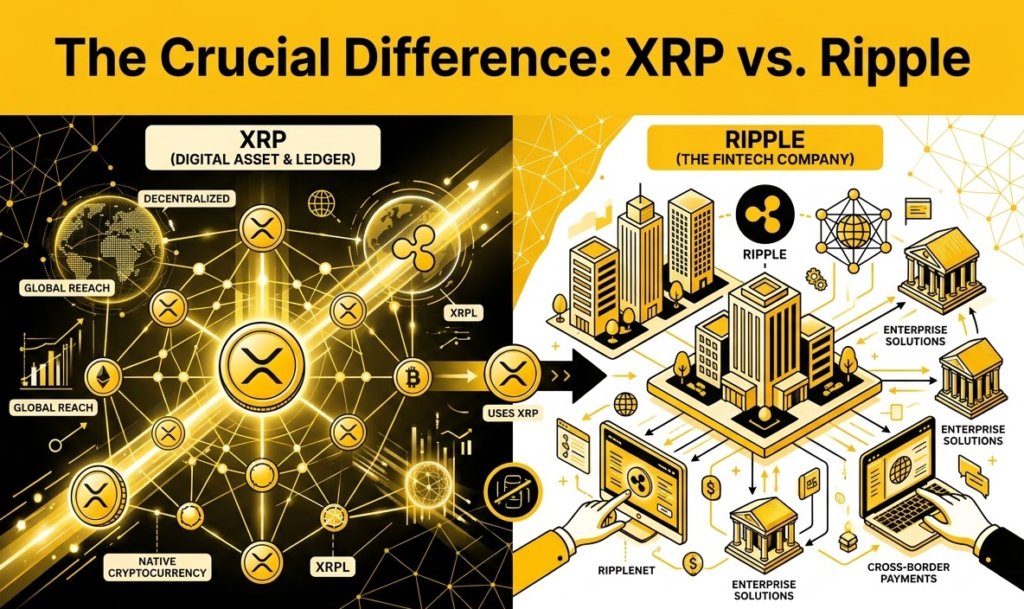
The Crucial Difference: XRP vs. Ripple
If you remember only one thing from this article, make it this:
XRP is not Ripple.
I know that sounds obvious, but the distinction gets blurred constantly.
Here is the clean version:
| Name | What it actually is |
|---|---|
| XRP | A digital asset |
| XRP Ledger | A public blockchain |
| Ripple | A financial technology company |
| Ripple Payments | Ripple’s enterprise payment infrastructure |
| RLUSD | Ripple’s U.S.-dollar-denominated stablecoin |
The XRP Ledger is open-source and public. Ripple is a private company that builds products and contributes to the broader XRP ecosystem.
The relationship is significant, but the two are not the same entity.
The XRPL’s official overview describes the ledger as a decentralized public blockchain maintained by a global community of software engineers, server operators, users and businesses.
At the same time, I would not go too far in the other direction and pretend Ripple is just another random participant.
Ripple has historically held a very large XRP position. It has contributed heavily to XRP-related development and has built commercial products around digital-asset payments. That gives Ripple meaningful economic and commercial influence within the ecosystem.
So when somebody says, “Ripple doesn’t control XRP,” the technically useful follow-up question is:
What kind of control are we talking about?
Control over the ledger’s consensus is one thing.
Ownership of XRP is another.
Influence over development is another.
Commercial influence is another.
Those four things should not be mixed together.
XRP vs. Bitcoin and Ethereum
If you come into XRP after spending time with Bitcoin or Ethereum, you may initially wonder why it feels so different.
That is because it was designed around a different problem.
Bitcoin is fundamentally associated with decentralized peer-to-peer money and Proof of Work security.
Ethereum became a general-purpose programmable blockchain, with smart contracts supporting a huge ecosystem of applications.
XRP and the XRPL have historically placed much more emphasis on payments, settlement, exchange and moving value.
Here is a simple way to think about the three:
| Network | What I would associate it with first | Core design emphasis |
|---|---|---|
| Bitcoin | Digital money | Peer-to-peer value transfer and Proof of Work |
| Ethereum | Programmable blockchain | Smart contracts and decentralized applications |
| XRP / XRPL | Digital settlement | Payments, liquidity and asset exchange |
That does not mean Bitcoin cannot be used for payments.
It does not mean Ethereum cannot settle financial assets.
And it certainly does not mean XRP can only be used by banks.
These are differences in design emphasis, not rigid walls.
Still, if you ask me why XRP’s ecosystem discussions so often revolve around financial institutions, the answer is right there in the original design priorities.
The project has always been interested in making the movement of value faster and more efficient.
Core Attributes of the XRP Token
Fast Settlement and Very Low Transaction Costs
This is where XRP becomes much easier to appreciate if you have ever tried moving money internationally.
Traditional international transfers can involve banks, correspondent relationships, compliance checks, foreign-exchange providers and local payment rails. Depending on the corridor, the process can be frustratingly slow or expensive.
The XRPL approaches the problem differently.
The ledger reaches agreement on the order and outcome of XRP transactions every few seconds. The XRPL’s current overview of its consensus system describes validators reaching agreement every three to five seconds.
That does not mean every real-world payment automatically reaches a person’s bank account in three seconds.
This distinction matters.
The blockchain can settle the digital-asset leg quickly, but a real-world payment may still depend on an exchange, bank, payment processor, compliance process or local payout system.
Think of it like having an extremely fast highway.
The highway may be empty and perfectly maintained, but you still have to get onto it and eventually drive off it.
The transaction cost is another major selling point.
The current minimum cost for a standard XRPL transaction is 10 drops, or 0.00001 XRP, according to the official XRPL transaction-cost documentation. That fee is destroyed rather than paid to a miner or validator.
There is an important little detail here that is easy to miss.
You will often see people say, “XRP transactions always cost 0.00001 XRP.”
That’s not quite right.
Ten drops is the current minimum for a standard transaction. The actual required cost can increase when the network is under heavier load. The XRPL documentation explicitly explains that transaction costs can scale with network load.
So when you read that XRP transactions cost “a fraction of a cent,” the general idea is fair, but you should not treat 0.00001 XRP as a permanent fixed price for every possible transaction.
The 100 Billion XRP Supply
XRP’s supply model is one of the first things that makes people stop and compare it with Bitcoin.
Bitcoin has a maximum supply of 21 million BTC, with coins entering circulation through mining.
XRP is completely different.
The XRP Ledger was created with a total of 100 billion XRP. There is no mining process slowly generating new XRP. The XRPL documentation on XRP explains the asset’s origin and supply model.
That means XRP is sometimes casually described as “pre-mined,” although technically it is better to say that XRP was created at inception rather than mined.
There is no XRP mining race.
No miner buys a bigger machine and receives more XRP.
No new block reward continuously adds XRP to the supply.
The network simply operates with the XRP that already exists.
There is another interesting feature: transaction fees are burned.
Whenever you send a normal XRP transaction, a small amount of XRP is permanently destroyed. The XRPL transaction-cost documentation confirms that these fees are irrevocably destroyed rather than paid to another participant.
At today’s reference fee, that is only 10 drops.
So don’t read the word “burn” and immediately imagine some enormous deflationary mechanism.
The amount destroyed through ordinary transactions is tiny relative to the overall supply.
The more important point is that the protocol does not recycle those fees to validators as newly created XRP.
The XRP disappears.
Ripple’s XRP Escrow
This is where XRP’s supply story gets more complicated – and much more interesting.
Ripple received a large amount of XRP during the early development of the ecosystem.
In 2017, Ripple placed 55 billion XRP into cryptographically secured escrow arrangements to make the amount of XRP that could enter circulation more predictable. Ripple’s original explanation said the escrows could release up to 1 billion XRP per month, with unused amounts returned into new escrow arrangements. You can read the company’s explanation in Ripple’s detailed account of its XRP escrow.
If you put yourself in the position of an XRP investor at the time, you can see why this mattered.
Imagine a company holding a huge quantity of an asset.
Even if the company promises not to dump everything tomorrow, the market has no easy way to know what “not everything” means.
Escrow turns part of that uncertainty into something that can be checked on the ledger.
The important thing here is that escrow does not create new XRP.
It simply locks existing XRP under rules enforced by the XRP Ledger.
The XRPL itself also has a native escrow function. According to the official XRPL escrow documentation, escrow can lock XRP or eligible tokens until predefined conditions are met.
That means Ripple’s use of escrow is an application of a native ledger capability rather than a special mechanism that exists only because Ripple is involved.
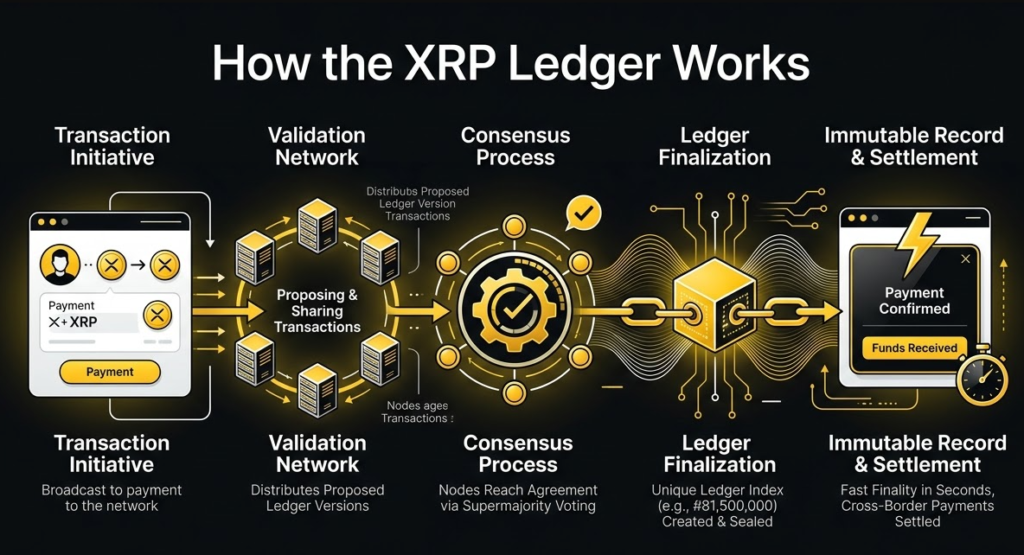
How the XRP Ledger Works
Consensus Without Mining or Conventional Staking
If you are familiar with Bitcoin, the XRP Ledger’s consensus mechanism can feel strange at first.
Where are the miners?
There aren’t any.
Where is the Proof-of-Work competition?
There isn’t any.
Where do XRP validators stake their XRP to earn protocol rewards?
They don’t.
Instead, the XRP Ledger uses the XRP Ledger Consensus Protocol.
The basic objective is pretty simple: independent servers need to agree on which transactions belong in the next validated ledger.
The XRPL consensus documentation explains the protocol’s goal of reaching agreement among independent participants while maintaining correctness and continued operation.
I like thinking about it as a group decision.
Imagine ten people are trying to write the next page of a shared accounting book.
Everyone has seen slightly different transactions.
They compare notes.
They agree on what is valid.
They reject transactions that violate the rules.
Eventually, they settle on one version.
That is obviously a simplified analogy, but it captures something important: the network does not need miners competing against one another to decide who gets to write the next block.
The protocol is built around agreement.
Unique Node Lists and Validator Nodes
Now we get to one of the most misunderstood parts of XRPL: Unique Node Lists, or UNLs.
A validator is a server that participates in the consensus process.
But simply running a validator does not magically give you control.
Each server has a set of validators it trusts for consensus purposes. That set is called its UNL.
The XRPL documentation on consensus structure explains how servers use trusted validators when evaluating consensus.
This is where XRP’s decentralization debate gets interesting.
Bitcoin’s security model asks questions about hash power.
Proof-of-Stake systems often ask questions about stake.
XRPL asks you to think about trusted validators and the overlap between those trust relationships.
The standard consensus process requires a high level of agreement among trusted validators. If too many trusted validators become unavailable or behave badly, the network can stop making forward progress rather than confirm an invalid ledger.
That is a deliberate trade-off.
The system would rather stop than finalize something it cannot reliably agree upon.
And that brings us back to the decentralization question.
The fact that Ripple runs validators is not, by itself, proof that Ripple controls the ledger.
But the fact that Ripple has historically published or participated in recommended validator infrastructure is also worth knowing when you are evaluating the network’s trust structure.
I would not reduce the subject to “centralized” or “decentralized” and walk away.
Look at the actual validator structure.
Look at who operates validators.
Look at how much overlap exists between validator lists.
Look at how the network behaves when validators disappear.
That gives you a much better picture.
Real-World Utility: Global Payments
Is XRP Really Going to Replace SWIFT?
I would be careful with that sentence.
You will often hear people say, “XRP will replace SWIFT.”
That is much more dramatic than the technology actually requires.
SWIFT is primarily a messaging network connecting financial institutions. The more interesting question is what happens after a payment message has been sent.
Cross-border finance can involve:
- Correspondent banking
- Foreign-exchange conversion
- Liquidity management
- Compliance checks
- Local settlement
- Bank accounts in different currencies
- Final payout infrastructure
One particularly interesting problem is pre-funded liquidity.
Let’s say a financial institution needs to make regular payments into Mexico.
It may need Mexican pesos available in advance.
That money can sit in an account waiting for transactions.
From a business perspective, that is capital that could potentially be doing something else.
XRP’s proposed role is to reduce the need for some of that pre-funded liquidity by acting as a bridge asset.
How On-Demand Liquidity Works
Ripple’s On-Demand Liquidity documentation describes ODL as a system that uses XRP as a bridge currency to move funds between currencies without requiring customers to pre-fund every destination market. The mechanics are explained in Ripple’s documentation for On-Demand Liquidity.
Let’s make the concept painfully simple.
Suppose:
You send USD.
The payment provider converts the USD into XRP.
XRP crosses the ledger.
The receiving side converts XRP into MXN.
The recipient gets pesos.
So:
USD → XRP → MXN
The XRP doesn’t have to sit with the recipient.
It can be the bridge that connects the two currencies.
That is why I think the phrase “digital settlement asset” makes more sense for XRP than simply calling it “another cryptocurrency.”
Of course, there is an important catch.
A bridge is only useful when there is liquidity on both sides.
If there is no efficient XRP/USD market or no efficient XRP/MXN market, the theoretical three-step process becomes much less attractive.
Liquidity is therefore just as important as transaction speed.
This is also why institutional adoption cannot be measured simply by asking how many banks “use XRP.”
The more useful questions are:
- Which payment corridors are active?
- How much liquidity is available?
- What spreads do institutions face?
- How quickly can transactions settle?
- What regulatory requirements apply?
- What does the customer actually receive?
- Does using XRP reduce working-capital requirements?
Those questions tell you much more about whether the system is commercially useful.
Advanced XRPL Features and the Expanding Ecosystem
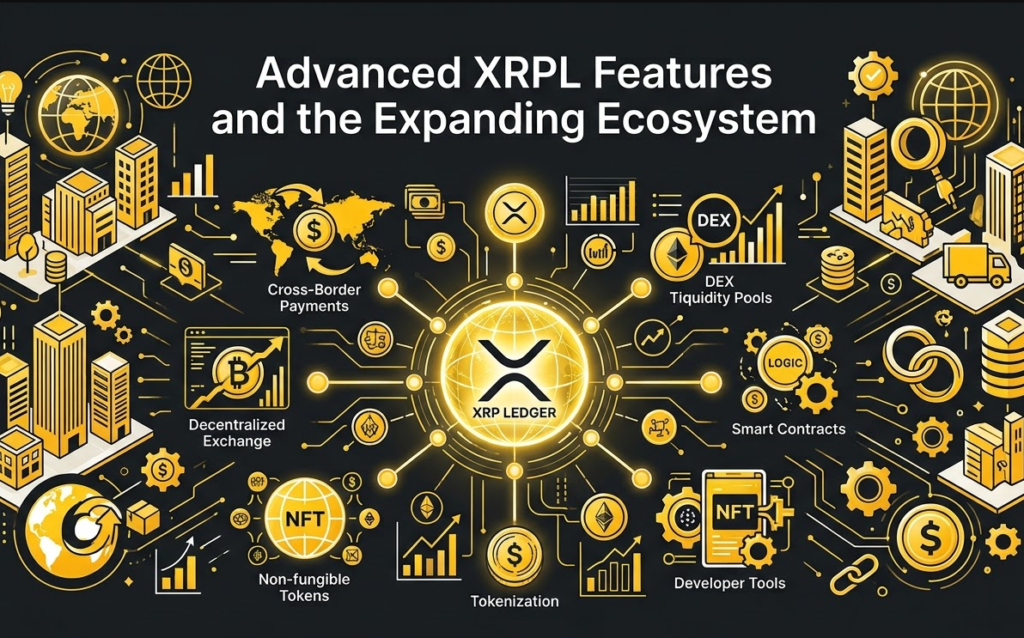
If your mental picture of XRP is still just “a coin used for bank transfers,” you are missing a big part of the XRPL today.
The ledger has developed into a broader financial infrastructure platform.
It has a built-in decentralized exchange.
It supports tokenized assets.
It supports NFTs.
It has native automated market makers.
And Ripple’s RLUSD stablecoin is also issued on the XRP Ledger alongside other networks.
That makes the ecosystem considerably more interesting than the old “XRP is a payment coin” description suggests.
Native AMMs and XLS-30
Automated Market Makers, or AMMs, are now part of the XRP Ledger’s native functionality through XLS-30.
If you have used a decentralized exchange, you may already know the basic idea.
Instead of matching your trade with another person through a traditional order book, you trade against a liquidity pool.
An AMM might hold XRP and another asset.
You put one asset in.
You take the other asset out.
The price changes according to the mathematical relationship between the assets in the pool.
The XRPL’s AMM documentation explains that each AMM contains a pool of two assets and issues LP tokens to liquidity providers.
What makes XRPL’s implementation particularly interesting is that the AMM is integrated into the ledger’s decentralized exchange rather than existing as an entirely separate application layer.
If you are providing liquidity, though, don’t make the mistake of thinking “AMM” automatically means “easy yield.”
Liquidity provision carries market and impermanent-loss risks.
So yes, the XRPL has DeFi functionality.
No, that does not make DeFi risk disappear.
NFTs and XLS-20
NFTs are another example of how the XRPL has expanded beyond payments.
The XRP Ledger natively supports non-fungible tokens through its NFT functionality, commonly associated with XLS-20.
An NFT can represent a unique digital or physical asset, depending on how the issuer structures the underlying rights.
On the XRPL, NFTs can be minted, held, bought, sold and burned through ledger functionality. The technical details are laid out in the XRPL documentation on NFTs.
This is worth paying attention to because the interesting part of tokenization is not necessarily collectible artwork.
Imagine a financial asset represented digitally.
Or a certificate.
Or a ticket.
Or an asset linked to a real-world claim.
The blockchain can provide a transparent record of ownership or transfer.
But here’s the part that often gets skipped in crypto marketing:
A blockchain token does not automatically create legal ownership of a real-world asset.
If a token claims to represent a physical asset, you still need a legal and contractual connection between the token and the asset.
Technology can solve recordkeeping.
It cannot, by itself, rewrite property law.
Interledger and the Bigger Interoperability Picture
There is another technology worth knowing about: Interledger Protocol, or ILP.
ILP is not XRP.
It is not the XRP Ledger.
It is not owned by Ripple.
The Interledger Foundation’s overview of ILP describes it as an open protocol for moving value across different payment networks and ledgers.
I find the internet analogy useful here.
Your email does not care whether the person receiving it uses the same physical network equipment you use.
The internet provides standards that allow different networks to communicate.
Interledger is trying to apply a similar idea to payments.
A bank may operate one system.
A mobile wallet may operate another.
A blockchain may operate another.
A stablecoin may exist on another network.
Rather than demanding that every system become identical, interoperability protocols can act as the connective tissue.
That is particularly relevant to institutional finance because the financial world is unlikely to suddenly move onto one blockchain.
There are simply too many existing systems.
RLUSD and the Digital Dollar Layer
RLUSD adds another interesting piece to the picture.
Ripple announced the global launch of Ripple USD in December 2024, describing it as a USD-denominated stablecoin backed by U.S. dollar deposits, U.S. government bonds and cash equivalents. You can read Ripple’s original announcement in its official RLUSD launch release.
The distinction between XRP and RLUSD is crucial.
XRP has a market price that moves.
RLUSD is designed to maintain a value of approximately one U.S. dollar.
So they can have completely different jobs.
| Asset / technology | Potential role |
|---|---|
| XRP | Bridge liquidity and settlement |
| RLUSD | Dollar-denominated digital liquidity |
| XRPL | Ledger and transaction infrastructure |
| AMM | Automated liquidity |
| DEX | On-chain asset exchange |
| ILP | Connecting different payment systems |
If you think about institutional finance, this combination starts to make sense.
A company may want a volatile bridge asset for a particular settlement route.
Another company may want dollar-denominated stablecoin liquidity.
A decentralized exchange can provide market liquidity.
An interoperability protocol can connect separate networks.
You do not need one asset to do every job.
The SEC vs. Ripple Lawsuit
Why the SEC Case Mattered
You cannot really understand XRP’s history without understanding the legal battle between Ripple and the U.S. Securities and Exchange Commission.
The SEC filed its lawsuit against Ripple, Brad Garlinghouse and Christian Larsen in December 2020.
At the heart of the dispute was a deceptively simple question:
When XRP is sold, is that sale a securities transaction?
The legal answer turned out to be more complicated than a yes-or-no label attached to XRP itself.
The case involved the Howey test, the U.S. Supreme Court framework used to determine whether an arrangement constitutes an investment contract.
That is why the wording matters so much.
The question was not simply “Is XRP a cryptocurrency?”
The court had to examine particular transactions and the circumstances surrounding them.
Judge Analisa Torres’ 2023 Ruling
On July 13, 2023, Judge Analisa Torres issued a major ruling distinguishing between different categories of XRP sales.
The court found that Ripple’s direct institutional sales involved investment-contract transactions under the circumstances considered by the court.
But the court reached a different conclusion regarding Ripple’s programmatic sales of XRP through digital-asset exchanges.
That distinction became one of the most important pieces of the entire case. The SEC’s later filings summarize the district court’s findings and the subsequent procedural history.
So if you see someone write:
“XRP is not a security.”
Or:
“Ripple lost the SEC case.”
Take a breath.
Neither sentence captures the entire ruling.
The court did not simply declare every possible XRP transaction outside securities law.
Instead, it distinguished among different types of transactions.
The basic picture was:
| Sales context | Court’s 2023 treatment |
|---|---|
| Certain direct institutional sales | Found to involve investment-contract transactions |
| Programmatic exchange sales | Not found to establish the required Howey element under the circumstances analyzed |
| Certain other XRP distributions | Not treated as securities transactions under the circumstances analyzed |
That distinction became one of the most important pieces of the entire case.
Where the Case Stands Now
The litigation continued after the 2023 ruling.
On August 7, 2024, the district court entered a final judgment imposing a $125,035,150 civil penalty against Ripple and an injunction relating to securities-registration requirements.
Both the SEC and Ripple appealed.
Then, on August 7, 2025, the SEC announced that the parties had filed a joint stipulation dismissing the appeals. According to the SEC’s official litigation release, the dismissal resolved the SEC’s civil enforcement action while the district court’s final judgment remained in effect.
That is the part of the legal history I would pay the most attention to today.
The case did not end with “Ripple won everything.”
It also did not end with “XRP was declared an illegal security.”
The final outcome preserved the district court’s judgment, including the civil penalty and injunction concerning Ripple’s institutional sales.
At the same time, the court’s distinction regarding programmatic exchange sales became enormously important for how XRP is viewed in U.S. secondary-market trading.
There is still a broader regulatory question around digital assets in the United States, and future laws or regulatory decisions can change the environment.
So I would describe the outcome as important legal clarity around particular XRP transactions, rather than claiming that every future XRP-related activity is permanently settled.
Frequently Asked Questions
Is XRP truly decentralized if Ripple owns a large portion of the supply?
This is one of those questions where the honest answer requires more than one sentence.
The XRP Ledger is a public blockchain that uses independent validators to reach consensus. Ripple does not have a master switch that allows it to rewrite the ledger whenever it wants.
But Ripple’s large XRP holdings are a legitimate part of the decentralization discussion.
Token ownership gives economic influence.
Software development creates another kind of influence.
Running validators creates another.
Publishing or participating in validator infrastructure creates another.
None of these should automatically be treated as equivalent to direct protocol control.
The XRPL’s official network overview explains that the ledger is maintained by a global community and that validators can be operated by different types of participants.
So if you are researching XRP seriously, don’t stop at the question “Does Ripple own XRP?”
Ask:
Who controls consensus?
Who runs validators?
Who develops the software?
Who owns XRP?
How are validator lists chosen?
Those questions give you a much clearer picture.
Why can’t you mine XRP?
Because XRP was not created through mining.
The XRP Ledger began with its XRP supply already created.
There is no Bitcoin-style mining reward.
Validators participate in consensus, but they do not receive newly minted XRP for validating transactions.
That is one reason you cannot buy a mining machine and start generating XRP.
If someone tells you that you can “mine XRP” through a special website or mining app, I would be extremely cautious.
The XRP Ledger itself does not have a Proof-of-Work XRP mining system.
What is a “Drop” in the XRP network?
A drop is simply a tiny unit of XRP.
One XRP equals 1,000,000 drops.
So:
| XRP | Drops |
|---|---|
| 1 XRP | 1,000,000 drops |
| 0.1 XRP | 100,000 drops |
| 0.001 XRP | 1,000 drops |
| 0.00001 XRP | 10 drops |
The current standard transaction cost is 10 drops, as explained in the XRPL’s transaction-fee documentation.
The terminology sounds technical, but the idea is really no different from cents and dollars.
You don’t need to think about XRP only in whole numbers.
How do I securely store my XRP?
If you are holding XRP yourself, this is the part I would take more seriously than almost anything else.
The blockchain can be incredibly secure and you can still lose your money because you gave the wrong person your recovery phrase.
Your private keys are effectively what give you control over the assets.
There are several broad approaches:
| Storage method | Why people use it | Main thing to watch |
|---|---|---|
| Hardware wallet | Keeps signing credentials more isolated from everyday devices | Physical security and backup |
| Software wallet | Convenient for regular transactions | Malware, phishing and device compromise |
| Exchange custody | Convenient for trading | You rely on the exchange to safeguard the assets |
The XRPL’s wallet documentation explains the basic distinction between hardware and software wallets and their different security/convenience trade-offs.
If you are storing a meaningful amount, I would think about security in layers.
First, protect the recovery phrase.
Second, protect the device.
Third, verify addresses before sending.
Fourth, don’t blindly trust links sent through Telegram, Discord, X, email or random “support” accounts.
And never type your recovery phrase into a website because someone tells you that you need to “synchronize” or “verify” your wallet.
A legitimate wallet support process should not need your secret recovery phrase.
One careless transaction can be irreversible, so security is not an optional extra with XRP or any other self-custodied crypto asset.
Conclusion: Where Does XRP Fit in the Future of Institutional Blockchain Adoption?
After you strip away the price speculation, the social-media arguments and the endless debate over whether XRP will reach some enormous future valuation, the underlying idea is actually quite practical.
XRP is designed to help move value.
The XRP Ledger is designed to settle transactions quickly.
Ripple is building financial infrastructure around digital assets.
And the broader XRPL ecosystem is expanding into areas such as tokenization, decentralized exchange infrastructure, AMMs, NFTs and stablecoins.
That is a much more interesting story than simply asking whether XRP is “the next Bitcoin.”
I don’t think that comparison is particularly useful.
Bitcoin and XRP were built with different priorities.
Bitcoin’s story is about decentralized money and monetary scarcity.
Ethereum’s story is about programmable blockchain infrastructure.
XRP’s story is much more closely tied to settlement and liquidity.
If you are a normal user sending $50 to a friend, you may never need XRP.
If you are a financial institution moving millions of dollars between currencies, the problem looks very different.
Suddenly, a few seconds instead of a potentially longer traditional settlement process can matter.
A tiny transaction cost can matter.
Not having to keep large pools of idle foreign currency in advance can matter.
Having a public ledger that settles transactions transparently can matter.
That is where XRP’s institutional thesis becomes interesting.
But there is an important reality check.
A fast blockchain does not automatically become global financial infrastructure.
A cheap transaction does not automatically create demand.
And a technology company having relationships with financial institutions does not automatically mean every bank will eventually use XRP.
Adoption depends on liquidity, regulation, compliance, economics, integration costs and whether the technology actually solves a problem better than existing alternatives.
That is why I think the best way for you to evaluate XRP is to look beyond the price.
Ask what the network is actually doing.
Look at transaction activity.
Look at liquidity.
Look at institutional products.
Look at the development of the XRPL.
Look at how tokenization and stablecoins evolve.
Look at the regulatory environment.
And, perhaps most importantly, keep XRP, XRPL and Ripple separate in your head.
XRP is the asset.
XRPL is the ledger.
Ripple is the company.
Once those three pieces stop blending together, the entire XRP story becomes much easier to understand.
And perhaps that is the most useful takeaway.
XRP does not need to replace every currency on Earth to have a purpose.
It does not need to make traditional banks disappear.
It does not even need every blockchain user to own it.
Its most interesting role is considerably narrower: to serve as a fast-moving bridge and settlement asset inside a financial world where money increasingly needs to move across different currencies, institutions and digital networks.
Whether that opportunity becomes enormous or remains a specialized part of global finance is ultimately a question of adoption, economics and regulation.
But the technology itself is much easier to appreciate once you stop looking at XRP merely as a ticker symbol and start looking at the problem it was built to solve.