MEXC legitimacy, solvency and safety scorecard
If you are asking, “Is MEXC legit and safe?”, I would separate that question into three parts: whether the exchange genuinely operates, whether it provides evidence that customer assets are backed, and whether you can legally and reliably use its services from your location.
MEXC has operated since 2018 and provides cryptocurrency trading services across a large range of markets. Its monthly reserve reports are a positive transparency signal. But an exchange can be legitimate as a business and still expose customers to regulatory, operational, market, and custody risks.
| Metric | What the evidence indicates |
|---|---|
| Platform legitimacy | MEXC is an operating centralized cryptocurrency exchange established in 2018. That alone does not establish that every product is safe or every customer is eligible. |
| Corporate and regulatory position | MEXC operates through corporate entities across jurisdictions. The relevant contracting entity and its permissions can differ by market and service. |
| Proof of Reserves | MEXC published an October 2026 report audited by Hacken, reporting reserve ratios above 100% for BTC, ETH, USDT and USDC. |
| BTC reserve ratio | MEXC reported 294% in its October 2026 report. This is a snapshot-based reserve ratio, not a guarantee that every customer can withdraw at every moment. |
| Guardian Fund | MEXC reported a Guardian Fund valued at approximately $101 million in its September 2026 report, structured using USDT and BTC. |
| Futures Insurance Fund | MEXC reported a balance of approximately 798 million USDT in September 2026. This fund is intended to address liquidation-related shortfalls, not to insure every customer loss. |
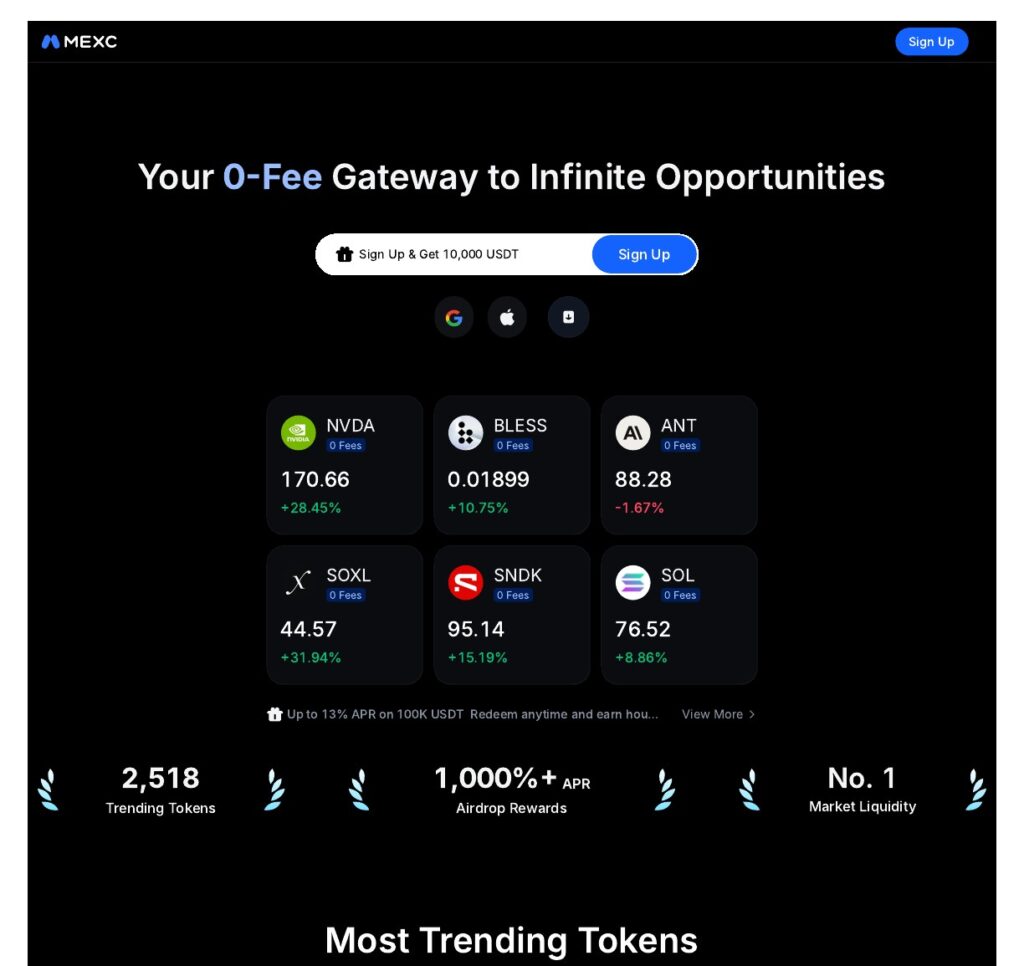
| Spot trading fees | MEXC advertises 0% maker and taker fees for eligible Spot trading. Check the current fee page and your trade history because fees for other products and services may differ. |
| Identity verification | MEXC uses tiered KYC verification. Required documents, facial checks, product access and withdrawal limits depend on the verification level and applicable regional rules. |
| Restricted markets | The User Agreement names jurisdictions including the United States, United Kingdom, Canada, Singapore, Mainland China and others. The list can change. |
| Regulatory concerns | Dubai’s VARA announced fines against MX Global Ltd, commercially operating as MEXC, in June 2026. The Netherlands’ AFM had previously warned consumers about MEXC Global operating without the required authorisation. |
The reserve figures above come from MEXC’s own published reports, including its October 2026 Proof of Reserves announcement and its September 2026 report. They are useful evidence, but they should be read alongside the exchange’s regulatory status and the limits of Proof of Reserves.
My conclusion is straightforward: MEXC is a real exchange with meaningful transparency measures, but I would not treat it as risk-free or assume that its low fees and large token selection outweigh every other consideration. Your location, trading strategy, custody needs and ability to tolerate a withdrawal delay matter just as much as the headline reserve ratio.
Where does MEXC stand globally?
Offshore exchange status versus regulatory warnings
MEXC’s global presence should not be confused with having permission to provide every crypto service in every country. Cryptocurrency exchanges often operate through different legal entities, and the entity named in a user’s terms may not be the same company that appears in a regulator’s notice.
That distinction matters if something goes wrong. The legal entity holding the customer relationship, the country where the service is offered, and the permissions required under local law can affect which rules apply and where a customer can complain.
Two official regulatory developments illustrate why it is worth checking the details rather than relying on an exchange’s marketing claims.
Dubai: VARA enforcement action in June 2026. The Virtual Assets Regulatory Authority published a notice of fines against MX Global Ltd, commercially operating as MEXC on June 22, 2026. VARA said the entity had provided virtual-asset broker-dealer and/or exchange services to customers in Dubai without the required licence during the period from 2022 to April 2026. It also identified failures related to KYC obligations and directed the entity to cease unlicensed virtual-asset activities in or from Dubai. VARA’s notice specifies that the enforcement action targeted MX Global Ltd, not every company associated with the broader MEXC group.
The Netherlands: AFM warning in September 2025. The Dutch Authority for the Financial Markets warned consumers about MEXC Global on September 24, 2025. The AFM said MEXC was offering crypto-asset services in the Netherlands without the required authorisation and raised concerns about the unclear location and legal identity of the entity providing the services. Its notice also highlighted the risks customers could face if the provider encountered financial difficulties. You can read the regulator’s original warning.
These notices do not prove that MEXC is a scam. They do, however, show that the exchange’s regulatory position has raised concrete concerns in specific markets. A regulator’s warning about unlicensed activity is a different matter from a criminal finding that an entire platform is fraudulent, so I would not conflate the two.
For customers in the European Union, the relevant framework is the Markets in Crypto-Assets Regulation, or MiCA. The European Securities and Markets Authority maintains an interim MiCA register that includes authorised crypto-asset service providers and a separate register of non-compliant entities. MEXC’s position should be checked against the latest register and local regulator notices before you assume that EU consumer protections apply to your account.
I would also be careful with broad claims that MEXC has been “fined by every major regulator” or that it is “fully licensed worldwide.” Those statements go beyond what the notices above establish. The safer approach is to check the specific legal entity, regulator, country, date and service involved.
Restricted jurisdictions: The United States, United Kingdom, Canada and beyond
MEXC’s User Agreement names a set of prohibited jurisdictions where it does not provide services or accept registrations and trading applications. The current list includes the United States, United Kingdom, Canada, Singapore, Mainland China, Hong Kong, Malaysia, Kazakhstan, North Korea, Cuba, Iran, Sudan and certain Russian-controlled regions of Ukraine. It also includes countries subject to specified comprehensive sanctions and certain FATF high-risk classifications.
The exchange’s own restricted-countries guide, updated October 21, 2026, describes the prohibited jurisdictions and additional regional restrictions. Its User Agreement should be treated as the primary source for the applicable contractual terms, although you should check the current version for your account and location.
| Location or market | Practical position to check |
|---|---|
| United States | Named as a prohibited jurisdiction in MEXC’s User Agreement. |
| United Kingdom | Named as a prohibited jurisdiction. Do not assume that being able to open the website means you are eligible to trade. |
| Canada | Named as a prohibited jurisdiction. |
| Singapore | Named as a prohibited jurisdiction. |
| Mainland China and Hong Kong | Named as prohibited jurisdictions. |
| Malaysia and Kazakhstan | Named as prohibited jurisdictions in the current guide. |
| Russia and Belarus | MEXC announced in October 2026 that it is discontinuing services for users in these markets. Follow the individual notice sent to your account for the applicable deadlines. |
| Netherlands | MEXC has announced a service wind-down. Its October 2026 guide states that users should move assets by October 31, with final offboarding scheduled for November 16, 2026. |
| Other EU/EEA markets | Do not infer authorisation from availability alone. Check the latest MiCA register and local regulatory guidance. |
This table is a practical summary, not a permanent legal list. MEXC can update its terms, and regulators can change their requirements. If you live in a country with unclear eligibility, confirm the position directly through official MEXC terms and your local regulator before depositing funds.
Do not use a VPN to bypass a prohibited-country restriction. A VPN can change the IP address that a website sees; it does not change your residence, remove your legal obligations or grant you permission to use a restricted service. MEXC’s terms state that false representations about location or residence can lead to account termination and liquidation of open positions. Trying to get around a geoblock can therefore make a difficult account-access problem worse.
If your country is restricted, the sensible option is to use a provider authorised to serve residents there. Do not risk your funds on the assumption that a location check will never catch up with you.
Is MEXC safe to store crypto? Solvency, Hacken audits and protection funds
Hacken-audited monthly Proof of Reserves
Proof of Reserves, commonly shortened to PoR, is one of the main ways MEXC attempts to demonstrate that it holds crypto assets corresponding to customer balances. In its October 2026 report, MEXC said Hacken independently audited its reserve disclosures and reported ratios above 100% for BTC, ETH, USDT and USDC.
The reported ratios were:
| Asset | Reserve ratio reported by MEXC in October 2026 | What the ratio means |
|---|---|---|
| BTC | 294% | MEXC reported BTC reserves equivalent to 2.94 times the covered customer BTC liabilities in the snapshot. |
| USDT | 122% | Reported USDT reserves were 1.22 times the covered customer USDT liabilities. |
| USDC | 115% | Reported USDC reserves were 1.15 times the covered customer USDC liabilities. |
| ETH | 111% | Reported ETH reserves were 1.11 times the covered customer ETH liabilities. |
These figures are from MEXC’s October 2026 Proof of Reserves announcement. Because reserve ratios are snapshots, they can change with deposits, withdrawals, trading balances and movements in platform wallets. Check the latest report before making a decision based on a particular number.
MEXC describes its PoR process as combining on-chain wallet disclosures, user-level balance verification and Merkle-tree technology. In broad terms, a Merkle tree allows a platform to organise a large set of account balances into a cryptographic structure. A user can then check whether a balance was included in the liabilities represented by that snapshot without the exchange publishing every customer’s private account information.
The audit framework described by MEXC covers Proof of Liabilities, Proof of Ownership, reserve calculations and Merkle-tree verification. The exchange also discloses wallet addresses so that users and other observers can inspect the reported on-chain holdings.
That is a meaningful transparency measure. It gives users more to examine than a simple statement saying, “Trust us, the money is there.” But it is important to understand what a PoR report can and cannot tell you.
A reserve ratio above 100% is not the same as a complete guarantee of solvency. A PoR snapshot can provide evidence about specified assets and liabilities at a particular point in time. By itself, it does not necessarily prove that every liability has been captured, reveal every off-chain obligation, establish the quality of all internal controls, or guarantee that the exchange will process your withdrawal immediately during a crisis.
I would look at several things when reviewing a PoR report:
- Date of the snapshot: Is the report recent enough to be useful, or are you relying on data from months ago?
- Assets covered: Does the report include the coins you actually hold, or only a small selection of major assets?
- Liability methodology: Can customers verify that their balances were included in the reported liabilities?
- Wallet ownership: Is there evidence that the exchange controls the wallets listed as reserves?
- Independent review: Is a third party involved, and does the report explain the scope of its work?
- Consistency over time: Do the reports continue to appear regularly, and are changes in reserve ratios explained clearly?
Hacken’s involvement is a positive signal, but the existence of an auditor should not be treated as a blanket endorsement of the exchange or every service it offers. You still need to assess the legal and operational risks separately.
The $100 million Guardian Fund and Futures Insurance Fund
MEXC also describes additional financial buffers intended to address different kinds of risk. Its September 2026 report said the Guardian Fund was worth approximately $101 million and used a dual-reserve structure involving USDT and BTC. The same report put the Futures Insurance Fund at approximately 798 million USDT.
These are substantial headline figures, but their purpose matters more than the size alone.
The Guardian Fund is presented by MEXC as a reserve intended to provide an additional layer of protection in connection with platform-related issues. The Futures Insurance Fund, meanwhile, is designed primarily to absorb liquidation-related shortfalls when a position’s losses exceed the margin available to cover them. MEXC explains this function in its September 2026 reserve report.
The Futures Insurance Fund is not a general insurance policy for everyone who trades on MEXC. It does not mean that the exchange will reimburse a user whose token falls in price, whose trade is liquidated, or whose account is compromised after a phishing attack. If the fund cannot cover a liquidation shortfall, additional risk-management mechanisms may still apply.
Similarly, the Guardian Fund’s published value does not mean that every customer has an unconditional, legally enforceable right to recover losses from it. Before relying on any protection fund, read the current terms and any conditions that explain which events qualify, how claims are assessed, and what exclusions apply.
There is another important point: do not add reserve balances and protection-fund balances together and assume the result represents cash available to repay every customer. These figures can refer to different assets, purposes, accounting scopes and risk scenarios. They may not be directly comparable, and a fund designated for futures liquidations is not necessarily available to cover unrelated liabilities.
In my view, these funds are useful pieces of evidence, not reasons to ignore basic custody discipline. I would still keep only the funds I need for active trading on an exchange and consider self-custody for assets I intend to hold over a longer period, provided I can manage private-key security safely.
MEXC Verify, two-factor authentication and account protections
Exchange security is partly a platform issue and partly a user issue. Even a well-secured exchange cannot stop every scam if a customer hands over login credentials, approves a malicious transaction or installs a fake app.
MEXC provides a tool called MEXC Verify, which lets users check whether a website address, email address, phone number or social media account is an official MEXC channel. The official MEXC Verify page explains what the tool checks, while MEXC’s phishing-prevention guide describes how to use it through the website or app.
I would make this a habit before responding to anyone who claims to be a MEXC employee. A convincing profile picture, a Telegram username containing “MEXC Support,” or a message that knows your username does not prove the sender is legitimate.
Use these protections where available in your account:
- Two-factor authentication (2FA): Add an authenticator-based second factor where supported. Keep recovery codes in a secure location that is separate from your everyday login device.
- Anti-phishing code: Set a code that should appear in legitimate MEXC emails, following the platform’s current instructions. If a message is missing the code or contains suspicious links, do not click through.
- Withdrawal address controls: If address whitelisting is available for your account, consider enabling it and reviewing any withdrawal delay or confirmation rules.
- Unique password: Use a password that you do not reuse on email, social media or other exchanges.
- Official apps and URLs: Type the official website address directly or use a trusted bookmark. Avoid downloading apps from third-party links sent in private messages.
- Login and withdrawal alerts: Review available security notifications and investigate any activity you do not recognise.
To check a suspicious contact, open the official MEXC Verify portal, select the relevant channel and enter the complete URL or account identifier. MEXC says the result will indicate whether the source is verified. A positive result is useful, but it does not mean you should ignore other red flags such as requests for your password, verification code, seed phrase or an upfront “release fee.”
Remember that a centralised exchange account is not the same as a self-custody wallet. On an exchange, you rely on the platform’s custody systems and withdrawal processes. If you control your own wallet, you take on the responsibility of securing the private keys and recovery phrase. Neither option eliminates risk; it simply changes where much of the risk sits.
Why MEXC accounts get restricted or frozen?
A lot of negative exchange stories follow a similar pattern: a customer attempts to withdraw funds, the withdrawal is delayed, support asks for more information, and the customer concludes that the platform has stolen the money. Sometimes the exchange may have handled the situation poorly. In other cases, a restriction may be connected to identity checks, location rules, a disputed transaction or an automated risk review.
Without access to the account records and the exchange’s investigation, it is not possible to know which explanation applies to an individual complaint. I would avoid assuming that every freeze proves fraud, but I would also avoid assuming that every restriction is justified simply because the exchange calls it a security measure.
Myth: MEXC still allows completely anonymous trading
Older articles and forum posts may describe MEXC as an exchange where users can trade without identity checks. That is not a safe assumption to make in 2026.
MEXC now publishes tiered identity-verification guidance. Its October 2026 KYC guide says users must complete verification to access the platform’s products and services, while also explaining that the exact limits for unverified accounts can depend on the region.
The key distinction is between saying “MEXC has KYC requirements” and saying “every account must complete the same verification steps before it can do anything.” Those statements are not identical.
MEXC describes two main individual verification levels:
| Verification level | Typical requirements | What to know |
|---|---|---|
| Primary KYC | A supported government-issued identity document | MEXC says this level provides access to certain features and a higher crypto withdrawal limit than an unverified account. |
| Advanced KYC | Additional facial recognition or a liveness check, depending on the verification flow | This level can unlock higher limits or additional services. |
| Institutional verification | Business or institutional documentation | Requirements and limits differ from individual accounts. |
MEXC’s October 2026 guide states a daily crypto withdrawal limit of up to 80 BTC for Primary KYC and up to 200 BTC for Advanced KYC, with higher limits for eligible institutional accounts. Those are platform-published limits, not a promise that every user in every country will be eligible for the same services.
The important takeaway is that you should check the verification requirements shown for your account before depositing funds. Do not rely on an old guide that says you can remain anonymous indefinitely. If your account needs identity verification to withdraw, discovering that only after you have transferred a substantial balance is an avoidable problem.
Myth: A VPN makes MEXC safe to use from a restricted country
A VPN can change your apparent IP address. It does not change your country of residence or override an exchange’s User Agreement.
MEXC’s current restricted-jurisdiction terms prohibit users from certain countries and regions and reserve the right to take action if a user misrepresents their location or residence. The terms describe possible measures including immediate account termination and liquidation of open positions.
Trying to bypass a restriction can also create practical problems. For example, your login IP may indicate one country while your identity document, payment records or other account information indicates another. That mismatch may trigger further checks. It does not prove that an account will automatically be frozen in every case, but it can complicate verification and account access.
If you are in a prohibited jurisdiction, do not use a VPN as a workaround. If you have moved countries, check the exchange’s rules and contact official support about how to update your residence details before continuing to trade.
Understanding “abnormal trading” flags and withdrawal restrictions
MEXC can restrict accounts or transactions when its risk systems identify activity that requires further review. The exact criteria used by its internal monitoring systems are not fully public, so it would be misleading to claim that one particular trading pattern always causes a freeze.
Possible reasons for an account or withdrawal review can include:
- KYC discrepancies: The identity details submitted do not match the account information, or the exchange needs an updated document.
- Location concerns: Login or account information appears inconsistent with the user’s stated residence, or the account is accessed from a prohibited jurisdiction.
- Suspicious transaction patterns: Deposits, withdrawals or transfers trigger anti-money-laundering or fraud checks.
- P2P disputes: A payment is disputed, reversed or flagged by a counterparty or payment provider.
- Account-security concerns: The platform detects a suspicious login, an unauthorised change or other activity that may put the account at risk.
- Trading or liquidation disputes: The user contests a trade, liquidation or other action and the exchange initiates a review.
These are general possibilities, not a verified list of MEXC’s internal trigger rules. High-frequency trading or arbitrage by itself should not be described as an automatic reason for a freeze without evidence. Similarly, a withdrawal delay does not by itself prove that the exchange is insolvent.
If MEXC restricts your account, focus first on preserving evidence and using the official support channel. Save the case number, screenshots, transaction IDs, deposit records, withdrawal addresses and the exact wording of any notice. Ask what review is required, which documents are missing, and whether the restriction applies to trading, withdrawals or the entire account.
Do not send more money to someone who claims they can unlock your account in exchange for a fee. Do not share passwords, authenticator codes or seed phrases with anyone claiming to be support. If you suspect an account compromise, use the official security tools and change your credentials through the verified website or app.
Entity relationship and regional compliance architecture
The following map summarises how the main entities and risks relate to one another. It is a conceptual guide rather than a legal ownership chart or proof that every entity provides every MEXC service.
Global crypto trader
        |
        | Trades crypto and derivatives
        v
MEXC exchange platform
        |
        |-- Account access depends on KYC and location eligibility
        |
        |-- Proof of Reserves reports
        |       |
        |       |-- Merkle-tree liability verification
        |       |-- On-chain wallet disclosures
        |       |-- Hacken audit reports
        |
        |-- Security controls
        |       |
        |       |-- MEXC Verify
        |       |-- Two-factor authentication
        |       |-- Anti-phishing code
        |
        |-- Risk and protection mechanisms
        |       |
        |       |-- Guardian Fund
        |       |-- Futures Insurance Fund
        |
        |-- Regulatory boundaries
                |
                |-- VARA enforcement action involving MX Global Ltd
                |-- AFM warning concerning MEXC Global in the Netherlands
                |-- User Agreement restrictions and local licensing rules
The relationship between these elements is important. Proof of Reserves addresses a specific question about reported assets and liabilities. Security tools help protect access to your account. Insurance and protection funds have defined purposes. Regulatory permissions determine whether the exchange may offer particular services in a given market. None of these checks replaces the others.
Complete MEXC KYC and verify official channels
The safest time to check your identity-verification status and account-security settings is before you need to make an urgent withdrawal. The following steps describe the general process. The exact screens, document options and available features may differ between the app, website, account type and country.
Phase 1: Complete the required identity verification
Step 1: Open the official MEXC website or app.
Use the official MEXC website or an app obtained through a trusted official channel. Do not register through a link sent by an unknown person on Telegram, Discord, X or email.
Before uploading identity documents, check that the domain is correct. A fake website can imitate MEXC’s branding and still send your information to a scammer.
Step 2: Open the Identity Verification section.
Sign in and navigate to your account’s identity-verification page. Review the verification levels and any regional eligibility notice shown on screen.
If you live in a prohibited jurisdiction, do not attempt to use a different country’s details to get through verification. If your residence has genuinely changed, contact official support to confirm the correct procedure.
Step 3: Submit a supported government-issued identity document.
Choose an accepted document from the options shown in your account. Depending on your location, the platform may accept a passport, national identity card or driver’s licence. Do not assume that every document type is accepted in every country.
Make sure the image is clear, the document is valid and the information matches the details you submitted. Avoid editing the image or covering information that the verification process requires.
Step 4: Complete any additional face or liveness check.
If the verification flow asks for facial recognition or a liveness check, follow the on-screen instructions. Use a device with a working camera and suitable lighting. If the system rejects your submission, read the reason provided before trying again.
MEXC’s published guide says Primary and Advanced KYC have different requirements. You may be able to proceed directly to Advanced KYC, depending on the current process, so follow the options displayed for your account rather than assuming that every user must complete the levels in a fixed order.
Step 5: Confirm your status before transferring a large balance.
Wait for the verification result and check whether your account can access the specific features you intend to use. Completing identity verification does not override country restrictions, guarantee access to every product or remove all transaction reviews.
For the latest requirements, consult MEXC’s KYC guide.
Phase 2: Verify links and contacts with MEXC Verify
Step 1: Open the official verification tool.
Go directly to MEXC Verify. You can also follow MEXC’s official instructions for finding the tool in the app or through the website’s support section.
Step 2: Select the channel you want to check.
Depending on the available options, you can check a website URL, email address, phone number or social media account. Enter the complete address or account identifier rather than a vague display name.
Step 3: Review the verification result.
MEXC says the tool displays a positive confirmation for a verified official source and a warning when a source is not verified. If a contact cannot be verified, do not assume it is legitimate simply because the person knows details about your account.
Step 4: Protect your credentials.
Never share your password, one-time verification codes, authenticator recovery codes or wallet seed phrase with someone who claims to be MEXC support. Be especially suspicious of messages that promise to recover frozen funds, remove a withdrawal restriction or guarantee investment profits in exchange for an upfront payment.
Step 5: Secure the account itself.
Enable two-factor authentication where available, set an anti-phishing code, use a unique password and review your login and withdrawal settings. If address whitelisting is available, consider using it after understanding its rules and any withdrawal delays it may introduce.
These steps cannot eliminate exchange risk, but they reduce the chance that a fake support account or phishing website will steal your credentials.
Frequently asked questions
Is MEXC a legitimate crypto exchange or a scam?
MEXC is an operating cryptocurrency exchange that has been active since 2018. It publishes Proof of Reserves reports audited by Hacken and offers account-security tools. That evidence supports describing MEXC as a real platform rather than simply labelling it a scam. However, regulatory concerns and custody risks remain relevant. Legitimacy does not mean every product is authorised in every country or that customer funds are guaranteed.
Has MEXC ever been hacked, and is it safe to hold funds there?
I would not describe MEXC as having an “unblemished” security record unless that claim can be supported by a comprehensive, independently verified incident history. Public information can help identify disclosed incidents, but the absence of a known major platform-wide breach does not prove that no security incident has ever occurred. MEXC’s PoR reports, wallet controls and account protections are useful signals, not guarantees against hacking, operational failure or withdrawal restrictions. For long-term holdings, consider whether self-custody is appropriate for your experience and security practices.
Is MEXC legal to use in the United States, the UK or Canada?
MEXC’s current User Agreement names the United States, United Kingdom and Canada as prohibited jurisdictions. Singapore and several other locations are also listed. The rules can change, so check the latest User Agreement and local requirements before opening or using an account. A VPN does not remove a residency restriction or grant legal permission to access a service.
Why do some users report frozen MEXC accounts or blocked withdrawals?
Restrictions may arise from identity-verification issues, location discrepancies, suspicious transactions, account-security checks, P2P disputes or other risk reviews. The reason in an individual case cannot be determined from a social media post alone. If this happens to you, contact official support, save the case number and transaction records, and ask which review or documents are required. Never pay an unofficial “recovery agent” to unlock funds.
Is KYC mandatory to trade or withdraw on MEXC?
MEXC has tiered KYC requirements and says users must complete verification to access its products and services, while unverified accounts may face restrictions depending on region. Primary KYC generally requires an identity document, while Advanced KYC can involve a facial or liveness check and may provide higher limits. Check the current requirements shown in your account because eligibility and limits vary.
Does MEXC’s Proof of Reserves mean customer funds are guaranteed?
No. A PoR report provides evidence about the assets and liabilities included in a particular snapshot. It does not automatically establish that every liability is included, that all off-chain obligations are covered, or that the exchange can meet every withdrawal request under every market condition. A reserve ratio above 100% is a positive data point, not deposit insurance.
What does Hacken’s audit of MEXC’s reserves actually prove?
MEXC says Hacken audits its monthly Proof of Reserves disclosures, which include reserve calculations, wallet ownership, liabilities and Merkle-tree verification. This helps users examine the reported backing of covered customer assets. It should not be interpreted as a guarantee of the exchange’s overall solvency, regulatory compliance, trading fairness or future performance. Check the report’s date and scope before relying on the figures.
Is MEXC’s $100 million Guardian Fund insurance for every user?
MEXC describes the Guardian Fund as an additional protection mechanism and reported a value of approximately $101 million in September 2026. That does not automatically mean every loss qualifies for compensation. Read the current terms to understand the fund’s purpose, eligibility conditions and limitations. It is not a substitute for understanding exchange custody risk or for protecting your own login credentials.
Are MEXC’s 0% Spot trading fees completely free?
MEXC advertises 0% maker and taker fees for eligible Spot trading. That statement concerns trading fees, not necessarily every cost associated with using the platform. Deposit and withdrawal fees, network charges, spreads, slippage and fees for other products can still matter. Check the current MEXC fee page and the fees recorded in your own trade history.
What should I do if I think a MEXC support account is fake?
Do not click the sender’s links or provide any credentials. Open the official MEXC Verify tool independently and check the website, email, phone number or social media account. If you have already shared credentials, use the official website to secure your account, change your password, review two-factor authentication and contact official support. Never share your seed phrase or pay an unknown person to recover funds.
Final verdict: Is MEXC legit and safe in 2027?
MEXC is a real cryptocurrency exchange with a broad trading offering, zero-fee Spot trading on eligible markets, monthly Proof of Reserves reports audited by Hacken, and security features such as MEXC Verify. Those are meaningful positives for users who want access to a wide selection of crypto assets.
But the strongest case for using MEXC should not be built on its fee structure or reserve ratios alone. The VARA enforcement action involving MX Global Ltd and the AFM’s warning about MEXC Global in the Netherlands demonstrate that regulatory status is a genuine consideration. A PoR report can help you assess reported reserves, but it cannot guarantee that you will never face a withdrawal delay, a platform disruption or a loss.
My practical recommendation is to treat MEXC as a trading venue that requires ongoing due diligence, not as a risk-free place to park your savings. Before depositing, confirm that the platform can legally serve your location, review the current KYC requirements, examine the latest reserve report, enable security controls and test the deposit and withdrawal process with a small amount. Keep records of your transactions and do not leave more on the exchange than you need for your trading activity.
If you are in a prohibited jurisdiction, do not try to get around the restriction with a VPN. If your priority is long-term storage rather than active trading, compare the exchange’s custody risks with the responsibilities of self-custody before deciding where your assets belong.
Bottom line: MEXC is not adequately described by a simple “legit” or “scam” label. It has verifiable operating activity and transparency measures, alongside regulatory and operational risks that users should take seriously. Whether it is a sensible choice for you depends on your jurisdiction, the products you plan to use and how much risk you can afford to take.