
OKX Philippines regulatory and operational scorecard
If you’re searching “is OKX legit in the Philippines?”, there are two different questions to answer. First, is OKX an established international exchange? Yes. Second, is OKX authorised to offer crypto-asset services to Philippine residents under the local regulatory framework? The official records reviewed for this article do not show OKX as a licensed Philippine virtual asset service provider or a locally registered crypto-asset service provider.
The distinction matters because an exchange can operate internationally without being authorised to solicit customers in every country. OKX’s global reputation does not replace the registrations required by Philippine regulators.
The SEC’s 2025 advisory identified OKX among ten crypto platforms that were offering or marketing services to Filipinos without the required local registration and licence. The SEC warned about risks including loss of funds, limited legal recourse, fraud and identity theft. Its official advisory on unregistered crypto-asset service providers is the primary reference for this status.
| Metric | What Philippine users should know |
|---|---|
| Individual crypto ownership | Not subject to a blanket prohibition simply because an individual holds digital assets |
| OKX SEC status | Named in the SEC’s 2025 advisory on unregistered platforms |
| OKX BSP VASP status | Not listed in the BSP VASP directory reviewed for this guide |
| Internet access | Major Philippine ISPs restricted access following regulatory directives in August 2025 |
| New registrations | Do not assume OKX can lawfully onboard Philippine residents |
| Existing accounts | Check account-specific withdrawal access; availability is not guaranteed |
| PHP cash-out | May require transferring supported assets to a locally authorised platform |
| Local options | Coins.ph, PDAX and Maya appear in the BSP’s published VASP directory |
| Tax authority | The Bureau of Internal Revenue (BIR) administers applicable Philippine tax rules |
| Proof of Reserves | OKX publishes cryptographic reserve reports, but they do not replace local licensing |
A practical warning: the regulatory situation and the technical ability to access a website are not the same thing. A website loading on your phone does not mean the operator is licensed, while a blocked website does not automatically mean that every individual act of owning cryptocurrency is illegal.
OKX and Philippine regulation
Individual ownership versus platform authorisation
It is important not to confuse the legal status of a digital asset with the legal status of the company offering services around it.
The Philippine SEC’s Crypto-Asset Service Provider (CASP) Rules, SEC Memorandum Circular No. 4, series of 2025, form part of the country’s framework for regulating crypto-asset service providers. The SEC also published related guidelines under SEC Memorandum Circular No. 5, series of 2025. Both appear in the SEC’s official list of 2025 memorandum circulars.
These rules are aimed at the businesses and services covered by the regulatory framework. They should not be reduced to a claim that every Philippine resident who owns Bitcoin or USDT is automatically breaking the law.
The distinction is similar to the one between owning an asset and using a service provider that lacks the required authorisation. Your personal ownership of crypto and the exchange’s permission to solicit customers in the Philippines are different legal questions.
The BSP has a separate role in regulating virtual asset service providers under its financial supervision framework. Its published directory lists active non-bank and bank VASPs, including Coins.ph, PDAX and Maya Philippines. OKX does not appear in the directory reviewed for this article. You can check the BSP’s official VASP directory, which is dated July 15, 2026.
For customers, the takeaway is straightforward: do not treat OKX’s international reach, global trading volume or availability in other countries as proof of local authorisation.
The August 2025 SEC advisory naming OKX
In August 2025, the Philippine SEC warned the public against ten crypto platforms it said were operating without the required local registration and licence. OKX was among them, alongside Bybit, MEXC, KuCoin, Bitget, Phemex, CoinEx, BitMart, Poloniex and Kraken.
The SEC warned that using unregistered platforms could expose Filipino investors to total loss of funds, limited legal recourse, fraud, market manipulation and identity theft. It also noted that unregistered platforms could be exploited for money laundering and terrorist financing.
The advisory is sometimes described as dated August 4, 2025, because that was the date reported by Philippine media. The SEC’s webpage records its posting date as August 11. Those dates refer to the reported advisory and the publication record, respectively, rather than necessarily contradicting one another. Philstar’s coverage of the SEC warning lists OKX among the named platforms.
This was more than a general warning about crypto volatility. The SEC was addressing the platforms’ lack of required local registration and authorisation to operate or market crypto-asset services in the Philippines.
Why PLDT, Smart and Globe restricted access
Following regulatory action, Philippine internet providers began restricting access to the flagged exchanges. PLDT and its wireless arm Smart confirmed that they had blocked access to the identified websites after receiving an order from the National Telecommunications Commission (NTC). Globe also joined the restrictions.
A report from The Philippine Star on August 12, 2025, listed OKX among the ten affected platforms and explained that PLDT and Smart had acted on the NTC’s directive. You can read the report on PLDT’s blocking of unregistered crypto sites.
This helps explain why OKX may fail to load over a Philippine mobile connection or home broadband service. However, blocking is a network-level measure. It does not establish that every user has lost access to their account or that every on-chain transaction is impossible.
Nor should you assume that a site loading through another connection proves the platform is authorised. Technical access and regulatory status are separate matters.
Is OKX safe for existing Philippine account holders?
If you already hold assets on OKX, the immediate concern is usually practical: can you access your account, protect it and move your funds somewhere you can lawfully use?
There is no universal answer for every account. Withdrawal availability can depend on account status, verification, asset type, blockchain network, security controls and OKX’s current policies. Do not rely on a general online claim that all existing users can always withdraw without restriction.
What Proof of Reserves can tell you
OKX publishes Proof of Reserves (PoR) reports using cryptographic verification techniques, including zk-STARKs. Its official Proof of Reserves page reported its 48th report in October 2026, showing $29.4 billion in primary assets. The downloadable reserve and liability reports include zk-STARK v2 files, with the latest listed snapshot dated October 3, 2026.
In simple terms, Proof of Reserves is intended to help users check whether an exchange holds specified on-chain assets that cover reported customer account liabilities. OKX uses a Merkle-tree system and zk-STARK proofs to let users verify that their balances are included in the report without exposing every customer’s private account details.
That is a useful transparency tool, but it has limits. A PoR report is a snapshot, not a guarantee of future solvency. It does not provide deposit insurance, prove that every possible obligation has been captured or protect you against phishing, account compromise, market losses or a withdrawal restriction.
Most importantly, Proof of Reserves does not make an unregistered platform locally authorised. It addresses a different question: what assets the exchange reports holding, and whether the published cryptographic checks support those claims.
Prepare your account before making a withdrawal
If you still have an accessible OKX account, avoid rushing through a transfer while you are unsure about the destination or network. Before initiating a withdrawal:
- Confirm that you can log in and complete any requested identity checks.
- Review your account security settings and enable available two-factor authentication.
- Check whether an anti-phishing code and withdrawal-address whitelist are available to you.
- Confirm the withdrawal network, fee, minimum amount and any account-specific restrictions.
- Verify that the receiving platform accepts the exact token on the same network.
- Keep your transaction ID and records of the transfer.
These are basic safeguards, but they can prevent costly mistakes. A transfer sent to the wrong address or through an unsupported network may be difficult or impossible to recover.
A non-custodial wallet can be an intermediate destination if you understand how self-custody works. It is not automatically safer for every user, though: you become responsible for the wallet credentials and transaction approvals. If you are planning to cash out into pesos, transferring directly to a verified local exchange that supports the asset and network may be simpler.
How to move crypto from OKX to PHP through a local platform
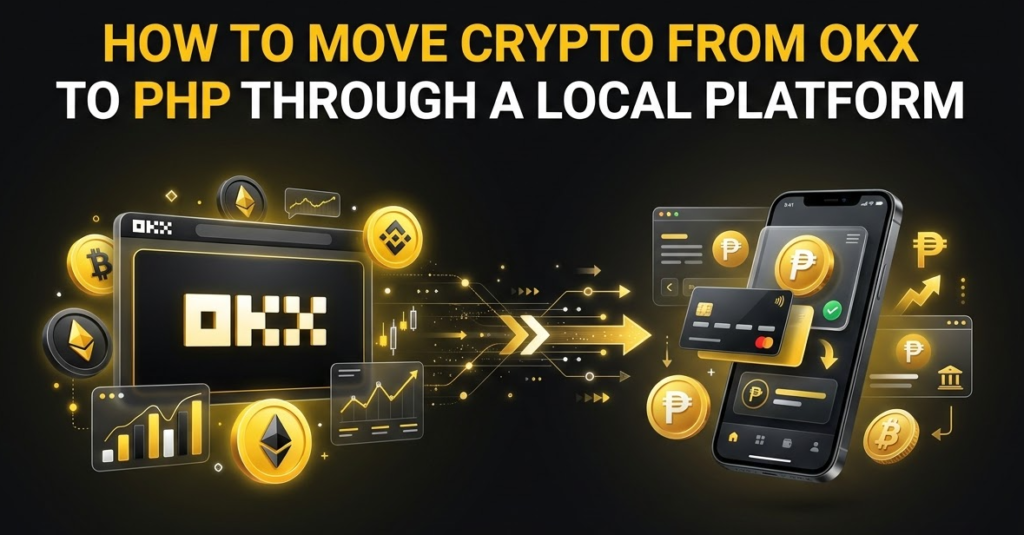
The usual off-ramp route is to transfer a supported crypto asset from OKX to a locally authorised platform, sell it for Philippine pesos, and then withdraw the PHP to an eligible bank account or e-wallet. Each step depends on current service availability.
The BSP’s VASP directory lists Coins.ph, PDAX and Maya Philippines among its active providers. This is a starting point for choosing a local service, not a guarantee that every token or payment method is supported by each one.
Choose and verify a local platform
Open the official website or app of your chosen provider. Complete the identity verification required for your account and check that you can access its crypto deposit, trading and PHP withdrawal features.
Before choosing a platform, verify:
- Whether it supports the asset you hold, such as USDT, BTC or ETH.
- Which blockchain networks it accepts for deposits.
- Whether deposits and trading for that asset are currently enabled.
- Whether the platform lets you sell the asset for PHP.
- Which banks and e-wallets are supported for cash-out.
- Current transaction fees, limits and processing times.
Coins.ph and PDAX are options to investigate, while Maya offers crypto services under its BSP VASP licence. Maya’s crypto terms and conditions explain that its virtual asset services are provided under a licence granted by the BSP to Maya Philippines Inc.
Service status matters as much as licensing. Coins.ph recently posted an advisory saying PHP cash-in via InstaPay and PESONet, along with QRPH collection services, was temporarily unavailable while the company implemented internal-control enhancements requested by the BSP. The notice said existing customers could still access other services, including cash-outs and crypto trading. Check the latest Coins.ph service advisory before relying on a particular payment route.
Transfer crypto from OKX
Once your local account is verified and you have confirmed the receiving platform’s deposit support, follow these steps:
Open the deposit page on the local platform. Select the exact asset you intend to receive. If the platform offers multiple networks, choose the network that matches the asset you plan to send.
Copy the deposit address. Copy the address shown by the receiving platform. If it provides a memo, tag or other reference field, record that too. Some assets require additional information beyond the wallet address.
Open the withdrawal page on OKX. Select the same asset and paste the receiving address. Choose the identical network and review the minimum withdrawal amount and fee.
Verify the details before confirming. Check the first and last characters of the address, the network and any required memo or tag. If you are unsure, stop and consult the receiving platform’s official instructions.
Complete the security checks. Confirm the transaction using the authentication method required by OKX. Save the transaction ID so you can track it on the relevant blockchain explorer.
Wait for the receiving platform to credit the deposit. Blockchain confirmation does not always mean the asset will be immediately available for trading. The receiving service may require a specified number of confirmations or additional compliance checks.
Do not send USDT over TRC-20, Solana or any other network merely because it has a lower fee. The receiving platform must explicitly support that token on that network. A network mismatch can result in delayed or lost funds.
Convert the asset to PHP and withdraw
After the deposit is credited, sell the asset using the local platform’s supported trading or conversion feature. Check the quoted exchange rate, spread and trading fee before confirming. The PHP amount you receive may differ from a headline market price because of liquidity and transaction costs.
Next, open the PHP withdrawal or cash-out page. Choose a supported destination, such as your own GCash, Maya or bank account, if the platform currently offers that route. Confirm the recipient name, account number, fee, transfer limit and processing time.
For example, Coins.ph’s cash-out guide explains its verification requirements and withdrawal process. Its InstaPay information lists a PHP 10 fee for a successful cash-out transaction, but fees and supported destinations can change, so check the amount displayed in the app before confirming. PDAX publishes its own cash-in and cash-out fee schedule, which lists different charges and limits depending on the transfer method.
Never assume the same fee or processing time applies to every e-wallet. InstaPay is designed for near-real-time transfers between participating institutions, while other methods may take longer. If a provider has temporarily disabled a payment rail, use only another route that the provider itself confirms is available.
Common misconceptions and risks
Myth: OKX has an active BSP VASP licence
The BSP’s published VASP directory reviewed for this article does not list OKX. Its July 15, 2026 directory names local providers such as Coins.ph, PDAX and Maya Philippines, but not OKX.
The SEC also named OKX in its 2025 advisory on unregistered crypto platforms. Unless the SEC or BSP publishes an official change, do not assume that OKX’s international regulatory status authorises it to offer services locally.
Myth: cryptocurrency ownership is illegal in the Philippines
That is too broad. The SEC’s action described above targeted unregistered platforms and their offering or marketing of crypto-asset services. It should not be read as a blanket statement that every individual who owns digital assets is committing an offence.
Still, the distinction is not a reason to ignore local rules. If you use a platform flagged by the SEC, you may face access difficulties and could have less local regulatory recourse if something goes wrong.
Myth: a VPN makes OKX available legally
A VPN may change how a website connection appears, but it does not change your residence, create a local licence or override a platform’s terms. Using one to bypass access restrictions can also create account-security or compliance problems. I would not recommend making a financial plan that depends on circumventing a regulator-directed block.
If you cannot access OKX, use official support channels to understand what account access or withdrawal options remain available. Do not share your password, recovery phrase or authentication codes with anyone claiming they can “unblock” the exchange for you.
Taxes and recordkeeping under Philippine rules
Crypto trading can have tax implications, and transferring an asset from one platform to another is not the same event as selling it for pesos. The precise tax treatment depends on the nature of the transaction, how the asset is used and the taxpayer’s circumstances.
The Department of Finance has discussed the Philippines’ commitment to implementing the OECD Crypto-Asset Reporting Framework to combat cross-border tax evasion and illicit financial flows. Its June 2025 announcement signals that crypto-related tax transparency is receiving greater attention.
Keep records of purchases, sales, fees, transfers, dates and PHP values. If you sell crypto for pesos or receive crypto-related income, do not assume that moving funds to a local e-wallet removes any applicable tax obligations. Consult the BIR’s current guidance or a qualified Philippine tax professional for advice specific to your situation.
Frequently asked questions
Is OKX legal and registered with the SEC in the Philippines?
OKX was named in the SEC’s August 2025 advisory on unregistered crypto-asset service providers. The BSP VASP directory reviewed for this article also does not list OKX. Do not treat OKX’s global operations as proof of Philippine authorisation.
Why is OKX blocked by PLDT, Smart or Globe?
In August 2025, the SEC flagged ten unregistered crypto platforms, including OKX. The NTC subsequently directed internet providers to restrict access, and PLDT, Smart and Globe implemented blocks reported by Philippine media.
Can existing Philippine users still withdraw from OKX?
It depends on the account and the withdrawal service currently available to you. Do not assume every withdrawal will be accepted. Check your account status, official OKX support information and the receiving platform’s deposit requirements before initiating a transfer.
How can I convert OKX crypto into PHP for GCash or Maya?
If your account can withdraw crypto, one possible route is to send a supported token and network to a verified local provider, sell it for PHP and withdraw to a supported e-wallet or bank account. Confirm current deposit networks, payment options, fees and service status first.
Which local crypto platforms should I consider?
Coins.ph, PDAX and Maya Philippines appear in the BSP’s published VASP directory reviewed for this article. Compare their current supported assets, deposit networks, trading fees, PHP withdrawal options and account-verification requirements rather than choosing based on brand recognition alone.
Is OKX Proof of Reserves enough to prove that my funds are safe?
No. OKX’s zk-STARK Proof of Reserves reports provide a way to verify specified asset and liability data at a particular snapshot. They do not guarantee future solvency, insure customer funds or replace local regulatory authorisation.
Is OKX available through a Philippine mobile app?
App availability can change, and an app appearing in a store does not establish that the platform is locally authorised. Check the official SEC and BSP records and the platform’s current local terms before using an app to trade.
Can I use a VPN to access OKX from the Philippines?
A VPN does not remove the platform’s local regulatory status or override its terms. Trying to bypass network restrictions can create account and compliance risks. Use official support channels instead.
Does Coins.ph charge a fee to cash out PHP?
Coins.ph’s published InstaPay guide lists a PHP 10 fee for a successful transaction, while its cash-out options and other fees can vary. Check the current amount shown in your account before confirming. Also check for service advisories that may affect the payment method you intend to use.
Do I have to pay tax when I sell crypto in the Philippines?
Tax obligations depend on the transaction and your circumstances. Keep records of sales, costs, fees and transfers, and consult current BIR guidance or a qualified tax professional if you need to determine how a particular transaction should be reported.
Final verdict: should Filipinos use OKX?
OKX is an established global exchange, but its international reputation does not resolve the Philippine licensing question. The SEC named it among unregistered platforms in 2025, and major Philippine internet providers subsequently restricted access after regulatory directives. The BSP directory reviewed for this guide lists local VASPs such as Coins.ph, PDAX and Maya Philippines, but not OKX.
For existing users, the priority is to protect account access, verify withdrawal options and avoid sending assets to an unsupported network. If your goal is to convert crypto into pesos, a verified local provider may offer a more practical route, provided it currently supports your asset and payment method.
The bottom line: owning crypto is a different question from using an offshore exchange that has not obtained the required local authorisation. Before trading or moving funds, check the latest SEC and BSP information, confirm the service status of your chosen platform and keep a clear record of every transaction.



