
Introduction: The Core Paradigm Shift
If you are new to crypto, the word wallet creates a pretty natural mental picture. You download an app, create an account, receive some Bitcoin or ETH, and it feels as though those coins are now sitting somewhere inside that application.
That picture is convenient, but technically wrong.
A crypto wallet is better understood as a cryptographic key management system and blockchain interface. The wallet does not physically contain your BTC, ETH, USDT, or NFTs. Those assets are represented by state recorded on their respective blockchains. What your wallet controls is the cryptographic authority needed to move or interact with those assets.
Ethereum’s own documentation makes this distinction very clearly: users do not literally hold cryptocurrency inside a wallet; they hold the private keys that control accounts whose balances are recorded on Ethereum’s ledger. (ethereum.org)
Once you understand that, almost everything else about wallets becomes easier.
You can understand why losing a phone does not necessarily mean losing your crypto. You can understand why a hardware wallet can be destroyed while your assets remain untouched. You can understand why a 24-word recovery phrase can be more important than the expensive device sitting on your desk.
And, perhaps most importantly, you can understand why someone can lose crypto without a hacker ever seeing their seed phrase.
That last point matters a lot in modern Web3.
The “Container Fallacy”: Your Crypto Isn’t Inside the Wallet
Imagine that you own 5 ETH.
The ETH is not sitting inside MetaMask. It is not physically stored inside a Ledger. It is not downloaded into your iPhone. There is no little pile of cryptocurrency waiting inside the wallet application.
Instead, the blockchain maintains the state associated with your account or smart contract. Your wallet holds or derives the cryptographic credentials that allow you to prove that you are authorized to perform certain actions.
For a traditional Ethereum externally owned account, or EOA, that authority comes from a private key. Ethereum describes an EOA as an account controlled by a private key, with the corresponding public key and address used to identify it on the network. (ethereum.org)
This distinction becomes practical when something goes wrong.
If your phone falls into a swimming pool, your crypto does not fall into the pool with it. If you have your recovery material properly backed up, you can restore access using another compatible wallet.
On the other hand, if somebody gets your private key or recovery phrase, the physical phone may be perfectly safe on your desk and your crypto can still disappear.
That’s the weird thing about crypto custody: the most valuable object may be a secret that you cannot see.
The Cryptographic Trio: Private Keys, Public Keys, and Wallet Addresses
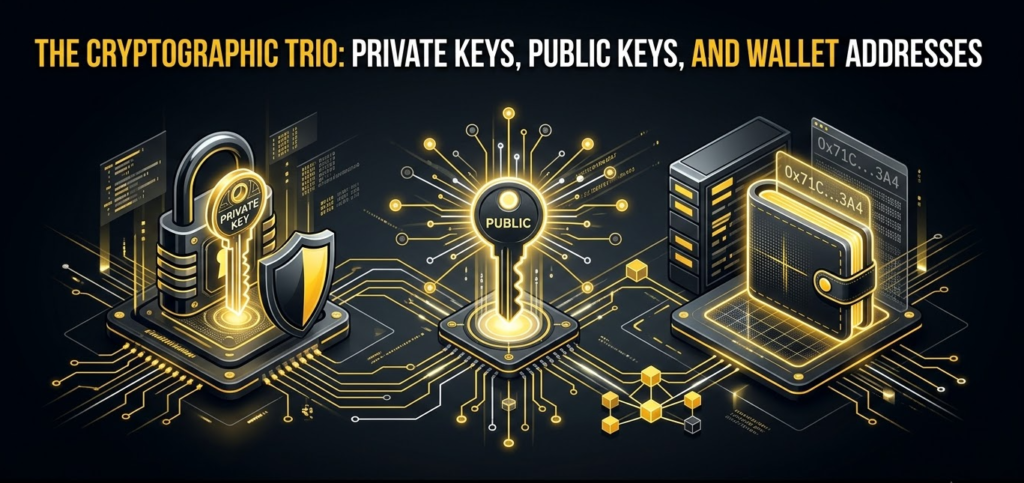
To understand how a crypto wallet works under the hood, you need to understand three related but different things:
- Private key: the secret cryptographic value used to authorize actions.
- Public key: the mathematical counterpart derived from the private key.
- Wallet address: a user-facing identifier derived or formatted from public-key information, depending on the blockchain.
They are connected, but they are not interchangeable.
The Private Key: Your Ultimate Cryptographic Secret
At the center of a traditional crypto wallet is the private key.
For Bitcoin and Ethereum’s common elliptic-curve systems, the private key is represented as a large random number. In the case of secp256k1, it is selected from a very large mathematical range, making properly generated keys computationally impractical to guess.
You can think of the private key as the ultimate authorization secret. Whoever controls it can generally create valid signatures for the corresponding account.
This is why you should never type a private key into a website just because that website tells you it needs to “verify your wallet.”
It doesn’t.
A legitimate DApp may ask your wallet to sign something. It should not ask you to reveal the private key itself.
This is also why screenshots are a terrible way to back up sensitive wallet material. A private key or recovery phrase stored as an image becomes a piece of data that can potentially be synchronized, indexed, copied, backed up, or exposed to malware.
The safest mental model is simple:
Your private key should be treated as authorization, not as a password you casually enter.
Public Keys and Elliptic Curve Cryptography
The public key is derived mathematically from the private key.
This is where elliptic curve cryptography enters the picture.
Bitcoin and Ethereum commonly use the secp256k1 elliptic curve for traditional key pairs, while other networks can use different cryptographic schemes. Solana, for example, uses Ed25519-based public-key cryptography rather than simply copying Bitcoin’s secp256k1 model.
The important idea is not the curve equation itself. You do not need to become an elliptic-curve mathematician to use a wallet safely.
What matters is the direction of the relationship.
A private key can be used to derive the corresponding public key, but knowing the public key does not provide a practical way to reverse the process and recover the private key.
That one-way property is fundamental to the security model.
A wallet can therefore safely expose your public address to a blockchain explorer or DApp without giving that application your private key.
From Public Key to Wallet Address
A wallet address is not always simply the public key written out in full.
Different blockchains have different address-generation rules.
On Ethereum, for example, the public key is processed with the Keccak-256 hash function, and the final 20 bytes are used to form the familiar hexadecimal address beginning with 0x. Ethereum’s official documentation describes this process and notes that a standard EOA address is represented by 20 bytes, or 40 hexadecimal characters, plus the 0x prefix. (ethereum.org)
So when you see something like:
0x5e97870f263700f46aa00d967821199b9bc5a120
you are not looking at someone’s private key.
You’re looking at an address derived from public-key information.
That’s an important distinction because people often use “wallet address” and “public key” as if they mean exactly the same thing. They don’t.
Private Key vs. Public Key vs. Address
| Component | Can you share it? | Main purpose |
|---|---|---|
| Private key | Never | Authorize cryptographic signatures |
| Public key | Generally yes | Verify signatures / derive identifiers |
| Wallet address | Yes | Receive assets and identify an account |
If you remember only one rule from this section, make it this:
Your address tells people where to send assets. Your private key tells the blockchain that you are authorized to move them.
Key Generation: How One Seed Can Control Thousands of Addresses
Most modern self-custodial wallets do something more sophisticated than generating one completely independent private key every time you create an account.
They commonly use hierarchical deterministic, or HD, wallet architecture.
This is one of the most useful innovations in practical crypto custody because it allows a single backup to recreate a large family of related keys.
The Bitcoin BIP-32 specification defines hierarchical deterministic wallets, while BIP-39 defines a mnemonic system for representing wallet entropy as a human-readable sequence of words. The Bitcoin BIPs repository lists both standards among its deployed application specifications. (GitHub)
Entropy Becomes a Recovery Phrase
When you create a modern wallet, the wallet needs a source of randomness.
That randomness is called entropy.
BIP-39 provides a standardized way of turning appropriate entropy into a mnemonic phrase. Depending on the entropy size and checksum, the resulting phrase can contain 12, 15, 18, 21, or 24 words. The BIP-39 specification describes the mnemonic as a human-friendly representation that is then converted into a binary seed for deterministic wallet generation. (GitHub)
This is why your recovery phrase feels strangely simple compared with the mathematics underneath it.
You may see:
word1 word2 word3 ...
but those words ultimately represent cryptographic information from which wallet keys can be deterministically generated.
And that’s why the phrase is so powerful.
It is not merely a “backup password.”
It is a recovery mechanism for the wallet’s key hierarchy.
One Seed, Many Keys
The next layer is HD derivation.
Instead of manually backing up dozens or hundreds of private keys, the wallet derives child keys from a master seed according to deterministic rules.
Conceptually, the process looks like this:
Recovery Phrase → Seed → Master Key → Derivation Path → Child Key → Address
A derivation path can look intimidating:
m/44'/60'/0'/0/0
But it is essentially a roadmap telling the wallet which branch of the deterministic key tree it should use.
Bitcoin’s BIP-32 specification was specifically designed to make deterministic wallets interoperable between different wallet implementations. (GitHub)
BIP-44 then extends the HD concept with a convention for organizing accounts and different cryptocurrency environments.
This is why you can create a wallet once and then generate multiple Ethereum addresses, Bitcoin accounts, or other supported accounts without writing down a completely new private key for every one.
Why Recovery Compatibility Matters
There is an important practical lesson here.
A recovery phrase does not magically guarantee that every wallet application will restore the exact same addresses.
The wallet must use compatible standards, derivation paths, passphrase settings, and network-specific conventions.
This is why someone can correctly enter a seed phrase into another wallet and still see an apparently empty account.
The seed may be correct.
The wallet may simply be looking down a different branch of the derivation tree.
That is one reason experienced users record not only their recovery phrase but also important wallet configuration details when appropriate.
How a Crypto Wallet Actually Signs a Transaction

Now we get to the part that makes a crypto wallet feel almost magical.
You click Send.
A few seconds later, the blockchain says the transaction is valid.
What’s actually happening?
A surprisingly sophisticated cryptographic workflow has taken place behind that simple button.
Step One: The Wallet Constructs the Transaction
Suppose you want to send ETH to another address.
Your wallet first needs to construct the transaction.
Depending on the network, the transaction can contain information such as:
- Sender or originating account
- Recipient
- Amount
- Nonce or sequence information
- Network identifier
- Fee parameters
- Contract call data
- Gas-related parameters
Ethereum’s documentation describes transactions as cryptographically signed instructions that change the state of the network. (ethereum.org)
The wallet interface is therefore doing more than displaying your balance. It is assembling the exact message that you are being asked to authorize.
This is where wallet software becomes extremely important.
If the transaction data says “send 1 ETH to Bob,” but the application tricks you into signing something else, the cryptography will not magically save you.
Cryptography proves that you authorized the message.
It does not prove that you understood the message.
That’s a subtle distinction, and it explains many modern Web3 attacks.
Step Two: The Wallet Signs the Transaction
Once the transaction is constructed, the wallet creates a cryptographic signature using the private key.
For Ethereum’s traditional EOAs, that involves ECDSA over secp256k1.
The wallet does not reveal the private key to the blockchain.
It produces a signature that can be verified using the corresponding public-key information.
This is an important correction to a common explanation: the wallet does not “encrypt the transaction with your private key.” Digital signatures and encryption are different cryptographic operations.
The private key is used to sign.
The network later verifies.
That’s the elegant part.
Step Three: The Signed Transaction Is Broadcast
After signing, the wallet can hand the signed transaction to an RPC endpoint or another node interface.
The RPC provider acts as a communication bridge between the wallet software and the blockchain network.
The signed transaction is then propagated through the network and, depending on the chain, enters a transaction pool or mempool before being included in a block.
Your private key does not need to travel through that process.
The signed transaction does.
That’s a huge difference.
Step Four: Validators Verify the Signature
When the network receives the transaction, nodes and validators can verify whether the signature is valid and whether the transaction satisfies the protocol’s rules.
If everything checks out, the transaction can be included in a block and the blockchain state changes accordingly.
Ethereum describes this basic mechanism directly: transactions initiated by EOAs are cryptographically signed and broadcast to the network, where they update the state when accepted. (ethereum.org)
From the user’s perspective, it looks like:
Click → Confirm → Done
Underneath, it’s:
Construct → Hash → Sign → Broadcast → Validate → Execute → Record
Pretty neat.
Why Hardware Wallets Can Sign Without Giving Your Computer the Private Key
This is where hot and cold wallet architecture starts to make practical sense.
With a normal software wallet, the private key or the material required to derive it is ultimately accessible to the software environment on your phone or computer, although it may be protected by encryption and operating-system security.
A hardware wallet changes the architecture.
The signing operation takes place on the dedicated device rather than handing the raw private key to your computer.
Your laptop can prepare a transaction. The hardware wallet can inspect or receive the transaction, sign it internally, and return the signature.
The computer receives the signature.
It does not need to receive the private key.
This is why hardware wallets are so useful for long-term custody.
But don’t misunderstand what they protect you from.
A hardware wallet can protect against a compromised computer stealing your private key.
It cannot automatically protect you from authorizing a transaction you intentionally approve.
That difference becomes critical in Web3.
Crypto Wallet Types: Custody and Architecture
Once you understand the key mechanics, the huge number of wallet products becomes much easier to organize.
Instead of thinking about wallets as hundreds of unrelated apps and devices, I prefer to classify them across a few fundamental dimensions.
Self-Custodial vs. Custodial Wallets
The first question is:
Who controls the keys?
In a self-custodial wallet, you control the private keys or recovery mechanism.
In a custodial wallet, another organization controls the underlying keys.
A centralized exchange is the obvious example.
You may see a balance of 2 BTC on your exchange account, but you don’t personally possess the private key that authorizes withdrawals from the exchange’s underlying wallets.
This is where the classic phrase “not your keys, not your coins” comes from.
It is deliberately blunt.
The phrase isn’t saying that centralized exchanges are automatically evil or unusable. Exchanges are extremely useful for onboarding, trading, liquidity, and fiat conversion.
The point is simply that custody introduces a dependency.
With self-custody, you assume the responsibility.
With custody, you outsource part of that responsibility.
Hot vs. Cold Wallets
The second question is:
How exposed are the keys to connected systems?
A hot wallet is generally connected to an internet-enabled environment.
Browser extensions, desktop wallets, and mobile wallets fall into this category.
They’re convenient because you can open a DApp, connect your wallet, sign a transaction, and continue with your day.
Cold wallets take the opposite approach.
They aim to keep private-key operations isolated from internet-connected environments.
A hardware wallet is a common example, but cold storage is broader than a particular piece of hardware.
Multisig
Multisig changes the authorization model again.
Instead of relying on one private key, a wallet can require multiple independent signatures.
A 2-of-3 configuration, for example, means two out of three designated signers must approve an action.
This is particularly useful for:
- DAO treasuries
- Company funds
- Family wealth
- Joint custody
- High-value Bitcoin storage
The key advantage is that compromising one signer does not necessarily compromise the entire vault.
The trade-off is operational complexity.
You have added more people, more devices, more backups, and more things that can go wrong.
Security is rarely about finding one perfect technology. It’s about choosing which risks you are willing to manage.
MPC Wallets
MPC, or Multi-Party Computation, takes a different approach.
Rather than keeping one conventional private key in a single location, an MPC system uses cryptographic protocols that distribute signing authority across multiple parties or devices.
The exact architecture varies significantly between providers, so it is a mistake to assume every “MPC wallet” works identically.
The attractive idea is that there does not have to be one obvious seed phrase sitting in a drawer that represents the entire wallet.
For institutional users, this can make key management, policy enforcement, approvals, and recovery much more sophisticated than a basic single-key wallet.
But MPC also introduces its own trust and availability considerations, particularly when third-party infrastructure participates in the signing process.
Smart Contract Wallets and Account Abstraction
The next evolution is even more interesting.
Traditional Ethereum EOAs are fundamentally based on public/private key pairs. Ethereum’s documentation describes them as accounts controlled by private keys, while smart contract accounts are controlled by code. (ethereum.org)
Account abstraction allows wallet logic to become programmable.
Instead of saying:
“This one private key must authorize everything.”
you can build rules such as:
- Require multiple approvals for large transactions.
- Allow recovery through trusted guardians.
- Use different authentication methods.
- Bundle several operations together.
- Allow someone else to sponsor transaction fees.
- Use alternative validation logic.
ERC-4337 introduced an approach that supports account abstraction without requiring a consensus-layer protocol change. It uses UserOperation objects, bundlers, and an EntryPoint contract to process smart-account activity. (Ethereum Improvement Proposals)
Ethereum’s current account-abstraction documentation highlights capabilities such as flexible security rules, account recovery, transaction batching, and sponsored gas payments. (ethereum.org)
This is one of the reasons I don’t think the future of wallets will look exactly like today’s seed-phrase experience.
The seed phrase is powerful.
But it’s not necessarily the final user interface for digital ownership.
How Wallets Connect to Web3 DApps?

A crypto wallet becomes much more interesting once you connect it to a DApp.
You visit a decentralized exchange, NFT marketplace, lending protocol, or blockchain game.
The website says:
Connect Wallet
You click it.
Your wallet appears.
What happens next?
The DApp generally does not receive your private key.
Instead, the wallet acts as the authorization layer between the website and blockchain.
On Ethereum-compatible environments, browser wallets have traditionally exposed provider interfaces that allow websites to request blockchain interactions. Mobile applications can also use connection protocols such as WalletConnect to establish sessions between wallets and DApps.
The basic security principle remains the same:
The DApp can request. The wallet decides.
That distinction is extremely important.
A malicious website can ask your wallet to sign something dangerous, but it should never need your seed phrase to make that request.
And this leads directly to one of the biggest misconceptions in Web3 security.
Token Approvals vs. Private-Key Theft
When people hear that a wallet has been “hacked,” they often imagine a hacker somehow stealing the private key.
That absolutely can happen.
But it is not the only route to losing funds.
On Ethereum and other smart-contract networks, users frequently authorize contracts to spend tokens on their behalf.
For example, when you interact with a decentralized exchange, you may approve a smart contract to spend a certain amount of USDC, USDT, or another token.
MetaMask explains that token approvals give a DApp permission to access and move a particular token on your behalf, and that malicious or excessively broad approvals can become an attack vector. (MetaMask)
Imagine you hold $10,000 worth of a particular ERC-20 token.
You connect to a fake DEX.
The website tells you:
“Approve token to continue.”
You sign the transaction.
Your seed phrase was never exposed.
Your private key was never copied.
But you just authorized a malicious contract to access your tokens.
That’s enough.
The blockchain doesn’t know that you were tricked.
It only knows that a valid signature authorized a valid operation.
Approve vs. Permit
The situation becomes even more interesting with signature-based authorization systems.
Some tokens and applications support permit-style mechanisms where the user signs authorization data rather than submitting a traditional on-chain approval transaction first.
The exact implementation varies, but the security lesson remains the same:
A signature can have economic consequences even when you are not sending coins directly.
This is why I always recommend treating unfamiliar signature requests with the same seriousness as a withdrawal.
Don’t assume that “Sign” means harmless.
Sometimes it absolutely isn’t.
Why Disconnecting a DApp Isn’t Enough
Another common mistake is confusing a wallet connection with a token allowance.
You might disconnect your wallet from a website, but an existing token approval can remain active on-chain.
MetaMask specifically distinguishes disconnecting from a DApp from revoking smart-contract allowances. (Trung Tâm Trợ Giúp MetaMask)
That means if you have interacted with a questionable DApp, you should check both:
- Which websites are connected to your wallet.
- Which smart contracts have permission to spend your tokens.
Those are different things.
Blind Signing: Where Hardware Wallets Stop Saving You
This is one of the most important lessons for anyone moving from a hot wallet to a hardware wallet.
People often think:
“My Ledger is offline, so I can’t be drained.”
That’s too simplistic.
Your hardware wallet may do an excellent job protecting the private key.
But if you willingly approve a malicious contract interaction, the device may faithfully sign it.
Think about it this way.
A hardware wallet is like a very secure vault clerk.
The clerk can make sure nobody steals your signing authority from the vault.
But if you walk into the vault and say:
“Please authorize this transaction.”
the clerk may still execute your instruction.
The security challenge therefore moves from protecting the key to understanding what you’re signing.
This is why transaction simulation, readable contract information, hardware-device confirmation screens, and careful DApp verification have become increasingly important.
MetaMask itself recommends examining token approval details, checking the requesting contract, and avoiding unlimited permissions when they are unnecessary. (Trung Tâm Trợ Giúp MetaMask)
Cold storage protects one layer of the system.
It does not make the entire Web3 experience magically trustworthy.
Hot vs. Cold vs. Custodial: Putting It All Together
Here’s the simplest way I would map the major wallet architectures:
| Wallet architecture | Key control | Connectivity | Typical use |
|---|---|---|---|
| Hot software wallet | User | Online | DeFi, trading, NFTs |
| Hardware cold wallet | User | Mostly isolated | Long-term holdings |
| Custodial exchange | Exchange | Online | Trading and fiat on-ramp |
| Multisig vault | Multiple users/devices | Flexible | Treasury and shared funds |
| MPC wallet | Distributed parties | Online/warm | Institutional or advanced custody |
| Smart contract wallet | Programmable | Online/warm | Flexible Web3 accounts |
There is no universal “best crypto wallet.”
There is only a wallet architecture that makes sense for your threat model.
If you trade every day, an air-gapped Bitcoin signer may be incredibly secure but painfully inconvenient.
If you hold your retirement-sized crypto portfolio, keeping everything inside a browser extension because it is convenient is probably a poor risk decision.
If you manage a DAO treasury, one seed phrase in one founder’s desk drawer is a terrible organizational model.
Context matters.
A Practical Wallet Architecture for Real Users
If I were designing a wallet setup for someone who actively uses crypto but also wants serious security, I would not try to make one wallet do everything.
I’d separate the roles.
Your Hot Wallet: The Spending Account
Keep only the funds you actually need for active Web3 use.
This wallet is where you connect to:
- DEXs
- NFT marketplaces
- DeFi protocols
- Blockchain games
- Experimental applications
- New protocols you’re testing
The advantage is convenience.
The disadvantage is exposure.
Every DApp interaction is another opportunity to encounter a malicious contract, phishing site, fake token, signature request, or compromised front end.
Your Cold Wallet: The Savings Account
Your long-term holdings belong in a different environment.
A hardware wallet can dramatically reduce exposure to malware running on your everyday computer because the private key does not need to be exposed to the computer during the signing process.
For significant holdings, you should also think about the recovery layer.
A hardware wallet is not your backup.
The recovery phrase is the backup.
If your device disappears but the seed remains secure, you can generally recover the wallet using a compatible implementation.
If both disappear, the situation is very different.
Your Multisig or MPC Layer: The Vault
For genuinely large portfolios, shared assets, or institutional funds, you may want to move beyond single-key custody.
Multisig provides explicit multi-party approval.
MPC can distribute signing capability through cryptographic protocols.
Neither is automatically better.
They’re different ways of reducing dependence on one secret.
Technical Comparison of Major Wallet Architectures
| Architecture | Key location | Signing model | Recovery | Main risk |
|---|---|---|---|---|
| Hot EOA wallet | Encrypted software/device storage | Single-key signature | Seed phrase | Phishing, malware, malicious DApps |
| Hardware wallet | Dedicated secure signing environment | On-device signature | Seed / backup | Blind signing, physical compromise |
| MPC wallet | Distributed key shares | Threshold signing | Distributed recovery | Provider/infrastructure dependency |
| Multisig | Multiple independent keys | M-of-N approval | Multiple signers | Coordination and signer loss |
| Smart contract wallet | Contract + authorization keys | Programmable validation | Guardians / custom logic | Contract vulnerabilities |
| Custodial wallet | Third-party infrastructure | Provider-controlled | Account recovery | Counterparty risk |
This table is more useful than simply asking whether a wallet is “safe.”
Security is multidimensional.
What Happens If You Lose Your Wallet?
Let’s walk through a few scenarios.
You Lose Your Phone
If the phone contained a self-custodial software wallet, the blockchain does not care that the phone is gone.
Your assets remain associated with the relevant blockchain accounts.
If you have your recovery phrase and the wallet implementation is compatible, you can restore access on another device.
The critical step is making sure nobody else can access the old device or your backup.
You Lose Your Hardware Wallet
Again, the device itself is not the blockchain account.
If the recovery phrase remains secure, you can typically restore the wallet on another compatible device.
This is why a hardware wallet should never be treated as the only copy of your wallet.
You Lose the Seed Phrase
This is much more serious.
If your only recovery mechanism disappears and the device eventually becomes unavailable, there may be no centralized company capable of resetting your wallet.
That’s the trade-off of self-custody.
You gain control.
You also inherit responsibility.
Someone Finds Your Seed Phrase
This is potentially catastrophic.
The attacker doesn’t need your phone.
They don’t need your Ledger.
They don’t need your password.
If the phrase gives them access to the wallet’s keys, they can potentially restore the wallet elsewhere and authorize transactions themselves.
So don’t take photos of it.
Don’t email it.
Don’t put it into cloud notes.
Don’t paste it into a “wallet recovery” website.
And definitely don’t give it to someone claiming to be customer support.
The Real Security Boundary: Your Signing Decision
After all the technical explanations, there is one lesson I want you to keep.
A wallet is only one component of your security model.
Your device matters.
Your seed backup matters.
Your hardware matters.
Your wallet software matters.
But so does your behavior.
You can own one of the most secure hardware wallets available and still lose funds by signing a malicious transaction.
You can use a beautifully audited open-source wallet and still type your seed phrase into a fake website.
You can use multisig and still lose access if all your signers are badly managed.
You can use MPC and still introduce a dangerous dependency on a provider.
Technology reduces risk.
It doesn’t eliminate judgment.
How to Think About Wallet Security Like a Security Engineer
Instead of asking:
“Which wallet is the safest?”
ask a better series of questions.
What am I protecting?
Is it $200 of spending money?
$20,000 of trading capital?
Or a portfolio that represents years of savings?
The answer should influence the architecture.
What am I protecting it from?
Different wallets solve different problems.
| Threat | Useful defense |
|---|---|
| Malware stealing software keys | Hardware wallet |
| Phishing | Strong operational discipline |
| One compromised signer | Multisig / MPC |
| Lost device | Secure recovery backup |
| Fire or water | Metal seed backup |
| Malicious DApp | Transaction simulation and careful signing |
| Exchange failure | Self-custody |
| Single-person failure | Multisig / distributed custody |
| Seed phrase theft | Offline physical backup |
Notice something interesting.
There is no single product in that table.
That’s intentional.
Security is a system, not a logo.
The Future of Crypto Wallets
Traditional wallets were built around a simple concept:
Protect the private key.
That model works remarkably well, but it puts a huge burden on users.
Write down your seed.
Protect it.
Never lose it.
Never type it anywhere.
Don’t expose it.
Don’t let anyone photograph it.
Don’t forget where you put it.
For ordinary users, that’s a lot to ask.
Account abstraction is an attempt to move some of that complexity into programmable wallet infrastructure.
Ethereum’s current documentation highlights features such as flexible security rules, social recovery, transaction batching, sponsored gas payments, and custom authorization logic as important advantages of smart contract accounts. (ethereum.org)
ERC-4337 takes this further through UserOperation objects and bundlers, allowing smart-account functionality without requiring a fundamental consensus-layer change to Ethereum. (Ethereum Improvement Proposals)
Imagine a future wallet where you don’t have one terrifying recovery phrase that represents everything.
Instead, you might have:
- A phone-based authentication key.
- A hardware backup key.
- A trusted family member as recovery guardian.
- A daily spending limit.
- A second approval requirement for large transfers.
- A policy that blocks unknown contracts.
- A mechanism for someone else to sponsor your gas.
That’s much closer to how people expect modern financial accounts to behave.
And frankly, it’s probably easier for mainstream users to understand.
How Does a Crypto Wallet Work? A Simple Mental Model
If all of the cryptographic details feel overwhelming, strip the system down to five steps.
First, the wallet generates or imports secret key material.
That material may come directly from randomly generated keys or from a recovery phrase and HD derivation system.
Second, the wallet derives public information.
The private key produces public-key information, which is then transformed according to the blockchain’s address rules.
Third, the wallet constructs transactions.
When you want to move assets or interact with a smart contract, the wallet prepares the appropriate transaction or signing request.
Fourth, the wallet signs.
The private key remains secret while the wallet creates a cryptographic signature proving authorization.
Fifth, the network verifies and executes.
Nodes and validators check the signature and protocol rules before the transaction changes blockchain state.
That’s the whole machine.
Everything else – hardware wallets, seed phrases, multisig, MPC, smart accounts, WalletConnect, DApp interfaces – is essentially about making those five steps safer, more usable, more flexible, or easier to recover.
Frequently Asked Questions
Does a crypto wallet actually store cryptocurrency?
No. Crypto assets are represented on the relevant blockchain’s ledger rather than sitting physically inside your wallet application or hardware device.
The wallet manages the cryptographic credentials that allow you to authorize actions involving those assets. Ethereum’s official account documentation explicitly explains that users hold private keys while the funds themselves remain recorded on Ethereum’s ledger. (ethereum.org)
What is the difference between a private key, public key, and wallet address?
A private key is the secret cryptographic value used to authorize signatures. A public key is derived from that private key and can be used to verify signatures or derive an account identifier. A wallet address is the user-facing identifier used to receive assets and interact with the network.
On Ethereum, the address is derived from the public key using Keccak-256 and the final 20 bytes of the hash. (ethereum.org)
Think of it as:
Private key = secret authorization
Public key = verification information
Address = destination identifier
What is a seed phrase?
A seed phrase, also called a mnemonic phrase or recovery phrase, is a human-readable representation of wallet entropy defined by standards such as BIP-39.
BIP-39 specifies how mnemonic words are generated and converted into a binary seed that can then be used with deterministic wallet systems such as BIP-32. (GitHub)
The important point is that your seed phrase is extremely sensitive.
Anyone who obtains it may be able to recreate the wallet and access its assets.
How does a wallet sign a transaction without exposing the private key?
The wallet uses the private key to create a digital signature over the relevant transaction data.
The private key itself does not need to be transmitted to the blockchain.
Network participants can use the corresponding public information to verify that the signature is valid.
With hardware wallets, the signing operation can happen inside the dedicated device, further isolating the private key from the connected computer.
What is the difference between a hot wallet and a cold wallet?
A hot wallet operates in an internet-connected environment, such as a mobile phone or browser extension.
A cold wallet is designed to isolate private-key operations from internet-connected environments, commonly through dedicated hardware.
Hot wallets are generally more convenient for active Web3 use.
Cold wallets are generally better suited to protecting assets that do not need frequent interaction.
What is the difference between custodial and self-custodial wallets?
With a self-custodial wallet, you control the keys or authorization mechanism.
With a custodial wallet, a third party controls the underlying keys on your behalf.
A centralized exchange account is a common example of custodial infrastructure.
Self-custody gives you direct control but also means you become responsible for key protection and recovery.
What happens if you lose your seed phrase or hardware wallet?
Losing the hardware device does not necessarily mean losing the assets. If you have the correct recovery phrase and configuration, you can generally restore the wallet on a compatible device.
Losing the only copy of the recovery information is much more serious.
In a genuinely self-custodial system, there may be no company with a master reset button.
That is both the strength and the responsibility of self-custody.
How do DApps connect to a crypto wallet safely?
DApps typically communicate with wallets through wallet-provider interfaces, connection protocols, or systems such as WalletConnect.
The DApp can request information or ask the wallet to sign a transaction, but it should not receive your private key or recovery phrase.
Your wallet is supposed to remain the authorization boundary.
That means you should treat every signature request as something that deserves inspection rather than blindly clicking Confirm.
Can someone drain a wallet without stealing the seed phrase?
Yes.
A malicious DApp can potentially trick a user into authorizing a dangerous token approval, signature, or smart-contract interaction.
For example, token approvals can give a smart contract permission to move tokens on a user’s behalf. MetaMask warns that malicious or excessive approvals can be used as an attack vector and recommends reviewing the permissions being requested. (MetaMask)
This is why keeping your seed phrase offline is necessary but not sufficient.
You also need to understand what you’re signing.
Final Thoughts: A Wallet Is Really a Permission System
When you first enter crypto, it’s tempting to think about wallets as digital containers.
That mental model is easy, but it hides the interesting part.
A wallet is really a permission system built around cryptography.
Your assets remain on a blockchain. Your keys provide authority. Your wallet turns human intentions into transactions. Cryptographic signatures prove authorization. Nodes and validators verify those signatures. Smart contracts add programmable rules on top.
From there, everything else is a variation on the same theme.
Hot wallets prioritize accessibility.
Cold wallets prioritize isolation.
Custodial wallets outsource key management.
Multisig distributes authority.
MPC distributes signing capability.
Smart contract wallets make authorization programmable.
Once you see wallets this way, choosing one becomes much less about finding a mythical “best crypto wallet” and much more about designing the right security architecture for your own situation.
For a small amount you use every day, convenience may matter most.
For long-term holdings, isolation and recovery matter more.
For a business or DAO, shared control may be the right answer.
And for the next generation of Web3 users, programmable smart accounts may eventually make the old seed-phrase experience feel as awkward as carrying a paper map feels today.
But one principle isn’t going away anytime soon:
Your wallet doesn’t protect you from every bad decision. It gives you the tools to make good ones.
Learn what your keys do. Understand what you’re signing. Separate spending money from long-term holdings. Back up recovery material properly. And whenever a wallet asks you to approve something you don’t understand, stop.
That pause can be worth more than any security feature on the device.