

Binance South Africa trust scorecard
| Evaluation metric | What South African users should know |
|---|---|
| Platform legitimacy | Binance is an established international exchange, but platform size alone does not guarantee customer protection. |
| Local regulatory status | Crypto assets are regulated within South Africa’s financial framework. Binance’s authorization for a particular local service should be checked against official records rather than assumed. |
| Main regulators | The Financial Sector Conduct Authority (FSCA) regulates relevant financial services and crypto-asset financial products. The Financial Intelligence Centre (FIC) oversees anti-money-laundering obligations under the applicable legal framework. |
| Supported fiat currency | ZAR availability and payment options can vary. Check the live Binance deposit and P2P interfaces before transferring money. |
| Identity verification | Binance requires identity verification for its standard services. Additional information may be requested depending on the product or transaction. |
| Proof of Reserves | Binance publishes cryptographic reserve-verification information, but this is not equivalent to a comprehensive independent financial audit. |
| SAFU emergency fund | Binance’s Secure Asset Fund for Users is an additional protection mechanism, not a government-backed deposit guarantee. |
| Tax obligations | SARS may tax crypto profits or income under the rules applicable to the taxpayer and transaction. |
My view is that Binance can be a useful option for eligible South African traders, but you should separate three questions: whether the exchange is legitimate, whether the particular service is authorized for the South African market, and whether the risks fit your circumstances. They overlap, but they are not interchangeable.
Is Binance legal in South Africa? Understanding FSCA and FIC rules

Cryptocurrency is not illegal in South Africa, but that does not mean every crypto company can offer every service without authorization. The distinction between an individual’s ability to trade crypto and a provider’s right to operate a regulated business is essential.
What does the FSCA regulate?
The Financial Sector Conduct Authority (FSCA) supervises market conduct and regulates financial services within its mandate. In 2022, South Africa classified crypto assets as financial products under the Financial Advisory and Intermediary Services (FAIS) Act. Businesses providing relevant advice or intermediary services may therefore need authorization.
The FSCA’s guidance for financial service providers explains that crypto-asset service providers must obtain the relevant licence to conduct regulated business. However, you should look at the specific legal entity and authorization rather than assume every service on an international exchange has the same regulatory status.
Binance’s own licences and legal disclosures state that Binance RSA offers crypto products and services, excluding crypto futures and options, under an exemption in FSCA FAIS Notice 25 of 2023. The same page says crypto futures and options are offered through Binance Bahrain BSC in its capacity as a juristic representative of FiveWest OTC Desk, an authorized South African financial services provider.
That is more precise than either saying Binance is “fully licensed by the FSCA” or claiming it has no South African regulatory arrangement at all. An exemption for specified services is not the same as a blanket licence covering every product, and the entity offering the service matters.
Before using Binance, check the latest FSCA register and licensing information and read Binance’s current South African disclosures. If you intend to use derivatives, leveraged products, or another service beyond ordinary spot trading, verify its legal provider and authorization separately.
What does the FIC Travel Rule mean for your crypto transfers?
South Africa has also introduced requirements designed to make crypto transfers more traceable and reduce money laundering and terrorist financing.
The Financial Intelligence Centre (FIC) issued Directive 9 to implement the Travel Rule for crypto-asset transfers. It took effect on 30 April 2025, requiring covered crypto-asset service providers to collect, retain, and transmit specified information about the originator and beneficiary of transfers. The FIC’s official announcement explains the requirements.
In practice, Binance may ask for information about who is sending or receiving crypto, especially when you deposit crypto from an external wallet or withdraw it to another provider. You may need to identify whether a wallet belongs to you or to another person and provide additional beneficiary details.
Binance announced changes for South African customers beginning on 30 April 2025, including requests for sender information on crypto deposits and beneficiary information on withdrawals. See its South African crypto-transfer notice.
These checks are not necessarily a sign that your account is in trouble. They can be part of the provider’s legal obligations. If you transfer funds between your own wallets, keep the wallet addresses and transaction records available in case the exchange requests supporting information.
SARS tax obligations: don’t confuse exchange activity with tax-free income
Crypto profits can be taxable in South Africa. The treatment depends on the facts, including why you acquired the asset, how you used it, how frequently you trade, and whether the activity resembles a business.
SARS explains that crypto-asset transactions are subject to ordinary tax principles, meaning income tax or capital gains tax may apply depending on the circumstances. Its crypto-asset tax guidance is the best starting point for understanding how to report your activity.
As a broad guide:
-
Frequent or business-like trading: Profits may be treated as ordinary income and taxed at the applicable rate.
-
Long-term investment disposals: Gains may be subject to capital gains tax, depending on the circumstances.
-
Staking or other rewards: These may create taxable income, depending on how and when the rewards are received and the relevant tax rules.
-
Crypto-to-crypto trades: Swapping one crypto asset for another can have tax consequences even when you do not withdraw rand to a bank account.
The last point catches people out. Moving funds from Binance to your FNB, Capitec, Standard Bank, Absa, or Nedbank account is not necessarily the event that creates the tax liability. A taxable disposal may already have occurred when you sold or exchanged the asset.
South Africa implemented the OECD’s Crypto-Asset Reporting Framework (CARF) on 1 March 2026. Under the framework, covered crypto-asset service providers report specified transaction information to SARS. SARS confirmed that individual taxpayers must still declare their crypto transactions through their normal income-tax returns; CARF does not replace personal tax filing. Read the SARS CARF announcement.
Keep your Binance trade history, deposit and withdrawal records, transaction fees, acquisition costs, and rand valuations. If your trading is frequent or your activity is substantial, a tax professional can help determine the correct treatment rather than relying on a generic online calculation.
Is Binance safe for South African users?
Regulatory compliance and account security are two different things. Even if you use an authorized service, your assets can still be lost through phishing, compromised credentials, market volatility, or a mistake with a crypto transfer.
Proof of Reserves: a useful check with limitations
Binance’s Proof of Reserves portal lets users check whether their account balances were included in a cryptographic snapshot. Binance describes its use of Merkle trees and zk-SNARKs to support that process.
A Merkle tree combines many records into a cryptographic structure. A user can check that their balance was included in the relevant snapshot without seeing every other customer’s private information. This provides more transparency than a simple promise that funds are backed.
However, a reserve snapshot is not a comprehensive independent audit of an exchange’s finances. It does not necessarily establish that every liability has been counted or guarantee that withdrawals will always be available. The PCAOB’s explanation of Proof of Reserves outlines these limitations.
If you are using Binance from South Africa, look at the date of the snapshot and the assets covered. Treat PoR as one useful part of your assessment, not as proof that every possible risk has disappeared.
SAFU: an emergency fund, not deposit insurance
Binance’s Secure Asset Fund for Users (SAFU) is intended to provide an additional layer of protection in extreme situations, such as certain security incidents. Binance reported that SAFU held $1 billion in USDC in January 2026, according to its official SAFU FAQ.
That is a substantial reserve, but it is not a South African government-backed deposit guarantee. It does not promise compensation for every trading loss, scam, mistaken transfer, or compromised account. The value and arrangements of the fund may also change.
I would consider SAFU a positive feature, but not a reason to keep all your savings on an exchange. If you are holding crypto for years rather than trading actively, compare exchange custody with self-custody and be realistic about your ability to protect a recovery phrase.
Protect your Binance account
Before depositing a meaningful amount, take a few basic steps:
-
Use a long, unique password and secure the email account linked to Binance.
-
Enable a supported two-factor authentication method, such as an authenticator app or passkey where available.
-
Set an anti-phishing code if the feature is offered for your account.
-
Enable withdrawal address whitelisting if it suits your needs.
-
Review account activity, devices, API keys, and withdrawal settings regularly.
-
Never share verification codes, passwords, or recovery credentials with anyone claiming to be support.
These measures reduce the chance of unauthorized access, but they do not protect you against every risk. For example, a convincing phishing site may trick you into approving a malicious action even when you have strong login security. Always check the website address and review transaction details before confirming.
Depositing ZAR: EFT, bank transfers, cards, and P2P
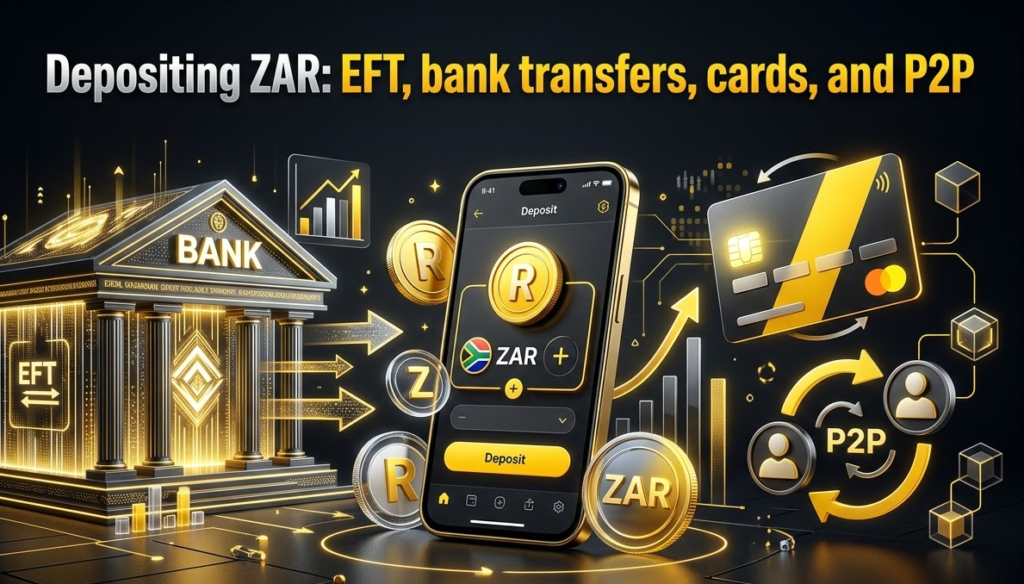
South African users may be able to fund Binance with rand through supported fiat payment methods or P2P trades. However, the available options can change, so do not assume every method is active simply because an older guide mentions it.
Binance announced ZAR deposits and withdrawals through Instant EFT in August 2022, followed by express rand withdrawals in January 2023. You can review its original ZAR gateway announcement and withdrawal announcement. These announcements document the launch of those services, but they do not guarantee that every payment option remains available to every customer today.
| Payment method | How it works | What to check |
|---|---|---|
| Bank transfer or EFT | You transfer rand using the payment instructions displayed by Binance. | Confirm the current deposit method, beneficiary details, processing time, and fees before sending funds. |
| Debit or credit card | If offered, you purchase crypto through a supported card-payment service. | Check fees, card eligibility, conversion rates, and whether your bank permits the transaction. |
| Binance P2P | You buy or sell crypto directly with another user, using a supported payment method. | Check the counterparty, payment details, order conditions, and actual receipt of funds. |
Banks such as Capitec, FNB, Standard Bank, Absa, Nedbank, and Investec should not be treated as guaranteed Binance payment partners simply because they support ordinary EFT payments. A bank may process a transfer while applying its own fraud checks, transaction limits, or account terms. Check the exact payment instructions shown in your Binance account and your bank’s current policies.
How to complete KYC and deposit ZAR
Create and verify your account. Register through the official Binance website or app. Complete the identity-verification steps shown for your account. Depending on the current requirements, you may be asked for a South African identity document or passport, a selfie or facial verification, and additional information.
Confirm your details. If Binance requests proof of address or further documents, follow the instructions in the authenticated account interface. Requirements can differ by service, account risk checks, and applicable rules, so do not assume that a particular document automatically unlocks every limit.
Open the deposit section. Look for ZAR under the fiat deposit options. If direct bank transfer is offered, follow the current instructions carefully and verify the beneficiary information before making payment. Do not use bank details copied from an unofficial forum or sent by a stranger.
Make your first trade carefully. Once the rand balance appears in your account, choose a trading pair that matches your goal, such as BTC/ZAR or a supported stablecoin pair. Check the price, trading fee, order type, and total amount before confirming. If you are new to the exchange, start small while you learn how orders and withdrawals work.
If ZAR deposits are unavailable, check the current P2P marketplace rather than assuming the feature has been permanently discontinued. The options shown in your account are more relevant than an old tutorial.
Common misconceptions South African traders should avoid
“Crypto trading is illegal in South Africa”
That is too broad. Crypto assets are not legal tender, but South Africans can participate in crypto markets subject to the laws that apply to their activity. The FSCA regulates relevant financial services and crypto-asset products, while the FIC imposes anti-money-laundering obligations on covered institutions.
The South African Reserve Bank’s crypto-asset FAQ explains that crypto assets are not guaranteed or backed by the Reserve Bank. The fact that they are not legal tender does not mean that simply holding them is prohibited.
“If I only withdraw rand, SARS cannot see my crypto profits”
Do not rely on that assumption. A taxable event may occur when you dispose of or exchange a crypto asset, even if the proceeds remain in your Binance account. In addition, SARS says CARF reporting by covered service providers began in South Africa in March 2026.
Keep accurate records and declare transactions according to the applicable tax rules. Moving money through a local bank does not determine, by itself, whether a transaction is taxable.
“EFT and P2P provide the same protection”
They do not. With a direct fiat deposit, you follow the payment process offered by Binance or its payment provider. With P2P, you transact with another user, and the platform’s escrow mechanism applies to the crypto side of the order.
P2P escrow does not reverse a mistaken bank transfer or guarantee that the counterparty has paid. If you sell crypto, wait until the funds are actually in your bank account before releasing the asset. If you buy, double-check the recipient and follow the order instructions rather than accepting a request to move the trade outside Binance.
Frequently asked questions
Is Binance legal in South Africa?
Crypto trading is not generally prohibited for individuals in South Africa, but regulated services are subject to local requirements. Binance’s published disclosures state that Binance RSA offers certain crypto products under an exemption in terms of FSCA FAIS Notice 25 of 2023, while futures and options are offered through a different arrangement. Check the latest Binance legal disclosures and the FSCA’s official information before using a specific product.
Is Binance safe for South African traders?
Binance offers account-security controls, Proof of Reserves information, and the SAFU emergency fund. These are useful safeguards, but none eliminates market risk, phishing, account compromise, withdrawal restrictions, or exchange counterparty risk. Use strong authentication, verify all transfers, and avoid keeping more crypto on an exchange than you need.
Can I deposit and withdraw ZAR on Binance?
Binance previously announced ZAR deposits and withdrawals through Instant EFT. Current availability may differ by account, payment method, or service. Check the live deposit and withdrawal screens in the official app before transferring money, and confirm the payment details with your bank.
Does SARS tax Binance trading profits?
Crypto transactions can trigger income tax or capital gains tax depending on the circumstances. SARS also implemented CARF reporting in March 2026, requiring covered service providers to report certain transaction information. Keep your records and consult the SARS crypto-asset tax guidance to determine what applies to you.
Why does Binance ask for Travel Rule information?
South Africa’s FIC Directive 9, effective from 30 April 2025, requires covered crypto-asset service providers to collect, retain, and transmit specified sender and beneficiary information for crypto transfers. Binance may therefore ask who owns a sending or receiving wallet and request further information before processing a transaction.
Final verdict: should you use Binance in South Africa?
Binance is a major global exchange with local product disclosures, ZAR payment options announced in the past, cryptographic reserve-verification tools, and an emergency fund. Those features can make it a practical option for eligible South African users, but they are not a guarantee that every service is locally authorized or that your funds are risk-free.
The regulatory details matter. Binance’s own disclosures distinguish between its spot and other crypto services, and South Africa’s FIC Travel Rule requirements mean users should expect identity and beneficiary checks for certain transfers. SARS tax reporting is another part of the picture, particularly after CARF took effect in March 2026.
My recommendation is to check the exact Binance entity and product you intend to use, verify the current ZAR payment options, secure your account, and maintain complete tax records. If you are choosing between Binance and a local exchange, compare the specific service’s regulatory status, fees, liquidity, available assets, and withdrawal process rather than relying on brand recognition alone.
Editorial transparency: This guide draws on publicly available Binance documentation and South African regulatory and tax sources cited in the text. It does not claim independent penetration testing or professional legal, tax, or financial certification. Cryptocurrency trading involves a risk of loss and this article is for educational purposes, not personalized financial advice.



