Bybit’s South Africa status and scorecard
If you’re asking whether Bybit is a real exchange you can access from South Africa, the answer is yes: Bybit has published South African launch materials and a help-centre guide for buying crypto with ZAR through Instant EFT. Its payment guide also identifies Bybit Fintech South Africa (Pty) Ltd as a juristic representative of Altify SA Capital (Pty) Ltd, an authorised financial services provider with FSP number 52727. You can check the details in Bybit’s official ZAR Instant EFT instructions.
That’s more useful than a vague claim that Bybit is simply “legal” or “banned.” An exchange can be accessible to residents while different services, legal entities and financial activities are subject to different rules. You should also separate the ability to buy crypto with rand from permission to use every trading product the platform offers.
| Question | What the available evidence says | What you should check |
|---|---|---|
| Can South African residents access Bybit? | Bybit has published South Africa-specific launch materials and ZAR purchase instructions. | Confirm that the product you want is available to your verified account. |
| Is crypto ownership generally prohibited? | South Africa has a regulatory framework for crypto assets; ownership and trading are not generally banned. | Check the rules applicable to your activity and provider. |
| Does Bybit have a local regulatory arrangement? | Bybit identifies its South African company as a juristic representative of an authorised financial services provider. | Verify the principal provider, FSP number, authorised activities and the legal entity serving you. |
| Can you pay in ZAR? | Bybit documents a ZAR Instant EFT route through OZOW. | Confirm the payment method, bank support, fees and limits shown at checkout. |
| Is KYC required? | Bybit says identity verification is mandatory for its products and services. | Check which identity documents and verification level your account requires. |
| Does SARS tax crypto gains? | Normal income tax rules apply; a gain may be treated as revenue or capital depending on the facts. | Keep records and declare transactions correctly. |
| Does Proof of Reserves guarantee safety? | It provides evidence about specified assets and liabilities at a snapshot in time. | Treat it as one security signal, not a complete audit or insurance policy. |
My verdict: Bybit is a genuine trading platform with a documented South African payment route and a disclosed local representative arrangement. That is a stronger starting point than an exchange that offers no local payment instructions or identifiable regulatory relationship. It still doesn’t remove trading risk, custody risk, service restrictions or your tax obligations.
Is Bybit legal in South Africa?
The first thing to understand is that the legality of owning crypto is different from the regulatory status of a business providing crypto-related financial services.
South Africa has brought crypto assets into its financial regulatory framework. The Financial Sector Conduct Authority (FSCA) regulates financial institutions and has a licensing framework for crypto asset service providers under the Financial Advisory and Intermediary Services (FAIS) Act. The FSCA explains that crypto asset service providers must obtain a licence to conduct business where the relevant activities fall within its licensing requirements. You can review the regulator’s official guidance for financial services providers.
For an ordinary user, that doesn’t mean buying Bitcoin or holding USDT automatically makes you a financial services provider. It means the businesses offering certain services need to meet the applicable requirements. If you use an exchange, you should understand which legal entity provides the service and what that entity is authorised to do.
Bybit’s local arrangement: what it does and doesn’t mean
Bybit’s ZAR Instant EFT help page states that Bybit Fintech South Africa (Pty) Ltd is a juristic representative of Altify SA Capital (Pty) Ltd, which it identifies as an authorised financial services provider with FSP number 52727.
A juristic representative arrangement is not the same thing as saying that the Bybit global platform independently holds every possible South African licence. It is also not accurate to ignore the arrangement and describe Bybit as having no local regulatory connection at all.
The practical question is what services the representative arrangement covers, which entity contracts with you, and whether the relevant activity falls within the principal provider’s authorisation. If you’re considering large deposits, derivatives or other higher-risk products, don’t rely on a marketing page alone. Verify the details through the FSCA’s regulated-entity search and the provider’s current legal documentation.
I would use three checks before depositing a meaningful amount:
- Check the entity: Identify the legal entity named in the account terms and the entity responsible for the service.
- Check the authorisation: Search the relevant provider and FSP number, then read the scope of its authorised activities.
- Check the product: Don’t assume that the regulatory position for buying crypto with ZAR automatically answers questions about derivatives, leverage, lending or yield products.
This is the distinction that gets lost in many “Is Bybit legit?” articles. A familiar brand name doesn’t tell you every detail of the legal relationship behind each service.
Is Bybit banned or excluded in South Africa?
Bybit has published South Africa-specific onboarding and ZAR payment instructions, so the claim that the platform is simply unavailable in the country doesn’t match its published service information. Its South Africa launch page promotes local access and ZAR deposits.
However, platform availability can vary by product, account status, payment provider and changes to local rules. Before placing an order, check the product interface and current terms rather than relying on a statement that “everything is supported.”
Spot trading, derivatives, fiat purchases and withdrawals are separate functions. A service being available in one area does not guarantee that every other feature is available to every South African customer on the same terms.
FSCA and FIC: how the regulatory framework affects Bybit users
The FSCA and Financial Intelligence Centre (FIC) have different roles. Understanding the difference helps you judge claims about licensing, identity checks and crypto transfers.
The FSCA and crypto asset service providers
The FSCA oversees market conduct in South Africa’s financial sector. Under the local framework, businesses conducting activities that qualify as regulated crypto-related financial services may need appropriate authorisation. The FSCA publishes information about regulated entities and approved crypto asset service providers, although the exact list and authorisation status should always be checked at the time you use a platform.
Do not rely on an exchange’s trading volume, international reputation or number of users as a substitute for checking its regulatory status. Equally, don’t treat a representative arrangement as meaningless: the legal structure matters, and it should be evaluated on its actual terms.
The FIC and the Travel Rule
The FIC deals with financial intelligence and anti-money-laundering obligations. South Africa’s Directive 9, concerning the Travel Rule for crypto asset transfers, came into effect on 30 April 2025. It requires relevant accountable institutions involved in crypto transfers to transmit and maintain specified information about originators and beneficiaries.
The FIC explains the requirements in its official Directive 9 media release.
In practical terms, a transfer between crypto platforms may require information about who is sending and receiving the assets. Depending on the transaction and the providers involved, you may be asked for identifying information or additional details about the transfer. That is part of compliance, not necessarily a sign that your account has been flagged for wrongdoing.
One important qualification: you shouldn’t automatically assume that every Bybit global operation is compliant with every South African obligation just because the platform has a local payment route. Compliance duties depend on the entities, activities and transactions involved. If a transfer is delayed for a compliance check, use the official support process and provide accurate information.
Is Bybit safe for South African users?
I wouldn’t judge an exchange’s safety from a single feature or security badge. It’s better to look at custody transparency, account protection, payment controls, dispute handling and the risks that remain outside the platform’s control.
Proof of Reserves: a useful signal, not a guarantee
Bybit publishes Proof of Reserves (PoR) reports that allow users to inspect specified reserve holdings against reported user liabilities. Its September 2026 PoR announcement says the report covered 50 tokens and that reserve ratios for all 50 assets in scope were at or above 100% for the snapshot dated 23 September 2026. The report was independently verified by Hacken, according to Bybit.
That’s useful information. If you hold BTC, ETH or USDT on an exchange, you want more than a promise that the assets are there. Cryptographic verification can provide evidence that specified on-chain assets cover the user liabilities included in the report.
But PoR has limits. It is a snapshot, not a promise about future solvency. It does not automatically prove that every liability, loan, legal obligation or operational risk has been captured. It also doesn’t protect you from a market crash, a phishing attack, a mistaken transfer or a loss caused by leveraged trading.
My approach is to treat PoR as one factor in a broader decision. Check the report’s date, the assets covered and the verification method. Then decide how much you’re comfortable leaving on the exchange. If you don’t need to trade an asset actively, consider whether keeping it in self-custody is more appropriate for your situation, while remembering that self-custody introduces its own risks.
Account security: the basics still matter
Even a well-known exchange cannot protect you if someone gets control of your login, email account or withdrawal approvals. Set up two-factor authentication (2FA), use a unique password and secure the email address linked to the exchange. Review withdrawal settings and anti-phishing features available in your account.
Be especially cautious of people offering “account recovery,” investment management or guaranteed returns through social media. A scammer may copy Bybit’s branding or pretend to be a local representative. Never share a one-time password, authenticator code, seed phrase or remote-access session with someone who contacts you unexpectedly.
Instant EFT and bank payment security
Bybit’s ZAR purchase instructions say that its Instant EFT flow directs users to OZOW, where they select their bank and authorise the payment. Bybit also says the bank account must be in the same name as the Bybit account. The guide states that orders are typically processed within about 10 minutes, although this is not a guarantee for every transaction.
Read the order screen before authorising anything. Confirm the rand amount, the displayed exchange rate, any fees and the final amount of crypto you will receive. A quick bank transfer doesn’t mean the purchase is fee-free, and a payment gateway doesn’t eliminate every risk associated with phishing, compromised devices or incorrect account details.
ZAR Instant EFT, local banks and P2P
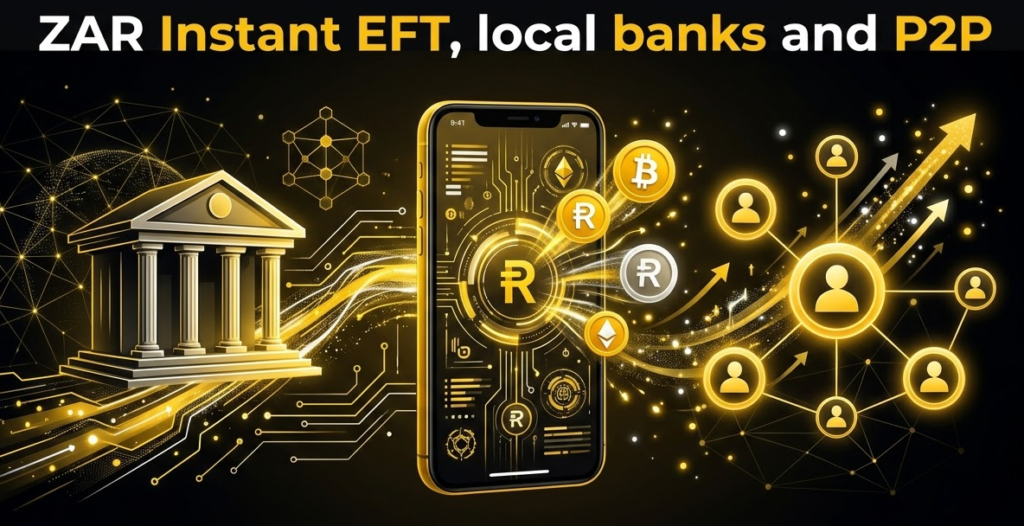
For many South African users, the most important practical question isn’t whether an exchange has a mobile app. It’s whether you can move money between your bank account and the platform without unnecessary friction.
Bybit documents a direct purchase route using ZAR and Instant EFT. Its guide describes the process through Buy Crypto → One-Click Buy, followed by selecting ZAR and Instant EFT. After you confirm the order, you’re redirected to OZOW to select your bank and approve the payment.
Which banks are supported?
The published guide directs users to choose their bank through the payment flow. It doesn’t provide a permanent guarantee that every bank, account type or transaction will work at all times. Capitec, FNB, Standard Bank, Absa and Nedbank may be the banks you want to check, but don’t treat a list in an article as confirmation of live availability.
The reliable test is the payment interface in your own verified account. If your bank appears as an available option, review the details and limits displayed there. If it doesn’t appear, don’t try to force the transaction through a third party claiming it can bypass the payment provider.
| Payment route | What it does | What to verify |
|---|---|---|
| ZAR Instant EFT | Lets eligible users purchase crypto using a rand bank payment through the supported flow. | Bank availability, fees, limits, displayed exchange rate and account-name matching. |
| P2P marketplace | Connects buyers and sellers who trade crypto against a chosen fiat payment method. | Seller history, payment instructions, order limits, escrow status and dispute rules. |
| Crypto transfer from another platform | Moves supported crypto assets to your Bybit account. | Network, address, memo/tag requirements, fees and compliance information. |
Instant EFT versus P2P
Instant EFT is usually the simpler starting point if your account offers it and you want to buy crypto using your own bank account. The flow is guided, and the order screen shows the price and payment details before you confirm.
P2P is different. You’re trading with another user, and the available payment methods, rates and order sizes depend on the advertisements currently listed. A seller may offer a price that looks attractive but have strict payment instructions or limits. Read the advertisement carefully, and don’t assume every seller supports the same bank or transfer method.
Bybit’s P2P escrow mechanism is intended to hold the crypto involved in an order while the payment is completed. That reduces a specific risk, but it does not mean every dispute will resolve in your favour. Never mark an order as paid before sending the money, and never release crypto based on a screenshot or an unverified message.
How to complete KYC and buy crypto with ZAR
Bybit requires identity verification for its products and services. Its individual KYC guide explains the standard verification process and notes that additional requirements can depend on region or service.
The outline below covers the general flow. The exact screens and accepted documents may change, so follow the requirements shown in your own account.
Phase one: register and verify your identity
Create an account: Use Bybit’s official website or app. Check the domain carefully before entering your email address or password.
Open identity verification: Go to your account settings and select the identity verification option. Choose your actual country of residence and the correct issuing country for your document.
Submit proof of identity: Upload a clear image of an accepted document. South African Smart ID cards, green barcoded ID books or passports may be accepted depending on the verification options currently shown to you. Don’t assume all documents are interchangeable; use the choices displayed in the account interface.
Complete the face check: If prompted, complete the selfie or liveness check. Use good lighting, make sure the document details are readable and avoid submitting altered images.
Wait for approval: Don’t assume that submitting documents means verification is complete. Check the account status before attempting a fiat purchase or withdrawal.
Phase two: buy crypto through ZAR Instant EFT
Open One-Click Buy: In the Bybit interface, select Buy Crypto → One-Click Buy, following the official ZAR Instant EFT guide.
Choose ZAR and Instant EFT: Select the rand as your fiat currency and Instant EFT as the payment method if both are available to you.
Enter your amount: Input the amount you want to spend. Check the transaction limits and the displayed quote. Don’t judge the cost from the headline price alone; review the amount of crypto you’ll receive after any applicable charges.
Confirm the order: Review the order details before continuing. If the quote changes or the payment page displays unexpected details, pause and check them rather than approving automatically.
Authorise the bank payment: The documented process redirects you to OZOW. Select your bank and follow its authorisation process. Bybit says the bank account must be in the same name as your Bybit account.
Confirm the purchase: Return to Bybit and check the order status and asset balance. Save the order confirmation and bank record for your own bookkeeping.
If a payment fails, check the available balance, payment authorisation and any required 2FA step. Don’t immediately repeat a failed transaction several times; first confirm whether the earlier payment was debited or is still pending.
What about withdrawals to a South African bank account?
Buying crypto with ZAR and withdrawing ZAR are not necessarily the same process. The availability of a fiat deposit method does not prove that every user can withdraw fiat through an identical route.
Before trading, open the withdrawal or sell-crypto section in your account and check which options are available. Review minimum amounts, fees, processing times, supported payment methods and any identity or source-of-funds checks. If you plan to use P2P to cash out, read the advertiser’s terms and wait for the actual payment to appear in your bank account before releasing crypto.
Keep in mind that bank transfers can be delayed or reviewed. If a transaction is held, use the official payment provider or exchange support channel. Be suspicious of anyone asking you to pay an extra “release fee” to a personal account or send more crypto to unlock a withdrawal.
What South African Bybit users should know
Using an offshore exchange doesn’t automatically put your crypto activity outside South Africa’s tax rules. SARS states that normal income tax rules apply to crypto assets and that taxpayers must declare relevant gains or losses. Depending on the facts, a transaction may be treated as revenue in nature or capital in nature. Those treatments can produce different tax outcomes.
You can start with SARS’s official crypto assets and tax guidance. It explains that crypto-related income may fall under gross income, while gains regarded as capital in nature may be assessed under the Capital Gains Tax (CGT) framework. The classification depends on the circumstances rather than simply the name of the exchange you use.
In practice, keep records of:
- The date and value of each crypto purchase and disposal.
- Rand values at the time of relevant transactions.
- Trading fees and eligible expenses.
- Transfers between your own wallets or accounts, with records showing that they were internal transfers.
- Staking, yield or other crypto-related rewards, where applicable.
- Bank statements and exchange transaction histories that support your calculations.
Don’t assume that moving crypto from one wallet to another is automatically the same as selling it, or that every swap has the same tax treatment. If you trade frequently, use leverage, receive rewards or transact across multiple platforms, it may be worth asking a South African tax professional to review your records.
CARF and crypto reporting from 2026
South Africa implemented the OECD’s Crypto-Asset Reporting Framework (CARF) on 1 March 2026. SARS explains that relevant crypto-asset service providers must report certain transaction information and that this information may be exchanged with participating jurisdictions. Individual taxpayers do not submit CARF reports themselves; they must continue declaring taxable crypto activity through their normal tax returns.
The details are set out in SARS’s CARF guidance. SARS says the framework can apply to foreign providers with a South African nexus or providers serving South African tax residents, depending on their activities and the rules.
The practical takeaway is simple: don’t treat offshore accounts as invisible. Maintain complete records, report taxable activity accurately and get advice if you’re uncertain about a transaction’s classification.
Common misconceptions about Bybit in South Africa

Myth: “Bybit is banned in South Africa”
Bybit’s South Africa launch page and its ZAR Instant EFT instructions show that it has published services aimed at South African users. That contradicts a blanket claim that the platform has no South African availability.
However, availability is not an unconditional promise that every product is accessible to every account. Check the specific service, your account status and the current terms before depositing.
Myth: “Bybit has no local regulatory arrangement”
Bybit’s ZAR Instant EFT guide identifies Bybit Fintech South Africa (Pty) Ltd as a juristic representative of Altify SA Capital (Pty) Ltd, an authorised FSP. That should be part of any fair assessment of its South African operation.
At the same time, a representative arrangement does not prove that Bybit Global holds a standalone local licence covering every possible service. Verify the legal entity and scope of authorisation relevant to the activity you intend to use.
Myth: “ZAR deposits are anonymous”
Bybit requires identity verification for its products and services, and the documented Instant EFT flow requires the bank account to be in the same name as the Bybit account. Don’t expect to deposit or withdraw substantial amounts anonymously through the official route.
Myth: “Proof of Reserves means there is no risk”
A reserve ratio above 100% is a useful data point, but it does not guarantee future solvency or protect against every operational, legal or market risk. It also cannot prevent you from losing money through poor trades, leverage, scams or compromised credentials.
Frequently asked questions
Is Bybit legal and operational in South Africa?
Bybit has published South Africa-specific launch information and instructions for purchasing crypto with ZAR through Instant EFT. Its local payment guide also identifies a South African company acting as a juristic representative of an authorised FSP. For a particular product, verify the current terms, legal entity and applicable regulatory status rather than assuming all services have identical coverage.
Can you deposit South African Rand (ZAR) on Bybit?
Yes. Bybit documents a ZAR Instant EFT purchase flow through OZOW. The available banks, transaction limits and payment conditions can depend on the options displayed in your account, so confirm them before authorising a transfer.
Does SARS tax crypto earnings on Bybit?
Crypto gains and income may be taxable under South African rules. SARS distinguishes between transactions treated as revenue and those treated as capital in nature, and the outcome depends on the circumstances. You should keep transaction records and declare relevant taxable activity through your tax return.
Is identity verification mandatory on Bybit in South Africa?
Bybit says identity verification of at least Standard level is mandatory for its products and services. The accepted documents and any additional requirements depend on the verification process shown in your account. Follow the official KYC instructions rather than relying on an outdated list of documents.
How does Bybit safeguard South African users’ funds?
Bybit publishes Proof of Reserves reports, supports account-security features such as 2FA, and uses escrow in its P2P marketplace. Each addresses a different risk, and none is a guarantee against all losses. Review the latest reserve data, secure your account and avoid keeping more on an exchange than you need for your trading activity.
Final verdict: should you use Bybit in South Africa?
Bybit has a documented route for buying crypto with ZAR and a disclosed South African representative arrangement, so I wouldn’t dismiss it as an exchange with no local presence. Its Instant EFT instructions are concrete enough to help you check whether the payment flow is available to your account, and its Proof of Reserves reporting gives you information you can review rather than relying entirely on a promise.
Still, I’d make the decision service by service. Verify the entity and authorisation relevant to the product you plan to use, check the fees and bank options in the live interface, complete KYC through the official platform, and keep records for SARS. If you trade derivatives, understand liquidation risk before you deposit funds. If you use P2P, follow the escrow process and never release crypto just because a buyer sends a screenshot.
Bybit may be a workable option for South African crypto users, but “legit” is the beginning of the assessment, not the end of it. Check the legal arrangement, confirm the payment route, protect your account and only risk money you can afford to lose.