

Unlike traditional fiat money, Bitcoin is not issued by a government or controlled by a central monetary authority. It runs on open-source software and a public blockchain that anyone can verify.
That sounds straightforward. The interesting part is what happens underneath.
When you send Bitcoin, there is no bank employee approving the transfer. Your wallet signs a transaction with a private key, the transaction is broadcast to the network, nodes verify it against Bitcoin’s rules, and miners compete to add valid transactions to the blockchain. Once enough confirmations accumulate, reversing that history becomes increasingly difficult.
Bitcoin was introduced in 2008 through Satoshi Nakamoto’s original whitepaper, which described a peer-to-peer electronic cash system designed to operate without a trusted third party.
Since then, Bitcoin has grown from an experimental digital currency into a globally traded asset, a settlement network, and an increasingly familiar institutional investment vehicle. The U.S. Securities and Exchange Commission approved the listing and trading of spot Bitcoin exchange-traded products in January 2024, while later regulatory changes expanded how crypto ETPs could operate.
I think the easiest way to understand Bitcoin is to forget the price chart for a moment.
Start with the system itself.
What problem does Bitcoin solve? Why does it need mining? Why are there only 21 million BTC? What exactly does a wallet hold? And why can losing a seed phrase be more serious than forgetting a banking password?
This guide walks through those questions from the basics to the more technical parts of the network.
What is Bitcoin?
A Simple Definition for Beginners
Bitcoin is a decentralized peer-to-peer digital currency and payment network.
That definition contains several ideas worth unpacking.
First, Bitcoin is digital. There are no physical Bitcoin coins sitting in a vault somewhere.
Second, it is peer-to-peer. You can send Bitcoin directly to another Bitcoin address without needing a bank to move the money between two accounts.
Third, it is decentralized. There is no Bitcoin headquarters, central server, or central bank that decides which transactions are valid.
Finally, Bitcoin is governed by software and network consensus. The rules determining how transactions are validated, how new BTC are issued, and how blocks are added are implemented in the Bitcoin protocol.
The original Bitcoin whitepaper described the system as a “peer-to-peer electronic cash system.” The goal was to allow online payments to move directly between parties without going through a financial institution.
That was a fairly radical idea in 2008.
Most digital money before Bitcoin ultimately depended on someone maintaining a centralized record.
Your bank balance exists because your bank maintains its database.
Your PayPal balance exists because PayPal maintains its records.
Your card payment works because banks, card networks, merchants, and payment processors coordinate behind the scenes.
Bitcoin takes a different route.
The network collectively maintains a public ledger. Independent computers called full nodes keep copies of the blockchain and check transactions against Bitcoin’s consensus rules. The Bitcoin developer documentation describes the blockchain as Bitcoin’s public, ordered and timestamped record of transactions, with full nodes independently validating the chain.
This is where several essential Bitcoin terms come together:
- Satoshi Nakamoto: The pseudonym used by the person or group that introduced Bitcoin and published its original whitepaper.
- Digital asset: A digital representation of value that can be held, transferred, or traded electronically.
- Peer-to-peer network: A network in which participants communicate directly rather than relying on one central server.
- Bitcoin address: An identifier used to receive Bitcoin.
- Private key: Secret cryptographic information that allows the holder to authorize transactions.
- Blockchain: The public ledger containing Bitcoin’s transaction history.
- Miner: A participant that uses computational power to compete for the right to add blocks.
- Full node: A computer that independently validates Bitcoin transactions and blocks.
One distinction is especially important for beginners:
Your Bitcoin is not stored inside your wallet.
Bitcoin exists as records on the blockchain. Your wallet manages the cryptographic keys that give you the ability to spend specific Bitcoin outputs.
The Bitcoin developer documentation on wallets explains that wallets generate and manage private keys, derive public keys, monitor relevant outputs, and create and sign transactions.
Once that clicks, Bitcoin becomes much easier to understand.
Bitcoin vs. Traditional Fiat Money

Bitcoin and fiat money can both be used to transfer value, but the systems behind them are very different.
Fiat currencies such as the U.S. dollar, euro, and Vietnamese dong are issued and managed within government and central-bank monetary systems.
Bitcoin is issued according to protocol rules.
That creates a fundamentally different monetary model.
| Bitcoin | Traditional fiat money |
|---|---|
| Issued through protocol rules | Issued through monetary and banking systems |
| Maximum supply of 21 million BTC | No fixed global supply cap |
| Decentralized network | Centralized monetary authorities |
| Transactions can be made without a bank | Banking and payment intermediaries are commonly involved |
| Public blockchain ledger | Private institutional ledgers |
| Permissionless at the base protocol level | Access to financial services can depend on intermediaries |
| Supply schedule is predictable | Monetary policy can change |
| Transactions are generally irreversible | Many traditional payments can be reversed or disputed |
The supply difference is probably the easiest place to see the contrast.
Central banks can expand the monetary base when monetary policy requires it. Bitcoin, by design, follows a predetermined issuance schedule.
That does not automatically make Bitcoin “better money.”
It simply means the monetary systems operate under different rules.
There is another major difference: access.
You can create a Bitcoin wallet without opening a bank account. You do not need a bank manager to approve your Bitcoin address.
But permissionless access comes with a price.
If you lose your private keys, there is no central Bitcoin institution that can reset your account.
That trade-off is easy to underestimate when first learning about Bitcoin.
Core Attributes of Bitcoin
Fixed Supply & Built-in Scarcity
Bitcoin’s maximum supply is designed to be 21 million BTC.
That number is not a marketing target. It is built into Bitcoin’s issuance mechanism.
New Bitcoin enters circulation through the block subsidy paid to miners. That subsidy is periodically reduced through the Bitcoin halving.
The Bitcoin vocabulary documentation explains that the block subsidy is reduced at each halving and that the halving schedule enforces Bitcoin’s predictable issuance and 21-million-coin supply cap.
This gives Bitcoin something that is unusual for a digital asset: predictable scarcity.
You can copy a digital file infinitely.
You cannot simply copy a Bitcoin and have the network accept both copies as legitimate units.
The blockchain and consensus rules determine which transaction history is valid.
Bitcoin’s issuance schedule also creates a form of mathematical monetary policy.
The network does not suddenly decide one morning to create another 100 million BTC.
Changing fundamental consensus rules would require broad agreement among participants running the network, and even then, users who disagree can choose not to follow the change.
The 21-million limit therefore has both a technical and social dimension.
It exists in the software, but Bitcoin’s monetary properties ultimately depend on people continuing to run software that enforces those rules.
That distinction matters.
Decentralization & Censorship Resistance
Bitcoin does not depend on one central server.
Thousands of independent computers can participate in the network, verify blocks, relay transactions, and enforce Bitcoin’s rules.
A full node does not simply accept whatever miners produce.
It validates the blocks independently.
This is one of the most important ideas in Bitcoin.
Miners provide computational work, but full nodes determine whether the blocks they receive follow the rules they enforce.
The Bitcoin developer documentation explains that each full node independently stores a blockchain containing only blocks that it has validated. When nodes agree on the same valid chain, they are considered to be in consensus.
This architecture contributes to Bitcoin’s censorship resistance.
If one exchange refuses to process a transaction, that does not necessarily prevent the transaction from existing on the Bitcoin network.
If one node goes offline, other nodes remain.
If one miner stops operating, other miners can continue producing blocks.
That is the theory.
In practice, censorship resistance depends on the continued availability of network infrastructure, miners, nodes, wallets, exchanges, and users.
Bitcoin also cannot guarantee that every country, exchange, or business will allow people to interact with it.
The protocol can resist certain forms of transaction censorship. It cannot override national law or shut down a regulated company.
That distinction is worth keeping in mind.
Immutability & Pseudonymity
Bitcoin transactions are designed to be extremely difficult to reverse once they have accumulated enough confirmations.
But calling Bitcoin “immutable” can be misleading if you interpret the word literally.
The better description is tamper-resistant.
Bitcoin’s blockchain is secured by cryptographic hashes, digital signatures, Proof of Work, and economic incentives.
Once a transaction becomes part of a sufficiently deep chain, changing it would require overcoming the computational work securing the chain and convincing the network to accept the altered history.
Bitcoin is also pseudonymous, not anonymous.
This is one of the biggest misconceptions I see among beginners.
Bitcoin addresses do not automatically contain your legal name.
But Bitcoin transactions are public.
Anyone can inspect the transaction history associated with a Bitcoin address.
The Bitcoin privacy documentation explicitly warns that Bitcoin transactions are public, traceable, and permanently stored on the network.
Once an address becomes connected to your real identity through an exchange, merchant, public post, or another data source, parts of your transaction history can potentially be linked back to you.
This creates an unusual privacy model.
Bitcoin gives you pseudonymous addresses, but the ledger itself is extremely transparent.
How Bitcoin Works Under the Hood
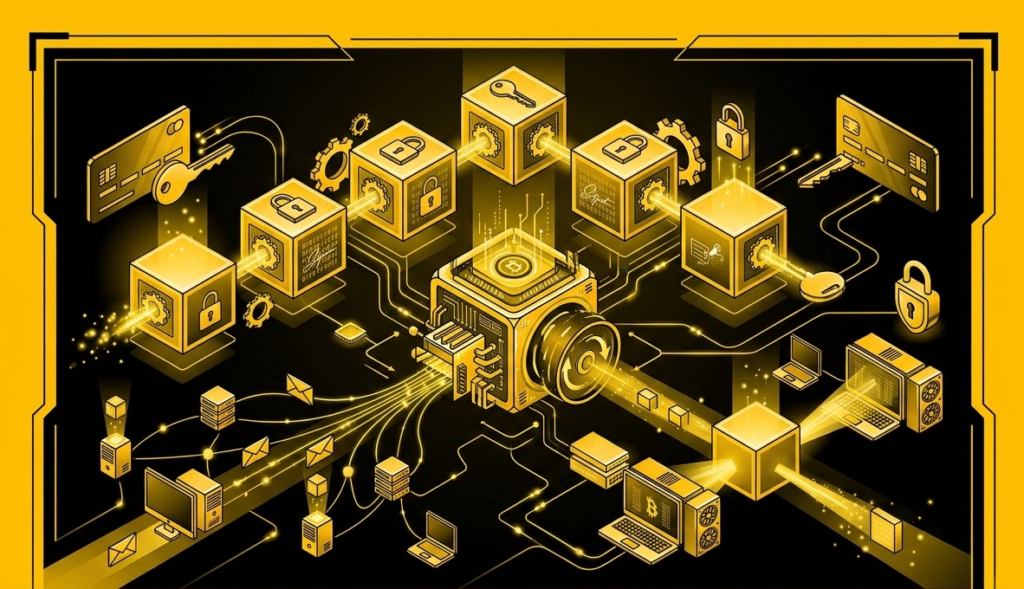
This is where Bitcoin gets more interesting.
You do not need to become a cryptographer to use Bitcoin, but understanding a few technical concepts makes the system much easier to evaluate.
The Blockchain & UTXO Model
Bitcoin does not track your balance in the same way a bank database tracks your checking account.
There is no single line that says: Nam’s Bitcoin balance: 1.52 BTC
Instead, Bitcoin uses a system called Unspent Transaction Outputs, or UTXOs.
Think of UTXOs like individual pieces of digital cash.
Suppose you receive:
- 0.4 BTC
- 0.7 BTC
- 0.9 BTC
Those are separate outputs.
If you want to send 1 BTC, your wallet might combine some of those UTXOs as inputs and create new outputs:
- 1 BTC to the recipient
- 0.0X BTC back to you as change
- A small amount paid as the transaction fee
The exact numbers depend on the transaction.
The important part is that Bitcoin consumes previous outputs and creates new outputs.
The Bitcoin transaction documentation explains that each transaction has inputs and outputs, with each input spending satoshis previously assigned to an output. Unspent outputs remain available until they are spent by a later transaction.
This model helps Bitcoin prevent double spending.
Once a UTXO has been spent, it cannot legitimately be spent again.
Full nodes check that condition.
That is a key difference between Bitcoin and simply maintaining a spreadsheet of account balances.
Public & Private Keys
Bitcoin ownership comes down to cryptographic control.
Your private key is secret.
Your public key can be shared.
The relationship between them allows your wallet to produce a digital signature proving that you are authorized to spend a particular output.
A simplified version looks like this:
Private key → digital signature → network verifies against public key
The private key itself is never supposed to be revealed to the network.
The Bitcoin vocabulary documentation explains that private keys must never be revealed because they allow spending of the associated Bitcoin, while signatures provide mathematical proof that the spender is authorized.
This is why the phrase “not your keys, not your coins” exists.
If an exchange controls the private keys, you are relying on that exchange to give you access to your Bitcoin.
If you control the private keys yourself, you remove that particular counterparty risk.
But you also take responsibility for security.
There is no customer support department that can simply reset a lost private key.
Bitcoin Mining & Proof of Work (PoW)
Mining is the mechanism Bitcoin uses to add new blocks and secure its blockchain.
Miners collect transactions and compete to produce a block that satisfies Bitcoin’s Proof-of-Work requirements.
The process involves repeatedly hashing block data until a valid result is found.
Bitcoin uses the SHA-256 hashing algorithm within this process.
The amount of computation being performed across the network is measured as hash rate, commonly expressed in EH/s, or exahashes per second.
Mining is highly competitive.
A miner does not get paid simply for owning mining hardware.
The miner must participate in the network and successfully produce a valid block under the protocol’s rules.
Bitcoin miners can receive transaction fees and newly issued Bitcoin through the block subsidy. The Bitcoin vocabulary documentation describes mining as a competitive market in which rewards are linked to computational work.
This creates an interesting security model.
An attacker attempting to rewrite Bitcoin’s recent history would need enormous computational resources.
The more honest mining power securing the network, the more difficult that attack becomes.
Proof of Work therefore does more than create new Bitcoin.
It is part of Bitcoin’s security budget.
Read more: How to Mine Crypto at Home in 2027: Full Beginner’s Guide
The Role of Full Nodes
Miners are not the final authority over Bitcoin’s rules.
Full nodes play a different role.
A full node downloads and validates blocks and transactions according to the consensus rules implemented by its software.
If a miner produces an invalid block, a properly functioning node can reject it.
This separation is important.
Miners compete to produce blocks.
Nodes independently verify whether those blocks are valid.
The Bitcoin blockchain documentation explains that full nodes independently validate the chain and maintain only blocks that satisfy their consensus rules.
This architecture also helps protect Bitcoin against certain forms of rule manipulation.
For example, miners cannot simply decide to create unlimited Bitcoin and expect every node to accept those coins.
Nodes enforce the rules they are running.
That is one of the reasons decentralization in Bitcoin is more complicated than simply counting miners.
Economic Mechanics: Bitcoin Halving & Issuance

What is the Bitcoin Halving?
The Bitcoin halving is a scheduled reduction in the block subsidy paid to miners.
It occurs every 210,000 blocks, which works out to roughly four years.
The Bitcoin halving history records the major events:
| Halving | Date | Block | Block subsidy after halving |
|---|---|---|---|
| First | November 28, 2012 | 210,000 | 25 BTC |
| Second | July 9, 2016 | 420,000 | 12.5 BTC |
| Third | May 11, 2020 | 630,000 | 6.25 BTC |
| Fourth | April 20, 2024 | 840,000 | 3.125 BTC |
The next halving will reduce the subsidy from 3.125 BTC to 1.5625 BTC.
The exact calendar date cannot be known years in advance because Bitcoin blocks are not produced at precisely fixed intervals.
That is why halving estimates are normally expressed in terms of block height.
The halving mechanism is one of Bitcoin’s most distinctive economic features.
Instead of relying on a central authority to decide how quickly new money enters circulation, Bitcoin follows a predetermined issuance schedule.
Impact on Mining Economics & Stock-to-Flow Ratio
The halving directly affects miners because the block subsidy represents a major part of their revenue.
When the subsidy is cut in half, miners receive fewer newly created BTC for each block they produce.
Their revenue then depends more heavily on:
- Bitcoin’s market price
- Transaction fees
- Electricity costs
- Mining hardware efficiency
- Network difficulty
- Operational expenses
- Access to low-cost power
This is why the halving is not simply a supply-side event.
It is also a business event for miners.
Less efficient operations can face pressure when their BTC revenue falls while electricity and infrastructure costs remain unchanged.
The halving also affects Bitcoin’s stock-to-flow ratio.
Stock-to-flow compares the existing stock of an asset with the amount of new supply produced over a period.
For Bitcoin, the “stock” is the amount of BTC already in circulation, while “flow” refers to newly mined BTC.
The ratio rises after each halving because the annual new supply decreases.
You will sometimes see stock-to-flow used to argue that Bitcoin’s price should follow a particular long-term path.
I would be careful with that interpretation.
Stock-to-flow is a useful way to describe scarcity. It is not a law of economics that guarantees a specific Bitcoin price.
Demand still matters.
Liquidity matters.
Interest rates matter.
Regulation matters.
Institutional flows matter.
And investor behavior can overwhelm a simple supply ratio for long periods.
The halving gives Bitcoin a predictable supply schedule. It does not give anyone a guaranteed price forecast.
Advanced Concepts & Modern Innovations
Bitcoin is no longer limited to the basic “send BTC from Alice to Bob” use case.
The base layer has evolved, and developers have built additional systems around it.
Layer 2 Scaling: The Lightning Network
Bitcoin’s base layer has limited block space.
That creates a practical problem if you want Bitcoin to support huge numbers of small everyday payments directly on-chain.
The Lightning Network addresses part of this problem by moving many transactions off the main blockchain while using Bitcoin’s blockchain as the settlement layer.
Instead of recording every small payment individually on-chain, users can transact through payment channels and settle the final result on Bitcoin’s base layer.
The Lightning Network describes the system as enabling instant Bitcoin payments with low fees, while individual payments do not need to be recorded directly on the blockchain.
This makes Lightning particularly interesting for:
- Small payments
- Frequent transactions
- Micropayments
- Merchant payments
- Machine-to-machine payments
- Cross-border transfers
The important distinction is that Lightning does not replace Bitcoin.
It builds another layer around it.
The Bitcoin blockchain can act as the settlement and security layer while Lightning handles a large number of smaller transactions away from the base chain.
That is the broader direction of Bitcoin scaling.
Instead of forcing every transaction through the same limited block space, different layers can handle different jobs.
On-Chain Evolution: Taproot, Ordinals & BRC-20
Bitcoin’s functionality has also expanded through protocol upgrades and application-layer conventions.
One of the most important upgrades was Taproot, activated in 2021.
Taproot introduced new spending rules based on Schnorr signatures, Merkle branches, and Tapscript.
The BIP 341 specification defines Taproot’s SegWit version 1 spending rules, while BIP 342 specifies validation rules for Tapscript.
Taproot did not turn Bitcoin into Ethereum.
It did, however, make certain types of transactions and smart-contract-like constructions more flexible and efficient.
Then came Ordinals and inscriptions.
Ordinals assign individual identities to satoshis, Bitcoin’s smallest native unit.
An inscription can attach arbitrary data to a satoshi, allowing Bitcoin-native digital artifacts to be created and transferred.
The Ordinal Theory Handbook explains that one Bitcoin contains 100 million satoshis and that ordinal theory gives individual satoshis identities that can be tracked and transferred.
The inscription documentation goes further, explaining that inscription content can be stored on-chain through Taproot script-path spending.
This created a new category of Bitcoin activity.
Developers began experimenting with:
- Digital collectibles
- On-chain artwork
- Text inscriptions
- Metadata
- Token protocols
- Experimental applications
BRC-20 emerged as one of those application-layer token conventions built around Ordinal inscriptions.
It is important to understand what that means.
BRC-20 is not a new Bitcoin consensus mechanism.
It is a token convention implemented through inscriptions and external indexing logic.
That distinction helps avoid a common misunderstanding: Bitcoin can host new application-layer experiments without becoming a completely different blockchain.
Institutional Integration & Spot Bitcoin ETFs
Bitcoin’s relationship with traditional finance changed significantly in January 2024.
On January 10, 2024, the U.S. SEC approved the listing and trading of several spot Bitcoin exchange-traded products.
The SEC’s official statement confirms the approval. The products began trading publicly on January 11, 2024.
This matters because buying Bitcoin directly is not the only way institutions can now obtain price exposure.
A spot Bitcoin ETP can hold Bitcoin while investors trade shares through traditional brokerage infrastructure.
That creates a bridge between Bitcoin markets and conventional capital markets.
The first trading day was already significant. An SEC-filed company disclosure citing the newly approved products reported approximately $4.6 billion in trading volume on January 11, 2024.
The institutional story did not stop there.
In July 2025, the SEC also approved orders allowing authorized participants to create and redeem certain crypto ETP shares in kind, rather than limiting the process to cash creations and redemptions. The SEC’s July 2025 announcement described this as bringing Bitcoin and Ether ETPs closer to the structure used by other commodity-based ETPs.
For Bitcoin, the significance is less about one particular ETF.
It is about infrastructure.
Traditional investors can gain exposure through familiar brokerage accounts.
Market makers can interact with regulated products.
Institutions can build investment products around Bitcoin without necessarily managing private keys themselves.
That does not eliminate Bitcoin’s volatility.
It simply lowers one of the barriers between Bitcoin and traditional financial markets.
Energy Consumption & Green Mining Transition
Bitcoin’s energy use is probably its most persistent environmental criticism.
And there is no honest way to discuss Bitcoin without acknowledging that Proof of Work consumes significant electricity.
The more interesting question is where that electricity comes from and how the mining industry is changing.
A 2025 study from the Cambridge Centre for Alternative Finance surveyed 49 mining firms operating across 23 countries. The participating companies represented roughly 48% of global Bitcoin mining activity in the study’s sample.
The Cambridge Digital Mining Industry Report estimated that the surveyed mining industry’s electricity mix consisted of 52.4% sustainable energy, including 42.6% renewables and 9.8% nuclear. Fossil fuels accounted for 47.6%, with natural gas at 38.2% and coal at 8.9%.
Cambridge also estimated annual Bitcoin electricity consumption at around 138 TWh and associated network-wide emissions at approximately 39.8 million tonnes of CO₂ equivalent, based on its survey-based methodology.
Those figures need careful wording.
52.4% is not the same thing as 52.4% renewable energy.
Cambridge’s sustainable category includes both renewables and nuclear power.
That distinction matters.
The data also does not represent a perfect census of every Bitcoin miner on Earth. It is based on a survey covering a substantial but incomplete portion of the global mining industry.
So I would not use the number to claim that Bitcoin mining is now “green.”
The better conclusion is more nuanced.
Bitcoin mining is a large electricity consumer, but its energy mix is changing, and renewable and nuclear sources make up a substantial portion of the surveyed industry’s reported electricity use.
The mining industry also has an unusual characteristic compared with many traditional industrial loads: mining operations can often move geographically and adjust their electricity consumption based on power prices and availability.
That flexibility is one reason Bitcoin mining increasingly appears in discussions around stranded energy, excess renewable generation, and grid balancing.
But the environmental debate is far from finished.
Bitcoin still consumes a meaningful amount of electricity, and almost half of the surveyed mix in Cambridge’s study came from fossil fuels.
The right conversation is therefore about absolute energy use, energy sources, emissions, hardware efficiency, and local grid impacts, rather than reducing everything to a single “green” or “bad” label.
How to Buy, Store, and Secure Bitcoin
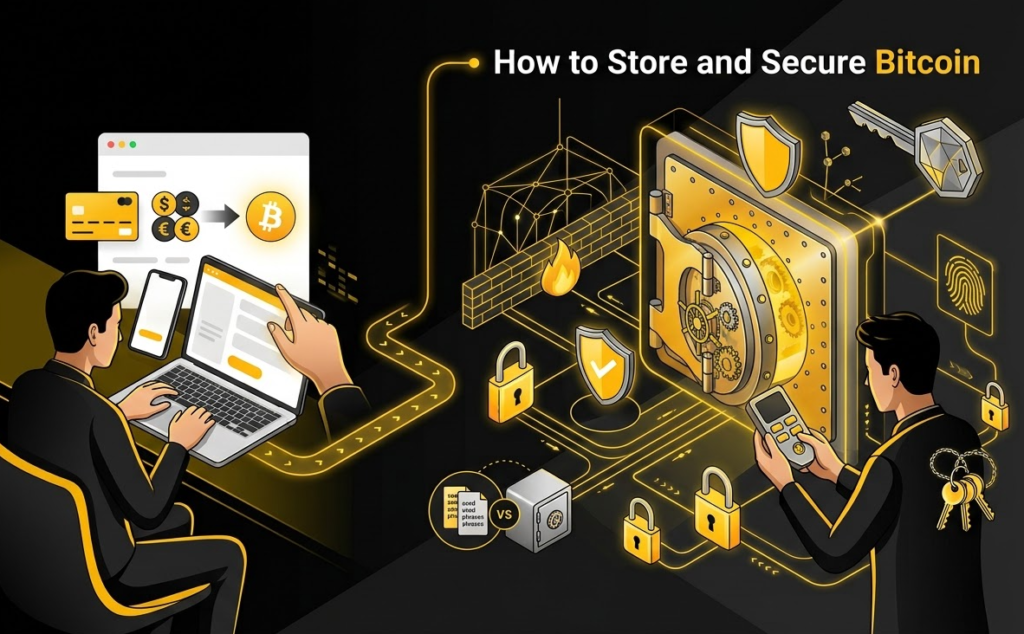
Buying Bitcoin is technically easy.
Keeping it safe is the part that deserves much more attention.
Custodial Exchanges vs. Self-Custody
The first decision is whether you want a third party to hold your Bitcoin.
With a custodial exchange, the exchange controls the private keys while your account gives you a claim on the assets.
This is convenient.
You can:
- Buy Bitcoin with fiat currency
- Trade it quickly
- Convert it back to fiat
- Use familiar login and recovery systems
- Avoid managing private keys yourself
But you also accept counterparty risk.
If the exchange freezes withdrawals, suffers a security breach, becomes insolvent, or has operational problems, you may not be able to access your funds when you want them.
Self-custody is different.
You control the private keys.
That gives you more direct control over your Bitcoin, but also makes you responsible for security.
The Bitcoin security guidance makes this trade-off clear: self-custody removes dependence on a third-party custodian, but losing your recovery information can permanently remove access to your funds.
For me, the key question is not “Which option is always better?”
It is:
How much responsibility are you actually prepared to take?
If you are holding a small amount while learning, a reputable regulated service may be simpler.
If you are holding Bitcoin for years and understand wallet security, self-custody can make more sense.
Hot Wallets vs. Hardware Cold Storage
A hot wallet is connected to an internet-enabled device.
Examples include:
- Mobile wallets
- Desktop wallets
- Browser wallets
They are convenient for everyday transactions.
A hardware wallet stores private-key information in a dedicated device designed to reduce exposure to online threats.
For long-term holdings, hardware wallets are commonly used because they separate key management from the computer or phone you use for everyday browsing.
But hardware does not automatically make you safe.
You can still lose your funds through:
- Fake wallet software
- Phishing
- Malicious firmware
- Social engineering
- Seed phrase theft
- Incorrect transaction signing
- Physical loss combined with poor backup practices
A hardware wallet is a security tool, not a magic shield.
Read more: What is a Crypto Wallet? The Complete List & Best Apps for 2027
Seed Phrase Management & Best Security Practices
Your seed phrase is one of the most important pieces of information in your Bitcoin security setup.
It can restore access to a wallet.
That also means anyone who obtains it may be able to access the Bitcoin controlled by that wallet.
The Bitcoin vocabulary documentation explains that a recovery phrase can restore an entire wallet and must therefore be stored securely.
A few rules are worth treating as non-negotiable:
- Never send your seed phrase to anyone.
- Never type it into a website unless you fully understand the recovery process and trust the wallet.
- Do not store it in a cloud document or ordinary notes app.
- Do not photograph it and leave the image in your phone’s photo library.
- Be extremely suspicious of anyone claiming to be wallet support.
- Test your backup and recovery process before storing significant value.
- Consider using a hardware wallet for long-term holdings.
- For larger amounts, learn about multisignature setups.
Bitcoin transactions also do not have a normal “undo” button.
If you send funds to the wrong address, the network cannot simply reverse the transaction.
Bitcoin’s own user guidance warns that Bitcoin payments are irreversible and that losing access to a self-custodied wallet can permanently mean losing the associated funds.
That is the price of financial control.
You become your own bank.
And that means you also become your own security department.
Frequently Asked Questions
Who is Satoshi Nakamoto?
Satoshi Nakamoto is the pseudonym used by the person or group that created Bitcoin.
Satoshi published the Bitcoin whitepaper in 2008 and participated in the early development of the network.
The identity of Satoshi Nakamoto has never been conclusively established.
Several people have claimed to be Satoshi over the years, but public claims are not the same as independently verified evidence.
For Bitcoin itself, the more important point is that the system did not remain dependent on its creator.
The network continued operating after Satoshi stepped away from public involvement.
That is consistent with one of Bitcoin’s central ideas: the protocol is intended to operate through a distributed network rather than through the authority of one individual.
Is Bitcoin legal and safe to use?
There is no single worldwide answer.
Bitcoin’s legal status, taxation, exchange rules, and permitted uses vary between jurisdictions.
In the United States, the CFTC has described Bitcoin as a commodity under the Commodity Exchange Act, while the SEC has separately regulated certain Bitcoin-related investment products. In 2026, the SEC and CFTC also issued a joint interpretation clarifying the treatment of certain crypto assets under federal securities and commodity laws.
Other countries take different approaches.
El Salvador is a useful example of why legal status can change over time. Bitcoin was initially granted legal-tender status, but subsequent reforms made acceptance by the private sector voluntary and removed the essential features of legal tender. The IMF’s 2025 documentation on El Salvador describes those reforms.
So if you are buying or using Bitcoin, check the rules that apply in your own jurisdiction.
Safety is a separate question.
The Bitcoin protocol and cryptographic system have operated since 2009, but that does not make every Bitcoin-related service safe.
The Bitcoin security FAQ points out that user error remains one of the most common sources of loss, including stolen or lost private keys.
In practice, the biggest risks for ordinary users often come from phishing, scams, exchange failures, bad wallet practices, and sending funds to the wrong address.
Can Bitcoin be hacked or shut down?
Bitcoin’s protocol is not immune to attacks.
No large computer network can honestly be described as impossible to attack.
Potential attack surfaces include:
- Private-key theft
- Wallet vulnerabilities
- Exchange compromises
- Mining concentration
- Network-level attacks
- Software bugs
- Social engineering
- Consensus attacks
But “hack Bitcoin” and “hack a Bitcoin user” are two very different things.
If someone steals your private key, they may be able to spend your Bitcoin without breaking Bitcoin’s cryptography.
If an exchange is compromised, your Bitcoin can be at risk even though the underlying Bitcoin blockchain continues operating normally.
The network itself is much harder to attack because transactions and blocks are independently verified by nodes and secured by Proof of Work.
Could Bitcoin be shut down?
A government can restrict exchanges, ban certain activities, regulate mining, block access to websites, or impose tax and reporting requirements.
But shutting down the global Bitcoin protocol is much harder because the network is distributed across many independent participants.
That does not mean Bitcoin is invincible.
It means there is no single server that someone can switch off.
Is Bitcoin a medium of exchange or “Digital Gold”?
Bitcoin can be used as a medium of exchange, but whether it works well as everyday money depends on the context.
On the base layer, Bitcoin transactions can take time to confirm and fees can rise when demand for block space increases.
That makes small everyday payments less convenient in some situations.
Layer 2 systems such as Lightning attempt to address this by enabling faster and cheaper payments outside the main blockchain.
At the same time, many investors treat Bitcoin more like a scarce digital asset than everyday spending money.
That is where the “digital gold” comparison comes from.
There are some obvious similarities:
- Limited natural or protocol-based supply
- No central issuer controlling the asset
- Global market
- Ability to hold the asset outside traditional financial institutions
- Potential role as a long-term store of value
But Bitcoin is not simply digital gold.
Gold has thousands of years of monetary history, physical properties, industrial demand, and a completely different supply system.
Bitcoin is software.
Its value depends on network adoption, market demand, security, liquidity, regulation, infrastructure, and continued belief in its monetary properties.
I think the most useful way to frame Bitcoin is therefore broader:
Bitcoin is both a payment network and a scarce digital asset, but the importance of each role depends on how people use it.
The base blockchain can function as a settlement layer. Lightning can handle faster payments. Exchanges provide liquidity. ETFs provide regulated investment exposure. Long-term holders may treat BTC as a scarce asset.
Bitcoin does not have to fit neatly into only one category.
Conclusion & The Future of Monetary Technology
Bitcoin started with a simple but ambitious question:
Can people transfer value online without depending on a central financial intermediary to maintain the ledger?
Satoshi Nakamoto’s answer was a peer-to-peer network secured through cryptography, Proof of Work, economic incentives, and a public blockchain.
More than a decade later, that architecture is still running.
The technology has also expanded.
The Bitcoin base layer now sits alongside Lightning for faster payments. Taproot has expanded Bitcoin’s scripting capabilities. Ordinals and inscriptions have introduced new forms of on-chain data and digital artifacts. Spot Bitcoin ETPs have connected the asset to traditional financial markets.
At the same time, the fundamental Bitcoin model has not changed.
There is still no central Bitcoin bank.
There is still no company that can arbitrarily create BTC.
There is still a predetermined issuance schedule.
There are still independent nodes checking the rules.
And private keys still determine who can authorize spending.
That combination is what makes Bitcoin interesting.
It is also what makes Bitcoin difficult to understand if you approach it only as a price chart.
The investment narrative gets most of the attention, but the underlying technology is arguably more important.
Bitcoin is an experiment in monetary infrastructure.
It asks whether scarcity can be encoded into software, whether strangers can coordinate without a central administrator, and whether a global financial network can remain operational while control is distributed across thousands of independent participants.
There are legitimate criticisms.
Bitcoin consumes substantial energy. The base layer has limited capacity. Transactions are generally irreversible. Self-custody can be unforgiving. Regulatory treatment varies between countries. The asset remains highly volatile.
None of those points should be ignored.
At the same time, dismissing Bitcoin simply because it is volatile or energy-intensive misses the bigger technical question.
The more interesting debate is whether decentralized monetary infrastructure has a meaningful role alongside banks, central-bank money, payment networks, ETFs, and other forms of financial infrastructure.
I do not think Bitcoin needs to replace the entire financial system for the experiment to matter.
It may be enough that it provides an alternative.
An alternative way to hold value.
An alternative way to transfer money.
An alternative settlement network.
And, perhaps most importantly, an open financial protocol that anyone can inspect, run, build on, or leave.
That is the part of Bitcoin I find most worth understanding.