If you have used Ethereum during a period of heavy demand, you already understand why Layer 2 became such a big deal. A simple token swap that feels trivial when the network is quiet can suddenly become expensive enough to make a small transaction pointless. L2 networks emerged from that very practical problem: how do we make blockchain applications usable at internet scale without simply asking Ethereum to process every computation itself?
The answer is not one single technology. It is an entire architectural shift involving rollups, data availability, compression, validity proofs, fraud proofs, sequencers, bridges, and increasingly modular blockchain infrastructure.
And this is where I think Layer 2 becomes much more interesting than the usual “faster and cheaper Ethereum” explanation. You are not merely moving transactions somewhere else. You are changing which part of the blockchain does what.
Introduction: Solving the Blockchain Scaling Problem
A Layer 1 is the foundational blockchain itself. Ethereum, Bitcoin, and Solana are examples of Layer 1 networks, although they use very different architectures and consensus mechanisms. Layer 2 refers to a secondary network or protocol that operates above an underlying blockchain and is designed to expand its practical capacity.
For Ethereum, the dominant L2 model today is the rollup.
The basic idea is surprisingly intuitive. Rather than asking Ethereum to execute every transaction individually, an L2 can process many transactions in its own execution environment, organize them into batches, compress relevant information, and then publish data or cryptographic commitments back to Ethereum. Ethereum therefore becomes less like the computer running every application and more like the settlement and security foundation underneath a much larger computational ecosystem.
Ethereum’s own documentation describes optimistic rollups as systems that execute transactions outside Ethereum while posting transaction data back to Mainnet, allowing fixed Layer 1 costs to be distributed across many transactions. Ethereum’s explanation of optimistic rollups
That distinction matters because “off-chain” does not automatically mean “insecure.” A well-designed rollup is specifically constructed so that Ethereum can ultimately verify or enforce the correctness of the L2’s state transitions.
Layer 2 at a glance
| Attribute | Description |
|---|---|
| Primary purpose | Increase transaction capacity while reducing user costs |
| Typical base layer | Ethereum for the modern rollup ecosystem |
| Main architectures | Optimistic rollups and ZK-rollups |
| Execution | Primarily handled on L2 |
| Settlement | Anchored to the underlying L1 |
| Data availability | Often provided through Ethereum data publication |
| Typical benefit | Higher throughput and lower transaction costs |
| Major risks | Sequencer dependence, bridges, smart-contract bugs, fragmentation |
| Common examples | Arbitrum, Optimism, Base, zkSync, Starknet, Scroll |
It is worth being careful with one popular claim: L2s do not all provide identical security. Saying that every Layer 2 automatically inherits “100% of Ethereum’s security” is too simplistic. The actual security model depends on whether transaction data is available on Ethereum, whether withdrawals can be made permissionlessly, how proofs work, what upgrade powers exist, and how centralized components such as sequencers are handled.
That nuance becomes increasingly important as the L2 ecosystem grows.
Why Does Blockchain Need Layer 2?
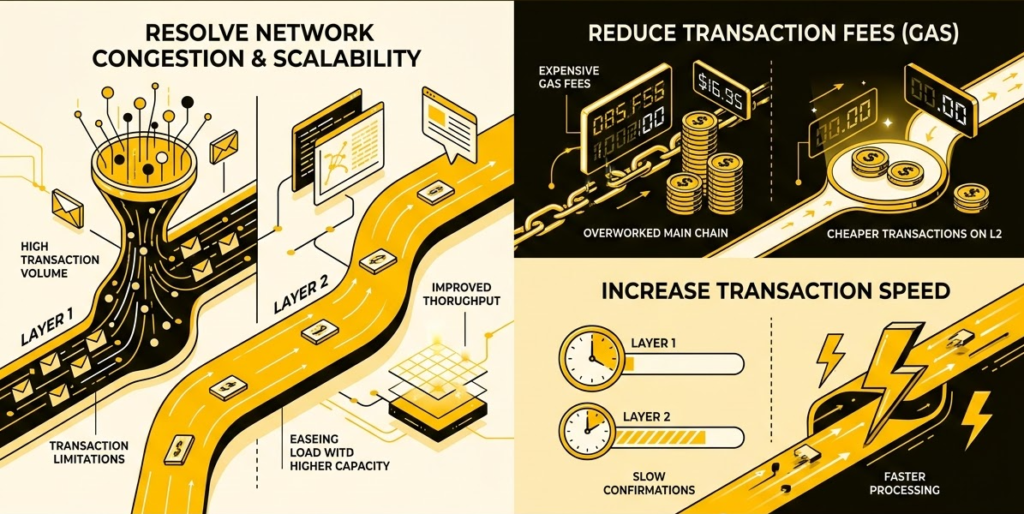
The underlying problem is a trade-off between decentralization, security, and scalability.
A public blockchain cannot simply behave like a conventional cloud server where the operator adds more machines whenever traffic increases. Every independent validator needs enough information and computational capacity to participate in the network’s verification process. If requirements become excessive, fewer participants can afford to operate nodes, potentially weakening decentralization.
Ethereum’s own scaling documentation explains the bottleneck in practical terms: when every validator has to independently process the same transactions, increasing activity can push the network toward capacity limits. Rollups change that equation by moving execution away from the base layer. Ethereum’s rollup scaling documentation
Think of Ethereum as a highly secure settlement court and an L2 as a specialized commercial district built around it.
You do not need the court to personally process every coffee purchase, NFT trade, game interaction, and DeFi transaction. What you need is a reliable system that records enough evidence for the court to verify what happened and provides a credible mechanism for resolving disputes.
That is essentially the role rollups attempt to play.
The old scaling dilemma
Historically, blockchain scaling discussions often revolved around simply making the Layer 1 bigger or faster.
That sounds attractive until you consider the consequences. Larger blocks require more storage, bandwidth, and processing resources. Faster block production can introduce its own networking and synchronization pressures. At some point, the blockchain may become extremely efficient for users but increasingly difficult for ordinary people to verify independently.
Layer 2 takes a different approach.
Instead of making the base chain perform everything, the ecosystem separates responsibilities:
- Execution can happen on L2.
- Data can be published to the L1 so the state remains reconstructible.
- Settlement happens through L1 contracts.
- Cryptographic proofs or challenge mechanisms establish correctness.
- Applications interact with a specialized execution environment rather than directly competing for every Ethereum block-space unit.
This separation is one reason Layer 2 is closely connected with the broader idea of a modular blockchain architecture.
How Layer 2 Works: Off-Chain Execution Meets L1 Settlement
The word “off-chain” sometimes makes newcomers nervous because it sounds like the transaction has left the blockchain entirely.
That is not quite what happens with a rollup.
A rollup is better understood as a separate execution environment whose state is ultimately anchored to the base blockchain. Users transact on the L2, while the rollup periodically publishes information to the underlying L1.
Suppose you and several thousand other people submit transactions within the same period. Processing every transaction individually on Ethereum would require each transaction to consume Ethereum block space. An L2 can instead execute those transactions together, compress relevant information, and publish a much smaller representation of that activity.
The fixed cost of interacting with Ethereum is therefore shared among many users.
Ethereum explains this mechanism particularly clearly for optimistic rollups: operators aggregate transactions into batches, compress transaction-related data, and publish those batches to Ethereum using mechanisms such as calldata or blobs. Ethereum’s rollup architecture guide
Transaction batching
Imagine a courier company where every customer hires a separate truck to deliver one package.
That is expensive.
Now imagine 2,000 customers use the same logistics hub. The company groups packages by destination, optimizes the route, and sends a handful of trucks instead of 2,000 individual vehicles.
The packages still reach their destinations, but the infrastructure cost per package falls dramatically.
That is broadly what rollup batching accomplishes.
The L2 does not necessarily send every computational step to Ethereum. Instead, it provides Ethereum with the information required to establish the validity and state of the rollup.
Compression matters more than many beginners realize
People often say that L2s are cheap simply because “transactions happen off-chain.”
That explanation leaves out one of the most important pieces.
Data is expensive.
Even if computation occurs elsewhere, the rollup still needs to communicate enough information to the Layer 1. The more efficiently that information can be represented, the fewer Ethereum resources the rollup consumes.
This is why transaction compression is so important to rollup economics.
Ethereum’s ZK-rollup documentation notes that the major scaling improvement comes not only from moving computation off-chain but also from reducing the amount of transaction data that must be posted to the base layer. Ethereum’s technical guide to ZK-rollups
The arrival of EIP-4844, introduced through Ethereum’s Dencun upgrade in March 2024, pushed this architecture further by giving rollups access to temporary data “blobs” designed specifically for cheaper data publication. Ethereum describes blobs as a lower-cost data mechanism intended to reduce rollup transaction fees. Ethereum’s Dencun documentation
This is one of those technical upgrades that sounds obscure but has a very real effect on the user experience.
When rollup data becomes cheaper to publish, the L2 has more room to offer low-cost transactions.
What Is a Rollup?
A rollup is a Layer 2 scaling system that executes transactions away from the base chain and then submits enough information to the base chain to establish the resulting state.
There are two major categories you will encounter:
- Optimistic rollups
- Zero-knowledge rollups, commonly called ZK-rollups
Both aim to solve a similar problem, but they prove correctness differently.
This is where many beginner guides become overly simplistic. The difference is not simply that one is “old” and the other is “new,” nor that one is automatically secure and the other is not. They represent different engineering approaches to proving that an L2 state transition is valid.
Optimistic Rollups: Assuming Correctness Until Challenged
Optimistic rollups take their name from an optimistic assumption: a proposed batch is treated as valid unless someone successfully proves that it is incorrect.
The operator or sequencer processes transactions and posts the resulting information to Ethereum. Instead of attaching a full validity proof to every batch, the system provides a mechanism through which an invalid result can be challenged.
Ethereum’s documentation describes the challenge mechanism as a fraud-proof process in which participants can dispute an incorrect rollup result during a defined challenge period. Ethereum’s optimistic-rollup explanation
This creates an important conceptual distinction.
With an optimistic rollup, the question is effectively:
“Can anyone prove that this state transition is wrong?”
With a validity-rollup design, the question is closer to:
“Can the cryptographic proof demonstrate that this state transition is correct?”
That difference has consequences for withdrawals, infrastructure, proving costs, and developer architecture.
How an optimistic rollup transaction moves
A simplified flow looks like this:
User → L2 sequencer → L2 execution → transaction batch → Ethereum → challenge/proof mechanism → final settlement
The sequencer usually orders transactions and packages them into blocks or batches. The resulting information is then committed to Ethereum.
If somebody identifies an invalid state transition, the protocol provides a dispute mechanism.
Arbitrum, for example, describes itself as an optimistic rollup in which validators can challenge assertions posted to Ethereum. Its technical documentation explains that the chain’s transaction inputs are recorded on Ethereum, allowing the state to be reconstructed from publicly available information. Arbitrum’s Nitro architecture documentation
This is one reason I would avoid saying that an optimistic rollup is simply “Ethereum but cheaper.” It is really a second execution environment with a specialized relationship to Ethereum.
ZK-Rollups: Proving Correctness with Cryptography
ZK-rollups approach the same scaling challenge from a different direction.
Instead of assuming that a transaction batch is correct and waiting for someone to challenge it, the system generates a validity proof showing that the proposed state transition satisfies the required rules.
Ethereum describes ZK-rollups as systems that execute transactions off-chain, bundle them into batches, and submit a compact summary together with cryptographic proof to Ethereum. Ethereum’s ZK-rollup documentation
The “zero-knowledge” part of the terminology can be confusing because you do not need to think of every ZK-rollup as primarily a privacy technology.
In the scaling context, zero-knowledge proofs are valuable because they allow one party to prove that a computation was performed correctly without requiring the verifier to reproduce every computational step.
That makes them extraordinarily powerful for blockchain scaling.
Why validity proofs matter
Imagine asking someone to verify that you correctly completed a million-step calculation.
One approach is to give them the entire calculation and allow them to inspect it. That is broadly analogous to a system where correctness can be challenged through execution and fraud proofs.
Another approach is to provide a compact mathematical proof that certifies the calculation’s validity.
The verifier does not need to repeat the entire million-step process.
That is the basic intuition behind validity proofs.
ZK-rollups can therefore offer a different finality model from optimistic systems. However, it would be misleading to call every ZK transaction “instantly final.” Proof generation itself can require computational work, and final settlement still depends on the Layer 1 accepting the proof.
zkSync and the ZK-rollup model
zkSync describes its architecture as a system of interoperable ZK Layer 2 rollups and explains that computation is performed off-chain while validity proofs are verified on Ethereum. zkSync’s rollup architecture documentation
Its documentation also emphasizes an important principle: even though execution takes place away from Ethereum, the L1 remains the security anchor for the rollup’s finalized state.
That is the central attraction of the model.
You get a specialized environment for execution without completely abandoning Ethereum’s settlement layer.
Optimistic vs. ZK Rollups: What Is the Difference?
If you are choosing an L2 as a user, the distinction can initially seem academic. In practice, however, the architecture influences withdrawal mechanics, proving infrastructure, development tooling, transaction costs, and the maturity of the security system.
| Feature | Optimistic Rollups | ZK-Rollups |
|---|---|---|
| Core assumption | Transactions are presumed valid unless challenged | Transactions are accepted with a validity proof |
| Proof model | Fraud proofs | Cryptographic validity proofs |
| Challenge period | Generally part of the security model | Not required for ordinary state validity |
| Computation | Mostly off-chain | Mostly off-chain |
| L1 settlement | Ethereum verifies/disputes state commitments | Ethereum verifies validity proofs |
| Typical examples | Arbitrum, Optimism, Base | zkSync, Starknet, Scroll |
| Main engineering challenge | Efficient dispute resolution | Efficient proof generation |
| User experience | Mature EVM ecosystem | Rapidly improving, but architecture varies |
The important takeaway is that neither category should be judged solely by marketing claims about speed.
A serious evaluation should look at the complete trust model: where the data lives, who controls upgrades, who can sequence transactions, how users can exit, what proof system is active, and what assumptions remain outside Ethereum itself.
The Rise of Ethereum Layer 2 Networks

The Ethereum ecosystem no longer revolves around a single execution environment.
Instead, it increasingly resembles a collection of specialized networks connected to a common settlement layer.
Some of the most recognizable names include:
- Arbitrum, an optimistic rollup ecosystem with extensive DeFi activity.
- Optimism, an optimistic-rollup platform and the foundation of the broader OP Stack ecosystem.
- Base, an Ethereum L2 developed by Coinbase and built using the OP Stack.
- zkSync, a ZK-rollup ecosystem focused on validity-proof-based scaling.
- Starknet, a validity-rollup platform using STARK-based cryptography.
- Scroll, an Ethereum-compatible ZK-rollup designed around Ethereum scaling.
The landscape changes quickly, so it is better to think of these networks as evolving infrastructure rather than a fixed leaderboard.
A network that looks dominant today can face very different competitive conditions six months or two years from now.
Why Layer 2 Fees Are So Much Lower
This is probably the most obvious question for everyday users.
Why does a swap or transfer sometimes cost substantially less on an L2 than on Ethereum Mainnet?
The answer comes down to shared infrastructure and data efficiency.
On Ethereum Mainnet, your transaction competes directly for scarce block space. On a rollup, your transaction becomes one item inside a larger batch. The cost of publishing that batch to Ethereum is then distributed across many users.
The economics are therefore fundamentally different.
Suppose the underlying L1 publication cost were $100 for a batch containing 10,000 transactions. In an extremely simplified example, the base publication component would represent roughly one cent per transaction before considering other costs.
Real rollup fee calculations are obviously more complicated, but the principle is straightforward: batching converts an expensive individual action into a much cheaper share of a collective operation.
EIP-4844 strengthened this model by creating dedicated blob space for rollup data, which Ethereum designed specifically to make rollup data publication cheaper. Ethereum’s explanation of EIP-4844 and blobs
That is why Ethereum’s scaling roadmap increasingly focuses on making data availability cheaper rather than simply increasing raw execution capacity on Mainnet.
What Is the Rollup-Centric Roadmap?
The phrase rollup-centric roadmap describes Ethereum’s strategic direction of using Layer 2 networks as major execution environments while keeping Ethereum itself focused on settlement, consensus, and data availability.
Instead of expecting Ethereum Mainnet to become the only place where applications operate, the architecture allows hundreds or potentially thousands of execution environments to build around Ethereum.
This is a profound change.
Ethereum becomes something closer to a shared settlement and security layer for an ecosystem of execution networks.
Proto-danksharding, introduced through EIP-4844, was an important step in that direction. Ethereum’s documentation explains that the upgrade introduced temporary blobs so rollups could publish data more economically, with the explicit goal of reducing L2 transaction costs and supporting greater scaling capacity. Ethereum’s Dencun FAQ
The longer-term roadmap extends this concept further through additional improvements to Ethereum’s data capacity.
Ethereum’s documentation on danksharding describes Proto-Danksharding as an intermediate stage toward a much larger data-availability architecture intended to support significantly more rollup activity. Ethereum’s danksharding roadmap
The Hidden Problem: Layer 2 Fragmentation
Here is where the Layer 2 story becomes less glamorous.
Having dozens of L2s is fantastic for scalability, but it creates a new problem: fragmentation.
Imagine you hold ETH on Arbitrum, USDC on Base, an NFT on another L2, and DeFi positions on Optimism.
Technically, all of these assets may exist within the broader Ethereum ecosystem.
Practically, however, they live in different environments.
Liquidity becomes fragmented. Applications have to decide which networks to support. Users need bridges or interoperability protocols. Developers must think about cross-chain messaging. Wallet interfaces need to make the complexity invisible.
The very technology created to make blockchain easier to scale can therefore make the ecosystem harder to navigate.
Why fragmentation matters
Fragmentation creates several forms of friction:
- Liquidity fragmentation: Capital is distributed across separate networks instead of one shared pool.
- User friction: Moving assets between L2s can require additional transactions.
- Developer complexity: Applications must decide how to handle users arriving from different networks.
- Bridge exposure: Cross-chain movement introduces additional smart contracts and trust assumptions.
- Price inefficiency: The same asset can have different liquidity conditions across different venues.
This is one reason interoperability is becoming almost as important as raw transaction throughput.
A world with 1,000 cheap blockchains is not necessarily better than a world with 10 highly connected ones.
For you as a user, the best infrastructure is the infrastructure you barely notice.
The Sequencer Problem
Another important issue is the role of the sequencer.
Many L2s rely on a centralized or relatively limited set of sequencers to order transactions. This is useful because it provides fast execution, predictable ordering, and a smoother user experience.
But it also creates a point of centralization.
Ethereum’s optimistic-rollup documentation explicitly notes that some rollups may use a single sequencer responsible for executing the chain, producing blocks, and submitting transactions to Ethereum. Ethereum’s documentation on L2 sequencers
The problem is not necessarily that the sequencer can steal everyone’s assets whenever it wants. A properly designed rollup can constrain what a sequencer can ultimately finalize on Ethereum.
The bigger concerns include:
- censorship,
- downtime,
- transaction ordering,
- MEV extraction,
- operational dependence on one infrastructure provider.
If the sequencer disappears, what happens?
If it refuses to include your transaction, what can you do?
If it goes offline during a market crash, can users still exit?
Those are much more useful questions than simply asking whether an L2 is “decentralized.”
Sequencer decentralization
The long-term direction for the industry is to make sequencing more decentralized or otherwise reduce the amount of trust users place in a single operator.
Different projects are experimenting with different approaches, including distributed sequencing, shared sequencing, forced inclusion mechanisms, and other cryptographic or economic designs.
There is no single universal solution yet.
That is worth remembering because the term “Ethereum Layer 2” can make different systems sound more similar than they actually are.
The Bridge Problem: Moving Assets Between L1 and L2
You cannot discuss Layer 2 without discussing bridges.
When you move ETH from Ethereum to an L2, you are generally interacting with contracts that lock or otherwise account for assets on one side while representing the corresponding value on the other side.
This sounds simple.
It is not.
Bridges are among the most sensitive pieces of blockchain infrastructure because they connect two separate environments and often control significant amounts of capital.
The risk is not necessarily the L2 itself. The risk may exist inside the bridge contracts, message-passing system, validator assumptions, upgrade keys, or verification mechanism.
Why bridges require careful analysis
Before moving a significant amount of capital across a bridge, I would want to know:
- Who controls the bridge contracts?
- Is the bridge upgradeable?
- How are messages verified?
- What happens if the sequencer goes offline?
- Is there a permissionless withdrawal mechanism?
- Are there emergency pause functions?
- What security assumptions exist outside Ethereum?
This is one of those situations where “official bridge” and “secure bridge” should never automatically be treated as synonyms.
Layer 2 and Modular Blockchain Architecture
Layer 2 is part of a broader movement toward modular blockchain architecture.
The traditional blockchain model tries to make one chain perform everything:
- execute transactions,
- maintain consensus,
- provide data availability,
- settle disputes,
- store state,
- and sometimes handle specialized application logic.
A modular architecture separates those responsibilities.
Ethereum increasingly acts as a settlement and data-availability foundation, while L2s specialize in execution.
Other networks can specialize in different components.
This modular approach resembles modern software architecture more than the traditional idea of one giant blockchain doing everything.
You can have one layer optimized for security and settlement, another for execution, another for data availability, and applications above them.
The advantage is flexibility.
The disadvantage is complexity.
And that trade-off will probably define much of blockchain infrastructure for years to come.
Layer 2 Beyond Ethereum
Although Ethereum dominates the modern rollup conversation, Layer 2 is not conceptually exclusive to Ethereum.
Bitcoin, for example, has its own second-layer scaling ecosystem, most notably the Lightning Network, which approaches scaling through payment channels rather than Ethereum-style rollups.
The underlying principle is similar: do more activity away from the base chain while using the base layer for final settlement or dispute resolution.
But the architectures are very different.
Ethereum L2s generally emphasize smart-contract execution and rollup settlement, while Lightning is primarily designed around fast, low-cost Bitcoin payments through payment channels.
So when someone says “Layer 2,” always ask a second question:
Layer 2 for which Layer 1, and using which architecture?
That one question eliminates a lot of confusion.
The Role of Data Availability
Data availability is one of the most important concepts in L2 security, yet it is rarely explained well to beginners.
Imagine that an L2 tells Ethereum:
“Trust me, thousands of transactions happened and this is the new state.”
If the underlying transaction information disappears, how can independent participants reconstruct the chain?
They cannot.
That is why rollups generally need a mechanism for making sufficient transaction data available to users and validators.
Ethereum’s ZK-rollup documentation emphasizes that publishing transaction data to Ethereum remains important even when validity proofs establish the correctness of state transitions, because the data allows independent participants to reconstruct and verify the L2 state. Ethereum’s explanation of data availability for ZK-rollups
This is an important distinction:
Validity proves that something was done correctly.
Data availability lets independent participants know what was done.
You need both for a robust permissionless system.
Why ZK Proofs Do Not Automatically Mean Privacy
Another common misunderstanding is that every ZK-rollup provides anonymous transactions.
Not necessarily.
“Zero-knowledge” refers to a family of cryptographic proof techniques. In the context of Ethereum scaling, the principal benefit can simply be proving computational correctness efficiently.
A ZK-rollup can therefore be highly transparent.
The transactions may still be publicly observable. The proof simply provides an efficient mathematical guarantee about the validity of the state transition.
This distinction becomes especially important when comparing scaling-focused ZK systems with privacy-focused ZK applications.
The same underlying cryptographic family can serve very different purposes.
The Developer Experience: Why EVM Compatibility Matters
One of the strongest reasons Ethereum L2s have attracted developers is compatibility.
If you already know Ethereum development, an EVM-compatible L2 can dramatically reduce the friction involved in deploying an application.
Instead of learning an entirely different smart-contract environment, developers can often reuse:
- Solidity contracts,
- wallets,
- development frameworks,
- testing infrastructure,
- libraries,
- deployment tools,
- existing security practices.
Ethereum’s documentation notes that EVM-compatible optimistic rollups allow developers to port existing Ethereum applications with relatively limited changes and continue using established Ethereum tooling. Ethereum’s explanation of EVM-compatible rollups
This network effect is easy to underestimate.
The best scaling technology in the world is not very useful if developers refuse to build on it.
Popular Layer 2 Networks and What They Represent
The major L2 names tend to fall into recognizable architectural categories, although the boundaries continue to evolve.
| Network | Broad architecture | Main idea |
|---|---|---|
| Arbitrum | Optimistic rollup | Ethereum-compatible scaling with fraud-proof security |
| Optimism | Optimistic rollup | Rollup stack designed for Ethereum scaling and broader ecosystem deployment |
| Base | Optimistic rollup | Coinbase-backed Ethereum L2 using the OP Stack |
| zkSync | ZK-rollup ecosystem | Ethereum scaling using validity proofs |
| Starknet | Validity rollup | STARK-based scaling architecture |
| Scroll | ZK-rollup | Ethereum-compatible ZK scaling |
These labels should not be interpreted as investment rankings.
They are architectural descriptions.
If you are choosing where to use a DeFi protocol, you should look beyond the name of the L2 and investigate actual liquidity, application support, withdrawal mechanics, bridge design, decentralization, and security history.
The Economics of Layer 2
Layer 2 economics are more complicated than simply “low fees.”
An L2 has its own costs.
There are costs associated with:
- sequencing transactions,
- execution,
- proving,
- publishing data,
- infrastructure,
- security,
- bridges,
- and sometimes token incentives.
The L2 then needs to turn those costs into a sustainable fee model.
For optimistic rollups, a significant component of the economics comes from posting transaction data to Ethereum.
For ZK-rollups, proof generation can become a major computational expense.
As proving technology becomes more efficient and Ethereum’s data capacity improves, the economics can change dramatically.
That is why today’s L2 fee structure should not be treated as permanent.
The technology is still evolving.
Does Layer 2 Really Reduce Gas Fees?
Yes, that is one of its primary purposes, but the amount varies.
A Layer 2 can be substantially cheaper than Ethereum Mainnet because it shares L1 costs across many transactions and uses compression. Ethereum’s official documentation describes optimistic rollups as capable of significant scalability improvements and explains that batching reduces the per-transaction burden of L1 costs. Ethereum’s optimistic-rollup guide
However, “L2 transactions are always cheap” is also too simplistic.
Fees can increase when:
- L2 activity becomes extremely congested,
- Ethereum’s data costs rise,
- blob capacity becomes constrained,
- an application uses expensive smart-contract logic,
- the network introduces additional execution costs.
EIP-4844 was specifically designed to make rollup data cheaper, but even Ethereum notes that blob space itself is limited and that periods of high demand can affect costs. Ethereum’s Dencun FAQ
So think of L2s as dramatically improving the economics of block space, not as eliminating transaction costs altogether.
What Happens If an L2 Sequencer Goes Offline?

This is one of the most practical questions you can ask.
The answer depends on the architecture.
A centralized sequencer can go offline while Ethereum itself continues operating normally. The L2 may become temporarily unusable or delayed, but a properly designed rollup can provide mechanisms for users to interact with the underlying L1 contracts directly in certain circumstances.
Ethereum’s documentation notes that optimistic rollups can provide ways for users to submit transactions directly to Ethereum if a sequencer becomes unavailable or delays inclusion beyond an allowed period. Ethereum’s explanation of censorship resistance on optimistic rollups
This is why I would never evaluate an L2 purely on transaction speed.
Ask what happens when things go wrong.
That is where the real security model reveals itself.
Are Layer 2 Networks Decentralized?
The honest answer is: some are more decentralized than others, and most are still evolving.
There are multiple dimensions to decentralization:
- Who sequences transactions?
- Who can upgrade contracts?
- Who controls emergency keys?
- Who can publish state?
- Who can challenge invalid state?
- Can users withdraw without permission?
- How many independent entities operate critical infrastructure?
A network can have decentralized settlement through Ethereum while still relying on a centralized sequencer for transaction ordering.
That does not make the system worthless.
It simply means you should understand what the centralization actually affects.
This is a much more useful framework than trying to place every blockchain into a simplistic “decentralized” or “centralized” category.
The Future of Layer 2: From Scaling to Invisible Infrastructure
The first generation of L2 adoption focused heavily on one selling point:
lower fees.
That was necessary.
But I suspect the next phase will be about something less obvious: making the existence of L2s almost invisible to ordinary users.
Imagine opening a DeFi application and never having to think about which network your transaction is using.
Your wallet automatically routes the transaction.
Liquidity is abstracted across networks.
The application handles bridging.
Fees are paid seamlessly.
The user simply sees a financial application.
That is probably the endgame.
The technical infrastructure may become increasingly complicated underneath the surface while the user experience becomes dramatically simpler.
In that sense, Layer 2 is not just a scaling technology. It is part of an attempt to make blockchain infrastructure disappear behind applications.
Layer 2 and the Future of Ethereum
Ethereum’s long-term scaling strategy is increasingly intertwined with rollups.
The base layer does not need to become the world’s fastest execution engine if it can become the world’s most reliable settlement and data-availability layer for many execution environments.
That is a fundamentally different vision of blockchain scaling.
Instead of one chain processing everything, Ethereum can coordinate a broader ecosystem of specialized execution networks.
The Dencun upgrade and EIP-4844 already moved Ethereum in that direction by introducing blob transactions specifically to reduce the cost of publishing rollup data. The Ethereum Foundation’s Dencun announcement
And Ethereum’s longer-term danksharding roadmap explicitly envisions increasing the amount of data available to rollups so that the ecosystem can support substantially greater transaction capacity. Ethereum’s danksharding roadmap
That does not mean Ethereum L2s have “solved scaling.”
It means the industry has changed the question.
Instead of asking:
“How can one blockchain process every transaction?”
we are increasingly asking:
“How can one secure blockchain support thousands of execution environments?”
That is a much bigger architectural problem.
What Should You Look for When Choosing an L2?
If you are actually going to use an L2 rather than simply reading about one, I would keep the evaluation practical.
Security
Look at the rollup’s actual security model, including proof systems, upgrade permissions, bridge architecture, and withdrawal mechanisms.
Liquidity
A theoretically excellent L2 is not particularly useful if the application you want has no meaningful liquidity there.
Ecosystem
Check whether the applications, wallets, stablecoins, exchanges, and infrastructure you already use support the network.
Fees
Do not look only at the advertised transaction fee. Consider the total cost of bridging assets, swapping, interacting with contracts, and eventually withdrawing.
Sequencer design
Understand whether the L2 relies on a single sequencer and what happens during downtime or censorship.
Exit guarantees
This is one of the most important points.
You want to understand how you can recover your assets if the operator stops cooperating.
Upgrade authority
A highly upgradeable system controlled by a small multisig may have a very different trust model from a system with more constrained upgrade mechanisms.
FAQ
What is a Layer 2 blockchain in simple terms?
A Layer 2 is a network built on top of a Layer 1 blockchain that handles many transactions outside the base chain and then anchors the resulting information back to that Layer 1. For Ethereum, rollups such as Arbitrum, Optimism, and ZK-based systems use this approach to increase capacity and reduce transaction costs.
The important point is that an L2 is not simply another independent blockchain. A rollup is designed to maintain a specific security and settlement relationship with its underlying Layer 1.
Why are gas fees so much lower on Layer 2 networks?
L2s reduce costs primarily by processing many transactions together and spreading the cost of publishing information to Ethereum across the entire batch. Compression further reduces how much data needs to be posted.
Ethereum’s documentation explains that optimistic rollups aggregate and compress transactions before publishing them to Mainnet, which allows the fixed cost of L1 settlement to be shared among many users. Ethereum’s explanation of rollup batching and compression
The introduction of blob transactions through EIP-4844 further reduced the cost of rollup data publication by creating a dedicated, cheaper data mechanism. Ethereum’s Dencun documentation
What is the difference between Optimistic and ZK-rollups?
Optimistic rollups assume that submitted state transitions are correct unless someone successfully challenges them through a fraud-proof mechanism. ZK-rollups instead attach cryptographic validity proofs that allow Ethereum to verify that the state transition was computed correctly.
In simple terms, optimistic systems primarily ask someone to prove that an invalid result is wrong, while ZK systems provide a mathematical proof that the proposed result is valid.
Both approaches execute transactions away from Ethereum and use Ethereum as an important settlement and security layer, but their technical and economic trade-offs differ. Ethereum provides separate technical explanations for optimistic rollups and ZK-rollups for developers who want to examine the architecture in detail.
Do Layer 2 networks have their own security?
They have their own operational and application-level security, but rollups are designed to derive important security guarantees from their underlying Layer 1.
For example, Ethereum describes optimistic rollups as hybrid scaling systems whose security properties are derived from Ethereum because state commitments and transaction data are anchored to Mainnet. Ethereum’s explanation of optimistic-rollup security
However, that does not mean every risk disappears.
An L2 can still have vulnerabilities in its bridge, smart contracts, sequencer, upgrade keys, proving system, or implementation. Therefore, “secured by Ethereum” should be understood as part of a larger security model rather than a blanket guarantee.
Is an L2 the same thing as a sidechain?
No.
A sidechain is generally an independent blockchain with its own consensus and security model. A rollup, by contrast, is specifically designed to use the underlying Layer 1 for important security and settlement functions.
Ethereum’s documentation distinguishes rollups from sidechains on precisely this basis: rollups publish data and state information to Ethereum and rely on Ethereum for settlement and security, while sidechains generally maintain their own independent consensus. Ethereum’s rollup documentation
That distinction is crucial when evaluating the security assumptions behind different scaling networks.
Are ZK-rollups faster than optimistic rollups?
Not automatically.
ZK-rollups can provide powerful scalability characteristics because validity proofs allow Ethereum to verify large amounts of computation without replaying every transaction. However, generating those proofs can itself require substantial computation.
Optimistic rollups avoid the need to generate a validity proof for every batch but rely on a dispute mechanism.
Therefore, “ZK equals faster” and “optimistic equals slower” are both oversimplifications. Actual performance depends on the implementation, hardware, proving system, data costs, sequencer architecture, and network demand.
What is the role of Ethereum in an L2?
For an Ethereum rollup, Ethereum can act as the settlement, consensus, and data-availability foundation.
The L2 executes transactions and maintains its application environment, while Ethereum stores or verifies the information needed to establish the rollup’s state and resolve disputes or validate proofs.
Ethereum’s ZK-rollup documentation describes this relationship directly: the L2 executes transactions in a separate environment, while Ethereum’s on-chain contracts verify proofs and provide the settlement layer. Ethereum’s ZK-rollup architecture guide
Can Layer 2 networks eliminate Ethereum gas fees completely?
No.
They can reduce them dramatically, but somebody still pays for computation and data publication.
The goal is to make those costs small enough that users can comfortably transact at scale. The actual fee depends on the L2’s architecture, current demand, Ethereum data costs, transaction complexity, and other factors.
The arrival of EIP-4844 made rollup data substantially cheaper, but Ethereum notes that blob capacity is finite, meaning periods of intense demand can still affect rollup costs. Ethereum’s Dencun FAQ
Why does Layer 2 matter for ordinary crypto users?
Because scaling is ultimately about usability.
If sending $20 requires a $30 transaction fee, the technology is not useful for that particular payment. If a decentralized exchange becomes too expensive for smaller traders, liquidity and user participation suffer. If a blockchain game requires users to approve costly transactions every few seconds, the experience becomes frustrating.
L2s attempt to solve that gap.
They allow the security and settlement characteristics of a major Layer 1 to support a much larger number of everyday interactions without requiring every action to consume the same amount of scarce base-layer block space.
And that, in my view, is the real significance of Layer 2.
It is not simply about making crypto transactions cheaper.
It is about changing the economic boundary of what a blockchain can realistically do.
Final Thoughts: Layer 2 Is More Than a Cheaper Ethereum
The easiest way to understand Layer 2 is to think of it as a second execution environment built around a highly secure base blockchain.
But the deeper story is much more interesting.
Rollups are changing how blockchains divide responsibilities. Ethereum increasingly focuses on consensus, settlement, and data availability, while L2 networks compete to provide fast and inexpensive execution. Optimistic rollups use fraud-proof mechanisms, ZK-rollups use validity proofs, and both are experimenting with increasingly sophisticated ways to scale without abandoning the underlying Layer 1.
The technology is already useful, but it is not finished.
Sequencer centralization still matters. Bridges remain complicated. Liquidity is fragmented. Different L2s make different trust assumptions. And as the number of execution environments grows, interoperability may become just as important as transaction throughput.
If you are new to crypto, I would not obsess over TPS alone. Look at the entire architecture: where transactions execute, where data is stored, who can order transactions, how correctness is proven, how assets move, and what happens if something fails.
Once you understand those pieces, Layer 2 stops looking like a collection of confusing crypto buzzwords.
You start seeing the bigger picture: Ethereum does not necessarily need to execute every transaction itself to become a global settlement layer. It needs to provide a sufficiently secure foundation on which many specialized networks can operate.
That is the bet behind the rollup-centric future.
And if that architecture works at the scale the industry is aiming for, you may eventually use Layer 2 every day without even realizing which Layer 2 you are using.