
OKX South Africa operational and compliance scorecard
If you’re asking “is OKX legit in South Africa?”, the answer needs more nuance than a simple yes or no. OKX is an established international exchange, and it has published terms specifically addressing its services for South African residents. However, you should not interpret that as meaning every product on the global platform is independently licensed by South Africa’s Financial Sector Conduct Authority (FSCA).
The most important recent development is OKX’s South Africa Terms Addendum, published on September 18, 2026. It identifies Aux Cayes FinTech Co. Ltd., the Seychelles-incorporated OKX entity, as a juristic representative of CurrenC Group (Pty) Ltd, an authorised financial services provider holding FSP licence 53709 under the Financial Advisory and Intermediary Services Act (FAIS Act).
OKX explicitly states that Aux Cayes does not itself hold an FSCA financial services provider licence. Instead, it provides the services covered by the addendum under CurrenC’s mandate and oversight. The arrangement is limited to the services expressly identified in the applicable terms; it does not automatically cover every product available on OKX globally.
| Metric | What it means for South African users |
|---|---|
| Individual crypto ownership | Holding and trading crypto is not subject to a blanket prohibition |
| Local service arrangement | OKX describes a juristic representative arrangement with CurrenC Group |
| FSCA licensing | OKX’s offshore entity says it does not independently hold an FSCA FSP licence |
| Covered products | Only services identified in the applicable South Africa terms are covered by the arrangement |
| ZAR P2P trading | OKX has supported ZAR P2P trading, subject to current availability and account eligibility |
| Identity verification | KYC is required for relevant exchange and P2P services |
| FIC Travel Rule | South African accountable institutions must follow applicable crypto-transfer information requirements |
| SARS tax | Crypto gains may be treated as revenue or capital, depending on the facts |
| Proof of Reserves | OKX publishes cryptographic reserve and liability reports |
| Main risks | Price volatility, P2P payment fraud, custody risk, regulatory changes and account restrictions |
For me, the useful question is not whether OKX has a large international user base. It is whether the particular service you intend to use is covered by the current South African arrangement, what recourse you have if something goes wrong, and whether the payment route fits your needs.
How OKX operates under South African regulation
Crypto ownership versus FSCA authorisation
South Africa has a regulatory framework for financial services involving crypto assets. The FSCA declared crypto assets to be financial products under the FAIS Act in October 2022 through General Notice 1350 of 2022. This brought relevant advice and intermediary services involving crypto assets within the financial-services licensing framework.
The FSCA later issued guidance and communications concerning crypto-asset service provider licensing. Its Communication 29 of 2023 reminded businesses providing financial services in relation to crypto assets of the licensing application deadline.
That framework does not mean every individual who owns Bitcoin or USDT is automatically operating illegally. It regulates relevant financial services and the businesses providing them. Holding crypto for investment is a different matter from operating an exchange or providing regulated advice and intermediary services.
For users, three distinctions are worth keeping in mind:
- Crypto ownership: An individual can hold crypto, but that does not remove tax or other legal obligations.
- Domestic licensing: A business providing covered financial services may need the appropriate FSCA authorisation.
- OKX’s South African arrangement: OKX says specified services are provided through its relationship with CurrenC Group, rather than under an independent FSCA FSP licence held by Aux Cayes itself.
This last point is where much of the confusion comes from. Calling OKX “directly FSCA-licensed” would not match the company’s own disclosure. Calling it entirely outside any local financial-services oversight would also miss the representative arrangement it has disclosed.
What the CurrenC arrangement means
Under the September 2026 addendum, CurrenC Group (Pty) Ltd is the authorised financial services provider under whose licence and oversight Aux Cayes provides the covered services. OKX says Aux Cayes acts as the contracting entity for those services, while CurrenC oversees the regulated financial services that fall within the arrangement.
The addendum also describes how trades may be executed. Depending on the product and execution method, OKX may route an order to a related affiliate or use an affiliated liquidity provider. That affiliate may act as principal or counterparty. The terms say these arrangements can create conflicts of interest, which the company says it will identify and manage.
That is a detail I would not skip. A licence or representative relationship does not mean every trade is matched in the same way, nor does it guarantee that a customer will never experience a dispute.
The addendum says complaints relating to the covered financial services are handled through CurrenC’s complaints framework. Users can first contact OKX, then escalate to CurrenC if the issue remains unresolved, and may refer an eligible complaint to the FAIS Ombud.
You can review the South Africa Terms Addendum before deciding whether the services described there match what you want to use. The document also says the arrangement does not constitute FSCA approval or endorsement of any crypto asset, product or service.
FIC Directive 9 and the Travel Rule
South African crypto users may encounter additional identity and transaction-information checks when moving assets between service providers. These are part of the country’s anti-money-laundering framework.
The Financial Intelligence Centre (FIC) issued Directive 9 on November 15, 2024. It took effect on April 30, 2025, and applies the Travel Rule to relevant accountable institutions involved in crypto-asset transfers. The directive requires information about the originator and beneficiary to accompany qualifying transfers and requires records to be maintained. The FIC explains the purpose and scope in its official Directive 9 media release.
In practice, this means a crypto transfer may involve more than a wallet address. A service provider may ask for information about who is sending or receiving the assets, especially when the transaction involves another regulated provider.
I would not assume that OKX complies with every South African requirement merely because it operates globally or publishes general compliance statements. Its South African terms, the scope of its representative arrangement and the requirements applicable to each transfer are the better starting points.
Is OKX safe for South African users?
No exchange can remove every crypto risk. A more useful assessment looks at reserve transparency, account protection, custody arrangements and how payments are handled.
Understanding OKX Proof of Reserves
OKX publishes Proof of Reserves (PoR) reports using cryptographic methods, including zk-STARKs. Its Proof of Reserves page lists a reserve and liability report dated October 3, 2026, using zk-STARK v2.
In broad terms, Proof of Reserves is intended to help users verify that the exchange holds specified on-chain assets and that reported customer liabilities are represented in the verification process. OKX uses a Merkle-tree system and cryptographic proofs to allow checks without exposing every user’s private account information.
That is a useful transparency measure, but it is not a magic shield. A PoR snapshot does not guarantee future solvency, prove that every possible liability has been included or insure your account against a hack, scam or market crash. It also says nothing about whether a particular service is authorised in your country.
If you want to inspect the reports yourself, use the official download page, review the snapshot date and follow OKX’s verification instructions. Avoid relying only on a headline saying the exchange is “over 100% backed” without checking which assets and liabilities the report covers.
ZAR P2P trading and local bank transfers
OKX has supported peer-to-peer trading in South African rand. Its published P2P materials include ZAR among the fiat currencies available to eligible users in Africa. However, the presence of ZAR in a historical promotion or a general help page does not guarantee that a suitable advert is available for your account today.
P2P trading works differently from depositing rand directly with a bank-linked exchange. Buyers and sellers arrange the fiat payment between themselves, while the platform’s escrow mechanism holds the crypto associated with the order until the transaction conditions are met.
The process typically looks like this:
- A buyer selects a seller and agrees to a ZAR price and payment method.
- The seller’s crypto is placed in escrow for the order.
- The buyer sends rand using the agreed payment method.
- The seller confirms that the money has cleared.
- The crypto is released according to the platform’s P2P process.
OKX’s P2P requirements for the Africa region include ZAR among supported fiat currencies for certain merchant-advertising categories. This supports the claim that ZAR P2P has been offered, but the actual adverts and available banks may vary.
Do not assume that every Capitec, FNB, Standard Bank, Absa, Nedbank or Investec account will work with every seller. A merchant’s payment methods are determined by the live advert, and banks may impose their own transfer rules.
P2P safety: what I would check before paying
The biggest practical risk in a P2P transaction is not the crypto price moving by a few cents. It is sending money to the wrong person, relying on a fake payment confirmation or releasing assets before the payment has genuinely cleared.
Use these precautions:
- Choose merchants with a strong completion record and a meaningful trading history.
- Check that the payment account belongs to the person or business named in the order.
- Keep all communication and payment instructions within the platform’s official order process.
- Never release crypto based on a screenshot or an SMS notification alone.
- Confirm that the funds have arrived in your own banking app.
- Do not accept requests to pay a third party or move the conversation to an unofficial channel.
Escrow reduces some risks, but it cannot guarantee that every payment is legitimate. If something looks unusual, stop and use the platform’s dispute process rather than improvising a workaround.
Centralised exchange custody versus the OKX Web3 Wallet
An exchange account and a self-custodial wallet have different risk profiles.
When you hold assets in a centralised exchange account, the platform manages the account infrastructure and controls the withdrawal process under its terms. This can be convenient for frequent trading, but access depends on the exchange and its operational, security and compliance systems.
A non-custodial wallet is intended to let you control the credentials used to authorise transactions. OKX describes its Web3 Wallet as a non-custodial product, but you should check the documentation for the specific wallet version and recovery method you use rather than assuming every wallet feature uses the same MPC architecture.
Self-custody reduces your dependence on an exchange for access to assets, but it transfers more responsibility to you. If you lose recovery credentials, approve a malicious contract or send assets to the wrong address, recovering the funds may be impossible.
SARS crypto tax: income tax, capital gains and CARF
South African tax treatment depends on what you do with crypto and why you hold it. There is no single tax rate that applies to every transaction.
The South African Revenue Service explains that crypto gains may be treated as revenue under ordinary income-tax rules or as capital gains under the Eighth Schedule to the Income Tax Act. Frequent, business-like trading may support revenue treatment, while a long-term investment may be treated as capital in nature. The classification depends on the facts and relevant tax principles, not simply on how long you happened to hold one coin.
SARS provides guidance in its Crypto Assets & Tax section. For the 2026 tax year, SARS lists the maximum effective capital gains tax rate for individuals as 18%, while ordinary income tax can reach 45%, depending on taxable income. Those are maximum rates, not automatic charges on every crypto sale.
South Africa’s Crypto-Asset Reporting Framework (CARF) took effect on March 1, 2026. Under the framework, relevant crypto-asset service providers must collect and report certain crypto transaction information to SARS. SARS says the first reporting period runs from March 1, 2026, to February 28, 2027, with the first CARF return due by May 31, 2027. The initial exchange of CARF information between participating jurisdictions is scheduled for September 2027. See SARS’s official CARF guidance.
CARF does not replace your personal tax obligations. SARS says individuals must continue to declare crypto transactions in their income-tax returns under existing legislation. Keep records of purchases, disposals, exchange rates, fees, transfers and the purpose of each transaction. If you are uncertain whether your activity is revenue or capital in nature, consult a tax professional rather than choosing the lower rate by default.
How to complete KYC and buy crypto with ZAR on OKX P2P
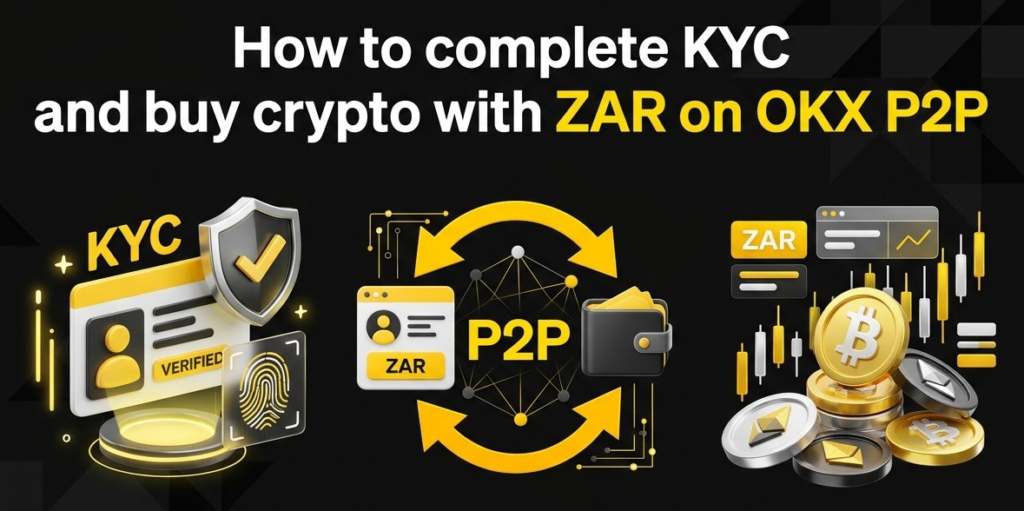
The exact screens may change, so treat the following as a practical walkthrough rather than a guarantee that every feature will be available to every South African account.
Register and verify your identity
Create your account through the official OKX website or app. Avoid sponsored links or messages from people claiming to be support staff.
Enter accurate personal details. Use your legal name and current residence information. Crypto platforms may ask for identity and address details as part of KYC and anti-money-laundering checks.
Submit an accepted identity document. OKX’s verification screen will show which documents are accepted for your account. A South African Smart ID card, green barcoded ID book or passport may be relevant, but do not assume all documents or account levels have identical requirements.
Complete any requested face or liveness check. Follow the instructions in the official app and make sure the image is clear.
Wait for approval before trading. Do not assume that submitting a document immediately unlocks every deposit, P2P or withdrawal function. Account access and transaction limits may depend on the verification status.
Buy crypto using ZAR P2P
Open the P2P marketplace. Select ZAR as the fiat currency and the crypto asset you want to buy, if those options are available to your account.
Review the merchant carefully. Check the completion rate, order count, limits and payment methods. A high completion rate can be a useful signal, but it is not a guarantee that a transaction is safe.
Read the payment instructions before placing the order. Make sure the bank transfer method and account details match the advert. Do not send money to a different recipient because a seller asks you to do so in chat.
Pay from your own bank account. Follow the order instructions and keep your payment confirmation. Once you have genuinely sent the funds, mark the order as paid within the platform.
Confirm that the crypto has been released. Do not cancel an order after paying without following the platform’s dispute process. If the seller fails to release the assets, use the official appeal mechanism and provide the requested evidence.
Frequently asked questions
Is OKX legal and operational in South Africa?
OKX published a South Africa-specific terms addendum in September 2026. It says the offshore entity Aux Cayes FinTech Co. Ltd. provides specified services as a juristic representative of CurrenC Group, an authorised financial services provider. OKX does not claim that Aux Cayes independently holds an FSCA FSP licence. Check the addendum to see which services are covered.
Can South African users buy crypto with ZAR on OKX?
OKX has supported ZAR through its P2P marketplace, and ZAR appears in its Africa-region P2P documentation. However, live adverts, payment methods and account eligibility can change. Confirm the options shown in your verified account before making a transfer.
Does OKX have a direct FSCA licence?
OKX’s September 2026 South Africa addendum states that Aux Cayes FinTech Co. Ltd. does not independently hold an FSCA financial services provider licence. It provides the services covered by the addendum under a juristic representative arrangement with CurrenC Group (Pty) Ltd, FSP 53709.
Is KYC mandatory for South African OKX users?
Relevant exchange and P2P services require identity verification. The exact documents accepted and the verification level needed depend on the current account process. Follow the official verification screen rather than relying on a third-party list of accepted IDs.
Does SARS tax crypto trading on OKX?
Yes, crypto transactions can have tax consequences under South African law. Gains may be treated as ordinary income or capital gains depending on the facts. SARS’s CARF reporting framework also took effect in March 2026, increasing reporting obligations for relevant service providers.
Does OKX Proof of Reserves guarantee my funds are safe?
No. Proof of Reserves helps users verify specified assets and liabilities at a snapshot in time. It does not insure customer assets, guarantee future solvency or eliminate cyber, market, liquidity and counterparty risks.
Can I use Capitec or FNB for OKX P2P?
A ZAR P2P advert may offer a payment method associated with Capitec, FNB or another South African bank. The available methods depend on the individual merchant and the current marketplace. Check the live advert before placing an order.
Is OKX P2P anonymous?
You should not expect anonymous trading. KYC requirements and South African anti-money-laundering rules can require identifying information, and the FIC Travel Rule requires relevant information to accompany qualifying transfers between accountable institutions.
Are OKX’s futures and perpetuals available in South Africa?
Do not assume that every product visible on the global platform is covered by the South African representative arrangement. The September 2026 addendum states that only specifically covered services fall within the arrangement. Check the applicable product terms and disclosures before trading derivatives.
What should I do if I cannot access OKX or my account is restricted?
Use official OKX support channels and check your account’s verification and withdrawal status. Avoid unofficial “unblocking” services, VPN-based workarounds or anyone asking for your password, authentication codes or recovery phrase. If a transaction is pending, keep the transaction ID and follow the platform’s official process.
Final verdict: should South Africans use OKX?
OKX has made a specific regulatory disclosure for South Africa, and that is more informative than simply describing it as an offshore exchange operating outside local oversight. Its September 2026 addendum identifies a juristic representative arrangement with CurrenC Group (Pty) Ltd, while also making clear that OKX’s offshore entity does not independently hold an FSCA FSP licence.
For everyday users, the next step is to verify which services are actually covered, confirm that your account has passed KYC, and check the live availability of ZAR P2P payment methods. Treat escrow as a useful safeguard rather than a guarantee, and do not release assets until your bank confirms that the money has arrived.
Finally, keep tax records from the start. SARS treats crypto gains according to the nature of the activity, and CARF reporting has increased the information that relevant providers must collect and report.
My conclusion: OKX may be an option for South African users under the services and terms it has specifically disclosed, but it should not be described as independently FSCA-licensed or as risk-free. Read the local addendum, verify the product you intend to use and make your decision based on the actual terms, not the size of the global brand.



