
That last point matters. I see Web3 as an attempt to change how the internet distributes power, ownership, and trust-not as a magical replacement for every website, app, or cloud service you already use.
You can still browse websites, send messages, watch videos, and buy things in a Web3 environment. The difference is how certain parts of the experience work behind the scenes. Instead of relying exclusively on a company’s database and account system, an application may use public blockchain records, smart contracts, wallet-based authentication, and decentralized storage.
Imagine that you spend years building a reputation on an online platform. You publish content, develop an audience, and establish relationships with other users. Then the platform changes its rules, restricts your account, or shuts down. In a conventional system, your access to that reputation and audience may depend heavily on the company operating the service.
Web3 explores a different model. Your assets might live in a wallet you control, your identity might be portable across compatible applications, and some application rules might be enforced by publicly verifiable smart contracts. Those capabilities can reduce dependence on a single intermediary.
They do not, however, guarantee complete ownership of everything you create or use online. A wallet cannot force a centralized website to keep displaying your content, and a token does not automatically grant copyright or legal ownership of an associated image. The details depend on the application, its contracts, and the rights attached to the asset.
If you want a practical Web3 definition, start here: Web3 is an effort to make parts of the internet more open, interoperable, and user-controlled through cryptography and decentralized infrastructure. Understanding both the benefits and the limitations is the best way to separate the technology from the hype.
The evolution of the web: Web1 vs Web2 vs Web3

The terms Web1, Web2, and Web3 are useful ways to discuss changes in how people use the internet. They are not official protocol versions released on strict dates, and the boundaries between them are blurry. Old-style static websites still exist, social platforms continue to dominate online activity, and Web3 applications often depend on conventional cloud infrastructure.
Still, the framework helps explain what proponents of Web3 want to change.
Web1 (roughly the 1990s to early 2000s): The read-only era
The earliest public web was largely about publishing and accessing information. You visited a website, read its content, followed links, and moved on. Most users were consumers of information rather than active participants in large online communities.
Personal homepages, directories, news sites, and simple HTML pages were typical examples. Building a website required some technical knowledge, and the tools for publishing interactive content were less accessible than they are today.
Yet there was an important feature of the early web that sometimes gets lost in nostalgic comparisons: its foundations relied on open protocols. HTTP, HTML, URLs, and other shared standards allowed independent servers and browsers to communicate without needing approval from one company that controlled the entire web.
That openness did not make every website decentralized in every sense. A website could still be hosted on a single server, and its owner could remove content whenever they wanted. But the broader web was built around interoperable protocols rather than one unified social platform.
I would describe Web1 as an internet where publishing was possible, but participation at scale was comparatively difficult for ordinary users.
Web2 (roughly the mid-2000s to the present): The read-write era
Web2 brought interactive applications and user-generated content into everyday life. Instead of simply reading a page, you could publish videos, comment on posts, upload photographs, build an online store, or collaborate with people around the world.
Platforms such as Facebook, YouTube, and X made publishing much easier. Cloud infrastructure and managed databases also allowed companies to build complex applications without maintaining every part of their own physical infrastructure.
The trade-off was a shift in control. A platform generally manages user accounts, stores content, decides which features are available, and sets the rules for moderation and monetization. Even when users create most of the value, the company often controls the infrastructure through which that value is accessed.
Advertising adds another layer. Many free services generate revenue by collecting behavioral data, measuring engagement, and selling targeted advertising. Not every Web2 business follows this model, but it has become influential enough to shape how much of the internet works.
Consider a creator with a large audience on a social platform. The creator may own the videos they produce, subject to the relevant rights and terms, but the platform controls recommendation algorithms, account access, and much of the distribution system. A change to those systems can significantly affect the creator’s reach.
This is not proof that Web2 is inherently bad. Centralized platforms offer convenience, customer support, content moderation, account recovery, and performance at a scale that is difficult to reproduce. The problem is that users often have limited influence over the rules of the services they depend on.
Web3 (emerging from the 2010s onward): The read-write-own era
Web3 proposes a different balance between users and platforms. Its supporters want people to do more than publish and consume content: they want users to hold assets, interact with open protocols, and carry parts of their digital identity or reputation across applications.
Blockchain technology is central to many Web3 systems because it provides a shared ledger that participants can verify without relying entirely on one company’s private database. Smart contracts add programmable rules to that ledger. Cryptographic wallets let users authorize transactions and prove control of an address.
For example, you might swap tokens through a decentralized exchange, use a token-gated community, or move a digital collectible between compatible applications. Depending on the system, these actions can happen without a conventional account administrator approving every operation.
But “own” needs a careful definition. Holding a token in a wallet means you control the ability to authorize transactions for that token, assuming your keys remain secure. It does not automatically mean you own the underlying intellectual property, control the website displaying it, or have a legal claim to a company’s revenue.
Web3 also introduces new responsibilities. If you lose the keys to a self-custodied wallet, recovery may be difficult or impossible unless the wallet has a recovery mechanism. If you interact with a malicious smart contract, there may be no customer support team capable of reversing the transaction.
I would therefore treat Read-Write-Own as an ambition rather than a description of every Web3 product. The most useful question is not whether a project calls itself decentralized, but which decisions, assets, and services users can genuinely control.
Web1 vs Web2 vs Web3: A practical comparison
| **Dimension** | **Web1** | **Web2** | **Web3** |
| Core idea | Read | Read and write | Read, write, and potentially own digital assets |
| Common infrastructure | Web servers and open protocols | Centralized platforms, databases, and cloud services | Blockchains, smart contracts, wallets, and a mix of decentralized and centralized services |
| User identity | Often anonymous or site-specific accounts | Platform accounts and social logins | Wallet addresses, cryptographic signatures, and optional identity systems |
| Content and data | Published pages | User-generated content stored and managed by platforms | Onchain records plus offchain content, depending on the application |
| Business models | Hosting, subscriptions, advertising | Advertising, subscriptions, platform fees | Transaction fees, tokens, protocol fees, subscriptions, and conventional revenue models |
| Typical examples | Personal homepages and early web directories | Social networks, video platforms, cloud apps | Decentralized exchanges, blockchain games, token-based communities |
| Main trade-off | Limited interactive functionality | Convenience with platform dependence | More direct control in some areas, but greater complexity and new security risks |
One point I would stress is that these models overlap. A Web3 application can have a centralized frontend, use a cloud-hosted database, and rely on a blockchain for only a small part of its functionality. Likewise, a conventional Web2 application can use cryptographic authentication without becoming a Web3 application.
The distinction is about architecture, control, and the role of decentralized infrastructure-not simply whether a product mentions crypto.
The origins of Web3: Gavin Wood vs Tim Berners-Lee’s Semantic Web
The phrase “Web 3.0” has been used in more than one way. This can create confusion because Tim Berners-Lee’s vision for a Semantic Web and Gavin Wood’s vision for a decentralized web are related to the broader evolution of the internet, but they are not the same concept.
If you are researching Web3, keeping these histories separate will help you avoid mixing two different technical ideas.
Tim Berners-Lee’s Web 3.0: The Semantic Web
The Semantic Web grew out of the idea that web data should be structured in ways that computers can interpret more meaningfully, rather than merely displaying pages for people to read.
In the conventional web, a browser can display the words “Paris,” “France,” and “Population,” but the page’s text alone does not always make the relationships between those pieces of information explicit in a machine-readable form. Semantic technologies aim to describe entities, properties, and relationships so that software can process and connect data more reliably.
Standards such as the Resource Description Framework (RDF) provide ways to represent information as structured relationships. The W3C’s 1999 RDF announcement describes RDF as a framework for defining and organizing information through metadata.
The broader Semantic Web vision involved making data easier to combine across different systems. That could help software answer questions using information distributed across multiple sources, provided the data was appropriately structured and its meaning could be interpreted.
Notice what this approach focuses on: the meaning and structure of information, not necessarily who controls the servers or owns a digital asset.
Semantic Web technologies do not require cryptocurrency, public blockchains, or token ownership. They address a different problem from the one that modern blockchain-based Web3 advocates usually emphasize.
Gavin Wood’s Web3: The decentralized web
Gavin Wood, an Ethereum co-founder, used the term Web 3.0 in his 2014 essay “dApps: What Web 3.0 Looks Like”. His argument focused on the need for a web where users could interact without placing the same level of trust in centralized organizations.
The essay explored the risks of entrusting personal information and online activity to organizations whose incentives might not align with users’ interests. Its proposed direction involved cryptography, decentralized protocols, and applications that could operate without relying entirely on trusted intermediaries.
This vision became an important influence on the modern meaning of Web3. Blockchain networks supply shared state, smart contracts make certain rules programmable, and cryptographic signatures allow users to authorize actions without handing a platform their private keys.
The distinction is worth remembering:
- Semantic Web: Make data more structured and meaningful for machines.
- Blockchain-based Web3: Use decentralized infrastructure and cryptography to change how applications coordinate, authenticate users, and manage digital assets.
These ideas are not mutually exclusive. A decentralized application can use semantic metadata, and structured data can exist on a blockchain. But they solve different problems and should not be treated as synonyms.
Why does this historical distinction matter?
Because Web3 is a broad term, projects sometimes use it to describe technologies that have little to do with decentralization or user ownership. Others use “Web 3.0” to discuss machine-readable data, even though that tradition predates blockchain-based Web3.
When you encounter the term, look at what the author actually means. Are they discussing data interoperability, blockchain-based ownership, decentralized identity, or some combination of these ideas?
That simple check makes it easier to evaluate technical claims without getting caught up in terminology.
How Web3 works: Breaking down the Web3 tech stack
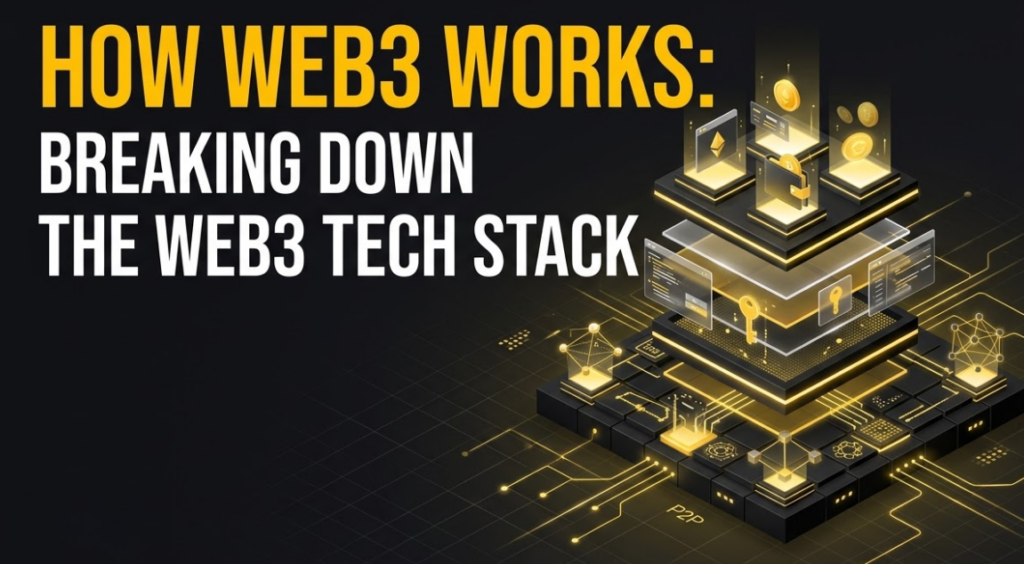
Web3 is not a single protocol, blockchain, or software package. It is a collection of technologies that work together to support decentralized applications, often called dApps.
A typical application may have a frontend that looks much like a conventional website, a wallet that manages the user’s cryptographic keys, a blockchain that records transactions, smart contracts that enforce application rules, and storage infrastructure for files that would be impractical to put directly onchain.
Understanding these layers matters because decentralization is rarely all-or-nothing. An application can use a decentralized smart contract while relying on a centralized service to deliver its interface. Another application may distribute its files across a peer-to-peer network but still depend on a small number of infrastructure providers to make those files easy to access.
A simplified Web3 architecture
User interface / dApp frontend
Website or mobile application
Wallet and cryptographic identity
Connects an account, signs messages, and authorizes transactions
RPC provider or node
Relays requests and transactions to a blockchain network
Blockchain and smart contracts
Execute application logic and record state changes
Blockchain state
Balances, contract state, ownership records, and transaction history
Offchain data
Images, videos, documents, and other application content
This is a simplified architecture, not a mandatory blueprint. Some applications use several chains, multiple RPC providers, indexing services, or specialized data networks. Others use smart accounts, relayers, or alternative authentication systems.
The key is to understand what each component does-and what happens if it fails.
Base settlement layer: Layer 1s and Layer 2 rollups
A Layer 1 blockchain is a base network with its own consensus and execution rules. Ethereum and Solana are examples of Layer 1 networks, although their architectures differ considerably.
A Layer 2 (L2) is a system built on top of another blockchain to handle transactions or computation outside the base layer while relying on that base layer for some security or settlement functions. Ethereum rollups are an important example.
The goal is to make applications cheaper or more practical to use without requiring every transaction to be processed directly on Ethereum mainnet. Rollups generally execute transactions separately and submit data or proofs to Ethereum according to their design.
The Ethereum documentation on optimistic rollups explains how these systems process transactions offchain and use Ethereum for important settlement and verification functions. Optimistic rollups typically assume submitted results are valid unless successfully challenged, while validity-proof rollups use cryptographic proofs to establish that execution followed specified rules.
Examples of Ethereum scaling ecosystems include Arbitrum, Optimism, and Base. Their exact architectures, proof systems, upgrade controls, and decentralization properties differ, so the L2 label alone does not tell you everything you need to know.
For developers, the practical benefit is that many rollups support EVM-compatible tooling. That can make it easier to reuse Solidity contracts and familiar development workflows. But deployment still requires checking the target network’s chain ID, RPC configuration, supported features, bridge assumptions, and operational characteristics.
You should also distinguish between an L2 and a separate Layer 1 that happens to support EVM-style contracts. Similar development tools do not imply identical security models.
Decentralized data storage: IPFS and Arweave
Blockchains are useful for recording ownership, transactions, and compact state changes, but they are usually a poor place to store large images, videos, and documents directly. Storing large files onchain can be expensive, so Web3 applications often separate onchain logic from offchain content storage.
Two names you will frequently encounter are IPFS and Arweave.
IPFS (InterPlanetary File System) is a protocol suite for content-addressed storage and peer-to-peer data exchange. Rather than identifying a file only by the server location where it lives, IPFS can identify content using a content identifier (CID) derived from the content’s representation.
This helps users verify that retrieved data matches the expected content. However, content addressing does not guarantee that the file will remain available forever. IPFS data must still be provided by nodes, and important content may need to be pinned or replicated.
The IPFS documentation on persistence and pinning makes this distinction clear: persistence depends on data being retained by nodes or services, and pinning helps prevent content from being removed by garbage collection on the nodes responsible for it.
Arweave takes a different approach, focusing on long-term data storage. Its ecosystem is built around the goal of preserving information over time, with economic and technical mechanisms intended to support persistent availability. The Arweave documentation introduces its approach to long-term storage.
Neither system should be treated as a magic guarantee that a file can never disappear. Availability depends on the system’s design, incentives, gateways, and the way the application references its data. If your dApp relies on a critical image, metadata file, or frontend, you should understand how that content is stored and how users can retrieve it if a particular gateway fails.
Why not store everything on a blockchain?
Imagine a digital collectible whose ownership is recorded by a smart contract, while its artwork is stored in a separate file network. The contract may establish which address holds the token, but the image is retrieved from a URI or content identifier referenced by the token’s metadata.
This arrangement can be much more practical than placing the full image directly onchain. It also creates a dependency: if the image cannot be retrieved, the token may still exist while its associated media becomes unavailable through the application.
That is why I would separate three questions when reviewing a Web3 asset:
- What exactly is recorded onchain?
- Where are the associated files stored?
- Who or what keeps those files available?
The answers can differ significantly between projects. A blockchain record may be durable even when the website displaying it disappears.
The authentication revolution: Sign-In with Ethereum (SIWE / EIP-4361)
In a conventional website, you may sign in with an email address and password or use an identity provider such as Google. The website or its authentication provider verifies your credentials and establishes a session.
Web3 introduces another option: proving control of a cryptographic account by signing a message with the corresponding private key.
The Sign-In with Ethereum (SIWE) standard, defined in EIP-4361, provides a structured format for authenticating Ethereum accounts with offchain services. It allows a website to request a signed message containing information such as the domain, account address, chain ID, nonce, and issue time.
Here is a simplified version of the process:
- You choose to sign in. The application generates a message that identifies the website and includes a unique nonce.
- Your wallet displays the request. You review the message and decide whether to sign it.
- The wallet signs the message. Your private key is used to produce a signature; the private key itself should never be sent to the website.
- The server verifies the signature. It checks that the signature matches the claimed account and that the message satisfies the application’s security requirements.
- The application creates a session. If verification succeeds, the service can issue a session cookie or another session credential.
The nonce is important because it helps prevent replay attacks, in which an attacker attempts to reuse a previously captured authentication message. The server should also validate the domain, chain ID, timestamps, and other relevant fields.
One point deserves emphasis: signing in is not the same as authorizing a blockchain transaction. A well-designed SIWE flow asks you to sign an authentication message, not grant unlimited permission to spend your assets. You should still read what your wallet displays, particularly if a request contains unexpected transaction or token-approval permissions.
SIWE also does not eliminate every centralized component. The website still needs to verify the signature, manage the user’s session, and protect any data stored on its servers. What changes is the authentication mechanism: users can prove control of an address without handing the application a conventional password.
Does wallet-based identity mean you are anonymous?
Not necessarily. A wallet address is a public identifier, and blockchain activity can often be inspected by anyone. If the address is linked to your name, social profile, or other identifying information, it may be possible to associate your onchain activity with you.
Wallet-based authentication can reduce dependence on centralized identity providers, but it does not automatically provide privacy. In some cases, it makes activity more publicly traceable than a conventional account system.
That distinction is important if you plan to use Web3 for financial services, social networking, or identity credentials. Self-custody gives you control over keys; it does not make every action private.
Core pillars of the Web3 ecosystem
Web3 is an umbrella term covering several different categories of applications. Some focus on financial services, others on digital ownership, community governance, social networking, or physical infrastructure.
These categories often overlap. A decentralized finance protocol may be governed by a DAO, issue tokens, and rely on decentralized storage for parts of its interface. A social application may use blockchain-based identity while storing most posts offchain.
I find it useful to understand the main categories by looking at the problem each one is trying to solve-not simply by memorizing another set of crypto acronyms.
Decentralized finance (DeFi)
Decentralized finance, or DeFi, uses smart contracts and blockchain networks to provide financial services without requiring a conventional financial institution to control every transaction.
Common applications include decentralized exchanges, lending and borrowing protocols, collateralized stablecoins, and onchain asset-management systems. Instead of relying entirely on a bank or broker to maintain a private ledger, users interact with smart contracts that manage assets and apply predefined rules.
Take a decentralized exchange such as Uniswap as an example. Rather than matching every trade through a traditional order-book operator, automated market maker designs use liquidity pools and mathematical rules to determine how trades change pool balances and prices.
A lending protocol such as Aave allows users to supply assets and borrow against collateral under the rules of its contracts and risk-management system. The exact borrowing limits, interest rates, and liquidation conditions depend on the protocol and market conditions.
The Ethereum overview of DeFi explains how smart contracts can serve as programmable building blocks for financial products.
What makes DeFi interesting is composability. If two protocols use compatible assets and interfaces, one application can build on top of another. Developers sometimes call these components “money legos” because a lending protocol, exchange, and collateral system can be combined into a more complex product.
But composability also creates dependencies. If one protocol has a vulnerability or a stablecoin loses its peg, other applications that rely on it may suffer losses. Smart contract bugs, oracle failures, liquidity shortages, liquidation cascades, governance attacks, and bridge vulnerabilities can all create financial risk.
If you are considering a DeFi application, I would look beyond the advertised yield. Ask where the return comes from, what collateral supports the system, which contracts control the assets, and what could happen during a sharp market move. A high displayed yield does not tell you whether the underlying risk is acceptable.
Non-fungible tokens (NFTs) and digital ownership
A non-fungible token (NFT) is a token that represents a distinct item or identifier rather than a set of interchangeable units. NFTs can be used for digital collectibles, memberships, game items, tickets, and other applications where individual tokens need to be distinguished.
The important question is what the token actually represents.
An NFT’s ownership record may be maintained by a smart contract, while its image or other metadata is stored elsewhere. Owning the token generally gives you control over that token under the contract’s rules. It does not automatically grant copyright, commercial rights, or ownership of every file associated with it.
For example, buying an NFT tied to a piece of artwork does not necessarily transfer the artist’s copyright to you. That depends on the licence and applicable legal terms, not merely on the fact that the token has changed hands.
NFTs can also support memberships and access control. A community might check whether a wallet holds a particular token before granting access to an event or digital service. This can make membership portable across compatible applications, although the access system itself still needs to recognize and enforce the relevant rules.
I would therefore think of NFTs as a flexible ownership and identification mechanism, not a guarantee that a digital item is scarce, valuable, or legally owned in every possible sense.
Decentralized autonomous organizations (DAOs)
A decentralized autonomous organization, or DAO, is a way for a group to coordinate decisions, funds, or shared resources through a combination of governance processes and software.
A DAO may use proposals, voting, token-based governance, multisignature wallets, and smart contracts to manage a treasury or approve changes to a protocol. Instead of leaving every decision to one executive, the organization distributes some decision-making authority among its participants.
The Ethereum DAO guide describes DAOs as collectively owned organizations whose rules and treasury management can be coordinated through blockchain-based mechanisms.
Imagine a community that pools funds to support open-source software. Members propose grants, discuss the proposals, vote according to the DAO’s rules, and authorize payments when the required conditions are met. Smart contracts can make parts of this process transparent and enforceable.
However, a DAO is not automatically democratic or decentralized just because it has a token and a voting page. If a small group holds most of the voting power, it may dominate decisions. Some DAOs rely on a small multisignature group to execute approved proposals, while others give administrators significant emergency powers.
There is also a difference between governance and automatic execution. A community can vote on a proposal without the outcome being executed automatically onchain. Some systems require a separate transaction, multisignature approval, or additional operational steps.
If you are evaluating a DAO, I would examine who can propose changes, who controls the treasury, how voting power is distributed, and what emergency permissions exist. The label tells you less than the actual governance design.
Decentralized physical infrastructure networks (DePIN)
DePIN stands for decentralized physical infrastructure networks. These projects use software, token incentives, and distributed participation to coordinate physical resources such as wireless connectivity, computing power, storage, or sensor networks.
The basic idea is that infrastructure does not always need to be built and owned by one large company. A network might reward independent participants for providing useful resources, then let applications pay to access the combined capacity.
Helium is an example associated with decentralized wireless infrastructure. Participants can contribute eligible network equipment and earn rewards according to the protocol’s rules and applicable network requirements.
Render Network focuses on decentralized GPU rendering and compute, connecting demand for computational work with available GPU resources.
These models can open alternative ways to coordinate supply. Instead of one company funding every piece of infrastructure, a network can recruit many participants who contribute equipment and receive compensation.
But incentives alone do not guarantee a useful network. Wireless coverage must exist where people need it, compute providers must deliver the expected performance, and customers must have a reason to pay for the service. Token rewards can encourage participation, but they cannot manufacture lasting demand for an uncompetitive product.
I would evaluate a DePIN project by asking whether its infrastructure provides a measurable service that customers genuinely need. How is service quality verified? How are fraudulent contributions detected? Does customer revenue support the economics, or does participation rely heavily on token subsidies? Those questions help separate a working infrastructure model from a reward mechanism looking for a business.
SocialFi, decentralized social networks, and identity
SocialFi combines social networking with Web3 concepts such as tokens, wallets, digital ownership, and community incentives. Some projects let creators monetize access or issue digital assets associated with their communities. Others focus on making identity and social relationships more portable across applications.
Decentralized social protocols aim to reduce the dependence on a single platform for user identity, content distribution, or application development. Farcaster’s protocol overview, for example, describes a design intended to let developers build social applications around a shared protocol and user identities.
The distinction between a protocol and an app is crucial. A centralized social platform controls the product experience and much of the underlying infrastructure. A protocol-based ecosystem can allow multiple apps to interact with a shared identity or data layer, depending on its architecture.
That could give users more choice. If one interface becomes unpleasant or changes its rules, an alternative application may be able to access compatible identity or social data without rebuilding the entire network from scratch.
Still, portability is not automatic. Different apps may support different features, moderation policies, content formats, and data models. Some social data may remain hosted by specific operators, and an identity can be portable without every post or relationship being available everywhere.
Decentralized identity extends beyond social networking. Systems using decentralized identifiers (DIDs), verifiable credentials, and naming services such as the Ethereum Name Service (ENS) explore ways to represent identities or credentials without depending entirely on one universal account provider.
These systems also have limits. A DID does not prove that a real-world claim is true by itself, and a verifiable credential is only as trustworthy as its issuer and verification process. A human-readable name may improve usability, but it does not eliminate impersonation risks.
The promise is greater flexibility in how identity and reputation are managed. Whether a particular application delivers that promise depends on its technical design, governance, privacy protections, and adoption.
The realities of Web3: Challenges, trade-offs, and centralization bottlenecks
Web3 is often presented as an escape from centralized technology companies. Yet many applications still depend on centralized infrastructure, complex wallet workflows, and services users cannot easily inspect.
That does not make the entire idea meaningless. It means decentralization needs to be evaluated layer by layer.
If a project claims that users control their data, I would ask where the data lives, who can modify or remove it, and what happens if the main website goes offline. If it claims that no intermediary is required, I would check whether users can actually interact with the underlying protocol without relying on the project’s preferred service.
The decentralization illusion: RPC nodes and cloud hosting
A Web3 application may interact with a public blockchain, but most users do not run their own blockchain node. Instead, the app often sends requests through a remote procedure call (RPC) endpoint.
An RPC service lets an application query blockchain data, simulate contract calls, and broadcast transactions. Providers such as Infura and Alchemy offer infrastructure that makes this process easier for developers.
The convenience is obvious. Running and maintaining reliable blockchain infrastructure requires technical work, and an RPC provider can save a team from operating every component itself.
The trade-off is dependency. If an application relies on one provider and that provider experiences an outage, rate-limits the application, or blocks particular requests, the user experience may be affected even though the blockchain itself is still operating.
The same issue appears in frontend hosting. A dApp may use smart contracts that anyone can call, yet the website users visit may be hosted on a conventional cloud platform. If that frontend disappears, technically capable users might still interact with the contracts through other tools, but most ordinary users will struggle to find or use those alternatives.
This is why I would distinguish decentralized protocol execution from decentralized application delivery. They are separate properties.
A more resilient design may use multiple RPC providers, allow users to configure their own endpoints, publish verifiable frontend artifacts, and document alternative access paths. It may also distribute critical data across multiple storage providers.
However, redundancy is not the same as decentralization. Several providers can still depend on the same cloud infrastructure or operational assumptions. The goal is to identify meaningful failure points rather than simply count the number of services in a diagram.
Smart contracts do not eliminate trust
Smart contracts can automate rules and make some actions publicly verifiable. But you still need to understand who wrote the code, who can upgrade it, and which external inputs it relies on.
A lending protocol may depend on price oracles. A bridge may rely on a set of validators or a messaging system. A token contract may have an administrator who can pause transfers or change certain parameters. A DAO may vote on changes but delegate execution to a small multisignature group.
These mechanisms are not automatically bad. Emergency controls can protect users during an exploit, and upgrades can fix bugs. But they introduce trust assumptions that should be visible rather than hidden behind a decentralization slogan.
For any application holding meaningful value, I would look for a clear explanation of administrative permissions, upgradeability, audits, bug-bounty programs, oracle dependencies, and incident-response procedures. An audit is useful evidence, but it is not a guarantee that a contract cannot be exploited.
User experience barriers and security risks
For Web3 to reach a wider audience, users need to do more than understand the technology. They need to complete ordinary tasks without feeling that every click could result in a costly mistake.
Wallets are a major part of this challenge. A self-custodied wallet gives users direct control over their keys, but that control comes with responsibility. A lost seed phrase, compromised device, malicious signature, or mistaken transaction can lead to losses that are difficult or impossible to reverse.
Gas fees introduce another complication. Users may need the network’s native token to pay transaction fees, even when the application they are using deals with a different asset. Fees can also change with network demand, and a transaction may fail after consuming some gas.
The interface can make these problems worse. If a wallet displays confusing contract data or an application asks users to sign a message they do not understand, even a technically sound protocol can expose people to phishing or authorization mistakes.
I would not expect mainstream users to learn blockchain internals just to perform a basic task. Better products should explain what an action does, what it costs, and what permissions it grants before asking the user to approve it.
Account abstraction and smarter wallets
Account abstraction is one approach to improving the wallet experience. Instead of relying exclusively on accounts with fixed transaction-validation rules, smart accounts can use programmable logic to determine which actions and signatures are valid.
Ethereum’s ERC-4337 standard provides an account-abstraction framework that operates through higher-layer infrastructure without requiring a change to Ethereum’s core consensus protocol. Its design includes UserOperations, bundlers, and an EntryPoint contract.
Depending on the wallet implementation, account abstraction can support features such as:
- Flexible authentication: A wallet may support multiple signers, guardians, or alternative authentication mechanisms.
- Social recovery: Users may be able to restore access through a defined recovery process instead of relying on one seed phrase alone.
- Transaction batching: Several actions can be grouped into a more convenient interaction.
- Gas sponsorship: A paymaster may cover fees under specified conditions, allowing users to transact without holding the native gas token themselves.
- Programmable controls: Wallet logic can enforce spending limits, session permissions, or other rules.
These capabilities can make Web3 applications feel less intimidating, but they do not eliminate risk. Smart wallets introduce their own contracts and configuration choices. Recovery systems must be designed carefully, and a gas sponsor may apply restrictions or stop supporting a particular service.
Account abstraction is therefore a tool for improving usability, not a blanket guarantee of safety. The actual experience depends on the wallet, the application, and the policies that govern them.
Privacy, regulation, and consumer protection
Web3’s public ledgers can make transactions easier to audit, but transparency can also expose sensitive patterns. A wallet address may reveal financial activity, relationships between addresses, and interactions with particular applications. Even when a person’s name is not recorded directly onchain, external data can sometimes connect an address to an identity.
Privacy-preserving tools exist, but their design, availability, and legal treatment vary. Users should not assume that using a wallet automatically makes them anonymous.
Regulation is another area where broad claims are unhelpful. The legal status of tokens, decentralized finance, exchanges, custody services, and digital assets differs across jurisdictions and can change over time. Calling an application decentralized does not automatically exempt its developers, operators, or users from relevant legal obligations.
For a mainstream user, the practical question is whether a service offers clear information about risks, fees, asset custody, and available remedies. For a developer, the questions also include jurisdiction, data protection, consumer obligations, and the legal implications of the service being offered.
The centralization trade-off is not always obvious
A project may decentralize one layer while centralizing another. For example, a smart contract can be publicly accessible, but its frontend may be maintained by one company. The data may be replicated across several storage nodes, but users may retrieve it through one gateway. Governance may be token-based, but a few large holders may dominate votes.
A useful way to evaluate a Web3 project is to ask:
| **Question** | **Why it matters** |
| Who controls the smart contracts? | Reveals upgrade, pause, and administrative powers |
| Where is the frontend hosted? | Shows whether access depends on a particular web host or operator |
| How does the app access blockchain data? | Identifies RPC providers and possible service bottlenecks |
| Where are user files and metadata stored? | Helps assess content availability and persistence |
| Who controls governance? | Shows whether decision-making is distributed or concentrated |
| What happens if a provider disappears? | Tests whether the application has realistic fallback options |
I would not demand that every component be fully decentralized before considering a product useful. Some centralized services provide genuine benefits in speed, cost, and user support. The important thing is to know where those dependencies exist and whether they undermine the particular claim the project is making.
Web3 is most credible when its architecture is transparent about what users control, what they do not control, and which assumptions must remain true for the application to work.
Frequently asked questions about Web3
What is Web3 in simple terms?
Web3 is an approach to building internet applications using decentralized networks, blockchain technology, smart contracts, and cryptographic identity. Its goal is to give users more control over digital assets and online interactions, although many Web3 applications still rely on centralized services for parts of their infrastructure.
How does Web3 differ from Web1 and Web2?
Web1 is commonly associated with mostly read-only websites, while Web2 introduced interactive applications and large-scale user-generated content. Web3 adds a focus on decentralized infrastructure, cryptographic ownership, and portable digital assets, though these models overlap rather than replace one another completely.
Who coined the term Web3, and when?
Gavin Wood, an Ethereum co-founder, used the term Web 3.0 in his 2014 essay “dApps: What Web 3.0 Looks Like”, describing a decentralized web built around cryptography and reduced reliance on trusted intermediaries. The phrase has since developed into a broader term for blockchain-based internet applications.
What is the difference between Web3 and Tim Berners-Lee’s Semantic Web?
The Semantic Web focuses on structuring web data so computers can interpret relationships and meaning more effectively, using technologies such as RDF. Blockchain-based Web3 focuses on decentralized infrastructure, cryptographic authentication, and digital ownership; the two approaches can complement each other but are not synonymous.
How do you log into a Web3 application without a password?
You can connect a compatible wallet and sign an authentication message to prove control of your account. The Sign-In with Ethereum standard (EIP-4361) defines a structured approach to this process, allowing a service to verify your signature without receiving your private key.
What are the biggest challenges blocking mainstream Web3 adoption?
Major challenges include complicated wallet management, phishing and smart contract vulnerabilities, unpredictable transaction fees, limited privacy, regulatory uncertainty, and reliance on centralized infrastructure. Better wallet design, account abstraction, clearer transaction prompts, and more resilient infrastructure can help, but they do not eliminate every risk.
How do DeFi, NFTs, and DAOs fit into Web3?
DeFi uses smart contracts to provide financial services, NFTs represent distinct digital tokens or assets, and DAOs coordinate group decisions and resources through governance mechanisms. These are different application categories within the broader Web3 ecosystem, and a single project may combine several of them.
Final thoughts: Is Web3 the future of the internet?
I would be careful about declaring Web3 either the inevitable future of the internet or a failed experiment. Both positions overlook what is actually happening: developers are exploring different ways to manage digital assets, coordinate online communities, authenticate users, and reduce dependence on centralized platforms.
The strongest Web3 applications solve a specific problem. A decentralized exchange can offer transparent, programmable trading rules. A DAO can coordinate a community treasury. A decentralized storage network can provide alternative ways to publish and retrieve content. A wallet-based identity system can let users authenticate without relying exclusively on a conventional identity provider.
Those are meaningful capabilities, but each comes with trade-offs. Blockchain transactions can be expensive or difficult to reverse, wallet security can be intimidating, and decentralized applications may still depend on cloud providers, RPC gateways, or centralized interfaces. Token ownership also does not automatically confer intellectual property rights or control over the surrounding service.
If you are exploring Web3 as a user, focus on what you actually control, what permissions you grant, and how you can recover access if something goes wrong. If you are a developer, examine the full architecture-including smart contracts, data availability, authentication, infrastructure dependencies, and governance-rather than judging a project by its branding.
The real promise of Web3 is not that every part of the internet must run on a blockchain. It is that users and developers may gain more choices over how digital systems operate, who controls them, and where trust is required. Whether a particular application delivers that promise depends on its design, its incentives, and the degree of control it genuinely gives its users.