

What is Proof of Work (PoW)?
Proof of Work is a cryptographic consensus mechanism in which distributed network participants, known as miners, expend computational power and electricity to find valid block hashes. The resulting proof allows other nodes to verify that a block satisfies the network’s rules, helping secure transaction history and resist double-spending without a central authority.
If you have ever wondered why Bitcoin mining involves specialized machines running around the clock, this is the key idea: miners do not solve complicated mathematical equations in the usual sense. They perform enormous numbers of hash calculations, searching for an output that meets a specific numerical target.
Bitcoin is the best-known example of Proof of Work POW. Its consensus system combines cryptographic hashing, competitive block production, difficulty adjustments, and economic incentives. Miners compete to discover a valid block, while full nodes independently check whether that block follows the protocol. The miner’s result is easy to verify, even though finding it may require substantial computation.
You should also distinguish mining from the entire consensus process. Miners propose blocks, but they cannot force the network to accept invalid transactions simply by spending more electricity. Nodes check the rules, including transaction validity, block structure, and the proof of work itself. A block that violates the rules remains invalid, regardless of how much computation went into producing it.
Bitcoin’s developer documentation on proof of work explains how valid blocks are linked through hashes and how the network uses accumulated work to determine the chain it recognizes (Bitcoin developer guide on proof of work).
PoW is more than a way to create new coins. It is a way to make participation in block production costly enough that rewriting the ledger requires real resources. That security model has trade-offs, particularly around electricity consumption, specialized hardware, and mining-pool concentration, but understanding the underlying mechanics makes those debates much easier to evaluate.
How Proof of Work works
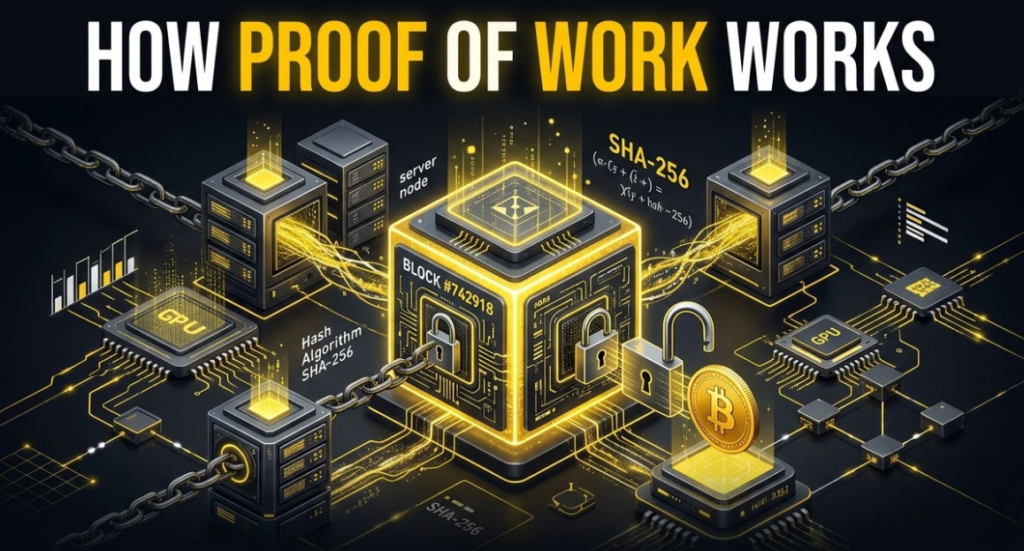
To understand PoW properly, you need to look at what a miner actually calculates. The process is surprisingly simple at the individual-operation level, even though the amount of computation across a large mining network can be enormous.
Bitcoin uses the SHA-256 cryptographic hash function twice on a block header. The miner repeatedly changes the candidate header and checks whether its hash meets the target set by the network. There is no shortcut that reliably predicts which input will produce a suitable hash, so miners search through candidate values until one works.
Step-by-step mining execution workflow
Imagine you are running a Bitcoin mining machine. You are not trying to solve an equation with a known path to the answer. You are repeatedly generating candidate outputs and checking whether any of them satisfy the rules.
The workflow looks like this:
- Gather transactions. A miner selects valid transactions for a candidate block, generally considering transaction fees and block-space constraints. The block also includes a special coinbase transaction that creates the block subsidy and collects eligible fees.
- Build the block header. The header contains the previous block’s hash, the Merkle root representing the block’s transactions, a timestamp, a compact encoding of the target, and a nonce. Bitcoin’s block header is 80 bytes long.
- Try different nonce values. The miner changes the nonce and calculates a new hash. Bitcoin’s nonce field is 32 bits, so it offers ${2}^{32}$ possible values before the miner needs to change another part of the candidate header.
- Compare the hash with the target. The miner interprets the hash according to Bitcoin’s consensus rules and checks whether its value is at or below the permitted target. A failed attempt provides no partial credit toward finding a valid block.
- Broadcast and verify the block. Once a miner finds a qualifying hash, it broadcasts the block. Other nodes verify the proof of work and independently check the block’s transactions and structure before accepting it.
Bitcoin’s developer guide to block headers and proof of work documents the 80-byte header, the nonce field, and the relationship between the target and mining difficulty (Bitcoin developer guide on block headers and proof of work).
One technical detail is easy to miss: changing the nonce does not give you an unlimited search space. A miner can exhaust all ${2}^{32}$ values in that field, so mining software also changes other header-related data. It may update the extra nonce in the coinbase transaction, which changes the Merkle root, or adjust other permitted fields to create new candidates.
This is why a mining machine can keep searching without waiting for a new transaction every time it runs through the nonce range. It can generate a new candidate header and continue.
The cryptographic hash formula
Bitcoin’s proof-of-work check can be expressed as:
\[ \operatorname{SHA256}(\operatorname{SHA256}(\text{Block Header})) \leq \text{Target} \]
The formula is compact, but each part matters:
- Block header: A fixed-length structure that summarizes key information about the candidate block.
- SHA-256: A cryptographic hash function that maps input data to a 256-bit output.
- Double hashing: Bitcoin applies SHA-256 twice to the serialized header for its proof-of-work calculation.
- Target: A numerical threshold. A lower target means fewer possible hashes qualify, making mining harder.
Suppose the target is relatively high. A larger portion of possible hash outputs will fall below it, so a miner has a better chance of finding a valid block with each attempt. If the target is lowered, fewer outputs qualify, and miners must generally perform more attempts.
You may see a valid hash displayed as a long string of hexadecimal characters with many leading zeros. That visual pattern is useful, but the protocol does not simply count zeros in the displayed string. It checks the numerical hash against the target. Leading zeros are a consequence of a low numerical value in hexadecimal representation.
There is also no need for a miner to understand the transactions’ meaning to calculate the hash. The machine processes bytes. Full nodes perform the separate work of checking whether transactions follow Bitcoin’s consensus rules.
This distinction explains why proof of work is easy to verify. Finding a qualifying hash may require an enormous number of attempts, but checking the winning hash takes very little work compared with discovering it.
What is a nonce in crypto?
A nonce is a number used as part of a candidate block header. In Bitcoin mining, changing it changes the header input, which produces a different hash output. Miners use this mechanism to search for a hash that satisfies the current target.
The nonce is not a secret key, a cryptocurrency balance, or a number that guarantees a block reward. It is simply one of the fields miners can vary during the search.
Because SHA-256 is designed so that small input changes produce unpredictable output changes, increasing a nonce by one does not make the next hash progressively closer to the target. A nonce of 100 is not inherently better than a nonce of 99 or 101. Each candidate is another attempt.
That unpredictability is the whole point. If miners could predict which nonce would produce a valid result, they would not need to perform the same volume of trial-and-error computation.
The difficulty adjustment algorithm
Hash rate changes constantly. Mining companies may install more efficient machines, new facilities may come online, electricity prices may force older rigs to shut down, and market conditions can make mining more or less profitable. Without a mechanism to respond to these changes, block production would fluctuate significantly as the amount of competing computation changed.
Bitcoin’s difficulty adjustment is intended to keep the average block interval near ten minutes over time. It does not guarantee that every block arrives precisely ten minutes after the previous one. Instead, it adjusts the target based on how quickly the network produced blocks over a recent period.
Maintaining block creation times
Bitcoin adjusts its mining difficulty every 2,016 blocks, a period intended to represent approximately 14 days at the ten-minute target interval.
If the previous period’s blocks arrived faster than expected, the protocol raises difficulty by lowering the target. If they arrived more slowly, the protocol lowers difficulty by raising the target, subject to its adjustment limits.
This is a feedback mechanism. Imagine that a large number of new ASIC miners suddenly join the network. The increased hash rate means miners collectively find qualifying hashes more frequently at the existing target. When the next difficulty adjustment occurs, the protocol responds by making valid hashes harder to find on average.
The reverse happens if a large amount of hash power leaves. Blocks may arrive more slowly before the next adjustment, after which the protocol can reduce difficulty.
The Bitcoin developer guide on target and nBits explains how target values are encoded in the block header and how the network recalculates difficulty.
For miners, this creates an important economic feedback loop. More efficient equipment can improve an operator’s chance of earning rewards in the short term, but widespread increases in hash rate can eventually raise difficulty and reduce each unit of hash power’s share of expected rewards.
For users, difficulty adjustment helps keep Bitcoin’s issuance schedule more predictable despite changes in mining participation. It does not control Bitcoin’s market price or guarantee stable transaction fees. Those depend on different factors.
Mathematical formulation of difficulty recalibration
A simplified conceptual relationship is:
${D}_{new}\approx {D}_{current}\times \frac{{T}_{target}}{{T}_{actual}}$
Here, $D$ represents difficulty, ${T}_{target}$ is the intended time for the adjustment period, and ${T}_{actual}$ is the measured time. If the blocks arrive faster than expected, the ratio increases difficulty. If they arrive more slowly, it decreases difficulty.
Using target times, the same relationship can be written as:
$Targe{t}_{new}\approx Targe{t}_{old}\times \frac{{T}_{actual}}{{T}_{target}}$
These formulas explain the direction of the adjustment, but Bitcoin’s actual consensus implementation has specific limits and timestamp rules. The protocol does not accept an arbitrary difficulty value just because a miner claims the network needs one.
The adjustment also cannot prevent short-term randomness. A block may arrive seconds after the previous one, or the network may go considerably longer than ten minutes without finding a block. Ten minutes is an average target, not a countdown timer.
That distinction matters if you are evaluating confirmation times. A merchant accepting a Bitcoin transaction should consider the number of confirmations, transaction value, and potential attack risk rather than assuming the next block will arrive exactly ten minutes later.
Mining hardware and algorithms: ASICs vs GPUs and CPUs

PoW mining is not just about the consensus algorithm. It is also about the hardware needed to run that algorithm efficiently. A miner’s profitability depends on how much useful computation its equipment can perform, how much electricity it consumes, how much the equipment costs, and how the network’s difficulty and rewards change over time.
Different algorithms create different hardware markets. Bitcoin’s SHA-256 algorithm strongly favors specialized ASICs, while Monero XMR‘s RandomX is built to make general-purpose CPUs more competitive. Neither approach eliminates the need to evaluate costs, but the design choice can have a major effect on who can participate.
Enterprise ASIC mining: SHA-256 and Scrypt
An application-specific integrated circuit (ASIC) is a chip built for a particular task. Bitcoin mining ASICs are engineered to perform SHA-256 calculations at high speed and with better energy efficiency than general-purpose computers.
That specialization is why a standard desktop PC is not a realistic competitor in modern Bitcoin mining. A CPU can calculate SHA-256 hashes, but it cannot match a purpose-built mining machine’s hash rate per unit of cost and electricity.
Large mining operators often deploy racks of ASIC machines in facilities built around power delivery, cooling, networking, and maintenance. Equipment brands such as Bitmain’s Antminer and MicroBT’s Whatsminer are familiar names in this market. Their economics depend on the exact model, operating conditions, and electricity price rather than the brand alone.
Mining performance is commonly expressed in hashes per second:
| Unit | Meaning
|
|---|---|
| H/s | One hash per second |
| kH/s | One thousand hashes per second |
| MH/s | One million hashes per second |
| GH/s | One billion hashes per second |
| TH/s | One trillion hashes per second |
| PH/s | One quadrillion hashes per second |
| EH/s | One quintillion hashes per second |
Bitcoin’s network hash rate is often measured in exahashes per second because the combined computational power of its miners is so large. Individual devices are generally measured at much smaller scales, such as terahashes per second.
Hash rate alone does not tell you whether a machine is profitable. You also need its energy efficiency, usually expressed as joules per terahash for Bitcoin ASICs. A faster machine may earn a larger share of block rewards but still deliver poor returns if it consumes too much electricity or costs too much to purchase.
Mining revenue is also probabilistic. A solo miner may spend a long time without finding a block, even if its hardware is working correctly. Mining pools combine participants’ hash power and distribute rewards according to their payout rules, helping reduce income variability while introducing pool fees and some dependence on the pool operator.
Scrypt, used by Litecoin LTC and Dogecoin DOGE, is another PoW algorithm with a specialized ASIC market. Although Scrypt was originally developed with memory requirements intended to affect hardware efficiency, ASICs have been built for it too. The lesson is that an algorithm’s initial design goals do not guarantee that general-purpose hardware will remain competitive forever.
The Cambridge Bitcoin Electricity Consumption Index tracks modeled estimates of Bitcoin mining electricity use and offers context on the changing hardware and energy profile of the network. Its figures are estimates, not a direct meter reading from every mining facility, so you should interpret them alongside the methodology and assumptions.
ASIC resistance and democratized mining: RandomX and kHeavyHash
Some PoW projects deliberately choose algorithms intended to reduce the advantage of specialized mining hardware. The aim is to make it easier for people with ordinary equipment to participate, limiting the degree to which mining becomes concentrated among operators who can afford large ASIC deployments.
Monero XMR is a well-known example. Its RandomX algorithm is optimized for general-purpose CPUs and uses memory-intensive operations and generated programs to reduce the efficiency advantage that specialized hardware might otherwise enjoy. The official Monero mining guide explains the project’s approach and its emphasis on CPU mining.
This does not mean every CPU earns a profit, or that mining becomes equally efficient across all machines. Modern CPUs differ in core count, cache, memory bandwidth, power draw, and price. Electricity costs and network difficulty still determine whether an individual miner is likely to cover operating expenses.
The term ASIC-resistant should also be used carefully. It generally describes an algorithm intended to limit the economic advantage of specialized hardware, not a mathematical guarantee that no ASIC could ever be built. The hardware market evolves, and algorithm designers may need to respond when specialized implementations gain a meaningful advantage.
Other networks choose different trade-offs. Kaspa’s kHeavyHash algorithm has also been targeted by specialized mining hardware, illustrating how an algorithm’s competitive landscape can change as a network matures. The right question is not whether a coin advertises ASIC resistance, but whether its actual hardware distribution supports the degree of mining access the project claims to value.
If you are thinking about mining at home, calculate expected returns before buying equipment. Include the machine’s purchase price, electricity consumption, cooling, maintenance, noise, possible downtime, pool fees, and the likelihood that future difficulty changes will reduce your share of rewards. A coin being mineable on your computer does not automatically make mining economically sensible.
Proof of Work vs Proof of Stake
Proof of Work vs Proof of Stake are two different ways to make attacks on a blockchain costly. PoW relies on computational work backed by physical resources. PoS relies on economic collateral committed by validators. Both aim to help distributed participants agree on a valid transaction history, but their security assumptions and operational costs differ.
| Feature | Proof of Work (PoW) | Proof of Stake (PoS)
|
|---|---|---|
| Primary Sybil resistance | Computational hash power | Staked native assets |
| Main security cost | Hardware, electricity, and operations | Capital at risk, infrastructure, and penalties |
| Block production | Miners compete to find a qualifying hash | Validators are selected through protocol rules |
| Response to misconduct | Attackers bear mining costs and may lose future revenue; invalid blocks are rejected | Certain provable violations can trigger slashing |
| Energy use | Can be substantial at network scale | Generally much lower for consensus |
| Common examples | Bitcoin, Litecoin LTC, Dogecoin DOGE, Monero XMR, Kaspa | Ethereum ETH, Cardano, Polkadot, Solana |
A frequent mistake is to compare PoW and PoS as if one has security costs and the other has none. PoS still requires computers, connectivity, maintenance, and economic capital. PoW adds a continuous competitive expenditure on hashing, which makes its energy profile much more significant.
Ethereum ETH‘s experience provides a clear example of the difference. The network completed its transition from PoW to PoS in September 2022, and Ethereum ETH‘s documentation estimates that the change reduced its energy consumption by approximately 99.95%. That number is specific to Ethereum ETH‘s transition; it should not be applied as an exact universal comparison between all PoW and PoS systems. See the Ethereum Merge overview.
PoW and PoS also create different forms of concentration. Mining can concentrate among operators with cheap power, efficient ASICs, access to financing, and large facilities. PoS can concentrate among large token holders, custodians, staking providers, and professional validator operators.
Neither consensus design makes attacks impossible. The practical security of a PoW network depends on the distribution and cost of hash power, while a PoS network depends on stake distribution, validator behavior, protocol penalties, and the assumptions built into its finality mechanism.
For developers, the choice affects infrastructure, incentives, and recovery strategies. For investors, it affects how you should assess a network’s security budget, issuance, and concentration risk. And for anyone comparing cryptocurrencies, the consensus label is a starting point, not a complete security rating.
The 51% attack and Nakamoto consensus

The central security question for a PoW blockchain is not simply whether miners can find valid hashes. It is whether an attacker can produce an alternative history with enough accumulated work to convince the network to reorganize blocks that other participants previously accepted.
Bitcoin addresses this through Nakamoto consensus: nodes follow the valid chain with the greatest accumulated proof of work, subject to the protocol’s consensus rules. As more blocks are added on top of a transaction, replacing that transaction generally requires recreating the work for the affected history and overtaking the competing chain.
What is a 51% attack?
A 51% attack occurs when an attacker controls enough of a PoW network’s hash power to gain a sustained majority of the computational power participating in block production. With that advantage, the attacker can have a greater chance of building an alternative chain faster than the honest network.
The most widely discussed goal is a double-spend attack. An attacker might pay a merchant, wait for the payment to receive confirmations, and then attempt to reorganize the chain so that a conflicting transaction spends the same coins elsewhere. If the alternative chain becomes the one recognized by the network, the merchant’s original payment may disappear from the accepted history.
A majority-hash-power attacker may also censor transactions by repeatedly excluding them from blocks or reorganize recent blocks. But a 51% attack does not grant unlimited control over Bitcoin. It does not let an attacker create coins beyond the protocol’s issuance rules, spend coins without the necessary signatures, or force full nodes to accept blocks that violate consensus rules.
The distinction is critical. Hash power helps determine which valid chain has the most work; it does not override every other rule in the protocol.
The Bitcoin developer guide’s explanation of chain reorganizations and proof of work describes why an attacker needs substantial computational resources to replace established transaction history (Bitcoin developer guide on chain reorganizations and proof of work). The guide also explains that the risk is not limited to exactly 51%: a sufficiently lucky attacker with less hash power can sometimes succeed in a limited double-spend attempt, although the odds and feasibility differ.
For businesses accepting Bitcoin, this is why confirmations matter. A zero-confirmation transaction has not yet been included in a block, while additional confirmations increase the amount of work an attacker would need to overcome to replace it. The appropriate confirmation threshold depends on the value at risk and the merchant’s tolerance for reversal risk.
Why Bitcoin is difficult to attack-but not impregnable
Bitcoin’s scale makes a sustained majority-hash-power attack exceptionally demanding. An attacker would need access to an enormous amount of compatible mining equipment, the electricity and infrastructure to run it, and the ability to coordinate that capacity against the existing network.
However, it is inaccurate to say a 51% attack is physically impossible. Security claims should be grounded in the cost and availability of resources, not in absolute language.
A realistic assessment must consider several factors:
- Hardware access: Can an attacker acquire or manufacture enough suitable ASICs? Even with sufficient capital, supply constraints and deployment time matter.
- Electricity and facilities: Can the attacker obtain enough power, cooling, and networking capacity to operate the machines?
- Existing hash rate: The greater the honest network’s hash rate, the more resources an attacker generally needs to compete with it.
- Attack duration: A brief attack and a sustained attempt to rewrite a substantial amount of history have different resource requirements.
- Economic consequences: A successful attack could damage confidence in the currency, potentially reducing the value of the attacker’s holdings or mining investment.
Why Bitcoin is difficult to attack-but not impregnable
Bitcoin’s scale makes a sustained majority-hash-power attack exceptionally demanding. An attacker would need access to an enormous amount of compatible mining equipment, the electricity and infrastructure to run it, and the ability to coordinate that capacity against the existing network.
However, it is inaccurate to say a 51% attack is physically impossible. Security claims should be grounded in the cost and availability of resources, not in absolute language.
A realistic assessment must consider several factors:
-
Hardware access: Can an attacker acquire or manufacture enough suitable ASICs? Even with sufficient capital, supply constraints and deployment time matter.
-
Electricity and facilities: Can the attacker obtain enough power, cooling, and networking capacity to operate the machines?
-
Existing hash rate: The greater the honest network’s hash rate, the more resources an attacker generally needs to compete with it.
-
Attack duration: A brief attack and a sustained attempt to rewrite a substantial amount of history have different resource requirements.
-
Economic consequences: A successful attack could damage confidence in the currency, potentially reducing the value of the attacker’s holdings or mining investment.
Mining pools add another nuance. A pool coordinates work from many independent miners, so its reported share of hash rate does not necessarily mean one entity owns all the machines. Still, concentration of block-template selection or pool management can create censorship and coordination risks even when the underlying hardware belongs to different operators.
For this reason, I would avoid describing any blockchain as “unhackable.” Bitcoin’s PoW model makes certain attacks expensive and difficult, but security still depends on the network’s real-world distribution of hash power, honest participation, software implementation, and economic incentives.
The energy perspective: Stranded energy, renewables, and thermodynamics
Energy consumption is one of the most contested parts of PoW. Mining uses electricity to perform repeated hash calculations, and the aggregate demand can be substantial. Supporters argue that this expenditure helps secure a decentralized monetary network and can sometimes make use of electricity that would otherwise be wasted. Critics point to emissions, competition for power, equipment waste, and the opportunity cost of using electricity for mining rather than other purposes.
Both sides raise questions worth examining. You cannot assess the environmental impact of PoW simply by looking at a hash-rate chart, nor can you conclude that mining is environmentally beneficial just because a facility uses some renewable electricity.
Grounding digital trust in physical resources
The core idea behind PoW is that producing blocks requires an ongoing expenditure of resources. An attacker cannot create a competing chain merely by claiming that it performed work. It must generate hashes that satisfy the protocol’s target and build a chain with sufficient accumulated work.
That gives the system a physical cost component. Electricity, equipment, and operating infrastructure must be paid for in the real world, while other nodes can verify a block’s proof of work without repeating the entire mining process.
However, PoW does not guarantee absolute mathematical scarcity by itself. Bitcoin’s issuance schedule and supply limit are enforced by its consensus rules, while PoW makes it costly to propose and extend blocks. Full nodes reject blocks that attempt to violate the issuance rules, even if those blocks contain valid hashes.
This is an important distinction: energy expenditure helps protect the ledger, but software rules define which transactions and monetary changes are valid. The combination is what makes the system work.
How should you interpret Bitcoin’s energy consumption?
Researchers estimate Bitcoin’s electricity use because there is no single meter that measures every miner across the globe. Estimates depend on assumptions about mining hardware, efficiency, network hash rate, equipment lifetimes, and the mix of machines believed to be operating.
The University of Cambridge’s Bitcoin Electricity Consumption Index provides estimates and methodological context for Bitcoin’s electricity demand. Cambridge has also published research discussing revisions to its modeling approach and the difficulty of estimating an industry with incomplete data. Its analysis of Bitcoin electricity consumption explains why hardware changes and better industry data can materially affect estimates.
Electricity consumption and carbon emissions are related, but they are not the same metric. The climate impact depends partly on where mining takes place, which power sources supply the facilities, when electricity is consumed, and what other demand competes for that electricity. A miner using low-carbon power may have a different emissions profile from one relying on a carbon-intensive grid, even if their electricity consumption is similar.
Still, the source of electricity does not settle every environmental question. Renewable electricity may have alternative uses, and demand from miners can affect local power prices or grid planning. Mining equipment also has a manufacturing footprint and a finite useful life.
A serious assessment therefore asks several questions together:
-
How much electricity does the mining operation use?
-
What are its actual electricity sources and associated emissions?
-
Does the operation use power that would otherwise be curtailed, or does it compete with existing demand?
-
What happens to the local grid when mining demand rises or falls?
-
How long are the machines used before replacement, and how is electronic waste handled?
Methane flaring and stranded hydroelectric power
One argument in favor of flexible PoW mining is that it can operate in locations where electricity is difficult to transport or sell. Because a mining facility can be deployed near an energy source and can adjust its consumption in response to operating conditions, it may sometimes serve as a buyer for electricity that would otherwise be curtailed or go unused.
Hydroelectric facilities can experience periods when generation exceeds local demand or transmission capacity. In some circumstances, mobile mining operations can consume a portion of that surplus. But this benefit depends on the local grid, contractual arrangements, seasonality, and whether the electricity truly lacks a better alternative use.
Methane flaring is another example. Oil and gas operations may burn excess methane when capturing or transporting it is uneconomic or impractical. Some mining projects use generators powered by gas that might otherwise be flared or vented, with the aim of monetizing the energy while reducing direct methane release.
The environmental result is not automatic. Capturing and combusting methane can reduce the climate impact relative to venting it, but the total outcome depends on combustion efficiency, methane leakage, generator performance, and the emissions from the resulting electricity use. Mining can also create an economic incentive to continue producing fossil fuels if the operation becomes a reliable source of demand.
That is why claims about “green mining” need evidence about the specific site, not just a broad description of the energy source. You should look for transparent reporting on power consumption, methane capture, leakage rates, grid effects, and the counterfactual scenario-what would have happened without the mining operation.
PoW’s energy use is a real cost of its security model. Whether a particular mining operation creates a broader energy or environmental benefit depends on where it operates, how it gets its power, and what would otherwise happen to that energy.
FAQ about Proof of Work
What is Proof of Work (PoW), and how does it secure a blockchain?
Proof of Work is a consensus mechanism in which miners repeatedly calculate cryptographic hashes to find a block that meets the network’s difficulty target. Other nodes verify the proof and independently check the block’s validity. Rewriting accepted history requires producing an alternative chain with sufficient accumulated work, making attacks costly in computing resources, electricity, and infrastructure.
What is a nonce, and how do crypto miners find a valid block?
A nonce is a changeable number in a candidate Bitcoin block header. Miners repeatedly modify it and calculate the double SHA-256 hash of the header, checking whether the result is at or below the target. If no nonce produces a valid hash, mining software changes other header-related data and continues searching.
What is the primary difference between Proof of Work and Proof of Stake?
PoW uses computational work and electricity to make block production costly, while PoS uses cryptocurrency committed as economic collateral. PoW miners compete to find valid hashes; PoS validators participate in consensus under rules that can penalize certain violations. Both approaches have security trade-offs, and neither guarantees decentralization simply by being used.
How does the Difficulty Adjustment Algorithm work?
Bitcoin adjusts its mining difficulty every 2,016 blocks, targeting an average block interval of approximately ten minutes. If blocks were produced faster than expected, difficulty rises; if they were slower, difficulty falls, subject to protocol limits. This helps stabilize block production as the network’s total hash rate changes.
What is an ASIC miner, and why do some coins try to block them?
An ASIC miner is a specialized device built to perform a particular mining algorithm efficiently. Bitcoin mining relies heavily on SHA-256 ASICs, while Monero uses RandomX to make general-purpose CPU mining more competitive. Algorithms described as ASIC-resistant aim to limit specialized hardware’s advantage, but they cannot guarantee that specialized implementations will never emerge.
What is a 51% attack, and how likely is it on Bitcoin?
A 51% attack occurs when an attacker controls enough hash power to gain a sustained majority of a PoW network’s block-production capacity. This can enable chain reorganizations and double-spending attempts, but it does not let the attacker create arbitrary coins or force nodes to accept invalid blocks. Bitcoin’s scale makes a sustained majority attack extremely demanding, but no network should be described as absolutely immune.
Why does Proof of Work require so much energy?
PoW relies on repeated hashing to make block production costly. Miners compete to find a valid result, and the expected computational effort increases with network difficulty. This ongoing expenditure helps protect the transaction history, but it also creates electricity costs and environmental trade-offs that depend on mining hardware, power sources, and local grid conditions.
Final thoughts: Is Proof of Work still relevant?
Proof of Work remains one of the most influential ideas in blockchain engineering because it ties the production of digital ledger history to a cost that exists outside the ledger itself. Bitcoin uses that model to let a distributed network agree on transaction history without requiring a central operator to approve every block.
Its strengths are clear: the rules for checking valid work are straightforward, the cost of rewriting established history can be substantial, and miners do not need to acquire a native token through staking before they can compete. Its weaknesses are just as real. Mining can consume considerable electricity, specialized hardware can create barriers to entry, and hash power can concentrate among large operators or coordinated pools.
Proof of Stake offers a different approach, using economic collateral and protocol penalties rather than competitive hashing. Ethereum’s transition showed that a major network can change its consensus mechanism and reduce its consensus-related energy footprint dramatically. But lower energy use does not automatically settle every question about decentralization, censorship resistance, or long-term security.
If you are evaluating a PoW network, I would focus on four things before getting distracted by price predictions or mining profitability calculators:
-
Hash-rate distribution: Understand how much computational power the network has and how concentrated it is among pools and operators.
-
Mining economics: Compare hardware efficiency, electricity costs, difficulty, block rewards, and transaction-fee revenue.
-
Consensus rules: Understand how nodes validate blocks, how reorganizations work, and what confirmations mean for the transactions you accept.
-
Energy transparency: Examine credible estimates, local power sources, and the actual environmental conditions rather than relying on broad claims about mining being either inherently wasteful or inherently beneficial.
And if you are thinking of mining yourself, do the financial calculation before buying equipment. Your expected return depends on much more than the number of hashes your machine can produce. Electricity prices, hardware depreciation, difficulty changes, pool fees, and the market value of mining rewards can all change the result.
The bottom line: Proof of Work secures a blockchain by making valid block production computationally expensive and alternative histories costly to create. Its security comes from the interaction between cryptography, accumulated work, economic incentives, and independent node validation-not from electricity consumption alone. Understanding that distinction is the key to evaluating PoW honestly, whether you are building blockchain infrastructure, researching consensus mechanisms, or deciding whether mining makes sense for you.