Key Specifications and Architectural Overview of Sui
If you have used Ethereum or another account-based blockchain, you probably have a familiar mental picture of how blockchain transactions work. A wallet holds tokens, a smart contract stores application data, and transactions update balances or modify contract state. Validators agree on the order of those transactions before the network considers them final.
Sui takes a different approach.
Developed by Mysten Labs, Sui is a Layer-1 blockchain built around an object-centric data model. Instead of organizing everything primarily through account-based storage tables, it treats assets, NFTs, and application data as individual objects with unique identifiers, ownership rules, and version information. This design lets the network identify which transactions are independent and execute many of them in parallel.
The programming language is Sui Move, an adaptation of the Move language originally developed in the Meta Diem project. Sui’s version extends the resource-oriented programming model with native object ownership and other features designed around its architecture.
For transactions involving shared objects, Sui uses Mysticeti, a directed acyclic graph (DAG)-based Byzantine Fault Tolerant consensus protocol. Transactions involving eligible address-owned objects can use a separate fast path that avoids the need for global consensus ordering.
The result is a blockchain designed to reduce unnecessary coordination between unrelated transactions.
Sui’s public mainnet launched on May 3, 2023. Its native token, SUI, has a maximum supply of 10 billion and plays several roles: paying transaction fees, securing the network through delegated proof-of-stake, providing liquidity, and participating in on-chain governance.
Here is a quick overview of the network:
| Dimension | Technical specification |
|---|---|
| Core development company | Mysten Labs |
| Mainnet launch | May 3, 2023 |
| Network type | Layer-1 smart contract blockchain |
| Smart contract language | Sui Move |
| Data architecture | Object-centric state model |
| Consensus protocol | Mysticeti DAG-based consensus |
| Transaction processing | Parallel execution with a fast path for eligible owned objects |
| Shared-object processing | Consensus ordering |
| Native token | SUI |
| Maximum supply | 10 billion SUI |
| Consensus latency | Sub-second in reported measurements; varies by workload and conditions |
| Transaction composition | Programmable Transaction Blocks (PTBs) |
| User onboarding | zkLogin and conventional wallet authentication |
| Main token utilities | Gas, staking, liquidity, and governance |
Sui’s mainnet launch date is confirmed in Mysten Labs’ account of the network’s journey to mainnet. Its token supply and utility are documented in the official Sui tokenomics guide.
One thing I want to clarify before going deeper is the difference between a performance target and a real-world guarantee. Sui is often described using figures such as 390 milliseconds of consensus latency or 297,000 transactions per second. These figures help explain the architecture’s potential, but they should not be interpreted as fixed performance levels for every application or every moment on mainnet. Workload, validator hardware, network conditions, and shared-object contention all matter.
The interesting part of Sui is not one headline number. It is the way its data model, execution engine, consensus protocol, and transaction format work together.
How Sui Network Works?
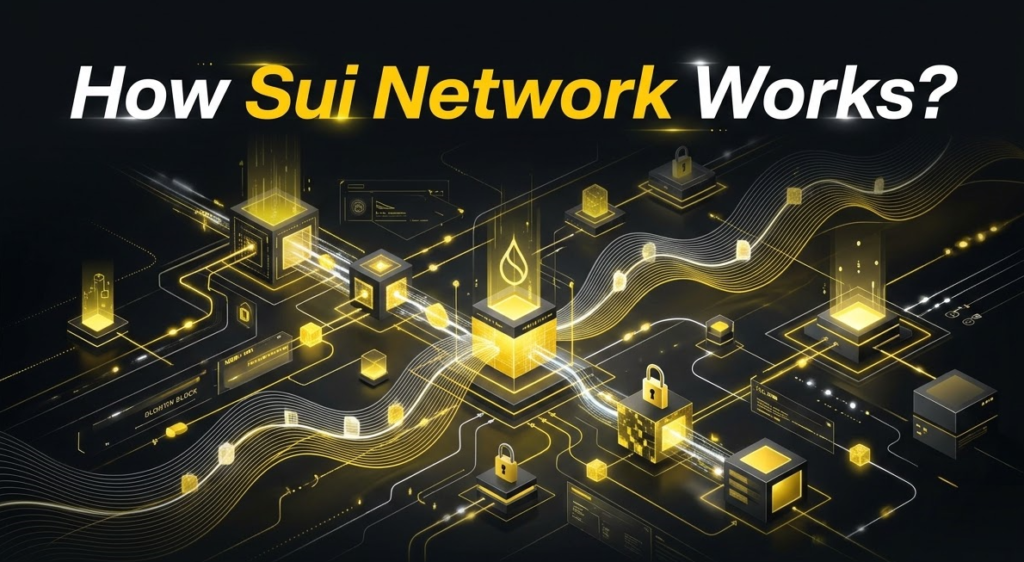
The most important architectural difference between Sui and many established smart contract platforms is how they represent state.
On an account-based blockchain such as Ethereum, an account can hold a balance, while smart contracts maintain their own storage. A token contract, for example, commonly stores balances in a mapping that connects wallet addresses with token amounts.
Sui organizes state differently. Its basic unit of storage is an object. Each object has an identity, a type, an owner, and a version. Transactions consume objects and produce new or updated objects.
That might sound like a small technical distinction, but it has significant consequences for execution.
Objects as First-Class Citizens
Think about a simple NFT marketplace.
On a conventional account-based system, the application might store ownership information in a contract mapping. The contract maintains a relationship between token IDs and wallet addresses, and every transfer updates the relevant storage entries.
On Sui, the NFT itself can be represented as an object. It has a unique identifier, a type defined by a Move package, and an ownership status that determines who can use it.
The object model is not limited to NFTs. It can represent:
- Fungible token coins.
- Collectible assets.
- Game characters and equipment.
- Tickets and access credentials.
- Lending positions.
- Liquidity pool data.
- Application-specific records.
- Smart contract packages.
According to the official Sui object model documentation, each object has several important properties:
| Object property | What it means |
|---|---|
| Unique ID | A globally unique identifier for the object |
| Owner | The address, object, or ownership category controlling it |
| Version | A value that changes when the object is modified |
| Type | The Move-defined structure that determines what the object represents |
| Metadata | Information such as the digest of the transaction that last modified it |
Sui object IDs are 32-byte identifiers. They are derived from the digest of the transaction that created the object and a counter representing the number of IDs generated by that transaction.
This structure makes ownership and transaction dependencies more explicit.
Imagine that Alice owns an NFT and wants to transfer it to Bob. The transaction needs to reference the NFT object and prove that Alice is authorized to use it. If the NFT is an address-owned object, the network can verify the ownership relationship without requiring every unrelated application object to be processed through the same global transaction sequence.
That is one of the foundations of Sui’s parallel execution model.
Compare this with a traditional account-based model:
| Feature | Account-based model | Sui object-centric model |
|---|---|---|
| Main state structure | Accounts and contract storage | Individual typed objects |
| Asset representation | Often stored in contract mappings | Can exist as independent objects |
| Ownership | Usually implemented through contract logic | Built into object ownership rules |
| Transaction inputs | Accounts, storage slots, and contract calls | Explicit object references |
| Parallel execution | Depends on state conflicts and execution architecture | Object dependencies help identify independent transactions |
| Asset transfer | Often requires interaction with a token contract | Eligible owned objects can be transferred directly |
This does not mean account-based blockchains cannot execute transactions in parallel. Ethereum clients and other networks have explored parallel execution techniques. The distinction is that Sui makes object ownership and object dependencies fundamental parts of its data architecture.
For developers, this can make it easier to understand which pieces of state a transaction reads or changes.
For users, the benefits are less visible but potentially meaningful: faster transfers, more efficient application interactions, and fewer unnecessary dependencies between unrelated operations.
Single-Owner vs Shared Objects
Not every object on Sui has the same ownership model. This is where the architecture becomes especially interesting.
Sui distinguishes between several object ownership categories, including address-owned, shared, immutable, wrapped, and consensus-address-owned objects.
Two categories are particularly important for transaction performance: address-owned objects and shared objects.
An address-owned object is controlled by a particular address. A personal NFT or a coin object held in a wallet is a straightforward example. Transactions involving eligible address-owned objects can use Sui’s fast path.
A shared object is different. Multiple users or applications may need to access and modify it. A decentralized exchange liquidity pool is a good example: thousands of users may want to trade against the same pool.
Because multiple transactions can compete to change the same shared state, the network needs consensus ordering to determine how those changes should be processed.
The difference can be summarized like this:
| Object type | Typical use case | Processing path |
|---|---|---|
| Address-owned | Personal coins, NFTs, and user-owned assets | Fast path when eligible |
| Shared | Liquidity pools, marketplaces, and common application state | Consensus ordering |
| Immutable | Published packages and data that cannot be changed | Read-only access |
| Wrapped | Data stored inside another object | Depends on the containing object |
| Consensus-address-owned | Address-controlled objects that require consensus sequencing | Consensus path |
Sui’s object ownership documentation explains how ownership determines whether an object uses the fast path or consensus sequencing.
Let’s take two examples.
Example A: Alice transfers a coin to Bob
Alice owns a coin object and wants to send it to Bob. The transaction references the coin and uses Alice’s signature to authorize the transfer.
If the transaction meets the fast-path requirements, it does not need to wait for Mysticeti to order it alongside every other transaction involving unrelated objects.
Example B: Alice swaps tokens on a shared liquidity pool
Now imagine Alice wants to swap tokens through a decentralized exchange. The pool is shared because many users can interact with it. Alice’s transaction may change the pool’s reserves, and other transactions may be attempting to change the same state.
The network needs to establish a consistent order for those operations. That is where consensus becomes necessary.
This is a key design choice. Sui does not force every transaction through the same processing path. It uses the ownership model to determine which transactions require coordination and which can be executed independently.
There is an important limitation, though. A shared object can become a performance bottleneck if too many transactions compete to modify it. A popular liquidity pool, for example, may experience contention even when the broader network has substantial unused capacity.
So, while Sui supports parallel execution, developers still need to design applications carefully. Splitting workloads across independent objects, reducing unnecessary shared-state updates, and managing contention are all important parts of building efficient applications.
The Technical Engine
Sui’s performance does not come from one isolated technology. Three components work together:
- Sui Move provides the programming and asset-safety model.
- Mysticeti coordinates transactions that require consensus.
- Programmable Transaction Blocks allow multiple operations to execute as one atomic transaction.
Understanding these components gives you a much better picture of how the network works than simply looking at its TPS claims.
Sui Move: Built-In Asset Protection and Safer Smart Contract Design
Move was originally developed for Meta’s Diem project, where the goal was to build a programming language suitable for managing digital assets and financial transactions.
The language takes a resource-oriented approach. Instead of treating every value as an ordinary piece of data that can be copied, overwritten, or discarded, Move allows developers to define rules governing how particular types of resources can be used.
Sui builds on this foundation with its own object model and programming features.
One of the most important concepts is the use of abilities.
Move abilities determine which operations are permitted for a type. The main abilities are:
| Ability | Purpose |
|---|---|
copy |
Allows values of the type to be copied |
drop |
Allows values to be discarded |
store |
Allows values to be stored inside other objects or transferred using certain public operations |
key |
Allows a struct to represent an on-chain Sui object |
For example, a developer defining an NFT-like object can create a struct with the key ability and a unique object identifier.
A simplified example looks like this:
public struct Collectible has key, store {
    id: UID,
    name: String,
    creator: address,
}
This structure defines a type of object with an ID, a name, and a creator address. The key ability makes it a Sui object, while store allows it to be stored or transferred through supported operations.
The important idea is that the language can enforce restrictions on how an asset is manipulated.
For example, if a token type does not have the copy ability, developers cannot simply duplicate it through an ordinary copy operation. If a resource does not have the drop ability, it cannot be silently discarded when it goes out of scope.
These restrictions help prevent certain classes of asset-management mistakes.
The official Sui Move fundamentals guide explains the type system and abilities in more detail.
Sui Move vs Solidity
The difference between Sui Move and Solidity is not simply that one is newer or more secure. They reflect different programming models.
Solidity is designed for the Ethereum Virtual Machine. Developers commonly store token balances and application state inside contracts, then write functions that update those storage structures.
Sui Move is designed around resources and objects. Assets can exist as independent objects with explicit ownership, and transactions specify the objects they consume or modify.
| Dimension | Sui Move | Solidity |
|---|---|---|
| Main execution environment | Sui Move VM | Ethereum Virtual Machine |
| State model | Object-centric | Account and contract storage |
| Asset handling | Resource-oriented objects | Contract-defined token and asset logic |
| Type safety | Strong resource and type rules | Static typing with Solidity-specific protections |
| Ownership | Native object ownership | Usually implemented through contract logic |
| Parallelism | Object dependencies support parallel execution | Depends on chain and execution environment |
| Common use | Sui applications and assets | Ethereum and EVM-compatible applications |
You should also be careful with claims that Sui Move completely eliminates reentrancy attacks.
Move’s resource semantics and Sui’s transaction execution model can reduce certain risks associated with common EVM patterns. However, no programming language can guarantee that every smart contract is secure. Developers can still introduce logic errors, incorrect authorization rules, economic vulnerabilities, or unsafe interactions with external components.
Sui Move provides tools for building safer applications. It does not replace audits, testing, and careful security design.
Mysticeti Consensus: Achieving Sub-Second Latency
Consensus is the process through which validators agree on the ordering and validity of transactions that require coordination.
Sui’s consensus protocol is called Mysticeti. It uses a directed acyclic graph, or DAG, to organize messages and proposals from validators.
A DAG is a data structure in which information can reference earlier information without requiring every event to fit into one simple linear chain of blocks.
In Mysticeti, multiple validators can propose blocks in parallel. Instead of relying on one leader to do all the work in a strictly sequential process, the protocol allows validators to make use of the network’s available bandwidth.
The protocol is designed to reduce communication overhead while maintaining Byzantine Fault Tolerant security.
The official Sui consensus documentation explains that Mysticeti can commit blocks after three communication rounds in its described protocol design. It also supports parallel voting and certification, which helps reduce both median and tail latency.
Why does that matter?
Imagine a financial application where users are constantly trading, transferring assets, and updating shared application state. Every unnecessary round of communication adds waiting time. Reducing those rounds can make the application feel more responsive and improve the amount of work the network can process.
Mysticeti has been associated with a widely quoted 390 ms consensus latency figure. This came from measurements after its deployment on Sui and has been documented in research on production performance. The Mysticeti research paper presented at NDSS 2025 includes a production latency graph showing a reduction from approximately 1.9 seconds to around 397 milliseconds following the transition to Mysticeti.
However, consensus latency and end-to-end transaction finality are not always identical measurements. The result can also vary depending on workload and network conditions.
Current Sui documentation describes controlled Mysticeti benchmark testing with average consensus commitment around 0.5 seconds and sustained throughput around 200,000 TPS in the reported setup. It also lists higher peak throughput under different controlled configurations. The documentation explicitly warns that these are benchmark results, not production metrics.
That distinction is important. A benchmark measures what a protocol can achieve under a particular setup. It does not guarantee that every decentralized application will consistently achieve the same result.
What happens to transactions that do not need shared-state consensus?
They may use Sui’s fast path instead. An eligible transaction involving address-owned objects can avoid the full shared-object consensus process, which is one reason simple transfers can be particularly fast.
Mysticeti therefore does not need to process every single transaction in the same way. Its main role is to coordinate the transactions that require shared ordering.
Programmable Transaction Blocks: Chaining Up to 1,024 Atomic Operations
Another feature that makes Sui attractive to developers is the Programmable Transaction Block (PTB).
A PTB lets developers combine multiple operations into one transaction. Rather than sending a separate transaction for every action, an application can construct a sequence of commands that execute together.
For example, a user might want to:
- Split a coin object.
- Swap one portion through a decentralized exchange.
- Deposit the resulting tokens into a lending protocol.
- Transfer another portion to a different address.
- Receive an NFT or another application object.
A developer can combine those actions into one PTB rather than asking the user to approve a separate transaction for each step.
The official Sui documentation allows up to 1,024 commands in a single PTB. You can see the limit and transaction composition rules in the Sui transaction payment documentation.
PTBs also support atomic execution.
This means that if one required command fails, the transaction can revert rather than leaving the application in a partially completed state.
Consider a token swap with a minimum-output requirement. The user wants to exchange Token A for Token B, but only if the resulting amount is at least 100 Token B. If the exchange cannot provide that amount, the transaction should fail rather than completing an unfavorable swap and continuing with the remaining commands.
That kind of all-or-nothing execution is useful for DeFi applications, games, NFT marketplaces, and complex financial workflows.
PTBs also reduce the number of interactions between an application and the network. A single transaction can contain several dependent operations, with outputs from earlier commands passed into later commands.
For users, this can mean fewer wallet approval prompts and a smoother experience. For developers, it means more flexibility when composing application logic.
Still, 1,024 commands should not be interpreted as a recommendation to put 1,024 complex operations into every transaction. Large PTBs consume resources and must remain within gas and transaction limits. Good application design is about combining useful operations efficiently, not maximizing the command count.
Native Web2 UX Integration
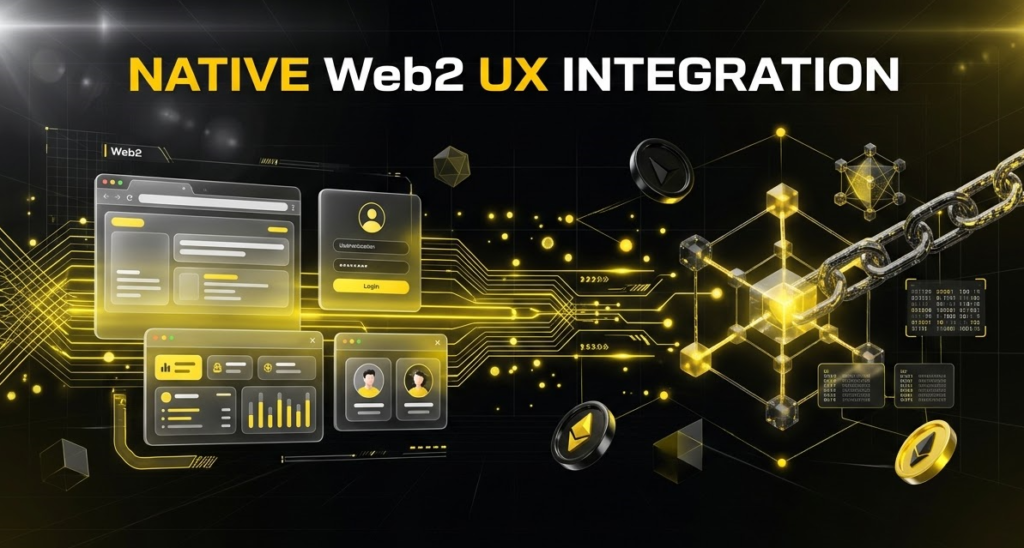
One of the biggest obstacles to mainstream crypto adoption has never been the blockchain itself. It is the user experience.
A new user downloads a wallet, writes down a seed phrase, stores it somewhere safe, learns how transaction signatures work, and tries not to lose access to their funds. For people who are already comfortable with online banking or social media applications, that process can feel unnecessarily complicated.
Sui addresses part of this problem through zkLogin.
zkLogin allows users to create and access Sui addresses using familiar OAuth credentials, such as Google, Apple, Facebook, or Twitch. Instead of requiring users to manage a traditional seed phrase as the only way to access their account, the protocol uses zero-knowledge proofs to establish that a user controls a valid login credential without publishing the credential itself on-chain.
How zkLogin Eliminates Seed Phrase Friction
The basic idea is straightforward: users authenticate through an identity provider they already use, and the application uses that authentication flow to derive a Sui address.
A simplified onboarding process looks like this:
- The user opens a Sui-enabled application.
- The application generates an ephemeral key pair.
- The user signs in through a supported OAuth provider.
- The application receives a signed JSON Web Token (JWT).
- A proving service generates a zero-knowledge proof.
- The proof and ephemeral signature are used to authorize transactions.
The resulting address is tied to the relevant identity information and a user-specific salt.
This allows users to access a blockchain account without directly handling a conventional seed phrase during the normal login experience.
The official zkLogin documentation describes the integration process and supported providers.
Sui currently documents support for providers including Google, Apple, Facebook, and Twitch on mainnet. Other providers have different availability statuses, so developers should check the current provider list rather than assume every OAuth service is supported.
Privacy Preservation and Zero-Knowledge Proof Safeguards
The important part of zkLogin is not merely that a user can log in with Google. It is that the system uses cryptographic proofs to avoid publicly revealing the underlying identity credentials.
A zero-knowledge proof allows one party to demonstrate that a statement is true without revealing the sensitive information used to establish that statement.
In zkLogin, the proof allows validators to verify that the user has a valid OAuth credential associated with the relevant account, without publishing the complete JWT on-chain.
The protocol uses several components:
| Component | Role |
|---|---|
| OAuth provider | Authenticates the user |
| JWT | Contains signed identity claims |
| Ephemeral key pair | Signs transactions for a limited period |
| User salt | Helps derive a consistent Sui address |
| Proving service | Generates the zero-knowledge proof |
| Validators | Verify the proof and transaction signature |
The address derivation process uses information such as the provider’s issuer (iss), the user’s identifier (sub), the application audience (aud), and the user-specific salt.
The salt is particularly important because it helps prevent a direct public link between an OAuth identity and a Sui address.
There are, however, security considerations that users should understand.
First, zkLogin does not mean that Google or Apple becomes the owner of the user’s assets. The OAuth provider authenticates the user, while the transaction requires the relevant cryptographic signing process. The provider cannot simply decide to move the user’s SUI on its own.
Second, zkLogin does not eliminate every dependency. The proving service and salt-management infrastructure are important components. The official technical reference notes that a proving service and salt service can potentially link identity information under certain circumstances, even though the protocol is designed to avoid publishing the user’s sensitive identity details on-chain.
Third, losing access to the required recovery information can create problems. The salt is important for deriving the same address, and ephemeral keys have a limited validity period. Users should understand the recovery options offered by their wallet or application before storing significant assets in a zkLogin account.
You can review these details in the zkLogin technical reference.
For someone new to crypto, zkLogin can make the first interaction much easier. For experienced users, conventional wallets, hardware wallets, and other authentication methods remain useful alternatives.
SUI Tokenomics
SUI is more than a payment token used to cover transaction fees. It is part of the network’s security and economic design.
The token has a maximum supply of 10 billion SUI. It is used to pay gas fees, participate in delegated proof-of-stake, provide liquidity across applications, and support on-chain governance.
The important distinction is that the 10 billion maximum supply does not mean all tokens were available when mainnet launched. SUI entered circulation according to an allocation and release schedule.
SUI Supply Distribution and Maximum Token Ceiling
Sui’s token allocation was designed to support several groups involved in building and maintaining the network.
The original distribution is commonly presented as follows:
| Allocation category | Share of maximum supply |
|---|---|
| Community Reserve | 50% |
| Early Contributors | 20% |
| Investors | 14% |
| Mysten Labs Treasury | 10% |
| Community Access Program and App Testers | 6% |
| Total | 100% |
The Community Reserve is managed by the Sui Foundation and supports ecosystem development, validator delegation, grants, research, and other community programs.
The other allocations recognize the contributions of early developers, investors, and the original development company. Their tokens are subject to release schedules, which means the amount of SUI in circulation changes over time.
The official SUI token allocation announcement explains the original distribution, while the SUI token schedule page provides information about circulation and unlocks.
Why does this matter?
Because token supply affects market liquidity and potential selling pressure. If a significant allocation becomes unlocked, recipients may gain the ability to sell, stake, or otherwise use those tokens. That does not mean they will automatically sell, but it is an important factor when evaluating the market.
I would look at several figures rather than focusing only on the 10 billion cap:
- Circulating supply.
- Remaining locked supply.
- Upcoming unlock dates.
- Staking participation.
- Token distribution among large holders.
- The amount of SUI used across applications.
- Changes in staking rewards and network demand.
A maximum supply tells you the upper limit. It does not tell you how many tokens are currently available to trade or how much selling pressure the market may face in the future.
The Storage Fund: Preventing State Bloat Through Refundable Fees
One of Sui’s more interesting economic features is its Storage Fund.
On a blockchain, storing data is not free. Every new object or piece of persistent state creates an ongoing responsibility for validators and future network participants. Even if the original user disappears, the network still has to preserve the relevant data.
This creates a long-term problem known as state growth or state bloat.
Imagine a game where users create millions of temporary objects, collectible items, or activity records. If the network stored all of those objects indefinitely without accounting for the cost, future validators would inherit an increasingly large storage burden.
Sui addresses this through a storage-fee model.
When a transaction creates persistent on-chain data, users pay a storage fee. That fee contributes to the Storage Fund, which is used to help compensate validators for maintaining historical state.
The Storage Fund itself participates in staking rewards. This means it can earn rewards that help pay for the long-term cost of storing data, including data created before a new validator joined the network.
This is an important design choice. A validator that joins later should not have to absorb the entire historical storage burden without any corresponding economic support.
Sui also includes a storage rebate mechanism.
When a transaction deletes an object or removes previously stored data, the user can receive a partial rebate on the storage fee associated with that data.
According to the official Sui gas-fee documentation, the initial storage-fee structure makes 99% of the storage fee rebateable and 1% non-rebateable.
That means deleting an object does not necessarily return the entire original storage payment. The rebate is partial, and the exact amount depends on the applicable storage-fee accounting.
Let’s look at a simplified example.
Suppose a user creates an object and pays 1 SUI in storage fees. Under the initial 99% rebateable structure, up to 0.99 SUI may be eligible for a rebate if the relevant data is later deleted, while 0.01 SUI is non-rebateable.
This example illustrates the principle rather than guaranteeing a particular rebate for every transaction. Actual fees and rebates depend on the protocol’s current rules and the object’s storage accounting.
The model creates an incentive for developers to manage state carefully. If an application no longer needs an object, deleting it can recover part of the original storage cost and reduce the amount of unnecessary data maintained by the network.
It is also important to understand that storage fees and computation fees are different.
| Fee type | What it pays for |
|---|---|
| Computation fee | Resources used to execute transaction logic |
| Storage fee | Persistent data added to the network |
| Storage rebate | Partial return of eligible storage fees when data is deleted |
This distinction is useful when designing applications. A transaction that performs little computation but creates a large amount of persistent data may still have meaningful storage costs.
Delegated Proof-of-Stake and Epoch Gas Pricing
Sui uses a delegated proof-of-stake system.
SUI holders can delegate their tokens to validators, contributing to the validator’s stake and participating in the network’s security model. In return, eligible stakers receive rewards according to the protocol’s staking economics.
Validators operate the infrastructure that processes transactions, participates in consensus, and helps maintain the network.
At the beginning of each epoch, the validator committee and staking-related parameters are updated. Sui’s epoch structure also plays an important role in gas pricing.
How does staking work?
A user selects a validator and delegates SUI to that validator’s staking pool. The validator combines delegated stake with its own stake and participates in the network’s proof-of-stake system.
Rewards are calculated according to network rules and distributed through staking pools.
The amount a user earns depends on several factors, including:
- The validator’s performance.
- The validator’s commission rate.
- The total amount of stake participating in the network.
- The applicable reward subsidies and gas-fee income.
- The duration and timing of the stake.
Staking rewards are not guaranteed investment returns. Validator commission and protocol parameters can change, and token prices can move independently of the number of SUI earned.
The Sui tokenomics documentation explains staking pools, reward calculations, and epoch transitions.
Epoch-based gas pricing
Sui uses a reference gas price that validators help determine for the next epoch.
During an epoch, validators submit their preferred reference gas price for the following epoch. At the transition, the protocol calculates a stake-weighted percentile from the submitted values. The resulting reference gas price remains in effect during the new epoch.
This is designed to make ordinary transaction costs more predictable than a system where gas prices change continuously with every short-term fluctuation in demand.
The official validator rewards and gas-price guide explains how the reference gas price is calculated.
However, users can still encounter different costs depending on the transaction’s computation and storage requirements. A complex transaction that creates many objects may cost more than a simple transfer, even when both use the same reference gas price.
Common Pitfalls and Misconceptions About Sui
Sui’s architecture is genuinely different from many established blockchains, but that also creates room for misunderstanding. A few claims are repeated frequently in crypto discussions without enough technical context.
Misconception: Sui Move Is Identical to Aptos Move
Sui Move and Aptos Move share a common origin in the original Move language developed during the Diem project.
However, they are not identical implementations.
Sui extends Move with an object-centric model, including native object ownership, transaction inputs, and other features tailored to its execution architecture.
Aptos also uses Move, but its data model and execution design differ. Developers cannot assume that a Move package written for one network will work on the other without adaptation.
The official Sui Move concepts documentation explains the Sui-specific changes and restrictions.
For developers, the practical lesson is simple: understanding general Move syntax is useful, but building on Sui requires learning the Sui object model and its framework.
Misconception: Every Sui Transaction Requires Full Consensus Validation
This is one of the most important misunderstandings about Sui.
Transactions involving eligible address-owned objects can use the fast path. They do not need the same global consensus ordering required for shared objects.
Shared objects, on the other hand, require consensus sequencing because multiple users may attempt to modify the same state.
The difference is fundamental to Sui’s performance model.
If you transfer an NFT that only you own, the network can process the operation without coordinating every unrelated transaction. If you interact with a shared liquidity pool, consensus is needed to establish a valid order for competing updates.
This is not a way to bypass security. The fast path still relies on transaction authorization, object ownership, and the protocol’s validation rules.
The Sui object ownership guide provides a technical explanation of which ownership types use fast-path processing and which require consensus.
Misconception: Storage Fees Are Completely Non-Refundable
Sui’s storage-fee model is not simply a permanent payment with no possibility of recovery.
Users can receive a partial rebate when previously stored data is deleted. Under the initial documented structure, 99% of the storage fee is rebateable and 1% is non-rebateable.
This is designed to encourage efficient state management while ensuring that the network retains an economic contribution toward long-term storage costs.
However, a storage rebate is not a universal guarantee that every transaction will return the same amount originally paid. Developers need to understand the storage accounting rules and how their applications create, modify, and delete objects.
Misconception: Sui’s TPS Benchmark Is Its Guaranteed Mainnet Performance
Sui’s historical benchmark of 297,000 TPS is often repeated as though every application can achieve that number under normal network conditions.
That is not how benchmark results should be interpreted.
The original performance tests used a controlled setup with specific validator hardware and workload assumptions. They demonstrated the potential of Sui’s transaction-processing architecture, but they did not establish a guaranteed real-world throughput rate for every application.
The Sui performance update explains the original benchmark and the testing environment.
Current Mysticeti documentation also distinguishes controlled benchmark results from production metrics.
If you are evaluating a Sui application, it is more useful to examine its actual latency, transaction success rate, shared-object contention, and network costs than to rely on a single headline TPS number.
Entity Relationships and Sui System Architecture
Sui’s architecture becomes easier to understand when you map its core components and their relationships.
| Entity | Relationship | Role |
|---|---|---|
| Sui Network | Developed by Mysten Labs and an open-source ecosystem | Layer-1 blockchain infrastructure |
| Mysten Labs | Original core development company | Built the initial Sui technology |
| Sui Move | Native smart contract language | Defines objects and application logic |
| Object-centric model | Core state architecture | Organizes data around individually identified objects |
| Mysticeti | Consensus protocol | Orders transactions involving shared state |
| Fast path | Transaction processing route | Handles eligible owned-object transactions |
| PTBs | Transaction composition format | Bundles multiple operations atomically |
| zkLogin | Authentication primitive | Enables social login-based Sui accounts |
| SUI | Native token | Pays gas, supports staking, liquidity, and governance |
| Storage Fund | Economic infrastructure | Helps fund long-term state storage |
The important point is that none of these features works in isolation.
Sui Move defines the objects and the rules governing them. The object model makes transaction dependencies explicit. The execution engine can then identify which operations are independent, while Mysticeti handles the ordering requirements for shared objects. PTBs allow applications to combine several operations into one transaction, and SUI provides the economic incentives that support the network.
That combination is what makes Sui different from a blockchain that simply increases block size or raises its validator hardware requirements to pursue higher throughput.
How to Stake SUI and Use zkLogin dApps
If you are new to Sui, you do not need to understand every technical detail before interacting with the network. You can start with a wallet, explore a supported application, and learn how the system works as you go.
There are two useful starting points: creating a wallet through zkLogin and delegating SUI to a validator.
Phase 1: Onboarding Through zkLogin
Step 1: Open a Sui-enabled application or wallet
Start with a wallet or decentralized application that supports zkLogin.
One option is Slush, the official Sui wallet developed by Mysten Labs. It supports social login as well as conventional recovery-passphrase accounts.
You can find it through the official Slush wallet documentation.
Always verify that you are using the genuine application. Search results, social media links, and sponsored listings can sometimes lead to imitation websites.
Step 2: Select a supported social login provider
Choose a supported provider such as Google, Apple, Facebook, or Twitch.
The application redirects you to the provider’s authentication process. You sign in using your normal credentials and approve the requested access.
This does not mean that the provider receives permission to move your SUI. The OAuth process establishes your identity, while the blockchain transaction still requires the appropriate cryptographic authorization.
Step 3: Complete the zkLogin setup
The application generates an ephemeral key pair and uses the OAuth response to create the necessary proof.
The resulting Sui address is derived using the relevant identity claims and a user-specific salt.
You can now interact with supported Sui applications through the wallet.
Before depositing significant assets, make sure you understand the wallet’s recovery options, the role of the salt service, and what happens if you lose access to your OAuth account.
Phase 2: Staking SUI for Rewards
Step 1: Transfer SUI into your wallet
Make sure your wallet contains native SUI. You also need a small amount available to pay transaction fees.
If you are transferring SUI from an exchange, confirm that you have selected the correct Sui network and destination address.
Step 2: Open the staking interface
In a supported wallet, look for the staking option. In Slush, this is available through its staking functionality.
You should see a list of validators and information about their performance and commission.
Step 3: Choose a validator
Do not choose a validator based only on its advertised reward rate.
Consider:
- Validator uptime and reliability.
- Commission rate.
- Stake distribution.
- Reputation and operational transparency.
- Whether the validator has a history of consistent performance.
Delegating to a validator contributes to the network’s delegated proof-of-stake system, but it does not transfer ownership of your tokens to the validator.
Step 4: Confirm the staking transaction
Enter the amount of SUI you want to delegate and review the transaction details.
Once you approve the transaction, the stake becomes active according to the protocol’s epoch rules.
Rewards are distributed through the staking pool. You should review the wallet’s unstaking and withdrawal instructions before committing funds, since timing depends on epoch transitions and the applicable staking rules.
Step 5: Monitor your position
Check your staking position periodically. Validator commission rates, network parameters, and reward conditions can change.
Remember that earning more SUI does not guarantee that the dollar value of your position will increase. Market price risk remains separate from staking rewards.
FAQ About Sui (SUI)
What is Sui (SUI) and how does it work?
Sui is an object-centric Layer-1 blockchain developed by Mysten Labs. It uses the Sui Move programming language, a parallel execution architecture, and Mysticeti consensus to support decentralized applications.
Instead of organizing all state primarily around account balances and contract storage, Sui represents assets and application data as objects with unique IDs and ownership rules. Independent transactions can be executed in parallel, while transactions involving shared objects use consensus ordering.
SUI is the network’s native token. It pays gas fees, supports staking, provides liquidity, and participates in on-chain governance.
What makes Sui Move different from Ethereum’s Solidity?
Sui Move uses a resource-oriented programming model built around objects and explicit ownership. Solidity is designed for the Ethereum Virtual Machine and commonly stores token balances and application data inside smart contracts.
Sui Move gives developers native object types and abilities that restrict how resources can be copied, transferred, or discarded. This can reduce certain asset-management risks and helps the network identify transaction dependencies.
However, neither language guarantees that every smart contract is secure. Both require careful development, testing, and auditing.
What are Programmable Transaction Blocks?
Programmable Transaction Blocks are Sui transactions that combine multiple commands into one atomic execution.
A PTB can perform operations such as splitting coins, calling Move functions, transferring objects, and interacting with application contracts. The commands can use outputs from earlier steps as inputs for later operations.
Sui supports up to 1,024 commands in a single PTB. If a required command fails, the transaction can revert rather than leaving the application in a partially completed state.
How does Sui’s Storage Fund work?
The Storage Fund helps compensate validators for maintaining persistent blockchain data.
When a transaction creates on-chain storage, the user pays a storage fee that contributes to the fund. If the data is later deleted, the user may receive a partial storage rebate.
Under the initially documented fee structure, 99% of the storage fee is rebateable and 1% is non-rebateable. The mechanism encourages applications to remove unnecessary data while supporting the network’s long-term storage requirements.
What is zkLogin on Sui?
zkLogin is a native Sui authentication feature that allows users to access blockchain accounts through familiar OAuth providers such as Google, Apple, Facebook, and Twitch.
It combines an OAuth credential, an ephemeral key pair, a user-specific salt, and a zero-knowledge proof. The proof allows validators to verify the required authentication information without publishing the user’s complete identity credential on-chain.
This makes wallet onboarding easier while preserving a self-custodial transaction model. Users should still understand the recovery and security requirements associated with their chosen wallet.
What is Mysticeti consensus?
Mysticeti is Sui’s DAG-based Byzantine Fault Tolerant consensus protocol.
It allows multiple validators to propose blocks in parallel and uses a reduced number of communication rounds to commit the DAG. The protocol is designed to improve throughput and reduce latency for transactions involving shared objects.
The often-quoted 390 ms figure refers to measured consensus latency, not a universal guarantee that every transaction will achieve finality in exactly that time.
Does every Sui transaction require Mysticeti consensus?
No. Eligible transactions involving address-owned objects can use Sui’s fast path and avoid the shared-object consensus process.
Transactions involving shared objects, such as decentralized exchange liquidity pools, require consensus ordering because multiple users may attempt to modify the same state.
This hybrid design allows Sui to avoid unnecessary coordination for independent transactions while maintaining consistent ordering where it is required.
What is the maximum supply of SUI?
SUI has a maximum supply of 10 billion tokens.
However, not all tokens were in circulation at mainnet launch. The supply is released according to allocation and unlocking schedules covering the Community Reserve, early contributors, investors, Mysten Labs Treasury, and the Community Access Program.
For current circulating supply and unlock information, consult the official SUI token schedule.
Can I stake SUI and earn rewards?
Yes. SUI holders can delegate tokens to validators through supported wallets and participate in the network’s delegated proof-of-stake system.
Rewards depend on factors such as validator performance, commission, total stake, and protocol parameters. They are not guaranteed investment returns, and the market value of SUI can fluctuate independently of staking rewards.
Is Sui faster than Ethereum?
Sui is designed around a different execution model, and its object-centric architecture allows independent transactions to run in parallel. Mysticeti also provides low-latency consensus for shared-object transactions.
However, comparing blockchain speed using one TPS figure can be misleading. Different networks process different workloads, use different hardware assumptions, and measure throughput in different ways.
A fair comparison should consider end-to-end finality, transaction costs, decentralization, application complexity, shared-state contention, and real production performance—not just peak benchmark numbers.
Final Thoughts
Sui is interesting because it approaches blockchain performance from the data model upward.
Instead of relying exclusively on a faster consensus protocol to process every transaction, it starts by organizing state around individual objects and their ownership relationships. That makes it easier to identify which transactions are independent and which require coordination.
Sui Move provides the programming model for those objects. Mysticeti handles consensus when shared state needs to be ordered. The fast path reduces coordination for eligible owned-object transactions, while Programmable Transaction Blocks allow developers to combine complex workflows into atomic operations.
The economic layer matters too. SUI supports gas payments, staking, liquidity, and governance, while the Storage Fund addresses the long-term cost of maintaining persistent data. zkLogin adds another practical advantage by making it easier for users to access blockchain applications without immediately learning traditional seed-phrase management.
Of course, Sui is not without trade-offs. Shared-object contention can limit performance in some applications, Move requires developers to learn a different programming model, and token unlocks remain important for anyone evaluating SUI as an investment.
I would not judge Sui only by its headline TPS figures or the speed of a simple token transfer. The more useful question is whether its object-centric architecture makes real applications easier to build, cheaper to operate, and more responsive for users.
If that design continues to attract developers and meaningful application activity, Sui has a compelling technical foundation. But long-term network value will depend on adoption, security, decentralization, token economics, and the quality of the applications built on top of it—not speed alone.