One distinction matters from the beginning: delta-neutral does not mean risk-free. Ethena’s model depends on derivatives markets, custodians, exchanges, collateral quality, liquidity, and the protocol’s ability to manage periods when hedging becomes expensive. I’ll unpack how those pieces fit together, what sUSDe’s “Internet Bond” actually represents, and where the risks sit.
Key Specifications and Architectural Overview of Ethena
Ethena is built around a different idea from the traditional stablecoin model. Instead of promising that every token corresponds to a dollar sitting in a bank account, it constructs a synthetic dollar from crypto collateral, derivatives positions, and operational infrastructure designed to keep the combined position close to a dollar in value.
Ethena’s own protocol documentation describes USDe as a synthetic dollar backed by crypto assets and corresponding short futures positions, alongside liquid stablecoins. That wording is important: USDe is not simply a token backed by ETH, nor is it a conventional fiat-backed stablecoin. Its backing model combines several assets and financial positions, each with its own risks.
| Metric | Ethena’s design |
|---|---|
| Core development team | Ethena Labs |
| Founder | Guy Young |
| Main synthetic dollar | USDe |
| Target value | Approximately $1 USD |
| Stability mechanism | Delta-neutral hedging using spot assets and short derivatives |
| Backing assets | Approved crypto assets, staked assets, and liquid stablecoins; composition can change |
| Yield-bearing product | sUSDe, commonly called the “Internet Bond” |
| Governance token | ENA |
| Custody and settlement | Institutional off-exchange settlement providers |
| Risk buffer | Ethena Protocol Reserve Fund |
A few details in this outline need careful qualification before we go deeper:
-
The collateral list is not a permanent shopping list. Ethena’s eligible backing assets and their allocations can change through its risk and governance processes. It is safer to describe BTC, ETH-related assets, and liquid stablecoins as examples than to imply that every asset named in an older list is always accepted.
-
OES reduces direct exchange-custody exposure; it does not remove counterparty risk. Custodians, exchanges, settlement processes, and derivatives positions still matter.
-
The Reserve Fund is a risk buffer, not an unlimited guarantee. Its size must be evaluated against the scale and type of exposures it is meant to absorb.
-
ENA governance is not the same as an automatic claim on protocol revenue. Tokenholders’ rights and any revenue-related mechanisms depend on the governance framework and approved proposals.
These distinctions are not just technical housekeeping. They determine what you are actually trusting when you hold USDe or deposit it into sUSDe.
How USDe Works?

The phrase algorithmic stablecoin is often used loosely, and that can make discussions about USDe confusing. People sometimes group every crypto dollar that is not backed one-for-one by bank deposits into the same category. That misses the most important part of Ethena’s design.
USDe is a synthetic dollar. Its target value is supported by a portfolio that combines spot crypto assets with offsetting short derivatives positions. The protocol is designed to neutralize much of the price exposure that would otherwise come from holding volatile assets such as ETH or BTC.
Compare that with the model used by Terra’s UST before its collapse in May 2022. UST relied heavily on a relationship between UST and the LUNA token, with market incentives and mint-and-burn mechanisms intended to preserve the peg. When confidence broke and redemptions accelerated, the system’s reflexive structure amplified the collapse rather than absorbing it.
Ethena takes a different route. It does not depend on an unbacked governance token being worth enough to redeem USDe. Instead, it uses identifiable backing assets and derivatives positions. That is a meaningful structural difference, but it should not be translated into “USDe cannot depeg.” A synthetic dollar can still face losses, liquidity problems, exchange failures, funding-rate shocks, custody disruptions, or a breakdown in the mechanisms that connect its backing to the market price.
The protocol itself makes this distinction clear in its overview of USDe and its risk model: USDe is not the same as a fiat-backed asset such as USDC or USDT, and the risks involved are different.
The Delta-Neutral Hedging Strategy Explained
The central mechanism is delta-neutral hedging. The word delta describes how much the value of a position changes when the price of its underlying asset moves. If a portfolio has positive delta, it generally benefits when the asset price rises and loses value when it falls. A short derivatives position can offset some or all of that exposure.
Here is a simplified ETH example.
Imagine Ethena holds $100 million worth of ETH or an ETH-related liquid staking asset. If ETH rises by 10%, the spot collateral would gain roughly $10 million in market value. If ETH falls by 10%, the same collateral would lose roughly $10 million.
To offset that directional exposure, the protocol can open a short ETH perpetual futures position with approximately $100 million in notional value. If ETH falls, the short position should gain value as the spot collateral loses value. If ETH rises, the short position should lose value while the spot collateral gains.
A simplified delta-neutral position
Long $100M ETH
Benefits when ETH rises; loses when ETH falls.
Short $100M ETH perpetuals
Loses when ETH rises; benefits when ETH falls.
Intended result
The two positions offset much of their exposure to ETH price movements, leaving a portfolio whose value is less sensitive to the direction of ETH.
Illustrative example only. Actual positions, hedge ratios, collateral haircuts, fees, and risk limits vary.
This is the basic intuition behind Ethena’s delta-neutral model. But there are several reasons why the word neutral should not be mistaken for perfectly hedged.
First, the spot and derivatives positions may not move in exactly the same way. A staked ETH token, for example, can trade at a discount or premium to ETH itself. Its liquidity may also behave differently during market stress. Second, perpetual futures require margin and are subject to funding payments. Third, the protocol must manage exchange exposure, execution costs, liquidation risk, and the possibility that a hedge cannot be adjusted when markets become disorderly.
There is also a difference between a hedge’s notional value and its actual economic protection. A $100 million short position does not automatically guarantee that a $100 million spot position is perfectly insulated under every market condition. The relationship depends on asset correlation, contract specifications, liquidity, funding, and how quickly the positions can be adjusted.
Ethena’s protocol overview describes the use of delta-hedged Bitcoin, Ethereum, and other governance-approved spot assets through perpetual and deliverable futures, while also holding liquid stablecoins. The mix is intended to make USDe scalable without relying exclusively on traditional banking rails.
How Perpetual Funding Rates Fit Into the Hedge
Perpetual futures contracts do not have a fixed expiry date. To keep their prices near the spot market, exchanges use a funding mechanism: traders on one side periodically pay traders on the other.
When demand for leveraged long positions is stronger, perpetual contracts may trade at a premium and funding is often positive. In that environment, longs generally pay shorts. A strategy that holds spot assets and shorts perpetuals can therefore collect funding payments.
When demand shifts toward shorts, funding can turn negative. The short side then pays the long side. The same hedge that generated revenue during bullish, leveraged market conditions can become a cost.
This is one of the most important points to understand about USDe: the hedge is designed primarily to reduce directional price exposure, while funding and basis conditions influence whether the derivatives leg generates income or consumes it.
The Ethena FAQ identifies staking rewards, perpetual funding rates or expiry-futures basis, and rewards on liquid stablecoins as sources of protocol-level revenue. These sources do not all behave in the same way, and none should be treated as a guaranteed return.
How sUSDe Generates Yield?
The Dual-Yield Engine: Staking Rewards and Derivatives Income
USDe is designed to function as the synthetic dollar itself. sUSDe is the yield-bearing version you receive when you stake USDe through Ethena’s staking mechanism.
The distinction is similar to the difference between holding an asset and depositing it into a savings product. USDe aims to maintain a value close to one dollar. sUSDe represents a claim on staked USDe, with its value relative to USDe increasing as rewards accrue to the staking contract.
Ethena calls sUSDe the Internet Bond because its yield comes from crypto-native financial activity rather than the interest paid on a conventional bank deposit. That name is memorable, but you should not interpret it as meaning sUSDe is a traditional bond. It does not have a fixed maturity date, a guaranteed coupon, or the same legal protections as a government or corporate bond.
The yield engine has several potential sources.
Staking rewards from underlying assets. When the protocol holds eligible staked ETH-related collateral, that collateral may generate staking rewards. These rewards come from Ethereum’s proof-of-stake system and related staking arrangements. They are not fixed: validator economics, network conditions, staking-provider fees, and the amount of ETH earning rewards all affect the outcome.
Perpetual funding and futures basis. As explained earlier, a short perpetual position may collect funding when long traders pay shorts. The protocol may also earn from the basis between spot prices and dated futures prices, depending on how the positions are structured and closed.
Rewards on liquid stablecoins. Ethena’s documentation also identifies rewards on liquid stablecoins as a potential source of protocol revenue. This matters because it would be misleading to describe every dollar of sUSDe yield as coming from ETH staking and perpetual funding alone. The actual contribution from each source can change as the backing portfolio evolves.
The Ethena FAQ on protocol revenue outlines these three categories. For anyone evaluating sUSDe, the useful question is not simply “What is the APY today?” It is “Which sources are generating that APY, how sustainable are they, and what risks are being taken to earn it?”
A high yield during a period of strong demand for leveraged long positions may look attractive. But if funding rates normalize or turn negative, that income can shrink quickly. Staking rewards are generally less volatile than derivatives funding, but they are not large enough on their own to guarantee a high overall yield.
How sUSDe Accrues Value
sUSDe uses an exchange-rate model rather than simply increasing every holder’s token balance through a rebasing mechanism. When you stake USDe, you receive sUSDe at the prevailing exchange rate. As rewards accrue to the staking contract, each sUSDe can represent a larger amount of USDe.
For example, imagine you deposit 1,000 USDe when one sUSDe is worth 1.00 USDe. You might receive 950 sUSDe if the exchange rate is already above one. If the exchange rate later rises to 1.10 USDe per sUSDe, those 950 tokens would represent 1,045 USDe before any fees or other applicable conditions.
The important point is that your sUSDe token count does not necessarily increase. Its conversion value can increase instead.
This is why you should compare the sUSDe-to-USDe exchange rate over time rather than relying only on a wallet balance. Ethena’s staking guide explains that users receive sUSDe according to the current exchange rate and that the value can increase as protocol rewards are transferred into the staking contract.
Understanding APY: Why Yesterday’s Yield Is Not Tomorrow’s Yield
You will often see crypto products advertised with a headline APY. It is tempting to compare that number with a bank savings rate and decide immediately which one is better. With sUSDe, that comparison leaves out a lot.
The yield is variable because its underlying sources are variable. Perpetual funding rates can change with leverage demand, staking returns can change with network conditions, and the backing mix can change through governance and risk management. The protocol may also alter how revenue is allocated among staking rewards, reserves, and other ecosystem purposes.
A displayed seven-day or thirty-day annualized APY is a snapshot of recent performance, not a promise that the same return will continue for the next twelve months. Annualizing a short period can make a temporary spike look like a stable long-term rate.
Before depositing, I would check at least four things:
-
The measurement period: Is the advertised APY based on the last seven days, thirty days, or a longer period?
-
The yield composition: Is the return mainly coming from funding, staking, stablecoin rewards, or incentives?
-
The exchange rate: How much USDe does one sUSDe represent today, and how has that rate changed?
-
The exit conditions: Is there a cooldown, withdrawal queue, or liquidity constraint that could delay access to your USDe?
A product can show a positive APY while still carrying meaningful market, smart-contract, liquidity, and counterparty risks. Yield is compensation for taking risk, not evidence that the risk has disappeared.
The Ethena Protocol Reserve Fund: Managing Negative Funding Risk
A delta-neutral strategy can generate revenue when funding conditions are favorable, but it can also incur costs when funding turns negative. Ethena’s Protocol Reserve Fund exists as an additional layer of protection against periods when the protocol’s revenue is insufficient or when market conditions create stress.
The Reserve Fund is intended to provide capital to cover negative funding and act as a bidder of last resort for USDe in open markets. Ethena describes its role in the governance forum’s Reserve Fund section, where the fund is presented as an additional margin of safety behind USDe.
Think of it as a financial buffer. During periods when the derivatives strategy earns more than it needs, the protocol can build or maintain reserves. When funding turns negative, the reserve may help absorb the resulting costs rather than forcing the entire impact immediately onto the broader system.
However, there are three important qualifications.
First, the Reserve Fund is finite. Its ability to absorb losses depends on its size relative to the protocol’s exposure. A reserve that looks substantial in dollar terms may still be small compared with a large derivatives portfolio or a severe market shock.
Second, negative funding is not the only risk. Exchange insolvency, custodian failure, settlement delays, collateral depegs, liquidity gaps, and smart-contract vulnerabilities can create losses that a funding reserve may not be designed to cover fully.
Third, reserve usage and staking rewards are not identical concepts. The existence of a Reserve Fund does not mean sUSDe holders have an unconditional guarantee of a minimum APY or principal value. The fund is a risk-management mechanism within a wider system, not deposit insurance.
The protocol’s quarterly governance reporting is useful for evaluating this buffer because it discusses backing, supply, reserve balances, and risk metrics. For example, Ethena’s July–September 2026 governance update reported a Reserve Fund balance of approximately $62.57 million as of the update, against a USDe supply of roughly $4.76 billion on October 12, 2026. Those figures are time-specific, not permanent characteristics of the protocol. They also illustrate why the fund should be assessed as a ratio against exposure, not just as a large-looking dollar amount.
Off-Exchange Settlement and Counterparty Risk

Why Ethena Uses Off-Exchange Settlement
Ethena needs access to centralized derivatives markets to run its hedging strategy. But sending all backing collateral directly to an exchange would create a major risk: if the exchange became insolvent, froze withdrawals, or misused customer assets, the protocol could have difficulty recovering the collateral.
Ethena’s answer is Off-Exchange Settlement (OES). Under this arrangement, backing assets are held with institutional custody providers, while the protocol can delegate assets for trading without transferring their beneficial ownership to the exchange.
In simplified terms, the arrangement separates three functions:
-
Custody: An institutional provider holds the backing assets.
-
Trading access: Assets can be made available for derivatives trading through a controlled delegation process.
-
Settlement: Profits and losses are settled between the relevant parties on a recurring basis, reducing the amount of unsettled exposure that can accumulate.
Ethena’s OES documentation describes its use of providers including Copper, Ceffu, and Fireblocks. Earlier Ethena materials and governance discussions have also referred to Cobo. This is a good example of why you should not treat a list of providers in an older article as a permanent, exhaustive list: custody arrangements can evolve.
How OES Works in Practice
Imagine Ethena has backing assets held with an institutional custodian. It wants to open a short ETH perpetual position on a derivatives exchange.
Instead of transferring the backing assets into the exchange’s ordinary custody system, the protocol uses the OES provider’s infrastructure to delegate the required assets for trading access. The exchange can recognize the assets as collateral for the trading relationship, while the custody provider remains involved in the control and settlement process.
The protocol then manages the derivatives position. As the position generates profit or loss, settlement occurs through the OES arrangement. If the exchange experiences an operational or financial failure, the aim is to limit the amount of backing assets directly exposed to that exchange.
Ethena’s overview of backing custody explains that its backing assets are held with OES providers and that the providers enable delegation and undelegation without transferring the assets directly to centralized exchanges. The documentation also explains that frequent settlement is intended to reduce the impact of an exchange failure between settlement cycles.
Simplified OES flow
-
Backing assets
USDe collateral is held within the protocol’s custody architecture.
-
OES provider
The custodian supports controlled delegation and settlement workflows.
-
Derivatives venue
Ethena accesses the exchange’s liquidity and opens or manages hedge positions.
-
Recurring settlement
Profit and loss are settled through the OES arrangement, reducing unsettled exposure.
This is a conceptual workflow, not a complete legal or technical representation of every provider’s implementation.
Copper, Ceffu, and Other Custody Providers
Copper’s ClearLoop and Ceffu’s MirrorX are examples of infrastructure designed to support institutional trading while keeping assets within a custody framework.
Ethena’s Copper ClearLoop case study describes the use of Copper’s infrastructure in its initial setup. Ceffu has also published a case study on its MirrorX integration with Ethena, explaining how institutional clients can delegate assets for trading without transferring them onto the exchange itself.
The security benefit is meaningful, but it is not absolute. OES does not make an exchange irrelevant. Ethena can still have exposure to unsettled profit and loss, trading interruptions, disputes, and the operational performance of its custodians. If a custodian becomes unavailable, the protocol may face delays in delegating or withdrawing assets even if the assets themselves remain intact.
Ethena’s own OES documentation identifies two key categories of risk:
-
Accessibility and availability: The ability to deposit, withdraw, delegate, or undelegate assets may be disrupted. This can interfere with trading workflows and the availability of USDe minting or redemption.
-
Operational performance: If an exchange fails, the protocol may rely on the OES provider’s cooperation and legal performance to transfer or settle profit and loss that is at risk.
That is a more realistic way to describe the benefit than saying OES “eliminates exchange counterparty risk.” It is designed to reduce direct custody exposure and limit unsettled balances, but it cannot eliminate every legal, operational, or market risk in the chain.
What Happens If a Custodian or Exchange Fails?
There is no single outcome that applies to every failure. It depends on where the assets are held, the legal structure of the custody arrangement, whether positions remain open, the amount of unsettled PnL, and how quickly assets can be transferred or redelegated.
If an exchange fails, Ethena may need to recover outstanding PnL or move trading activity to another venue. If an OES provider experiences an outage, the protocol may have difficulty accessing or delegating assets even if ownership is not in dispute. If a derivatives position moves sharply before it can be adjusted, the protocol may still incur losses.
This is why custody diversification matters. Using multiple providers and venues can reduce reliance on one institution, but it also increases operational complexity. More counterparties mean more systems, legal agreements, reconciliation processes, and points where something can go wrong.
For an investor, the right question is not whether Ethena has a custodian. It is whether you understand the full chain of custody, trading, and settlement—and whether the protocol publishes enough information to monitor that chain over time.
ENA Governance and Protocol Tokenomics
What Does ENA Actually Do?
ENA is Ethena’s governance token. It is separate from USDe and sUSDe, and its role is not to maintain the synthetic dollar’s peg directly.
USDe is the dollar-oriented asset. sUSDe is the staking and yield-bearing asset. ENA is associated with governance: it gives tokenholders a way to participate in decisions about the protocol’s direction, risk framework, and selected parameters.
Governance matters because Ethena’s model cannot operate independently of policy decisions. The protocol needs to decide which backing assets are eligible, how much exposure can be allocated to particular venues, how risks should be monitored, and how revenue should be used. Those decisions can affect both the safety and competitiveness of USDe.
Ethena’s governance forum separates discussions into areas including ENA governance, the Reserve Fund, and the Risk Committee. This is a useful reminder that governance is not simply a tokenholder vote on every operational action. The protocol also relies on committees, specialist risk analysis, and operational teams.
Governance Does Not Automatically Mean Full Control
It is easy to assume that owning a governance token means you directly control every smart contract and every decision made by a protocol. In practice, governance systems can be more complicated.
Ethena’s model has included a Risk Committee that evaluates backing strategies and risk matters, with tokenholder governance playing a role in the appointment and oversight framework. Operational responsibilities and smart-contract permissions may remain with designated entities or multisignature arrangements.
This distinction matters. A tokenholder vote may influence the direction of the protocol without giving each holder direct control over the systems that execute transactions or manage collateral.
If you hold ENA, pay attention to:
-
Which decisions are subject to tokenholder votes.
-
Whether proposals are binding or advisory.
-
Who appoints and oversees the Risk Committee.
-
Which entities retain operational or upgrade permissions.
-
How changes to backing assets, risk limits, and revenue allocation are implemented.
The Ethena governance forum is the primary place to follow proposals and discussions. I would read the proposal itself rather than relying only on social-media summaries, especially when a decision could affect collateral risk or token economics.
ENA and the 2026 Fee-Switch Proposal
ENA’s economic role has also been part of an evolving discussion about whether protocol revenue should support token buybacks.
In August 2026, Ethena Labs Research and the Risk Committee proposed a fee-switch framework linking potential ENA buybacks to USDe supply milestones. The proposal outlined increasing revenue allocations at higher supply levels, with the first threshold beginning at a 14-day average USDe supply of $7.5 billion. The proposal was subsequently reported as having passed a Snapshot vote in September 2026.
According to Ethena’s July–September 2026 governance update, the proposed framework included revenue allocation milestones of 5% at $7.5 billion, 10% at $10 billion, 15% at $15 billion, and 20% at $20 billion. The update also described a plan for up to 95% of the relevant net revenue paid to the Ethena Foundation to be directed to ENA buybacks once the milestones are reached.
There are several caveats worth keeping in mind.
First, a passed governance vote is not the same thing as every future buyback already having occurred. The mechanism depends on supply conditions, implementation, and actual protocol revenue.
Second, buybacks are not the same as a guaranteed dividend. They may create demand for ENA, but the effect on market price depends on token supply, liquidity, market conditions, and how the acquired tokens are handled.
Third, the revenue allocated to buybacks is revenue that might otherwise support other priorities, including sUSDe competitiveness or ecosystem incentives. A fee switch therefore involves trade-offs. It may improve ENA’s value-accrual story while reducing the amount of revenue available for other uses.
For the latest details, check the original ENA Fee Switch Activation discussion, including its implementation status and any subsequent governance decisions. Avoid treating a proposed percentage as an unconditional or permanent entitlement for ENA holders.
ENA, USDe, and sUSDe: Three Different Roles
| Asset | Main role | What holders should understand |
|---|---|---|
| USDe | Synthetic dollar | Designed to track $1 through collateral and derivatives hedging; not a bank-deposit-backed dollar |
| sUSDe | Yield-bearing staked USDe | Represents staked USDe; its exchange rate can rise as rewards accrue, but yield is variable |
| ENA | Governance token | Used in governance processes; its market value and any revenue-related benefits depend on token economics and approved mechanisms |
You should not assume that holding ENA gives you the same exposure as holding USDe, or that holding sUSDe gives you governance rights equivalent to ENA. Each token serves a different purpose and carries a different risk profile.
Common Pitfalls and Misconceptions About Ethena
Misconception: USDe Is Just Another Algorithmic Stablecoin
This description misses the distinction between an uncollateralized reflexive system and a derivatives-backed synthetic dollar.
USDe is supported by spot backing assets and corresponding short futures positions. That makes its architecture materially different from Terra’s UST model. But it does not make USDe equivalent to cash or a fully reserved fiat stablecoin.
The more accurate description is that USDe is a crypto-native synthetic dollar that uses collateral and derivatives hedging to target dollar stability. Its backing can be affected by market losses, funding costs, collateral liquidity, counterparty failures, and operational problems.
Misconception: sUSDe Offers a Fixed or Guaranteed APY
sUSDe’s yield is variable. It depends on the performance of the protocol’s revenue sources and the way revenue is allocated.
When perpetual funding is positive, the short derivatives positions may collect payments. When funding becomes negative, they may incur costs. Staking rewards and liquid-stablecoin rewards can contribute income, but they do not turn the overall return into a fixed coupon.
A high APY shown on a dashboard is a historical or annualized indicator, not a promise. It can change, and it may fall sharply if the market environment changes.
Misconception: All USDe Collateral Sits on Centralized Exchange Order Books
This is not how Ethena describes its custody model. Its OES architecture is designed to keep backing assets with institutional custody providers while enabling controlled access to derivatives venues.
However, the opposite claim—that Ethena has no exchange counterparty exposure—is also too strong. Derivatives positions are still executed through trading venues, and profit-and-loss settlement depends on counterparties and operational systems. OES reduces direct custody exposure; it does not erase the rest of the risk.
Misconception: Delta-Neutral Means the Portfolio Cannot Lose Money
Delta-neutral hedging is a way to reduce sensitivity to price movements. It is not a guarantee against every type of loss.
A portfolio can be close to delta-neutral and still lose money because of funding payments, trading fees, slippage, liquidation, basis changes, collateral discounts, or a breakdown in the hedge. During extreme volatility, the protocol may not be able to adjust positions at the expected price.
The phrase describes a risk-management objective, not an insurance policy.
Misconception: The Reserve Fund Guarantees USDe’s Peg
The Reserve Fund is an additional buffer. It can help absorb losses and support market operations, but it has a finite balance and a defined purpose.
If losses exceed the available protection, or if the protocol faces a problem that the fund cannot address, the fund may not be sufficient to prevent a depeg or other impairment. You should evaluate its size relative to supply and exposure, and read the latest reporting rather than relying on an old headline figure.
Ethena System Architecture
The relationship between Ethena’s core components is easier to understand when you view them as one system rather than three separate tokens.
Ethena Protocol
Protocol design, collateral management, hedging, staking, and governance
USDe
Synthetic dollar backed by collateral and hedges
ENA
Governance and protocol decision-making
sUSDe
Staked USDe with variable yield
Reserve Fund
Additional buffer for defined risk scenarios
Backing and hedging infrastructure
Spot collateral + short perpetual or dated futures positions + liquid stablecoins
Custody and settlement
OES providers, derivatives venues, recurring PnL settlement, and operational risk controls
Conceptual map of the protocol’s main relationships. It is not a complete smart-contract or legal-entity diagram.
The main takeaway is that USDe’s stability, sUSDe’s yield, and ENA’s governance role are connected, but they are not interchangeable. A change in funding conditions may affect protocol revenue and sUSDe rewards. A change in eligible backing assets may alter the risk profile of USDe. A governance proposal may change how the protocol allocates revenue or manages exposures.
That is why evaluating Ethena requires more than checking whether USDe is trading at $1. You also need to understand the collateral, the hedge, the custody arrangement, the reserve buffer, and the decisions that govern the system.
How to Mint USDe and Stake for sUSDe?
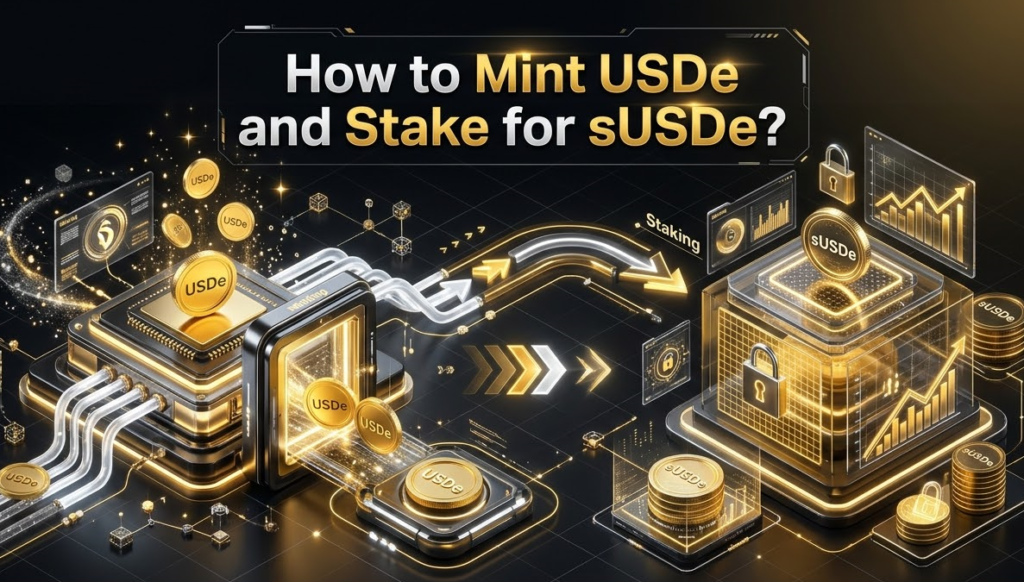
The following describes the general user journey. Actual access, eligible collateral, fees, minimum amounts, and minting or redemption requirements can change. Some minting and redemption routes may also be restricted to approved or whitelisted participants, so do not assume every wallet can mint USDe directly from any asset.
Phase One: Acquiring USDe
Step one: Visit the official Ethena interface.
Start from Ethena’s official website and follow the link to its application. Be careful with sponsored search results, copied websites, and social-media links. A fake interface can look almost identical to the real one while directing your wallet to malicious contracts.
Step two: Connect a supported wallet.
Use a wallet and network supported by the current application. Check that you are connecting to the intended website and that the wallet displays the correct network before signing anything.
Step three: Check the available acquisition route.
Depending on your location, wallet, and eligibility, you may be able to obtain USDe through a supported minting route or acquire it through a supported exchange or DeFi market. Check the current interface for eligible assets, fees, limits, and any access restrictions.
Step four: Review the transaction before confirming.
Do not assume that a displayed dollar value means you will receive exactly the same amount of USDe after fees and execution costs. Review the quote, asset, network, slippage, and destination address before approving the transaction.
Phase Two: Staking USDe into sUSDe
Step one: Open the sUSDe staking interface.
Use Ethena’s official staking route and confirm that the token and contract information match the official documentation.
Step two: Approve USDe if required.
The staking contract may need permission to transfer USDe from your wallet. Read the approval request carefully. Avoid granting unlimited token approvals to unfamiliar contracts when a smaller approval is sufficient.
Step three: Enter the amount and review the exchange rate.
The amount of sUSDe you receive depends on the current conversion rate. If sUSDe is already worth more than one USDe, you should expect to receive fewer sUSDe tokens than the number of USDe deposited.
Step four: Stake and verify the transaction.
After confirming, check the transaction status and verify that sUSDe appears in your wallet or staking interface. Do not rely solely on a wallet notification; check the transaction on the relevant block explorer if anything looks unusual.
Step five: Monitor yield and withdrawal conditions.
Track the sUSDe exchange rate and the protocol’s current reward information. Before unstaking, check the current cooldown and withdrawal rules. Ethena’s staking guide has described a seven-day cooldown, but operational parameters can change, so confirm the latest rules in the live interface before depositing.
A practical warning: never stake money you may need immediately. Even if the underlying smart contract permits unstaking, a cooldown or market-liquidity problem can delay when you can use or sell the resulting USDe.
FAQ
What Is Ethena, and How Does It Maintain Its $1 Peg?
Ethena is a synthetic dollar protocol that issues USDe, a crypto-native asset designed to track the value of one US dollar. Rather than relying exclusively on dollars held in bank accounts, USDe uses crypto collateral, liquid stablecoins, and corresponding short derivatives positions.
The short positions are designed to offset much of the price exposure from the spot collateral. This delta-neutral structure helps support the target peg, but it does not guarantee that USDe will always trade at exactly $1. Funding costs, liquidity, collateral performance, exchange failures, and other risks can affect its market price.
How Does Ethena’s Internet Bond (sUSDe) Generate Yield?
sUSDe is the yield-bearing version of USDe. Its potential revenue sources include staking rewards from eligible staked assets, funding payments or futures basis earned through derivatives positions, and rewards on liquid stablecoins.
The amount distributed to sUSDe holders can change as these revenue sources and the protocol’s allocation decisions change. Its APY is variable, not fixed or guaranteed.
Is USDe an Algorithmic Stablecoin Like Terra/UST?
No. USDe uses spot collateral and offsetting derivatives positions, while Terra’s UST relied on a reflexive mint-and-burn relationship with LUNA. These are materially different mechanisms.
However, being collateralized does not make USDe risk-free. Its stability depends on the quality and liquidity of its backing, the performance of derivatives hedges, custody and settlement infrastructure, and the protocol’s risk controls.
What Happens If Perpetual Funding Rates Turn Negative?
When funding becomes negative, short perpetual positions may have to pay funding to long traders. This reduces the income generated by the hedge and can make the derivatives strategy a cost rather than a source of revenue.
Ethena’s Protocol Reserve Fund is designed to provide an additional buffer against negative funding and other defined stress scenarios. If negative funding persists, however, the protocol may have less revenue available for sUSDe rewards. A finite reserve cannot guarantee protection against every possible loss.
How Does Ethena Protect Funds From Centralized Exchange Bankruptcies?
Ethena uses Off-Exchange Settlement providers to hold backing assets in institutional custody while enabling controlled delegation to derivatives venues. This is designed to reduce the amount of collateral directly exposed to exchange custody and facilitate recurring profit-and-loss settlement.
It does not eliminate all exchange or counterparty risk. Unsettled PnL, custodian availability, settlement disputes, operational failures, and market movements can still affect the protocol.
Can I Redeem sUSDe for USDe at Any Time?
You can generally initiate an unstaking process through the supported interface, but access to the resulting USDe may be subject to a cooldown or other withdrawal conditions. Ethena’s published staking guide has described a seven-day cooldown. Check the current interface and documentation before staking because withdrawal parameters can change.
Does Holding ENA Give Me a Share of Ethena’s Revenue?
Not automatically. ENA is primarily a governance token, and holding it does not by itself establish an unconditional contractual right to protocol revenue.
Ethena’s 2026 governance discussions introduced a proposed fee-switch and buyback framework linked to USDe supply milestones. Its practical effect depends on implementation, qualifying revenue, governance decisions, and the conditions specified in the approved mechanism. Follow the official ENA governance discussions for updates rather than assuming that every ENA holder receives a direct payment.
Is sUSDe Safer Than USDe Because It Earns Yield?
Not necessarily. sUSDe and USDe have different functions, but staking does not remove the risks of the underlying protocol. sUSDe holders remain exposed to the economic and operational risks associated with Ethena’s backing, derivatives, custody, smart contracts, and withdrawal arrangements.
In addition, sUSDe introduces its own considerations, including the staking contract, exchange-rate mechanics, and withdrawal conditions. A higher potential return should not automatically be interpreted as a safer investment.
Final Thoughts
Ethena is an interesting experiment in building dollar-oriented financial infrastructure without relying entirely on conventional bank deposits. Its central idea is straightforward: hold spot collateral, hedge its directional price exposure with short derivatives, and use the resulting portfolio to support a synthetic dollar. The more interesting part is everything that has to work around that idea—funding markets, collateral liquidity, custodians, exchanges, settlement systems, reserve management, and governance.
If you only remember one thing, remember this: USDe is not simply a dollar token with a different issuer. It is a synthetic dollar whose stability depends on a functioning derivatives and custody architecture. That architecture creates opportunities, but it also introduces risks that are different from those of traditional fiat-backed stablecoins.
sUSDe adds another layer. It gives users exposure to protocol-generated yield through an exchange-rate-based staking mechanism, but that yield is variable and depends on market conditions. When leveraged demand supports positive funding, returns may look attractive. When funding weakens or turns negative, the economics can change quickly. The Reserve Fund helps manage certain stress scenarios, but it should never be treated as an unlimited guarantee.
ENA, meanwhile, gives the ecosystem a governance and coordination layer. Its longer-term economic significance depends on how governance evolves, how effectively risk decisions are made, and whether revenue-related mechanisms are implemented in a way that supports the protocol without undermining USDe’s competitiveness.
My view is that Ethena deserves to be evaluated as a financial system, not just as another stablecoin ticker. Before using it, I would examine the latest backing composition, funding-rate environment, reserve coverage, custody arrangements, and sUSDe withdrawal terms. I would also compare its risk-adjusted returns with other yield-bearing dollar products rather than chasing the highest advertised APY.
That approach may sound less exciting than following a headline yield, but it is much more useful when you are deciding whether to hold USDe, stake into sUSDe, or take exposure to ENA.
Ethena’s opportunity is clear: it aims to create scalable crypto-native dollar infrastructure and a new way to generate dollar-denominated returns. Its challenge is equally clear: maintaining that system through negative funding, liquidity shocks, counterparty failures, and changing market conditions. Understanding both sides is the starting point for making an informed decision.