
What is USDC (USD Coin)? An overview
A simple definition for beginners
USDC, originally known as USD Coin, is a dollar-pegged stablecoin issued by Circle through its regulated affiliates.
The basic idea is wonderfully simple: 1 USDC is intended to represent 1 U.S. dollar.
That sounds almost too ordinary in crypto, but that’s precisely the point.
Bitcoin can move thousands of dollars in a single day. Ether can do the same. USDC is built for a different job. If I want to move $1,000 of dollar value across a blockchain without taking direct exposure to BTC or ETH’s price movements, a dollar-denominated stablecoin is much more practical.
Circle describes USDC as a fully reserved digital dollar that can be redeemed 1:1 for U.S. dollars. Its current USDC overview also states that reserves are held for the benefit of USDC holders and that USDC is available across a broad range of blockchain and financial applications. (Circle)
In practical terms, you can think of USDC as a bridge between traditional dollars and blockchain-based financial infrastructure.
You can use it to:
- Move dollar-denominated value between crypto wallets.
- Trade crypto without constantly converting back to bank dollars.
- Supply liquidity to DeFi protocols.
- Borrow against crypto collateral.
- Settle payments.
- Transfer funds across supported blockchain networks.
- Hold dollar exposure onchain.
- Build applications that need programmable digital money.
The “digital dollar” description is useful, but there is an important distinction.
USDC is not the U.S. dollar itself.
It is a private-sector digital token designed to maintain a one-dollar value and backed by reserve assets held by Circle for USDC holders. That means you are relying on the issuer, its reserve structure, its redemption arrangements, its regulatory framework, and the blockchain infrastructure on which the token operates.
That last part is easy to overlook.
USDC may be designed to stay near $1, but sending USDC on Ethereum is a different experience from sending it on Solana, Base, Arbitrum, or another supported network. The token’s dollar value and the blockchain’s transaction mechanics are separate things.
Circle’s current supported-chain documentation lists USDC across numerous networks, including Ethereum, Arbitrum, Base, Polygon PoS, Solana, Avalanche, OP Mainnet, Sui, Stellar, and others. (Circle Docs)
That multichain availability is a big part of why USDC has become more than a simple trading stablecoin.
The issuers: Circle and the Centre Consortium
If you look at older USDC articles, you’ll often see Circle and Coinbase’s Centre Consortium mentioned together.
That’s historically correct, but it is no longer the current structure.
Circle and Coinbase co-founded the Centre Consortium in 2018 to establish standards and governance around fiat-backed digital currencies. The original announcement from Circle describes Centre as a joint venture intended to create standards for fiat money on the internet, with USDC as its first major initiative. (Circle)
USDC launched that same year. Circle’s original announcement described it as a fiat stablecoin backed by cash reserves and pegged 1:1 to the U.S. dollar. (Circle)
But the structure changed in 2023.
Circle and Coinbase announced that Centre would no longer operate as a separate entity and that Circle would take full control of USDC issuance and governance. Coinbase remained commercially involved and took an equity stake in Circle. The two companies also continued sharing certain USDC-related interest income under their new agreement. (Circle Investor Relations)
So if you’re reading an old article that says “Centre issues USDC,” be careful with the date.
The cleaner description today is: Circle is the issuer of USDC through regulated Circle entities. Coinbase is an important commercial partner and shareholder, but it is not the issuer of USDC.
That distinction becomes particularly relevant when discussing reserve management, redemption, regulation, and who ultimately controls USDC’s smart-contract infrastructure.
Stablecoins vs. volatile assets (BTC & ETH)
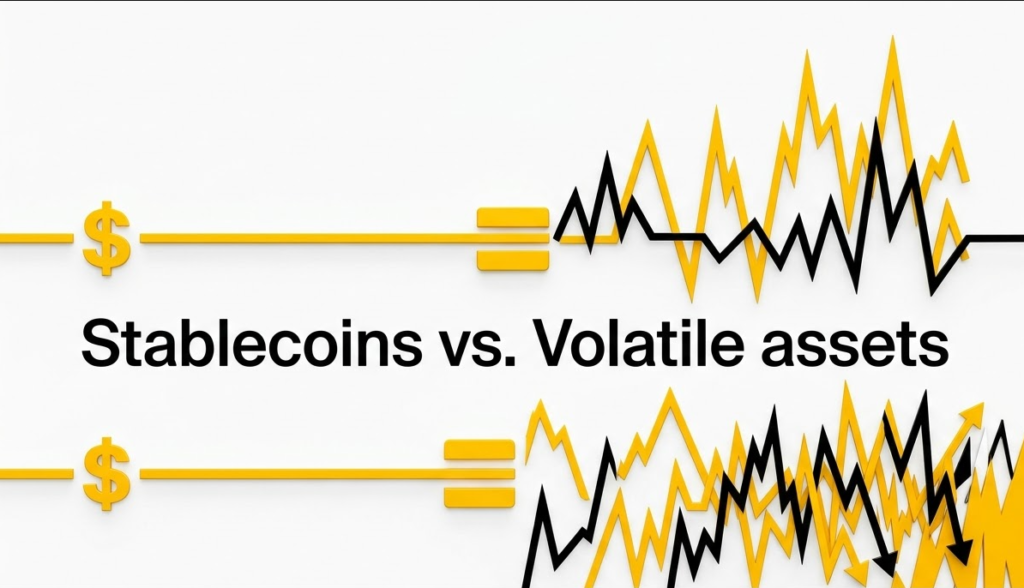
Bitcoin and Ether are excellent examples of why stablecoins exist in the first place.
Imagine you’re running a crypto lending platform.
You lend someone $10,000 worth of assets. If you denominate the loan in BTC, the dollar value can change dramatically before the borrower even makes a payment. That creates unnecessary volatility for a product that fundamentally needs a unit of account.
USDC approaches the problem differently.
If the value stays close to $1, you can use it to express:
- Loan principal.
- Trading balances.
- Merchant invoices.
- Collateral.
- Liquidity positions.
- Treasury balances.
- Cross-border settlement amounts.
That’s particularly useful in DeFi.
A decentralized lending protocol can use USDC as a unit of account without requiring the protocol to depend entirely on a volatile native token.
The same applies to Web3 commerce.
A merchant might be happy to accept $100 worth of USDC because the accounting target is obvious. Accepting $100 worth of BTC creates a different treasury problem because the value can change materially before the merchant converts it.
Of course, “stable” doesn’t mean risk-free.
USDC can trade above or below $1. It can experience temporary market stress. The issuer can freeze certain addresses under applicable legal or compliance processes. Smart contracts can contain vulnerabilities. Blockchain transactions can fail or be sent to the wrong network.
What USDC attempts to remove is the ordinary price volatility of the underlying digital asset.
That’s a very different proposition from removing every risk.
Behind the reserves: How USDC maintains its backing
Collateral breakdown: cash and U.S. Treasuries
The most important question for any fiat-backed stablecoin is painfully straightforward:
What actually backs the tokens?
Circle’s current reserve disclosure says USDC is backed by an equivalent value of U.S.-dollar-denominated reserve assets. These include cash held at regulated financial institutions and assets associated with the Circle Reserve Fund, such as short-dated U.S. Treasuries and overnight U.S. Treasury repurchase agreements. (Circle)
That is important because “100% backed” does not mean Circle keeps every dollar sitting in a checking account.
A large reserve can instead contain highly liquid assets that are designed to preserve capital and remain readily convertible to cash.
The Circle Reserve Fund is a government money market fund managed by BlackRock. Circle has described the fund as a registered Rule 2a-7 government money market fund whose portfolio consists of cash and short-dated U.S. Treasuries. (Circle)
Circle’s current transparency page provides reserve composition information and explains that Treasury securities and overnight reverse Treasury repos can be held through the Circle Reserve Fund or in appropriate custodial structures. (Circle)
This structure is quite different from simply holding a pile of speculative crypto assets and calling them collateral.
The objective is liquidity.
If a USDC holder wants dollars, the reserve assets need to be capable of supporting redemption.
Institutional custody and Wall Street partners
This is where the traditional financial system quietly enters the picture.
You have probably heard two names repeatedly in discussions around Circle’s reserves:
BlackRock and BNY Mellon.
Their roles are different.
BlackRock manages the Circle Reserve Fund. BNY Mellon serves as a major custodian for the reserve assets.
Circle announced BNY Mellon as a primary custodian for USDC reserves in 2022, describing the relationship as part of its effort to connect digital-asset infrastructure with traditional financial-market infrastructure. (Circle)
Circle subsequently expanded its relationship with BlackRock. Its description of the Circle Reserve Fund states that BlackRock manages the fund and that BNY Mellon provides custody for the fund’s assets. (Circle)
That arrangement matters for a simple reason: USDC isn’t operating in a financial vacuum.
There are banks.
There are custodians.
There are asset managers.
There are regulated entities.
There are reporting and assurance processes.
And there are blockchain smart contracts on the other side.
That combination is one of the defining characteristics of USDC.
It is a blockchain asset backed by a reserve structure that sits largely inside traditional financial infrastructure.
Monthly reserve attestation reports
This is where USDC’s transparency model gets particularly interesting.
Circle publishes reserve information and says its USDC reserves are subject to monthly attestations by Deloitte, one of the Big Four accounting firms.
Circle’s current transparency information states that monthly reserve attestations are publicly available and that Deloitte performs the relevant assurance work. (Circle)
There is a subtle but important difference between an attestation and a traditional full financial statement audit.
An attestation provides assurance over specified management assertions according to the applicable engagement. It should not automatically be interpreted as “Deloitte audits every part of Circle’s entire business every month.”
That’s why I prefer to use the exact term monthly reserve attestation rather than simply saying “monthly audit.”
For someone evaluating USDC, the practical benefit is visibility.
You can look at:
- The amount of USDC in circulation.
- The reported reserve assets.
- The composition of those reserves.
- The relevant assurance reports.
- Changes in circulation over time.
As of September 24, 2026, Circle reported approximately $75.2 billion USDC in circulation on its current USDC page. (Circle)
That number is useful, but it is also a moving target. USDC supply changes whenever tokens are minted or redeemed.
How does USDC work and maintain its $1.00 peg?
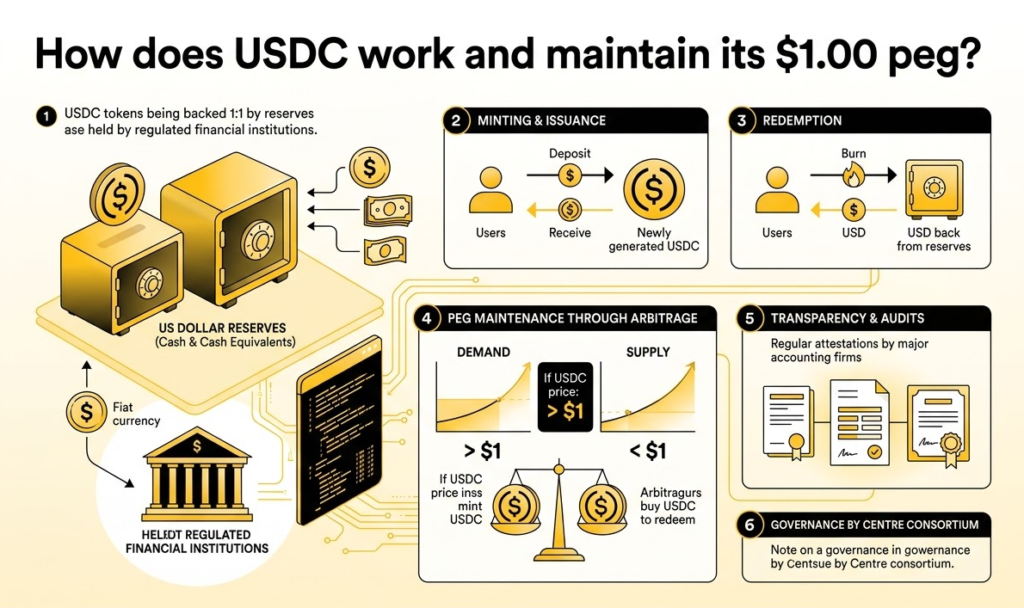
The direct minting and redemption mechanism
The cleanest way to understand USDC’s supply is to think about a two-way door.
Dollars enter → USDC is created.
USDC leaves → dollars are redeemed.
Institutional customers that meet Circle’s requirements can use Circle’s infrastructure to mint and redeem USDC. Suppose an eligible institution sends $1 million to Circle.
Circle can issue approximately 1 million USDC under the applicable minting process. Now imagine that institution wants its dollars back. It returns 1 million USDC for redemption.
The USDC is removed from circulation and the corresponding dollar value is returned according to the redemption process.
This is fundamentally different from Bitcoin’s monetary issuance schedule.
Bitcoin does not have a company sitting behind a redemption window promising to exchange your BTC for one U.S. dollar.
USDC does.
That’s one of the reasons USDC is called a centralized fiat-backed stablecoin.
The blockchain side is decentralized in the sense that anyone can interact with the public network and token contracts, but the issuance and redemption layer remains controlled by Circle and its regulated entities.
Circle’s original USDC launch documentation described this model clearly: institutions could deposit dollars, convert those dollars into USDC for blockchain use, and later redeem the tokens back into bank dollars. (Circle)
Market arbitrage dynamics
The direct mint-and-redeem system is only half the story.
The other half is the market.
USDC does not have to trade at exactly $1.000000 every second for the system to work. It can move slightly above or below $1 on exchanges. This is where arbitrage comes into play. Imagine USDC is trading at $0.999.
A trader who has access to the relevant market could buy USDC below its target value and potentially sell or redeem it closer to $1, depending on fees, liquidity, access, and settlement constraints.
Now reverse the situation. Suppose USDC trades at $1.001.
Market participants may have an incentive to obtain newly issued USDC through the minting process and sell it at the higher market price, again subject to access and transaction costs.
The simplified relationship looks like this:
| Market condition | Potential arbitrage incentive |
|---|---|
| USDC below $1 | Buy discounted USDC and sell/redeem toward $1 |
| USDC above $1 | Mint or source USDC around $1 and sell at the premium |
| USDC near $1 | Arbitrage incentive becomes smaller |
The result is a feedback mechanism.
It does not mean arbitrage magically guarantees a perfect $1 price.
During market stress, liquidity can disappear. Banking access can become constrained. Redemption can be limited to eligible users. Exchanges can price assets differently. Fees can eliminate the theoretical arbitrage opportunity.
The March 2023 banking crisis showed exactly why this distinction matters.
Native USDC vs. bridged USDC (USDC.e)
What is native USDC?
Native USDC is USDC issued directly by Circle on a supported blockchain.
That sounds like a small technical distinction until you start moving funds across Layer 2s.
It is actually one of the most important things you can learn before transferring USDC.
Circle currently supports native USDC across a large number of networks. Its supported-chain documentation lists networks including Ethereum, Arbitrum, Base, Solana, Polygon PoS, Avalanche, OP Mainnet, and many others. (Circle Docs)
The token can have the same ticker – USDC – while its contract address differs from one blockchain to another.
For example, the native USDC contract on Ethereum is not the same contract address as native USDC on Base.
That’s normal. Each blockchain has its own token contract. What matters is that Circle issued the corresponding token natively on that network.
Native USDC generally provides the cleanest relationship between:
Circle → blockchain → USDC contract → redemption infrastructure.
That’s why Circle often encourages applications to distinguish native USDC from bridged versions.
What is bridged USDC (USDC.e) and its inherent risks?
Bridged USDC is different.
Imagine Ethereum has native USDC.
A third-party bridge wants to make that value available on another blockchain.
One traditional approach is:
- Lock native USDC on Ethereum.
- Verify that deposit.
- Mint a representation on the destination chain.
- Allow users to trade or transfer that representation.
The destination token is then effectively dependent on the bridge.
Circle explicitly describes bridged USDC as a synthetic or bridged representation created when USDC is locked on one blockchain and a corresponding token is minted on another. Bridged USDC is not issued by Circle. (Circle)
This is why you’ll often see USDC.e.
The .e suffix is frequently used to identify a bridged version originating from Ethereum, although the exact naming convention depends on the network and application.
The risks are different from those of native USDC.
A bridged token can introduce:
- Bridge smart-contract risk.
- Validator or relayer risk.
- Custodial or escrow risk.
- Liquidity fragmentation.
- Contract upgrade risk.
- Operational dependencies.
- Potential confusion between similarly named tokens.
Circle’s documentation gives a practical warning: Circle Mint supports native USDC on supported chains but does not support bridged USDC.e on those networks. Sending the wrong version can result in funds becoming unrecoverable.
This is one of those crypto details that can save you from a very expensive mistake.
Never assume that “USDC” means the same token contract everywhere.
Before sending funds, check the blockchain, token name, token contract, and receiving platform’s supported version.
Native interoperability via Circle’s CCTP
What is the Cross-Chain Transfer Protocol (CCTP)?
CCTP stands for Cross-Chain Transfer Protocol.
It is Circle’s infrastructure for moving native USDC between supported blockchain networks through a burn-and-mint process.
The key word is native.
Instead of taking native USDC, locking it in a bridge, and creating a separate wrapped token, CCTP burns the USDC on the source blockchain and authorizes the corresponding amount to be minted on the destination blockchain.
Circle describes CCTP as a permissionless onchain utility, meaning developers can integrate it without needing to become a Circle customer simply to use the protocol. (Circle)
The protocol has evolved substantially.
CCTP V1 launched in 2023. CCTP V2 launched in March 2025 and became the canonical version, introducing features such as Fast Transfer and Hooks. Circle announced that CCTP V1 would enter its deprecation process in 2026. (Circle)
That matters today because an article explaining CCTP purely as the original V1 product is already outdated.
The “burn-and-mint” cross-chain model
The process is easier to understand with an example.
Suppose you have 1,000 USDC on Ethereum and want native USDC on another supported chain.
The basic CCTP flow is:
Step 1: Burn
The 1,000 USDC is burned on Ethereum.
Step 2: Attest
Circle’s attestation infrastructure observes the burn and provides the relevant authorization.
Step 3: Mint
The destination-chain transaction uses the attestation to mint 1,000 USDC for the recipient. Circle’s technical explanation of CCTP describes this source-chain burn, attestation, and destination-chain mint process. (Circle)
The advantage is that the destination token remains native USDC. There isn’t a giant pool of USDC sitting on the destination chain that a bridge must maintain simply to facilitate the transfer. This can reduce liquidity fragmentation and eliminate some of the risks associated with traditional lock-and-mint bridge designs.
It does not mean CCTP is risk-free.
You still have smart contracts, attestations, source and destination chains, wallets, transaction execution, and Circle’s infrastructure involved.
But the trust model is different.
And that difference matters.
Circle reported that CCTP had processed more than $126 billion in cumulative volume and over 6 million cross-chain transfers by December 23, 2025, illustrating how quickly the protocol had become part of the wider USDC infrastructure. (Circle)
Regulatory compliance and global licensing
MiCA compliance in the European Union
USDC’s regulatory positioning is one of the areas where its history has changed quickly.
In July 2024, Circle announced that it had become the first global stablecoin issuer to achieve compliance with the European Union’s Markets in Crypto-Assets framework, commonly known as MiCA, through its French entity.
The announcement followed Circle’s acquisition of an Electronic Money Institution license from France’s ACPR, allowing compliant issuance of USDC and EURC in the European Union. (Circle Investor Relations)
The distinction between “licensed” and “compliant” matters here.
MiCA creates a regulatory framework for crypto assets in the EU, including specific rules for stablecoins classified as e-money tokens.
Circle’s current regulatory disclosures list its French Electronic Money Institution license and, as of 2026, a Crypto-Asset Services Provider authorization from France’s AMF under MiCA. (Circle)
So if you are researching old USDC articles, you may find regulatory descriptions that are no longer complete.
Circle’s European regulatory structure has developed considerably since USDC first launched.
U.S. regulatory framework and oversight
The U.S. picture is more complicated because Circle operates through several regulated entities and licenses rather than one single “USDC license.”
Circle’s regulatory footprint includes state-level money-transmission and virtual-currency permissions as well as federal developments.
Circle says it was the first company to receive a New York BitLicense in 2015, and its current regulatory information lists a New York limited-purpose trust company charter. (Circle)
There is also an important recent development.
In July 2026, Circle announced that it had received final approval from the Office of the Comptroller of the Currency (OCC) to establish Circle National Trust, a national trust bank. Circle said the bank would provide federally regulated digital-asset custody and could eventually support management of the USDC Reserve under its approved business plan. (Circle Investor Relations)
Circle’s regulatory disclosures also identify its U.S. money-transmission activities and FinCEN registration through the relevant entities.
The practical lesson is that “USDC is regulated” is too broad to be a useful statement by itself.
A better question is:
Which Circle entity, which activity, and which jurisdiction?
Licensing for money transmission, custody, stablecoin issuance, banking, and crypto-asset services are different things.
That distinction becomes increasingly important as stablecoins move closer to mainstream financial infrastructure.
USDC vs. Tether (USDT): Key differences
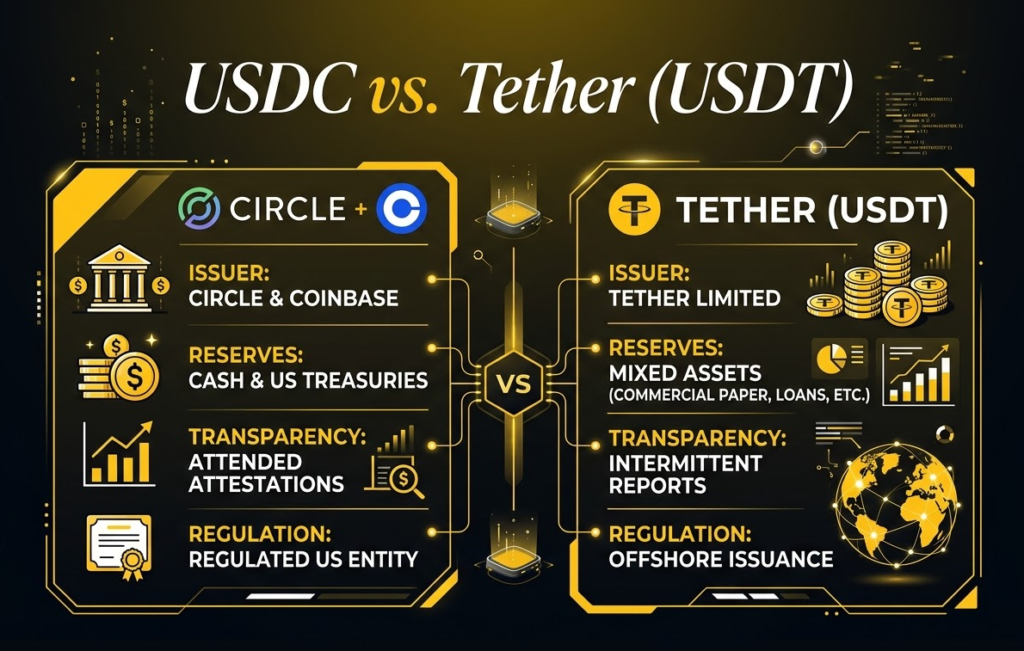
Reserve transparency and custody models
USDC and USDT are the two dominant dollar stablecoins, but they have developed under different corporate and regulatory structures.
USDC is issued by Circle.
USDT is issued by Tether.
Both aim to maintain a 1:1 relationship with the U.S. dollar and both rely on reserve assets.
But the reserve reporting and corporate structures differ.
Circle publishes monthly USDC reserve attestations and provides detailed reserve disclosures through its transparency page. Circle also identifies BlackRock as manager of the Circle Reserve Fund and BNY Mellon as a major custodian. (Circle)
Tether has its own reserve reporting and assurance framework.
The comparison therefore isn’t simply: “USDC is transparent and USDT isn’t.”
That is too simplistic.
A better comparison is to look at what information each issuer publishes, how frequently it is reported, what assets are included, who provides assurance, how redemption works, and what regulatory structure applies to the issuer in the jurisdiction you’re using it in.
Those are measurable differences.
Market dominance: DeFi collateral vs. CEX liquidity
The other major difference is where each stablecoin is used.
Current market data shows USDT remains substantially larger by market capitalization. DeFiLlama’s current stablecoin dashboard shows approximately $184 billion USDT compared with roughly $74 billion USDC, with USDT accounting for about 60% of total stablecoin market capitalization at the time of retrieval. (DefiLlama)
But market capitalization alone doesn’t tell the whole story.
A July 2026 study from the Andersen Institute, using DeFiLlama data, found that USDT had approximately $61.5 billion located at centralized exchanges, compared with about $10.1 billion for USDC on July 28, 2026. The same analysis found approximately $12.0 billion USDC in lending protocols versus $6.9 billion USDT. (Andersen Institute)
That helps explain why people sometimes describe USDT as the dominant trading stablecoin while USDC has a particularly strong presence in DeFi.
But even that needs a little caution.
The distribution changes constantly.
Exchange balances move.
Lending positions change.
Bridges migrate liquidity.
New chains launch.
Stablecoin issuers add native deployments.
So I wouldn’t use “USDC is for DeFi and USDT is for exchanges” as a rigid rule.
Instead, think of it as a current market pattern.
| Area | USDC | USDT |
|---|---|---|
| Issuer | Circle | Tether |
| Dollar peg | 1:1 target | 1:1 target |
| Current market size | Smaller | Larger |
| Reserve disclosure | Monthly attestations and public reserve data | Regular reserve reporting and assurance |
| Institutional/regulatory positioning | Strong presence in regulated markets | Broad global market presence |
| DeFi presence | Significant | Significant |
| Centralized exchange liquidity | Strong | Generally deeper |
| Native multichain infrastructure | Extensive | Extensive |
| Cross-chain Circle infrastructure | CCTP | Tether uses its own ecosystem and integrations |
The most useful choice often comes down to the specific blockchain, exchange, protocol, jurisdiction, and recipient you’re dealing with.
Frequently asked questions
How does Circle generate revenue from USDC?
Circle earns revenue primarily from income generated by the reserve assets backing USDC, with economics also shared with distribution partners under commercial arrangements. Circle and Coinbase have explicitly described sharing interest income generated from USDC reserves and broader distribution and usage. (Circle Investor Relations)
What was the March 2023 SVB depeg event and how was it resolved?
USDC temporarily lost its $1 peg after Circle disclosed that $3.3 billion, around 8% of its reserves at the time, was held at Silicon Valley Bank. After U.S. regulators announced that SVB depositors would be made whole, Circle said the reserve deposit would become fully available and that USDC remained redeemable 1:1. (Circle)
The episode is worth remembering because it exposed a risk that is easy to miss: even a fully reserved stablecoin can be affected by the traditional banking system holding part of its reserves.
At the time, Circle said 77% of the reserve, or about $32.4 billion, was held in short-dated U.S. Treasury bills, while roughly $9.7 billion was the cash component. (Circle)
What is the difference between native USDC and USDC.e on Layer 2s?
Native USDC is issued directly by Circle on the relevant blockchain, while USDC.e is generally a bridged representation created through a third-party bridge. Circle explicitly warns users to distinguish native USDC from bridged versions because Circle Mint may not support USDC.e on a given network. (Circle)
How do I safely purchase, store, and transfer USDC?
First, verify the exact blockchain and token contract supported by the receiving platform. For larger balances, use a reputable self-custody or hardware wallet, protect your seed phrase, and double-check the destination address and network before confirming a transaction.
When transferring USDC, I would always check these five things before clicking send:
- Network: Ethereum, Base, Arbitrum, Solana, Polygon, or another supported chain.
- Token version: Native USDC or bridged USDC.e.
- Contract address: Particularly important when interacting with DeFi.
- Receiving platform: Confirm that it accepts USDC on that exact network.
- Gas: Make sure you have enough of the network’s native gas asset to complete the transaction.
A five-second check here can save you hours of trying to recover funds later.
Conclusion: The role of USDC in the future of global finance
USDC started with a straightforward idea: take the U.S. dollar and make it usable on public blockchains.
That idea has grown considerably.
Today, USDC sits between two financial systems.
On one side, you have traditional infrastructure: banks, custodians, Treasury securities, regulated entities, accounting firms, and financial licenses.
On the other side, you have blockchains, smart contracts, DeFi protocols, wallets, exchanges, bridges, and programmable applications.
USDC connects those two environments.
That’s why I think looking at USDC purely as a “stable cryptocurrency” misses the bigger picture.
The token itself is relatively simple. The infrastructure behind it is not.
Circle manages a reserve system designed to support 1:1 redemption. BlackRock manages the Circle Reserve Fund, while BNY Mellon plays a major custodial role. Deloitte provides monthly reserve attestations. Circle has built regulatory relationships across multiple jurisdictions. And the company continues expanding native USDC deployments across blockchain networks. (Circle)
Then there is CCTP.
Instead of creating another wrapped representation every time USDC moves between chains, CCTP allows native USDC to be burned on one network and minted on another. That approach directly addresses one of the biggest problems created by the multichain era: fragmented liquidity.
The market numbers show why all of this matters.
As of September 24, 2026, Circle reported about $75.2 billion USDC in circulation. DeFiLlama currently places USDC at roughly $74 billion in market capitalization, while USDT remains considerably larger at roughly $184 billion. (Circle)
So USDC is not the largest dollar stablecoin by supply.
But size alone isn’t the entire story.
USDC has become deeply integrated into DeFi, institutional settlement, cross-chain infrastructure, payments, and programmable financial applications. Circle’s own 2026 reporting says USDC had supported more than $70 trillion in cumulative onchain settlement as of March 25, 2026, although that figure is a company-reported cumulative metric rather than an independent market-wide measurement. (Circle Investor Relations)
That distinction is worth keeping in mind.
USDC still has risks.
Circle is a centralized issuer. Redemption depends on the issuer and its banking and regulatory infrastructure. USDC can temporarily trade away from $1. Blockchain transactions can fail. Smart contracts can contain vulnerabilities. Regulatory requirements can change. And choosing the wrong network or token version can result in lost funds.
The March 2023 SVB episode was a useful reminder of another reality: stablecoin risk does not disappear simply because the token is backed by reserves. The institutions holding and managing those reserves still matter.
For me, the most useful way to understand USDC is therefore simple:
USDC is a blockchain-native representation of dollar value, backed by traditional financial reserves and built to move through programmable, multichain infrastructure.
Bitcoin was created to rethink money without a central issuer.
USDC takes almost the opposite route.
It keeps the familiar dollar, keeps a centralized issuer and reserve system, and changes the rail on which that dollar can move.
That difference is exactly why USDC has found such a large role in Web3 – and why its future is likely to depend as much on regulation, payments infrastructure, institutional adoption, and cross-chain interoperability as it does on crypto trading itself.