
KuCoin legitimacy, solvency and safety scorecard
When someone asks me whether KuCoin is legit, I think it helps to separate several questions that often get bundled together. Is it a real exchange? Does it provide evidence of asset backing? Has it suffered a security incident? Can you legally use its services where you live? And, if something goes wrong, how much control do you have over your money?
Those questions have different answers. KuCoin has been operating since 2017 and reported more than 38 million users in its 2024 annual review. It publishes reserve information and offers a range of account-security features. But its operator also faced serious US enforcement action, and KuCoin is not available to everyone in every jurisdiction.
| Metric | What the available evidence shows |
|---|---|
| Platform legitimacy | KuCoin is an operating centralized cryptocurrency exchange, not an anonymous website that appeared overnight. Its existence and operating history do not guarantee the safety of every product or transaction. |
| Corporate and operating structure | KuCoin has used multiple legal entities. The US criminal case identified Peken Global Limited, a Seychelles-based entity, as the operator of KuCoin involved in that case. The contracting entity for your account may depend on the service and region. |
| Latest Proof of Reserves snapshot | KuCoin’s official page displays data dated September 30, 2026. The reported reserve ratios are 109% for BTC, 117% for ETH, 110% for USDT and 127% for USDC. |
| 2020 security incident | KuCoin disclosed a hot-wallet breach on September 26, 2020. It later reported recovering funds through industry partners and law-enforcement cooperation, with the remaining amount covered by the company and its insurance fund. |
| KYC requirements | New users must complete identity verification to use KuCoin products and services. Some legacy accounts have limited withdrawal and position-closing access, so it is inaccurate to say that every unverified account is unable to withdraw. |
| US regulatory case | In January 2025, Peken Global Limited pleaded guilty to operating an unlicensed money-transmitting business and agreed to penalties exceeding $297 million. KuCoin also agreed to leave the US market for at least two years. |
| Geographic restrictions | KuCoin restricts access in a number of countries and regions, including the United States, Canada, Mainland China and Singapore under relevant platform or product terms. The precise list can vary by service and must be checked against the current terms. |
| Security tools | KuCoin provides an Official Verification Center, anti-phishing features and account-security settings. The KuCoin Web3 Wallet is a separate non-custodial product with a different custody model from the centralized exchange. |
For the latest reserve figures, use KuCoin’s official Proof of Reserves page. For the regulatory case, the most important primary source is the US Department of Justice announcement dated January 27, 2025. KuCoin’s own 2024 annual review provides the company’s user-count figure.
My assessment is that KuCoin has meaningful evidence of operational legitimacy and has taken steps to improve transparency since the 2020 hack. But “legitimate” is not the same as “safe for every user,” and neither term should be confused with having permission to operate in every country. If you plan to use KuCoin, your location, custody needs and tolerance for account-access risk matter as much as the exchange’s reserve ratios.
The 2020 security incident and user reimbursement
What happened in the September 2020 hot-wallet breach?
KuCoin’s security history cannot be assessed honestly without discussing September 2020. On September 26, the exchange detected unusual transfers involving Bitcoin, Ether and multiple ERC-20 tokens from its hot wallets. Its initial security update said that some assets had been transferred out of the exchange and that its cold wallets remained safe.
In a later account of the incident, KuCoin put the total value of affected assets at approximately $285 million, based on market prices at the time. The company said the attackers obtained access through a compromise involving the backup image of the affected hot wallets. KuCoin suspended deposits and withdrawals while it investigated, replaced the affected wallet system and worked with blockchain projects, exchanges and law enforcement.
You can read the original September 26, 2020 security incident update and KuCoin co-founder Johnny Lyu’s later account of the incident and recovery.
The distinction between hot and cold wallets is worth understanding here. A hot wallet is connected to systems used to process routine transactions, which makes it practical for deposits and withdrawals but also exposes it to a different set of online threats. Cold storage keeps private keys offline or otherwise separated from routine internet-facing systems. That separation can reduce exposure, but it does not make an exchange invulnerable: the 2020 incident showed how a compromise in the hot-wallet environment could still lead to a large loss.
The breach also illustrates why I am cautious about broad claims such as “the exchange has never been hacked.” KuCoin did suffer a major security incident. The more useful question is how the company responded, what was recovered, what was changed, and what the incident tells us about the risks of keeping assets with a centralized custodian.
How KuCoin says it covered the affected user assets
KuCoin described its response as a combination of on-chain recovery, cooperation with blockchain projects and law enforcement, and coverage of the remaining shortfall through its insurance fund.
According to the company’s retrospective, it recovered approximately $222 million, or 78%, through cooperation with exchanges, projects and other industry partners. It reported another $17.45 million, or 6%, recovered through law-enforcement cooperation. The remaining approximately $45.55 million, or 16%, was covered by KuCoin and its insurance fund.
| Recovery channel | Amount reported by KuCoin | Share of the original loss |
|---|---|---|
| Recovery with exchanges, projects and industry partners | About $222 million | 78% |
| Recovery through law-enforcement cooperation | About $17.45 million | 6% |
| Coverage by KuCoin and its insurance fund | About $45.55 million | 16% |
| Total | About $285 million | 100% |
These figures come from KuCoin’s own retrospective, so they should be attributed to the company rather than presented as an independent forensic audit. KuCoin stated that no users ultimately suffered a loss from the incident because the recovered funds and company/insurance-fund coverage made up the shortfall.
That outcome is significant. A large exchange hack can leave customers facing uncertainty about whether they will ever get their assets back. KuCoin’s stated response was to take responsibility for the affected balances, pursue recovery and cover the remainder. The exchange also said it replaced the compromised hot-wallet system and strengthened risk controls.
But there is a difference between saying that KuCoin covered the losses from this particular incident and claiming that users are guaranteed reimbursement after any future incident. The first is a historical statement supported by the company’s account. The second would require a much broader contractual guarantee, and the 2020 response does not establish one.
I would treat the incident as both a positive and a negative in the trust assessment. The breach itself demonstrates that a large platform can suffer serious operational-security failures. The recovery demonstrates that KuCoin took steps to address the resulting losses. Neither fact cancels out the other.
What the 2020 incident tells you about exchange security today
A security response should be judged on more than whether the company eventually restored customer balances. It is also worth asking how the incident occurred, whether the platform disclosed what happened, how it changed its controls, and what evidence exists that those controls continue to operate.
When reviewing KuCoin’s current security claims, I would look for:
- Incident transparency: Does the company publish specific details about a major event, including what was affected and what response followed?
- Recovery accountability: Does the company explain how affected assets were recovered or covered, rather than using vague language about “protecting users”?
- Changes to security controls: Has the company described concrete changes to wallet infrastructure, monitoring or withdrawal risk controls?
- Current evidence: Are recent reserve reports, security settings and official communications available for users to review?
The 2020 incident provides a documented case study, but it cannot prove that the same class of incident is impossible today. Security architecture changes over time, threats change too, and no centralized exchange can promise zero risk.
Is KuCoin safe to store crypto? Merkle-tree Proof of Reserves and cold storage
Monthly Proof of Reserves: What the latest figures show
KuCoin publishes Proof of Reserves reports that allow customers to compare the platform’s reported wallet assets with the liabilities it says it owes users. The process uses a Merkle tree to organise account-balance information into a cryptographic structure, while on-chain wallet information allows users to inspect the assets included in the reserve calculation.
The latest snapshot currently displayed on KuCoin’s official Proof of Reserves page is dated September 30, 2026. The page reports these ratios:
| Asset | Customer liabilities reported by KuCoin | Wallet assets reported by KuCoin | Reserve ratio |
|---|---|---|---|
| BTC | 7,358.6669 BTC | 7,994.3664 BTC | 109% |
| ETH | 99,131.5384 ETH | 115,905.4647 ETH | 117% |
| USDT | 965,449,021.59 USDT | 1,057,452,810.48 USDT | 110% |
| USDC | 79,789,664.75 USDC | 101,094,761.90 USDC | 127% |
Source: KuCoin’s September 30, 2026 snapshot, published on its official Proof of Reserves page. Figures are reproduced from the exchange’s displayed data and may change in subsequent reports.
The ratios are above 100% for all four listed assets. In simple terms, KuCoin reported holding more of each asset in the covered wallets than the corresponding user liabilities in the snapshot. That is useful evidence, particularly when you can inspect the underlying wallet information and verify your own inclusion in the liability data.
However, the latest report available at the time of writing is the September snapshot, not an October snapshot. I would rather use a dated, verifiable report than repeat an older percentage as if it were a live guarantee.
How Merkle-tree verification works
A Merkle tree is a data structure that combines many individual records into a single cryptographic summary, commonly called a Merkle root. If a record changes, the resulting cryptographic structure changes too. This makes the technique useful for checking whether an individual account balance was included in a larger set of liabilities without publishing a complete list of customer balances.
KuCoin says users can verify their own asset data through its reserve-verification process. The general workflow is:
- Check the snapshot date and the assets covered by the report.
- Sign in through KuCoin’s official website and open the account-asset verification function.
- Follow the published instructions to obtain the relevant verification information.
- Compare the account data with the Merkle-tree proof supplied by the platform.
- Review the disclosed wallet addresses and reserve calculations rather than relying solely on a percentage in a headline.
Use the instructions on the official PoR page rather than a third-party website asking for your login credentials or recovery phrase. A verification tool should not require you to disclose your password, authenticator code or wallet seed phrase to an unknown service.
What a reserve ratio above 100% does not prove
A reserve ratio is useful, but it does not answer every question about an exchange’s financial condition. This is one of the most important distinctions in the entire “Is KuCoin safe?” discussion.
Proof of Reserves is not automatically a complete audit of the exchange’s balance sheet. A reserve snapshot does not, by itself, prove that every liability has been included, that all off-chain obligations have been accounted for, or that the company has no debts outside the assets covered by the report. Nor does it establish that every withdrawal will be processed immediately during a market crisis.
A report also has a timestamp. Assets can move after the snapshot, customer balances can change, and reserve ratios can fluctuate. A ratio above 100% in September is evidence about the covered assets at that point in time, not a promise about the exchange’s position on every subsequent day.
When I assess an exchange’s solvency disclosures, I look at three separate questions:
| Question | What the evidence can tell you |
|---|---|
| Does the platform show on-chain assets? | Published wallet addresses allow users to inspect the reported holdings on the relevant blockchains. |
| Are customer liabilities represented? | Merkle-tree verification can help users check whether their account balances are included in the reported liability set. |
| Is the whole business financially sound? | PoR alone cannot establish this. Broader liabilities, legal obligations, operations, governance and other financial information also matter. |
KuCoin’s reserve reports are a positive transparency signal. They should form one part of your assessment, alongside its regulatory history, account-security controls and custody model.
Cold storage, multi-signature controls and withdrawal monitoring
KuCoin describes a security architecture that uses hot and cold wallets, access controls and transaction-risk monitoring. The basic logic is straightforward: an exchange needs some assets readily available to process customer activity, while other assets can be held in more isolated storage to reduce their exposure to internet-facing systems.
Multi-signature arrangements can require more than one authorised key or approval before certain transactions are executed. This can reduce the risk associated with a single compromised key, although the protection depends on how the system is implemented and managed.
Withdrawal monitoring adds another layer. An exchange may examine transaction patterns, account changes and other risk indicators before allowing a transfer to proceed. Such controls can help prevent unauthorised withdrawals, but they can also lead to additional checks when a legitimate transaction looks unusual to the system.
I would not assume that every KuCoin wallet uses exactly the same storage arrangement or that every withdrawal passes through an identical set of controls. Public descriptions of an exchange’s security architecture rarely reveal every internal detail. The appropriate conclusion is that wallet separation, multi-signature controls and monitoring are useful security measures, not proof that a future compromise is impossible.
You can improve your own security by enabling two-factor authentication, setting an anti-phishing code, using a unique password and checking withdrawal details carefully. For large balances, it is also sensible to consider whether all your assets need to remain on a centralized exchange.
KuCoin exchange accounts versus the KuCoin Web3 Wallet
There is an important difference between holding assets in a centralized exchange account and holding them in the KuCoin Web3 Wallet.
On the centralized exchange, KuCoin controls the custody infrastructure used to hold assets and process trading and withdrawals. You access your account through the platform and rely on its systems to execute transactions. Your balance in the exchange interface is not the same as independently controlling a private key on a blockchain.
The KuCoin Web3 Wallet, by contrast, is described by KuCoin as a non-custodial wallet. According to its official wallet introduction, users control their private keys and recovery phrase. That changes who is responsible for protecting the assets.
| Feature | Centralized KuCoin exchange | KuCoin Web3 Wallet |
|---|---|---|
| Who controls the custody infrastructure? | KuCoin controls the exchange’s custody systems. | The user controls the wallet’s private keys or recovery phrase. |
| How are transactions processed? | Through KuCoin’s platform and exchange systems. | Through blockchain transactions and connected protocols or applications. |
| Can the platform restrict account access? | Yes, account access or services may be limited under the terms and applicable laws. | The wallet provider does not hold custody of the user’s private keys, but access to the app or connected services can still be interrupted. |
| Who is responsible for key security? | KuCoin is responsible for its custody systems; the user is responsible for account credentials and security settings. | The user is responsible for backing up and protecting the private keys and recovery phrase. |
| Main risks | Exchange insolvency, operational failures, regulatory restrictions, account compromises and withdrawal delays. | Lost or stolen keys, phishing, malicious smart contracts, incorrect transfers and other on-chain risks. |
Self-custody removes the need to trust an exchange to hold your private keys, but it is not automatically safer for everyone. If you lose your recovery phrase and have no backup, the wallet provider may be unable to restore access. If a scammer obtains the phrase, they can control the wallet’s assets.
KuCoin’s own Web3 Wallet recovery guidance explains the importance of backing up the recovery phrase and keeping it private. Never enter that phrase into a website claiming to verify your exchange account or recover a frozen centralized-exchange balance.
Where is KuCoin prohibited?
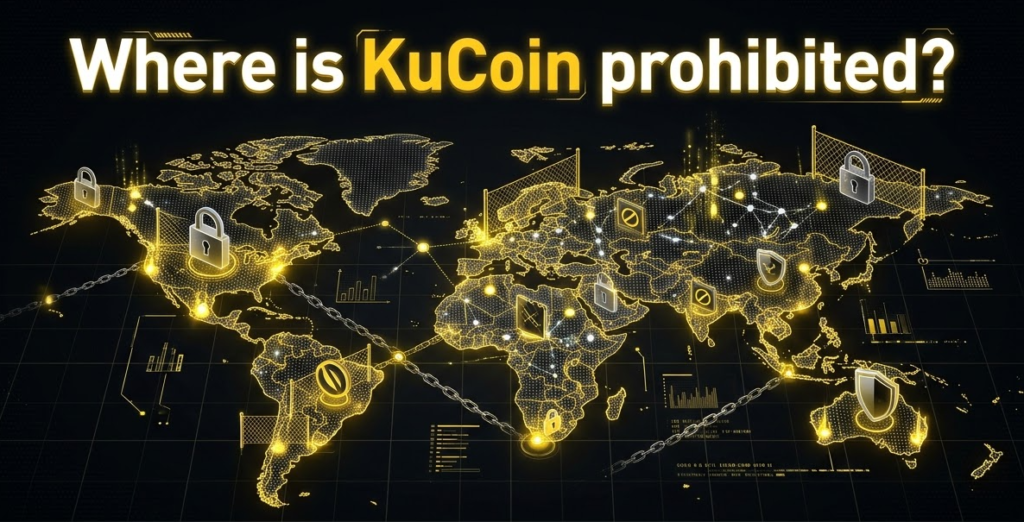
Offshore structure versus regulatory enforcement
KuCoin’s global brand should not be confused with a single worldwide licence. Cryptocurrency exchanges often use different corporate entities for different activities, and the company named in a regulatory case may differ from the entity listed in your account agreement.
The most significant recent legal development for KuCoin’s US market was the federal case announced in January 2025.
On January 27, 2025, the US Department of Justice announced that Peken Global Limited, a Seychelles-based entity that had operated KuCoin, pleaded guilty to one count of operating an unlicensed money-transmitting business. The company agreed to monetary penalties totalling more than $297 million, including approximately $112.9 million in criminal fines and $184.5 million in forfeiture. The DOJ said KuCoin had failed to implement effective anti-money-laundering and KYC controls and had not registered with the US Treasury’s Financial Crimes Enforcement Network as required.
The settlement also required KuCoin to leave the US market for at least two years. The DOJ’s official announcement provides the details.
This was not simply a social-media allegation or an anonymous customer complaint. It was a formal criminal case that ended in a guilty plea by the operating entity. That fact deserves more weight in a trust assessment than a marketing claim about global popularity.
KuCoin published its own statement following the DOJ resolution, saying that it had resolved the matter and was strengthening its compliance programme. The company’s statement is relevant for understanding its position, but the DOJ’s record is the primary source for the legal outcome.
For US residents, the practical implication is clear: do not assume that KuCoin’s international website or mobile app makes its services available to you. The settlement required a US market exit for at least two years from January 2025. At the time of writing, that period has not yet elapsed, and the existence of a settlement does not itself establish that KuCoin has obtained all approvals needed to return.
What about Canada?
Canada also appears in KuCoin’s restricted-market information. The precise restrictions and legal requirements can differ by province, service and product, so I would check both KuCoin’s current terms and the relevant Canadian securities regulator before assuming that an account can be opened or maintained.
KuCoin’s Terms of Use explain that services may be restricted or prohibited based on location, including IP addresses associated with restricted jurisdictions. The terms also reserve the right to monitor access locations and limit or terminate services to meet regulatory obligations.
For Canada, the key point is not simply whether the website loads. A user must consider whether KuCoin is accepting customers from their province, whether the relevant service is permitted and whether the exchange’s current restrictions apply to existing accounts as well as new registrations.
Restricted countries and regions
The exact restrictions can change, and some limitations apply to particular products rather than every part of the platform. KuCoin also publishes product-specific exclusion lists, which can be broader than the list used for general account access. For that reason, a single list copied from an old blog post is not reliable enough to establish eligibility in 2026.
KuCoin’s terms and product notices identify restrictions affecting jurisdictions that include the following:
| Region | Examples of restrictions to check |
|---|---|
| North America | United States and Canada |
| Asia-Pacific | Mainland China and Singapore |
| Sanctioned or high-risk jurisdictions | Iran, Syria, North Korea, Cuba and other jurisdictions subject to applicable restrictions |
| Territories and regions | Crimea and certain other restricted territories, depending on the applicable terms |
| Other markets | Additional countries may be excluded from specific products, promotions or trading services. |
This is a practical overview, not a complete or permanent list. For example, a country excluded from a token sale or promotional event is not necessarily excluded from every exchange service on the same basis. Always read the relevant terms for the product you intend to use.
Do not try to bypass a geographic restriction with a VPN. A VPN can change the IP address visible to the platform, but it does not change your legal residence or remove a contractual restriction. KuCoin’s terms reserve the right to monitor IP addresses and limit services where required for regulatory compliance. Attempting to hide your location can make account verification and access to your funds more complicated.
If you have moved to another country, contact official support and ask how to update your residence details before continuing to trade. If your location is prohibited, use a service authorised to accept customers there rather than risking an account closure.
Why KuCoin accounts get locked
Myth: KuCoin still allows no-KYC trading
KuCoin has required identity verification since November 1, 2018, according to its official identity-verification guide. The platform introduced a stricter verification framework for new users in August 2023.
The current rules do not support the blanket claim that anyone can freely open a new account, trade anonymously and withdraw without identity checks. KuCoin says new users must complete identity verification to use its products and services.
There is a nuance, however. KuCoin’s guide says that users who registered before August 31, 2023, but had not completed standard verification were left with access to certain remaining services, including selling crypto, closing futures contracts, closing margin positions and redeeming from KuCoin Earn. It also says withdrawal services were not affected for those legacy accounts, although deposits and broader access were restricted.
That means two claims should be avoided:
- “KuCoin allows everyone to trade without KYC.” This is outdated and misleading.
- “Every unverified account is unable to withdraw.” That is also too broad because KuCoin’s published guidance distinguishes legacy accounts and the services they may retain.
The safest approach is to check your own verification status and the current rules for your country before depositing funds. Do not assume that a legacy-account exception applies to a new registration.
Why using a VPN from a restricted region is risky
Some users try to register with a VPN because the exchange website is inaccessible from their country. That can appear to work initially, but it does not establish eligibility to use the platform.
KuCoin’s Terms of Use say access may be restricted based on location, including IP addresses associated with restricted jurisdictions. The platform reserves the right to monitor access locations and take compliance-related action.
If the IP address suggests one country while your identity documents or other account details show another, the platform may request further verification or limit services. That is not proof that every IP mismatch automatically causes an account freeze, but it is a risk worth taking seriously.
I would not recommend using a VPN to circumvent restrictions in the US, Canada or any other prohibited jurisdiction. If you need access because you have genuinely relocated, ask KuCoin how to update your residence information and whether the services you want to use are available in your new location.
Understanding withdrawal holds and “abnormal activity” reviews
An unexpected withdrawal hold is stressful, especially when the funds are needed urgently. But it is important to distinguish between a security review, a contractual restriction and a situation where the exchange may be unable or unwilling to return assets.
Possible reasons for a review include:
- Password or 2FA changes: Platforms may apply temporary withdrawal holds after sensitive security settings are changed to reduce the risk of an attacker taking over an account and immediately removing funds.
- Identity-verification issues: Expired documents, inconsistent personal information or a request for additional KYC evidence can delay account actions.
- Location restrictions: Access from a prohibited jurisdiction or inconsistent residence information may lead to account limitations.
- Suspicious transactions: Transfers that trigger anti-money-laundering or fraud controls may require additional review.
- P2P or payment disputes: Disputed payments or potentially fraudulent transaction patterns can prompt further investigation.
- Account compromise: Unusual login behaviour or unauthorised changes may cause the platform to restrict activity while it investigates.
These are common categories of exchange risk, not a confirmed list of KuCoin’s internal triggers. KuCoin does not publicly disclose every rule used by its automated risk systems, so claims that a specific trading strategy will always result in a freeze should be treated cautiously.
If you encounter a restriction, use the official support channel, keep the case number and ask which action is required to resolve the issue. Save transaction IDs, screenshots, deposit records and any written explanation you receive. Do not send extra crypto to an unofficial “recovery specialist,” and never share your password, verification code or seed phrase.
Short withdrawal holds after account-security changes
A temporary withdrawal hold after changing a password or resetting two-factor authentication is different from an indefinite account restriction. Exchanges may apply a cooling-off period after security-sensitive changes so that an attacker who has stolen login credentials cannot immediately redirect funds.
The duration and applicable conditions can vary. Do not assume that every KuCoin account has the same 24-hour hold, and do not rely on an old guide that gives a fixed timeframe without linking to the current policy.
Before changing security settings, read the warning displayed in your account. If a withdrawal hold is applied, note when it began and whether the platform has requested any additional action. If the stated waiting period passes without resolution, contact official support through a verified channel.
How KuCoin’s protections fit together
The following map illustrates the relationship between KuCoin’s exchange, reserve disclosures, security controls and regulatory restrictions. It is a conceptual summary, not a complete technical diagram of the company’s internal systems.
Global crypto trader
        |
        |-- Trades through the centralized exchange
        |          |
        |          |-- Account access depends on KYC and eligibility
        |          |-- Exchange custody and withdrawal controls
        |          |-- Trading and liquidation risks
        |
        |-- Checks solvency evidence
        |          |
        |          |-- Monthly Proof of Reserves snapshots
        |          |-- Merkle-tree liability verification
        |          |-- On-chain wallet disclosures
        |
        |-- Protects account access
        |          |
        |          |-- Two-factor authentication
        |          |-- Anti-phishing code
        |          |-- Official Verification Center
        |
        |-- Assesses legal availability
                   |
                   |-- US DOJ case and market exit
                   |-- Country and product restrictions
                   |-- Local licensing and compliance rules

KuCoin Web3 Wallet
        |
        |-- Separate non-custodial product
        |-- User controls private keys and recovery phrase
        |-- User bears responsibility for key backup and on-chain transactions
The key distinction is that each layer addresses a different risk. Proof of Reserves helps users examine reported backing for covered assets. Account-security controls reduce the chance of unauthorised access. Geographic restrictions reflect contractual and legal boundaries. The Web3 Wallet shifts custody responsibility to the user rather than eliminating risk.
Step-by-step guide: Complete KuCoin KYC and verify official contacts
If you intend to use KuCoin and your location is eligible, completing identity verification and learning how to check official communications can reduce avoidable account problems. The steps below follow KuCoin’s published process, although the exact screens and document options may differ by region and account status.
Phase 1: Complete identity verification
Step 1: Access the official KuCoin website or app.
Start from the official KuCoin website or an app downloaded through a trusted channel. Check the URL carefully before entering your password or uploading identity documents.
Step 2: Open Identity Verification.
Sign in and navigate to the account’s KYC or Identity Verification section. Read the requirements shown for your location. If you are in a prohibited jurisdiction, do not attempt to register using another country’s details.
Step 3: Submit a supported government-issued document.
Select one of the document types accepted by the current verification flow, such as a passport, national ID card or driver’s licence where supported. Make sure the document is valid and the photo is clear. The information should match your account details.
Step 4: Complete the facial verification or liveness check.
Follow the on-screen instructions if the process requests a selfie or face-verification scan. Use a device with a working camera and good lighting. If verification fails, check the reason shown by KuCoin before submitting again.
Step 5: Confirm the verification result.
Wait for the platform to confirm your status. Check whether the features you need are available, rather than assuming that completing KYC automatically grants access to every product. Regional restrictions and product-specific rules still apply.
For the latest instructions, use KuCoin’s official identity-verification guide.
Phase 2: Verify URLs and contacts through the Official Verification Center
Step 1: Open the official verification page.
Go directly to KuCoin’s Official Verification Center. Avoid using a link sent by the suspicious account you are trying to check.
Step 2: Choose the type of information to verify.
KuCoin’s tool supports checks for official wallet addresses, email addresses, Telegram IDs, X accounts, websites and other contact information. Select the appropriate category and enter the full identifier.
Step 3: Review the result carefully.
Compare the result with the website or account contacting you. If the source cannot be verified, do not share account details or send crypto to it. A display name, profile picture or claim to be an employee is not sufficient proof of authenticity.
Step 4: Use account-security features.
Enable two-factor authentication and set an anti-phishing code if available. Use a unique password and keep recovery information secure. Do not disclose verification codes to a person claiming to be support.
Step 5: Treat urgent payment requests as a warning sign.
A message claiming your account will be permanently frozen unless you transfer crypto to a “security wallet” is a serious red flag. KuCoin’s verification tools can help check the source, but you should also examine the request itself. Never send assets to an address supplied by an unverified contact as a condition of “unlocking” your account.
Frequently asked questions
Is KuCoin a legitimate cryptocurrency exchange or a scam?
KuCoin is an operating cryptocurrency exchange with a history dating back to 2017. It publishes Proof of Reserves data and has documented its response to the September 2020 hot-wallet breach. Those facts support describing it as a real exchange rather than a simple scam website. However, legitimacy does not guarantee that every product is safe or legally available in every country. Its US criminal case and regional restrictions are material considerations.
Has KuCoin ever been hacked, and were customer funds lost?
Yes. KuCoin disclosed a major hot-wallet breach on September 26, 2020, and later put the affected assets at approximately $285 million. The company reported recovering around 84% through industry partners and law-enforcement cooperation and covering the remaining 16% through KuCoin and its insurance fund. KuCoin stated that customers ultimately suffered no loss from that incident. This historical outcome does not guarantee reimbursement after a future incident.
Is KuCoin legal to use in the United States or Canada?
KuCoin’s current restrictions and applicable legal requirements must be checked before use. In the United States, the operator Peken Global Limited pleaded guilty in January 2025 to operating an unlicensed money-transmitting business and agreed to penalties exceeding $297 million. The settlement required KuCoin to leave the US market for at least two years. Canada is also named in KuCoin’s restricted-market information. Do not assume that a website or app being accessible means the service is permitted for you.
Is KYC mandatory on KuCoin?
KuCoin says new users must complete identity verification to use its products and services. The standard process requires identity documents and may include facial verification. However, legacy accounts that registered before the stricter framework introduced in August 2023 may retain limited services, including certain withdrawals or position-closing functions, according to KuCoin’s published guide. Check the current requirements for your account instead of relying on outdated no-KYC claims.
How does KuCoin prove that customer assets are backed?
KuCoin publishes Proof of Reserves reports using on-chain wallet information and Merkle-tree verification. Its latest displayed snapshot, dated September 30, 2026, reports reserve ratios of 109% for BTC, 117% for ETH, 110% for USDT and 127% for USDC. These figures show the exchange’s reported reserves relative to covered customer liabilities at that snapshot. They are not a guarantee of full solvency or immediate withdrawals in every situation.
Does KuCoin’s Proof of Reserves report guarantee that it cannot become insolvent?
No. Proof of Reserves is useful evidence about specified assets and liabilities at a particular point in time. It does not necessarily establish that every liability, off-chain obligation or business risk is included. The figures can also change after the snapshot. Treat PoR as one part of a broader assessment, not as a guarantee that the exchange can never fail.
Can I use a VPN to access KuCoin from a restricted country?
You should not use a VPN to bypass a geographic restriction. A VPN changes the IP address visible to a website, but it does not change your legal residence or override the exchange’s terms. KuCoin reserves the right to monitor location information and limit services where required. Attempting to conceal your location can complicate verification and account access.
Why has KuCoin blocked my withdrawal?
A withdrawal may be delayed by identity-verification issues, account-security changes, suspicious transaction checks, regional restrictions or other compliance reviews. The precise reason depends on your account and cannot be determined from the delay alone. Contact official support, keep your case number and transaction records, and ask what steps are required. Avoid anyone offering to recover funds for an upfront fee.
Is the KuCoin Web3 Wallet safer than keeping crypto on the exchange?
The Web3 Wallet is non-custodial, meaning you control its private keys and recovery phrase. That removes the need to rely on KuCoin to hold those keys, but it also makes you responsible for backing them up securely. Losing the recovery phrase or signing a malicious transaction can lead to permanent loss. The centralized exchange and Web3 Wallet have different risks; neither is automatically safer for every user.
How can I tell whether a KuCoin email, Telegram account or website is genuine?
Use KuCoin’s Official Verification Center to check a website, email address, Telegram ID, X account or wallet address. Open the tool independently rather than clicking a link in the suspicious message. Never disclose your password, verification code, private key or seed phrase to a person claiming to be support, and be wary of urgent requests to transfer funds.
Final verdict: Is KuCoin legit and safe in 2027?
KuCoin is a legitimate operating exchange with published reserve data, a documented response to its 2020 security breach and tools intended to help users protect their accounts. The September 2026 Proof of Reserves snapshot reports ratios above 100% for BTC, ETH, USDT and USDC. Those are useful positives, particularly because customers can inspect the dated report rather than relying only on marketing language.
But there are real qualifications. KuCoin’s operator pleaded guilty in a US criminal case in January 2025, agreed to penalties exceeding $297 million and accepted a requirement to leave the US market for at least two years. Its geographic restrictions also mean that some customers cannot legally or contractually use the platform. And while KuCoin says it fully covered the affected assets after the 2020 hack, that historical response does not create a universal guarantee for future losses.
My practical recommendation is to verify your eligibility first, read the current terms, complete KYC before you need urgent access to your funds, review the latest Proof of Reserves report and enable the available security features. Start with a small deposit and test the withdrawal process before moving a larger balance. Keep a record of your transactions and do not leave more crypto on an exchange than you need for active trading.
If you choose the KuCoin Web3 Wallet instead, understand that self-custody transfers responsibility to you: protect your recovery phrase, double-check transaction details and never sign requests from unknown websites.
Bottom line: KuCoin is not accurately described by a simple “safe” or “scam” label. It has credible signs of operational legitimacy and transparency, but also a significant regulatory record and the normal risks of centralized crypto custody. Whether it is a reasonable choice for you depends on your location, the products you intend to use and how much risk you can afford to take.



