
BNB is one of the longest-running crypto assets from the 2017 ICO era, but its role has changed significantly since launch. It began as a utility token associated with the Binance exchange and later became the native asset of the broader BNB Chain ecosystem.
Today, BNB is used for transaction fees, staking, governance-related functions, DeFi applications, Launchpool participation, and activity across several BNB Chain networks. Those networks include BNB Smart Chain (BSC), opBNB, and BNB Greenfield.
One point I think beginners should understand early is the difference between BNB, Binance, and BNB Chain. They are related, but they are not interchangeable terms. BNB is the token. Binance is a centralized crypto platform and company ecosystem. BNB Chain is the blockchain ecosystem built around BNB.
This guide breaks down how BNB works, its tokenomics, the architecture behind BNB Chain, practical uses, staking, security, and the mechanisms that affect its supply.
What is BNB?
A concise definition for beginners
BNB is the native utility asset used throughout the BNB Chain ecosystem. BNB Chain’s official overview of BNB describes the token as a core asset for transaction fees, staking, DeFi, CeFi, PayFi, and other applications across the ecosystem.
BNB was introduced in 2017 alongside the launch of Binance. At that time, the name stood for Binance Coin. Its initial role was closely connected to the Binance exchange, where users could use BNB for certain utility functions such as trading-fee benefits.
The role of BNB expanded as the underlying blockchain infrastructure developed.
Today, BNB is also the native gas asset for BNB Smart Chain. When you interact with a smart contract, swap tokens on a decentralized exchange, or transfer BEP-20 assets, BNB can be required to pay network fees.
This gives BNB two major practical identities:
| Role | How BNB is used |
|---|---|
| Exchange ecosystem asset | Used for selected Binance-related products and services |
| Blockchain gas asset | Pays transaction fees on BNB Chain networks |
| Staking asset | Can be delegated or staked through supported mechanisms |
| DeFi asset | Used across decentralized applications and liquidity markets |
| Launchpool asset | Can be locked in eligible Binance Launchpool campaigns |
| Governance-related asset | Supports governance functions within parts of the ecosystem |
BNB is therefore more than a token sitting on an exchange balance. Its utility is tied to blockchain infrastructure as well as applications built on top of that infrastructure.
There is also some terminology that new users encounter quickly.
BEP-20 refers to the token standard commonly used for fungible tokens on BNB Smart Chain. It is broadly comparable to Ethereum’s ERC-20 standard.
Gas fee is the fee paid to have transactions processed by the network. On BNB Smart Chain, BNB is the native asset used for gas.
Utility token describes a token that provides access to particular functions or services within an ecosystem.
Jager is the smallest denomination of BNB. As with other cryptocurrencies that use smaller units, this allows transactions and balances to be represented with greater precision.
The easiest mental model is simple: BNB is the fuel and utility asset connecting many parts of the BNB Chain ecosystem.
The rebranding strategy: BNB vs. Binance
One of the most common sources of confusion is treating Binance and BNB Chain as the same thing.
They are not.
Binance refers primarily to the centralized exchange and the broader company ecosystem operating products and services around crypto trading.
BNB is the blockchain ecosystem’s native token.
BNB Chain is the blockchain infrastructure and ecosystem that includes BNB Smart Chain, opBNB, BNB Greenfield, and associated applications and tools.
The terminology also changed over time. Binance Coin was rebranded as BNB, with BNB later associated with the phrase “Build and Build.” The change reflected the fact that BNB’s utility had expanded beyond the original Binance exchange use case.
BNB Chain’s official documentation now presents BNB Chain as a broader ecosystem containing multiple infrastructure components rather than simply a blockchain operated for exchange users.
That distinction matters when reading about decentralization.
For example, saying “Binance controls BNB” can be misleading because the centralized exchange and the public blockchain are different systems. At the same time, Binance and BNB Chain remain closely connected through branding, products, ecosystem development, and historical origins.
For a beginner, I would keep the terminology straight:
Binance = centralized platform ecosystem
BNB = native crypto asset
BNB Chain = blockchain ecosystem
BNB vs Ethereum (ETH)
BNB and ETH serve similar basic functions in their respective ecosystems: both can pay transaction fees and both can be used throughout decentralized applications.
The underlying networks, however, have different architectures and economic models.
| Attribute | BNB / BNB Smart Chain | Ethereum |
|---|---|---|
| Native asset | BNB | ETH |
| Smart-contract environment | EVM-compatible | EVM |
| Consensus | Proof of Staked Authority (PoSA) | Proof of Stake |
| Main network role | BNB Smart Chain ecosystem | Ethereum ecosystem |
| Validator structure | 45 active validators | Large distributed validator set |
| Gas asset | BNB | ETH |
| Layer-2 ecosystem | Includes opBNB | Extensive independent L2 ecosystem |
| Main design emphasis | High throughput and relatively low transaction costs | Decentralization, security and broad settlement infrastructure |
BNB Smart Chain is EVM-compatible, meaning developers familiar with Ethereum’s smart-contract environment can work with BSC using many familiar development concepts and tools.
Ethereum, meanwhile, operates with Proof of Stake and has a much larger validator ecosystem.
Neither comparison should be reduced to “one chain is faster, therefore it is better.” Blockchain architecture involves trade-offs between validator participation, performance, decentralization, costs, execution, and application requirements.
Core attributes and key utilities of BNB
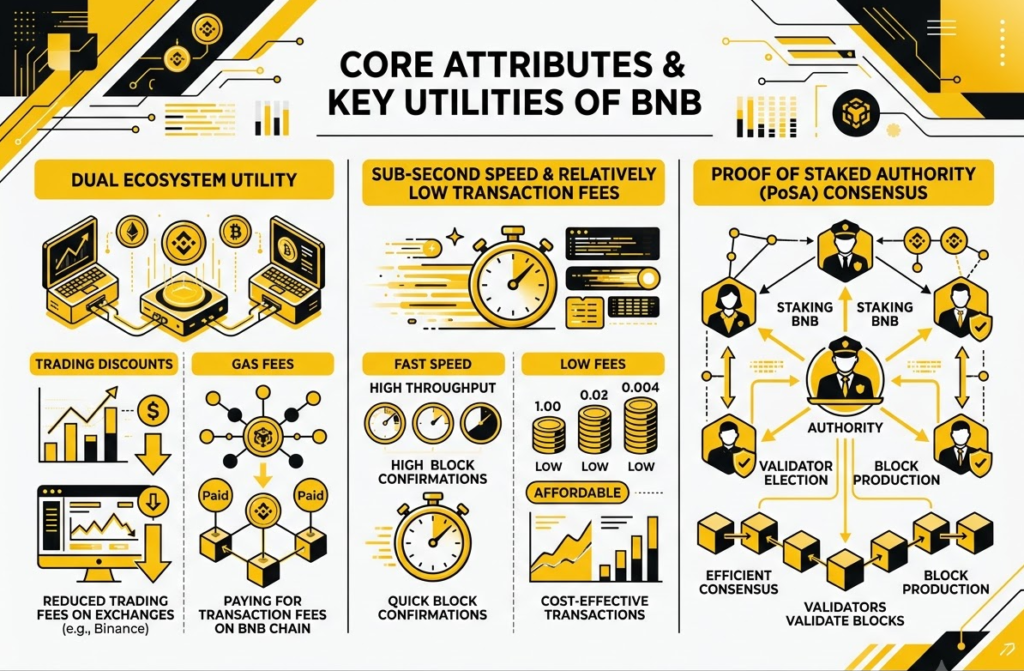
Dual ecosystem utility: trading discounts and gas fees
BNB’s original exchange-related utility remains part of its identity, but its blockchain role has become increasingly important.
On the Binance side, BNB can be used within eligible products and programs. Depending on the product and user’s circumstances, BNB may also be relevant to trading-fee benefits.
On BNB Smart Chain, its function is more fundamental.
BNB is the native gas asset. When a user sends a transaction or interacts with a smart contract, the network charges a transaction fee denominated in BNB.
This means someone who holds BEP-20 tokens but has no BNB may be unable to move those tokens because they lack the native asset required to pay gas.
The same principle exists on Ethereum. Holding USDT, USDC, or another ERC-20 token does not remove the need for ETH when paying Ethereum transaction fees.
That makes BNB a practical infrastructure asset rather than simply an investment token.
BNB Chain also documents uses involving staking, liquid staking, DeFi, PayFi, and other applications through its official BNB utility overview.
Sub-second speed and relatively low transaction fees
Transaction speed is one of BNB Smart Chain’s most visible characteristics.
BSC has undergone several protocol upgrades aimed at reducing block intervals and improving finality. In June 2026, BNB Chain reported that BSC had reached approximately 0.65-second finality, compared with roughly 45 seconds in 2022.
The improvement involved several protocol-level changes rather than a single switch being flipped. BNB Chain’s technical explanation of sub-second finality discusses upgrades including BEP-126, BEP-590, BEP-648, and BEP-667.
That distinction is important because block time and finality are not exactly the same thing.
A block can be produced quickly without meaning that a transaction is immediately considered final. Finality describes when the network has reached the relevant level of confirmation that makes reversing the transaction substantially more difficult under the protocol’s assumptions.
Transaction costs are another major part of BSC’s appeal.
BSC generally aims to provide lower-cost execution than Ethereum mainnet, although actual fees change with network conditions and transaction complexity. It would therefore be misleading to promise that every BSC transaction costs a fixed amount.
The same caution applies to throughput figures. BNB Chain has published benchmark results and development targets, but benchmark throughput should not automatically be interpreted as the guaranteed transaction capacity of every real-world application.
In the first half of 2026, BNB Chain reported improvements to BSC’s block interval and throughput benchmarks in its 2026 technical roadmap, while also outlining further performance targets. Those future figures should be treated as roadmap goals rather than current mainnet guarantees.
Proof of Staked Authority (PoSA) consensus
BNB Smart Chain uses Proof of Staked Authority, commonly abbreviated as PoSA.
The model combines staking with validator authority. Validators participate in securing and producing blocks, while BNB holders can delegate their assets through supported staking mechanisms.
According to the BNB Smart Chain validator documentation, BSC operates with 45 active validators selected according to staking rankings.
The validator set is divided into:
- 21 Cabinet validators
- 24 Candidate validators
The active validator set is elected according to the network’s staking mechanism, with validator rankings playing a central role.
This is one of the major architectural differences between BSC and Ethereum.
Ethereum uses Proof of Stake with a much larger validator participation model. BSC instead uses a relatively small active validator set to achieve fast block production and low transaction latency.
The trade-off is straightforward: a smaller validator set can make high-performance coordination easier, but it also means validator participation is more concentrated.
That is why it is better to describe PoSA in terms of its architecture rather than simply calling it “better” or “worse.”
Tokenomics: burn mechanics and supply scarcity
The 100 million target supply cap
BNB launched in 2017 with an initial supply of 200 million BNB. The ecosystem subsequently introduced several mechanisms intended to reduce circulating supply over time. BNB Chain’s long-term objective has been to reduce the total BNB supply toward 100 million BNB.
The important point is that 100 million is a target, not a statement that BNB currently has a 100 million circulating supply. The actual supply changes after every burn.
For example, BNB Chain reported that its 36th quarterly burn, completed on July 15, 2026, removed approximately 1.616 million BNB, leaving a reported total supply of approximately 133.17 million BNB at that point. The figures and methodology are documented in the official 36th BNB Burn announcement.
That number should always be associated with its date because supply changes after subsequent burns.
The BNB Auto-Burn mechanism
The BNB Auto-Burn mechanism is designed to reduce the BNB supply automatically on a quarterly basis. The amount burned depends on variables including the BNB price and the number of blocks produced on BNB Smart Chain.
Binance Academy explains the mechanism and its formula in its updated BNB Auto-Burn guide.
The simplified idea is: More network activity and the relevant BNB price conditions influence the amount calculated for the burn.
The formula is designed to make the burn mechanism independent of Binance’s quarterly financial results. That is an important distinction from simply announcing that a company has decided to buy and destroy tokens. Auto-Burn is executed according to a predefined on-chain mechanism.
However, the mechanism does not guarantee that BNB will become scarce at a predictable rate. The amount burned can vary because the inputs used by the formula vary. So while the long-term target is to reduce supply toward 100 million BNB, nobody can accurately translate that target into a fixed date without making assumptions about future BNB prices, network activity, and burn parameters.
Real-time gas burning via BEP-95
Auto-Burn is not the only supply-reduction mechanism.
BEP-95 introduced a real-time BNB burning process associated with gas fees on BNB Smart Chain.
Instead of waiting for a quarterly Auto-Burn event, part of the relevant gas-fee mechanism is burned as transactions occur.
Binance Academy’s BEP-95 documentation explains that the initial burn ratio was set at 10% and remains at 10% according to the current documentation.
BNB Chain has also reported hundreds of thousands of BNB burned through BEP-95 since its introduction.
There is therefore a useful distinction between the major mechanisms:
| Mechanism | Timing | Main principle |
|---|---|---|
| Auto-Burn | Periodic | Calculates BNB burn using network and market variables |
| BEP-95 | Real time | Burns part of the relevant gas-fee mechanism |
| Pioneer Burn | Special mechanism | Accounts for certain eligible lost or inaccessible BNB |
For that reason, describing BNB tokenomics as having only a “dual-burn mechanism” is incomplete. Auto-Burn and BEP-95 are the two major ongoing mechanisms, while Pioneer Burn is another component of the broader supply-reduction framework.
The 3-tier layer architecture powered by BNB
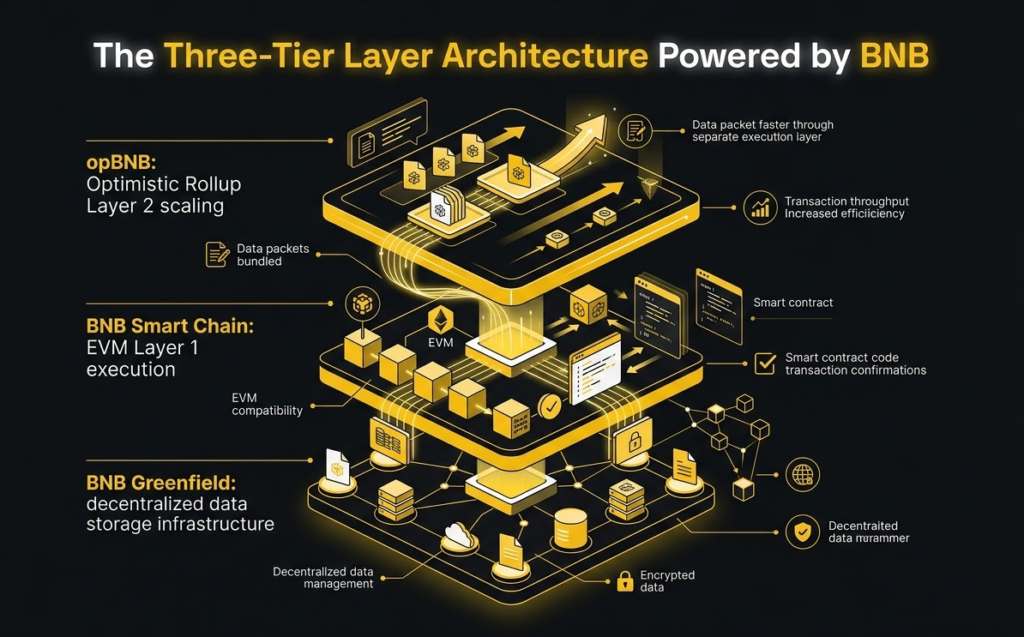
One of the more important developments in the BNB ecosystem is that BNB Chain is no longer simply synonymous with BNB Smart Chain.
The ecosystem now contains multiple infrastructure layers with different jobs.
BNB Smart Chain: EVM Layer 1 execution
BNB Smart Chain is the primary general-purpose smart-contract blockchain in the ecosystem.
It provides EVM-compatible execution, allowing developers to deploy decentralized applications and smart contracts using an environment familiar to Ethereum developers.
BSC is where many common BNB Chain activities take place:
- Token transfers
- DeFi applications
- DEX trading
- NFT applications
- Gaming
- Smart-contract execution
- Staking-related activities
The official BNB Smart Chain introduction describes BSC as an EVM-compatible blockchain using PoSA and a 45-validator active set.
Its combination of EVM compatibility, relatively fast finality, and low transaction costs has helped make it a major execution layer for applications.
opBNB: Optimistic Rollup Layer 2 scaling
opBNB has a different role.
It is a Layer 2 scaling network built on top of BNB Smart Chain and is powered by the Optimism OP Stack.
The basic idea is to move a portion of transaction processing away from the underlying BSC layer while still relying on it as part of the settlement architecture.
The official opBNB documentation explains that opBNB uses an architecture based on the Bedrock version of the Optimism OP Stack. Transactions are processed through sequencer infrastructure and relevant state information is submitted to the underlying chain.
This design allows applications that require large transaction volumes to operate without putting every individual execution step directly onto the BSC execution layer.
The distinction is therefore:
BSC = Layer 1 execution
opBNB = Layer 2 scaling
That difference is important because opBNB is not simply another name for BSC.
opBNB is also EVM-equivalent, so developers familiar with Ethereum-style smart contracts can work with the environment using familiar tooling. The opBNB developer guide provides the technical details for developers building or deploying applications there.
BNB Greenfield: decentralized data storage infrastructure
BNB Greenfield addresses a different problem altogether. Instead of focusing primarily on smart-contract execution, Greenfield is designed around decentralized data storage and ownership.
The BNB Greenfield documentation describes it as a decentralized storage infrastructure designed around data ownership, management, and a broader data economy. The architecture uses blockchain-based coordination alongside storage providers. BNB also has a role within Greenfield. The Greenfield validator documentation identifies BNB as the gas and governance token and explains how BNB is bridged between BNB Smart Chain and the Greenfield network.
The Greenfield validator architecture uses a Cosmos/Tendermint-based Proof of Stake blockchain, which makes its technical architecture different from BSC’s PoSA design.
This gives the wider ecosystem three distinct infrastructure roles:
| Network | Primary role | Core technology |
|---|---|---|
| BNB Smart Chain | Smart-contract execution | EVM + PoSA |
| opBNB | Layer 2 scaling | OP Stack |
| BNB Greenfield | Decentralized storage | Cosmos/Tendermint-based infrastructure |
That three-layer structure is one of the most important things to understand if you’re trying to figure out what BNB Chain actually is today.
Ecosystem applications and yield utility
Binance Launchpad and Launchpool token farming
BNB also has utility outside direct blockchain transactions.
Two Binance products that frequently appear in discussions about BNB are Launchpad and Launchpool. They serve different purposes.
Launchpad is associated with token launches, while Launchpool allows users to lock eligible assets and receive distributions of tokens from participating projects. On Launchpool, the amount a user receives depends on the relevant campaign rules and the user’s proportion of the eligible locked assets.
The official Binance Launchpool page provides campaign-specific information, including eligible assets and distribution mechanics. BNB is commonly one of the assets involved in Launchpool campaigns, although eligibility and terms can change between projects. This is important because Launchpool should not be confused with staking BNB for network security.
A Launchpool campaign is a promotional token-distribution mechanism. Blockchain staking, by contrast, is connected to network validation and delegation.
They can both produce token rewards, but they are fundamentally different activities.
DeFi and DEX integration
BNB is widely used within decentralized finance applications on BNB Smart Chain.
A typical example is PancakeSwap, a decentralized exchange ecosystem that has historically played a major role in BNB Chain’s DeFi activity.
A user can hold BNB and interact with decentralized applications without relying entirely on a centralized exchange.
For example, someone might:
- Hold BNB in a self-custody wallet.
- Connect the wallet to a BSC-based DEX.
- Swap BNB for another BEP-20 token.
- Provide liquidity where supported.
- Use another DeFi protocol with the resulting assets.
Each smart-contract interaction can require BNB for gas. That is why the value of BNB’s utility cannot be understood simply by looking at exchange-related use. Its demand is also connected to activity taking place across applications that require the native asset for transaction fees.
Of course, DeFi carries its own risks, including smart-contract vulnerabilities, liquidity risk, market volatility, impermanent loss, bridge risk, and malicious token contracts. Holding BNB does not remove those risks.
Web3 storage and cross-chain wallets
BNB’s ecosystem extends beyond trading and DeFi. Greenfield introduces decentralized storage, while BSC and opBNB support smart-contract applications. Wallet infrastructure provides users with access to these networks. A practical example is a self-custody wallet that supports BNB Smart Chain.
The user might hold:
- BNB for gas
- BEP-20 stablecoins
- DeFi tokens
- NFTs
- Other application-specific assets
A blockchain explorer can then be used to inspect transactions and wallet activity. For BSC, BscScan provides a public explorer for addresses, transactions, blocks, tokens, and smart contracts.
This is another reason I would avoid thinking about BNB simply as “the Binance exchange token.” Its current utility is distributed across a broader blockchain infrastructure.
How to buy, stake, and secure BNB
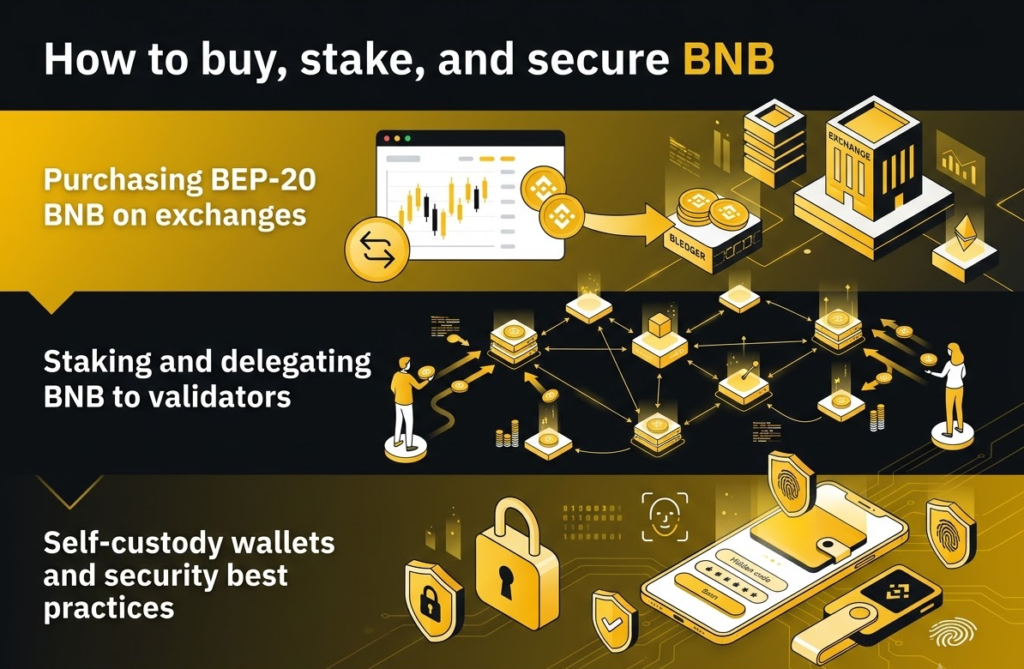
Purchasing BEP-20 BNB on exchanges
There are two broad ways to obtain BNB.
The first is through a centralized exchange.
A user can purchase BNB using whatever fiat or crypto trading pairs are available in their jurisdiction and account.
The second is through decentralized markets. A user who already holds another supported crypto asset can potentially swap it for BNB through a decentralized exchange.
For beginners, the bigger issue is often not buying BNB itself but choosing the correct network when withdrawing it. If you want BNB on BNB Smart Chain, you need to make sure the withdrawal network and receiving wallet are compatible.
A token with the same ticker can exist across different networks. Sending an asset using the wrong network can create recovery problems.
Before withdrawing, check:
- Receiving wallet compatibility
- Network selected on the exchange
- Deposit network supported by the wallet
- Address format
- Minimum withdrawal amount
- Withdrawal fee
- Whether a memo or tag is required
BNB Chain’s official BNB overview also lists supported ways of acquiring and using BNB across the ecosystem.
Staking and delegating BNB to validators
BNB can also be used in staking-related activities.
On BNB Smart Chain, validators stake BNB as part of the network’s consensus mechanism. Other holders can participate through delegation where supported. The important distinction is that delegating BNB does not mean you become a validator yourself.
A validator operates infrastructure and participates directly in block production and consensus. A delegator contributes stake to a validator according to the network’s staking rules.
Potential rewards are variable and depend on factors such as validator performance, network parameters, commission, staking conditions, and the amount delegated. Therefore, staking should not be described as a fixed-interest savings account.
The official BSC validator documentation explains how the validator set is selected and how staking rankings contribute to validator participation. Before delegating, I would check the validator’s commission, uptime, historical performance, current status, and any applicable unbonding or redelegation rules.
Self-custody wallets and security best practices
If you hold BNB yourself, wallet security becomes your responsibility.
The basic rules are simple: Never share your seed phrase.
A legitimate exchange, wallet provider, support employee, or project representative should not need your recovery phrase.
Check the network before sending.
Selecting BNB Smart Chain, opBNB, Ethereum, or another supported network can produce very different results.
Verify smart-contract addresses.
Scammers can create tokens with almost identical names and symbols.
Avoid signing transactions you don’t understand.
A wallet signature can grant permissions or authorize actions beyond simply sending a transaction.
Keep a small amount of BNB for gas.
If all your BNB is moved elsewhere while your BEP-20 assets remain in the wallet, you may not have enough native gas to move those assets.
Consider hardware-wallet storage for larger holdings.
A hardware wallet can reduce exposure to certain online threats, although it does not protect against every form of phishing or user error.
The general rule is straightforward: the larger the amount you hold, the more seriously you should treat key management.
Frequently asked questions
What does BNB stand for?
BNB originally stood for Binance Coin. The name later became associated with Build and Build as the token’s role expanded beyond the Binance exchange ecosystem.
What is the difference between BNB the token and Binance the exchange?
BNB is the native crypto asset used across the BNB ecosystem, while Binance is a centralized crypto exchange and broader company ecosystem. BNB Chain is the blockchain infrastructure associated with the BNB ecosystem.
How does the BNB Auto-Burn mechanism reduce overall token supply?
Auto-Burn periodically calculates and removes BNB from circulation using network and market-related variables. BNB Chain also uses other mechanisms, including real-time BEP-95 burning and Pioneer Burn.
How can I use BNB to earn passive rewards on Binance Launchpool?
When an eligible Launchpool campaign is available, users can lock supported assets such as BNB and receive a share of the project’s token distribution according to the campaign rules. Details can change for each campaign, so the current Binance Launchpool information should be checked before participating.
Conclusion: The future of BNB Chain infrastructure
BNB started with a relatively straightforward purpose: provide utility around the Binance ecosystem.
That description is now incomplete.
BNB has become the native asset connecting several different pieces of blockchain infrastructure. BNB Smart Chain provides EVM-compatible execution. opBNB adds Layer 2 scaling. BNB Greenfield focuses on decentralized data storage.
At the token level, BNB serves as a gas asset, staking asset, DeFi asset, and participant asset for certain Binance ecosystem programs. Its supply is also subject to multiple burn mechanisms, including Auto-Burn and BEP-95.
The tokenomics are worth watching, but they should not be viewed in isolation. The long-term effect of a burn mechanism depends on how much BNB is burned, how quickly the network grows, and how the broader supply and demand dynamics develop.
The same applies to network performance.
BSC’s move toward sub-second finality represents a significant technical change. BNB Chain has also published further performance targets for 2026 and beyond, including higher throughput ambitions. Those figures should be treated as development targets unless and until they are achieved and documented on the live network.
From a technical perspective, the most useful way to understand BNB is therefore not simply as “a Binance coin.”
It is better understood as the native asset at the center of a multi-network blockchain ecosystem.
For anyone researching BNB, the three concepts worth remembering are:
BNB is the token.
BNB Smart Chain is the main EVM execution network.
BNB Chain is the broader infrastructure ecosystem that now includes BSC, opBNB, Greenfield, and the applications built around them.
That distinction makes the rest of the BNB ecosystem much easier to understand.