Key Specifications & Architectural Overview of Canton
If you have spent time exploring crypto, you have probably noticed a recurring trade-off: public blockchains make it easy to verify transactions, but they also expose far more information than many traditional businesses are comfortable sharing. A bank cannot necessarily publish every detail of a securities trade, a fund transfer, or a collateral arrangement and expect its clients to be happy about it.
That is the problem Canton Network is designed to address.
Canton is a privacy-enabled blockchain network developed around the needs of financial institutions. Instead of forcing every application to operate on one completely transparent public ledger, it connects independent applications and participants while allowing transaction information to remain visible only to the parties entitled to see it. Its smart contracts are written in Daml, a language designed to represent business agreements, rights, obligations, and authorization rules.
The network’s interoperability layer is called the Global Synchronizer. It coordinates transactions between applications and independent ledger environments, allowing them to interact without requiring every participant to expose its entire internal ledger.
Canton Coin (CC) provides an economic incentive layer for the network. Participants use it to pay certain network fees, while application providers and infrastructure operators can earn new coins for contributing useful activity. Its tokenomics follow a Burn-and-Mint Equilibrium (BME) model: usage fees remove coins from circulation, while rewards introduce new coins according to a defined issuance mechanism.
The network’s Global Synchronizer mainnet went live on June 25, 2024, and its governance structure has since evolved. The Global Synchronizer Foundation, initially established with support from the Linux Foundation, changed its name to the Canton Foundation in September 2025. That distinction matters when you read older articles describing Canton’s governance.
Here is a practical overview of the network:
| Dimension | Canton Network |
|---|---|
| Core developer | Digital Asset |
| Network type | Privacy-enabled network of interoperable blockchain applications |
| Smart contract language | Daml |
| Privacy model | Sub-transaction, need-to-know data visibility |
| Interoperability layer | Global Synchronizer |
| Native utility token | Canton Coin (CC) |
| Token implementation | Amulet application and related Daml contracts |
| Economic model | Burn-and-Mint Equilibrium |
| Network fees | Certain fees are paid by burning CC |
| Infrastructure operators | Validators and Super Validators |
| Primary market | Institutional finance, capital markets, and real-world asset tokenization |
| Global Synchronizer mainnet | June 25, 2024 |
The dates and governance details above are supported by the Linux Foundation’s Global Synchronizer announcement and the Canton Foundation’s explanation of its name change.
One point deserves special attention: Canton is not simply another public Layer-1 blockchain with a different branding strategy. Its architecture is built around a different set of priorities. Rather than maximizing public visibility and permissionless access at every layer, it aims to make blockchain-style coordination practical for organizations that need confidentiality, controlled participation, and enforceable business rules.
That does not automatically make Canton better than Ethereum, Solana, or other public networks. It makes it a different tool for a different class of problems.
How Canton Network Works?
To understand what Canton is, I would start with its privacy model rather than its token. The most interesting part of the network is not that it has a coin or a collection of institutional partners. It is the way independent financial applications can coordinate transactions without exposing every piece of information to everyone else.
Traditional public blockchains generally rely on a shared ledger. Anyone with access to the chain can inspect public transaction data, including wallet addresses, balances, and transaction histories. Depending on the application, additional information may be visible through smart contract events and on-chain storage.
That transparency is useful. It makes public verification possible and allows independent developers to build applications around shared state. But it can also create problems for institutions handling sensitive financial information.
Canton approaches the issue through three connected components:
- Daml: Defines the business logic, rights, and permissions of smart contracts.
- Validators: Process transactions and maintain the ledger state for the parties they represent.
- Global Synchronizer: Coordinates communication and atomic execution between independent participants.
Let’s break down how those components fit together.
Sub-Ledger Privacy: Why Institutions Avoid Public Ledgers
Imagine two financial institutions settling a securities transaction. One institution transfers an asset, while the other delivers cash. Both parties need to know that the exchange has completed correctly. However, neither necessarily wants every other participant in the financial ecosystem to see the transaction amount, the identities involved, or the commercial terms.
On a fully transparent public blockchain, hiding this information can require additional privacy infrastructure. Even when transaction contents are encrypted or obscured, metadata and transaction patterns may still reveal useful information.
Canton’s privacy model starts from a different assumption: not every participant needs access to every transaction.
Its ledger is organized around parties and contracts. A party is an identity that can participate in an application, and a contract defines a particular agreement or piece of shared state. Each contract has stakeholders, such as signatories and observers, who are entitled to see relevant information.
A validator node maintains the ledger state for the parties it hosts. It does not automatically receive the complete transaction history of every other organization on the network.
This is often described as sub-transaction privacy or need-to-know privacy. Instead of distributing one identical transaction record to every participant, Canton can distribute different projections of the same transaction to the parties entitled to see each part.
Digital Asset explains this model in its Canton ledger privacy documentation.
Consider a simplified delivery-versus-payment transaction:
- A buyer agrees to purchase a financial asset.
- The seller agrees to deliver the asset.
- A payment application coordinates the cash leg.
- The asset and payment legs must complete together.
- Each participant receives the information needed to verify its own obligations and the outcome.
The buyer needs to know that the asset was delivered. The seller needs to know that payment was completed. A custodian may need to verify its responsibilities, while another institution involved in a separate part of the transaction may not need access to the full commercial agreement.
Canton’s privacy architecture is intended to support that kind of selective visibility.
There is an important nuance here. Privacy does not mean that information can never be disclosed beyond the original contract stakeholders. Canton supports a mechanism known as divulgence, through which additional parties may receive information when the consequences of a transaction make that disclosure necessary. For example, a party that participates in a workflow may need to see the resulting state of a contract even if it was not an original signatory.
That is why privacy has to be designed into the application itself. Developers must understand who signs a contract, who can exercise its choices, who observes it, and what information becomes visible as a transaction progresses.
This is a more sophisticated model than simply hiding wallet balances.
Why does this matter to financial institutions?
A bank or asset manager does not necessarily want to choose between two extremes: a completely isolated internal database or a public blockchain where sensitive business activity is broadly visible. Canton attempts to provide a middle ground.
Institutions can preserve control over their own application data while still participating in transactions that cross organizational boundaries.
However, privacy should not be confused with complete anonymity. Canton applications still operate with identifiable parties, authorization rules, and compliance processes. An institution can build KYC, AML, and other regulatory requirements into its workflows. The network itself does not magically make every application compliant; the quality of the implementation and the participating organizations’ controls still matter.
Daml Smart Contracts: Formalizing Financial Agreements
The next important component is Daml, short for Digital Asset Modeling Language.
Daml is a programming language designed to model multi-party agreements. Rather than treating a smart contract as nothing more than a collection of functions that update blockchain storage, Daml gives developers a way to express who has rights over an agreement, who must authorize an action, and what changes are permitted.
That distinction is particularly useful in finance.
Think about a securities lending agreement. The transaction may involve a lender, a borrower, a collateral provider, a custodian, and other service providers. Each participant has different responsibilities, and not every party should be allowed to modify every part of the agreement.
A conventional application might represent those rules through a combination of database permissions, backend services, and custom business logic. Daml allows developers to express many of those rules directly in the contract model.
A Daml template defines the structure of a contract. It can specify signatories, observers, and choices that stakeholders may exercise. Those choices represent permitted actions, such as transferring an asset, approving a settlement, or updating an agreement.
For example, a simplified asset transfer might require:
- The current owner to authorize the transfer.
- The receiving party to satisfy the required conditions.
- The asset contract to be active and available.
- The resulting contract state to reflect the new ownership.
If a required authorization is missing, the transaction should not be accepted as a valid state transition.
This is one reason Daml is relevant to institutional workflows. Financial agreements are not simply token transfers. They contain conditions, responsibilities, exceptions, and relationships between multiple parties. A language designed to model those relationships can make the business logic easier to reason about.
Daml also supports composable transactions. A workflow can involve several contract operations that are processed as one transaction, rather than leaving the ledger in a partially updated state if one component fails.
That matters for processes such as delivery-versus-payment, where transferring the security without completing the corresponding payment would be an unacceptable outcome.
You can explore the language and its development model through Digital Asset’s Daml documentation.
It is worth being precise about what Daml does not guarantee. Writing a contract in Daml does not automatically make a financial product legally valid, compliant, or free of software defects. Developers still need to model the correct business rules, test edge cases, manage permissions, and obtain appropriate legal and regulatory review.
Daml gives them a framework for expressing and enforcing agreement logic. It does not replace the people and institutions responsible for designing that logic.
The Global Synchronizer: Interoperability Without External L2 Bridges
A network of private financial applications would not be particularly useful if every application remained isolated.
Imagine a tokenized money market fund operating on one application, a collateral management platform operating on another, and a trading application running in a third environment. Each system may have its own participants, permissions, and internal ledger state.
If these applications cannot communicate, institutions still face the same fragmentation that blockchain infrastructure is supposed to reduce.
This is where the Global Synchronizer comes in.
The Global Synchronizer is an interoperability service that coordinates transactions and messages between independent Canton applications. It provides shared infrastructure for participants that need to synchronize their workflows without requiring them to merge their internal ledgers into one public database.
A simplified transaction flow looks like this:
- An application creates a transaction proposal.
- The relevant participant validators check the transaction against their local contract state and authorization rules.
- The participants exchange the required confirmation messages through a synchronizer.
- The synchronizer coordinates message ordering and the transaction protocol.
- The involved participants reach a consistent outcome.
The key idea is that the synchronizer helps coordinate the transaction, but it does not need to expose every private contract involved in the workflow to every network participant.
The Global Synchronizer uses decentralized infrastructure operated by independent organizations. The Canton Network’s Global Synchronizer overview describes its Byzantine Fault Tolerant consensus design and the role of Super Validators in operating the service.
This architecture is particularly relevant to atomic composability.
Suppose an institution wants to use a tokenized fund share as collateral for a trade. The collateral application and trading application may operate independently, but the transaction needs to coordinate both sides. If one leg succeeds while the other fails, the institution could end up with an inconsistent financial position.
Canton’s synchronization model is designed to coordinate such multi-application workflows so that the required state changes can complete together or fail without leaving an unintended partial settlement.
You may see this described as interoperability without conventional external bridges. That is a useful distinction, but it should not be interpreted as meaning that Canton has no trust assumptions or technical risks. Participants still rely on validator software, synchronizer infrastructure, governance processes, and correct application logic.
The benefit is that cross-application coordination is built into the network architecture rather than being left entirely to unrelated third-party bridge contracts.
Canton Coin (CC) Tokenomics
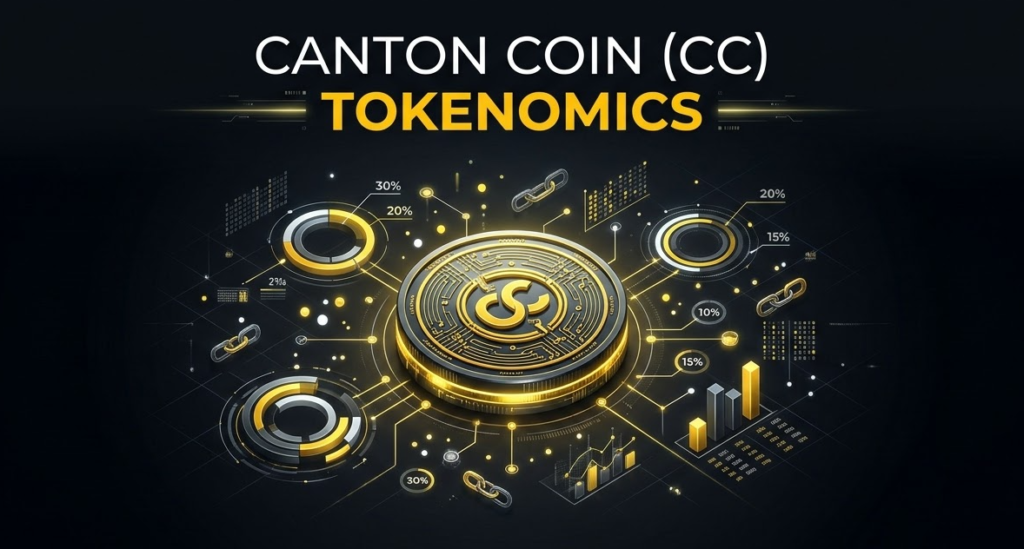
Now we get to the part most crypto investors want to understand: the token.
Canton Coin (CC) is the native utility token associated with Canton Network’s Global Synchronizer economy. It is designed to reward participants who contribute useful network activity rather than relying on a traditional model in which a large initial allocation is distributed to founders, venture capital investors, or early insiders.
That is an important part of Canton’s economic design, but it also means you need to understand how the token is created, used, and removed from circulation.
The central mechanism is called Burn-and-Mint Equilibrium, or BME.
Under this model, users pay certain network fees by burning CC. At the same time, participants who provide useful services can earn the right to mint new CC. The system aims to balance the supply impact of usage fees and network rewards over time.
The official Canton Coin FAQ explains the basic design, while the Canton Coin whitepaper provides a more detailed description of its economics.
The Amulet Contract Identity and Splice Open-Source Infrastructure
You will encounter three related terms when researching Canton Coin:
- Canton Coin (CC): The name of the native utility token.
- Amulet: The name used in the token’s underlying application and smart contract implementation.
- Traffic Credits: A network resource used to pay for sending data through the Global Synchronizer.
These terms are connected, but they are not interchangeable.
The Amulet application is implemented using Daml smart contracts and forms part of the open-source Splice infrastructure. Its contracts handle coin balances, transfers, fee calculations, rewards, and other token-related operations.
The Splice project provides the software components used to operate and interact with the Canton Coin application. Its documentation is particularly useful if you want to move beyond general token descriptions and inspect how the system works at the implementation level.
For example, the Splice tokenomics documentation describes the activity records and reward processes used to calculate CC issuance.
The Amulet name therefore refers to the application and contract layer, not to a separate cryptocurrency that happens to share the same ecosystem.
It is also important to distinguish the token’s official abbreviation from exchange-specific trading symbols. The official Canton Coin documentation identifies the asset as CC. Do not assume that a symbol such as CCCA is the universal or canonical ticker without checking the particular exchange or market listing.
The Burn-and-Mint Equilibrium Model
Many cryptocurrencies use a fixed maximum supply. Bitcoin, for example, has a maximum supply of 21 million BTC. Other projects rely on scheduled issuance, staking rewards, or discretionary token burns.
Canton Coin follows a different approach.
Its BME model is designed to connect token issuance with actual network utility. Coins are burned when users pay qualifying fees, while new coins are minted as rewards for participants who contribute to the network.
The basic mechanism can be summarized as follows:
| Network condition | Burn activity | Minting activity | Potential supply effect |
|---|---|---|---|
| High network usage | More CC is burned | Rewards continue under the issuance rules | Supply growth may slow or become negative |
| Low network usage | Less CC is burned | Eligible contributors can still earn rewards | Supply may expand |
| Balanced activity | Burns and issuance are closer | Rewards offset fee burns | Supply may remain relatively stable |
The key point is that burning and minting are separate processes.
When a user pays a fee by burning CC, those coins are removed from circulation. They are not simply transferred to a validator’s wallet. New CC is issued through the reward mechanism, which calculates the amount participants can mint based on eligible activity and the rules of the relevant round.
According to the Canton Coin application documentation, eligible contributors include infrastructure operators and application providers. Validators can also earn minting rights through qualifying network activity.
The model is designed to create a relationship between usage and supply. When demand for network services increases, more fees may be burned. When network activity is lower, minting rewards can help maintain incentives for the participants who keep the infrastructure operating.
This is not the same as a guaranteed deflationary token.
A coin can have a burn mechanism and still experience net supply growth if the amount minted exceeds the amount burned. Conversely, supply can contract if burns exceed issuance. The result depends on real activity and the applicable reward rules.
The Canton Coin whitepaper also discusses an equilibrium target of approximately 2.5 billion CC per year under its described economic model. This should be understood as a design reference in the whitepaper, not a fixed maximum supply or a promise that annual issuance will always equal that number. Actual issuance is governed by the protocol’s reward mechanics and subsequent changes.
For an investor, this distinction is important. A burn mechanism alone does not prove that a token is scarce, undervalued, or likely to appreciate. You need to compare actual fee burns with actual issuance, and understand who receives the newly minted coins.
Canton’s design also emphasizes that there is no traditional pre-mine or venture-capital allocation in the original distribution model. The official FAQ states that coins are earned through contributions to network utility. That is a meaningful difference from projects that allocate large portions of their supply before public usage begins, but it does not remove the need to examine future issuance and reward concentration.
Traffic Credits, Holding Fees, and UTXO Maintenance
Canton’s fee system can seem confusing if you are used to paying Ethereum gas fees directly from a wallet for every transaction.
On the Global Synchronizer, participants use Traffic Credits to pay for the data they submit to the network. The amount of traffic consumed depends on factors such as message size and delivery costs.
A validator operator can obtain traffic credits by burning CC at the applicable conversion rate. In practical terms, the operator exchanges CC for the right to submit a certain amount of data through the synchronizer.
The process is not simply a direct transfer of CC from the user to a validator. Instead, the coins used to purchase traffic are burned, and the protocol records the relevant reward information.
The Splice traffic purchase documentation explains that traffic credits are used for submissions to the Global Synchronizer and that the sending validator is charged for the traffic it sends. It also describes how CC is burned to increase a validator’s traffic balance.
This design creates a connection between network consumption and token usage. Applications that send more data through the synchronizer can incur higher traffic costs, while participants that use less bandwidth generally consume fewer traffic credits.
There is another mechanism worth understanding: holding fees.
Canton Coin uses contract-based coin balances. In this context, a coin contract can be compared loosely to a UTXO-style balance record: it represents a specific amount of CC held in a particular contract.
If a participant accumulates many small coin contracts, the network has to maintain more individual pieces of state. That can increase storage and operational overhead.
Holding fees are intended to discourage the long-term accumulation of tiny, fragmented coin contracts. They are charged according to the number of separate coin contracts and the time they remain outstanding, rather than simply being a percentage of the amount held.
The Splice documentation explains that holding fees can accrue and be collected through the Amulet_Expire process when a coin contract expires. It also notes that the holding-fee rules were changed through CIP-0078: holding fees are not charged when a coin is used as an input to a transfer, and the mechanism is intended to encourage the merging or removal of dust balances.
You can inspect the details in the Splice tokenomics documentation.
Why does this matter?
Because Canton is designed for institutional activity, where a large number of contracts and transactions may be created by applications operating continuously. Managing ledger state efficiently is part of keeping that infrastructure practical.
Holding fees are therefore not simply another speculative tax on token holders. They are an economic mechanism intended to encourage more efficient management of the network’s contract state.
Governance and Institutional Ecosystem
Canton’s institutional positioning is one of its most visible characteristics. Its ecosystem includes financial institutions, market infrastructure providers, technology companies, custodians, and organizations building tokenization applications.
But it is important to separate three different things:
- The organizations that develop software for Canton.
- The organizations that operate network infrastructure.
- The organizations that use Canton applications for financial activity.
These roles can overlap, but they are not identical.
The Canton Foundation and Linux Foundation Oversight
Older Canton materials refer to the Global Synchronizer Foundation (GSF). The foundation was announced on July 1, 2024, with support from the Linux Foundation. Its purpose was to facilitate transparent and neutral governance of the Global Synchronizer.
The Global Synchronizer mainnet had already gone live on June 25, 2024. The foundation announcement followed shortly afterward and described the governance structure being established around the interoperability service.
In September 2025, the GSF changed its name to the Canton Foundation. The organization explained that the new name better reflected its role in supporting the Global Synchronizer and the wider Canton Network ecosystem. Its mission and existing membership continued.
This means that the outline’s reference to the Global Synchronizer Foundation is historically correct, but the current name is Canton Foundation.
The distinction also matters when interpreting the relationship with the Linux Foundation. The Canton Foundation was formed in partnership with and supported by the Linux Foundation; that does not mean the Linux Foundation directly operates every Canton application or controls all network activity.
The Canton Foundation’s announcement provides the clearest explanation of the transition.
The foundation’s role includes supporting transparent governance, member engagement, and the development of the Global Synchronizer. Its website describes how Super Validators participate in decisions affecting the synchronizer’s operation and code.
This structure is intended to reduce dependence on a single infrastructure provider. It does not mean that every aspect of the Canton Network is governed through one universal voting system. Individual applications can retain their own governance and operating arrangements.
That flexibility is part of the network’s design: a financial institution may want to participate in shared interoperability infrastructure without giving up control over its own application rules.
Super Validators and Enterprise Adoption
Super Validators, often abbreviated as SVs, are organizations that operate important infrastructure for the Global Synchronizer.
They help maintain the decentralized service, participate in governance, and support the network’s ability to coordinate activity between independent applications.
The Global Synchronizer’s governance model uses Super Validators to participate in decisions about changes to the service. The Canton Foundation’s overview of its governance and Super Validators provides information about their role and participating organizations.
Super Validators should not be confused with every ordinary Canton validator. A standard validator supports the applications and parties hosted by an organization. A Super Validator has additional responsibilities in the Global Synchronizer’s decentralized infrastructure and governance.
The distinction matters because Canton is not organized around one monolithic validator set that handles every private application in exactly the same way.
The network’s ecosystem includes organizations from several parts of the financial industry. Some develop applications, some provide custody or infrastructure services, and others participate in trading, settlement, or tokenization workflows.
A few examples help illustrate the range of activity.
Goldman Sachs and BNP Paribas
Both institutions were named among the early participants in the Canton Network initiative. The original announcement described a group of financial market participants working with Digital Asset to build an interoperable network for institutional assets.
The Canton Network launch announcement provides historical context and lists participating organizations. Being named as a participant should not automatically be interpreted as proof that every institution has deployed every service on the network or uses CC directly in its internal operations.
Hashnote USYC
Hashnote’s US Yield Coin, commonly known as USYC, is a tokenized yield-bearing fund product that was announced as available on Canton in October 2024.
The use case is interesting because tokenized fund shares can potentially be used in financial workflows where confidentiality is important. An investor or institution may need to hold or deliver collateral without making its entire position visible to unrelated parties.
Canton and Hashnote described the integration as enabling USYC holders to hold and deliver collateral with privacy between the relevant issuer and holder. You can read the original announcement in Hashnote’s USYC launch on Canton.
Brale and institutional stablecoin settlement
Brale is another example of the network’s relevance to regulated financial infrastructure. In June 2026, Visa announced a collaboration with Brale to explore private stablecoin settlement using Brale’s SBC stablecoin on Canton.
The project was described as a proof of concept, not as evidence that all Visa settlement activity had moved to Canton. Its purpose was to evaluate how privacy-enabled blockchain infrastructure could support institutional payment flows while limiting visibility into sensitive transaction data.
The Visa announcement on its collaboration with Brale is useful because it illustrates the difference between a live institutional product and an exploratory project.
These examples demonstrate why Canton is attracting attention beyond the usual crypto-native audience. Its target market includes institutions that already have complex systems for custody, compliance, settlement, and asset servicing.
For those organizations, the appeal is not necessarily that a blockchain removes every intermediary. It is that shared infrastructure may reduce reconciliation work, improve coordination, and allow assets and obligations to move between applications under controlled conditions.
Still, institutional interest should not be confused with guaranteed token demand. A bank can use Canton technology without necessarily holding a large speculative position in CC. The economic connection depends on how the relevant application uses the Global Synchronizer and its fee arrangements.
Common Pitfalls and Misconceptions About Canton
Canton’s terminology can make it easy to misunderstand what the network actually does. Some descriptions make it sound like a conventional public Layer-1. Others describe CC as a fixed-supply token or suggest that every transaction on every Canton application burns the coin.
Those interpretations are too simplistic.
Misconception: Canton Is a Standard Public EVM Layer-1
Canton is not designed as a direct competitor to Ethereum in the sense of offering an identical public EVM environment with a different consensus mechanism.
Its application model is built around Daml smart contracts, parties, permissions, and privacy-aware transaction processing.
That changes the developer experience and the way applications are structured. A developer building on Canton needs to think about stakeholders, authorization, contract visibility, and multi-party workflows. The goal is not simply to deploy a Solidity contract and let anonymous wallets interact with it through a public mempool.
This does not mean Canton cannot connect with other blockchain environments or support digital assets. It means its core architecture is designed around a different set of assumptions.
Ethereum prioritizes a broadly shared public execution environment. Canton prioritizes coordination between independent applications that may need to preserve private business data.
Neither approach is universally superior. If you are building an open, permissionless DeFi protocol, a public smart contract platform may be more suitable. If you are coordinating confidential securities transactions between regulated institutions, Canton’s design may be more appropriate.
Misconception: Canton Coin Has a Fixed Maximum Supply
Canton Coin does not follow the familiar Bitcoin-style hard-cap model.
Its supply is governed by the BME mechanism, in which eligible network activity can create minting rights and qualifying usage fees can burn CC.
This means that supply can expand or contract depending on the relationship between issuance and burns.
The whitepaper’s discussion of an approximate annual equilibrium target should not be mistaken for a fixed maximum supply. A target or issuance curve is not the same thing as a permanent supply ceiling.
If you are evaluating CC as an investment, look at:
- Total circulating supply.
- New coins minted during the period you are evaluating.
- CC burned through network fees.
- The distribution of rewards between applications and infrastructure operators.
- Changes to the reward rules over time.
- Whether network activity is generating meaningful demand for the Global Synchronizer.
A high transaction count does not necessarily mean an equally high amount of CC is burned. The relevant question is how those transactions use the network’s fee mechanisms and what the resulting traffic costs are.
Misconception: Amulet, Canton Coin, and Traffic Credits Are the Same Thing
These terms refer to different layers of the system.
| Term | Meaning |
|---|---|
| Canton Coin (CC) | Native utility token |
| Amulet | Token application and smart contract implementation |
| Traffic Credits | Resource used to pay for Global Synchronizer traffic |
A participant can hold CC, use it to purchase traffic credits, and then consume those credits when submitting data through the synchronizer.
The traffic credits are not simply another freely transferable version of CC. They represent the ability to consume network resources.
This distinction is important when you read tokenomics discussions. A transaction that consumes traffic credits is not necessarily a direct transfer of CC from one wallet to another. The CC may have been burned earlier when the traffic balance was purchased.
Misconception: Every Canton Transaction Burns CC
The fee model needs to be understood at the level of the infrastructure being used.
The official Splice documentation describes how traffic submitted to the Global Synchronizer is paid for by burning CC. However, Canton also supports independent and dedicated synchronizer environments. Not every possible application or synchronizer arrangement necessarily follows the same fee path.
A proposal published in October 2026, CIP-0129, illustrates that this area is still evolving. It proposes extending CC-based traffic burning to dedicated synchronizers that historically used different commercial fee arrangements. A proposal should not be treated as an already activated protocol rule.
You can review the proposal in the Canton Foundation’s CIP-0129 document.
For token analysis, this distinction is crucial. You should not calculate network-wide CC burns by multiplying every Canton transaction by an assumed fee. Instead, examine the actual fee mechanisms and the data reported by the network.
How Canton Fits Together
Canton is easier to understand when you look at the relationships between its main components.
| Entity | Relationship | Role |
|---|---|---|
| Canton Network | Developed around software from Digital Asset | Privacy-enabled network of applications |
| Daml | Smart contract language used by Canton applications | Defines business logic and permissions |
| Global Synchronizer | Interoperability layer | Coordinates cross-application transactions |
| Canton Foundation | Supports Global Synchronizer governance | Facilitates governance and ecosystem development |
| Super Validators | Operate decentralized infrastructure | Support synchronizer operation and governance |
| Canton Coin (CC) | Native utility token | Pays qualifying fees and rewards contributors |
| Amulet | CC application and contract implementation | Handles token-related operations |
| Traffic Credits | Purchased using CC | Pay for Global Synchronizer traffic |
| Hashnote USYC | Institutional asset application | Example of tokenized fund assets on Canton |
| Brale | Stablecoin infrastructure provider | Example of institutional payment experimentation |
The relationships are important because Canton is not a single application, a single smart contract, or a token with a blockchain attached to it.
It is better understood as a network of applications and participants connected through shared synchronization infrastructure. Daml defines how agreements work, validators maintain the relevant ledger state, and the Global Synchronizer coordinates cross-application activity.
Canton Coin sits within the economic layer of that infrastructure.
How Transactions and Traffic Credits Flow in Canton
If you want to understand how Canton Coin is used in practice, it helps to follow the lifecycle of a transaction.
The example below focuses on a transaction that uses the Global Synchronizer. Exact implementation details can vary by application, but the basic flow reflects the documented Splice traffic model.
Phase 1: Acquiring CC and Preparing Traffic Credits
Step 1: Acquire Canton Coin
A participant first needs access to CC if it intends to pay fees through the Canton Coin application.
CC can be earned through eligible network contributions or acquired through supported wallets, custodians, and trading venues. Availability depends on the participant’s jurisdiction and the services it uses.
The official Canton FAQ provides information about the token’s distribution model and supported access routes.
For institutions, custody and operational controls are particularly important. A financial organization may use a qualified custodian or an approved infrastructure provider rather than holding tokens in an ordinary retail wallet.
Step 2: Convert CC into Traffic Credits
The validator operator needs a traffic balance to submit data through the Global Synchronizer.
It can purchase traffic credits by burning CC at the applicable USD-to-CC conversion rate. The resulting traffic balance represents the amount of network traffic the validator can consume.
This is not the same as depositing CC into a conventional gas account where every individual application transaction directly transfers tokens to a block producer.
The Splice traffic purchase guide explains the process and the relationship between traffic consumption and CC burning.
Phase 2: Executing a Private Daml Workflow
Step 3: Initiate the Daml transaction
An application creates a transaction based on its Daml contract logic.
For example, a buyer and seller may agree to exchange a tokenized asset for a payment. The application checks which parties are required to authorize the transaction and whether the relevant contracts are in a valid state.
The transaction is not automatically broadcast as a fully transparent public record. Each participant receives the information it is entitled to see under the ledger’s privacy model.
Step 4: Submit the transaction through the Global Synchronizer
The relevant validator nodes exchange messages through the synchronizer.
The synchronizer coordinates message ordering and supports the transaction protocol between the involved participants. Traffic credits are consumed when the validator submits the relevant data.
The amount of traffic consumed depends on the size and delivery cost of the messages. The sending validator is charged for its own traffic.
Step 5: Confirm the atomic outcome
The participant validators check the transaction against the relevant contracts and authorization requirements.
If all required conditions are satisfied, the transaction can complete with a consistent outcome across the involved parties. If the workflow cannot complete, it should not leave the participating ledgers in an unintended partially settled state.
For a delivery-versus-payment transaction, this is particularly important: the asset transfer and payment leg need to be coordinated.
Phase 3: Fee Burning and Reward Accounting
Step 6: Account for the CC burn
The CC used to purchase traffic credits is burned according to the token application’s fee mechanism.
The burn removes those coins from circulation. It is not a payment that simply moves the same CC to a Super Validator’s personal balance.
Step 7: Calculate eligible rewards
The protocol records activity and calculates the corresponding minting rights under the BME mechanism.
Eligible contributors can include application providers and infrastructure operators. The exact reward allocation depends on the activity records and reward rules for the relevant round.
The Splice documentation on the steps in a tokenomics round explains how activity is recorded and how CC issuance is calculated.
This is the economic loop behind Canton Coin:
Network activity → Traffic consumption → CC burning → Activity records → Eligible minting rewards.
It is a more nuanced system than simply burning a percentage of every transaction and redistributing the rest to validators.
Frequently Asked Questions About Canton
What is Canton and how does it work?
Canton Network is a privacy-enabled blockchain network designed to connect independent financial applications and institutions. It uses Daml smart contracts to define business agreements and authorization rules, while the Global Synchronizer coordinates transactions between applications.
Canton Coin (CC) is the network’s native utility token. It is used to pay qualifying network fees and reward participants who contribute useful activity. Its economic model combines fee burning with reward-based minting.
What is the main utility of Canton Coin?
Canton Coin is primarily used within the network’s economic system.
Its key functions include:
- Paying qualifying Global Synchronizer fees by burning CC to purchase traffic credits.
- Supporting the economic incentives for application providers and infrastructure operators.
- Rewarding participants who contribute measurable utility to the network.
CC is not simply a governance token that gives every holder unrestricted control over all Canton applications. Its central purpose is to support the network’s usage-based economic model.
How does Canton Coin’s Burn-and-Mint Equilibrium model work?
The BME model combines two processes.
First, users burn CC to pay qualifying fees, permanently removing those coins from circulation. Second, eligible network contributors receive minting rights based on their activity and the protocol’s reward rules.
If burns exceed newly minted coins, circulating supply can decrease. If issuance exceeds burns, supply can increase. The mechanism is designed to connect token economics with network utility rather than enforce a fixed maximum supply.
Why do financial institutions choose Canton over public blockchains like Ethereum?
Canton is designed around privacy, controlled participation, and multi-party financial workflows.
Its sub-transaction privacy model allows parties to see the information relevant to their contracts without requiring every network participant to receive the entire transaction record. Daml also gives developers tools to define rights, obligations, and authorization rules for complex agreements.
This can make Canton attractive for tokenized securities, collateral management, institutional settlement, and other financial workflows where confidentiality is important.
However, that does not mean Canton is automatically a better choice for every blockchain application. Public networks such as Ethereum offer different benefits, including broad public accessibility and a large permissionless developer ecosystem.
Does Canton Coin have a fixed maximum supply cap?
No. Canton Coin does not follow a Bitcoin-style fixed maximum supply model.
Its supply is managed through the Burn-and-Mint Equilibrium mechanism. New coins can be minted as rewards for eligible network activity, while qualifying usage fees burn CC and remove it from circulation.
The net supply effect depends on the relationship between minting and burning. A burn mechanism does not guarantee that CC will always be deflationary.
What is the difference between Canton Coin and Amulet?
Canton Coin (CC) is the native utility token. Amulet is the name associated with the smart contract application and implementation that manages token-related operations within the Splice infrastructure.
In simple terms, CC is the token, while Amulet refers to the application and contract layer used to manage it.
What are Traffic Credits on Canton?
Traffic Credits are a network resource used to pay for submissions to the Global Synchronizer.
A validator operator can burn CC to purchase a traffic balance. When the validator sends messages through the synchronizer, the corresponding traffic is consumed.
Traffic Credits are therefore not simply another name for CC. They represent the ability to use network bandwidth and delivery resources.
Is Canton a public blockchain?
Canton is a network of interoperable applications with privacy-aware ledger infrastructure. It is not designed around the same fully transparent, anonymous public-ledger model used by many general-purpose public blockchains.
Its participants can operate applications with controlled identities, permissions, and data visibility. The Global Synchronizer provides shared interoperability infrastructure, while individual applications can retain control over their own business logic and privacy requirements.
Is Canton Coin a good investment?
That depends on your investment goals, risk tolerance, and view of institutional blockchain adoption.
Canton has a distinct use case: connecting financial applications that need privacy and coordinated settlement. Its tokenomics also attempt to connect CC issuance and burning with actual network activity.
But a compelling technology does not automatically make its token a good investment. Before buying CC, I would examine circulating supply, issuance, burn rates, reward distribution, exchange liquidity, custody options, and the extent to which real applications generate demand for the Global Synchronizer.
You should also distinguish between institutional participation in Canton and direct demand for CC. An organization can use Canton infrastructure without necessarily accumulating CC as a long-term investment.
Final Thoughts
Canton is an attempt to solve a problem that public blockchain infrastructure has not fully addressed: how can independent financial institutions share and synchronize assets and obligations without exposing every piece of sensitive business information?
Its answer combines Daml smart contracts, need-to-know privacy, independent validators, and the Global Synchronizer. Together, these components allow separate applications to coordinate workflows while retaining control over their own ledger data and business rules.
Canton Coin adds an economic layer to that infrastructure. Instead of relying on a fixed supply cap, it uses a Burn-and-Mint Equilibrium model in which qualifying usage fees remove CC from circulation and eligible contributors can mint rewards for providing network utility.
For me, the most important thing to understand is that Canton is not simply trying to bring another cryptocurrency into the market. Its ambition is to connect parts of the financial system that have traditionally operated through separate databases, intermediaries, and settlement processes.
That ambition is significant, but the long-term success of the network will depend on more than institutional announcements. It will depend on whether applications generate sustained usage, whether cross-application settlement creates measurable benefits, whether privacy and governance remain reliable, and whether the CC economic model captures enough of that activity to remain sustainable.
If you are researching Canton as a technology, focus on its privacy model and synchronization architecture. If you are evaluating CC as an asset, go one step further and study actual burns, issuance, and reward distribution. Those are related questions, but they are not the same question—and understanding the difference is essential to evaluating the network properly.