Key Specifications & Architectural Overview of ENA
Ethena is one of those crypto projects that becomes much easier to understand once you stop treating all its tokens as interchangeable. The ecosystem has several assets with very different jobs, and confusing them can lead to some fairly expensive misunderstandings.
At the center is USDe, Ethena’s synthetic dollar. It is designed to maintain a value close to one U.S. dollar through a combination of backing assets and offsetting derivatives positions. Then there is sUSDe, the staked version of USDe that allows eligible users to receive protocol-generated rewards. ENA sits in a different part of the system: it is the governance token used to influence how the protocol develops and how important decisions are made.
There is also sENA, which represents ENA deposited into Ethena’s staking mechanism. It is not simply another name for ENA, nor should it automatically be treated as a universal liquid-restaking token. Its principal purpose is to represent a user’s staked ENA position and reflect eligible rewards accumulated by the staking contract.
That distinction matters because Ethena’s governance, staking, stablecoin, and cross-chain infrastructure functions are related, but they are not identical.
| Metric | Explanation |
|---|---|
| Project | Ethena |
| Development organization | Ethena Labs |
| Founder | Guy Young |
| Native governance token | ENA |
| Blockchain standard | Ethereum ERC-20 |
| Maximum token supply | 15 billion ENA |
| Staking receipt token | sENA |
| Synthetic dollar | USDe |
| Yield-bearing dollar product | sUSDe |
| Governance structure | ENA tokenholder governance and specialized committees |
| Risk oversight | Ethena Foundation Risk Committee |
| Staking mechanism | ENA deposited into the Ethena staking contract in exchange for sENA |
| Cross-chain messaging | LayerZero infrastructure is used by Ethena ecosystem applications |
| Important infrastructure distinction | Some operators stake ENA as operational collateral for verifier services; this is not the same thing as every sENA holder restaking through Symbiotic |
The official Ethena documentation is the best starting point for understanding the protocol’s architecture, supported products, and staking mechanics. For governance decisions, the Ethena Governance Forum provides proposals, risk assessments, committee updates, and voting discussions.
One particularly important development arrived in 2026. Ethena governance approved a fee-switch framework that can direct a portion of protocol revenue toward ENA buybacks when specified USDe supply milestones are reached. This creates a potential additional economic connection between ENA and protocol activity, but it should not be confused with an unconditional claim on revenue. The mechanism has activation conditions, and the amount available for buybacks depends on the protocol’s actual revenue and implementation.
In the sections below, I’ll explain what ENA actually does, how Ethena’s governance works, what sENA represents, and where the token’s supply and vesting schedule deserve closer attention.
What is Ethena (ENA)?
Ethena (ENA) is the native governance token of the Ethena ecosystem, an Ethereum-based protocol built around USDe, a synthetic dollar designed to maintain a relatively stable value through crypto-native collateral and derivatives strategies.
ENA gives tokenholders a way to participate in decisions about the protocol’s direction. These decisions can include governance proposals, committee appointments, risk-management policies, and changes to the economic framework surrounding Ethena’s products.
Think of ENA as the governance and coordination asset of the ecosystem, rather than the dollar that users hold for price stability.
Ethena was founded by Guy Young and developed by Ethena Labs. The project attracted attention because it approached dollar-denominated assets differently from conventional stablecoin issuers. Instead of relying exclusively on bank deposits or short-term government securities, its original USDe model used crypto assets and offsetting derivatives positions to manage market exposure.
That design introduced a different set of opportunities and risks. Funding rates, exchange counterparties, custody arrangements, collateral liquidity, smart contracts, and market dislocations all became important parts of the system’s risk profile.
ENA exists within this broader structure. It helps coordinate the community and governance processes responsible for overseeing the protocol as it evolves.
ENA Is a Governance Token, Not a Stablecoin
The simplest way to understand ENA is to separate its role from the role of USDe.
ENA is a market-traded crypto asset. Its price can move substantially depending on market conditions, token supply, demand, governance developments, and expectations about Ethena’s future.
USDe, by contrast, is designed to maintain a value close to $1. Its objective is price stability rather than governance participation.
This means holding ENA does not give you the same exposure as holding USDe. If you buy ENA, you are purchasing a volatile governance asset associated with the Ethena ecosystem. If you acquire USDe, you are obtaining the protocol’s synthetic dollar instrument, subject to its backing, redemption, liquidity, and operational risks.
There is another distinction worth remembering: ENA ownership does not automatically entitle you to the yield earned by sUSDe holders. That yield comes from a different product and a different mechanism.
What Is ENA Token Used For?
ENA has several important functions within the Ethena ecosystem.
Governance participation
ENA holders can participate in governance decisions, including voting on proposals and electing members of specialized governance bodies. This gives tokenholders a mechanism to influence the protocol’s development without requiring every participant to manage every technical or financial decision directly.
Risk Committee elections
One of the most consequential governance functions is the election of the Ethena Risk Committee. This committee evaluates risks associated with the protocol’s collateral, derivatives counterparties, custody arrangements, liquidity, and other financial dependencies.
Protocol development and ecosystem coordination
ENA can be used in governance decisions concerning ecosystem incentives, integrations, and the allocation of resources intended to support Ethena’s development.
Staking and reward mechanisms
Eligible ENA holders can stake their tokens through Ethena’s staking interface and receive sENA. The staking contract can accumulate eligible distributions, which are reflected in the value of sENA over time.
Potential economic value accrual
The 2026 fee-switch approval introduced a framework under which a portion of eligible protocol revenue can be used for ENA buybacks once specified USDe supply thresholds are reached. This gives ENA a potential economic connection to protocol growth, but the actual effect depends on revenue, supply conditions, and execution.
The important point is that ENA’s utility is not limited to a single function. It connects governance, staking, and the protocol’s evolving economic model.
ENA Governance Architecture

Ethena’s governance model is especially important because USDe is not a simple token backed by cash deposits in a conventional bank account.
Its structure involves financial positions, collateral assets, exchanges, custody providers, smart contracts, and liquidity venues. A problem in any of these areas can affect the protocol’s ability to maintain its intended operation.
For that reason, Ethena uses a governance structure that combines tokenholder participation with specialized risk oversight.
ENA holders can vote on governance matters and participate in committee elections, while specialist committees assess technical and financial questions that require more detailed expertise.
This arrangement is intended to avoid two extremes: a system in which a small group makes every decision without community accountability, and a system in which every complex risk decision is left to a broad tokenholder vote without sufficient technical analysis.
Protocol Governance and the Ethena Risk Committee
The Ethena Risk Committee is a specialized body responsible for identifying, evaluating, and managing risks across the ecosystem.
Its work is particularly relevant to USDe because the synthetic dollar’s backing strategy depends on financial infrastructure that can behave differently during normal markets and periods of stress.
For example, a derivatives position may appear relatively straightforward when exchanges are operating normally, liquidity is deep, and funding rates are favorable. The same position can become more difficult to manage when markets move sharply, exchanges experience operational problems, or funding rates remain negative for an extended period.
A risk committee needs to consider these situations before they become emergencies.
Its responsibilities include reviewing areas such as:
- Derivatives counterparty exposure: Evaluating the exchanges and trading venues used by the protocol, including concentration limits and counterparty risks.
- Custody arrangements: Assessing how collateral is held, transferred, and protected.
- Collateral eligibility: Reviewing whether assets are suitable for use within USDe’s backing structure.
- Liquidity and redemption conditions: Considering whether assets can be liquidated or transferred when users want to redeem USDe.
- Smart-contract dependencies: Reviewing the risks introduced by protocols, integrations, and other external infrastructure.
- Reserve Fund adequacy: Assessing whether the reserve is appropriately sized relative to the protocol’s exposures.
- Yield sustainability: Examining where returns originate and whether they remain viable under different market conditions.
Ethena’s committee structure has also evolved. In January 2026, ENA holders approved reducing the committee from five voting members to three. The subsequent 2026 election process confirmed the importance of tokenholder participation in selecting the specialists responsible for this work.
The Risk Committee re-election announcement explains the selection process and the committee’s areas of responsibility. The July–September 2026 governance update provides further information about the fifth committee term and other major governance developments.
It is worth understanding what the committee does not do. It does not guarantee that USDe will always remain at exactly $1, nor does its involvement eliminate counterparty, collateral, market, or smart-contract risks.
Instead, its role is to evaluate those risks, recommend safeguards, and provide a more structured decision-making process.
How Do ENA Holders Elect the Risk Committee?
ENA governance gives tokenholders a role in selecting committee members through governance voting.
The process generally involves several stages:
Candidate selection
Potential committee members or research organizations can apply or be considered for appointment. Relevant expertise may include financial risk management, investment analysis, blockchain infrastructure, and protocol governance.
Community review
Candidates can present their experience, qualifications, intended responsibilities, and approach to risk oversight. Tokenholders can evaluate the available information before voting.
Voting
Eligible ENA holders participate in the election process through the designated governance platform. Voting power is associated with the applicable governance rules and eligible token balances.
Foundation review and confirmation
The election process may include a subsequent eligibility review before the incoming committee is formally confirmed.
Ongoing oversight
Once appointed, committee members review proposals, assess risks, and publish analysis through governance channels where appropriate.
This structure is a form of delegated governance. Tokenholders help select the people responsible for specialist oversight, rather than individually approving every operational decision.
I would not interpret that as meaning every ENA holder has equal influence over every decision. Governance power depends on voting participation, token distribution, delegation arrangements, proposal rules, and the specific voting mechanism being used.
The concentration of voting power is therefore an important consideration when evaluating how decentralized a governance system really is.
Managing the Ethena Reserve Fund and Collateral Parameters
The Ethena Reserve Fund is an additional financial buffer intended to help the protocol withstand adverse conditions.
Its purpose is particularly important because the income generated by the protocol can vary. Funding rates may become negative, derivatives markets may behave unexpectedly, and liquidity conditions can deteriorate when the wider crypto market experiences stress.
A reserve fund can provide additional capital to absorb losses or support market operations during difficult periods.
According to the Ethena Governance Forum’s Reserve Fund description, the fund is intended to provide capital during periods of negative funding and act as a potential buyer of last resort for USDe in open markets.
This does not mean the fund is an unlimited guarantee. Its ability to help depends on its size, composition, liquidity, and the scale of the event it is expected to absorb.
The Risk Committee evaluates questions such as:
- How much reserve capital is appropriate relative to USDe supply?
- Which assets should be held in the reserve?
- How liquid are those assets during periods of market stress?
- Could the reserve be exposed to the same counterparties or market conditions as the main backing portfolio?
- When should reserve capital be deployed?
- What happens if several adverse events occur at the same time?
There is an important governance distinction here. ENA holders influence the broader governance framework, but they do not necessarily vote on every individual collateral adjustment or reserve transaction. Some decisions are delegated to specialized committees or other authorized entities under the protocol’s governance arrangements.
That separation allows the system to combine community oversight with more focused financial analysis.
The 2026 ENA Fee Switch: A New Economic Connection
One of the most significant developments for ENA holders in 2026 was the approval of the ENA fee-switch proposal.
Historically, a major question surrounding ENA was how the growth of Ethena’s products might translate into economic value for the governance token. A protocol can attract users, increase its stablecoin supply, and generate revenue without automatically distributing those benefits to tokenholders.
The fee-switch framework attempts to establish a more explicit connection.
The proposal approved in September 2026 links the share of eligible protocol revenue directed toward ENA buybacks to USDe supply milestones. The proposed schedule begins at a 5% revenue allocation when the relevant USDe supply threshold reaches $7.5 billion, increasing at higher milestones.
The framework includes the following thresholds:
| USDe supply milestone | Proposed revenue allocation for ENA buybacks |
|---|---|
| $7.5 billion | 5% |
| $10 billion | 10% |
| $15 billion | 15% |
| $20 billion | 20% |
The proposal also describes directing up to 95% of eligible net revenue paid to the Ethena Foundation from specified business lines toward ENA buybacks once the relevant milestones are reached.
These are not interchangeable percentages. The milestone-based allocation determines the applicable share under the framework, while the 95% figure describes the proposed use of eligible Foundation revenue. The exact implementation and amount of buybacks depend on the applicable conditions.
The ENA Fee Switch Activation proposal contains the proposed mechanism and supporting analysis. Ethena’s Q3 2026 governance update confirms that the Snapshot vote passed.
Does this mean ENA holders now receive a guaranteed share of protocol profits?
No. A buyback is not the same as a direct cash distribution, and the framework is not a fixed-yield promise. Buybacks depend on revenue generation and activation conditions. They can also affect the amount of revenue available for other uses, including incentives and sUSDe-related distributions.
For ENA holders, this is an important change in the token’s potential economic role. But it still requires careful monitoring of actual execution, buyback transactions, and the conditions under which the mechanism operates.
sENA Staking and Cross-Chain Infrastructure
The relationship between ENA and sENA is one of the easiest parts of the Ethena ecosystem to misunderstand.
The basic staking process is straightforward: a user deposits ENA through Ethena’s staking interface and receives sENA in return. However, the receipt token does not necessarily represent a one-for-one claim on ENA at all times.
Ethena uses a vault-style mechanism in which eligible rewards can accumulate within the staking contract. As a result, the value represented by sENA can increase relative to the amount of ENA originally deposited.
This is different from a conventional staking system in which users simply receive periodic reward payments directly into their wallets.
What Is sENA?
sENA is the token representing ENA deposited into Ethena’s staking contract.
When a user stakes ENA, the contract issues sENA according to the current exchange ratio. The initial exchange ratio was designed to begin at one sENA for one ENA, but it can change as eligible distributions accumulate.
The distinction is similar to the way some liquid staking receipt tokens represent a claim on an underlying asset plus accumulated staking rewards.
For example, imagine that you deposit 1,000 ENA when the exchange ratio is one sENA for one ENA. You receive 1,000 sENA.
Over time, if eligible distributions increase the value represented by the staking contract, those 1,000 sENA may represent a claim on more than 1,000 ENA when you eventually unstake.
The exact amount depends on the exchange ratio at that time.
Ethena’s official How to Stake ENA guide explains the process. It also clarifies that users do not need to manually claim rewards simply to benefit from an increase in the value represented by sENA.
There are a few important details:
- Staking ENA results in the issuance of sENA.
- Eligible rewards accumulate within the staking contract.
- The value of sENA can increase relative to ENA as distributions accrue.
- Users can request to unstake through the official interface, subject to the applicable process.
- A seven-day cooldown has been documented for unstaking before ENA becomes available for withdrawal.
The actual availability of the interface and its features may depend on the user’s jurisdiction and the current protocol configuration.
How Does ENA Staking Work?
At a high level, the process involves depositing ENA into a smart contract and receiving a corresponding sENA position.
The staking contract handles the conversion and accounting. Users do not need to calculate their reward entitlement manually.
A simplified example makes the process easier to follow.
Suppose you deposit 5,000 ENA. At an exchange ratio of 1:1, you receive 5,000 sENA.
If eligible distributions subsequently increase the exchange ratio to 1.05 ENA per sENA, your 5,000 sENA would represent 5,250 ENA before considering any fees, restrictions, or other applicable conditions.
This example is illustrative rather than a prediction of the actual exchange ratio or future rewards.
The important detail is that the reward can be reflected through the value of the receipt token rather than arriving as a separate ENA payment every day.
Is sENA a Liquid Restaking Token?
This is where the distinction between Ethena’s staking mechanism and external infrastructure integrations becomes essential.
sENA is the liquid receipt token associated with staking ENA through Ethena. However, that does not establish that every sENA holder is automatically restaking through Symbiotic or directly securing LayerZero infrastructure.
Those are separate mechanisms and should be described separately.
Ethena’s official staking guide explains the ENA-to-sENA conversion and reward-accounting process. It does not, by itself, establish that sENA is universally deposited into Symbiotic or that every holder receives a share of cross-chain verifier fees.
There are, however, genuine connections between ENA and cross-chain infrastructure.
Ethena ecosystem assets such as USDe and USDtb operate across multiple networks. Cross-chain transfers require messaging and verification infrastructure to ensure that transactions initiated on one blockchain are properly validated on another.
LayerZero provides cross-chain messaging infrastructure used by applications across the ecosystem. Decentralized Verifier Nodes, or DVNs, perform verification functions within the messaging architecture.
Some infrastructure operators supporting Ethena’s cross-chain services have arrangements that require them to maintain staked ENA as operational collateral. Their obligations can include maintaining a minimum balance and potentially facing penalties if they fail to meet specified security requirements.
For example, public filings describing a DVN services agreement explain that an operator was required to maintain a minimum staked ENA balance and that certain security failures could trigger slashing provisions. The agreement also describes compensation tied to processed cross-chain volume.
You can examine the relevant SEC-filed agreement disclosure for details.
This is a more precise way to understand the relationship:
- ENA staking through Ethena: Users deposit ENA and receive sENA.
- Infrastructure collateral: Certain operators stake ENA to support specific operational services.
- LayerZero DVN services: Verifier infrastructure checks cross-chain messages.
- Symbiotic restaking: A separate shared-security mechanism that should not be assumed to apply automatically to every sENA position.
This distinction matters for risk analysis. A user holding sENA should understand the staking contract’s terms and reward mechanics, rather than assuming their position carries the same obligations, slashing exposure, or reward sources as an independent infrastructure operator.
What Is LayerZero’s Role in Ethena?
LayerZero is a cross-chain messaging protocol. It enables applications to communicate across different blockchain networks through a configurable verification architecture.
For Ethena, cross-chain messaging is important because USDe and other ecosystem assets are not limited to a single blockchain environment.
When an asset moves between networks, the system needs to verify that the source-chain transaction is valid and that the corresponding destination-chain action is authorized.
DVNs are part of this verification process. Applications can configure their security requirements around the verifier infrastructure they trust.
Ethena-related infrastructure operators can therefore play a role in securing the movement of assets and messages across supported networks.
But there is a difference between saying that ENA is used as collateral by certain operators and saying that all sENA holders are directly securing every LayerZero message. The former is supported by the relevant infrastructure arrangements; the latter is too broad.
What About Symbiotic?
Symbiotic is a shared-security protocol that allows assets to be used as economic collateral for other services.
In a restaking model, deposited assets can support the security of external networks or services, potentially subjecting them to additional obligations and slashing risks.
The concept is relevant to Ethena’s broader security strategy because ENA can serve as an economic asset within infrastructure arrangements.
However, users should not assume that the existence of Symbiotic integrations automatically means every ENA staking position is restaked through Symbiotic. The exact asset, vault, operator, delegation route, and slashing conditions must be verified in the relevant integration documentation.
Before depositing assets into any restaking vault, I would check:
- Which token is actually accepted as collateral?
- Is the position based on ENA, sENA, or another asset?
- Which operator or service receives the economic security?
- What conditions can trigger slashing?
- Can the position be withdrawn immediately?
- Is there an additional withdrawal or unbonding period?
- What fees or reward-sharing arrangements apply?
Restaking can create additional utility, but it also introduces additional dependencies. More integrations do not automatically mean less risk.
ENA vs USDe vs sUSDe
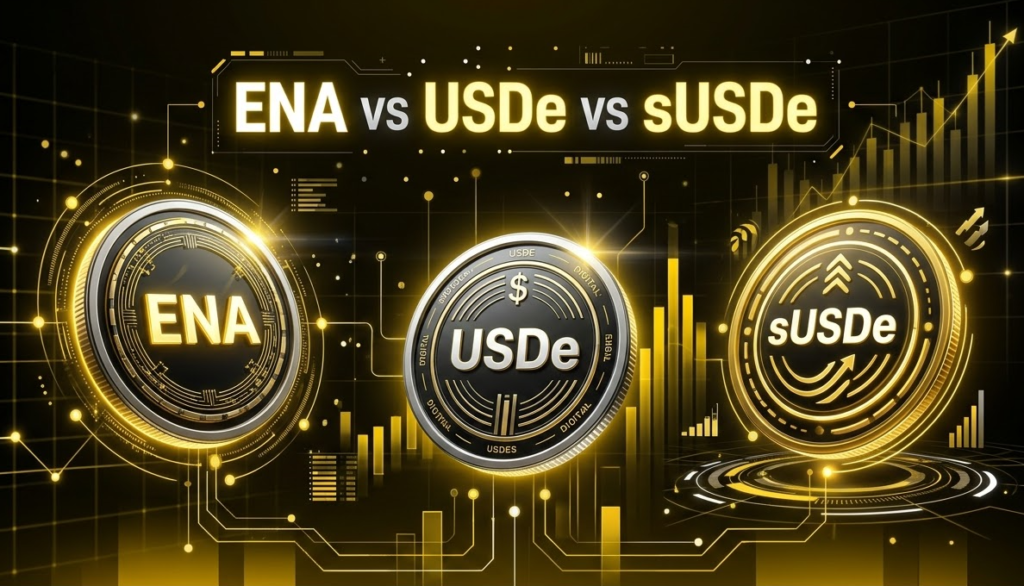
If you remember only one thing from this section, remember that ENA, USDe, sUSDe, and sENA are not different versions of the same asset.
They serve different purposes.
| Asset | Main function | Intended behavior | Main consideration |
|---|---|---|---|
| ENA | Governance and ecosystem token | Floating market price | Volatility and token supply |
| USDe | Synthetic dollar | Designed to track $1 | Backing, derivatives, liquidity, and counterparty risks |
| sUSDe | Staked USDe product | Represents staked USDe with accumulated rewards | Variable yield and product-specific risks |
| sENA | Staked ENA receipt token | Represents ENA deposited into the staking contract | Exchange ratio, staking terms, and eligible distributions |
Let’s look at each asset in more detail.
ENA: The Volatile Governance Asset
ENA is the token used for governance participation and other ecosystem functions.
It does not have a dollar peg. Its market price can rise or fall depending on investor sentiment, liquidity, supply changes, governance decisions, and expectations about Ethena’s business.
If you own ENA, you are exposed to the market value of the token itself.
You may also have governance rights under the applicable rules and access to staking through the Ethena interface, depending on eligibility and protocol availability.
The 2026 fee-switch approval adds another potential dimension because eligible protocol revenue may be used for ENA buybacks once the specified conditions are met.
Still, ENA should not be treated as a guaranteed income-generating asset. Governance participation, staking rewards, and buybacks are separate mechanisms, each with its own conditions.
USDe: Ethena’s Synthetic Dollar
USDe is designed to maintain a value close to one U.S. dollar.
Unlike a conventional stablecoin that may rely primarily on cash and short-term government securities held by an issuer, Ethena’s original synthetic dollar model used crypto collateral combined with offsetting derivatives positions.
The central idea is delta hedging.
In simplified terms, the protocol holds assets that can have positive exposure to crypto prices while maintaining short derivatives positions designed to offset much of that price exposure.
For example, if the value of the underlying crypto asset rises, the short derivatives position can lose value while the backing asset gains value. If the crypto asset falls, the derivatives position can gain value while the backing asset loses value.
The objective is to reduce net directional exposure to the underlying asset.
This does not mean the system is risk-free. Hedging depends on the positions behaving as expected, the exchanges functioning correctly, collateral remaining available, and liquidity being sufficient when the protocol needs to adjust or unwind exposure.
Ethena’s official protocol documentation explains the relationship between USDe’s backing assets and derivatives positions.
It is also important to understand that the protocol’s backing composition can change over time. Ethena’s risk assessments and governance discussions address eligible assets, counterparty exposure, and changes to the portfolio.
sUSDe: The Yield-Bearing Internet Bond
sUSDe is the staked version of USDe.
Users who stake USDe through the supported mechanism receive sUSDe, which represents their staked position and its accumulated value.
The yield is generated through the protocol’s revenue sources, which can include derivatives funding and basis-related returns, as well as income from backing assets where applicable.
These returns are variable. They depend on market conditions and the protocol’s actual income after relevant costs and reserve allocations.
This is why sUSDe is often described as an Internet Bond. The comparison refers to its yield-bearing structure, not to a conventional government bond with guaranteed interest payments.
The Ethena FAQ explains how funding rates and other sources of protocol revenue contribute to the overall return.
A period of positive funding may benefit the short side of perpetual futures markets, while prolonged negative funding can reduce returns or create additional costs.
So, if you want exposure to Ethena’s yield-bearing dollar product, sUSDe is the relevant asset to research. Holding ENA alone does not automatically provide sUSDe yield.
sENA: The Staked ENA Receipt
sENA is different from sUSDe because its underlying asset is ENA rather than USDe.
When you stake ENA, you receive sENA according to the applicable exchange ratio. Eligible distributions can accumulate within the staking contract, increasing the value represented by sENA.
The token is therefore a representation of a staked ENA position, not a dollar-denominated savings instrument.
Its value remains connected to ENA. If ENA’s market price falls, the dollar value of a user’s sENA position can also fall, even if the exchange ratio between sENA and ENA increases.
That is an important risk to remember. A growing ENA-denominated claim does not guarantee a growing dollar value.
Tokenomics, Vesting Schedules, and Supply Distribution
Tokenomics is one of the most important areas to examine before buying or holding ENA.
A token can have strong governance utility and a growing ecosystem, but its market performance is also influenced by how many tokens exist, who owns them, when locked tokens become transferable, and whether new demand can absorb the additional supply.
ENA has a fixed maximum supply of 15 billion tokens.
That is the headline figure, but the allocation and release schedule provide a much clearer picture of potential supply pressure.
The 15 Billion ENA Maximum Supply
Ethena’s initial token allocation is commonly presented across four broad categories:
| Allocation | Percentage | ENA amount |
|---|---|---|
| Core Contributors | 30% | 4.50 billion |
| Investors | 25% | 3.75 billion |
| Ecosystem Development | 20% | 3.00 billion |
| Foundation | 15% | 2.25 billion |
| Airdrops | 10% | 1.50 billion |
| Total | 100% | 15.00 billion |
The exact presentation of community and ecosystem categories can differ between data providers, particularly when airdrops are grouped under broader ecosystem allocations. For a careful analysis, it is important not to count the same tokens twice.
The broad allocation tells us how the initial supply was assigned:
Core Contributors — 30%
This allocation is intended for the people involved in developing and operating the project, including contributors and relevant advisors.
It represents a substantial share of the total supply. Investors should therefore pay attention to its vesting schedule and the timing of future releases.
Investors — 25%
This portion was allocated to early investors who supported the project.
Investor allocations can create potential market supply as tokens become transferable. However, an unlock does not automatically mean that every recipient sells immediately.
Some investors may hold their tokens, use them for governance, stake them, or transfer them for other reasons.
Ecosystem Development — 20%
This allocation supports the development and expansion of the Ethena ecosystem.
It can be used for incentives, integrations, partnerships, and other initiatives intended to increase adoption.
Foundation — 15%
The Foundation allocation supports the broader ecosystem and its development.
Potential uses include governance-related activities, research, risk assessment, audits, ecosystem expansion, and other approved initiatives.
Airdrops — 10%
Airdrops distribute tokens to eligible users and participants.
They can help broaden token ownership and reward early ecosystem activity, although the long-term effect depends on whether recipients continue participating after receiving their allocations.
For an overview of token distribution and vesting data, see Ethena’s tokenomics profile on Tokenomics.com and the available ENA unlock schedule. Third-party trackers are useful for monitoring, but their figures should be cross-checked against official disclosures and any updated token agreements.
ENA Vesting Schedules
Vesting determines when allocated tokens become available to recipients.
It is not enough to know that a project has a 15 billion token cap. You also need to understand how much of that supply is already circulating and how much may become transferable in the future.
The original vesting structure included different arrangements for different allocation categories.
| Allocation | Broad vesting structure |
|---|---|
| Core Contributors | One-year cliff followed by three years of linear monthly vesting |
| Investors | One-year cliff followed by three years of linear monthly vesting |
| Ecosystem Development | Multi-year vesting and ecosystem distribution schedule |
| Foundation | Initial release followed by a longer vesting period |
| Airdrops | Campaign-based distributions and release schedules |
A cliff means that tokens do not unlock gradually during the initial period. Instead, a specified amount becomes available when the cliff ends, after which the remaining allocation may vest over time.
Linear vesting works differently. Tokens are released gradually across a defined period.
For example, if an allocation of 1.2 billion tokens vests evenly over 36 months, the theoretical monthly release would be approximately 33.33 million tokens. Actual schedules can include more detailed contractual conditions, so this simplified calculation should not replace the official vesting documents.
The 2026 Investor Unlock Changes
A particularly important development occurred in August 2026, when Ethena announced an agreement involving certain lead investors and the accelerated release of remaining original investor ENA tokens.
The arrangement was intended to change the timing of some previously scheduled investor releases, with a single-tranche release beginning October 5, 2026, rather than continuing under the earlier monthly unlock schedule.
However, the announcement also distinguished these accelerated releases from certain locked ENA holdings that remained subject to their contractual restrictions unless the relevant agreements were amended.
This matters because token unlock trackers may not always reflect every contractual distinction immediately.
A scheduled release, a legally transferable token, and a token that is actually sold into the market are three different things.
Investors should therefore avoid treating every unlock event as an automatic increase in immediate selling pressure.
Ethena’s Q3 2026 governance update discusses the investor arrangements and the broader tokenomics developments announced during the quarter.
Why Token Unlocks Matter for ENA Holders
Token unlocks can influence market supply and investor expectations.
Suppose a project has 10 billion tokens circulating and another 1 billion becomes transferable. If recipients decide to sell a substantial portion, the market may need additional demand to absorb that supply without a major price adjustment.
But the effect is not always negative.
An unlock can also increase liquidity, allow more holders to participate in governance, and make tokens available for staking or ecosystem activities.
What matters is the relationship between new supply and real demand.
When evaluating ENA, I would monitor several metrics together:
- Circulating supply and its rate of growth.
- The size of upcoming unlocks relative to average trading volume.
- The allocation category receiving the unlocked tokens.
- The difference between scheduled unlocks and actual transfers.
- The amount of ENA held in staking contracts.
- Governance participation and the distribution of voting power.
- The execution of the approved buyback framework.
- Changes in the market demand for ENA.
A large unlock is not automatically bearish, just as a buyback announcement is not automatically bullish. Both need to be evaluated in the context of actual market activity.
Fixed Supply Does Not Mean No Dilution Risk
ENA’s 15 billion maximum supply provides a defined ceiling, but it does not eliminate dilution concerns.
If a large portion of the maximum supply remains locked, the circulating supply can continue increasing even though no new tokens are being created beyond the cap.
For existing holders, this means their percentage ownership of the total supply can decline as additional tokens enter circulation, unless they acquire more tokens or participate in mechanisms that change the distribution.
The key question is not simply whether ENA has a fixed supply. It is how quickly the remaining supply becomes available and whether demand can grow at a comparable pace.
Common Pitfalls and Misconceptions About Ethena
Ethena’s ecosystem has several connected assets and mechanisms. That creates opportunities, but it also makes the project easy to misunderstand.
Here are some of the most common mistakes worth avoiding.
Misconception: ENA Is the Same as USDe
This is incorrect.
ENA is the governance token, while USDe is the synthetic dollar.
ENA has a floating market price and can experience significant volatility. USDe is designed to maintain a value close to one dollar through its backing and hedging structure.
They serve different purposes and carry different risk profiles.
If you want governance exposure, ENA is the relevant token. If you want exposure to Ethena’s synthetic dollar, USDe is the relevant asset to study.
Misconception: Holding ENA Automatically Pays USDe Interest
Holding ENA does not automatically make you eligible for sUSDe yield.
The yield-bearing product is sUSDe, which represents staked USDe.
ENA has its own staking mechanism through sENA, and the reward mechanics are separate.
It is possible for an investor to hold ENA, stake ENA for sENA, and separately acquire USDe or stake USDe for sUSDe. But those are distinct positions, not one automatic reward package.
Misconception: sENA Is Just Another Name for ENA
sENA represents ENA deposited into the staking contract.
The amount of ENA represented by one sENA can change as eligible distributions accumulate.
This means users should pay attention to the exchange ratio, withdrawal process, cooldown conditions, and the current staking rules.
The receipt token is connected to ENA, but it is not identical to holding liquid ENA directly in a wallet.
Misconception: Every sENA Holder Is Restaking Through Symbiotic
This is too broad.
Ethena’s staking documentation describes the sENA receipt mechanism. Separate infrastructure arrangements may involve ENA being staked as collateral by operators supporting services such as cross-chain verification.
Those arrangements should not be automatically attributed to every sENA holder.
Before describing a position as restaked, check the actual vault, operator, accepted collateral, and slashing conditions.
Misconception: The Risk Committee Guarantees USDe’s Peg
The Risk Committee is an important part of Ethena’s risk-management framework, but no committee can eliminate every market or operational risk.
USDe depends on multiple systems working as intended.
These include derivatives exchanges, custody arrangements, collateral markets, smart contracts, liquidity venues, and cross-chain infrastructure.
A strong risk framework can reduce the likelihood or impact of certain failures. It cannot guarantee that no failure will occur.
Misconception: ENA Buybacks Guarantee a Higher Token Price
The approved fee-switch framework is a meaningful governance development, but buybacks do not guarantee price appreciation.
The actual effect depends on:
- Whether the relevant USDe supply milestones are reached.
- Whether the protocol generates eligible revenue.
- The amount allocated to buybacks.
- The execution price and liquidity available.
- The amount of ENA entering circulation through unlocks.
- Overall market conditions and investor demand.
Buybacks can support demand, but they do not remove volatility or token supply risk.
System Architecture: How ENA Connects to the Ethena Ecosystem
The following simplified relationship map shows how the major assets and entities fit together.
                         ETHENA ECOSYSTEM
                                |
                         Ethena Labs
                                |
                  Develops and supports protocol
                                |
             +------------------+------------------+
             |                  |                  |
            ENA                USDe              sUSDe
             |                  |                  |
      Governance token     Synthetic dollar    Staked USDe
             |                  |                  |
      +------+-------+     Backing and         Protocol-generated
      |              |     hedging structure   yield exposure
      |              |
 Risk Committee   sENA
 elections          |
      |          Staked ENA
      |          receipt token
      |
 Risk oversight
      |
 Collateral, custody,
 counterparty and reserve
 assessment

 Cross-chain infrastructure:
 LayerZero messaging + DVN operators
      |
 Certain operators may stake ENA
 as operational collateral
The diagram deliberately separates the sENA staking mechanism from the ENA collateral used by certain infrastructure operators. They are related to the same ecosystem, but they are not necessarily the same position or reward arrangement.
How to Stake ENA for sENA and Participate in Governance
If you already hold ENA and want to explore staking, the process is relatively straightforward. However, you should understand the exchange ratio and withdrawal conditions before approving any transaction.
The following is an educational walkthrough. Interface labels, eligibility requirements, and supported features may change, so always follow the current instructions on Ethena’s official website.
Phase 1: Acquire ENA and Prepare Your Wallet
Step 1: Set up an Ethereum-compatible wallet
Use a wallet that supports Ethereum and ERC-20 tokens.
Before connecting, make sure you control the wallet and understand how to protect its recovery phrase. Never share your seed phrase or private keys with a website, support representative, or third party.
Step 2: Acquire ENA
You can acquire ENA through supported exchanges or other available market venues.
Before purchasing, check the token contract address and make sure you are interacting with the genuine ENA asset. Token tickers can be copied by unrelated or malicious tokens.
Step 3: Keep enough ETH for transaction fees
Because the staking process takes place through Ethereum-compatible infrastructure, you may need ETH to pay gas fees.
Do not send your entire ETH balance into another transaction if you still need it to approve and complete the staking operation.
Phase 2: Stake ENA and Receive sENA
Step 1: Open the official Ethena interface
Navigate to the official Ethena website and locate the staking interface through the project’s own navigation.
Avoid clicking random staking links shared through social media or unsolicited messages.
Step 2: Connect your wallet
Connect your Ethereum-compatible wallet and confirm that the selected network is correct.
Review the permissions requested by the interface. A legitimate staking transaction should not require you to reveal your recovery phrase.
Step 3: Select the ENA staking option
Choose the option to stake ENA.
Enter the amount you want to deposit and review the estimated sENA amount you will receive.
Pay attention to the current exchange ratio. Do not assume that one ENA will always produce exactly one sENA.
Step 4: Review and confirm the transaction
Check the amount, contract interaction, network fee, and transaction details before signing.
Once the transaction is confirmed on-chain, the staking contract should issue sENA to your wallet.
Step 5: Monitor your position
After staking, monitor the sENA balance and the applicable exchange ratio.
Remember that the value of sENA is linked to ENA. An increase in the ENA-denominated value represented by sENA does not guarantee a higher dollar value if ENA’s market price falls.
Phase 3: Participate in Ethena Governance
Step 1: Visit the official governance forum
Use the Ethena Governance Forum to review proposals, committee discussions, and risk assessments.
Read the proposal itself rather than relying only on social media summaries.
Step 2: Check voting eligibility
Governance proposals can have specific eligibility rules. Confirm whether your ENA or sENA position qualifies under the current voting mechanism.
Do not assume that every token balance automatically counts toward every proposal.
Step 3: Review the proposal and its implications
Look at the proposal’s objectives, potential costs, risks, and implementation requirements.
For example, a proposal concerning the Reserve Fund may have very different implications from one concerning ecosystem incentives or ENA buybacks.
Step 4: Cast your vote
If you are eligible, follow the voting interface and confirm the proposal details before submitting your vote.
Keep in mind that governance participation is not risk-free. A decision can be approved and still produce outcomes that some tokenholders dislike.
Phase 4: Understand the Risks Before Using Additional Infrastructure
If you are considering using ENA or sENA in an external staking or restaking platform, do not assume that the original Ethena staking terms still apply.
Check the additional protocol’s documentation and identify:
- The actual asset being deposited.
- The vault or contract receiving it.
- The operator responsible for the service.
- Any slashing or penalty conditions.
- The withdrawal and unbonding period.
- The source of rewards.
- The smart-contract and counterparty risks.
A token that is liquid in one context may become subject to additional restrictions when deposited into another protocol.
Risks of Holding ENA and Using Ethena Products
Ethena’s architecture creates several potential sources of value, but it also introduces risks that investors should understand before committing capital.
ENA Market Volatility
ENA is a volatile crypto asset.
Its price can be affected by market-wide movements, changes in token supply, governance decisions, investor sentiment, and the perceived growth of the Ethena ecosystem.
Even if the protocol continues operating successfully, ENA can fall in value.
Token Unlock and Supply Risk
The 15 billion token cap does not mean all tokens are already circulating.
Future unlocks can increase the amount of ENA available for trading. The market impact depends on the size of the release, recipient behavior, and available demand.
Governance Concentration
Tokenholder voting does not necessarily mean power is evenly distributed.
Large holders, delegates, and organized participants can have more influence than smaller holders.
A governance system may be formally open while practical decision-making remains concentrated among a relatively small number of participants.
Smart-Contract Risk
Ethena relies on smart contracts for staking, token accounting, and other protocol functions.
A vulnerability, configuration error, compromised administrative key, or unexpected interaction with another protocol could result in losses.
Audits and monitoring help reduce risk, but they cannot prove that a contract is impossible to exploit.
Derivatives and Counterparty Risk
USDe’s design involves derivatives positions and external trading infrastructure.
Exchange outages, custody failures, liquidation problems, liquidity shortages, or extreme market movements can affect the protocol’s ability to maintain its intended hedging strategy.
Negative Funding Rates
Funding rates are not permanently positive.
If short positions must pay funding for an extended period, the protocol’s returns can decline or become negative.
This is one reason the Reserve Fund and risk-management process matter.
Restaking and Cross-Chain Risk
When assets are used to support external infrastructure, users may be exposed to additional risks.
These can include operator failure, slashing, bridge vulnerabilities, verification mistakes, and dependencies on external protocols.
A cross-chain integration may improve usability, but it also expands the number of systems that need to function correctly.
Regulatory and Access Risk
Stablecoin products, derivatives, staking services, and digital asset governance can face changing regulatory requirements.
Access to particular features may depend on the user’s location, the service provider, and the applicable legal framework.
Always review the current terms and eligibility restrictions before using Ethena products.
Frequently Asked Questions About Ethena (ENA)
What Is Ethena (ENA) and What Is Its Main Function?
ENA is the native governance token of the Ethena ecosystem on Ethereum. Its main functions include governance participation, voting on proposals, participating in Risk Committee elections, and supporting the protocol’s broader economic and staking mechanisms.
The token is not the same as USDe, Ethena’s synthetic dollar.
What Is the Difference Between ENA and USDe?
USDe is a synthetic dollar designed to maintain a value close to $1. ENA is a volatile governance token used to participate in the management and development of the Ethena ecosystem.
USDe focuses on dollar-denominated value stability, while ENA provides governance and ecosystem utility.
What Is sENA?
sENA is the receipt token users receive when they stake ENA through Ethena’s staking mechanism.
It represents a staked ENA position. Eligible distributions can accumulate within the staking contract, increasing the value represented by sENA relative to ENA.
It should not automatically be described as a universal liquid-restaking token securing every Symbiotic or LayerZero service.
Does Holding ENA Generate USDe Yield?
No. Holding ENA does not automatically provide the yield associated with sUSDe.
sUSDe is the staked version of USDe and is the relevant product for users seeking exposure to Ethena’s yield-bearing dollar mechanism.
ENA staking through sENA is a separate process with its own reward and exchange-ratio mechanics.
What Is the Maximum Supply of ENA?
ENA has a fixed maximum supply of 15 billion tokens.
The initial allocation includes core contributors, investors, ecosystem development, the Foundation, and airdrops. The vesting schedule determines when allocated tokens become available.
How Does the Ethena Risk Committee Work?
The Ethena Risk Committee evaluates risks across the ecosystem, including collateral eligibility, derivatives counterparties, custody arrangements, liquidity, smart-contract dependencies, and the Reserve Fund.
ENA holders participate in the governance process that elects committee members. The committee provides specialized oversight rather than guaranteeing that all risks will be eliminated.
Can I Unstake sENA at Any Time?
Ethena’s staking documentation describes an unstaking process through its interface, with a seven-day cooldown documented before ENA becomes available for withdrawal.
Check the current official interface and documentation before initiating an unstaking transaction because the applicable conditions may change.
Does Ethena Use LayerZero?
Yes. LayerZero messaging infrastructure is used for cross-chain operations involving Ethena ecosystem assets.
Decentralized Verifier Nodes help verify cross-chain messages. Certain infrastructure operators can maintain staked ENA as operational collateral under their service arrangements.
That does not mean every sENA holder directly secures LayerZero messaging.
What Is the ENA Fee Switch?
The ENA fee switch is a governance-approved framework that links a portion of eligible protocol revenue to ENA buybacks when specified USDe supply milestones are reached.
It is intended to create a clearer economic connection between protocol activity and ENA. It does not guarantee a fixed yield or direct cash payment to tokenholders.
Is ENA a Good Long-Term Investment?
That depends on your risk tolerance, investment horizon, and view of Ethena’s future adoption.
Potential positives include the growth of the USDe ecosystem, governance utility, staking mechanisms, cross-chain integrations, and the approved fee-switch framework.
Potential risks include token unlocks, market volatility, derivatives exposure, governance concentration, smart-contract vulnerabilities, and competition from other stablecoin and DeFi protocols.
I would evaluate ENA using both protocol fundamentals and token supply data rather than relying on ecosystem growth announcements alone.
Final Thoughts
Ethena is more than a single-token project. Its ecosystem combines a synthetic dollar, a yield-bearing dollar product, a governance token, an ENA staking mechanism, and cross-chain infrastructure.
ENA is the governance asset at the center of that structure. It gives holders a way to participate in protocol decisions, elect members of the Risk Committee, and influence the ecosystem’s direction. The approved 2026 fee-switch framework also creates a potential link between protocol revenue and ENA buybacks, although the effect depends on actual revenue and the conditions required to activate the mechanism.
sENA adds another layer by representing staked ENA and reflecting eligible distributions through its exchange ratio. But it is important not to confuse that staking receipt with every external restaking or infrastructure-collateral arrangement. LayerZero DVN operators, Symbiotic integrations, and Ethena’s native staking contract have different roles and risk conditions.
For anyone researching ENA, I would focus on four things: the quality of Ethena’s governance, the sustainability of USDe’s backing and revenue model, the actual implementation of the fee switch, and the remaining token unlock schedule.
Those factors provide a much better basis for understanding the token than price predictions or short-term market narratives.
Ethena’s long-term success will depend on whether it can maintain confidence in USDe, manage its financial and technical risks, expand useful integrations, and create sustainable economic value across its ecosystem. ENA gives tokenholders a role in that process, but it does not remove the risks involved in participating in crypto markets.
Editorial note: I have deliberately corrected three points in the supplied outline: sENA is described as Ethena’s ENA staking receipt token rather than automatically as a Symbiotic/LayerZero restaking asset; ENA used as collateral by certain DVN operators is treated as a separate infrastructure arrangement; and the Risk Committee is described as a specialist oversight body elected through governance, not as an entity that directly controls every reserve or collateral decision. These distinctions are important for technical accuracy.