Key Specifications and Architectural Overview of ether.fi
If you’ve spent time in Ethereum DeFi, you’ve probably noticed that staking has become more complicated than simply depositing ETH and waiting for rewards. Liquid staking made ETH positions transferable, restaking introduced another layer of potential rewards and responsibilities, and newer financial products now let users put those positions to work in lending markets, automated vaults, and payment systems.
ether.fi sits at the intersection of these developments.
At its core, ether.fi is a liquid staking and restaking ecosystem built around Ethereum. Users deposit ETH and receive liquid tokens representing their position. The protocol connects staking infrastructure with EigenLayer restaking, allowing eligible staked ETH to support additional services known as Actively Validated Services (AVSs). Users can then keep their liquid positions in a wallet or use supported assets across DeFi applications.
The project has also grown beyond its original staking product. ether.fi Stake handles ETH staking, ether.fi Liquid offers automated yield strategies, and ether.fi Cash connects eligible crypto balances with spending and borrowing services. ETHFI is the ecosystem’s governance token, while sETHFI represents ETHFI that has been staked through the protocol’s newer staking system.
| Dimension | ether.fi specification |
|---|---|
| Protocol | ether.fi |
| Founding leadership | Mike Silagadze and Rok Kopp |
| Main ecosystem | Ethereum staking, liquid restaking, DeFi vaults, and financial services |
| Primary settlement network | Ethereum, with products and services also available on supported additional networks |
| Core staking asset | ETH |
| Liquid staking/restaking tokens | eETH and weETH |
| eETH design | Rebasing liquid restaking token |
| weETH design | Wrapped, non-rebasing liquid restaking token |
| Restaking infrastructure | EigenLayer and participating AVSs |
| Governance token | ETHFI |
| ETHFI maximum supply | 1 billion tokens |
| Staked governance token | sETHFI |
| Automated yield product | ether.fi Liquid |
| Payment and borrowing product | ether.fi Cash |
| Validator infrastructure | Distributed node operators, with DVT used by some operators |
| Security model | Smart contracts, validator infrastructure, withdrawal controls, and external security reviews |
One point deserves attention before going further: ether.fi’s interface and product descriptions have evolved. Its current staking page emphasizes receiving weETH when staking ETH, while eETH remains important for understanding the protocol’s original rebasing-token architecture and the relationship between the two assets. You should always check the current deposit and redemption interface rather than assume every historical token route is still the default.
The official ether.fi staking page describes its current staking experience, while the ether.fi Help Center provides product-specific explanations for eETH, weETH, Liquid, and Cash.
What Makes ether.fi Different? Non-Custodial Staking and Validator Key Control
Traditional staking services often ask users to deposit ETH into a pooled system and rely on an operator to manage validator infrastructure. That arrangement can be convenient, but it introduces a question that matters more than the advertised APY: who controls the keys, and who can authorize withdrawals?
ether.fi was designed around a different approach. Its architecture separates the user’s control over withdrawal credentials from the operational responsibilities of validator infrastructure. This is the foundation of its non-custodial positioning.
However, it is worth being precise. Non-custodial does not mean the user personally runs every validator or holds every key used by the network’s operators. The protocol distributes responsibilities across smart contracts, stakers, and node operators. Understanding those distinctions is more useful than simply calling the system decentralized.
Why Non-Custodial Validator Key Control Matters
Ethereum validators use different cryptographic credentials for different jobs. The validator signing key is used to perform duties such as attestations and block proposals. Withdrawal credentials determine where a validator’s withdrawable funds can ultimately be sent.
These keys serve different purposes, and confusing them leads to misleading descriptions of staking products.
In a conventional delegated staking arrangement, an operator may control much of the validator infrastructure and manage the signing process. The user may receive a token or account balance representing their claim, but the actual operational setup can be relatively opaque.
ether.fi’s design aims to preserve the user’s control over withdrawal credentials while allowing independent operators to run validator infrastructure. This reduces the need to trust one centralized staking provider with unilateral control over the user’s withdrawal destination.
That separation is important for several reasons:
- Withdrawal control: The operator should not be able to redirect a user’s withdrawal destination simply because it operates the validator.
- Operator accountability: Node operators perform defined duties under the protocol’s rules rather than receiving unrestricted ownership of deposited ETH.
- Reduced single-provider dependence: A distributed operator network can reduce the concentration of infrastructure and operational responsibility.
- Transparent execution: Deposits, token issuance, and other protocol interactions can be inspected through Ethereum smart contracts.
There is still a meaningful distinction between controlling withdrawal credentials and controlling the validator signing process. Validators need online signing infrastructure to perform their duties. Operators may therefore hold or participate in the management of signing credentials, depending on the validator configuration.
For users, the central benefit is not that ether.fi eliminates every trust assumption. It is that the protocol is designed to separate key responsibilities and reduce dependence on a single centralized custodian.
The ether.fi Cash Vault documentation also illustrates how the project’s newer account infrastructure approaches non-custodial authorization: transactions require the user’s authorization through its wallet-signing system. That is a separate product architecture from Ethereum validator key management, but it reflects the same broader emphasis on user-controlled authorization.
Distributed Validator Technology and Node Operator Selection
A validator must remain online and perform its assigned duties. If it goes offline, it can miss rewards and incur penalties. If it signs conflicting messages, it may face slashing.
This creates a practical infrastructure problem. A validator operated by one server can become unavailable if that machine fails, its network connection drops, or its operator makes a configuration mistake.
Distributed Validator Technology (DVT) addresses part of this problem by distributing validator signing responsibilities across multiple independent operators.
Instead of placing the complete validator signing key on one machine, DVT divides signing authority into key shares. A group of operators works together to produce valid signatures, with a threshold of participants required to complete the operation. The full key does not need to be reconstructed on a single online server for normal validator duties.
For example, a cluster might use a five-of-seven threshold. In that configuration, five participating operators are required to produce a valid signature. The remaining operators provide redundancy if some machines become unavailable.
This can improve resilience because one failed server does not necessarily take the validator offline. It can also reduce the risk that a single compromised operator gains complete control over signing.
The Ethereum community’s DVT explanation describes how key shares and threshold signatures work. The SSV Network technical documentation provides a more detailed example of distributed validator operation.
It would be inaccurate, though, to say that every ether.fi validator automatically uses DVT. Its operator infrastructure includes different implementations and setups. In its Q3 2026 Operator Atlas report, ether.fi describes which operators use SSV-based DVT and how validator clients and infrastructure are distributed.
That transparency is useful because decentralization is not a binary feature. It depends on the number of independent operators, their geographic and hosting diversity, the software clients they run, and how much stake is concentrated among them.
DVT can reduce certain operational risks, but it cannot eliminate every form of slashing, software failure, or operator coordination problem.
Understanding Liquid Restaking: How eETH and weETH Work
Liquid staking solves a simple problem: ETH locked in staking is not as flexible as ETH sitting in a wallet. If you deposit ETH into a staking system, you generally want to earn staking rewards without losing the ability to use the economic value of your position.
A liquid staking token represents that position in a transferable form.
Liquid restaking adds another layer. Instead of using staked ETH only to support Ethereum consensus, the protocol can also allocate eligible stake to additional services that require economic security. EigenLayer is one of the best-known systems for this purpose.
ether.fi connects these ideas through eETH and weETH.
How eETH Generates Staking and Restaking Rewards
When you deposit ETH through ether.fi’s liquid staking system, your deposit becomes part of the protocol’s staking infrastructure. The ETH supports Ethereum validators, which perform consensus duties and earn rewards for participating correctly.
Those rewards can include:
- Consensus-layer rewards for validator duties.
- Execution-layer rewards associated with block proposals.
- Priority fees and MEV-related income, depending on validator configuration and distribution rules.
- Additional rewards associated with restaking, where applicable.
The liquid token represents the user’s economic position in this system. Rather than requiring the user to run a validator, maintain infrastructure, or claim every reward manually, the protocol handles the underlying staking operations.
The restaking component connects eligible stake to EigenLayer. EigenLayer allows staked ETH and supported liquid staking assets to provide economic security to other services. These services are called Actively Validated Services, or AVSs.
An AVS may require operators to perform tasks beyond Ethereum’s base consensus. Depending on the service, those tasks can include data availability, infrastructure verification, middleware services, or other forms of decentralized validation.
Why would anyone provide security to an AVS? Because the service can compensate participating operators and delegators with rewards. In principle, this creates an additional source of income on top of ordinary Ethereum staking.
But there is a trade-off. Restaking can introduce additional obligations and risk. If an AVS has slashing enabled and an operator violates its rules, the associated stake may be exposed to penalties under the applicable restaking configuration.
This is why the phrase “dual yield” needs a little context. ETH staking rewards and restaking rewards are not two guaranteed interest payments. The first depends on Ethereum validator performance and network economics; the second depends on AVS participation, reward arrangements, operator performance, and any applicable slashing conditions.
You should also distinguish restaking rewards from promotional points or token incentives. A points campaign is not the same as a protocol-generated staking return, and neither should be treated as guaranteed income.
EigenLayer’s official documentation explains AVSs, operators, restaking, and the associated security model. ether.fi’s staking product page describes how users access its staking service.
eETH vs weETH: Rebasing and Non-Rebasing Explained
The difference between eETH and weETH is one of the most important concepts to understand before using ether.fi across DeFi.
Both tokens represent exposure to ether.fi’s liquid restaking position, but they handle accrued value differently.
eETH is the rebasing version. Its balance can increase as rewards accrue. If you hold eETH in a compatible wallet, your token quantity may grow over time as the protocol distributes accumulated rewards through rebasing.
weETH is the wrapped, non-rebasing version. Its token balance does not increase simply because rewards accrue. Instead, the value represented by each weETH changes relative to ETH and the underlying eETH position.
A simplified example makes the distinction easier to see.
Imagine you deposit 10 ETH and receive a liquid token position. As rewards accumulate, the economic value of that position increases.
With a rebasing token, your displayed balance might rise from 10 eETH to 10.1 eETH, assuming the relevant reward accrual and token mechanics produce that change.
With a non-rebasing token, you might continue to hold the same number of weETH, but each token represents a larger amount of the underlying value over time.
The two models can represent similar economic exposure, but they behave differently in smart contracts, wallet displays, lending markets, and accounting systems.
| Feature | eETH | weETH |
|---|---|---|
| Token design | Rebasing | Wrapped, non-rebasing |
| Balance behavior | Token balance can increase through rebases | Token quantity generally remains unchanged |
| Reward representation | Reflected through balance changes | Reflected through the exchange rate |
| DeFi integration | Depends on protocol support for rebasing assets | Often easier for integrations that prefer non-rebasing tokens |
| Typical use | Holding a rebasing liquid restaking position | Using a non-rebasing representation across supported DeFi markets |
This distinction matters when you deposit tokens into a lending protocol or liquidity pool. Some applications are designed to handle rebasing assets correctly; others prefer a token whose balance does not change automatically.
That is one reason weETH is useful for integrations with protocols such as Aave, Pendle, and Morpho, where supported markets can use the wrapped token as collateral or a composable asset. However, the availability of a specific market is not guaranteed across every network or at every point in time.
You should also avoid assuming that eETH and weETH always have a fixed one-to-one market price. Their relationship is defined by the protocol’s conversion mechanics and the value represented by each token. Market prices can diverge from theoretical redemption value when liquidity is limited or market conditions become stressed.
The ether.fi weETH guide describes weETH as the wrapped version of eETH. The current staking interface also emphasizes weETH as the non-rebasing token users receive through the current staking flow.
What Happens When You Withdraw eETH or weETH?
A liquid token is useful partly because it can be transferred or used in DeFi. But that does not mean every withdrawal is instant.
When you redeem a liquid restaking position, the protocol needs to account for the underlying staking position, available liquidity, and Ethereum’s validator withdrawal mechanics. Depending on the route you choose, you may receive ETH through a direct liquidity route or wait for the protocol’s withdrawal process.
There are several practical considerations:
- Liquidity: Immediate redemption depends on available liquidity and the route supported by the protocol.
- Withdrawal queues: Ethereum validator exits and protocol-level queues can introduce delays.
- Fees: Some withdrawal routes may charge fees. Check the current transaction preview before confirming.
- Market pricing: Selling a liquid token on a DEX is different from redeeming it through the protocol. The market price may be above or below its expected underlying value.
The difference is important. If you sell weETH on a secondary market, you are accepting the price available in that market. If you redeem through ether.fi’s official process, you are following the protocol’s withdrawal rules and liquidity conditions.
For a large position, I would check both routes before making a decision. A secondary-market sale may be faster but could incur slippage, while a protocol redemption may have a different timeline and fee structure.
The Expanding Product Suite
ether.fi has developed into more than a liquid restaking protocol. Its broader product suite is designed to let users move from earning on crypto assets to deploying them in DeFi strategies, borrowing against them, and spending through payment infrastructure.
That expansion is commercially interesting, but it also means users need to distinguish between different products. A position in an ETH staking contract does not carry exactly the same risks as a managed DeFi vault or a credit-card borrowing balance.
ether.fi Stake: The Foundation of the Ecosystem
ether.fi Stake is the product that connects users with Ethereum staking and liquid restaking.
The general process is straightforward:
- Connect a supported wallet or account.
- Select the ETH staking product.
- Enter the amount to deposit.
- Review the expected token received, fees, and current rewards information.
- Confirm the transaction.
- Hold or deploy the resulting liquid token in supported applications.
The token received depends on the current product flow and network. As noted earlier, the current staking page prominently presents weETH, while eETH remains relevant to the protocol’s token architecture.
The displayed reward rate is not a fixed promise. Ethereum staking rewards vary with network conditions, validator performance, the amount of ETH staked across the network, and other factors. Restaking-related rewards can also change according to AVS participation and incentive arrangements.
If you are comparing ether.fi with another liquid staking protocol, look beyond the headline APY. Consider the withdrawal process, operator concentration, validator configuration, smart contract risk, token liquidity, and how rewards are distributed.
ether.fi Liquid: Automated Yield-Optimizing Vaults
For users who want to do more with their liquid assets, ether.fi Liquid offers automated DeFi strategies through vaults.
The idea is simple: instead of manually moving assets between lending markets, liquidity pools, and other DeFi positions, you deposit into a supported vault and allow its strategy system to manage allocations.
Depending on the vault, assets may be deployed across different protocols and networks. The system can rebalance positions, compound rewards, and maintain a portion of assets in liquid form to support withdrawals.
The current Liquid documentation describes vault categories such as:
- ETH Yield: Supports eligible ETH-denominated assets, including wETH and weETH.
- BTC Yield: Uses supported Bitcoin-denominated assets such as eBTC.
- USD Yield: Supports USDC deposits.
The precise supported assets and strategies can change, so the live vault page is more reliable than an old screenshot or third-party list.
How does the automation work?
First, you choose a vault based on the asset you want to deploy. After depositing, the vault allocates funds across its selected strategies. The platform monitors positions and can rebalance them according to its strategy design. Rewards are then reflected in the user’s position through the vault’s accounting and compounding mechanisms.
The benefit is convenience. You do not need to manage every lending position or manually move funds each time a strategy changes.
But automation is not the same as safety. A vault can expose users to several layers of risk:
- Smart contract risk: A vulnerability in the vault or an integrated protocol can lead to losses.
- DeFi protocol risk: The vault depends on external lending markets, exchanges, or other applications.
- Liquidity risk: A strategy may not be able to unwind positions immediately.
- Leverage and liquidation risk: Some strategies may use leverage or collateralized positions.
- Strategy risk: A strategy can underperform, become less attractive, or behave unexpectedly during market stress.
- Network risk: Assets deployed across multiple networks are exposed to the security and operational conditions of those networks.
APY figures also need careful interpretation. A displayed vault APY may represent a blended estimate based on the vault’s current strategy allocation and recent performance. It is not a guaranteed return, and the actual result can change.
The ether.fi Liquid guide explains deposits, automated rebalancing, vault allocation views, withdrawal liquidity, fees, and strategy risks. It notes that fees vary by vault and that gas costs may also apply.
One useful feature is the Breakdown view. Rather than showing only a headline APY, the interface provides information about positions, protocols, and networks. This helps users understand where capital is deployed and how much exposure the vault has to particular external systems.
If you are considering a deposit, I would look at that breakdown before comparing yields. A vault advertising a higher rate may simply be taking on more leverage, more protocol exposure, or more liquidity risk.
ether.fi Cash: Using Crypto for Everyday Spending
Staking and DeFi are useful, but most people cannot pay for groceries or a hotel booking directly with a liquid restaking token. ether.fi Cash attempts to bridge that gap by connecting crypto holdings with payment-card infrastructure.
The Cash product provides a virtual and physical card that can be used at merchants accepting its supported payment network. Users can access eligible assets through different spending modes.
Two modes are especially important: Direct Pay and Borrow.
Direct Pay mode uses eligible balances from the user’s account or vault to fund purchases. The current help documentation describes USDC and LiquidUSD as supported spending assets in this mode. The purchase is funded from the available balance, rather than creating a loan against the user’s portfolio.
Borrow mode works differently. Instead of selling the underlying crypto assets to pay for a purchase, the system uses eligible holdings as collateral for borrowing. The user can then spend against the available borrowing capacity while retaining exposure to the collateral assets.
| Feature | Direct Pay | Borrow Mode |
|---|---|---|
| How purchases are funded | Eligible balances are deducted directly | A loan is created against eligible collateral |
| Crypto holdings | Spendable balance is used | Collateral can remain in the vault |
| Interest | No borrowing interest on the direct payment itself | Interest accrues on the borrowed amount |
| Main limitation | Only supported spending assets qualify | Borrowing is limited by collateral value and LTV |
| Main risk | Payment availability and asset conversion | Interest costs, collateral volatility, and liquidation |
Borrowing can be useful if you want access to spending power without selling an asset you believe may appreciate. But it is not free liquidity.
Interest begins accruing on the outstanding loan, and the rate can change with lending-market conditions. If collateral values fall, the loan-to-value ratio can rise. If the position reaches the applicable liquidation threshold, collateral may be liquidated to reduce the debt.
The current Cash card spending guide explains the distinction between these modes. The borrowing guide describes variable rates, collateral requirements, repayments, and liquidation risks.
This is why I would not describe Cash as simply “spending staking yields.” The product can let users spend eligible balances directly or borrow against a wider set of collateral assets. Those are very different financial actions.
There are also practical eligibility requirements. Cash access, card issuance, supported assets, and borrowing limits may depend on identity verification, account status, jurisdiction, and product terms. The ether.fi Cash FAQ explains card access and activation.
ETHFI Tokenomics, DAO Treasury, and Governance Utilities

ETHFI is the governance token associated with the ether.fi ecosystem. It is separate from ETH, eETH, and weETH.
ETH is the underlying Ethereum asset used for staking. eETH and weETH represent liquid staking or restaking positions. ETHFI is designed to support governance and ecosystem incentives.
The token’s utility has evolved over time, so it is important to separate its original governance role from newer staking and membership features.
The 1 Billion ETHFI Maximum Supply
ETHFI has a fixed maximum supply of 1 billion tokens. The project states that the full supply has been minted and that no additional issuance is planned under the published token allocation framework.
The token distribution has included several broad categories:
| Allocation category | Approximate allocation |
|---|---|
| Investors | 33.74% |
| DAO treasury / ecosystem fund | 21.62%–21.63% |
| Core contributors | 21.47% |
| User airdrops | 17.57%–19.27%, depending on the allocation snapshot |
| Partnerships and liquidity | 3.90%–5.60%, depending on the allocation snapshot |
These figures should be read with their publication dates in mind. ether.fi’s governance materials have displayed updated allocation figures as distributions and category accounting have changed. The current ETHFI governance page presents the live allocation summary, while the token allocation documentation provides a dated breakdown and explains the fixed 1 billion supply.
The maximum supply does not mean all tokens are necessarily circulating in the market. Some allocations have vesting schedules, ecosystem purposes, or other restrictions. Circulating supply, total supply, and maximum supply are different measurements.
For investors, the distinction matters because token unlocks can affect market supply even when the maximum supply does not change. A fixed cap can limit future issuance, but it does not guarantee that the market price will rise.
ETHFI Governance and the Role of sETHFI
ETHFI gives token holders a way to participate in the governance of the ether.fi ecosystem.
Governance topics can include:
- Protocol upgrades and parameter changes.
- Treasury allocation and ecosystem funding.
- Token utility and incentive design.
- Node operator and infrastructure-related decisions.
- Protocol revenue allocation and buyback proposals.
- Broader ecosystem development priorities.
The exact powers available to token holders depend on the governance framework and the proposal being considered. Holding ETHFI should not be interpreted as automatically giving an individual control over every protocol contract or operational decision.
The governance system has also developed a staking component. Users can stake ETHFI and receive sETHFI, a representation of their staked ETHFI position. According to ether.fi’s September 2026 help documentation, sETHFI accrues staking rewards, counts toward Cash membership tiers, and remains connected to governance participation.
The official sETHFI guide explains how users stake ETHFI and receive sETHFI. The ETHFI governance page describes the role of staking ETHFI in voting and membership benefits.
This is an important update to older descriptions that present ETHFI as a governance token with no staking-related product. The newer staking system adds another layer of utility, although its APY is variable and rewards are not guaranteed.
Protocol Fees, Buybacks, and Token Value Accrual
One of the biggest questions for any governance token is how the economic activity of its ecosystem connects to the token itself.
A protocol can attract users, generate fees, and expand its products without necessarily creating direct value for its governance token. Token holders therefore look for mechanisms that connect protocol revenue with token demand or distributions.
ether.fi has introduced buyback-related initiatives through governance proposals. One documented program directs revenue from eETH withdrawal fees toward ETHFI purchases, with acquired tokens distributed to sETHFI holders. Governance materials also describe a broader protocol-revenue buyback stream.
The ETHFI Buyback Program documentation describes the weekly withdrawal-fee buyback mechanism and the monthly broader-revenue buyback framework. The relevant DAO proposal provides additional governance context.
There are several details worth keeping in mind:
First, buybacks are not the same as a guaranteed dividend. They depend on revenue, program rules, and execution.
Second, the amount of ETHFI purchased can change with protocol activity and the revenue allocated to the program.
Third, the distribution of buyback-derived tokens to sETHFI holders means the benefit is connected to the staking mechanism, rather than automatically paid to every wallet holding ETHFI.
Finally, governance proposals and treasury decisions can change. Users should check the latest DAO records before assuming a particular fee percentage or buyback schedule remains unchanged.
The broader principle is that ETHFI’s potential value accrual depends on the actual economics of ether.fi’s products, how much revenue is generated, and how the DAO chooses to allocate that revenue. A buyback program can create a link between product activity and token demand, but it does not guarantee price appreciation.
ether.fi vs Lido: Liquid Staking and Liquid Restaking Compared
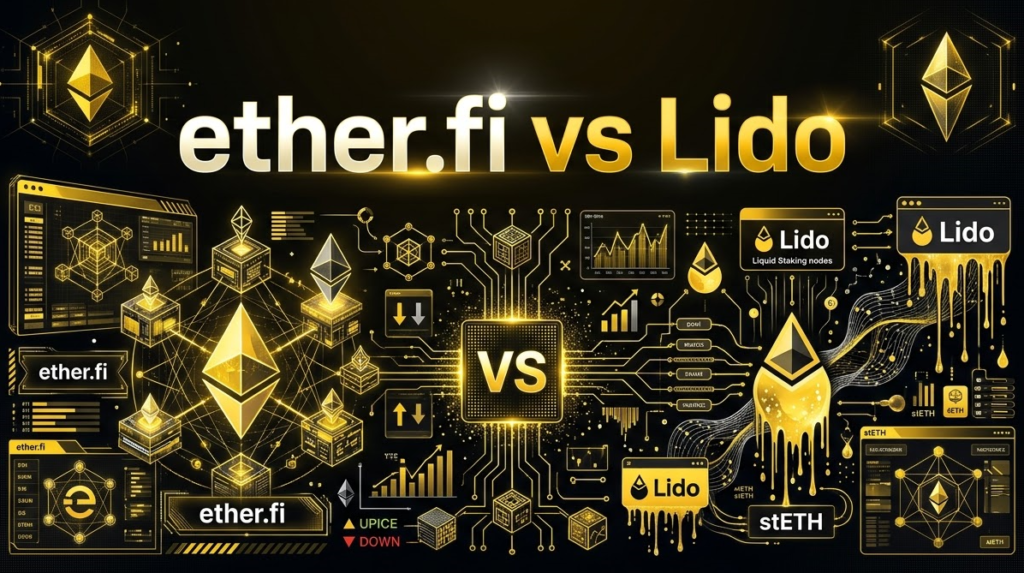
A common question is whether ether.fi is simply another version of Lido. The two projects overlap in the liquid staking market, but their product emphasis and architecture are not identical.
Lido is best known for stETH, a liquid staking token representing ETH staked through its validator network. ether.fi also offers liquid staking exposure, but it has built its identity around non-custodial staking architecture and liquid restaking through EigenLayer.
| Dimension | ether.fi | Lido |
|---|---|---|
| Main staking asset | ETH | ETH |
| Main liquid token | eETH / weETH | stETH / wstETH |
| Primary category | Liquid staking and liquid restaking | Liquid staking |
| Restaking integration | EigenLayer-linked restaking products | Separate restaking integrations may be available through the wider ecosystem |
| Token balance model | eETH rebasing; weETH non-rebasing | stETH rebasing; wstETH non-rebasing |
| Validator infrastructure | Distributed node operators, with DVT used by some | Distributed professional node operators |
| Additional products | Liquid vaults, Cash, ETHFI governance and sETHFI staking | Broader DeFi integrations and ecosystem products |
The token comparison is especially useful.
stETH and eETH are both rebasing-style liquid staking tokens, while wstETH and weETH are non-rebasing wrapped forms. In each case, the wrapped version is often more convenient for DeFi applications that do not handle rebasing balances well.
But the difference between the protocols goes beyond token mechanics. ether.fi’s product strategy includes restaking, automated vaults, and payment services, while Lido’s core product remains liquid staking and its surrounding ecosystem.
Neither protocol is risk-free. Both depend on smart contracts, validator operators, liquidity, and Ethereum’s staking mechanics. Restaking adds another set of risks when assets support additional services.
If you’re comparing the two, don’t rely only on headline APY. Look at the token’s market liquidity, redemption process, operator distribution, contract audits, and the degree of additional risk introduced by restaking.
Common Pitfalls and Misconceptions About ether.fi
Misconception: ether.fi Is Just a Standard Liquid Staking Protocol
Liquid staking and liquid restaking are related, but they are not interchangeable terms.
A standard liquid staking protocol issues a transferable token representing an ETH staking position. A liquid restaking protocol can also allocate eligible stake to additional services that use economic security.
ether.fi combines liquid staking with restaking integrations through EigenLayer. That adds potential reward sources, but also additional dependencies and risk.
Misconception: eETH and weETH Work the Same Way
They represent related economic exposure, but their balance mechanics differ.
eETH is rebasing, so its token balance can increase as rewards accrue. weETH is non-rebasing, so the number of tokens held generally stays the same while the value represented by each token changes.
This distinction affects wallet displays, accounting, and DeFi compatibility.
Misconception: Users Personally Hold Every Validator Key
The phrase “non-custodial” can create confusion.
Users retain control over important withdrawal credentials, while validator operations are handled through the protocol’s infrastructure and node operators. Depending on the configuration, signing responsibilities may be distributed across operators using DVT.
That is not the same as every user personally holding the full online validator signing key or running the validator themselves.
Misconception: Restaking Rewards Are Guaranteed on Top of ETH Staking Rewards
Restaking can create additional reward opportunities, but it also adds risk and operational complexity.
AVS rewards depend on the service, operator participation, incentive arrangements, and network conditions. If slashing is enabled for a particular service and the applicable conditions are met, stake can be exposed to penalties.
There is no reason to treat a projected restaking APY as a guaranteed second income stream.
Misconception: Liquid Vaults Are Risk-Free Because They Are Automated
Automation reduces the amount of manual work required, but it does not remove the risks of the underlying strategies.
A vault may depend on lending protocols, liquidity pools, smart contracts, or leveraged positions. If one of those systems fails, the vault can be affected.
Before depositing, check the vault’s allocation breakdown, external protocol exposure, withdrawal conditions, and fee structure.
Misconception: Cash Lets You Spend Any Crypto Asset Without Selling or Borrowing
Cash has different spending modes and asset eligibility rules.
Direct Pay uses eligible balances, while Borrow mode creates a loan secured by eligible collateral. Borrowing can preserve market exposure, but it introduces interest and liquidation risk.
The two modes should not be treated as equivalent ways of paying with crypto.
How to Stake ETH, Wrap to weETH, and Use ether.fi Products
The following guide outlines the typical user journey. Product screens, supported networks, token routes, and availability can change, so always check the live interface before confirming a transaction.
Phase 1: Stake ETH and Receive a Liquid Token
Step 1: Open the official ether.fi staking interface.
Go directly to the official ether.fi Stake page. Check that the domain is correct before connecting your wallet. Avoid links from unsolicited messages or social media replies.
Step 2: Connect a supported wallet or account.
Connect an EVM-compatible wallet supported by the interface. Review the permissions requested by the application. A wallet connection alone should not require you to reveal your recovery phrase.
Step 3: Select the ETH staking option.
Choose the amount of ETH you want to deposit. Review the current token output, displayed reward rate, fees, and withdrawal information.
Do not assume the product will always issue the same token. The current staking interface emphasizes weETH, while other routes and integrations may use eETH.
Step 4: Review and confirm the transaction.
Check the deposit amount and the network. Make sure you have enough ETH remaining to cover gas fees. Confirm the transaction through your wallet.
Step 5: Verify your liquid token balance.
Once the transaction has completed, check your wallet or the protocol interface to confirm the token received. You can then hold it or use it in supported DeFi applications.
Phase 2: Understand and Use eETH or weETH
Step 1: Check which token you hold.
Look at the token symbol and contract address. Do not rely only on a token name displayed by an unfamiliar website or wallet.
Step 2: Understand the balance model.
If you hold eETH, remember that its rebasing mechanics can change your displayed token balance. If you hold weETH, rewards are reflected through the token’s underlying exchange value rather than an automatically increasing balance.
Step 3: Check the destination protocol.
Before supplying either asset to a lending market or liquidity pool, verify that the destination application supports the exact token and network. A protocol may support weETH on Ethereum but not on every L2.
Step 4: Review the transaction and collateral terms.
If you use the token as collateral, check the applicable loan-to-value ratio, liquidation threshold, oracle assumptions, and withdrawal restrictions.
Phase 3: Deposit into ether.fi Liquid
Step 1: Open the Liquid product page.
Visit the official ether.fi Liquid interface and review the available vaults.
Step 2: Select a vault that matches your asset.
For example, an ETH-focused vault may accept wETH or weETH, while a USD-focused vault may accept USDC. The supported assets depend on the current vault configuration.
Step 3: Review the strategy breakdown.
Check the protocols, networks, and positions used by the vault. Look beyond the headline APY. A higher estimated yield may reflect more complex strategy exposure.
Step 4: Enter your deposit amount.
Review the deposit transaction, fees, and any relevant withdrawal conditions. Make sure you understand whether the vault can queue withdrawals under certain liquidity conditions.
Step 5: Confirm and monitor the position.
After depositing, use the vault dashboard to review your balance, rewards, and allocation breakdown. Remember that APY is variable and capital is not guaranteed.
Phase 4: Use ether.fi Cash
Step 1: Check eligibility and account requirements.
Review the current Cash terms, supported countries, identity-verification requirements, and card availability. The product may not be available in every jurisdiction.
Step 2: Set up the account and card.
Follow the official Cash onboarding process. The card may be available in virtual and physical form, depending on eligibility and account status.
Step 3: Choose Direct Pay or Borrow mode.
Use Direct Pay if you want purchases funded from eligible balances. Use Borrow mode only if you understand the loan terms and want to borrow against eligible collateral.
Step 4: Review interest and collateral conditions.
Before using Borrow mode, check the current rate, loan-to-value ratio, liquidation threshold, and available borrowing amount. These parameters can change with the underlying lending market.
Step 5: Monitor purchases and repayments.
Track card transactions and any outstanding loan balance. If you borrow, interest continues to accrue until the debt is repaid.
What to Consider Before Using ether.fi
ether.fi offers a broad product range, but the additional flexibility comes with additional risk. I would separate those risks into several categories rather than treating the entire ecosystem as one product.
Ethereum staking risk. Validators can miss duties, experience downtime, or violate consensus rules. These events can reduce rewards or lead to penalties.
Restaking and AVS risk. Restaking introduces additional services and operator obligations. If an AVS has slashing enabled, the stake allocated to that service may be exposed to penalties under its rules.
Smart contract risk. Deposits, token issuance, withdrawals, vault strategies, and governance-related operations rely on smart contracts. Audits can identify issues, but they cannot prove that a system is immune to every vulnerability.
Operator concentration. A protocol can have many node operators while still depending heavily on a small number of large providers, infrastructure hosts, or software clients. Operator distribution and client diversity deserve ongoing attention.
Liquid token liquidity risk. eETH and weETH can trade at prices that differ from their expected underlying value. During market stress, secondary-market liquidity may become thin and slippage may increase.
Vault strategy risk. Liquid vaults can depend on external DeFi protocols and strategies. Automated rebalancing does not guarantee that capital can always be withdrawn immediately or without loss.
Borrowing and liquidation risk. Cash Borrow mode uses collateral to support loans. A sharp decline in collateral value can increase LTV and trigger liquidation. Variable borrowing rates can also increase the cost of debt.
ETHFI token risk. ETHFI is a governance and ecosystem token, not a claim on a guaranteed share of protocol profits. Buyback programs and staking rewards depend on the applicable rules and revenue conditions.
Regulatory and product availability risk. Staking, restaking, borrowing, and payment products may be treated differently across jurisdictions. Certain services may be unavailable depending on the user’s location or account status.
ether.fi publishes security information and its smart contract repository includes audit materials from several security firms. Its GitHub smart contract repository lists audits and development resources, while Certora’s EigenLayer slashing assessment provides an example of an external review of a specific feature.
An audit is useful evidence, but it is not an insurance policy. You should still understand the product and its risks before depositing funds.
FAQ about ether.fi
What is ether.fi and how does it work?
ether.fi is an Ethereum staking and liquid restaking ecosystem. Users deposit ETH through its staking product and receive liquid tokens representing their position, such as eETH or weETH. The protocol coordinates validator infrastructure and connects eligible stake with EigenLayer restaking services. Its wider ecosystem also includes automated Liquid vaults, ETHFI governance, sETHFI staking, and Cash payment and borrowing services.
What is the difference between eETH and weETH?
eETH is a rebasing liquid restaking token, meaning its displayed token balance can increase as rewards accrue. weETH is the wrapped, non-rebasing version. Its token quantity generally remains unchanged while the value represented by each token changes over time. weETH is often more convenient for DeFi integrations that prefer non-rebasing assets.
How does ether.fi differ from traditional liquid staking protocols like Lido?
Both ether.fi and Lido provide liquid staking exposure to ETH. ether.fi places additional emphasis on non-custodial validator architecture and liquid restaking through EigenLayer. It also offers Liquid vaults and Cash services. Lido is best known for its stETH and wstETH liquid staking products. The two protocols have different operator structures, token mechanics, and product ecosystems.
Does ether.fi control users’ validator withdrawal keys?
ether.fi’s non-custodial design aims to preserve user control over withdrawal credentials while node operators manage validator infrastructure. The validator signing process is separate from withdrawal control and may involve operators or distributed validator technology. It is therefore more accurate to say that the protocol separates key responsibilities than to claim that every user personally holds every validator key.
What is EigenLayer and how does ether.fi use it?
EigenLayer is a restaking system that allows eligible staked assets to provide economic security to additional services known as AVSs. ether.fi connects eligible staking positions with EigenLayer infrastructure so that participating stake can support those services. Restaking can introduce additional reward opportunities, but also additional operator, service, and slashing risks.
What are Actively Validated Services (AVSs)?
AVSs are services that use restaked economic security and participating operators to perform validation or other infrastructure tasks. Their functions vary. They can include data availability, decentralized infrastructure, and other services that require operators to perform defined duties. Their reward and slashing arrangements depend on each service’s design.
What is the maximum supply of ETHFI?
ETHFI has a fixed maximum supply of 1 billion tokens. The project states that the full supply has been minted, with allocations assigned to investors, core contributors, user airdrops, partnerships, and the DAO treasury or ecosystem fund. A fixed maximum supply does not mean all tokens are circulating at once.
What is sETHFI?
sETHFI represents ETHFI staked through ether.fi’s staking system. It accrues staking rewards under variable conditions and can count toward certain Cash membership benefits. Staking ETHFI does not remove the token’s connection to governance participation. See the official sETHFI guide for current details.
Does ETHFI automatically give holders a share of all ether.fi revenue?
No. ETHFI is a governance token, and its economic benefits depend on the protocol’s current governance decisions and reward programs. ether.fi has documented buyback mechanisms that direct certain revenue streams toward ETHFI purchases and sETHFI holders, but these should not be confused with an unconditional dividend paid to every ETHFI holder.
What is ether.fi Liquid?
ether.fi Liquid is an automated yield product that deploys deposited assets across selected DeFi strategies. It can rebalance allocations and compound rewards, reducing the need for users to manage each position manually. Returns are variable, and vaults carry smart contract, external protocol, liquidity, and strategy risks.
What is ether.fi Cash?
ether.fi Cash is a crypto-linked payment and borrowing product. It offers a card that can be used with supported merchants. Users can spend eligible balances through Direct Pay or borrow against eligible collateral through Borrow mode. Borrowing incurs variable interest and can expose collateral to liquidation.
Can I use weETH as collateral?
Yes, where the relevant lending market or product supports it. ether.fi’s published borrowing documentation lists weETH among eligible collateral assets in certain markets. The applicable loan-to-value ratio and availability depend on the network, market, and account. Always check the live interface before depositing.
Are ether.fi staking rewards guaranteed?
No. Ethereum staking rewards depend on validator performance and network conditions. Restaking rewards depend on the services and incentives involved. Liquid vault yields and Cash borrowing rates are also variable. Any displayed APY is an estimate or current rate, not a guaranteed return.
Is ether.fi safe?
No DeFi protocol is completely risk-free. ether.fi uses smart contracts, node operators, and external infrastructure, and its code has been reviewed by security firms. However, users remain exposed to smart contract vulnerabilities, validator penalties, restaking risks, liquidity constraints, and external protocol failures. Security reviews reduce uncertainty but do not eliminate risk.
Final Thoughts
ether.fi started with a clear proposition: make Ethereum staking more accessible without forcing users to give up the flexibility of a liquid asset. Its liquid restaking architecture extends that idea by connecting eligible stake to EigenLayer services, while eETH and weETH provide different ways to represent the resulting position.
The wider ecosystem is now considerably broader. Liquid vaults let users deploy assets across automated DeFi strategies, ETHFI and sETHFI connect token holders with governance and staking incentives, and Cash brings eligible crypto balances into payment and borrowing workflows.
That breadth is appealing, but it also makes careful product selection more important. Staking ETH, holding weETH, depositing into a leveraged DeFi strategy, and borrowing against collateral are not variations of the same activity. Each carries its own risks, costs, and liquidity conditions.
If you’re researching ether.fi, start with the fundamentals: understand how your withdrawal credentials are controlled, know whether you’re holding eETH or weETH, and check exactly how the rewards on your chosen product are generated. Then look at the operator structure, external protocol exposure, withdrawal process, and current governance decisions.
The strongest case for ether.fi is not simply that it offers another way to earn yield on ETH. It is that it is trying to connect staking infrastructure, liquid DeFi assets, automated strategies, and everyday financial services in one ecosystem. Whether that approach succeeds over the long term will depend on security, transparency, adoption, and whether the products deliver real utility beyond attractive-looking APY figures.
Editorial note: The article distinguishes the current weETH-focused staking flow from the earlier eETH rebasing model, and treats ETHFI buybacks, sETHFI rewards, vault APYs, and Cash borrowing as conditional product mechanisms—not guaranteed returns.