Key Specifications and Architectural Overview of MemeCore
MemeCore is built around an idea that sounds simple but raises some interesting technical and economic questions: what if a blockchain could reward people for building internet culture, rather than treating memes as short-lived trading opportunities?
That is the thinking behind its Meme 2.0 concept.
Most meme tokens begin with a recognizable image, an online community, or a viral joke. A few develop into active ecosystems, but many depend heavily on speculation and social attention. When that attention disappears, the token often struggles to maintain its community or economic activity.
MemeCore wants to build infrastructure around that lifecycle. Instead of treating each meme token as an isolated smart contract, it introduces a native Layer-1 network, the MRC-20 token standard, Proof-of-Meme (PoM), and Meme Vaults. Together, these components are intended to connect token creation, community participation, staking, and reward distribution.
The project’s official documentation describes MemeCore as an EVM-compatible blockchain designed for the Meme 2.0 economy. Its central asset is M, which pays network gas fees and participates in staking and the wider PoM reward system.
Here is the essential technical snapshot.
| Metric | MemeCore specification |
|---|---|
| Blockchain | MemeCore |
| Network type | EVM-compatible Layer-1 |
| Native coin | M |
| Consensus and reward framework | Proof-of-Meme (PoM) |
| Ecosystem concept | Meme 2.0 |
| Token standard | MRC-20 |
| Project-level reward infrastructure | Meme Vaults |
| Initial token supply | 5 billion M at TGE |
| Maximum supply | 10 billion M |
| Additional supply | Issued through block rewards, subject to protocol rules |
| Main native utility | Gas fees, validator staking, delegation, and governance |
| Mainnet chain ID | 4352 |
| Official block explorer | MemeCoreScan |
| Mainnet RPC | https://rpc.memecore.net |
The supply and network configuration above are documented in MemeCore’s M token specification and network connection guide.
One point deserves clarification before we go further. MemeCore’s documentation describes PoM as a system that rewards cultural and economic contributions, but that does not mean social-media virality directly replaces staking as the mechanism that selects block producers. The technical consensus documentation describes validator selection based on staking rankings. The broader Meme 2.0 reward framework is designed to connect meme-project activity with additional incentives.
That distinction is important. A blockchain’s marketing concept, reward economy, and block-production mechanism are related, but they are not necessarily the same thing.
What is MemeCore (M)?
MemeCore is an EVM-compatible Layer-1 blockchain built specifically for meme-related assets and communities. Its native coin, M, is used for network transactions, staking, validator participation, and ecosystem rewards.
Unlike a meme token deployed on Ethereum or another general-purpose blockchain, MemeCore operates its own network. Developers can issue tokens, deploy smart contracts, and build applications within its infrastructure.
This gives MemeCore a different position from a typical meme coin.
A meme coin is usually an individual asset. It may have a token contract, a community, and a trading market, but it does not necessarily operate the blockchain that processes its transactions.
MemeCore, by contrast, is the underlying network. M is its native coin, while MRC-20 tokens are assets issued within the ecosystem.
Think of the relationship this way:
- MemeCore is the blockchain infrastructure.
- M is the native asset used to pay for network activity and participate in staking.
- MRC-20 defines how meme-related tokens are issued and interacted with.
- Meme Vaults provide project-level reward infrastructure.
- PoM connects validator security and the wider incentive system.
This architecture is designed to give meme projects more than a place to trade. It aims to provide a common environment where creators, token holders, validators, and communities can participate in an economic system.
Why Build a Blockchain Specifically for Meme Culture?
You might reasonably ask why meme projects need their own Layer-1 blockchain. Ethereum, BNB Chain, Solana, and other networks already support token creation, decentralized exchanges, liquidity pools, and community applications.
The answer is not that existing blockchains cannot support meme tokens. They clearly can.
MemeCore’s argument is that general-purpose networks do not necessarily provide a shared incentive structure specifically designed around meme communities. A token creator may launch an asset, attract attention, and build a following, but the economic benefits of that activity are not automatically distributed to the people who helped the project grow.
MemeCore attempts to address that gap through its own token standard and reward contracts.
For example, imagine a creator launches a meme token inspired by a popular online character. The community begins producing artwork, sharing videos, organizing discussions, and trading the token. Under a conventional token model, these activities may increase visibility, but the token contract itself does not necessarily recognize or reward those contributions.
MemeCore’s intended model adds more infrastructure:
- The project launches an MRC-20 token.
- A dedicated Meme Vault is created for the project.
- The ecosystem’s reward mechanisms can connect eligible participants with staking and distribution contracts.
- The project may become eligible for additional support through the Viral Grants Reserve if it meets the relevant criteria.
- Approved meme tokens can participate in the wider PoM reward system.
The idea is to create a more structured relationship between community activity and on-chain incentives.
Whether that model can produce sustainable communities is a separate question. The technology can provide reward mechanisms, but it cannot guarantee that a meme will remain culturally relevant or that its token will retain market value.
How MemeCore Works?
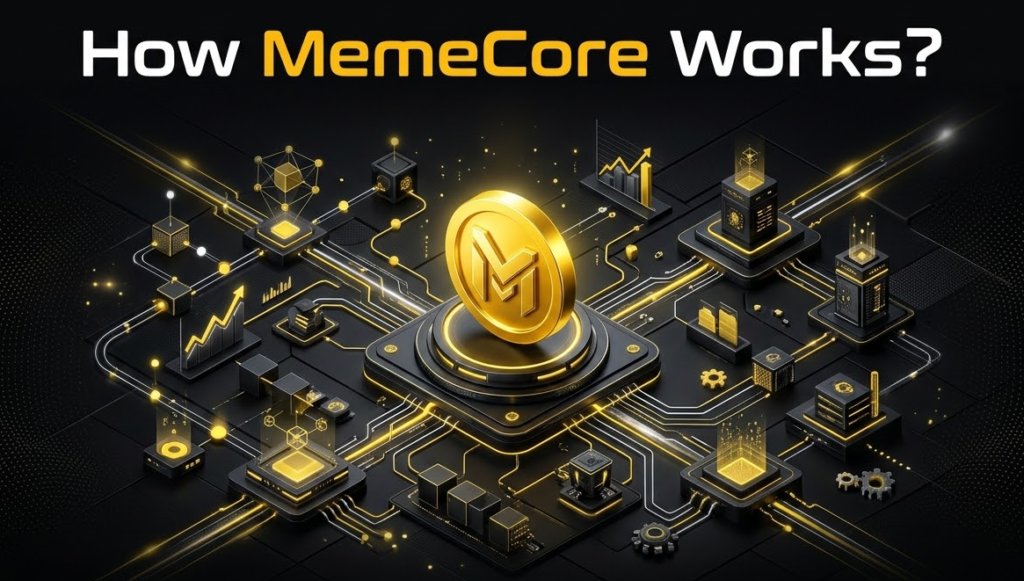
MemeCore uses the term Meme 2.0 to describe a move away from meme tokens that depend almost entirely on speculation.
The concept is based on a broader view of internet culture. Memes are not just images or jokes. They can create communities, shape online conversations, inspire products, and attract enormous amounts of attention.
Yet the people who create and maintain those communities do not always share in the economic value generated around them.
MemeCore wants to make that relationship more visible and more programmable.
From Speculative Hype to Meme 2.0 Economics
Traditional meme-token launches often follow a familiar pattern.
A project appears on social media, early buyers begin trading, and the community tries to attract more attention. If the token becomes popular, trading volume and market capitalization may rise. But the underlying project may have little infrastructure beyond its token contract and social channels.
This creates a fragile economic structure.
A sudden drop in attention can lead to falling liquidity, reduced participation, and a rapid decline in market confidence. In some cases, the community continues to exist, but there is no clear mechanism for rewarding the people who keep it active.
Meme 2.0 is intended to create a more organized alternative.
Instead of treating the token as the entire project, MemeCore treats it as one component of a wider system involving:
- Token creation and distribution.
- Community participation.
- Staking and delegation.
- Project-level reward pools.
- Validator incentives.
- Ecosystem grants.
- On-chain activity tracking.
This is an ambitious idea because it tries to connect two very different forms of value.
The first is financial value, which can be measured through transactions, liquidity, and token holdings. The second is cultural value, which is harder to measure. A meme can become popular because people find it funny, meaningful, relatable, or simply entertaining.
A smart contract can record a transaction, but it cannot automatically determine whether a joke is genuinely funny or whether a community has created something culturally important.
That is why I would treat Meme 2.0 as an economic framework with a cultural ambition, rather than assuming the protocol has solved the difficult problem of measuring internet culture objectively.
What Makes Meme 2.0 Different From a Regular Meme Coin?
A conventional meme token may provide little beyond basic transfer functionality and access to a trading market.
A token built within MemeCore’s MRC-20 ecosystem is designed to connect with additional infrastructure.
| Feature | Conventional meme-token model | MemeCore’s intended model |
|---|---|---|
| Token creation | Smart contract on an existing network | MRC-20 token on MemeCore |
| Network infrastructure | Provided by the host blockchain | MemeCore Layer-1 |
| Native gas | Asset of the host blockchain | M |
| Project reward infrastructure | Depends on external contracts or applications | Dedicated Meme Vault |
| Staking | Depends on the token’s own design | Can connect with PoM staking and delegation |
| Ecosystem grants | Usually external or project-specific | Potential access to Viral Grants Reserve |
| Community incentives | Often managed informally | Designed around on-chain reward contracts |
This does not mean every MRC-20 project is automatically successful or safe. A standardized token format can improve compatibility, but it does not guarantee good token distribution, honest creators, deep liquidity, or a healthy community.
You still need to evaluate each project individually.
Meme Vaults: Automated Liquidity and Reward Sharing
Meme Vaults are among the most distinctive components of MemeCore’s design.
According to the official Meme Vault documentation, a vault is an on-chain reward pool created for each meme project in the ecosystem. It is designed to distribute rewards to contributors who help grow the project.
When a new MRC-20 meme coin is issued on MemeCore, a dedicated Meme Vault is automatically created.
That is the basic mechanism. But it is worth being precise about what a Meme Vault does and does not promise.
A vault is not necessarily a conventional liquidity pool in which users deposit two assets to facilitate token swaps. Nor should it automatically be described as a guaranteed revenue-sharing product that pays creators a percentage of trading fees.
The official documentation describes it primarily as a reward pool and project-level incentive hub.
How a Meme Vault Is Created
The process begins when a project launches an MRC-20 token.
A dedicated vault is created alongside the token, establishing a smart-contract-based location for project rewards and participation mechanisms.
The vault is intended to support the project’s lifecycle by connecting eligible participants with rewards and providing a structure for future ecosystem support.
The general flow looks like this:
- A creator deploys an MRC-20 token.
- The system creates a dedicated Meme Vault for the project.
- The project’s community begins building activity around the token.
- Eligible participants can interact with the relevant staking and reward mechanisms.
- The project may qualify for additional funding through the Viral Grants Reserve, depending on the applicable criteria.
The automatic creation of a vault is important because it means project-level reward infrastructure is part of the token ecosystem’s design rather than something every creator must independently develop from scratch.
However, automatic creation does not mean every vault immediately receives additional grant funding. The Meme Vault documentation states that additional support depends on eligibility metrics. It also notes that the relevant evaluation metrics were still to be announced in the documentation available for this guide.
The Viral Grants Reserve
The Viral Grants Reserve is designed to support meme projects that demonstrate meaningful growth.
MemeCore’s PoM documentation states that 10% of block rewards are allocated to this reserve. Meme Vaults may become eligible for grants when projects meet the ecosystem’s evaluation criteria.
The documentation identifies possible indicators such as:
- Community size.
- Transaction volume.
- Total value locked (TVL).
- Other forms of on-chain traction and community activity.
The important qualification is that the project describes these as evaluation criteria, while the exact metrics and thresholds were not fully specified in the documentation reviewed.
You should therefore understand the Viral Grants Reserve as a designed funding mechanism, not as an automatic entitlement for every token creator.
A project might have a large social following but little on-chain activity. Another might have significant trading volume but a relatively small community. How the protocol weighs these different signals will influence which projects qualify for support.
This is one of the most important details to watch as MemeCore develops. The concept is interesting, but the quality of the implementation depends on transparent criteria, reliable data, and clear distribution rules.
The Meme Reserve and Automatic Token Allocation
MemeCore also documents a separate reserve mechanism associated with MRC-20 token creation.
According to its Meme (MRC-20) Reserve documentation, 5% of a newly created MRC-20 token’s total supply is automatically allocated to the reserve.
The documented split is:
| Allocation | Share of the new MRC-20 token supply | Intended recipient |
|---|---|---|
| M stakers’ reserve | 1% | Eligible M stakers |
| Meme-token stakers’ reserve | 4% | Eligible stakers of the relevant meme token |
| Total reserve allocation | 5% | MemeCore ecosystem reward mechanisms |
This mechanism connects the new token’s supply with the wider PoM reward structure.
For example, suppose a creator issues an MRC-20 token with a total supply of 100 million units. Under the documented 5% reserve mechanism, 5 million tokens would be allocated to the reserve:
- 1 million for the M stakers’ reserve.
- 4 million for the meme-token stakers’ reserve.
This is an illustration of the published allocation formula, not a claim about a specific live project.
The distinction between this reserve and the Meme Vault is worth remembering. They are related parts of the MemeCore reward architecture, but they should not be treated as identical contracts or as interchangeable names for the same pool.
Does a Meme Vault Guarantee Revenue Sharing?
No.
The phrase revenue sharing can create the impression that creators and holders automatically receive a fixed percentage of a project’s trading revenue. That is stronger than what the documented mechanics establish.
MemeCore describes reward pools, staking allocations, and grant funding. These mechanisms can distribute tokens to eligible participants, but that does not necessarily mean the protocol collects every project’s trading fees and pays them out as guaranteed income.
Before participating in any Meme Vault, you should investigate:
- Which contract controls the vault.
- Which assets are held inside it.
- Who is eligible to receive rewards.
- How rewards are calculated.
- Whether distributions are automatic or require a claim transaction.
- Whether rewards are subject to vesting.
- Whether the project can change its parameters.
- What happens if the token is removed from the PoM system.
A token allocation is not the same as a guaranteed financial return. If the reward asset loses market value, the economic value of the distribution can fall as well.
Proof-of-Meme (PoM) Consensus
Proof-of-Meme is the central mechanism behind MemeCore’s Meme 2.0 concept.
It is designed to connect the blockchain’s validator system with a wider ecosystem of meme projects, token holders, and community participation.
The name can be slightly misleading if you interpret it as a consensus algorithm in which social-media popularity alone determines who produces blocks.
MemeCore’s technical documentation describes a validator system based on staking rankings. The broader PoM framework introduces additional rewards and project-level mechanisms that connect meme-token activity with the network’s economic incentives.
This distinction helps explain how the system works without overstating what the protocol actually measures.
Proof-of-Stake vs Proof-of-Meme
Traditional Proof-of-Stake systems use token staking as a core part of network security.
Validators lock or delegate a network’s native asset to participate in block production and transaction validation. The protocol uses staking-related rules to determine validator eligibility, distribute rewards, and penalize certain forms of misconduct.
MemeCore also uses staking as a central part of its validator architecture.
What makes PoM different is the additional meme-project reward layer.
In the MemeCore model, participants may stake M or eligible meme tokens. The ecosystem also includes project-level vaults and reserves that connect meme-token creation and activity with rewards.
| Dimension | Traditional PoS model | MemeCore PoM framework |
|---|---|---|
| Native staking | Core security mechanism | Core security and reward mechanism |
| Validator selection | Depends on protocol-specific staking rules | Based on staking rankings in the documented validator system |
| Native token rewards | Commonly distributed to validators and delegators | M rewards are distributed through PoM mechanisms |
| Ecosystem-token rewards | Not necessarily built into the consensus design | Eligible meme-token rewards are part of the documented framework |
| Project-level reward pools | Usually separate or application-specific | Meme Vaults and reserves are integrated into the ecosystem design |
| Cultural contribution | Not normally a direct protocol feature | Recognized as part of MemeCore’s broader incentive concept |
The main difference is therefore not that MemeCore discards staking. It is that it attempts to build a reward economy around staking that includes meme projects and their communities.
How Validator Selection Works
MemeCore’s validator documentation describes a system in which validators compete for active positions based on staking rankings.
The documentation identifies seven active validators responsible for block production. The validator list is refreshed periodically, with rankings updated every 10 blocks in the documented configuration.
This means the validator system has two broad categories:
Active validators
These are the highest-ranked validators selected to produce blocks and participate directly in the network’s active consensus process.
Candidate validators
These are registered validators that are not currently among the active set. They may still receive delegations, which can improve their ranking in subsequent selection rounds.
The system therefore creates competition among validators for active positions.
The exact parameters can change through protocol governance or upgrades, so you should treat the documented validator count and refresh schedule as the published configuration rather than an immutable property of every future version.
What Does Staking Actually Do?
Staking is not just a way to earn rewards. It also connects participants with the network’s validator system.
MemeCore documents two major staking categories:
- M staking.
- Eligible MRC-20 meme-token staking.
M holders can delegate their assets to validators. Holders of eligible meme tokens may also delegate those assets through the relevant contracts.
The documentation explains that delegators receive an X-token representation of their delegated position, such as X$M or Xmemecoin, which can be used within the ecosystem.
That representation is important because it records the participant’s delegated position. It should not be confused with an entirely separate reward token or a guarantee that the underlying assets can be withdrawn instantly under every possible condition.
You should always review the current unstaking, reward-claiming, and validator rules before delegating.
How Are PoM Rewards Distributed?
MemeCore’s documentation describes a multi-reward structure involving both M and eligible meme tokens.
One documented distribution model allocates the majority of rewards to M stakers and a separate portion to meme-token stakers. The multi-reward guide describes a 75% allocation for M validators and delegators and a 24% allocation for meme delegators, with an additional 1% associated with the block producer.
The staking and delegation guide provides further detail about reward distribution among active validators and their delegators.
These percentages should be understood in the context of the documented reward model. They are not a universal promise that every participant receives the same return. Actual rewards depend on the eligible stake, validator performance, commission, token price, protocol parameters, and the reward rules in effect.
For example, a user delegating M to a validator may receive a share of the relevant M rewards, while a participant delegating an eligible meme token may receive a share of the corresponding reward allocation.
The two positions carry different risks.
M is the network’s native asset, while an individual meme token may have much lower liquidity and much higher price volatility. A larger nominal reward in a meme token does not necessarily translate into a better financial outcome.
Does Social Virality Directly Determine Block Production?
This is where you should be especially careful with the phrase Proof-of-Meme.
MemeCore’s project description emphasizes cultural contribution, community engagement, and viral activity. Its PoM documentation also discusses project growth, grants, and reward eligibility.
However, the technical validator guide describes block production through staking rankings. It does not establish a simple system in which a social-media post receives a score and directly gives its creator the right to produce the next block.
The broader ecosystem may use community and project activity to determine eligibility for grants or other rewards, but that is different from the consensus process itself.
In my view, this is one of the most important distinctions to understand before evaluating MemeCore’s technology. It is more accurate to describe PoM as a staking-based validator and multi-reward framework designed around meme-economy participation than to claim that social virality independently secures the blockchain.
The MRC-20 Token Standard and the M Token Economy
MemeCore’s ecosystem needs a common way to issue and manage meme-related tokens. That is the role of MRC-20.
MRC-20 is the official token contract standard described in the project’s documentation. It provides a common interface for creating and interacting with meme assets on MemeCore.
The standard is designed to connect token contracts with the network’s wider infrastructure, including Meme Vaults, PoM staking pools, grant eligibility, and on-chain activity tracking.
What Is MRC-20?
If you are familiar with Ethereum, you probably know ERC-20.
ERC-20 is a widely used token standard that defines a common interface for fungible tokens. It makes it easier for wallets, exchanges, and decentralized applications to interact with compatible assets.
MRC-20 serves a similar purpose within MemeCore.
It establishes a standard for issuing meme-related tokens and integrating them with the network’s ecosystem.
The official MRC-20 documentation identifies several intended compatibility features:
- Meme Vaults.
- PoM-based staking pools.
- Meme Grant Reserve eligibility.
- On-chain tracking of viral spread and community interaction.
- Integration with MemeCore APIs, wallets, and infrastructure.
The main advantage is standardization.
If every project used a completely different contract design, building common tools and reward mechanisms would become more complicated. A shared standard makes it easier for the ecosystem to recognize and interact with compatible tokens.
However, a standard does not automatically make every token safe. The quality of the implementation, ownership permissions, liquidity arrangements, and project team still matter.
How an MRC-20 Token Connects With Meme Vaults
The relationship between MRC-20 and Meme Vaults is one of the key features of MemeCore.
When a new MRC-20 token is issued, the system is designed to create a dedicated Meme Vault for the project.
That gives the token a connection to the ecosystem’s reward infrastructure from the beginning.
A simplified lifecycle looks like this:
| Stage | What happens |
|---|---|
| Token creation | A project issues an MRC-20 token |
| Vault creation | A dedicated Meme Vault is created |
| Reserve allocation | The documented 5% MRC-20 reserve mechanism applies |
| Community development | Users trade, hold, stake, and participate in the project |
| Reward eligibility | Eligible participants interact with PoM-related staking and reward mechanisms |
| Potential grant support | The project may qualify for Viral Grants Reserve funding |
This structure is intended to reduce the gap between launching a token and building an ecosystem around it.
But the token creator still needs to attract real users. A vault does not create a community by itself.
M Tokenomics: Initial Supply and 10 Billion Maximum Supply
M is the native coin of MemeCore and has several roles within the network.
The project’s official M token documentation lists the following supply figures:
| Supply metric | Amount |
|---|---|
| Initial supply at TGE | 5,000,000,000 M |
| Maximum supply | 10,000,000,000 M |
| Additional issuance | Through block rewards |
| Token decimals | 18 |
This is an important distinction: M has a 10 billion maximum supply, but the initial supply was 5 billion.
The remaining supply is not simply a pool of tokens that should be assumed to be immediately circulating. The documentation describes additional issuance through block rewards.
That means the token’s monetary model needs to be assessed over time.
If you are evaluating M as an investment, do not look only at the maximum supply. You should also examine:
- Current circulating supply.
- Amount of M already issued.
- Block reward schedule.
- Validator and delegator reward distribution.
- Vesting and unlocking arrangements.
- Treasury and foundation allocations.
- Actual token distribution across wallets.
M Token Allocation
MemeCore’s published allocation table divides the token supply into five categories.
According to the official token allocation documentation, the allocation is:
| Category | Allocation |
|---|---|
| Community | 58% |
| Foundation | 15% |
| Core contributors | 13% |
| Investors | 12% |
| Meme Treasury | 2% |
| Total | 100% |
The community allocation is intended to support participation and ecosystem growth. The foundation allocation supports development and longer-term operations, while the contributor and investor allocations relate to the people and organizations involved in the project.
The Meme Treasury is intended to support creator incentives, community activity, and ecosystem stability.
These percentages describe the published allocation structure. They should not be confused with the circulating supply at any particular moment.
A token may be allocated to a category but still subject to vesting, release schedules, or other restrictions. For a more complete supply analysis, you need to compare the allocation table with actual on-chain balances and unlocking information.
M’s Main Utility: Gas Fees
M is the native gas asset of MemeCore.
Whenever users interact with the network, they need to pay transaction fees. This includes actions such as:
- Transferring M.
- Sending an MRC-20 token.
- Creating or interacting with a Meme Vault.
- Staking M.
- Delegating tokens.
- Claiming rewards.
- Interacting with smart contracts.
The amount of gas required depends on the transaction and the network’s fee rules.
This gives M a practical role that does not depend entirely on speculation. Users need the native coin to perform network operations.
However, utility should not be confused with guaranteed demand. If network activity is low, the amount of M required for transaction fees may also be relatively low.
M’s Role in Staking and Validator Security
M is also used to register and participate in the validator system.
MemeCore’s validator documentation describes a minimum self-staking requirement for validator registration. The published guide specifies a 7 million M registration amount in the documented configuration.
That is a substantial requirement, so most ordinary users are more likely to participate as delegators rather than operate their own validator.
Delegation allows holders to assign their stake to a validator and receive a share of eligible rewards.
Before staking, consider:
- Validator uptime.
- Commission rates.
- Historical performance.
- Whether the validator is currently active or a candidate.
- The unstaking process.
- Reward-claiming requirements.
- The risks associated with token-price volatility.
A high advertised yield is not enough to determine whether a validator is a good choice.
M and Governance
MemeCore’s token documentation also lists governance rights as part of M’s utility.
Governance can allow token holders to participate in decisions about network parameters and ecosystem development.
However, governance rights should be evaluated through the actual voting contracts and rules. Holding M does not automatically mean that every project or application built on MemeCore is controlled by M holders.
There is a difference between network governance and the management of an individual meme project.
If a creator deploys an MRC-20 token, that project’s contract may have its own ownership and administrative structure. The broader MemeCore governance system does not necessarily control every decision made by every token project.
Does M Have a Deflationary Mechanism?
MemeCore’s token documentation mentions that a portion of network gas fees may be burned, contributing to deflationary pressure.
It also describes the possibility of recycling some gas fees into PoM reward pools.
This should not be interpreted as proof that M has a guaranteed net-deflationary supply.
M also has additional issuance through block rewards, so the net supply change depends on the relationship between new issuance and any tokens removed from circulation.
A useful way to think about it is:
Net supply change = new token issuance − tokens permanently removed from circulation.
If block rewards issue more M than the network burns, the supply can still increase. If burns exceed new issuance, the circulating or usable supply may decline.
The 10 billion maximum supply places a limit on total issuance, but it does not automatically make the token deflationary at every point in time.
Common Pitfalls and Misconceptions About MemeCore
MemeCore combines several different mechanisms, so it is easy to misunderstand the project if you focus only on its branding.
Here are the most important misconceptions to avoid.
Misconception: M Is Just Another Speculative Meme Token
M is not simply an individual meme coin launched on an unrelated blockchain.
It is the native asset of MemeCore’s Layer-1 network. Users need it for gas fees, and it participates in the network’s staking and reward system.
That gives M a different role from an ordinary MRC-20 meme token.
However, having infrastructure utility does not make M immune to speculation. Its market price can still be affected by broader crypto sentiment, token supply, liquidity, network adoption, and investor expectations.
A useful distinction is:
- M is the native coin of the blockchain.
- MRC-20 assets are meme-related tokens issued on the blockchain.
- Meme Vaults provide project-level reward infrastructure.
They are related, but they are not interchangeable.
Misconception: Proof-of-Meme Is Simply Social Media Popularity-Based Consensus
The name PoM can create the impression that the most viral meme automatically gains the greatest control over block production.
That is not how the published validator documentation describes the network’s active validator selection.
The documented validator system uses staking rankings to select active block producers. The wider PoM framework connects eligible meme tokens, staking, vaults, and community-related rewards.
Social and cultural activity may be relevant to project-level evaluation and grant eligibility, but it should not be confused with a direct replacement for validator staking.
Misconception: Every Meme Vault Guarantees Trading Revenue to Creators
A Meme Vault is a smart-contract-based reward pool.
It is designed to support project contributors and connect the project with MemeCore’s wider reward infrastructure.
That does not mean every vault automatically receives trading fees or guarantees a fixed passive income to creators.
Reward distribution depends on the relevant contracts, token allocations, staking rules, and eligibility requirements.
Always inspect the actual mechanism before treating a vault as an income-generating product.
Misconception: Every MRC-20 Token Is Automatically Safe
MRC-20 provides a common token standard, but it does not eliminate the risks associated with individual projects.
A token can still have:
- Concentrated ownership.
- Poor liquidity.
- Unclear token distribution.
- Administrative permissions that create risks.
- Misleading marketing.
- Vulnerable smart contracts.
- A community that disappears after launch.
A standard helps applications interact with assets. It does not guarantee that the assets themselves are trustworthy.
Misconception: A 10 Billion Maximum Supply Means 10 Billion M Are Already Circulating
MemeCore’s documentation lists an initial supply of 5 billion M and a maximum supply of 10 billion M, with additional tokens mined through block rewards.
The maximum supply is therefore not the same as the current circulating supply.
If you are comparing market capitalization or fully diluted valuation, use the correct supply figure for each calculation.
Market capitalization generally uses circulating supply, while fully diluted valuation uses the maximum or fully diluted supply assumption.
For example:
- Market cap = token price × circulating supply.
- FDV = token price × maximum supply.
These measures can produce very different results, especially when a large portion of the maximum supply has not yet entered circulation.
MemeCore System Architecture
The following map summarizes the relationship between MemeCore’s blockchain, token, consensus system, and project-level reward infrastructure.
                         MEMECORE ECOSYSTEM
                                  |
                  +---------------+---------------+
                  |                               |
           Layer-1 Blockchain                Meme 2.0 Economy
                  |                               |
             EVM Execution                  Community Projects
                  |                               |
             Native M Coin                   MRC-20 Tokens
                  |                               |
          +-------+-------+                       |
          |       |       |                       |
         Gas   Staking  Governance                 |
          |       |                               |
          |   Proof-of-Meme                       |
          |       |                               |
          |   Validators                          |
          |       |                               |
          +-------+---------------+---------------+
                                  |
                           Reward Framework
                                  |
                    +-------------+-------------+
                    |                           |
                Meme Vaults              Reserve Mechanisms
                    |                           |
             Project Rewards             MRC-20 Reserve
                    |                           |
             Contributors                 M Stakers
             and Participants             Meme Stakers
                    |
             Viral Grants Reserve
                    |
             Eligible Meme Projects
The architecture is designed to create a relationship between network security and the meme economy.
M provides the native asset for gas and staking. MRC-20 defines the token framework. Meme Vaults provide project-level reward infrastructure. The PoM system connects validator participation with the wider incentive model.
This is the project’s core proposition: meme projects should not have to operate as isolated speculative tokens when they could participate in a shared economic system.
How to Connect to MemeCore, Stake M, and Use MRC-20
If you want to explore MemeCore directly, you will need an EVM-compatible wallet, some M for gas, and a clear understanding of which network you are connecting to.
The following steps describe the general process. Always verify the latest settings through official documentation before signing transactions.
Phase 1: Configure an EVM-Compatible Wallet
MemeCore is EVM-compatible, so users can connect through wallets that support custom EVM networks.
MetaMask is one example.
Open your wallet’s network settings and add a custom network using the details published in MemeCore’s official connection guide.
| Network parameter | Mainnet setting |
|---|---|
| Network name | MemeCore |
| RPC URL | https://rpc.memecore.net |
| Chain ID | 4352 |
| Currency symbol | M |
| Block explorer | https://memecorescan.io/ |
Make sure you are using the official RPC and explorer addresses. Fake network configuration pages and impersonation websites are common risks in crypto.
After adding the network, confirm that the wallet displays MemeCore as the active chain.
Phase 2: Acquire M
You will need M to pay transaction fees and participate in the network’s staking system.
Check the official MemeCore website and the exchanges or markets that currently support the asset. Availability can change, so verify the trading pair and deposit network before sending funds.
When acquiring M, review:
- The exact token and network.
- Trading liquidity.
- The quoted price.
- Exchange withdrawal fees.
- Deposit and withdrawal restrictions.
- Whether the exchange supports native MemeCore withdrawals.
Do not assume that an M token displayed on another chain is automatically the same as native M on MemeCore. A wrapped or bridged representation can have different contract and redemption risks.
Phase 3: Transfer M to Your MemeCore Wallet
If you acquire M on a supported exchange, choose the correct withdrawal network.
Select MemeCore mainnet if the exchange supports it, then verify the receiving address and amount.
For your first transfer, it may be sensible to send a small test amount before moving a larger balance.
Once the transaction is confirmed, use MemeCoreScan to check the transaction and wallet balance.
Keep enough M available for gas. If you transfer your entire balance into a staking contract, you may not have enough left to pay for future transactions or reward claims.
Phase 4: Delegate M to a Validator
If you want to participate in staking, open the official MemeCore staking interface or use the relevant documented staking contracts.
Review the available validators before delegating.
Look at:
- Current validator status.
- Total delegated stake.
- Commission.
- Reward history, if available.
- Uptime and performance.
- Whether the validator is active or a candidate.
Connect your wallet and select the amount of M you want to delegate.
Your wallet will request approval for the transaction. Read the details carefully before signing.
Once the transaction is confirmed, verify the delegation through the relevant interface or block explorer.
Phase 5: Monitor and Claim Staking Rewards
Staking rewards may not appear as immediately spendable wallet balances.
MemeCore’s documentation describes reward contracts and claim transactions. Depending on the interface, users may need to initiate a claim through the staking application or a contract interaction.
Check the current rules for:
- Reward calculation.
- Validator commission.
- Claim frequency.
- Unstaking process.
- Any lock-up or withdrawal restrictions.
Do not rely on an advertised annual percentage yield without understanding how it is calculated.
A displayed reward rate may be affected by token issuance, validator participation, and the market value of the reward asset.
Phase 6: Explore MRC-20 Tokens and Meme Vaults
Once you have M for gas, you can explore applications and tokens within the MemeCore ecosystem.
Before interacting with an MRC-20 token, verify its contract address through official project channels and the block explorer.
For a Meme Vault, investigate:
- Which project the vault belongs to.
- Which tokens it holds.
- How reward eligibility is determined.
- Whether staking is required.
- How rewards are calculated.
- Whether there are vesting or withdrawal restrictions.
Never assume that a token is legitimate simply because it appears in a MemeCore-related interface.
Phase 7: Understand the Risks Before Participating
MemeCore combines staking, new token issuance, and meme-related reward mechanisms. Each creates a different form of risk.
M staking exposes you to M price volatility and validator-related risks. MRC-20 staking can add the risk of holding a much less liquid meme token. Meme Vault participation may involve smart-contract, eligibility, and reward-distribution risks.
Only commit assets after understanding the relevant contracts and withdrawal conditions.
Security, Audits, and Risks to Consider
A project can have an interesting technical design and still carry substantial risk. MemeCore is no exception.
If you are considering using the network or holding M, it is worth looking beyond the token’s narrative.
Smart-Contract Risk
MemeCore relies on smart contracts for token issuance, staking, reward distribution, and vault operations.
A bug in one of these contracts could affect funds or reward calculations.
Third-party security reviews can help identify vulnerabilities, but an audit is not a guarantee that a system is safe.
For example, CertiK’s MemeCore project page lists audit history and security findings for selected contracts. The page reports resolved, partially resolved, and acknowledged findings, as well as centralization-related observations.
That information should be read carefully. An audit of selected contracts does not mean every contract in the ecosystem has been audited, and an audit does not guarantee that future upgrades will be free of vulnerabilities.
Before using a vault or staking contract, confirm that the exact contract address is covered by the relevant security review.
Validator Concentration
MemeCore’s documented validator model uses a limited active validator set.
A smaller active set can make block production easier to coordinate, but it also raises questions about concentration and resilience.
You should examine:
- How many independent entities operate validators.
- Whether a small number of wallets control most of the stake.
- How candidates enter the active set.
- Whether governance can change validator parameters.
- How the network responds to validator downtime or misconduct.
The number of active validators alone does not tell you how decentralized the network is. Ownership and delegation concentration matter just as much.
Meme-Token Risk
MemeCore is designed to support meme assets, and meme assets can be extremely volatile.
A project may attract attention quickly, but that attention can disappear just as quickly. Low liquidity, concentrated ownership, and aggressive speculation can create large price movements.
The existence of a Meme Vault does not eliminate these risks.
A reward mechanism can distribute tokens, but it cannot guarantee that someone will want to buy those tokens later.
Token Issuance and Dilution
M has a 10 billion maximum supply, with additional issuance through block rewards.
This means token holders should monitor the issuance schedule and the amount of supply entering circulation.
A network can have a fixed maximum supply while still experiencing inflation during its growth phase.
The important question is not simply whether the maximum supply is capped. It is how quickly the remaining supply is issued and who receives it.
Governance and Upgrade Risk
Like other blockchain ecosystems, MemeCore may change technical parameters through governance or protocol upgrades.
Changes to validator requirements, staking rewards, reserve allocations, or grant criteria could affect participants.
Before delegating or interacting with a long-term reward mechanism, understand whether the relevant parameters can be modified and who has the authority to make those changes.
Frequently Asked Questions About MemeCore
What Is MemeCore and How Does It Work?
MemeCore is an EVM-compatible Layer-1 blockchain designed for the Meme 2.0 economy.
Its native coin, M, is used to pay gas fees and participate in staking, validator operations, and ecosystem rewards. The network uses the MRC-20 token standard for meme-related assets and Meme Vaults to provide project-level reward infrastructure.
Its Proof-of-Meme framework connects validator staking with additional incentives for eligible meme projects and participants.
What Is the Meme 2.0 Paradigm?
Meme 2.0 is MemeCore’s concept for turning meme culture into a more structured on-chain economy.
Instead of treating meme tokens only as speculative assets, the model aims to connect creators, communities, token holders, validators, and reward pools.
It uses MRC-20 tokens, Meme Vaults, staking, and grant mechanisms to create economic incentives around meme-project activity.
What Is Proof-of-Meme (PoM)?
Proof-of-Meme is MemeCore’s consensus and reward framework.
It combines a staking-based validator system with additional reward mechanisms involving eligible meme tokens and project-level activity.
The technical documentation describes validator selection through staking rankings. The broader PoM framework also includes Meme Vaults, reserves, and grant mechanisms intended to reward ecosystem participation.
How Is PoM Different From Traditional Proof-of-Stake?
Traditional Proof-of-Stake systems primarily use native-token staking to support validator selection and network security.
MemeCore also uses staking, but extends its reward design to include eligible meme tokens and project-level mechanisms.
The main difference is the additional meme-economy incentive layer, rather than the removal of staking from validator selection.
What Is the Utility of the M Token?
M is the native coin of MemeCore.
Its main functions include:
- Paying Layer-1 gas fees.
- Staking for validator participation.
- Delegating to validators.
- Receiving eligible network rewards.
- Participating in governance mechanisms.
M is also connected to the wider PoM reward framework.
What Is the Maximum Supply of M?
MemeCore’s official documentation lists an initial supply of 5 billion M at TGE and a maximum supply of 10 billion M.
Additional tokens are issued through block rewards, subject to the network’s monetary policy.
The maximum supply should not be confused with circulating supply. To evaluate dilution, you should examine the amount already issued and the remaining issuance schedule.
What Is the MRC-20 Token Standard?
MRC-20 is MemeCore’s official token standard for issuing and interacting with meme-related assets on the network.
It is designed to support integration with Meme Vaults, PoM staking pools, the Meme Grant Reserve, and MemeCore’s native infrastructure.
The standard provides a common framework, but it does not guarantee that every MRC-20 project is safe or successful.
What Are Meme Vaults?
Meme Vaults are on-chain reward pools created for meme projects within the MemeCore ecosystem.
A dedicated vault is automatically created when an MRC-20 meme coin is issued. The vault is designed to support project rewards and connect the token with wider PoM mechanisms.
Additional grant funding may be available to projects that meet the relevant eligibility criteria.
Do Meme Vaults Guarantee Revenue Sharing?
No.
Meme Vaults are designed to distribute rewards to eligible contributors and participants, but that should not be confused with guaranteed trading-fee revenue or fixed passive income.
Actual rewards depend on the relevant smart contracts, staking rules, reserve allocations, and eligibility requirements.
How Much of an MRC-20 Token Goes Into the Reserve?
MemeCore’s documentation states that 5% of a newly created MRC-20 token’s total supply is allocated to the Meme Reserve.
The documented split is 1% for the M stakers’ reserve and 4% for the meme-token stakers’ reserve.
This is a protocol allocation mechanism, not a guarantee that every participant receives an immediate or fixed-value payment.
How Many Validators Does MemeCore Have?
The published validator documentation describes seven active validators responsible for block production.
Other registered validators can remain candidates and compete for active positions through staking rankings.
The exact validator configuration may change through network upgrades or governance.
Can I Stake M?
Yes. MemeCore’s documentation describes M staking and delegation through its validator system.
Users can delegate M to validators and receive a share of eligible rewards, subject to the protocol’s commission and distribution rules.
Before staking, review validator performance, reward mechanics, and withdrawal conditions.
Is MemeCore EVM-Compatible?
Yes.
MemeCore is designed to support Ethereum Virtual Machine compatibility. This allows developers familiar with Ethereum’s development environment to build and deploy compatible smart contracts on the network.
Wallets and tools that support custom EVM networks can connect to MemeCore using the official RPC and chain ID.
What Is MemeCore’s Mainnet Chain ID?
The official MemeCore connection guide lists the mainnet chain ID as 4352.
It also provides the mainnet RPC endpoint, native currency symbol, and block explorer.
Always copy network details from the official documentation rather than relying on third-party configuration pages.
Is M a Good Investment?
That depends on your risk tolerance and your assessment of MemeCore’s adoption.
Potential strengths include its dedicated Layer-1 infrastructure, native staking system, MRC-20 standard, and Meme Vault reward design.
However, the project also faces significant risks: competition from established blockchains, validator concentration, smart-contract vulnerabilities, meme-token volatility, and additional M issuance through block rewards.
A 10 billion maximum supply does not guarantee price appreciation. You should assess actual network usage, token distribution, liquidity, and the sustainability of the reward system before making an investment decision.
Final Thoughts
MemeCore is trying to solve a problem that sits somewhere between blockchain infrastructure and internet culture.
Meme tokens can attract enormous attention, but attention alone does not create a durable economic system. Communities need tools to launch assets, coordinate participation, distribute rewards, and maintain activity after the first wave of excitement fades.
MemeCore’s approach is to build those tools directly into a Layer-1 blockchain.
M provides the native gas and staking asset. MRC-20 establishes a common token framework. Meme Vaults create project-level reward infrastructure, while the wider PoM system connects validators, delegators, and eligible meme projects.
The idea is ambitious, and there are some genuinely interesting elements in the design. In particular, automatically creating a vault for each new MRC-20 token and allocating a portion of its supply to ecosystem reserves gives MemeCore a more structured approach to meme-token incentives than a basic token-launch model.
But there is a difference between a promising mechanism and a proven economic outcome.
The network still needs developers, active users, reliable validators, useful applications, and communities that remain engaged beyond short-term speculation. The grant criteria and reward mechanisms also need to be transparent enough for participants to understand exactly how eligibility and distributions work.
If you are researching M, I would focus on three things rather than relying on the Meme 2.0 narrative alone:
- Network adoption: Is MemeCore attracting real applications, transactions, and active users?
- Reward sustainability: Do Meme Vaults and PoM incentives create meaningful participation without encouraging purely short-term farming?
- Token economics: How do block rewards, circulating supply, staking, and ecosystem allocations affect long-term demand for M?
MemeCore has a distinctive thesis: internet culture can become an economic activity with its own blockchain infrastructure. Whether that thesis succeeds will depend less on how viral the next meme becomes and more on whether the protocol can turn temporary attention into useful, transparent, and sustainable participation.