Introduction: The Fundamental Crypto Distinction
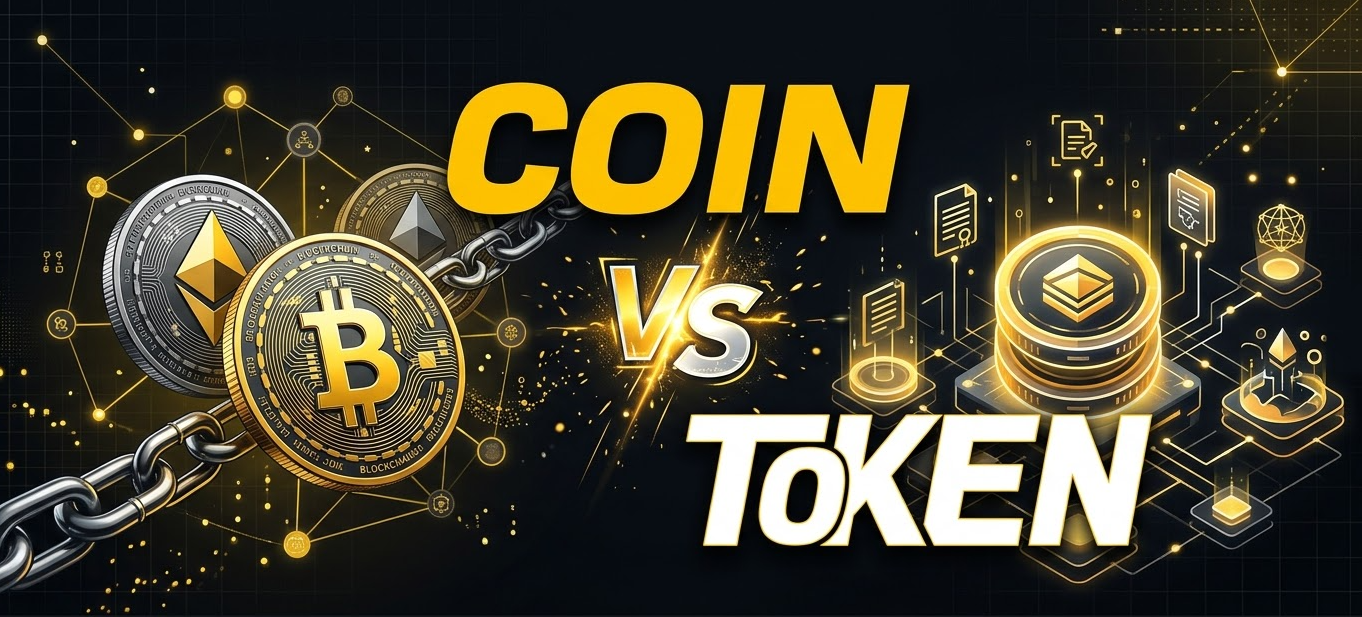
If you’ve spent any time around crypto, you’ve probably seen people use the words coin and token as if they mean exactly the same thing.
I understand why. In everyday conversation, both refer to digital assets that can be bought, sold, transferred, or held in a wallet. Someone might say, “I bought a new crypto token,” while another person calls the exact same asset a coin. Nobody in a casual Telegram group is going to stop the conversation to debate terminology.
But technically, there is an important difference.
A coin is the native asset of a blockchain. Bitcoin (BTC) belongs to Bitcoin. Ether (ETH) belongs to Ethereum. SOL belongs to Solana. AVAX is native to Avalanche. These assets are part of the underlying economic and technical machinery of their respective networks.
A token, on the other hand, is created on top of an existing blockchain or token infrastructure. USDT can exist as an Ethereum token, a Tron token, a Solana token, and on several other supported networks. UNI is an Ethereum-based token. LINK was originally issued as an Ethereum token. The blockchain provides the infrastructure, while the token exists within that infrastructure according to the rules of its contract or token program.
That sounds like a small distinction.
It isn’t.
Once you understand it, a lot of crypto behavior that initially seems confusing suddenly makes sense.
Why do you need ETH to send USDC on Ethereum?
Why can you hold $1,000 worth of a token but still be unable to transfer it?
Why does USDT have different versions on Ethereum, Tron and Solana?
Why did BNB start life as an Ethereum token and later become the native asset of its own blockchain ecosystem?
Why does wrapped ETH exist if ETH is already the native asset of Ethereum?
These questions all lead back to the same architectural distinction.
Coin vs. token isn’t really about what the asset looks like on an exchange. It’s about where the asset lives and what role it plays in the network.
Coin vs. Token at a Glance
| Key Feature | Crypto Coin | Crypto Token |
|---|---|---|
| Blockchain ownership | Native asset of its own blockchain | Built on an existing blockchain or token platform |
| Where balances live | Native blockchain state | Token contract, token account, or equivalent token program |
| Gas role | Usually pays network transaction fees | Usually needs the host chain’s native asset for fees |
| Creation | Defined by the blockchain protocol | Usually created through a smart contract or token program |
| Network security | Often involved directly in staking, mining or economic security | Usually does not secure the host blockchain itself |
| Examples | BTC, ETH, SOL, AVAX | USDT, UNI, LINK, USDC |
| Own blockchain? | Yes | No, at least in its token form |
| Can migrate? | Already native | Can potentially become a native asset after a mainnet launch |
There is one subtle point worth making before we go further.
The word “coin” doesn’t necessarily mean the asset must be used primarily as money.
ETH is a coin because it is Ethereum’s native asset, even though its role goes far beyond payments. Ethereum uses ETH for gas and staking, among other functions. The Ethereum documentation on Ether describes ETH as the native cryptocurrency that powers the network, including its role in transaction fees and staking.
Likewise, calling something a “token” doesn’t tell you whether it is valuable, useful, centralized, decentralized, fungible, non-fungible, or even well-designed.
“Token” describes its technical position in the stack.
That’s the part I want you to remember.
What Is a Crypto Coin? The Base Layer of Blockchain

Defining Native Layer-1 Assets
The easiest way to understand a coin is to imagine the blockchain as its own economy.
Bitcoin has its own blockchain.
Ethereum has its own blockchain.
Solana has its own blockchain.
Avalanche has its own blockchain.
Each network needs some native economic asset to perform important jobs inside that environment.
Bitcoin has BTC.
Ethereum has ETH.
Solana has SOL.
Avalanche has AVAX.
These are coins in the technical sense because they are native to their respective networks.
Ethereum’s own technical documentation puts it quite directly: Ether is Ethereum’s native cryptocurrency. It is used to pay transaction fees and secure the network through staking. (Ethereum’s explanation of Ether and its role)
That native status is the key.
You don’t deploy BTC as a Bitcoin smart contract to create Bitcoin itself.
Bitcoin exists because the Bitcoin protocol defines BTC as part of the network’s monetary and accounting system.
Ethereum doesn’t need an ERC-20 contract to create ETH.
ETH is part of Ethereum’s base protocol.
That distinction becomes especially obvious when you look at transaction fees.
What Does a Crypto Coin Actually Do?
A native coin can serve several different functions at the same time.
Store of value and medium of exchange
Bitcoin is the obvious example.
BTC can be transferred between Bitcoin addresses without needing another cryptocurrency to authorize the basic Bitcoin transaction.
Litecoin follows a similar model.
The coin is the native asset of the network and can function as a means of transferring value.
Network fuel
This is where things become more interesting.
A blockchain isn’t just a database storing balances. It is a network of computers performing computation and processing state changes.
Someone has to pay for those resources.
On Ethereum, that payment is made in ETH.
Ethereum’s documentation explains that gas measures computational work and that gas fees must be paid in ETH, the network’s native currency. (Ethereum’s technical explanation of gas and fees)
On Avalanche’s Primary Network, AVAX plays a similar role. Avalanche describes AVAX as the network’s native utility token used for fees, staking, and other network functions. (Avalanche’s documentation on the AVAX token)
This is one of the easiest ways to spot a native coin.
If you are using Ethereum mainnet, you need ETH for Ethereum gas.
If you’re using Avalanche’s Primary Network, you need AVAX for its network fees.
If you’re interacting with Solana, SOL is the network’s native asset used within the fee and transaction system.
The exact mechanics differ between chains, but the principle is similar.
Validator or miner incentives
Native coins can also help secure blockchain networks.
In a Proof-of-Work system, miners may receive the native asset as part of the network’s block-reward economics.
In Proof-of-Stake systems, validators can stake the native asset as economic collateral.
Ethereum is a clear example. Validators stake ETH to participate in consensus, and Ethereum can penalize provable malicious behavior by destroying part of a validator’s stake. The Ethereum staking documentation explains that validators need at least 32 ETH to activate their own validator, while smaller holders can participate through other staking arrangements.
This gives the native coin another job.
It isn’t merely an asset sitting on a blockchain.
It can become part of the mechanism that keeps the blockchain operating.
What Is a Crypto Token? Smart Contracts in Action

Riding on Someone Else’s Highway
Here’s the easiest mental model I use for tokens:
A coin owns the highway. A token uses the highway.
It’s not a perfect analogy, but it works surprisingly well.
Ethereum provides the blockchain infrastructure.
Developers can then create tokens that exist inside Ethereum’s execution environment.
The same basic idea exists on other networks.
Solana provides its own token infrastructure.
BNB Chain provides EVM-compatible infrastructure for smart contracts and tokens.
Other blockchains have their own token standards or asset systems.
On Ethereum, an ERC-20 token is essentially a smart contract implementing a standardized interface. The official ERC-20 specification defines functions for transferring tokens, checking balances, approving third parties to spend tokens, and other core behaviors.
That means the token contract keeps track of token ownership and follows the rules programmed into it.
You can have thousands of different ERC-20 tokens on Ethereum without creating thousands of separate blockchains.
That’s one of the reasons tokens became so important to the crypto ecosystem.
A project can launch an asset without first having to build an entire consensus network, validator set, wallet infrastructure, explorer ecosystem, block-production system and native fee market.
It can use an existing blockchain.
That dramatically lowers the technical barrier to launching a digital asset.
Token Standards: ERC-20, SPL, BEP-20 and Beyond
When people talk about token standards, they’re really talking about common technical rules for how assets behave.
Standards allow wallets, exchanges, decentralized applications and other smart contracts to understand and interact with tokens without every project inventing a completely different interface.
ERC-20
ERC-20 is probably the most recognizable token standard in crypto.
It defines a common interface for fungible tokens on Ethereum.
“Fungible” means one unit is interchangeable with another unit of the same token.
One USDC is intended to represent the same type of asset as another USDC.
One UNI is interchangeable with another UNI, assuming we’re talking about the same token contract.
The Ethereum ERC-20 documentation lists core functionality such as transferring tokens, checking balances, determining total supply and approving another address to spend tokens.
This standardization is extremely useful.
A wallet doesn’t need a completely custom integration for every ERC-20 project.
A DEX doesn’t need to reinvent the basic transfer logic for every token.
Other applications can interact with standardized functions.
That’s the whole point.
SPL tokens on Solana
Solana uses a different architecture.
Its token ecosystem is commonly associated with SPL Tokens, managed through Solana’s Token Program infrastructure.
Solana’s documentation explains that token mints define properties such as decimals and authorities, while token accounts hold balances and the Token Program provides instructions for minting, transferring, approving delegates and burning tokens. (Solana’s SPL Token documentation)
Solana also has Token Extensions, sometimes referred to as Token-2022, which add optional capabilities to token mints and token accounts. (Solana Token Extensions documentation)
This is a useful reminder that “token” doesn’t automatically mean “ERC-20.”
ERC-20 is one token standard.
It’s not the universal definition of a crypto token.
BEP-20 and BNB Chain
BEP-20 is associated with the BNB Smart Chain ecosystem and follows the broader EVM-compatible token model.
This means developers familiar with Ethereum’s smart-contract environment can create and interact with tokens using similar concepts.
The important distinction is that BNB itself is native to the BNB Chain ecosystem, while a BEP-20 token is an asset implemented through smart-contract infrastructure on the chain.
This becomes particularly interesting because BNB wasn’t always a native blockchain coin.
BNB originally launched as an ERC-20 token on Ethereum in 2017. According to BNB Chain’s own history of BNB, it later migrated to Binance Chain in 2019 and subsequently became the fuel for BNB Smart Chain.
That’s a perfect real-world example of why the distinction matters.
An asset’s classification can change as the underlying architecture changes.
ERC-721 and ERC-1155: Tokens Don’t Have to Be Fungible
Tokens also extend far beyond currencies.
ERC-721 is the standard most people associate with NFTs.
Unlike ERC-20, ERC-721 represents assets that are individually distinguishable. Ethereum’s ERC-721 specification explains that NFTs are distinguishable assets where ownership of each individual token needs to be tracked separately.
ERC-1155 goes further by allowing one contract to manage multiple token types, including fungible, non-fungible and semi-fungible configurations. (ERC-1155 specification)
So when you hear “token,” don’t automatically picture a coin-like asset.
A token can represent:
- A currency-like unit.
- A governance right.
- A membership credential.
- An in-game item.
- A collectible.
- A claim on another asset.
- A stable digital dollar.
- A real-world asset representation.
- A voting position.
- A permission or access right.
The technical category is broader than the everyday meaning of “crypto token.”
Major Types of Crypto Tokens
Once you understand the infrastructure, token categories become much easier to follow.
Utility Tokens
A utility token is generally designed to provide some function within a product, protocol or ecosystem.
LINK is a familiar example.
Chainlink uses LINK within its decentralized oracle ecosystem, where the token has roles related to economic incentives and network services.
The important point is that “utility token” describes the intended function, not the underlying technical architecture.
A utility token can still be an ERC-20 token.
It can still be subject to smart-contract risk.
It can still have a volatile market price.
And having a supposed utility doesn’t automatically make an asset valuable.
Governance Tokens
Governance tokens are generally designed to give holders some form of voting or governance participation.
UNI is a familiar example from the Uniswap ecosystem.
Maker’s MKR is another well-known governance asset.
The exact rights vary from protocol to protocol.
Some governance tokens allow direct on-chain voting.
Others use off-chain signaling.
Some have additional utility.
So I wouldn’t assume that holding a token automatically means you control a project.
You need to inspect the actual governance mechanism.
Stablecoins
Stablecoins are perhaps the clearest example of why coins and tokens get confused.
USDT looks like a currency.
It trades like a currency.
People use it to transfer dollar-denominated value.
But USDT is generally issued as a token on multiple blockchain networks rather than being one independent blockchain coin.
Tether’s own documentation states that Tether Tokens exist across multiple blockchain protocols, including Ethereum, Solana and Tron, among others. Its current supported-protocol page lists implementations such as ERC-20 on Ethereum and other compatible networks, TRC-20 on Tron, and a Solana token implementation. (Tether’s supported protocols)
That means saying “USDT is a coin” because it behaves like money is technically misleading.
USDT is a tokenized asset.
And there isn’t necessarily just one technical USDT representation.
There are different versions depending on the network.
This matters enormously when you withdraw USDT from an exchange.
Sending USDT over Tron is not the same thing as sending ERC-20 USDT over Ethereum.
The receiving platform needs to support the same network.
Otherwise, you can create a very expensive problem.
NFTs
NFTs are another category of tokens.
The “non-fungible” part means each token is distinguishable.
One NFT isn’t necessarily interchangeable with another NFT in the same collection.
That’s why NFT standards need different accounting models from ERC-20.
ERC-721 tracks individual token IDs.
ERC-1155 can track multiple token types through a single contract.
The technology is still based on tokens, but the assets can represent anything from artwork to game items to membership credentials.
Real-World Pitfalls: The “Gas Lock”
This is probably the single most useful practical distinction for anyone learning self-custody.
Imagine you have $1,000 worth of USDC in an Ethereum wallet.
You look at the balance and think:
“I’m fine. I have plenty of money here.”
Then you try to send the USDC.
The wallet says you don’t have enough ETH.
At first, this seems ridiculous.
You have $1,000 in crypto.
Why can’t you pay a tiny transaction fee?
Because the USDC and the gas payment are two different things.
USDC is a token.
ETH is Ethereum’s native asset.
The transaction that transfers your USDC still has to be processed by Ethereum.
That computation requires gas.
And Ethereum’s gas fees are paid in ETH.
The official Ethereum gas documentation explicitly states that gas fees must be paid in ETH and that smart-contract transactions can consume more gas than simple ETH transfers.
So if your wallet contains:
$1,000 USDC + $0 ETH
you may effectively have:
$1,000 of value + no fuel for an Ethereum transaction.
That’s the “gas lock.”
It isn’t a bug.
It’s a consequence of how the blockchain works.
Why Token Transfers Need the Native Coin
This becomes easier to understand if you look at what actually happens when you send a token.
Suppose you send 500 USDC to a friend.
You’re not simply moving a physical object called “USDC” from Wallet A to Wallet B.
Your wallet is submitting a blockchain transaction that calls the relevant token contract or token infrastructure.
On Ethereum, an ERC-20 contract typically implements functions such as transfer() and balanceOf().
The transaction invokes that code.
The Ethereum network executes the transaction.
The resulting state change updates the token balances.
All of that computation consumes gas.
Ethereum’s documentation gives a useful comparison: a basic ETH transfer uses 21,000 gas units, while an ERC-20 transfer can require substantially more computation. (Ethereum’s gas-cost examples)
And the gas isn’t paid using the token you’re transferring.
If you’re sending USDC, the network doesn’t automatically take a few cents worth of USDC as your Ethereum transaction fee.
You need ETH.
This is why I always recommend keeping a small amount of the relevant native asset in any self-custody wallet that you actively use.
The same principle appears elsewhere.
On Avalanche’s C-Chain, for example, ERC-20 tokens can be deployed and used, but transaction fees are paid in AVAX. Avalanche’s documentation explicitly explains that the C-Chain uses its native token for gas even when applications create their own ERC-20 tokens. (Avalanche on ERC-20 tokens and native gas)
The exact native asset changes from chain to chain.
The architecture is the important part.
Advanced Mechanics: Token Transformations and Edge Cases
When a Token Becomes a Coin
Here’s where the distinction gets really interesting.
A token can become a native asset.
This usually happens through a mainnet launch and token migration.
Why would a project do this?
Because launching as a token can be much easier.
Imagine you have a Web3 project but don’t yet have enough resources to build your own blockchain.
You could issue an ERC-20 token on Ethereum.
Now you can distribute it, build a community, list it on exchanges, create liquidity pools, use it in your application, and start developing an economic ecosystem.
Later, if the project grows enough, you may decide that having your own blockchain makes more sense.
You might want:
- Your own transaction-fee model.
- Your own consensus mechanism.
- More control over network upgrades.
- Specialized execution.
- A dedicated validator ecosystem.
- Custom blockspace economics.
- A native asset integrated directly into network security.
At that point, the project can create a blockchain and migrate the existing token into a native asset.
BNB provides one of the clearest historical examples.
BNB was originally issued as an ERC-20 token on Ethereum in 2017. BNB Chain’s official history says it migrated to Binance Chain in April 2019 and later became the fuel for BNB Smart Chain. (BNB Chain’s history of BNB)
That means calling BNB “a token” today without explaining its history can be confusing.
It was an Ethereum token.
Its current role is that of a native asset in the BNB Chain ecosystem.
This is why I don’t treat “coin” and “token” as permanent personality traits.
They describe an asset’s relationship to a blockchain at a particular point in its lifecycle.
Mainnet Migration Is More Than a Rebranding
A mainnet migration can involve several moving parts.
The project needs to establish the new network.
It needs wallets and explorers to support the new asset.
Exchanges need to understand the new deposit and withdrawal system.
Bridges or migration contracts may be involved.
Users may need to swap the old token for the new native asset.
The migration can be simple or extremely complicated depending on the project.
There is also a major security consideration.
If you receive an announcement saying:
“Send your old tokens here and receive new coins 1:1,”
you need to verify the migration contract carefully.
Fake migration websites are an obvious phishing opportunity.
A legitimate migration should be announced through official project channels and supported by verifiable smart contracts, documentation and exchange integrations.
Don’t trust a random link because someone dropped it into a Telegram group.
The Wrapped Asset Paradox: When a Coin Becomes a Token
Now let’s flip the concept around.
A native coin can effectively become a token on another blockchain.
The most familiar example is wrapped ETH, or WETH.
ETH is Ethereum’s native asset.
But many Ethereum applications were designed around the ERC-20 token standard.
That creates a compatibility problem.
ETH itself isn’t an ERC-20 token.
So how can an application that expects ERC-20 behavior interact with ETH?
You wrap it.
Ethereum’s official WETH explanation describes the mechanism: you deposit ETH into a smart contract and receive an equivalent amount of WETH that follows the ERC-20 standard. When you unwrap, the WETH is burned and the corresponding ETH is released.
The relationship looks like this:
1 ETH deposited → 1 WETH minted
Then:
1 WETH redeemed → 1 ETH returned
The important part is that WETH is not a second independent version of ETH’s native blockchain asset.
It’s a tokenized representation of ETH designed to work with applications that expect ERC-20 behavior.
And there is a practical detail worth remembering:
You still need native ETH to pay Ethereum gas.
Ethereum’s own WETH documentation explicitly warns users to keep native ETH available for gas even when interacting with WETH. (Ethereum’s WETH documentation)
This is another excellent example of why the coin-versus-token distinction isn’t just terminology.
It changes how you use your wallet.
Is USDT a Coin or a Token?
This question deserves its own section because it comes up constantly.
USDT is a token, not a native blockchain coin.
But there is an important wrinkle.
USDT exists across multiple blockchain environments.
Tether’s current supported-protocol documentation lists USDT implementations across networks including Ethereum, Avalanche, BNB Smart Chain, Solana, Tron, Ton, Near, Aptos and others. (Tether’s official supported protocols)
So “I have USDT” isn’t quite enough information.
You also need to know:
Which USDT?
For example:
- Ethereum USDT
- Tron USDT
- Solana USDT
- BNB Smart Chain USDT
- Avalanche USDT
These versions represent the same broader Tether asset but exist within different blockchain environments.
That’s why an exchange withdrawal screen may ask you to choose a network.
Choosing the wrong network can result in funds becoming inaccessible or requiring a recovery process, depending on the platforms involved.
The same concept applies to USDC.
Circle currently lists native USDC support across many blockchain networks, with Ethereum and many EVM networks using ERC-20 implementations and Solana using the SPL token standard. (Circle’s current USDC network documentation)
So if you’re moving stablecoins, the asset name and the network are both important pieces of information.
Coin vs. Token and Your Wallet
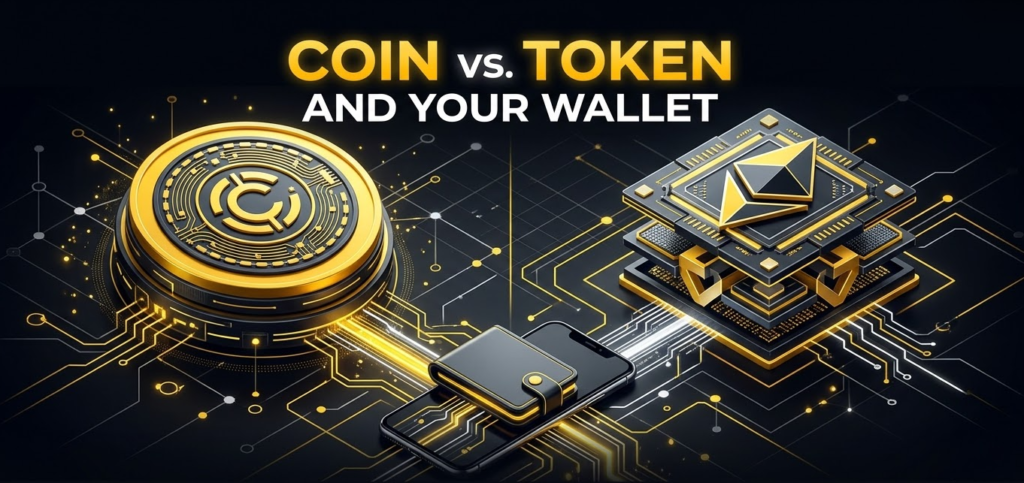
Wallet interfaces sometimes make this distinction look more confusing than it actually is.
You might open a wallet and see:
- ETH
- USDC
- UNI
- WETH
- LINK
- an NFT collection
They can all appear as assets inside the same application.
That doesn’t mean they’re technically equivalent.
ETH is native to Ethereum.
USDC may be an ERC-20 token on Ethereum.
UNI is an ERC-20 token.
WETH is an ERC-20 representation of ETH.
NFTs may use ERC-721 or ERC-1155.
The wallet is simply providing one interface through which you interact with different types of blockchain assets.
Think of the wallet as your dashboard.
The blockchain architecture underneath is what determines whether an asset is native or contract-based.
This distinction becomes particularly important when you add networks.
Suppose you have ETH on Ethereum mainnet and then switch your wallet to another network.
Seeing “ETH” in the interface doesn’t automatically mean you have the same asset in the same environment.
Some networks use bridged or wrapped representations.
Some L2s use ETH as a gas asset but have different transaction environments.
Some wallets abstract network details from you.
That’s convenient, but it can hide the technical distinction you actually need to understand before moving funds.
A Practical Wallet Example
Let’s say you have the following portfolio:
| Asset | Amount | Network | Technical Type |
|---|---|---|---|
| ETH | 0.5 ETH | Ethereum | Native coin |
| USDC | 1,000 USDC | Ethereum | ERC-20 token |
| UNI | 500 UNI | Ethereum | ERC-20 token |
| WETH | 0.2 WETH | Ethereum | ERC-20 token |
| SOL | 10 SOL | Solana | Native coin |
| USDC | 500 USDC | Solana | SPL token |
At first glance, your wallet might simply show six balances.
Technically, however, there are several different systems involved.
ETH is part of Ethereum’s native state.
USDC and UNI are tracked by smart contracts.
WETH is another smart-contract asset representing deposited ETH.
SOL is native to Solana.
Solana USDC is implemented using Solana’s token infrastructure.
That difference explains why the wallet needs different instructions to transfer each asset.
It also explains why you may need ETH for one transfer and SOL for another.
The 3-Step Quick Test: Is It a Coin or a Token?
If you want a fast way to identify an asset, don’t rely on its name.
Use these three questions.
Does it have its own blockchain?
If the asset is native to its own independent blockchain, you’re probably looking at a coin.
BTC is native to Bitcoin.
ETH is native to Ethereum.
SOL is native to Solana.
AVAX is native to Avalanche.
But be careful with terminology around Layer 2s, appchains and interconnected blockchain ecosystems. The important question is not whether the project has a website called “mainnet.”
The important question is whether the asset is native to that network’s base protocol.
Do you need another asset to pay transaction fees?
This is one of the strongest practical tests.
If you’re moving an ERC-20 token on Ethereum, you generally need ETH for gas.
If you’re moving an ERC-20 token on Avalanche C-Chain, you need AVAX for gas.
If you’re using Solana’s token infrastructure, SOL is the native asset associated with transaction fees.
That pattern is a strong clue that you’re dealing with a token rather than the network’s native coin.
Ethereum’s documentation explicitly states that gas fees are paid in ETH, while Avalanche explains that ERC-20 activity on C-Chain still uses AVAX for gas. (Ethereum gas documentation) (Avalanche native-token documentation)
Is the asset created and tracked through a smart contract or token program?
If yes, it’s probably a token.
On Ethereum, ERC-20 balances are tracked through the token contract.
On Solana, tokens are represented through token mints and token accounts managed by the Token Program infrastructure. (Solana’s token architecture)
This is often the most technical test, but it’s also the most reliable.
Why the Coin vs. Token Difference Matters
You might be wondering:
“Okay, but why should I care?”
You should care because the distinction changes how you interact with the asset.
It affects fees.
It affects wallets.
It affects transfers.
It affects network selection.
It affects security assumptions.
It affects how the asset is created and controlled.
And it can even affect what happens when a project changes its infrastructure.
Imagine you’re withdrawing USDT from an exchange.
If you don’t understand the difference between the token and the underlying network, you might choose Ethereum when the recipient expects Tron.
Or you might send a token to a wallet on a network the receiving platform doesn’t support.
The asset name alone isn’t enough.
You need to understand the network.
This is one reason I always tell people to stop thinking of crypto assets as just ticker symbols.
BTC is not simply “BTC.”
It’s BTC on the Bitcoin network.
USDT is not simply “USDT.”
It’s USDT on a particular blockchain or protocol.
ETH is not simply “ETH.”
It’s native ETH in a particular Ethereum-compatible execution environment, or potentially a wrapped representation on another system.
Once you start thinking this way, wallet mistakes become much easier to avoid.
The Bigger Picture: Coins Are Infrastructure Assets, Tokens Are Application Assets
This isn’t an absolute rule, but it’s a useful way to think about the ecosystem.
A native coin often sits closer to the infrastructure layer.
It helps pay for blockspace.
It can secure the network.
It can act as the native unit of account.
It can incentivize validators or miners.
Tokens often sit closer to the application layer.
They can represent governance.
They can represent dollars.
They can represent NFTs.
They can represent access rights.
They can represent protocol incentives.
They can represent claims or digital versions of other assets.
This is why Ethereum became so important to the token economy.
A single blockchain can support thousands of different token systems without requiring every project to build a blockchain from scratch.
The trade-off is that those projects inherit some properties of the host blockchain.
If Ethereum is congested, Ethereum-based tokens still operate on Ethereum’s infrastructure.
If gas is expensive, token transfers can become expensive.
If a smart contract has a vulnerability, users can be exposed to that vulnerability even though Ethereum itself continues operating normally.
That separation between blockchain security and application security is one of the most important ideas in crypto.
A token can be perfectly functional while its smart contract is badly designed.
A blockchain can be highly secure while a token running on it is a scam.
Those two statements can both be true.
FAQ
Is Ethereum (ETH) a coin or a token?
ETH is a native crypto coin.
It is the native asset of the Ethereum blockchain and is used to pay Ethereum gas fees and participate in network staking.
Ethereum’s official documentation describes Ether as the network’s native cryptocurrency and explains its role in transaction fees and staking. (Ethereum’s official ETH overview)
You may encounter ERC-20 versions of assets that represent ETH, such as WETH, but native ETH itself is not an ERC-20 token.
Is Tether (USDT) a coin or a token?
USDT is a token.
Tether issues its tokens across multiple blockchain networks rather than operating one independent blockchain where USDT itself is the native coin.
Tether’s official supported-protocol documentation currently lists implementations across networks including Ethereum, Tron, Solana, Avalanche, BNB Smart Chain and several others. (Tether’s supported protocols)
This is why you need to pay attention to the network when sending USDT.
Why do I need ETH to send an ERC-20 token from my Web3 wallet?
Because the ERC-20 token and ETH perform different jobs.
Your USDC, UNI or LINK balance is maintained by the token’s smart contract.
But the Ethereum blockchain still has to execute the transaction.
That computation consumes gas, and Ethereum gas fees are paid in ETH. (Ethereum’s technical gas documentation)
So you can have $10,000 of USDC and still be unable to send even $10 of it if your wallet contains zero ETH.
Can a crypto token ever turn into a coin?
Yes.
A project can initially launch a token on an existing blockchain and later build its own blockchain.
When the new network launches, the project can migrate the old token into a native asset through a token swap or migration process.
BNB is a well-known historical example. It originally launched as an ERC-20 token on Ethereum before migrating to Binance Chain and later becoming the native asset used across the BNB Chain ecosystem. (BNB Chain’s history of BNB)
The important point is that the asset’s technical classification can change as its underlying infrastructure changes.
Is BTC a coin or a token?
BTC is a coin because Bitcoin is its own blockchain and BTC is the native asset of that network.
There are, however, tokenized representations of Bitcoin on other chains, such as wrapped BTC representations used within Ethereum-based DeFi.
Those representations are tokens.
Native BTC remains the coin of the Bitcoin blockchain.
Is WETH a coin or a token?
WETH is a token.
More specifically, WETH is an ERC-20 representation of ETH.
You deposit ETH into the WETH smart contract and receive an equivalent amount of WETH. You can later redeem WETH for ETH.
Ethereum’s official WETH documentation explains that WETH exists because native ETH predates the ERC-20 standard and therefore doesn’t directly behave like an ERC-20 token inside applications that expect that interface. (Ethereum’s WETH explanation)
You still need native ETH to pay Ethereum gas.
Are all tokens created through smart contracts?
Not necessarily in exactly the same way.
On Ethereum, many tokens are represented by smart contracts, including ERC-20, ERC-721 and ERC-1155 assets.
On Solana, the token architecture is different. Token mints and token accounts are managed through Solana’s Token Program infrastructure rather than Ethereum-style smart contracts. (Solana’s SPL Token documentation)
So the broader idea is that tokens are created and managed through existing blockchain asset infrastructure, but the technical implementation varies from one blockchain to another.
Can a coin also be used like a token?
Yes, depending on the context.
A native coin can sometimes be wrapped or represented within another token standard.
WETH is the obvious Ethereum example.
ETH is the native coin.
WETH is the ERC-20 token representation.
The underlying economic relationship can remain 1:1, but the technical representation is different.
This is why the same economic asset can appear in more than one technical form.
Do tokens have their own blockchain?
A token, by definition in the usual crypto sense, does not have its own independent blockchain in its token form.
It exists on another network.
For example, an ERC-20 token exists on Ethereum.
A Solana token exists through Solana’s token infrastructure.
If a project eventually creates its own blockchain and its asset becomes native to that network, you are generally talking about a coin rather than the original token architecture.
Why does choosing the wrong network matter when sending a token?
Because the same asset name can exist on multiple networks as different technical representations.
USDT is a good example.
Tether supports different versions across Ethereum, Tron, Solana and other networks. (Tether’s supported-protocol list)
If you withdraw an asset using one network while the recipient only supports another, the receiving platform may not recognize or credit the deposit.
That’s why I treat the asset + network as one piece of information whenever I move crypto.
Final Thoughts: Stop Thinking of Crypto as Just Ticker Symbols
The coin-versus-token distinction looks like a small piece of crypto vocabulary.
It isn’t.
It’s really a shortcut for understanding how the blockchain stack works.
A coin is native to a blockchain.
A token uses infrastructure provided by an existing blockchain or token program.
That difference explains why ETH pays Ethereum gas while USDC doesn’t.
It explains why SOL is native to Solana while Solana-based USDC is a token.
It explains why BNB could start as an Ethereum token and later become a native asset.
It explains why WETH exists even though ETH already exists.
And it explains why having $1,000 worth of a token doesn’t necessarily mean you have enough network currency to move it.
If you remember only one thing, make it this:
A crypto asset’s ticker tells you what it is called. Its blockchain relationship tells you what it actually is.
When you receive, buy, bridge, withdraw or transfer an asset, don’t stop at the name.
Ask:
Which blockchain is it on?
Is it native to that blockchain?
Which asset pays the transaction fee?
Is it controlled by a protocol, a smart contract, or another token program?
Those four questions will prevent a surprising number of mistakes.
And once you start thinking in those terms, crypto becomes much less mysterious. You’re no longer just looking at a list of coins and tokens inside a wallet.
You’re looking at different layers of a financial and computing system, each with its own rules, dependencies and risks.