Key Specifications and Architectural Overview of Polygon (POL)
Polygon has changed considerably since its early days as a scaling network best known for its Proof-of-Stake chain. The MATIC-to-POL upgrade was part of a broader architectural shift: Polygon wanted a native token that could support a network of interconnected chains, rather than one primarily associated with a single chain.
That distinction is important when you research POL. It is already the native gas and staking token on Polygon PoS, but the larger Polygon 2.0 vision extends beyond that chain. AggLayer is intended to make participating networks work together more smoothly, while Polygon CDK gives developers tools to launch customized chains that can connect to the wider ecosystem.
There is also a timely detail that older Polygon guides often miss: Polygon zkEVM Mainnet Beta was sunset on July 3, 2026. It should not be described as an active execution chain in a current 2026 overview. Polygon’s published recovery guidance says eligible assets held in self-custodied wallets can be claimed through a dedicated interface until December 31, 2027, while assets locked in smart contracts require separate assistance from the relevant protocol or contract operator. You can review the official Polygon zkEVM sunset and claims information before taking action.
Polygon (POL) at a glance
| Metric | Technical specification |
|---|---|
| Ecosystem | Polygon |
| Native ecosystem token | POL |
| Previous token | MATIC |
| Migration ratio | 1 MATIC : 1 POL |
| Polygon PoS migration date | September 4, 2024 |
| Initial POL supply | 10 billion |
| Current emission framework | 2% annual emissions, subject to governance |
| Emission allocation | 1% staking layer, 1% Community Treasury |
| Polygon PoS gas token | POL |
| Polygon PoS staking token | POL |
| Multichain interoperability layer | AggLayer |
| Chain-development framework | Polygon CDK |
| Staking concept | Hyperproductive staking |
| Governance framework | Polygon Improvement Proposals and community governance |
The most important distinction in this table is between the initial supply and the emission framework. POL began with an initial supply of 10 billion tokens, matching the previous MATIC supply at the time of migration. However, the protocol’s tokenomics also introduced ongoing emissions. Therefore, 10 billion should not be described as a permanent maximum supply.
Polygon’s official POL tokenomics announcement explains the thinking behind the upgraded token, while PIP-17 documents the original proposal for the token migration, initial supply, and emissions framework.
One more qualification matters: POL is the native gas token on Polygon PoS, but Polygon CDK allows developers to configure their own chains. A CDK-based chain may use a different gas token or a gasless transaction model. The wider ecosystem is not simply one network where every application pays fees in POL.
The MATIC-to-POL Migration: Evolution to Polygon 2.0
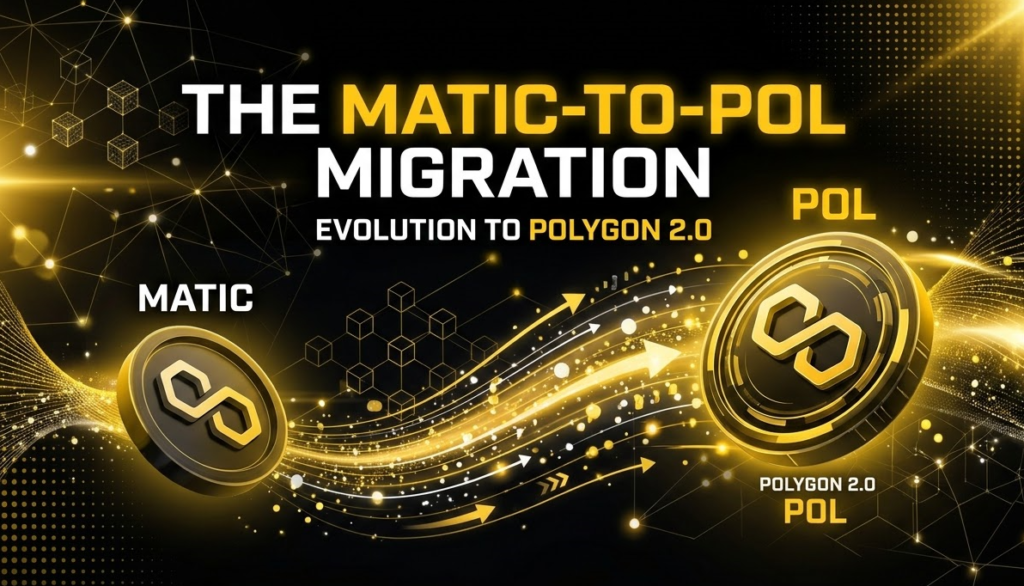
The MATIC-to-POL migration was more than a ticker change. It represented a change in how Polygon intended to use its native asset as the ecosystem expanded.
MATIC had become closely associated with Polygon PoS. It was used to pay transaction fees, support staking, and participate in network security. But Polygon’s longer-term roadmap called for more than one chain, with different networks potentially performing different roles.
POL was designed to support that broader direction.
Why Polygon upgraded MATIC to POL
MATIC was introduced during Polygon’s earlier development as the native asset of the network then known as Matic Network. As the ecosystem expanded, the Polygon brand became associated with Ethereum scaling, DeFi applications, NFT platforms, gaming, and other blockchain services.
The original token model was built around a relatively straightforward purpose: provide an asset for gas payments and staking on Polygon PoS.
That model becomes less straightforward when you imagine a future containing many interconnected chains. Each chain may need validators, sequencing services, data availability, proof generation, and other infrastructure. If every chain operates with completely separate economic incentives, liquidity and security participation can become fragmented.
Polygon’s answer was to introduce POL as a more flexible native asset.
The idea behind the term hyperproductive token is that POL can support multiple activities across an expanding network. Instead of being used only to secure one chain, the token is designed to support validators performing different roles across multiple participating networks.
Polygon’s original tokenomics explanation describes two central features:
- Validators can potentially validate multiple chains using the same staked asset.
- Individual chains can offer multiple roles, each with its own responsibilities and potential rewards.
For example, a validator could participate in transaction validation on Polygon PoS and potentially perform additional services for other compatible chains. Depending on the network and its implementation, those services could include sequencing, proof generation, or participation in a data availability committee.
This is the intended evolution from a single-chain staking asset toward a broader ecosystem security asset. The Polygon 2.0 tokenomics paper explains this hyperproductive design in more detail.
The September 4, 2024 migration
The mainnet transition from MATIC to POL took place on September 4, 2024.
On Polygon PoS, the change was automatic. Users holding MATIC in ordinary Polygon PoS wallets did not need to perform a manual token swap. POL became the native gas token, and the staking infrastructure was updated to use the new asset.
Polygon’s official migration announcement explained the transition and the different steps required depending on where tokens were held.
The important distinction is that the migration process was not identical across every network or custody arrangement.
| Where MATIC was held | General migration treatment |
|---|---|
| Polygon PoS wallet | Automatic 1:1 conversion |
| Polygon PoS staking position | Automatic upgrade under the staking migration |
| Ethereum wallet | Manual 1:1 migration through the official migration interface |
| Centralized exchange | Depends on the exchange’s supported conversion process |
| Polygon zkEVM before its sunset | Requires special attention to the network’s retirement and recovery process |
For users with MATIC on Polygon PoS, the token migration did not require a separate transaction. Some wallets continued to display the old MATIC symbol because of outdated network settings. In that situation, the displayed ticker did not necessarily mean the underlying native asset had failed to migrate.
How to migrate MATIC to POL on Ethereum
If you still hold legacy MATIC on Ethereum, the migration process is different from the automatic Polygon PoS transition.
The general procedure is:
Step 1: Open the official migration interface
Use the Polygon Portal POL upgrade page. Check the domain carefully and avoid migration links sent through unsolicited messages or social media accounts.
Step 2: Connect your Ethereum wallet
Make sure your wallet is connected to Ethereum Mainnet and that it holds the MATIC you want to migrate.
Step 3: Review the migration transaction
The interface should show the amount of MATIC being upgraded and the corresponding POL amount. The migration ratio is 1:1.
Step 4: Approve the token
If required, approve the migration contract to access the MATIC in your wallet. Read the approval carefully and avoid granting permissions through an unverified website.
Step 5: Execute the migration
Confirm the upgrade transaction. Once the transaction has been processed, check your wallet and the relevant blockchain explorer to verify that the POL balance has arrived.
Polygon’s MATIC-to-POL migration instructions provide the official process for Ethereum holders.
A particularly important warning: do not simply send MATIC to the migration contract address. The migration requires calling the appropriate migration function through the supported interface or an appropriately integrated application. Sending tokens directly to a contract address without following the required process can result in irreversible loss.
What if your MATIC is on a centralized exchange?
If your MATIC was held on a centralized exchange during the migration, the exchange may have handled the conversion for you.
Some exchanges automatically converted supported MATIC balances into POL and updated their trading pairs. Others may have had different schedules or custody arrangements.
You should therefore check the exchange’s own migration announcement and current deposit and withdrawal support. Do not assume that every exchange uses the same process.
Also distinguish between a token held in your exchange account and a token held in your own wallet. With an exchange account, the platform controls the conversion process. With a self-custody wallet on Ethereum, you generally control the migration transaction yourself.
A special warning about Polygon zkEVM in 2026
Older migration guides may tell zkEVM users to bridge MATIC to Ethereum and then use the migration interface. That advice reflects the earlier migration environment, not the network’s current status.
Polygon zkEVM Mainnet Beta was sunset on July 3, 2026. Its sequencer stopped producing blocks, and the ordinary AggLayer bridge route is no longer available for processing withdrawals from that network.
Polygon has provided a dedicated claims interface for eligible assets held in self-custodied wallets. The stated recovery window runs through December 31, 2027. Assets held inside smart contracts, including DeFi positions and multisig contracts, cannot be recovered through that same claims interface.
If you still have assets associated with Polygon zkEVM, do not follow an old bridge tutorial blindly. Start with the official Polygon zkEVM recovery page and follow its current instructions.
Polygon 2.0 Architecture: AggLayer and Polygon CDK
Polygon 2.0 is the architectural vision behind the move from a single-chain scaling ecosystem toward a network of interconnected blockchains.
The idea is simple to describe but technically challenging to implement: different chains should be able to retain their own execution environments and operating models while still communicating, moving assets, and sharing liquidity through common infrastructure.
Two components are central to that vision:
- AggLayer: the interoperability and aggregation layer connecting participating chains.
- Polygon CDK: a development framework that helps teams create customizable blockchain networks.
These components solve different problems. CDK helps developers build chains. AggLayer helps compatible chains interact with one another.
AggLayer: Unifying fragmented liquidity and chain state
One of the biggest challenges in a multichain ecosystem is fragmentation.
Imagine that you hold USDC on one network, while a DeFi application you want to use operates on another. Traditionally, you might need to bridge the asset, wait for confirmation, receive a wrapped representation, and then interact with the destination application.
This process can be confusing, especially when users must understand different bridges, token representations, and withdrawal periods.
AggLayer is designed to reduce that friction.
Rather than treating every connected chain as an isolated environment, AggLayer provides shared infrastructure for cross-chain settlement and interoperability. It coordinates information about connected networks and uses cryptographic proofs to verify that cross-chain movements are consistent with the assets and state recorded across the system.
The long-term objective is to make a collection of independent chains feel more like one connected environment from the user’s perspective.
The AggLayer overview describes its focus on unified liquidity, cross-chain state, and shared infrastructure.
How AggLayer works at a high level
To understand AggLayer, it helps to separate the process into several stages.
Connected chains execute their own transactions
Each connected blockchain maintains its own execution environment and state. It can have its own applications, users, governance arrangements, and technical configuration.
AggLayer does not require every chain to become an identical copy of Polygon PoS.
Chains communicate their state transitions
Connected chains submit the required information or certificates to AggLayer through the relevant integration components.
The system needs to establish what happened on the source chain before it can safely coordinate a cross-chain movement.
Cryptographic verification checks the accounting
AggLayer uses proof-based mechanisms to verify that cross-chain activity is consistent with the system’s accounting rules.
A key part of this design is the pessimistic proof. Rather than assuming that every connected chain is always honest and correct, the proof system checks whether the proposed state transition respects the limits of the assets recorded in the unified bridge system.
Cross-chain value can then be settled
Once the required checks are satisfied, the system can process the relevant cross-chain operation.
The aim is to make assets and applications more accessible across participating networks without requiring users to manually navigate every technical step.
The AggLayer technical overview introduces the aggregation model, while Polygon’s 2026 explanation of cross-chain security describes how pessimistic proofs help protect the accounting of cross-chain movements.
What is a pessimistic proof?
A pessimistic proof is a cryptographic mechanism used to verify that a connected chain has not created a state transition that would allow it to withdraw more value than the system’s accounting permits.
The name reflects the security assumption: the bridge should not blindly trust every connected network.
Consider a simplified example. A chain has deposited 100 units of an asset into the shared bridge system. It should not be able to claim that it has 150 units available for withdrawal.
The proof system checks whether the proposed movement is consistent with the recorded balance and permitted state changes. If the accounting does not add up, the transition should not be accepted.
This is important because cross-chain security failures often involve incorrect assumptions about what happened on another network. A bridge may receive a message claiming that an asset was deposited or released, but if the message is not properly verified, the system can become insolvent.
AggLayer’s approach aims to make the accounting itself cryptographically verifiable.
Of course, cryptographic proofs do not remove every possible risk. Users still need to consider smart-contract bugs, implementation errors, bridge configuration, network availability, and the security of the chains connected to the system.
AggLayer is becoming chain-agnostic
An important development in 2026 is that AggLayer’s ambitions have expanded beyond connecting chains that share an EVM-style architecture.
In May 2026, Polygon announced that Miden had completed a two-way value-settlement demonstration with Ethereum through AggLayer testnet infrastructure. Miden uses a different execution model, including client-side transaction proofs and a note-based state structure.
This matters because it suggests that AggLayer is being developed as a broader interoperability layer rather than a bridge exclusively for EVM-compatible chains.
However, be precise about the status. Polygon’s announcement described the Miden integration as a testnet milestone, with further production milestones still ahead. It should not be presented as proof that every type of blockchain can already connect to AggLayer in a fully operational mainnet environment.
You can read the May 2026 Miden and AggLayer announcement for the technical context.
Polygon CDK: Building customized blockchain networks
Polygon CDK, short for Chain Development Kit, is a modular framework for building and deploying blockchain networks.
Instead of forcing every application to operate on the same general-purpose chain, CDK gives developers more control over how their network is configured.
A project might want a public chain optimized for DeFi. Another might need a network for gaming, where predictable execution costs and high throughput are important. An institution might require a more controlled environment with privacy or compliance features.
A customizable chain framework gives these projects more room to design around their specific requirements.
Polygon’s official CDK page describes the framework’s developer options, including EVM compatibility, custom gas tokens, and interoperability features.
What can developers customize with Polygon CDK?
Depending on the selected CDK architecture and supported components, developers can configure several aspects of their network.
| Configuration area | What it means |
|---|---|
| Execution environment | Defines how transactions and smart contracts are processed |
| Gas token | Determines which asset is used to pay transaction fees |
| Data availability | Determines how transaction data is made available and stored |
| Sequencing | Defines how transactions are ordered and submitted |
| Settlement | Determines how the chain connects to its settlement layer |
| Privacy | Allows different levels of transaction visibility and control |
| Interoperability | Enables integration with AggLayer and other supported networks |
This flexibility is one reason CDK is relevant beyond conventional Ethereum scaling.
A developer does not necessarily need to launch a general-purpose public chain with the same configuration as every other Polygon-based network. The framework can support different operational models, depending on the selected architecture.
Why the Plonky2 description needs context
The original Polygon 2.0 vision placed significant emphasis on Polygon’s zero-knowledge proving research, including Plonky2 and the development of a common proving layer.
Plonky2 is a recursive proof system designed to make proof generation and verification more efficient. It formed an important part of Polygon’s earlier ZK research and helped establish the technical direction behind the ecosystem’s proving ambitions.
However, it would be misleading to describe every current Polygon CDK chain as a simple Plonky2 rollup.
The CDK infrastructure has evolved, and different configurations may use different execution clients, proving systems, and settlement arrangements. The legacy CDK node repository itself is marked as deprecated, with newer infrastructure such as cdk-op-reth and AggLayer-related components taking its place.
Developers should use the current Polygon CDK repository information and the Polygon developer documentation rather than relying on older tutorials that may describe retired components.
Polygon CDK and AggLayer: How they fit together
It is easy to confuse the two because they are often discussed in the same Polygon 2.0 context.
Think of CDK as the framework used to build and configure a chain, while AggLayer is the interoperability infrastructure that can connect supported chains.
For example:
- A developer uses Polygon CDK to create a customized blockchain.
- The developer configures its execution, gas token, data availability, and settlement requirements.
- The chain integrates the necessary AggLayer components.
- The connected chain can then participate in the supported cross-chain settlement and interoperability system.
This is the architectural separation that makes Polygon’s multichain approach interesting. Individual chains can retain their own identities and operating requirements while using shared infrastructure to interact with other networks.
Hyperproductive Staking and POL Tokenomics

POL’s token design is closely connected to Polygon’s broader multichain ambitions.
A conventional staking token is generally used to help secure one blockchain. Validators commit capital, perform consensus-related work, and receive rewards for contributing to the network.
POL’s hyperproductive design aims to extend that concept. The same staked asset can potentially support multiple chains and multiple infrastructure roles, rather than being restricted to one validator function on one network.
That is the idea behind the term hyperproductive staking.
What is hyperproductive staking?
Hyperproductive staking is Polygon’s proposed model for allowing POL holders and validators to support multiple participating chains and perform different kinds of work.
The concept goes beyond simply delegating tokens to a validator on Polygon PoS.
In the broader design, a validator could potentially contribute to several services:
- Transaction validation and block production.
- Sequencing transactions on supported networks.
- Generating or supporting zero-knowledge proofs.
- Participating in data availability committees.
- Providing other network-specific security services.
Each role can have its own technical requirements and reward structure.
For example, a validator might help secure Polygon PoS while also participating in another compatible chain’s infrastructure. If that chain offers rewards for the relevant service, the validator could receive additional compensation.
This is how POL is intended to become more productive across the ecosystem.
Polygon’s original POL tokenomics explanation describes the multi-chain and multi-role model.
What is actually available to POL stakers?
The distinction between the long-term design and currently available staking features is important.
The established Polygon PoS staking process allows POL holders to delegate tokens to validators. Validators participate in network operations, produce blocks, and contribute to consensus and checkpoint submission.
Staking takes place through Ethereum-based staking contracts, rather than by simply sending POL to a validator’s Polygon PoS address. Polygon’s official staking guide explains the process and the role of POL in securing the network.
The wider hyperproductive model is intended to expand the services that POL can secure as more compatible chains and infrastructure become available. It should not be interpreted as a guarantee that every connected chain already provides identical POL staking rewards.
In practice, you need to check which staking services are live, what role your chosen validator performs, and how rewards are calculated.
How Polygon PoS staking works
Polygon PoS uses validators to participate in network security.
Validators operate the infrastructure required to process transactions and participate in consensus. They also submit checkpoints to Ethereum as part of the network’s security design.
Most ordinary token holders do not need to run validator infrastructure themselves. Instead, they can delegate POL to an existing validator.
The basic relationship is straightforward:
- The delegator commits POL to a validator.
- The validator uses its infrastructure and stake to participate in network operations.
- Rewards are distributed according to the staking system and the validator’s performance and commission settings.
- The delegator receives a share of applicable rewards after relevant deductions.
Choosing a validator still matters. A validator with poor uptime, unreliable operations, or a high commission may deliver a less attractive staking experience than another option.
You should also understand the unbonding process and any applicable withdrawal conditions before staking.
Validator rewards are not guaranteed returns
Staking rewards depend on the protocol’s reward mechanism, network conditions, validator performance, and the amount of stake participating in the system.
A displayed reward percentage is not a fixed interest rate like a bank deposit. It can change as network participation and protocol settings change.
There are also practical risks:
- Validator downtime can reduce rewards.
- Commission settings can affect the amount delegated users receive.
- Unbonding rules can prevent immediate access to staked tokens.
- Token price volatility can outweigh staking income.
- Protocol changes can alter reward distribution.
A staking position may generate more POL over time while still losing value in fiat terms if the token price falls.
The 2% annual emission model
POL’s initial supply was set at 10 billion tokens, but the tokenomics framework includes an annual emission mechanism.
The original model allocates 2% of the initial supply per year across two broad purposes:
| Emission destination | Annual allocation under the original model | Purpose |
|---|---|---|
| Staking layer | 1% | Incentivize validators and network security |
| Community Treasury | 1% | Fund ecosystem development and community initiatives |
| Total | 2% | Support network security and ecosystem growth |
The staking allocation is intended to compensate validators and help maintain network participation. The Community Treasury allocation is intended to support development, research, grants, and ecosystem initiatives.
The important detail is that the emissions model is subject to community governance. The community can discuss and potentially adjust the mechanism as the network’s needs change.
Polygon’s official emissions explanation describes the two-part allocation and its intended purpose.
Does POL have a 10-billion hard cap?
No. This is one of the most important tokenomics misconceptions to correct.
POL began with an initial supply of 10 billion tokens, matching the original MATIC supply at the time of migration. But the protocol’s emission mechanism allows additional tokens to be created under the applicable rules.
The 10-billion figure is therefore not a permanent maximum supply.
The distinction between the different supply metrics is useful:
- Initial supply: The amount established at the token’s launch and migration.
- Total supply: The amount of tokens that have been issued, subject to the token contract’s accounting.
- Circulating supply: The amount considered available in the market under a data provider’s methodology.
- Maximum supply: A hard upper limit, if one is defined by the token’s rules.
Because POL has an ongoing emission mechanism, it is inaccurate to describe it as having an immutable 10-billion maximum supply.
How inflation affects POL holders
Token emissions can create dilution for existing holders if the circulating supply increases faster than demand for the token.
For example, suppose the amount of POL in circulation increases over time while network usage and demand remain unchanged. Each existing token may represent a smaller share of the overall supply.
However, inflation does not automatically mean the token’s market price must fall. Demand, staking participation, transaction activity, token utility, and market conditions all influence valuation.
The relevant question is whether the additional supply is creating enough economic activity and network security to justify its issuance.
That is why the allocation of emissions matters.
If staking rewards help maintain a secure and reliable network, they may support the long-term value of the ecosystem. If treasury funding produces useful applications, integrations, and adoption, it may also contribute to demand.
But those are economic objectives, not guaranteed outcomes.
What does the Community Treasury do?
The Community Treasury is intended to provide funding for Polygon ecosystem development.
Potential uses include:
- Grants for developers and infrastructure projects.
- Research and protocol development.
- Ecosystem growth initiatives.
- Incentives for applications and network adoption.
- Other initiatives approved through the governance framework.
The treasury’s effectiveness depends on how funds are allocated and what results they produce. A large treasury balance alone does not guarantee that the ecosystem will grow.
For investors, it is worth watching governance decisions and treasury spending rather than focusing only on the headline emission percentage.
How POL may capture value from AggLayer
Polygon’s longer-term thesis is that POL can become useful across both Polygon PoS and AggLayer-connected infrastructure.
In its published value-accrual discussion, Polygon describes potential fee opportunities for stakers who contribute to services such as settlement, interoperability, and cross-chain atomicity.
The economic idea is that additional connected chains and cross-chain activity could create more demand for the services secured by POL stakers.
However, do not assume that every future fee mechanism is already active or that all projected value will automatically flow to token holders. The actual rewards depend on deployed functionality, network participation, and governance-approved economic arrangements.
Polygon’s POL value-accrual explanation is useful for understanding the intended relationship between POL, Polygon PoS, and AggLayer.
Common Pitfalls and Misconceptions About Polygon (POL)
Polygon’s transition has created plenty of outdated information online. Some articles still describe MATIC as the active gas token, while others present the entire Polygon 2.0 roadmap as though every component were already fully deployed.
Here are the distinctions worth keeping in mind.
Misconception: MATIC is still the native gas token on Polygon PoS
POL replaced MATIC as the native gas and staking token on Polygon PoS on September 4, 2024.
If your wallet still displays MATIC, that may be a symbol or network-configuration issue rather than proof that the migration did not happen.
However, you should distinguish the native gas asset from legacy MATIC tokens held on Ethereum or in other environments. Those holdings may require a separate migration or conversion process.
The official migration announcement confirms the transition date and explains the different holder scenarios.
Misconception: Every Polygon CDK chain must use POL for gas
This is incorrect.
POL is the native gas token on Polygon PoS, but Polygon CDK is designed to support customized blockchain configurations.
A CDK chain can be configured with a custom gas token or a gasless transaction model, depending on its architecture and requirements.
That flexibility is useful for applications that want to control their user experience. For example, a payments application may prefer to let users pay fees in a familiar stablecoin rather than requiring them to hold POL.
If you are deploying or using a CDK chain, check its documentation to identify the actual gas asset.
Misconception: Polygon is still only an Ethereum sidechain
Polygon began with a strong association with its Proof-of-Stake scaling network, but its ecosystem has expanded.
Polygon 2.0 is a broader architectural vision involving multiple chains, ZK technology, chain-development infrastructure, and interoperability through AggLayer.
That does not mean Polygon PoS has stopped existing or that every chain in the ecosystem has become a zero-knowledge rollup. Polygon PoS remains an important network, while CDK and AggLayer support a wider range of chain configurations.
A more accurate description is that Polygon is evolving from a primarily single-chain scaling ecosystem into a broader multichain infrastructure project.
Misconception: AggLayer is just another token bridge
A conventional bridge often focuses on moving assets between two networks. AggLayer aims to provide a broader interoperability and settlement framework.
Its design includes proof-based accounting and mechanisms intended to coordinate cross-chain state and liquidity across participating chains.
The distinction is important because the goal is not simply to transfer wrapped tokens. It is to make independent chains work together through common infrastructure.
Still, AggLayer should not be described as eliminating every bridge risk or making every connected chain instantly interchangeable. Its security depends on the actual integration, proof system, contracts, and operational configuration.
Misconception: POL has a fixed 10-billion maximum supply
The initial supply was 10 billion POL, but the tokenomics model includes annual emissions.
The original framework directs 1% toward staking rewards and 1% toward the Community Treasury. The mechanism is subject to governance and can change.
If you are evaluating POL’s long-term valuation, use a supply model that accounts for emissions rather than assuming that the token supply can never exceed 10 billion.
Misconception: Hyperproductive staking means every POL holder earns rewards from every chain
The hyperproductive model is designed to allow POL to support multiple networks and infrastructure roles.
However, the availability of those roles depends on actual chain integrations and staking mechanisms.
Delegating POL to a Polygon PoS validator does not automatically mean you are receiving rewards from every AggLayer-connected chain. You need to verify which services your validator supports and which rewards are actually available.
Misconception: AggLayer makes all connected chains identical
AggLayer is designed to connect networks, not erase their differences.
Connected chains can retain their own execution environments, applications, governance arrangements, and operational requirements.
This flexibility is important for institutions and developers who need customized environments. A chain built for public DeFi does not need the same configuration as one designed for private financial workflows.
The objective is interoperability between different systems, not forcing every system to become one identical blockchain.
Polygon’s 2026 Developments
A current Polygon guide should look beyond the original Polygon 2.0 roadmap. Several developments illustrate how the ecosystem’s priorities and architecture have continued to evolve.
AggLayer expands beyond EVM-compatible chains
The May 2026 Miden testnet announcement was an important milestone for AggLayer’s chain-agnostic direction.
Miden uses a ZK-native execution environment, client-side transaction proofs, and a note-based state model rather than the conventional account-based approach familiar to Ethereum developers.
The successful testnet demonstration showed that AggLayer’s architecture could support value settlement across systems with substantially different execution models.
That does not mean all such integrations are already production-ready. The announcement identified further steps before the Miden integration reaches full mainnet deployment.
For builders, the broader message is that AggLayer is being developed to connect more than one type of blockchain architecture.
Polygon zkEVM Mainnet Beta has been sunset
Polygon zkEVM was once one of the most prominent parts of Polygon’s zero-knowledge scaling strategy. However, the Mainnet Beta sequencer was sunset on July 3, 2026.
This is a significant change for users and developers who still associate Polygon’s ecosystem with an active zkEVM network.
The recovery process now uses a dedicated claims interface for eligible assets held in self-custodied wallets. Assets held inside smart contracts cannot be recovered through that same interface.
If you have old positions on zkEVM, check the official sunset and recovery guidance before attempting to bridge, swap, or interact with the retired network.
Polygon’s focus on payments and institutional infrastructure
Polygon has also been placing greater emphasis on payments, stablecoins, and financial infrastructure.
Its Open Money Stack direction is intended to combine components such as wallets, payment rails, interoperability, and onchain settlement into a more integrated infrastructure offering.
AggLayer is positioned as the interoperability layer within this broader strategy, while Polygon CDK can support chains designed for specific institutional or application requirements.
Polygon’s Open Money Stack overview explains how the company sees these components fitting together.
For POL, this matters because the token’s long-term thesis depends partly on whether it develops meaningful utility across a growing ecosystem. More chains and more payment activity may create opportunities for POL staking and network services, but the economic impact depends on actual adoption and the fee mechanisms that are implemented.
How to Swap, Stake, and Use POL
If you are moving from MATIC to POL or want to participate in Polygon staking, the safest approach is to understand which network you are using before signing a transaction.
The following walkthrough covers the common scenarios.
Migrating MATIC to POL on Ethereum
This section applies to legacy MATIC held on Ethereum Mainnet, not MATIC that was already automatically converted on Polygon PoS.
Step 1: Open Polygon Portal
Navigate to the official POL migration interface.
Check the domain and confirm that the interface is the official Polygon Portal before connecting your wallet.
Step 2: Connect your Ethereum wallet
Select Ethereum Mainnet and connect the wallet that holds your MATIC.
Make sure you have enough ETH to cover the transaction’s gas fees.
Step 3: Review the amount
The migration should show a 1:1 conversion ratio.
For example, 500 MATIC should produce 500 POL before any unrelated costs or adjustments.
Step 4: Approve the migration contract
If the interface requests token approval, check the contract and permission details.
Do not approve a transaction simply because a website displays a familiar Polygon logo.
Step 5: Execute the upgrade
Confirm the migration transaction and wait for Ethereum to process it.
Step 6: Verify your POL balance
Check your wallet and the transaction record on a trusted block explorer. If the new token does not appear automatically, you may need to add the correct POL contract information to your wallet.
What if you already hold MATIC on Polygon PoS?
For ordinary Polygon PoS balances, the migration was automatic.
You should not need to perform a new MATIC-to-POL conversion simply because an old wallet interface continues to show the MATIC symbol.
Check the network’s native currency configuration and update the symbol if necessary. Do not send your tokens to an unrelated migration contract or attempt a second conversion without confirming what the wallet actually holds.
How to stake POL
POL holders can participate in Polygon PoS staking by delegating tokens to a validator.
Step 1: Visit the official staking interface
Start from the Polygon staking page.
Use the official site to review the current validator options and staking instructions.
Step 2: Connect your wallet
Connect a wallet holding POL on Ethereum Mainnet, as Polygon PoS staking uses Ethereum-based staking contracts.
Make sure you have sufficient ETH for the transaction fees.
Step 3: Compare validators
Do not choose a validator based solely on its advertised reward percentage.
Review its commission, performance, uptime, reputation, and other relevant operating metrics. A validator’s reliability can affect the rewards you receive.
Step 4: Delegate POL
Choose the validator and enter the amount you want to delegate.
Review the transaction details and confirm the delegation through your wallet.
Step 5: Monitor your staking position
Check your delegated balance and rewards through the staking interface.
If you decide to stop staking, follow the unbonding process. Do not assume that delegated POL can be withdrawn instantly.
How to use POL for gas on Polygon PoS
POL is the native gas asset on Polygon PoS.
To use it:
- Add Polygon PoS Mainnet to your wallet if it is not already configured.
- Transfer POL to your wallet on Polygon PoS.
- Confirm that the wallet is connected to the correct network.
- Use POL to pay for transactions, token transfers, and smart-contract interactions.
- Keep a small balance available for future network fees.
Be careful when transferring POL between networks. A token with the same ticker on Ethereum and Polygon PoS may be represented by different contract arrangements. Always verify the destination network and transfer route before sending funds.
How developers can explore Polygon CDK
If you are building an application-specific chain, start with the official Polygon CDK documentation.
The general development process involves:
- Defining the application’s requirements and expected transaction volume.
- Choosing the appropriate chain configuration.
- Selecting execution, sequencing, and data availability components.
- Deciding whether to use a custom gas token.
- Configuring settlement and interoperability requirements.
- Integrating AggLayer components where supported.
- Testing the network and its contracts before production deployment.
There is no universal CDK configuration that fits every application. A public DeFi chain, a gaming network, and a private institutional environment may require different trade-offs.
Frequently Asked Questions
What is Polygon (POL) and how does it work?
Polygon (POL) is the upgraded native token of the Polygon ecosystem. It replaced MATIC as the native gas and staking token on Polygon PoS on September 4, 2024. POL also supports Polygon’s broader multichain vision, including staking services and potential roles across participating AggLayer-connected networks.
What happened to MATIC?
MATIC was upgraded to POL at a 1:1 ratio. MATIC on Polygon PoS was automatically converted, while holders on Ethereum generally need to use the official migration process if they still hold legacy MATIC. Centralized exchanges handled the migration according to their own schedules and support arrangements.
Is POL the native gas token on Polygon?
Yes. POL is the native gas token on Polygon PoS. However, not every chain built with Polygon CDK must use POL. CDK supports customized network configurations, including custom gas tokens and gasless transaction models.
What is Polygon 2.0?
Polygon 2.0 is the broader architectural vision for an interconnected network of blockchains. It combines the idea of customizable chains with shared interoperability infrastructure. Polygon CDK helps developers build chains, while AggLayer provides mechanisms for connecting participating networks and coordinating cross-chain settlement.
What is AggLayer?
AggLayer is Polygon’s interoperability and aggregation layer. It is designed to connect participating blockchains through shared infrastructure, cryptographic proofs, and cross-chain settlement mechanisms. Its goal is to reduce fragmentation between chains and make liquidity and applications more accessible across the connected ecosystem.
What is the difference between Polygon CDK and AggLayer?
Polygon CDK is a framework for building customized blockchain networks. AggLayer is the infrastructure designed to connect participating networks. In simple terms, CDK helps you build a chain, while AggLayer helps that chain interact with other connected chains.
What is hyperproductive staking?
Hyperproductive staking is Polygon’s design for allowing POL to secure multiple participating chains and support multiple infrastructure roles. Potential roles include transaction validation, sequencing, zero-knowledge proof generation, and data availability services. The actual opportunities and rewards depend on which integrations and staking mechanisms are live.
What is the total supply of POL?
POL launched with an initial supply of 10 billion tokens. However, it also has an annual emission mechanism, so 10 billion is not a permanent maximum supply. The original framework allocates 1% annually to staking rewards and 1% to the Community Treasury, subject to community governance.
Does POL have a 2% inflation rate?
The original POL tokenomics framework introduced annual emissions equivalent to 2% of the initial supply, split between the staking layer and Community Treasury. The mechanism is subject to governance and can be adjusted. It is more accurate to describe it as an emission model than to assume that the market’s circulating supply must increase by exactly 2% every year.
Can I still convert MATIC to POL?
Yes, legacy MATIC held on Ethereum can be migrated through the official Polygon Portal interface at a 1:1 ratio. MATIC on Polygon PoS was automatically converted during the 2024 upgrade. If your assets are associated with Polygon zkEVM, follow the current recovery instructions because that network was sunset in July 2026.
How do I stake POL?
You can delegate POL to a validator through Polygon’s official staking interface. Staking uses Ethereum-based contracts, so you need POL for delegation and ETH to pay the transaction fees. Compare validators carefully and understand the unbonding process before committing your tokens.
Is Polygon zkEVM still active in 2026?
No. Polygon zkEVM Mainnet Beta was sunset on July 3, 2026, and its sequencer stopped producing blocks. Eligible assets held in self-custodied wallets can be recovered through the dedicated claims interface until December 31, 2027. Assets held in smart contracts require separate assistance from the relevant contract or protocol operator.
Conclusion
The move from MATIC to POL reflects a much bigger change in Polygon’s direction.
MATIC was closely associated with one major scaling network. POL was designed to support a broader ecosystem where multiple chains can use shared infrastructure, and where validators may perform more than one type of service.
Polygon 2.0 brings that vision together through two important components. Polygon CDK gives developers the tools to create customized networks, while AggLayer is designed to connect participating chains through cryptographic verification and shared settlement infrastructure. The ambition is to make a multichain environment feel more connected without forcing every network to surrender its own architecture.
Hyperproductive staking adds the economic layer. Instead of limiting POL to a single validator role, Polygon’s design aims to make the token useful across multiple networks and infrastructure services. The 2% annual emission model supports staking incentives and the Community Treasury, although it also means POL should not be evaluated as a permanently capped 10-billion-token asset.
There are still important details to watch. AggLayer integrations are progressing at different stages, staking opportunities depend on actual deployments, and the broader ecosystem continues to evolve. Polygon zkEVM’s 2026 sunset is also a reminder that not every product associated with the Polygon brand will remain active indefinitely.
If you are considering POL, I would look at three things rather than relying on the token upgrade story alone: how much real activity Polygon PoS and connected chains attract, whether AggLayer creates meaningful cross-chain usage, and whether POL’s staking and fee mechanisms translate that activity into sustainable demand.
That is the real question behind Polygon’s evolution. The success of POL will depend not simply on replacing MATIC, but on whether Polygon can turn its multichain architecture into infrastructure that developers, businesses, and everyday users genuinely want to use.
Add a reader-friendly comparison tableSeparate current features from roadmap claims