Key Specifications and Architectural Overview of Aster
Aster is a decentralized exchange focused on perpetual futures trading, with an ecosystem that combines multi-chain access, privacy-oriented order execution, high-leverage trading products, and yield-bearing collateral. Its current identity emerged from the merger of Astherus, a yield-focused DeFi platform, and APX Finance, a decentralized perpetual exchange. The project is now developing its own Layer-1 network, Aster Chain, while expanding products such as USDF and the ASTER token economy.
The idea behind Aster is fairly straightforward: traders should not have to choose between sophisticated derivatives tools, capital efficiency, and some degree of privacy. On many transparent blockchains, transaction data can reveal trading activity that other market participants may exploit. Aster aims to reduce that exposure through encrypted order execution and privacy-focused infrastructure.
Here is a quick overview of the ecosystem:
| Category | Aster’s design and current positioning |
|---|---|
| Project | Aster |
| Native token | ASTER |
| Strategic origin | Merger of Astherus and APX Finance |
| Early institutional backing | YZi Labs, formerly Binance Labs |
| Main product | Decentralized perpetual futures exchange |
| Trading environments | Pro, Simple/1001x, Shield, and Spot products |
| Layer-1 initiative | Aster Chain |
| Privacy approach | Encrypted orders, ZK-verifiable privacy features, and stealth addresses |
| Yield products | USDF, asBNB, asBTC, and related yield-bearing assets |
| Initial ASTER supply | 8 billion tokens |
| Token allocation | 53.5% Airdrop, 30% Ecosystem and Community, 7% Treasury, 5% Team, and 4.5% Liquidity and Listings |
| Long-term supply objective | Reduce total supply toward 3 billion through the buyback-and-burn mechanism |
Aster’s official documentation describes it as a privacy-focused decentralized exchange offering perpetual markets across crypto and other asset categories. Its broader product suite also includes spot trading and yield products. You can explore the platform’s current product descriptions in the official Aster documentation.
One detail is worth keeping in mind throughout this guide: Aster is an evolving project. Its official website describes ambitious performance and privacy specifications, but advertised technical capabilities should not automatically be treated as independently verified production results. The same caution applies to yield products and token economics. A published mechanism explains how a product is intended to work; it does not eliminate market, smart-contract, liquidity, or execution risk.
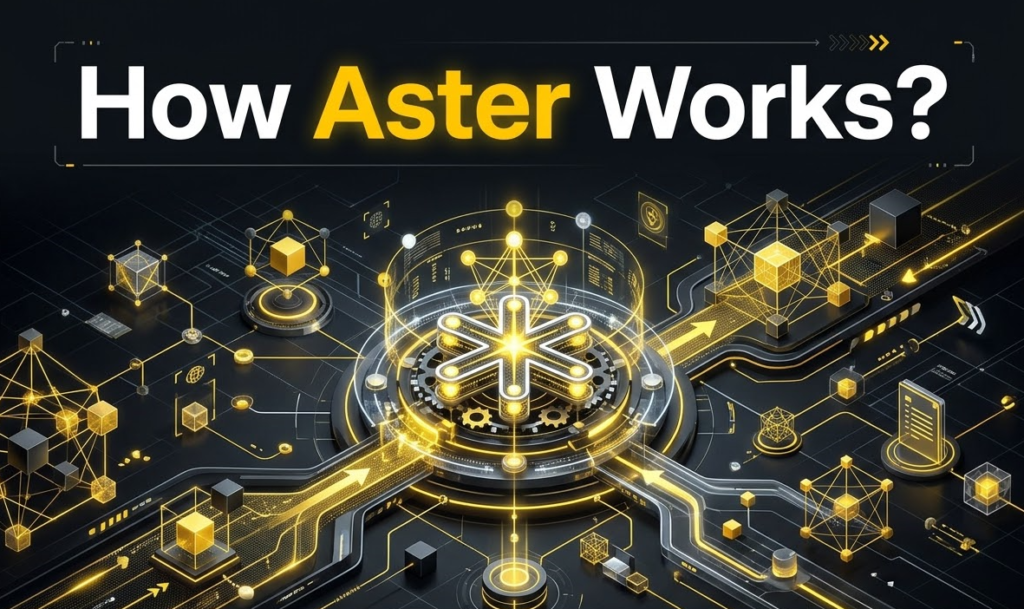
How Aster Works?
Combining Yield Infrastructure With Perpetual Trading
Aster did not begin as an entirely new project built around a single trading product. Its foundation came from two different DeFi businesses with complementary strengths.
Astherus focused on yield generation and capital efficiency. Its products included yield-bearing assets and strategies designed to help users earn returns from crypto holdings. APX Finance, meanwhile, had experience in decentralized perpetual trading and derivatives infrastructure.
Bringing these capabilities together created a more integrated product direction. Rather than treating trading and earning as separate activities, Aster could build an ecosystem in which assets used for collateral might also participate in yield strategies.
Consider how this changes the experience for a trader.
On a conventional derivatives platform, you deposit collateral, open a position, and leave the remaining margin sitting in your account. That capital is available to support your position, but it may not generate any additional return.
Aster’s yield products introduce another possibility. Depending on the supported asset and the platform’s collateral rules, a user may hold a yield-bearing asset such as USDF or asBNB and use it within the trading ecosystem. The goal is to make capital more productive without forcing users to withdraw their funds from the trading environment every time they want to access a yield opportunity.
This combination does not mean every asset automatically earns yield in every trading mode. Supported collateral, valuation ratios, margin settings, and product-specific conditions still matter. A trader should check the current collateral documentation before assuming that an asset can be used in a particular account configuration.
The strategic rebrand was announced in March 2025. The announcement described Astherus’ transition to Aster following an earlier merger with APX Finance and explained that the new project would focus more directly on decentralized perpetual trading. The announcement also confirmed that Aster would continue supporting yield products such as USDF and asBNB. The original announcement is available through The Block’s publication of the Chainwire release.
The merger therefore gave Aster two important building blocks:
- Trading infrastructure: APX Finance contributed experience in decentralized derivatives and perpetual markets.
- Yield infrastructure: Astherus contributed products designed to generate returns from crypto assets and collateral.
The real test is whether these products work together efficiently at scale. A platform can offer many features, but the experience only becomes compelling when traders can move between them without unnecessary friction, confusing collateral rules, or excessive transaction costs.
Strategic Backing From YZi Labs
Aster’s early development also attracted attention because of its association with YZi Labs, formerly known as Binance Labs.
The distinction between backing and ownership is important. An investment or strategic relationship can provide capital, industry connections, and access to an established network, but it does not automatically mean that the investor controls the protocol or guarantees its performance.
For Aster, the relationship is relevant because building a derivatives platform requires more than a trading interface. The project needs liquidity providers, market makers, infrastructure partners, wallet integrations, security expertise, and connections across different blockchain ecosystems.
An established investment network can help a project develop those relationships more quickly. It can also increase visibility among traders who already follow major DeFi infrastructure projects.
However, I would not treat institutional backing as a substitute for technical due diligence. A project still needs to demonstrate reliable execution, transparent risk management, healthy liquidity, and clear governance arrangements. Investors should evaluate those factors independently rather than assuming that a recognizable backer makes a protocol safe.
Zero-Knowledge Privacy and High-Performance Layer-1 Architecture
ZK-Encrypted Hidden Orders and the Problem of Position Hunting
Privacy is one of the central ideas behind Aster’s infrastructure strategy.
To understand why it matters, imagine that you open a large leveraged long position on a transparent blockchain. Depending on how the exchange is designed, other participants may be able to observe your order, transaction history, position size, or collateral movements.
That information can become valuable.
A sophisticated trading bot may monitor public transactions, identify large positions, estimate liquidation levels, and react before or during execution. Other market participants may use this information to trade against visible liquidity or take advantage of predictable order flow.
This is part of the broader problem commonly associated with maximal extractable value, or MEV. MEV describes the additional value that block producers or other transaction-ordering participants may capture by influencing the inclusion or ordering of transactions.
Not every form of MEV is the same, and not every visible trade leads to exploitation. Still, transparent execution can expose strategies that traders would rather keep private.
Aster’s response is to make order privacy part of its architecture. Its documentation describes an approach in which orders are encrypted before reaching the chain and decrypted for execution. The project also describes ZK-verifiable privacy features and stealth-address functionality as part of its Aster Chain design.
The general concept behind zero-knowledge proofs is that one party can demonstrate that a statement is valid without revealing all the underlying information. For example, a system might prove that a transaction satisfies certain rules without exposing every private input used to construct it.
If you want a more technical foundation, Ethereum’s explanation of zero-knowledge proofs provides a useful introduction to the underlying cryptographic principles.
In a trading environment, privacy can help protect information such as:
- The direction of a pending order.
- The size of a trade before execution.
- Certain account or transaction relationships.
- Strategy details that could otherwise be inferred from public activity.
Aster’s stated objective is to reduce the amount of actionable trading information exposed to other market participants. That could make it harder for bots to identify and target specific positions before execution.
However, there is an important distinction between an advertised privacy architecture and a fully proven guarantee of anonymity.
Zero-knowledge proofs do not automatically hide every piece of information associated with a transaction. The actual protection depends on what data is encrypted, what the proof verifies, how addresses are generated, how execution is handled, and what information remains visible through settlement or external systems.
For that reason, I would avoid describing Aster as a platform where every trading detail is permanently invisible to everyone. A more accurate interpretation is that Aster is building privacy mechanisms intended to reduce exposure of sensitive trading information.
There are also practical trade-offs. Privacy systems must balance confidentiality with verifiability, risk controls, compliance requirements, and the ability to investigate abnormal activity. A platform needs to prove that orders follow its execution rules without unnecessarily exposing the strategies it is trying to protect.
Aster Chain’s 50ms Block Times and Multi-Chain Design
Aster Chain is intended to provide dedicated infrastructure for the exchange rather than relying entirely on other networks for every part of the trading experience.
The official Aster website advertises several performance specifications:
- Block times of approximately 50 milliseconds.
- Throughput of up to 100,000 transactions per second.
- A Proof-of-Authority-Staked (PoSA) consensus design.
- Multi-chain connectivity across BNB Chain, Arbitrum, Ethereum, and Solana.
These are project-stated specifications. They should be understood as advertised design targets or capabilities, not as proof that the network continuously processes 100,000 real trading transactions per second under normal production conditions. Actual performance depends on network load, transaction complexity, validator behavior, and the way throughput is measured. A benchmark that counts simple transactions may not reflect the demands of a derivatives exchange.
The official Aster website provides the project’s current description of Aster Chain and its performance claims.
Why does a dedicated Layer-1 matter?
A derivatives platform has different requirements from a general-purpose blockchain application. Traders care about execution speed, predictable settlement, reliable price updates, and the ability to manage positions during volatile market conditions.
A network optimized for these activities could provide several benefits:
Faster execution. Shorter block intervals can reduce the time users wait for transaction confirmation, although block time alone does not determine the complete execution experience.
More predictable trading infrastructure. A dedicated network can be designed around the needs of order processing, margin management, and derivatives settlement rather than competing with unrelated applications for blockspace.
Integrated privacy features. If privacy functionality is built into the network architecture, developers may be able to use it more consistently than if they had to assemble separate tools for each application.
Cross-chain asset access. Traders can potentially use assets originating from different networks without maintaining entirely separate trading environments.
Aster’s multi-chain strategy is particularly relevant because liquidity is fragmented across blockchain ecosystems. BNB Chain, Ethereum, Arbitrum, and Solana have different users, assets, applications, and liquidity pools. Bringing them into a more unified interface could make the exchange more convenient.
But cross-chain connectivity introduces its own risks. Bridges, validators, messaging systems, and settlement mechanisms all create additional technical dependencies. A successful transfer requires more than displaying several networks in the same interface.
Before transferring funds, users should verify the supported network, token contract, destination address, and current bridge or withdrawal conditions. A token with the same ticker can exist on multiple networks without being interchangeable.
Simple Mode (1001x) vs Pro Mode
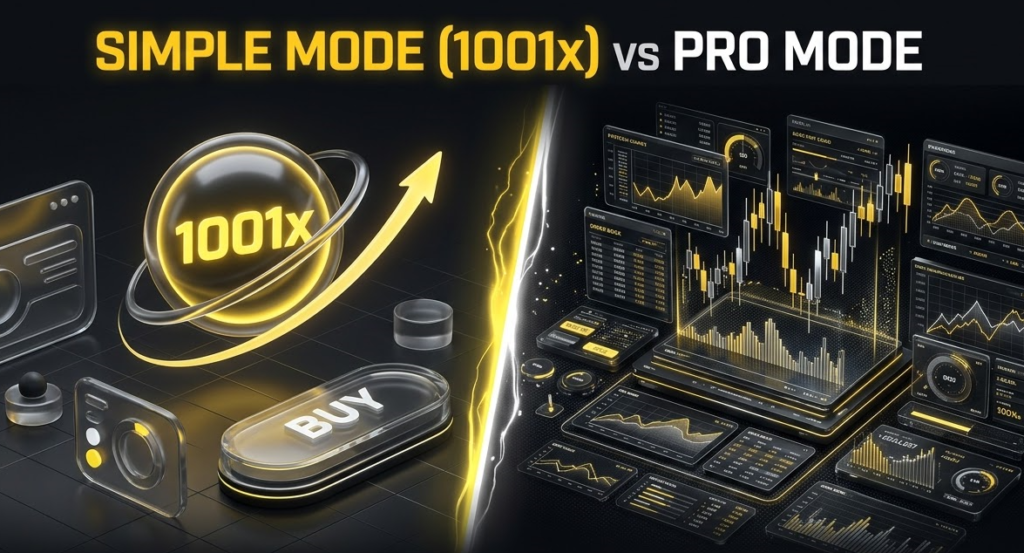
One of Aster’s most distinctive product decisions is its separation of trading experiences.
Instead of forcing every user into a single interface, Aster offers different environments for different trading styles. Pro is designed around advanced order-book trading, while Simple and 1001x products focus on streamlined execution and on-chain liquidity. Aster also documents Shield Mode as a simplified AMM-style environment with privacy-oriented features.
Understanding the differences is important because the headline leverage figure can easily distract from the underlying mechanics.
Simple Mode: One-Click High-Leverage Trading
Aster’s 1001x product is built around a simplified trading experience. Users choose a supported market, select a direction, configure their position, and submit an order without interacting with a traditional order book in the same way they would in Pro.
The product uses on-chain liquidity rather than relying on the standard Pro order-book model. Aster’s documentation describes 1001x as a one-click, MEV-resistant perpetual trading product.
The headline feature is its maximum advertised leverage of up to 1001x on eligible markets.
That number deserves serious attention, but not for the reason marketing materials might suggest.
Leverage increases the size of a position relative to the collateral supporting it. If you commit $100 and open a position with 100x leverage, your notional exposure is approximately $10,000 before fees and other adjustments.
At 1001x, the same $100 could theoretically support exposure of roughly $100,100, subject to the product’s actual margin and execution rules.
The problem is that leverage magnifies losses just as quickly as it magnifies gains.
A simplified illustration shows why extreme leverage is dangerous:
| Leverage | Approximate adverse price movement that can consume the initial margin |
|---|---|
| 10x | 10% |
| 50x | 2% |
| 100x | 1% |
| 500x | 0.2% |
| 1001x | About 0.1% |
These percentages are only rough illustrations. Actual liquidation depends on the platform’s margin model, fees, funding, maintenance requirements, and other execution conditions.
At 1001x, a move of approximately one-tenth of one percent against the position can be enough to consume the initial margin in a simplified model. In crypto markets, that kind of price movement can happen extremely quickly.
This is why I would not describe 1001x as a beginner-friendly feature simply because the interface is easy to use. A simple interface does not make a complex financial product less risky.
Aster also documents oracle protections for its 1001x markets. Its price-oracle documentation describes Pyth as a primary price source, Chainlink as a verification source, and Binance Oracle as a fallback for markets without Pyth support. The documentation also describes a circuit-breaker condition when the Pyth price deviates from Chainlink by more than 1%. You can review the details in the official 1001x price-oracle documentation.
Oracle safeguards can help reduce the risk of trading against abnormal or unreliable price data. They do not prevent ordinary market losses, guarantee execution at a desired price, or eliminate liquidation risk.
Pro Mode: Advanced Order-Book Derivatives
Pro Mode is designed for traders who want a more traditional derivatives interface.
Instead of relying on the simplified on-chain liquidity model used by 1001x, Pro provides an order-book environment. Traders can review available bids and asks, submit market or limit orders, and manage positions using more advanced tools.
Depending on the current market and account configuration, the Pro experience can include:
- Market and limit orders.
- Advanced charting and market data.
- Position management and risk controls.
- Multi-asset margin options.
- Grid trading tools.
- More detailed order-book execution.
The order book is particularly useful for traders who care about execution price and liquidity depth. A market order prioritizes immediate execution, while a limit order gives the trader more control over the price at which they are willing to trade.
Neither order type guarantees a perfect result. Market orders can experience slippage, while limit orders may not execute at all.
Pro also has its own liquidation framework. Aster’s documentation explains that liquidation calculations use mark price and margin conditions rather than simply relying on the last traded price. A position can be liquidated when its available margin falls below the required maintenance margin. The platform’s official liquidation documentation explains the relationship between collateral, unrealized PnL, and maintenance requirements.
Simple Mode vs Pro Mode: Which One Makes More Sense?
| Feature | Simple / 1001x | Pro |
|---|---|---|
| Main experience | Simplified, one-click trading | Advanced derivatives interface |
| Liquidity model | On-chain liquidity product | Order book |
| Trading controls | Streamlined | More detailed |
| Leverage | Up to 1001x on eligible markets | Market-specific limits |
| Order-book depth | Not the standard execution model | Available |
| Best suited to | Users who understand the risks of simplified high-leverage products | Traders who want more control over orders and positions |
I would not choose between these modes based only on the maximum leverage displayed on the screen.
For most traders, execution quality, fees, liquidity, and risk controls matter much more than the largest leverage number. A lower-leverage position with a clear exit strategy is often easier to manage than an extremely leveraged trade that can be liquidated by ordinary market noise.
USDF Yield Stablecoin and Asset Staking
USDF: A Yield-Bearing Stablecoin
USDF is one of the most important products inherited from Astherus.
It is designed as a yield-bearing stablecoin that aims to maintain a value close to one US dollar while generating returns through underlying DeFi strategies.
According to Aster’s documentation, USDF uses crypto assets and corresponding short futures positions as part of its backing and yield model. The strategy is intended to reduce directional market exposure through hedging rather than relying entirely on the price appreciation of the underlying assets.
In a simplified example, imagine that a strategy holds a crypto asset while opening a corresponding short futures position. If the two exposures are appropriately sized and maintained, gains and losses from market price movements may offset one another to a significant degree.
The strategy can then seek returns from other sources, such as funding payments or alternative DeFi opportunities.
That is the basic idea behind delta-neutral yield generation.
However, delta-neutral does not mean risk-free. A hedge can become imperfect when prices move sharply, liquidity dries up, funding rates change, or the futures position cannot be adjusted efficiently. Custody arrangements, collateral management, smart contracts, and counterparty exposure also matter.
Aster’s own documentation discusses how USDF differs from other stablecoin models and describes its intention to diversify yield sources when market conditions change. You can read the project’s explanation in USDF and the Stablecoin Landscape.
The important point is that USDF is not simply another fiat-backed stablecoin.
Its value proposition depends on the performance and risk management of the strategies supporting it. That creates potential yield opportunities, but it also introduces risks that users do not face in exactly the same way when holding a conventional cash-backed stablecoin.
How USDF Can Work as Trading Collateral
The capital-efficiency argument becomes more interesting when USDF is used within Aster’s trading ecosystem.
Suppose you hold USDT and want to participate in derivatives trading. You might convert some of that capital into USDF, allowing it to participate in the stablecoin’s underlying yield model. If the relevant Aster account supports USDF as collateral, you may also be able to use it to support trading positions.
This is the central attraction: the same capital may serve both as collateral and as an asset designed to generate yield.
But users should distinguish between the stablecoin itself and its yield-bearing representation.
Aster’s documentation describes asUSDF as the yield-bearing token associated with USDF. Staking USDF on Aster can mint asUSDF, with the underlying yield reflected in the token’s net asset value. The platform explains this mechanism in its asUSDF documentation for Pendle.
That distinction matters because holding USDF and holding asUSDF are not necessarily the same experience. They may have different redemption conditions, liquidity characteristics, and use cases across DeFi applications.
Before depositing either asset, check:
- Whether the asset is currently accepted as margin in your chosen trading mode.
- The collateral value ratio applied by the platform.
- Whether the asset can be withdrawn immediately.
- Whether additional staking or redemption steps are required.
- Whether the yield is variable or tied to a specific strategy.
- Whether the asset has sufficient liquidity on the markets where you intend to use it.
A yield-bearing asset can improve capital efficiency, but it can also make risk management more complicated. If the asset loses its peg or its redemption liquidity becomes constrained, the collateral supporting a leveraged position may become less reliable.
Liquid Yield Derivatives: asBNB and asBTC
USDF is not the only yield product in the Aster ecosystem.
Aster also supports liquid yield-bearing assets such as asBNB and asBTC. These products are designed to represent exposure to underlying crypto assets while incorporating staking or other yield-generating mechanisms.
For example, Aster describes asBNB as a liquid staking token associated with BNB. Users can stake supported BNB-related assets to mint asBNB, which is designed to provide access to rewards that may otherwise be difficult to use across DeFi applications.
The official asBNB documentation explains the product’s liquid staking structure and its integration with Pendle.
The broader concept is straightforward: instead of holding an asset that remains idle, users can hold a tokenized representation that may continue to participate in yield opportunities.
That can be useful for traders who want to maintain exposure to an underlying asset while using a more flexible representation within DeFi.
Still, liquid staking introduces additional layers of risk. The value of a derivative token can diverge from the underlying asset, depending on liquidity, redemption mechanics, validator performance, and market demand.
There is also a difference between earning staking rewards and earning trading-related yield. A product may combine several sources of return, but each source has its own risk profile.
I would treat asBNB, asBTC, and similar assets as financial products that require individual evaluation, not as interchangeable substitutes for the underlying tokens.
ASTER Tokenomics, Migration, and the 99% Fee Buyback-and-Burn Model
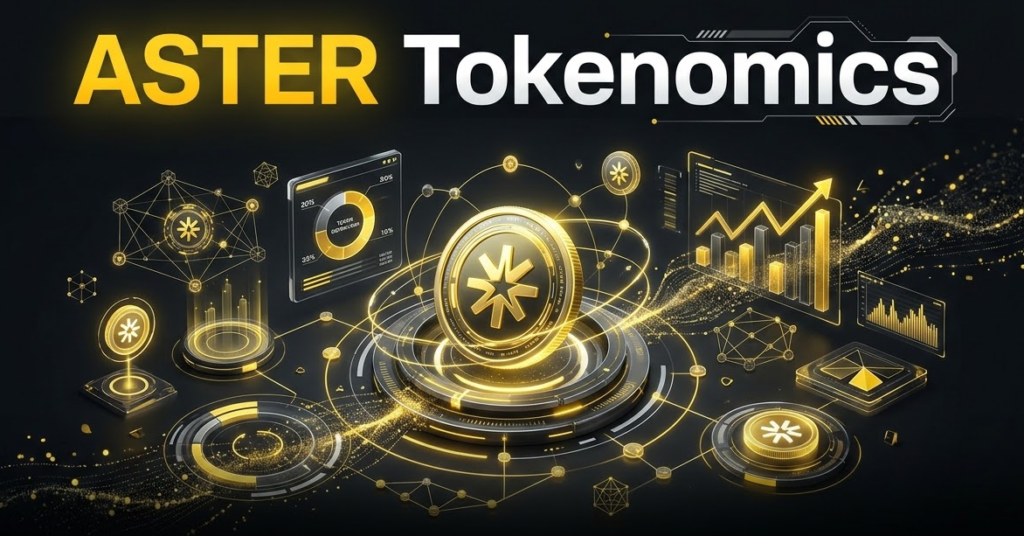
ASTER is the native token associated with the Aster ecosystem. Its role is connected to the project’s token distribution, staking incentives, and evolving protocol revenue model.
The initial maximum supply is 8 billion ASTER. The project has also introduced a long-term objective to reduce supply toward 3 billion through its buyback-and-burn mechanism.
To understand the token properly, it helps to separate three things:
- The original allocation of ASTER.
- The migration mechanism for legacy APX holders.
- The updated fee-based buyback, staking reward, and burn structure.
ASTER Token Distribution
Aster’s official tokenomics documentation publishes the following initial allocation:
| Allocation | Percentage | Token amount |
|---|---|---|
| Airdrop | 53.5% | 4.28 billion ASTER |
| Ecosystem and Community | 30% | 2.40 billion ASTER |
| Treasury | 7% | 560 million ASTER |
| Team | 5% | 400 million ASTER |
| Liquidity and Listings | 4.5% | 360 million ASTER |
| Total | 100% | 8 billion ASTER |
The largest allocation is reserved for airdrops and community rewards. This reflects the project’s emphasis on distributing tokens to traders, early participants, and ecosystem contributors.
The Ecosystem and Community allocation includes the APX upgrade pool, liquidity support, partnerships, grants, and other ecosystem activities.
The Treasury allocation is intended to support strategic development and operational needs. The Team allocation is reserved for contributors and advisors, while the Liquidity and Listings allocation supports market access.
Aster has also updated parts of its original vesting schedule. Its current documentation states that the team allocation remains locked until September 17, 2027, followed by 40 months of linear vesting. That is a meaningful detail for anyone evaluating future token supply pressure.
The full allocation and vesting information is available in the official ASTER tokenomics documentation.
A large community allocation can help distribute a token widely, but the percentage alone does not tell you whether the distribution is healthy. You also need to consider how quickly tokens enter circulation, who receives them, how rewards are earned, and whether the ecosystem creates genuine demand for the token.
APX-to-ASTER Migration: Why the 1:1 Assumption Is Incorrect
One common misunderstanding concerns the migration from APX to ASTER.
The transition was not designed as a permanent 1:1 conversion available at any time. Aster’s official migration documentation explains that the conversion ratio decreases over time, with different rates applying across designated periods.
The original migration began in September 2025. Aster’s official documentation explains that APX holders could deposit their tokens into the Aster Spot account and complete the exchange through the token-upgrade interface.
The important detail is that the conversion rate was time-dependent.
The fifth migration cycle is listed as running from April 15, 2026, to November 25, 2026, at a rate of 1 APX to 0.0625 ASTER. This means that, under that published schedule, 100 APX would convert into 6.25 ASTER rather than 100 ASTER.
Because the migration window and conversion rate are time-sensitive, users should check the live official interface before taking action. The official APX Token Exchange documentation explains the declining-rate structure, while the Aster APX upgrade page provides the migration interface.
If you still hold APX, do not rely on old articles or social media posts that describe the original conversion rate. Check the current cycle, eligible balances, and any applicable conditions directly through Aster’s official channels.
The 99% Daily Fee Buyback and Deflationary Burn Target
The most significant part of Aster’s updated tokenomics is its fee-based buyback-and-burn model.
Under the mechanism described in Aster’s documentation, 99% of daily protocol fees are used to buy ASTER automatically on the market. The tokens acquired through these buybacks are distributed to veASTER stakers as loyalty rewards.
At the same time, Aster burns an equivalent amount of ASTER from its reserves. The project states that burns take place every two weeks and will continue until the total supply reaches 3 billion tokens.
This structure has two separate effects:
First, buybacks create market demand. The protocol uses a portion of its fee revenue to purchase ASTER on the open market. The purchased tokens are then allocated to veASTER stakers.
Second, reserve burns reduce supply. An equivalent quantity is removed from the reserve allocation, reducing the total token supply.
It is important not to mix up these two operations. The purchased tokens are distributed to stakers; the matching burn comes from reserves. The mechanism is not simply buying tokens and sending those same tokens to a burn address.
Aster’s documentation describes the updated model in its official tokenomics page. The project announced the June 17, 2026 upgrade, while subsequent reporting documented the first burn under the revised mechanism. For additional context, see Crypto Briefing’s report on Aster’s first token burn.
The 3 billion figure should be understood as a long-term supply target, not a guarantee that the token will reach that level by a specific date. The pace depends on protocol revenue, market execution, the amount of ASTER purchased, and the continued operation of the mechanism.
What Is veASTER?
veASTER is associated with locking ASTER to participate in the project’s staking and reward system.
The general model is familiar across DeFi: users commit tokens for a period of time in exchange for a form of voting or reward weight. Longer lock periods can increase a participant’s influence or reward allocation, depending on the rules of the specific system.
For Aster, veASTER is relevant because the updated buyback mechanism directs purchased ASTER to stakers. That means staking is not merely a way to hold the token in a contract; it is part of the protocol’s intended value-distribution structure.
However, users should examine the current staking terms before locking tokens. Important questions include:
- How long must ASTER remain locked?
- Can the position be withdrawn early?
- Are there early-exit penalties?
- How are rewards calculated and distributed?
- Are rewards paid in ASTER or another asset?
- Can reward rates change through protocol decisions?
A staking reward is not the same as a guaranteed investment return. Its value depends on token prices, protocol revenue, reward rules, and the risks associated with locking assets.
Common Pitfalls and Misconceptions About Aster
Misconception: Aster Is a Fully Public and Transparent DEX
Aster’s privacy features are intended to reduce the exposure of sensitive trading information.
That does not mean the entire system is invisible or that every interaction is completely private under every circumstance.
Users should distinguish between public blockchain settlement, encrypted order data, stealth-address mechanisms, and the information that may remain visible to validators or other system components.
Aster’s documentation describes encrypted orders and privacy-focused execution, but users should review the technical implementation and available verification tools before assuming that all account activity is anonymous.
Privacy is a design property that needs to be evaluated at the level of actual system behavior, not just through a headline description.
Misconception: ASTER Is the Same as Yield-Bearing Trading Collateral
ASTER is the ecosystem’s native token. USDF, asUSDF, asBNB, and other yield-bearing assets serve different purposes.
ASTER is associated with the token economy, staking, and buyback-related rewards. USDF is a stablecoin product designed to generate yield through underlying strategies. asBNB represents a liquid staking-related asset.
These assets should not be treated as interchangeable.
A trader may use a supported yield-bearing asset as collateral, but that does not mean ASTER itself automatically generates the same underlying yield. Likewise, holding USDF does not necessarily provide the same staking rights or rewards as locking ASTER.
Always check the supported collateral list and the relevant account settings before transferring funds.
Misconception: Aster Is Only a BNB Chain Application
Aster has expanded beyond a single-chain product strategy.
Its documentation and website describe support for several networks, including BNB Chain, Ethereum, Arbitrum, and Solana. Aster Chain is intended to provide additional dedicated infrastructure for the platform’s privacy and execution requirements.
That does not mean every product or asset is available on every network. Supported markets, collateral types, deposit routes, and withdrawal options can differ.
The safest approach is to check the network shown in the deposit or withdrawal interface rather than assuming that a token is supported everywhere simply because Aster has multi-chain functionality.
Misconception: 1001x Leverage Makes Trading More Efficient
High leverage can reduce the amount of initial capital required to control a position, but it does not create a trading advantage by itself.
It also reduces the distance between the entry price and a potential liquidation event.
A trader who opens a 1001x position is exposed to very small price movements. Even if the market eventually moves in the expected direction, short-term volatility can liquidate the position first.
For this reason, 1001x should be understood as an extreme-risk product rather than a default trading setting.
How to Trade, Earn, and Stake on Aster
The following walkthrough explains the general process. Interfaces, supported networks, fees, and token migration conditions can change, so check the live official documentation before making transactions.
Phase One: Connect a Wallet and Prepare Your Assets
Start by visiting the official Aster website and confirming that the domain is correct. Be cautious of sponsored search results, copied websites, fake migration portals, and unsolicited wallet-connection links.
Once you are on the official platform:
- Select the wallet connection option.
- Choose a compatible wallet.
- Confirm that the selected network matches the asset you intend to deposit.
- Review the token contract and destination address.
- Connect only after checking the permissions requested by the application.
A wallet connection does not automatically mean that you have deposited funds, but signing an approval or transaction can grant permissions or move assets. Read each wallet prompt carefully.
For a deposit from a centralized exchange, choose the correct withdrawal network and send a small test amount if you are unfamiliar with the route. A transfer sent through an unsupported network may be difficult or impossible to recover.
Aster’s deposit and withdrawal guide explains the general process for transferring assets from exchanges and external wallets.
Phase Two: Understand the APX-to-ASTER Upgrade
If you hold legacy APX tokens, check whether your balance is eligible for the migration and which conversion cycle currently applies.
The general process described by Aster is:
- Open the official APX upgrade page.
- Connect the wallet holding APX.
- Deposit eligible APX into the Aster Spot account.
- Review the displayed conversion rate.
- Confirm the exchange only after checking the amount of ASTER you will receive.
- Verify the resulting ASTER balance in your Spot account.
Do not assume that the historical 1:1 ratio still applies. As explained earlier, the migration schedule uses declining conversion rates, and the current cycle should be checked directly before any transaction.
Phase Three: Explore USDF and Yield-Bearing Assets
If your goal is to earn yield, review Aster Earn and the documentation for the asset you intend to use.
For USDF, the general process involves acquiring or minting the stablecoin through the supported interface. Users may then have access to related yield-bearing products such as asUSDF, depending on current availability.
For asBNB, users can follow the platform’s staking or minting process using supported BNB-related assets.
Before depositing, consider the following:
- What assets back the product?
- Where does the yield come from?
- Is the yield variable?
- Are there withdrawal or redemption restrictions?
- What happens if the underlying strategy loses money?
- Can the asset be used as collateral in the trading mode you plan to use?
Do not choose a yield product solely because its displayed APY looks attractive. A higher return often reflects additional risk, and historical returns are not a promise of future performance.
Phase Four: Choose a Trading Mode
Once your assets are available, decide which trading environment matches your experience.
Pro Mode is more appropriate if you want to work with an order book, use limit orders, review market depth, and manage positions through advanced tools.
Simple or 1001x products provide a more streamlined experience, but the leverage and liquidation risks can be extreme.
Shield Mode is another simplified environment documented by Aster, with an AMM-style interface and privacy-oriented trading features.
Before opening a position, check:
- The market’s available leverage.
- Initial and maintenance margin requirements.
- Trading fees.
- Funding rates.
- Mark price and liquidation price.
- Whether the position uses isolated or cross margin.
- The liquidity available for your intended position size.
A good trading interface cannot compensate for poor position sizing. Decide how much you can afford to lose before entering the market, rather than trying to work that out after the trade moves against you.
Phase Five: Stake ASTER and Understand veASTER Rewards
If you want to participate in Aster’s staking and buyback reward model, review the current ASTER staking interface.
The general process is to connect your wallet, select the amount of ASTER to stake or lock, review the applicable duration and reward terms, and confirm the transaction.
Pay particular attention to the lock period and withdrawal conditions. A token locked for a long period may be difficult to access during a sudden market downturn.
Also remember that the value of rewards is affected by the market price of ASTER. Receiving additional tokens does not guarantee that the total dollar value of your position will increase.
Frequently Asked Questions About Aster
What Is Aster and How Does It Work?
Aster is a decentralized exchange focused on perpetual futures trading, privacy-oriented execution, and capital-efficient DeFi products. It emerged from the merger of Astherus and APX Finance and now combines trading products with yield-bearing assets such as USDF and asBNB.
The platform offers different trading environments, including Pro and simplified products, while developing Aster Chain as dedicated infrastructure for privacy and derivatives execution.
What Is the Difference Between Simple Mode (1001x) and Pro Mode?
Simple and 1001x products provide a streamlined trading experience that uses on-chain liquidity rather than the standard Pro order-book model. The product advertises leverage of up to 1001x on eligible markets.
Pro Mode offers an advanced order-book interface with more detailed order controls, charting, and position-management tools.
The two products have different execution and risk characteristics, so the highest leverage figure should not be treated as a reason to choose Simple Mode.
How Does Aster Aim to Prevent Position Hunting and MEV Exploitation?
Aster describes an architecture that encrypts orders before they reach the chain and uses privacy-oriented mechanisms such as ZK-verifiable features and stealth addresses.
The objective is to reduce the amount of sensitive trading information visible to other market participants before execution. This can make it harder for bots to infer and exploit certain trading strategies.
However, privacy depends on the precise implementation. It would be inaccurate to assume that every transaction, account detail, and trading activity is completely invisible in all circumstances.
What Is USDF and How Does It Generate Yield?
USDF is Aster’s yield-bearing stablecoin product. Its documented model uses crypto assets and corresponding short futures positions, with the goal of reducing directional exposure while generating returns from underlying strategies.
The yield can vary with market conditions and strategy performance. USDF is therefore not equivalent to a cash deposit or a risk-free dollar token.
Users should review the backing model, redemption terms, and current product documentation before depositing funds.
How Does Aster’s 99% Fee Buyback-and-Burn Model Work?
Under the updated mechanism described by Aster, 99% of daily protocol fees are used to purchase ASTER on the market. The purchased tokens are distributed to veASTER stakers as rewards.
A matching quantity of ASTER is burned from reserves, with burns scheduled every two weeks. The stated long-term objective is to reduce total supply from the original 8 billion toward 3 billion tokens.
The buyback and burn are separate operations: purchased tokens go to stakers, while the equivalent amount is removed from reserves.
Is Aster Chain Already Capable of 100,000 Transactions per Second?
Aster advertises throughput of up to 100,000 transactions per second and block times of approximately 50 milliseconds.
Those figures describe the project’s stated technical specifications. They should not be interpreted as independent proof of sustained real-world throughput under production trading conditions.
To evaluate actual performance, users should look for public network metrics, independent benchmarks, validator information, and verifiable transaction data.
Is 1001x Leverage Safe for Beginners?
No. A simplified interface does not make extreme leverage safe.
At 1001x, a very small adverse price movement can consume the initial margin. Fees, funding, slippage, and liquidation rules can make the practical risk even greater.
Beginners should understand perpetual contracts, margin, funding, and liquidation before using leveraged products. In many cases, much lower leverage—or no leverage—is the more sensible choice.
Is ASTER the Same as APX?
No. APX was the legacy token associated with APX Finance, while ASTER is the token introduced for the Aster ecosystem after the strategic merger and rebrand.
Aster created a migration process that allows eligible APX holders to exchange their tokens for ASTER. The conversion ratio decreases over time, so holders should check the official migration interface instead of assuming that the swap remains 1:1.
Can USDF and asBNB Be Used as Trading Collateral?
Aster documents support for several assets as collateral, including USDF and asBNB in certain configurations.
However, supported assets and collateral value ratios can differ across networks and trading modes. An asset’s availability in Aster Earn does not automatically mean it can be used in every trading account.
Check the live collateral list and account settings before transferring funds.
Final Thoughts
Aster is interesting because it brings together several ideas that are usually discussed separately: decentralized derivatives, privacy-focused order execution, multi-chain access, yield-bearing collateral, and a token economy linked to protocol activity.
Its origins also give it a different profile from a project built around a single new trading interface. The combination of Astherus’ yield infrastructure and APX Finance’s derivatives experience provides a foundation for an ecosystem where trading and earning are intended to work together.
The privacy strategy is one of the most compelling parts of the project. If Aster can make sensitive order information harder to observe while preserving reliable execution and verifiability, it could address a real problem in transparent on-chain trading.
Aster Chain adds another ambitious layer. Its advertised 50ms block times and 100,000+ TPS target suggest a network designed specifically for demanding trading activity. Still, those claims deserve ongoing scrutiny through independent performance data rather than being accepted at face value.
The yield products are equally worth examining, but they should not be confused with risk-free savings. USDF depends on underlying strategies, while liquid staking assets such as asBNB introduce their own liquidity and redemption considerations.
ASTER’s tokenomics also deserves attention. The initial 8 billion supply, community-heavy allocation, declining APX migration ratio, and updated buyback-and-burn model all influence how the token may evolve. The 3 billion supply objective is a long-term target, not a guaranteed outcome.
My overall view is that Aster is a project worth understanding if you follow decentralized derivatives and capital-efficient DeFi. But its strongest features are also the areas where careful research matters most. Privacy claims need technical verification, yield needs risk analysis, leverage needs discipline, and tokenomics needs to be assessed against actual protocol activity.
If you are exploring Aster, start with the official documentation, understand the product you intend to use, and never let an attractive headline—whether it is 1001x leverage, a yield figure, or a deflationary target—replace a proper assessment of risk.