Key Specifications and Architectural Overview of Dai (DAI)
If you have spent any time in decentralized finance, you have probably encountered Dai. It is one of the best-known decentralized stablecoins, and it has played an important role in DeFi lending, trading, liquidity provision, and collateral management since its launch.
At first glance, DAI looks like many other dollar-pegged cryptocurrencies. Its price is designed to stay close to $1, and you can transfer it between compatible wallets or use it across supported DeFi applications. But the mechanism behind it is quite different from the structure used by centralized stablecoins such as USDT and USDC.
DAI is generated through a decentralized collateral system. Users can deposit approved assets into smart contract Vaults and generate DAI against those deposits. The system requires collateral to exceed the value of the debt, creating a financial buffer against market volatility. Stability fees, liquidations, savings incentives, and stablecoin conversion mechanisms help the protocol manage its dollar target.
There is also an important development you should understand before researching DAI in 2026: MakerDAO rebranded as Sky Protocol in 2024. The ecosystem introduced USDS, also known as Sky Dollar, as an upgraded stablecoin alongside DAI. This did not mean that DAI was immediately discontinued. Both tokens continue to exist, and Sky provides a conversion route between them.
Here is a concise overview of the main components.
| Metric | Specification |
|---|---|
| Stablecoin | Dai (DAI) |
| Target value | $1 USD |
| Original protocol | Maker Protocol, formerly associated with MakerDAO |
| Current ecosystem | Sky Protocol |
| Original launch | 2017 |
| Collateral model | Overcollateralized, multi-collateral system |
| Minting mechanism | Sky Vaults, formerly Maker Vaults |
| Successor stablecoin | USDS (Sky Dollar) |
| DAI-to-USDS conversion | 1:1 through the official converter |
| Historical governance token | MKR |
| Current governance token | SKY |
| MKR-to-SKY conversion | Originally 1:24,000, subject to applicable upgrade terms |
| Savings mechanism | Dai Savings Rate (DSR) |
| USDS savings mechanism | Sky Savings Rate (SSR) |
| DAI savings representation | sDAI |
| USDS savings representation | sUSDS |
| Peg support | Collateral management, stability incentives, and Peg Stability Module mechanisms |
A few details deserve extra attention.
First, DAI is not backed exclusively by dollars sitting in a commercial bank. Its collateral system can include crypto assets and approved real-world asset exposures. The composition changes as governance adjusts the portfolio.
Second, the $1 target is a soft peg, not a promise that every DAI token can always be redeemed for one physical US dollar by a centralized issuer. Market conditions, liquidity, collateral quality, and protocol operations all matter.
Third, the transition from MakerDAO to Sky introduced new names and products, but the underlying DAI token did not simply disappear. You can still use DAI in supported applications, and the official protocol provides a 1:1 DAI-USDS conversion route.
For current technical information, the best starting points are the Sky Protocol developer documentation and the official Sky ecosystem interface. They provide information about token contracts, conversion routes, Vaults, savings products, and the protocol’s current structure.
How Dai Works?
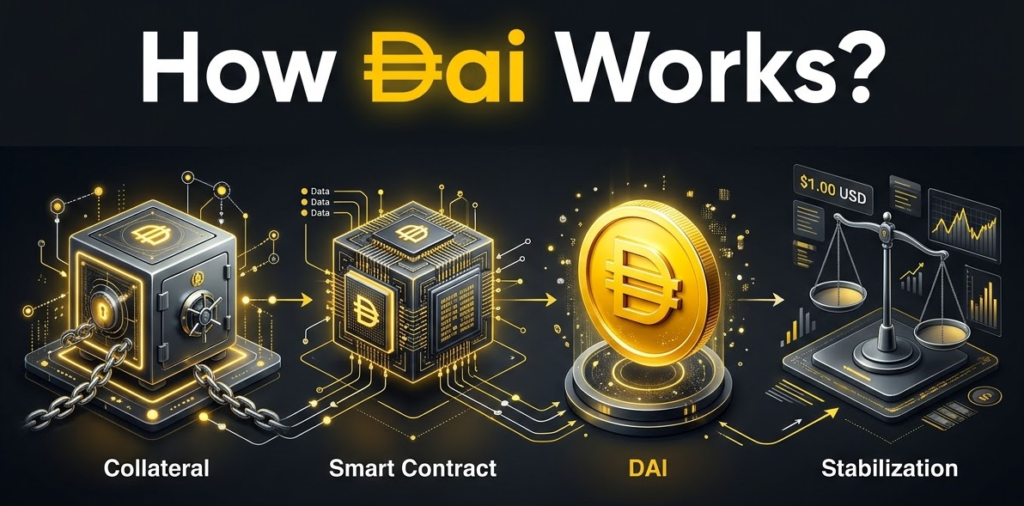
The easiest way to understand DAI is to think of it as a stablecoin generated against collateral rather than issued solely against deposits of fiat currency.
Imagine that you own ETH but want to hold a dollar-denominated asset without selling your ETH. You could deposit ETH into an approved Sky Vault and generate DAI against it. You retain exposure to the deposited collateral’s potential price movement, but you also take on debt that must be managed.
This is the basic idea behind DAI’s original Maker Vault model.
The system is designed to maintain more collateral value than the amount of DAI debt created. That excess collateral provides a buffer if the deposited asset loses value.
Sky Vaults: Minting DAI Against Crypto and Real-World Assets
A Vault is a smart contract position in which collateral is deposited and DAI debt is generated.
Historically, users often referred to these positions as Collateralized Debt Positions, or CDPs. The Maker ecosystem later adopted the term Vault, and the Sky Protocol continues to use that terminology.
The basic process works as follows:
- A user selects an approved collateral type.
- The user deposits that collateral into a Vault.
- The protocol evaluates the collateral value using its approved price-oracle system.
- The user generates DAI against the deposited collateral.
- The user manages the debt and pays the applicable stability fee.
- To recover the collateral, the user repays the required debt and completes the withdrawal process.
Let’s use a simplified example.
Suppose you deposit ETH worth $3,000 into a Vault. The applicable collateralization requirement allows you to generate up to $1,500 in DAI.
Your position would look something like this:
| Item | Value |
|---|---|
| Deposited ETH value | $3,000 |
| DAI generated | $1,500 |
| Collateralization ratio | 200% |
| Remaining collateral value above debt | $1,500 |
The collateralization ratio is calculated as:
Collateralization Ratio = (Collateral Value ⁄ Debt Value) × 100
This means the Vault has $2 worth of collateral for every $1 of debt.
The user can now spend, transfer, or deploy the generated DAI elsewhere, while the ETH remains locked in the Vault.
Of course, this is a simplified illustration. Actual borrowing capacity depends on the collateral type, current risk parameters, stability fees, liquidation requirements, and other protocol rules.
What Collateral Can Support DAI?
The original single-collateral system accepted only ETH. That model eventually evolved into Multi-Collateral Dai, allowing the protocol to support multiple approved assets.
Today, the broader Sky ecosystem can include different categories of collateral and credit exposure.
Crypto collateral
This category includes approved cryptocurrency assets. Depending on the current collateral configuration, users may be able to deposit assets such as ETH or wrapped versions of Bitcoin-related assets.
Crypto collateral is relatively transparent because its market value can be monitored through on-chain markets and approved price feeds. However, it can also be volatile. A sudden market decline can quickly reduce the safety margin of a Vault.
Liquid staking and other tokenized crypto assets
Certain liquid staking tokens and related assets can provide additional collateral options. These assets introduce risks beyond ordinary price volatility, including smart contract vulnerabilities, liquidity constraints, and potential deviations from the expected value of the underlying asset.
Real-world assets
The Sky ecosystem has also expanded into real-world asset exposure, commonly abbreviated as RWA.
These structures can include tokenized government securities, institutional credit arrangements, and other financial assets represented through approved legal and technical frameworks.
RWA exposure is different from depositing ETH into a permissionless Vault. It may involve custodians, asset managers, legal entities, off-chain reporting, and contractual enforcement.
That means the collateral system is not purely crypto-native. Some of its economic backing can depend on traditional financial infrastructure.
This is an important point when evaluating DAI’s decentralization. The protocol uses smart contracts and on-chain accounting, but not every underlying asset or economic relationship is necessarily represented by a fully permissionless crypto token.
Minimum Collateral Ratios and Automatic Liquidations
Overcollateralization is one of the most important safeguards in the DAI system.
The protocol does not generally allow users to generate an unlimited amount of DAI against a small collateral deposit. Each collateral type has risk parameters that determine how much debt it can support.
One of the most important parameters is the liquidation ratio.
A liquidation ratio establishes the minimum collateralization level at which a Vault becomes eligible for liquidation. It is not a universal percentage shared by every collateral type.
For example, imagine a hypothetical collateral type with a 150% liquidation ratio.
If you deposit $3,000 worth of collateral, the maximum debt at the threshold would be:
$3,000 ⁄ 1.5 = $2,000
The position has now fallen below the hypothetical 150% liquidation threshold.
In a real protocol position, the exact result depends on the collateral’s risk parameters, accrued fees, oracle prices, and other conditions.
What Happens During Liquidation?
When a Vault becomes unsafe, the protocol can initiate liquidation.
The purpose is to transfer the insufficiently collateralized position into the liquidation system, where collateral is sold to cover the debt and associated penalties.
Sky’s liquidation architecture uses auction mechanisms designed to sell collateral efficiently. The current documentation describes Liquidation 2.0, which uses Dutch-style auctions with prices that change over time.
The process can be summarized as follows:
- The protocol identifies an eligible unsafe Vault.
- The liquidation mechanism transfers the relevant collateral and debt into the liquidation system.
- An auction begins.
- Participants purchase collateral by providing the required DAI.
- The proceeds are used to cover the debt and liquidation-related amounts.
You can review the technical details in the Sky Protocol collateral liquidation documentation.
The system also includes limits on how much debt can be placed into auctions at a given time. These limits help prevent liquidation activity from overwhelming available market liquidity.
Why Liquidation Is Not a Guaranteed Safety Net
Liquidation reduces the risk of bad debt, but it does not eliminate it.
Imagine that ETH loses 30% of its value in a very short period. If the market moves faster than liquidators and arbitrage participants can respond, the protocol may struggle to sell collateral at prices sufficient to cover the outstanding debt.
Other potential problems include:
- Oracle delays or incorrect price information.
- Network congestion and unusually high gas fees.
- Insufficient liquidity for a particular collateral asset.
- A sudden collapse in the market value of collateral.
- Smart contract vulnerabilities.
- Auction participation that is weaker than expected.
If collateral is sold for less than the amount required to cover debt and penalties, the protocol may face a shortfall.
That is why the collateral ratio should be viewed as a risk-management parameter, not as a guarantee that a Vault can never become insolvent.
Stability Fees: The Cost of Generating DAI
Generating DAI through a Vault is not necessarily free.
Users who borrow DAI against collateral pay a stability fee. This fee is calculated according to the applicable rate for the collateral type and the amount of debt outstanding.
You can think of it as the borrowing cost associated with generating DAI.
For example, suppose you generate 1,000 DAI against ETH and the applicable annualized stability fee is 5%.
A simplified one-year illustration would produce approximately 50 DAI in borrowing costs, assuming the rate remains unchanged and ignoring compounding and other technical details.
The actual calculation is more sophisticated. Stability fees accrue through the protocol’s rate mechanism, and governance can change the applicable parameters.
Why does this matter for the stablecoin peg?
Because borrowing costs influence user behavior.
If the protocol wants to discourage excessive DAI generation, it can increase stability fees for selected collateral types. Higher borrowing costs may encourage users to repay debt, reducing the amount of DAI outstanding.
If the protocol wants to encourage additional borrowing, it may reduce applicable fees.
This is one of the monetary-policy tools used to manage the system.
The 2024 – 2026 Sky Protocol Transition: DAI, USDS, MKR, and SKY
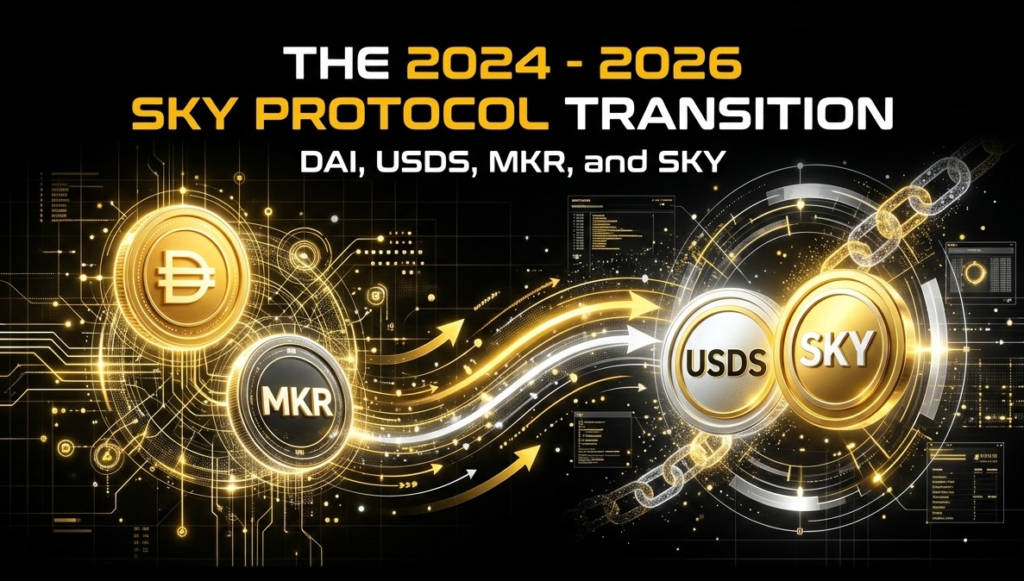
One of the biggest changes in the DAI ecosystem happened in 2024, when MakerDAO introduced the Sky brand.
If you still see references to MakerDAO in older articles, that is understandable. The project spent years building its identity around the Maker name, and much of its original documentation, research, and community discussion still uses it.
However, the ecosystem has since evolved.
Why MakerDAO Became Sky Protocol
MakerDAO was one of the earliest major DeFi governance systems. It introduced a decentralized stablecoin model based on collateralized borrowing and became a foundational part of the Ethereum DeFi ecosystem.
Over time, the protocol expanded beyond its original ETH-backed stablecoin design. It introduced additional collateral types, real-world asset exposure, savings mechanisms, and more complex governance structures.
The Sky rebrand was intended to represent this broader ecosystem and provide a new structure for its stablecoin and governance products.
The transition introduced two important token changes:
- DAI was joined by USDS, also known as Sky Dollar.
- MKR was joined by SKY as the successor governance token.
The project did not simply replace every old token overnight. Instead, it created conversion routes that allow users to move between the legacy and upgraded assets.
The official Sky explanation of its ecosystem transition describes Sky as the rebranded Maker ecosystem and explains the relationship between its stablecoin and governance tokens.
MKR and SKY: The Governance Token Transition
MKR was the original governance token of MakerDAO. Holders used it to participate in protocol decisions, including risk parameters, collateral configurations, and other governance matters.
SKY was introduced as the successor governance token.
The original conversion ratio was:
1 MKR = 24,000 SKY
The official SKY token documentation describes the converter and its fixed 1:24,000 exchange ratio.
However, there is an important 2026 qualification: the MKR-to-SKY upgrade has been subject to a delayed upgrade penalty. Therefore, you should not assume that every late conversion still delivers the original full 24,000 SKY for each MKR.
The current conversion terms should be checked through the official Sky interface before making a transaction.
Also, do not confuse the MKR-to-SKY conversion with the DAI-to-USDS conversion. They are separate token routes with different purposes and conditions.
DAI and USDS Coexistence: 1:1 Bidirectional Conversion
The introduction of USDS created a common question:
Is DAI being replaced by USDS?
The short answer is no. DAI continues to exist and remains supported across applications that choose to integrate it.
USDS is described as an upgraded stablecoin within the Sky ecosystem. Both assets are designed to maintain parity through a dedicated conversion mechanism.
The official USDS token documentation confirms that the DAI-USDS converter supports conversions in both directions at a fixed 1:1 ratio, without protocol fees on that route.
In practical terms:
1 DAI = 1 USDS
This is a token conversion, not an ordinary market trade. You do not need to find another trader willing to exchange DAI for USDS at a particular market price.
The converter is designed to exchange the two assets directly.
Why Introduce USDS If DAI Already Works?
The introduction of USDS gave Sky a new stablecoin identity and a foundation for additional ecosystem features.
It also allows the project to develop new products and integrations under the Sky brand while continuing to support DAI’s established role in DeFi.
There are several practical reasons for maintaining both tokens:
- DAI already has broad integration across DeFi protocols.
- Existing applications may continue to use DAI as their preferred stablecoin.
- Users can choose whether to keep DAI or convert to USDS.
- New Sky products can be built around USDS and its related savings mechanisms.
- A gradual transition reduces the need for every application and user to migrate immediately.
This is an important distinction between an upgrade and a forced replacement.
If you hold DAI in a compatible wallet, you do not automatically need to exchange it for USDS simply because the ecosystem has adopted a new name.
Is the 1:1 Conversion Completely Free?
The official DAI-USDS converter does not charge a protocol conversion fee, according to the Sky token documentation.
However, users still need to pay the applicable blockchain transaction cost. On Ethereum, that generally means gas fees.
You should also check the exact route and contract before approving a transaction. A third-party exchange, wallet interface, or intermediary may introduce its own costs even when the underlying protocol converter does not.
What Happens to DAI’s Existing DeFi Integrations?
DAI has been integrated into a large number of DeFi applications over several years.
It has been used as:
- A lending and borrowing asset.
- Collateral in decentralized lending markets.
- A trading pair on decentralized exchanges.
- A liquidity pool asset.
- A payment and settlement token.
- A savings asset through the DSR and sDAI ecosystem.
The Sky transition does not automatically remove these integrations.
In fact, maintaining DAI is important because DeFi applications do not all upgrade at the same speed. Some protocols may adopt USDS quickly, while others may continue supporting DAI for a long time.
For users, this means you should check the exact asset supported by an application before depositing. DAI and USDS are designed to convert at parity, but they remain different ERC-20 tokens with different contract addresses.
Never assume that a deposit address or token approval for one automatically applies to the other.
Peg Stability Mechanisms
A stablecoin can have a well-designed collateral system and still experience price deviations.
The market price of DAI is determined by trading activity, liquidity, and confidence in the protocol. The system therefore needs mechanisms that encourage market participants to help maintain the $1 target.
Several mechanisms work together:
- Stability fees influence the cost of generating DAI.
- The Dai Savings Rate encourages users to hold DAI.
- The Peg Stability Module provides conversion routes involving other stablecoins.
- Liquidations help maintain the solvency of collateralized positions.
No single mechanism guarantees that DAI will always trade at exactly $1.
The Dai Savings Rate: How DSR Works
The Dai Savings Rate, commonly abbreviated as DSR, is a protocol mechanism that allows DAI holders to earn a variable savings return.
The original DSR was introduced to encourage users to hold DAI rather than immediately sell or deploy it elsewhere.
The basic idea is straightforward:
- A user deposits DAI into the savings module.
- The protocol records the user’s position.
- The savings rate accrues over time.
- The user can withdraw the DAI balance and accumulated savings, subject to the module’s operation and applicable network conditions.
The DSR is not the same as a bank deposit account. It is a smart contract-based mechanism governed by protocol parameters.
The rate can change through governance decisions, and users should not assume that a historical APY will continue indefinitely.
Where Does the DSR Return Come From?
The DSR is part of the protocol’s monetary and accounting system.
The broader Maker/Sky system collects stability fees from Vault borrowers. It can also generate income through approved collateral and real-world asset arrangements.
Protocol surplus can support the system’s financial operations, including savings incentives.
The exact accounting is more complex than a simple formula in which every borrower pays interest directly to a specific saver. The protocol manages aggregate balances and rate accumulators through its smart contracts.
The Sky rate mechanism documentation explains how stability fees and the Dai Savings Rate are accounted for within the protocol.
What Is sDAI?
sDAI is the savings-oriented token associated with the Dai Savings Rate.
When users deposit DAI into the savings module, they receive sDAI as a representation of their position.
The value of sDAI relative to DAI changes as savings accrue. In other words, the amount of DAI represented by each sDAI can increase over time.
This is different from simply receiving additional DAI tokens in your wallet every day.
For example, imagine you deposit 1,000 DAI and receive a quantity of sDAI. As the savings rate accrues, that sDAI position represents more DAI than it did when you first deposited.
The exact exchange value depends on the savings module’s accounting.
One advantage of this structure is that sDAI can be integrated into other DeFi applications that support it. However, doing so may introduce additional smart contract, liquidity, or collateral risks.
The Sky Savings Rate: SSR and sUSDS
With the introduction of USDS, Sky also introduced the Sky Savings Rate, or SSR.
The SSR is the savings mechanism associated with USDS. Users deposit USDS and receive sUSDS, a yield-bearing token that reflects their savings position.
The basic relationship is:
- DAI deposited into the DSR can produce sDAI.
- USDS deposited into the SSR can produce sUSDS.
The two savings tokens should not be confused with DAI and USDS themselves.
sDAI and sUSDS represent savings positions, and their exchange values can differ because they have different launch dates and accumulated savings histories.
The official sUSDS information page describes the Sky Savings Rate as a variable protocol rate funded from aggregate Sky protocol surplus. It also explains that the rate is determined through Sky governance rather than being guaranteed by the interface provider.
That distinction matters. The displayed APY is not a fixed contractual return.
If governance changes the rate, the future return changes as well.
Is the DSR or SSR Risk-Free?
No.
The fact that a savings mechanism is native to a major DeFi protocol does not make it equivalent to an insured bank deposit.
Potential risks include:
- Smart contract vulnerabilities.
- Protocol accounting or governance failures.
- Changes to savings rates.
- Stablecoin depegging.
- Liquidity constraints in secondary markets.
- Risks associated with the broader collateral and surplus system.
If you hold sDAI or sUSDS, you are interacting with a smart contract-based financial product. You should understand the contract, the conversion process, and any additional protocol integrations before depositing a substantial amount.
The Peg Stability Module: How PSM Supports the Dollar Peg
The Peg Stability Module, or PSM, is another important part of the stablecoin system.
Its purpose is to provide a direct conversion route between selected stablecoins and DAI or USDS, depending on the specific module.
The idea is to make it easier for market participants to arbitrage price differences.
Imagine that DAI is trading at $1.02 on the open market.
If an eligible conversion route allows a participant to obtain DAI at approximately $1 using another stablecoin, the participant may have an incentive to acquire DAI through the protocol and sell it on the market.
That additional supply can put downward pressure on DAI’s market price.
Now imagine that DAI is trading at $0.98.
A participant may be able to buy DAI cheaply on the market and use an eligible conversion route to exchange it for another stablecoin at the protocol’s specified rate.
This can create buying demand for DAI and help move its market price back toward $1.
The mechanism does not force the market price to remain exactly at parity. Instead, it creates economic incentives that can help reduce deviations.
DAI-USDC and USDS-USDC Are Different Routes
This is where some explanations become confusing.
The Sky ecosystem has separate conversion routes involving DAI and USDS.
The official protocol token routes documentation lists:
- DAI and USDS conversion through the dedicated converter.
- DAI and USDC conversion through LitePSM.
- USDS and USDC conversion through LitePSM.
- MKR and SKY conversion through the governance-token converter.
Do not assume that every PSM route has identical terms.
For example, the Sky documentation describes direct USDS-USDC PSM conversions at a 1:1 rate with zero slippage and zero Sky Protocol swap fees. This is a specific route and should not be generalized to every possible stablecoin conversion or third-party trading interface.
Network gas costs can still apply, and the availability of a route depends on its current configuration and liquidity.
The Sky explanation of the Peg Stability Module provides a useful overview of how the mechanism supports USDS stability through direct USDC conversion.
How DAI Differs From USDT and USDC?
DAI, USDT, and USDC are all designed to maintain a value close to one US dollar. But their structures are quite different.
USDT and USDC are issued by centralized organizations. Their issuers manage reserve assets and are responsible for the legal and operational framework behind their stablecoins.
DAI is generated through a decentralized protocol using collateral and smart contracts. This gives it a different governance and risk structure.
However, the distinction is not as simple as saying that DAI is completely decentralized while USDT and USDC are completely centralized.
DAI’s collateral portfolio can include centralized assets, institutional arrangements, and real-world financial exposures. The protocol also relies on governance decisions, price oracles, and other infrastructure.
A more useful comparison looks at the actual components.
On-Chain Transparency vs Traditional Reserve Management
Centralized stablecoins generally rely on reserves held or managed by their issuers.
Those reserves may include cash, bank deposits, short-term government securities, and other approved financial instruments.
Users depend on the issuer’s legal obligations, reserve management, redemption policies, and reporting.
DAI uses a different approach.
Its collateral and debt accounting are represented through smart contracts. Users can inspect many important parts of the system directly on-chain, including Vault positions, token supply, collateral deposits, and protocol transactions.
This does not mean that every underlying asset is fully visible on-chain.
For example, when the system has exposure to tokenized real-world assets, the underlying financial instruments may be held through legal entities or custodial structures outside the blockchain.
The on-chain representation can show the protocol’s claim or exposure, but it cannot automatically prove every detail about the underlying off-chain asset.
A useful comparison is:
| Feature | DAI | USDT | USDC |
|---|---|---|---|
| Main structure | Decentralized collateral protocol | Centralized issuer | Centralized issuer |
| Primary backing model | Crypto and approved other collateral | Issuer-managed reserves | Issuer-managed reserves |
| Token generation | Protocol smart contracts | Issuer-controlled issuance | Issuer-controlled issuance |
| Governance | Sky governance | Issuer and corporate controls | Issuer and corporate controls |
| On-chain supply visibility | Yes | Yes | Yes |
| Underlying reserve transparency | On-chain collateral data plus off-chain RWA information | Issuer reports and reserve disclosures | Issuer reports and reserve disclosures |
| Main risks | Collateral, smart contracts, governance, oracles, RWA exposure | Issuer, reserve, banking, regulatory, and technical risks | Issuer, reserve, banking, regulatory, and technical risks |
The key point is that on-chain transparency and decentralization do not eliminate financial risk.
DAI’s structure allows users to inspect many protocol operations, but it also exposes them to the risks of smart contract-based collateral management.
Censorship Resistance and Smart Contract Controls
A common argument in favor of DAI is that its token contract is not structured like a centralized stablecoin issuer’s blacklist system.
The official DAI token documentation describes the ERC-20 contract and its main functions, including transfers, approvals, and signed-message permissions.
The documented token interface does not describe the ordinary issuer-operated address blacklist or freeze mechanism commonly associated with centralized stablecoin systems.
This is an important difference, but you should avoid turning it into an absolute claim that no part of the DAI ecosystem can ever restrict or affect a user’s ability to transact.
There are several separate layers to consider.
The DAI token contract
The ERC-20 token contract handles balances, transfers, approvals, and other token functions. Its documented design is different from a centralized issuer’s ordinary blacklist model.
Collateral contracts
DAI can be generated against collateral assets that have their own rules. Some underlying tokens may include administrative controls or transfer restrictions.
Protocol governance
Sky governance can change parameters, approve collateral types, and modify protocol components within the system’s governance framework.
Interfaces and service providers
A wallet, exchange, DeFi application, or front-end provider may apply its own restrictions. Those restrictions do not necessarily originate from the DAI token contract.
Real-world asset structures
Certain collateral exposures depend on off-chain institutions, legal agreements, and custodians. These arrangements may involve restrictions that do not exist at the token-contract level.
So, if censorship resistance is important to you, examine the exact token contract and the specific collateral or application you plan to use.
The absence of a conventional blacklist function in a token contract is useful information, but it is not proof that the entire financial ecosystem is free from centralized dependencies.
Can DAI Be Frozen Like USDT or USDC?
The answer depends on what you mean by “frozen.”
The DAI token contract’s documented functionality does not mirror the centralized blacklist mechanisms associated with USDT or USDC. However, an underlying collateral asset, an exchange, a DeFi application, or an off-chain legal arrangement can still introduce restrictions.
For example, suppose you deposit a tokenized real-world asset into a protocol position. If the underlying asset issuer has legal control over that token, the asset may carry restrictions that are separate from DAI itself.
Similarly, a centralized exchange can suspend deposits or withdrawals without changing the DAI smart contract.
This is why I would avoid describing DAI as absolutely impossible to censor. A more accurate statement is that DAI’s native token architecture offers a different censorship-resistance profile from stablecoins whose centralized issuers maintain direct address-freezing controls.
Common Pitfalls and Misconceptions About Dai (DAI)
Misconception: DAI Was Deprecated When USDS Launched
This is incorrect.
USDS was introduced as an upgraded stablecoin within the Sky ecosystem, but DAI continues to exist.
The official converter supports a 1:1 exchange between DAI and USDS. Users can choose whether to keep their existing DAI or move to USDS through the supported route.
The fact that a project launches a successor token does not automatically mean that the previous token has become invalid.
DAI also remains important because many DeFi applications already support it. A forced migration would create unnecessary disruption for users, developers, liquidity providers, and protocols.
If you hold DAI, you should check the assets supported by the application you intend to use rather than assuming that every Sky-related product now accepts only USDS.
Misconception: DAI Is Backed 1:1 by Physical US Dollars in a Bank
DAI is designed to maintain a $1 target, but that does not mean every DAI is backed by one physical US dollar held in a bank account.
Its collateral model is based on approved assets deposited into the protocol or represented through eligible financial arrangements.
These assets can include crypto collateral and real-world asset exposures.
This is fundamentally different from a centralized stablecoin issuer that claims to maintain reserves corresponding to the number of tokens in circulation.
DAI’s system uses overcollateralization to provide a buffer against changes in asset prices and the amount of debt generated.
For example, a Vault might hold $200 worth of collateral while supporting $100 of DAI debt. The excess collateral provides protection against a decline in the collateral’s market value.
However, the actual system is more complex because it combines multiple collateral types, different liquidation parameters, and other financial exposures.
Misconception: Every DAI Is Backed Only by ETH
This was closer to the original design of the system, but it no longer describes modern DAI.
The original Single-Collateral Dai system used ETH as its primary collateral. The protocol later introduced Multi-Collateral Dai, which expanded the range of approved assets.
The difference is important:
| Feature | Single-Collateral Dai (SAI) | Multi-Collateral Dai (DAI) |
|---|---|---|
| Original collateral model | ETH-focused | Multiple approved collateral types |
| Historical role | Early stablecoin system | Current DAI architecture |
| Collateral flexibility | Limited | Broader |
| Real-world asset exposure | Not part of the original ETH-only model | Can be included through approved structures |
| Current status | Legacy system | Active ecosystem |
The transition to Multi-Collateral Dai was a major development because it reduced the system’s dependence on one collateral asset.
However, adding more collateral types also introduces more complex risk-management requirements.
A protocol that accepts several assets must evaluate their liquidity, volatility, price-oracle quality, smart contract security, and liquidation characteristics separately.
Misconception: DAI Always Trades at Exactly $1
DAI is designed to maintain a $1 target, but its market price can move above or below that level.
A soft peg is not the same as a guaranteed fixed price.
DAI may trade at a small premium when demand is strong or when users have difficulty obtaining liquidity. It may trade at a discount during periods of market stress or reduced confidence.
The protocol uses several mechanisms to help manage these deviations, including:
- Stability fees.
- The Dai Savings Rate.
- Collateralized borrowing and repayment.
- Peg Stability Module conversion routes.
- Governance adjustments to risk and monetary parameters.
These mechanisms create incentives that can help restore the peg, but they do not remove market risk.
Misconception: DSR and SSR Offer Guaranteed Returns
The Dai Savings Rate and Sky Savings Rate are variable protocol rates.
They are not fixed bank deposit interest rates, and they are not guaranteed by a centralized financial institution.
Governance can adjust the rates based on protocol conditions and policy decisions.
A displayed APY is therefore a snapshot of the current rate, not a promise that you will earn the same return over the next year.
You should also distinguish between the protocol’s savings rate and returns offered by third-party lending or yield platforms. A DeFi application may advertise a higher return by adding lending, liquidity provision, or other strategies, but those activities introduce additional risks.
Misconception: DAI and USDS Are the Same Token
They are designed to convert at a 1:1 ratio, but they are separate tokens.
They have different contract addresses and may have different application support.
For example, a DeFi lending market might accept DAI but not USDS, or it might support both with different collateral parameters.
The same principle applies to sDAI and sUSDS. These are savings-oriented tokens, not ordinary DAI and USDS balances.
Always confirm the exact token and network before depositing or transferring assets.
System Architecture and Entity Relationship Map
The DAI ecosystem is easier to understand when you separate the stablecoin, collateral engine, governance system, and savings mechanisms.
The following diagram summarizes the main relationships.
                         MakerDAO
                             |
                      Rebranded in 2024
                             |
                       Sky Protocol
                             |
           +-----------------+------------------+
           |                 |                  |
        DAI Token         USDS Token         SKY Token
           |                 |                  |
           |                 |              Governance
           |                 |              and Voting
           |                 |
           +-------- 1:1 Converter --------+
                             |
                    Stablecoin Ecosystem
                             |
           +-----------------+------------------+
           |                 |                  |
       Sky Vaults       Savings Modules        PSM
           |                 |                  |
      Collateral          DSR / SSR          Stablecoin
      and Debt            sDAI / sUSDS       Conversion
           |
     +-----+----------------------+
     |                            |
 Crypto Collateral          Real-World Assets
     |                            |
     +-------------+--------------+
                   |
             DAI Generation
                   |
          $1 Soft-Peg Mechanisms
This structure shows why DAI should not be understood as a simple token issued by a company.
It is part of a broader financial protocol with collateral management, debt generation, governance, savings products, and stablecoin conversion mechanisms.
The Sky rebrand changed the ecosystem’s identity and introduced new tokens, but the DAI stablecoin remains part of that system.
How to Deposit DAI Into the Savings Rate or Convert to USDS
If you hold DAI, there are two common actions you may want to consider: using the savings mechanism or converting your DAI into USDS.
Both actions involve smart contracts, so you should verify the official interface and contract information before approving a transaction.
Phase 1: Access the Official Sky Interface
Start by visiting the official Sky website.
Check that the URL is correct before connecting your wallet. Fake DeFi websites and phishing pages often imitate popular protocol interfaces.
You should also verify that your wallet is connected to the correct network. The DAI and USDS routes described here are based on their Ethereum deployments.
Phase 2: Deposit DAI Into the Dai Savings Rate
If you want to use the DSR, the general process is:
- Connect a compatible Ethereum wallet.
- Select the DAI savings option.
- Enter the amount of DAI you want to deposit.
- Review the expected sDAI amount and the current savings information.
- Approve the token transaction if required.
- Confirm the deposit transaction.
- Check your wallet for the resulting sDAI position.
The sDAI token represents your savings position. Its value relative to DAI changes as savings accrue.
Before depositing, check the current interface and documentation to confirm that the DSR route is available and that the displayed rate is current.
You should also remember that the rate can change. A current APY is not a guaranteed future return.
Phase 3: Understand the Difference Between DSR and SSR
If you are considering USDS instead of DAI, the relevant savings mechanism is the Sky Savings Rate.
The process is broadly similar:
- Acquire USDS.
- Connect your wallet to the supported Sky interface.
- Select the USDS savings product.
- Enter the amount to deposit.
- Review the current SSR and the expected sUSDS position.
- Approve and confirm the transaction.
The resulting sUSDS position automatically reflects the applicable savings rate according to the module’s accounting.
Do not assume that sDAI and sUSDS can be exchanged directly at a 1:1 ratio. They represent different savings positions with different accrued values.
Phase 4: Convert DAI to USDS
If you want to use USDS instead of DAI, you can use the official conversion route.
The general steps are:
- Open the official Sky interface or another verified interface that supports the converter.
- Connect your Ethereum wallet.
- Select the DAI-to-USDS conversion route.
- Enter the amount of DAI.
- Review the expected USDS amount.
- Approve the transaction if necessary.
- Confirm the conversion.
- Verify that USDS has arrived in your wallet.
The official converter is designed for a 1:1 exchange without a protocol conversion fee. Standard Ethereum gas fees still apply.
Phase 5: Verify the Token and Transaction
After completing the conversion, check your wallet and the transaction record.
Make sure that:
- The token displayed is USDS, not sUSDS.
- The network is Ethereum.
- The amount received matches the expected conversion.
- The transaction was confirmed.
- The token contract matches the official documentation.
If you are transferring the resulting USDS to another platform, confirm that the receiving platform supports USDS specifically.
Is Dai (DAI) a Good Stablecoin to Hold?
DAI has a long history in DeFi and a distinctive collateral-based structure. But whether it is the right stablecoin for you depends on what you need it to do.
Some users want a stable asset for trading. Others want collateral for borrowing, a dollar-denominated asset for payments, or an asset they can deploy across decentralized applications.
DAI can serve several of these purposes, but it also carries risks that are different from those of centralized stablecoins.
Potential Advantages of DAI
A decentralized issuance model
DAI is generated through a smart contract-based collateral system rather than being issued solely at the discretion of a centralized stablecoin company.
This gives the system a different governance and operational structure.
Transparent on-chain accounting
Many important parts of the DAI system can be inspected on-chain. Users can review token transfers, collateral positions, Vault debt, and other protocol activity.
This level of visibility is useful for independent analysis, although it does not make every off-chain collateral arrangement fully transparent.
Broad DeFi integration
DAI has been used across lending platforms, decentralized exchanges, liquidity pools, and other applications for years.
Its long history gives it an established role in the DeFi ecosystem.
Flexible conversion into USDS
The 1:1 DAI-USDS converter gives users a way to move between the legacy stablecoin and the upgraded Sky stablecoin without needing to sell one token on an open market and buy the other.
Native savings mechanisms
The DSR and sDAI provide a protocol-based way to access savings returns on DAI. Users interested in the upgraded stablecoin can also explore the SSR and sUSDS.
Main Risks to Understand
Collateral market risk
If the value of collateral falls sharply, the protocol may need to liquidate Vaults to cover outstanding debt.
Rapid market movements can make liquidation more difficult.
Smart contract risk
DAI relies on smart contracts for token accounting, Vault operations, savings, and other protocol functions.
A vulnerability or unexpected contract interaction can create financial losses.
Oracle risk
The protocol depends on price information to evaluate collateral and determine whether positions remain safe.
Incorrect, delayed, or manipulated price information can create problems for the system.
Governance risk
Sky governance can change important protocol parameters. This flexibility is useful for risk management, but it also means that users are exposed to governance decisions.
Real-world asset risk
Some collateral exposures depend on traditional financial institutions, custodians, legal agreements, and off-chain assets.
This means that the protocol’s collateral portfolio is not entirely free from traditional financial and counterparty risk.
Stablecoin depegging risk
DAI is designed to remain close to $1, but market prices can deviate from that target.
During periods of stress, liquidity and confidence may weaken, making it harder for arbitrage mechanisms to restore the peg quickly.
DAI vs USDT vs USDC: Which One Should You Use?
There is no universal winner. Each stablecoin has a different structure and risk profile.
| Your priority | What to consider |
|---|---|
| DeFi-native collateral and borrowing | DAI or USDS may be suitable where supported |
| Centralized exchange liquidity | Compare USDT, USDC, DAI, and USDS market availability |
| Protocol-based savings | Review DSR/sDAI or SSR/sUSDS |
| Direct dollar redemption through an issuer | Review the issuer’s eligibility and redemption terms for USDT or USDC |
| On-chain collateral transparency | Examine the relevant Sky dashboards and contracts |
| Lower exposure to centralized issuer controls | Understand DAI’s token contract and the wider protocol’s dependencies |
The right choice depends on the application, the network, the liquidity available, and the risks you are comfortable accepting.
I would not choose a stablecoin solely because its marketing describes it as decentralized or fully backed. Look at the actual collateral, redemption structure, smart contract controls, and governance model.
FAQ
What Is Dai (DAI) and How Does It Maintain Its $1 Peg?
Dai is a decentralized, overcollateralized stablecoin designed to track the value of one US dollar. It is generated through approved collateral deposited into Sky Vaults. The protocol uses collateral risk parameters, stability fees, savings incentives, liquidations, and stablecoin conversion mechanisms to help maintain its $1 target.
Is DAI Being Replaced by USDS?
No. USDS was introduced as an upgraded stablecoin when MakerDAO transitioned to Sky Protocol, but DAI continues to exist. The official converter allows DAI and USDS to be exchanged in either direction at a 1:1 ratio without a protocol conversion fee. Network gas fees may still apply.
What Is the Difference Between DAI and USDS?
DAI is the original stablecoin of the Maker ecosystem, while USDS is the upgraded stablecoin introduced under Sky Protocol. Both target one US dollar and can be converted through the official 1:1 converter, but they are separate tokens with different contract addresses and potentially different application support.
What Is MakerDAO Called Now?
MakerDAO rebranded as Sky Protocol in 2024. The ecosystem introduced USDS as the upgraded stablecoin and SKY as the successor governance token to MKR. The legacy DAI and MKR tokens continue to exist, subject to their respective conversion and governance arrangements.
How Does DAI Differ From USDT and USDC?
DAI is generated through a decentralized collateral protocol, while USDT and USDC are issued by centralized organizations that manage their reserves. DAI provides more direct on-chain visibility into many collateral and debt operations, but it also carries smart contract, governance, oracle, and collateral risks.
What Is the Dai Savings Rate?
The Dai Savings Rate, or DSR, is a protocol mechanism that allows DAI holders to earn a variable savings return by depositing DAI into the relevant savings module. Users receive sDAI, which represents their savings position. The rate can change through protocol governance and is not guaranteed.
What Is the Sky Savings Rate?
The Sky Savings Rate, or SSR, is the savings mechanism associated with USDS. Users deposit USDS and receive sUSDS, which reflects their savings position and accrued value. The rate is variable and determined through Sky governance.
What Is the Peg Stability Module?
The Peg Stability Module, or PSM, provides direct conversion routes between selected stablecoins and DAI or USDS. These routes can support the dollar peg by giving traders an arbitrage path when market prices move away from their target. Exact rates, fees, and liquidity conditions depend on the specific module.
Is DAI Backed by Real US Dollars?
Not exclusively. DAI is backed through an overcollateralized system that can include approved crypto assets and real-world asset exposures. Its $1 target does not mean that every DAI is matched by one physical dollar in a bank account.
Can DAI Be Liquidated?
DAI itself is a stablecoin, but the Vault positions used to generate it can be liquidated if their collateralization ratios fall below the applicable liquidation thresholds. The protocol sells collateral through its liquidation system to cover debt and related penalties.
Is DAI Completely Decentralized?
DAI uses decentralized smart contracts and governance, but its wider ecosystem also depends on price oracles, collateral assets, governance decisions, and some off-chain financial arrangements. It is more accurate to evaluate the decentralization of each component than to describe the entire system as completely decentralized.
Can I Convert DAI to USDS Without Paying a Fee?
The official DAI-USDS converter is designed to provide 1:1 conversion without a protocol fee. However, users still pay the applicable blockchain gas fee. Third-party interfaces may also introduce their own charges.
Are sDAI and sUSDS the Same?
No. sDAI represents a position in the Dai Savings Rate, while sUSDS represents a position in the Sky Savings Rate. They are different tokens and should not be assumed to have the same value or a 1:1 exchange rate.
Final Thoughts
Dai has evolved considerably since its early days as an ETH-backed stablecoin. What began as a relatively simple collateralized borrowing system has developed into a much broader DeFi ecosystem involving multiple collateral types, real-world asset exposure, savings products, stablecoin conversion mechanisms, and governance structures.
The transition from MakerDAO to Sky Protocol added another layer to that evolution. USDS and SKY were introduced as upgraded tokens, but DAI was not simply switched off. The two stablecoins coexist, and users can convert between DAI and USDS through the official 1:1 converter.
For anyone researching DAI in 2026, I would focus on three things.
First, understand the collateral. DAI’s stability depends on the quality, liquidity, and risk management of the assets supporting the system. Crypto collateral, tokenized assets, and institutional exposures do not carry identical risks.
Second, understand the peg mechanisms. Stability fees, the DSR, the PSM, and liquidation auctions all contribute to the system’s operation, but none of them guarantees that DAI will trade at exactly $1 under every market condition.
Finally, understand the Sky transition. DAI, USDS, MKR, SKY, sDAI, and sUSDS serve different roles. Knowing which token you are holding—and which conversion or savings route you are using—can help you avoid unnecessary mistakes.
DAI remains an important part of decentralized finance, not because it is immune to risk, but because its collateral-based model offers an alternative to the centralized reserve structure used by many other stablecoins. If you understand how that model works and where its limitations lie, you can make a much more informed decision about whether DAI belongs in your DeFi toolkit.