Key Specifications and Architectural Overview of Dash
Dash is a cryptocurrency designed around a relatively straightforward idea: digital money should be practical to send and receive, not just an asset to hold or trade. Its network combines conventional Proof-of-Work mining with a second tier of collateralized servers called masternodes. This architecture supports features such as InstantSend, ChainLocks, CoinJoin, and an on-chain governance system.
The project began on January 18, 2014, under the name XCoin. It was created by Evan Duffield using Bitcoin-derived code and later became known as Darkcoin before adopting the Dash name in March 2015. The name is a shortened form of “Digital Cash.” The project has since expanded beyond its original payment focus through Dash Platform, a decentralized application and data layer. The official Dash FAQ and project roadmap provide an overview of its history and development.
| Specification | Dash network details |
|---|---|
| Project | Dash (DASH), commonly described as digital cash |
| Launch | January 18, 2014 |
| Founder | Evan Duffield |
| Original names | XCoin, then Darkcoin |
| Consensus architecture | X11 Proof-of-Work plus a masternode service layer |
| Mining algorithm | X11, a chain of 11 hash functions |
| Approximate block interval | 2.6 minutes |
| Standard masternode collateral | 1,000 DASH |
| Evonode collateral | 4,000 DASH |
| Payment feature | InstantSend |
| Block protection | ChainLocks |
| Optional privacy feature | CoinJoin |
| Approximate maximum supply | 17.74–18.92 million DASH, depending on the final emission path |
| Block subsidy reduction | Approximately 7.14% every 210,240 blocks, or roughly 383 days |
| Current block subsidy allocation | 20% miners, 60% masternodes, 20% governance budget |
| Platform components | Drive, DAPI, identities, data contracts, documents, and DPNS |
A few distinctions matter when reading this table. First, the maximum supply is generally described as a range rather than an exact 18.92 million coins that must necessarily enter circulation. Second, the 7.14% figure describes a reduction in the block subsidy at protocol-defined intervals; it does not mean the circulating supply falls by 7.14% every year. Third, Dash’s treasury allocation is now 20%, not the older 10% figure found in historical articles.
The current Dash feature documentation describes the network’s technical specifications, while its governance documentation explains the budget system.
The 2-Tier Network Architecture: Miners vs Masternodes
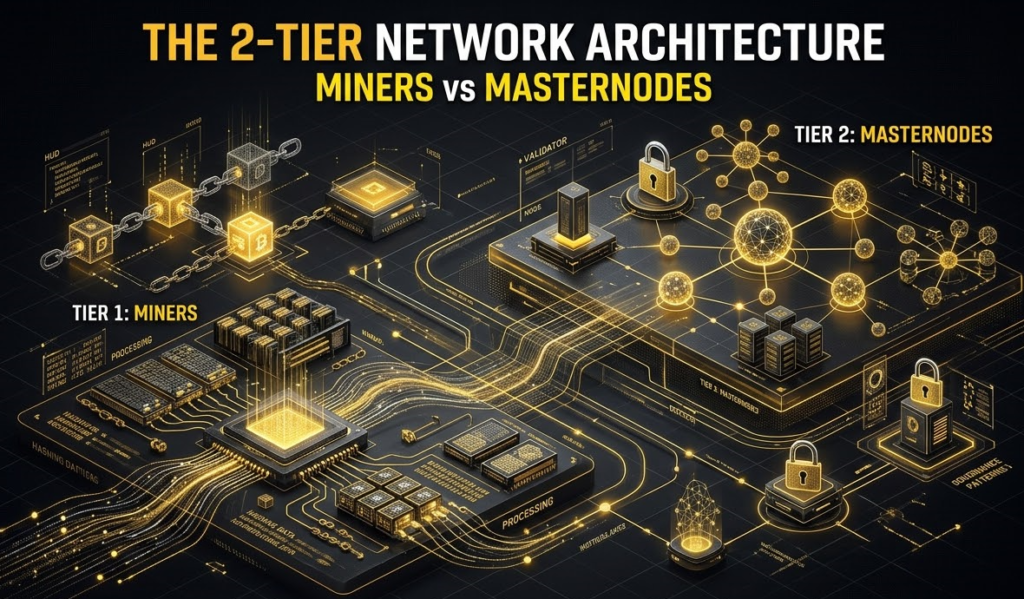
Dash’s most distinctive architectural decision is its separation of ordinary block production from additional network services. Bitcoin relies on miners to produce blocks and full nodes to independently validate the chain. Dash also uses Proof-of-Work miners, but adds a second tier of incentivized masternodes that coordinate services such as transaction locking, CoinJoin, and governance.
Think of the two tiers as performing different jobs rather than competing to do the same thing. Miners secure the base blockchain through computational work. Masternodes provide additional services that make the network more responsive and support its governance and application layers.
Layer 1: X11 Proof-of-Work Mining and Block Production
Dash uses Proof-of-Work to produce blocks and secure its base ledger. Miners compete to find valid blocks by repeatedly hashing candidate block data. The winning miner broadcasts the block, and other network participants validate it against Dash’s consensus rules.
The mining algorithm is called X11. Rather than applying a single hashing function in the same way Bitcoin applies SHA-256 for Proof-of-Work, X11 chains 11 different hashing algorithms:
- BLAKE
- BMW
- Grøstl
- JH
- Keccak
- Skein
- Luffa
- CubeHash
- SHAvite
- SIMD
- ECHO
The sequence is part of the block-hashing process. It was originally designed by Dash developer Evan Duffield, with the intention of making mining hardware development more difficult and diversifying the cryptographic hashing process. However, X11 should not be described as ASIC-resistant today. Specialized X11 ASIC miners exist and account for a substantial part of the network’s mining activity.
This is an important historical distinction. Early descriptions sometimes present X11 as a way to prevent ASIC mining altogether. That was an original design ambition, not a permanent property of the network. Dash’s own X11 documentation acknowledges that ASIC miners emerged.
Dash adjusts mining difficulty to keep block production near its target interval. Its documented average block time is approximately 2.6 minutes, somewhat shorter than Bitcoin’s ten-minute target. The actual time between individual blocks varies because Proof-of-Work is probabilistic: a target interval is an average, not a timer that forces a block to appear at an exact moment.
The miner’s role is fundamental. Masternodes do not replace mining or independently create ordinary Proof-of-Work blocks. They participate in a different layer of the network.
Layer 2: Masternodes and Evonodes
A Dash masternode is a server that provides additional services to the network in exchange for a share of the block reward. To register a standard masternode, its operator must prove control of 1,000 DASH in collateral.
That collateral is not simply a payment to the Dash development team. It remains under the owner’s control, but the masternode’s eligibility depends on the collateral continuing to satisfy the protocol’s requirements. If the owner spends or moves the required funds in a way that invalidates the collateral arrangement, the masternode stops qualifying for service and payment.
The collateral requirement creates an economic commitment. Operators have a financial reason to maintain reliable infrastructure because their node’s ability to earn rewards depends on remaining active and meeting network requirements.
Masternodes support several functions:
- InstantSend transaction locking.
- CoinJoin coordination.
- ChainLocks through Long-Living Masternode Quorums.
- Governance voting and budget decisions.
- Additional network services defined by Dash Core.
Masternodes are not all identical, however. Dash also has Evolution masternodes, commonly called Evonodes. An Evonode requires 4,000 DASH in collateral and runs both Dash Core and Dash Platform services. Its additional hardware and infrastructure requirements reflect the extra work involved in supporting Platform.
| Node type | Required collateral | Main responsibilities |
|---|---|---|
| Standard masternode | 1,000 DASH | Dash Core services, InstantSend, CoinJoin, ChainLocks participation, and governance |
| Evonode | 4,000 DASH | Standard Core services plus Dash Platform storage and validation services |
Evonodes are particularly important to Dash’s evolution beyond a payments network. They host Platform infrastructure, participate in Platform consensus, and help make decentralized data access possible.
The collateral requirement is only one part of running a node. Operators also need suitable server hardware, stable connectivity, security practices, software maintenance, and monitoring. A person who holds 1,000 DASH but does not operate or arrange the required infrastructure does not automatically provide masternode services.
The official masternode guide explains collateral and reward mechanics. The Evonode setup guide details the higher 4,000 DASH requirement and technical setup.
Speed, Security, and Privacy
Dash’s payment proposition depends on more than its average block interval. Waiting for a new block every few minutes would still be inconvenient for someone buying a coffee or paying a merchant. Dash therefore uses masternode quorums to provide faster transaction locking and additional protection against chain reorganizations.
It also offers CoinJoin, a separate feature designed to make transaction histories harder to follow. These three features address different problems and should not be treated as interchangeable.
InstantSend: Fast Transaction Locking
A normal blockchain transaction is broadcast to the network and waits to be included in a block. A recipient who wants stronger assurance may wait for additional confirmations. This process can be inconvenient for everyday payments, especially when the purchase is small and the customer expects to leave immediately.
InstantSend is designed to reduce that waiting period.
When a qualifying transaction is submitted, a Long-Living Masternode Quorum (LLMQ) coordinates the locking process. The quorum checks the transaction inputs and uses threshold signatures to establish that those inputs have been locked for that transaction. Once the lock is accepted, the network can treat the transaction as secured against competing attempts to spend the same inputs.
Dash documentation describes InstantSend as enabling transactions to be fully confirmed within approximately two seconds under normal operating conditions. This is why the feature is relevant to point-of-sale payments: a merchant can receive a much faster signal than waiting for an ordinary block confirmation.
The important technical point is that InstantSend does not make the base blockchain produce blocks every two seconds. Dash’s average block interval remains around 2.6 minutes. InstantSend uses the second-tier quorum system to provide a transaction lock before ordinary block confirmation.
It is also not a universal guarantee that every payment will always be locked in precisely two seconds. Transaction eligibility, network conditions, wallet support, and quorum operation matter. The official InstantSend guide explains how transaction inputs are locked and how LLMQs coordinate the process.
ChainLocks: Protection Against Deep Reorganizations
Proof-of-Work blockchains can experience reorganizations. A miner or group of miners may produce an alternative chain that eventually overtakes the previously accepted chain. In a sufficiently powerful attack, this can allow transactions to be reversed or replaced.
ChainLocks add a second layer of protection.
Dash uses a special Long-Living Masternode Quorum to observe newly mined blocks. When enough members of the quorum agree on a block, they create a cryptographic ChainLock signature. Nodes that receive a valid ChainLock reject conflicting blocks at the protected height and do not accept a competing chain that would replace the locked block.
The mainnet ChainLocks quorum uses a defined threshold-signature configuration. It is not simply a vote by every masternode, nor is it a miner’s decision. The mechanism relies on quorum formation and cryptographic signatures.
This substantially raises the difficulty of reorganizing a ChainLocked block, including in scenarios where an attacker has significant mining power. However, it is more accurate to say ChainLocks provide strong protection against reorganization attacks than to claim Dash is absolutely immune to every possible 51% attack. The security assumptions still include the integrity and availability of the quorum system, correct software, and the wider network.
InstantSend and ChainLocks complement each other:
- InstantSend locks transaction inputs so that conflicting spends are rejected.
- ChainLocks protect blocks after a quorum signs them, preventing conflicting reorganizations at protected heights.
Together, they help Dash offer faster payment assurance without changing its underlying Proof-of-Work block interval. The Dash roadmap records the introduction of Long-Living Masternode Quorums and ChainLocks, while the quorum documentation provides the technical details.
Is Dash a Privacy Coin? Understanding Optional CoinJoin
Dash is sometimes described as a privacy coin because privacy was an important part of its early identity. The project originally launched as XCoin, was renamed Darkcoin, and later adopted the Dash name. Its privacy feature has also evolved in terminology: what was historically known as PrivateSend is now generally documented as CoinJoin.
But does that mean Dash is a fully private cryptocurrency like Monero?
No. Dash transactions are transparent by default. Standard transactions use publicly visible blockchain addresses, amounts, and transaction relationships. Anyone with access to the blockchain can inspect ordinary transaction activity using an explorer.
Dash offers optional privacy through non-custodial CoinJoin. CoinJoin combines inputs from multiple participants into a transaction structure that makes it harder for outside observers to determine which input corresponds to which output. The user’s funds remain under the user’s control; the process does not require handing coins to a centralized mixer.
At a high level, the wallet prepares inputs in standardized denominations. It then coordinates with a masternode to join those inputs with those of other participants. The resulting transaction makes direct ownership links less obvious, although it does not erase the public blockchain record.
CoinJoin is not magic invisibility. Its privacy depends on factors such as the number of participants, transaction patterns, wallet behavior, the number of mixing rounds, and what information an observer already possesses. Users can undermine their own privacy by combining mixed and unmixed funds or revealing identifying information elsewhere.
It is also important not to confuse optional privacy with mandatory anonymity. Monero, for example, is designed to make privacy protections a default property of ordinary transactions. Dash’s standard transactions remain publicly traceable unless users deliberately use its optional privacy functionality.
The official CoinJoin documentation describes the non-custodial mixing process, while the Dash Core Wallet guide lists CoinJoin and InstantSend among the wallet’s supported features.
For users, the practical takeaway is simple: Dash is not an automatically anonymous payment network. It is a transparent cryptocurrency with an optional CoinJoin privacy feature. Whether that feature is available and appropriate for a particular user also depends on wallet version, local rules, and service-provider policies.
Dash Tokenomics, Treasury Superblocks, and DAO Governance
Dash has a declining block subsidy and a protocol-level funding mechanism. Instead of relying exclusively on donations, venture capital, or a centralized company budget, the network allocates part of its block subsidy to a governance budget. Masternode operators vote on proposals, and approved projects can receive funding through periodic superblocks.
This structure is one of the older examples of on-chain treasury governance in cryptocurrency. It also means that Dash’s monetary policy is not just about how many coins miners create. It includes how newly issued DASH is distributed among miners, masternodes, and the treasury.
The DASH Maximum Supply and Emission Reduction
Dash’s maximum supply is commonly stated as approximately 17.74 million to 18.92 million DASH. The exact outcome depends on the protocol’s emission schedule and how the available subsidy is distributed over time. The upper end, around 18.92 million, is widely used as the headline maximum-supply figure.
The network does not issue a fixed number of new coins forever. Instead, its block subsidy declines periodically. The protocol reduces the subsidy by approximately 7.14% every 210,240 blocks, which corresponds to roughly 383.25 days at the target block interval.
This is a disinflationary issuance model. New DASH continues to enter circulation while block rewards remain above zero, but the rate of new issuance gradually decreases.
It is worth distinguishing three different ideas:
- Maximum supply: The approximate upper limit on the amount of DASH that can be created under the emission schedule.
- Block subsidy: The amount of newly issued DASH assigned to a block.
- Circulating supply: The amount of DASH currently considered available in the market.
A reduction in block subsidy does not mean the circulating supply falls by the same percentage. Existing coins remain in circulation unless they are lost or otherwise made inaccessible. The 7.14% reduction applies to the subsidy schedule, not to the entire stock of DASH.
Dash’s official feature specifications describe the approximate supply range and subsidy reduction. The governance documentation also explains the approximately 383-day budget reduction interval.
The Current Block Reward Split: 20% Miners, 60% Masternodes, 20% Treasury
Older articles often state that 10% of Dash’s block reward goes to the treasury, with the rest split between miners and masternodes. That description is outdated.
In September 2023, the Dash network approved a treasury expansion. The change was activated with Dash Core v20 in December 2023. Under the updated subsidy allocation, the block subsidy is divided as follows:
| Recipient | Share of block subsidy | Purpose |
|---|---|---|
| Miners | 20% | Proof-of-Work block production |
| Masternodes | 60% | Second-tier network services |
| Governance budget | 20% | Community-approved development and ecosystem proposals |
The 20% governance allocation is particularly important. It provides recurring funding for development, integrations, marketing, community initiatives, and other projects that receive sufficient governance support.
There is another layer to the masternode allocation. The masternode portion is divided between Core masternodes and Platform services. Following the reward reallocation activated in August 2024, 62.5% of the masternode portion is paid to Core masternodes, while 37.5% is directed into a credit pool used for Evonode rewards on Dash Platform. Evonodes also receive Platform-related fees.
This distinction matters because saying “60% goes to masternodes” does not mean every standard masternode operator receives 60% of all block rewards. It describes the network-level allocation to the masternode tier, which is then distributed according to the protocol’s reward rules.
The updated allocation is documented in the Dash block reward reference and the governance overview.
How the Dash DAO Treasury and Superblocks Work
Dash’s treasury is funded by a portion of newly issued block rewards. Instead of paying the entire governance allocation directly to a single organization, the network accumulates the budget over a cycle and distributes it through a superblock.
A superblock occurs approximately every 16,616 blocks, or about 30.29 days. Before that point, masternode operators can vote on submitted proposals. The network then evaluates the voting results and allocates the available budget to proposals that meet the required approval conditions.
A proposal might request funding for:
- Core protocol development.
- Wallet improvements.
- Merchant and payment integrations.
- Developer tools and infrastructure.
- Community education and marketing.
- Research, events, and ecosystem expansion.
The proposal process is not a guarantee that every submitted project will receive funding. Applicants must explain what they want to accomplish, how much funding they need, and how the work will benefit the network. Masternode voting determines which proposals qualify, subject to the available budget and protocol rules.
This approach gives DASH holders who operate masternodes a direct role in deciding how part of the network’s issuance is spent. It also creates accountability questions. Voters need enough information to assess proposals, monitor delivery, and decide whether a project deserves continued funding.
The treasury can be a source of long-term development capital, but it does not guarantee that funded projects will succeed. A decentralized budget can still fund weak proposals, misjudge priorities, or struggle to coordinate complex development work.
For the voting and proposal rules, see the official Dash governance guide.
The Web3 Evolution
Dash began as a cryptocurrency focused on payments, but its development did not stop at faster transfers. Dash Platform adds a decentralized data and application layer that lets developers build applications using identities, structured documents, data contracts, and network-accessible APIs.
The distinction between Dash Core and Dash Platform is important. Core handles the base cryptocurrency network and its payment-related functions. Platform provides infrastructure for application data and identity features.
Dash Platform is not simply another name for the Dash blockchain, nor should it be described as a general-purpose smart contract platform identical to Ethereum. Its architecture is built around structured data, predefined contracts, and state transitions.
The platform launched on mainnet in Q3 2024, according to its official FAQ.
Dash Platform: Drive and Decentralized Data Storage
Drive is the storage component of Dash Platform. Rather than placing every application document directly onto the base payment blockchain, Platform stores structured application data through a separate layer hosted by Evonodes.
This data can include identities, documents, data contracts, and other application state. The Platform protocol validates submitted changes before they become part of the network’s committed state.
The process can be understood in a few stages:
- An application submits a state transition through the Platform interface.
- DAPI relays the request to the Platform network.
- The Platform consensus system validates and orders the transition.
- Once the transition is committed, the resulting state is stored through Drive.
- Applications can query the finalized data through the network’s API infrastructure.
Drive uses GroveDB as an authenticated storage backend. This enables the network to provide cryptographic proofs for certain queries, allowing a client to verify that returned data corresponds to the committed Platform state.
This architecture is useful for applications that need persistent data but do not need to put every piece of information on a conventional Layer 1 transaction ledger. It also provides a consistent framework for developers who want to build applications around identities and structured records.
The Drive documentation explains its storage model, while the Dash Platform overview describes the broader application stack.
DAPI: A Decentralized Way to Access Dash Platform
DAPI stands for Decentralized API. It provides an interface through which applications can interact with Dash Core and Dash Platform without relying on one centralized server as the sole gateway to network data.
For developers, this matters because blockchain infrastructure can be difficult to work with directly. Applications need to submit transactions, retrieve information, query data, and confirm that responses are valid. DAPI offers a standardized access layer built on Dash’s masternode infrastructure.
DAPI supports both Core and Platform functionality. Its documented interfaces include JSON-RPC and gRPC endpoints. Platform queries can also return cryptographic proofs that help clients verify the integrity of the information they receive.
A decentralized API does not mean that every application automatically becomes decentralized. Developers still choose how they host front ends, manage user interfaces, and handle off-network services. But DAPI provides a network-native way to access Dash data and submit Platform operations.
The official DAPI documentation covers its endpoints and security model.
DPNS: Human-Readable Names and Dash Identities
One of the biggest usability problems in cryptocurrency is the need to send funds to long addresses that are difficult to remember and easy to mistype.
Dash Platform addresses part of this problem through the Dash Platform Name Service (DPNS). DPNS allows users and applications to register human-readable names and associate them with Platform identities.
Instead of relying only on a cryptographic identifier, a user can interact through a registered name such as alice.dash. Some applications may display a simplified version of the name, but the registered Platform name belongs to the .dash namespace.
An identity is the underlying object that controls keys and authorizes actions. A DPNS name is a human-readable label linked to that identity. The two are related, but they are not the same thing.
The name registration process also includes protections against front-running. The documented process uses a pre-order phase that obscures the requested name, followed by a registration phase that reveals and registers it.
DPNS can make applications easier to use, particularly where people need to recognize contacts or identify one another without copying long strings of characters. It is a foundation for user-friendly experiences such as DashPay, although an application still needs to implement the relevant payment and contact features.
Read the DPNS documentation for the name registration process and its relationship with identities.
Dash vs Bitcoin
Dash is based on Bitcoin-derived code, but the two networks have developed different priorities and architectures. Bitcoin focuses on a relatively conservative base-layer design, with Proof-of-Work mining and a limited scripting model. Dash retains Proof-of-Work while adding masternodes, quorum-based services, and a protocol treasury.
| Dimension | Dash | Bitcoin |
|---|---|---|
| Original launch | January 2014 | January 2009 |
| Proof-of-Work | X11 | SHA-256 |
| Target block interval | About 2.6 minutes | About 10 minutes |
| Additional service layer | Collateralized masternodes and Evonodes | No equivalent native masternode tier |
| Fast transaction feature | InstantSend | Typically relies on confirmations or external payment layers |
| Reorganization protection | ChainLocks | Proof-of-Work chain selection and confirmation depth |
| Optional transaction privacy | CoinJoin | Privacy tools are available through wallets and protocols, but not as a default network feature |
| Protocol treasury | 20% of block subsidy | No equivalent automatic on-chain treasury allocation |
| Application data layer | Dash Platform | Applications use the Bitcoin ecosystem’s available scripting and off-chain infrastructure |
| Maximum supply | Approximately 17.74–18.92 million DASH | 21 million BTC |
The most visible difference is the masternode layer. Bitcoin nodes validate the blockchain, while miners produce blocks. Dash adds a collateralized second tier that performs extra services and participates in governance.
The networks also differ in their approach to transaction speed. Bitcoin’s base layer has a longer target block interval, while Dash uses InstantSend to lock qualifying transactions through masternode quorums. This does not mean Dash and Bitcoin offer identical security models or that one is automatically better for every use case.
Bitcoin has a much larger ecosystem, deeper liquidity, and a different monetary-policy profile. Dash’s design emphasizes payment usability and built-in governance, but it also introduces additional operational and economic dependencies around masternode infrastructure.
For someone evaluating the two, the useful question is not simply which network is faster. It is whether Dash’s added features solve a problem that matters to the intended user, and whether the network’s adoption, security, liquidity, and developer activity support that use case.
Common Pitfalls and Misconceptions About Dash
Dash has been around long enough to accumulate outdated descriptions, especially articles that repeat its early privacy branding or older reward allocations. Here are several points worth getting right.
Misconception: Dash Is a Mandatory Privacy Coin
Dash is not anonymous by default. Standard transactions are publicly visible on the blockchain. CoinJoin is an optional privacy feature that makes transaction tracing more difficult, but it does not erase transaction records or guarantee complete anonymity.
It is more accurate to describe Dash as a transparent digital currency with optional non-custodial CoinJoin privacy.
Misconception: Masternodes Mine Blocks
Masternodes do not perform X11 Proof-of-Work mining. Miners use specialized hardware to find valid blocks. Masternodes provide second-tier services, including InstantSend, CoinJoin coordination, ChainLocks participation, and governance.
Evonodes are a specialized masternode tier that also supports Dash Platform.
Misconception: Dash Has an Unlimited Supply
Dash does not have an unlimited block subsidy. Its issuance schedule reduces the block subsidy by approximately 7.14% every 210,240 blocks. Its maximum supply is commonly estimated at between 17.74 million and 18.92 million DASH.
The distinction between a declining issuance rate and a declining circulating supply is important. New coins continue to be issued while subsidies remain, even though the rate of issuance declines over time.
Misconception: Dash’s Treasury Still Receives Only 10%
The 10% treasury figure appears in older descriptions of Dash’s economics. The allocation was increased to 20% following a governance decision in 2023, activated with Dash Core v20 in December of that year.
The current subsidy split is 20% miners, 60% masternodes, and 20% governance budget.
Misconception: InstantSend Means Every Transaction Is Final in Exactly Two Seconds
InstantSend is designed to lock qualifying transactions quickly, and Dash documentation describes typical confirmation within approximately two seconds. But actual timing depends on transaction eligibility and network conditions. It is not a guarantee that every transaction, in every circumstance, will settle at precisely the same speed.
Misconception: Dash Platform Is Just Another Smart Contract Chain
Dash Platform is an application and data layer built around identities, data contracts, documents, and state transitions. Developers use its structured data model and APIs rather than treating it as a direct equivalent of a general-purpose smart contract environment.
This distinction helps set realistic expectations about what kinds of applications are straightforward to build on Platform.
How to Use Dash
The following steps explain the main ways people interact with Dash. The exact wallet screens and available features can vary by software version, so users should consult the current official documentation before moving funds or configuring infrastructure.
Phase 1: Sending a Dash Payment
Step 1: Choose a compatible wallet.
Download Dash Core from the official Dash website or use a reputable wallet that explicitly supports DASH. Dash Core is the full official wallet and supports features such as InstantSend, CoinJoin, and governance. A full wallet downloads and verifies the blockchain, so it requires more storage and synchronization time than a lightweight wallet.
Step 2: Secure the wallet.
Back up the recovery information and protect the wallet with a strong password or hardware wallet where supported. Never share a recovery phrase or private key with a person claiming to provide wallet support.
Step 3: Receive DASH.
Open the receiving section of the wallet and generate a receiving address. Share the address with the sender, or scan a payment QR code if the wallet supports it. Check the address carefully before sending funds.
Step 4: Send the transaction.
Enter the recipient’s address and the amount. Review the transaction fee and confirm the details before broadcasting the payment.
Step 5: Check the transaction status.
Where supported and eligible, the wallet may use InstantSend to lock the transaction. The recipient can check the payment status in the wallet or through a Dash block explorer. Remember that an InstantSend lock and an ordinary block confirmation are related but distinct stages.
Phase 2: Using CoinJoin
Step 1: Confirm that the wallet supports CoinJoin.
The official Dash Core Wallet documentation lists CoinJoin as a supported feature. Check the current wallet version and its documentation before relying on it.
Step 2: Understand the preparation process.
CoinJoin prepares funds in standardized denominations. This can require additional transactions and network fees before the mixing process begins.
Step 3: Allow the wallet to coordinate a mixing session.
The wallet communicates with masternodes to join a session with other participants. The process is designed to be non-custodial: the user retains control of the funds rather than depositing them with a centralized mixer.
Step 4: Review privacy and spending implications.
CoinJoin can make transaction relationships harder to identify, but it does not guarantee anonymity. Spending mixed funds alongside other funds or revealing identifying information can weaken privacy. CoinJoin transactions may also have different fee implications from ordinary payments.
Use privacy tools only in accordance with applicable laws and the rules of the services you use.
Phase 3: Operating a Masternode
Running a masternode is a technical and financial commitment. The collateral requirement alone does not make someone a node operator.
Step 1: Understand the collateral requirement.
A standard masternode requires 1,000 DASH. An Evonode requires 4,000 DASH. These are substantial financial commitments, and the market value of the collateral can fluctuate significantly.
Step 2: Prepare the server.
The operator needs a suitable server, a stable internet connection, and the relevant Dash software. Evonodes have higher hardware requirements because they provide Dash Platform services in addition to Core functionality.
Step 3: Secure the collateral.
Follow the official registration process and use a secure wallet arrangement. Dash’s documentation recommends hardware-wallet-based collateral management as a way to improve security.
Step 4: Register and configure the node.
The operator must create the required registration transactions, configure the server, and ensure the node appears correctly in the deterministic masternode list.
Step 5: Maintain the infrastructure.
Keep software updated, monitor uptime, protect server access, and respond to operational issues. A node that fails to provide its required services may lose eligibility for payments.
Step 6: Participate in governance.
Masternode operators can vote on proposals and participate in decisions about the network’s monthly budget. Voting is part of the service role, not a guaranteed source of investment returns.
The official masternode documentation and Evonode setup instructions should be treated as the primary references for current technical requirements.
Risks and Limitations to Understand Before Using Dash
Dash’s design offers several interesting features, but no blockchain architecture removes financial or technical risk. Anyone considering DASH as a payment asset, investment, or infrastructure commitment should evaluate the following areas.
Market volatility. DASH is a traded crypto asset. Its market price can rise or fall sharply, and the maximum-supply schedule does not guarantee price appreciation. A declining issuance rate is not the same thing as a guaranteed increase in demand.
Masternode capital requirements. Running a standard masternode requires 1,000 DASH, while an Evonode requires 4,000 DASH. The value of this collateral can change considerably. Operators also face server costs, maintenance responsibilities, and the risk of downtime.
Mining concentration and security assumptions. X11 mining relies on specialized hardware and a competitive mining market. ChainLocks add a quorum-based security layer, but they do not make the network immune to every possible failure or attack scenario.
Privacy limitations. CoinJoin makes some transaction relationships harder to trace, but ordinary Dash transactions remain transparent. Users should not assume that using CoinJoin makes their financial activity completely untraceable.
Governance risks. A treasury system gives masternode operators influence over network funding, but voting does not guarantee that proposals are well designed or successfully delivered. Governance quality depends on participation, transparency, and ongoing scrutiny.
Platform adoption. Dash Platform provides infrastructure for decentralized applications, but the existence of technical components does not automatically create a thriving application ecosystem. Developer adoption, user experience, reliability, and useful applications remain important measures of progress.
Wallet and operational security. A self-custodial wallet gives users control over their funds, but it also makes them responsible for protecting keys and recovery information. A compromised device, lost recovery phrase, or mistaken transaction can result in irreversible losses.
Dash is therefore best assessed as a combination of payment infrastructure, a two-tier network, and an evolving application platform—not simply as a coin with fast transactions.
Frequently Asked Questions About Dash (DASH)
What is Dash (DASH) and how does it work?
Dash is a peer-to-peer digital currency launched in January 2014 by Evan Duffield. It uses X11 Proof-of-Work mining to produce blocks and a second tier of collateralized masternodes to support services such as InstantSend, ChainLocks, CoinJoin, and governance. Dash Platform adds decentralized storage, identities, and application infrastructure.
How does a Dash masternode work?
A Dash masternode is a server that provides second-tier network services. Its operator proves control of 1,000 DASH in collateral for a standard masternode. Masternodes help coordinate InstantSend and CoinJoin, participate in ChainLocks quorums, and vote on governance proposals. They do not mine Proof-of-Work blocks.
How much DASH is required to run a masternode?
A standard Dash masternode requires 1,000 DASH in collateral. An Evonode, which also provides Dash Platform services, requires 4,000 DASH. Both types require appropriate server infrastructure and ongoing maintenance.
What is the difference between a masternode and an Evonode?
A standard masternode provides Dash Core services. An Evonode is a specialized masternode that provides both Core and Dash Platform services. It requires four times the collateral—4,000 DASH rather than 1,000 DASH—and has higher hardware requirements.
Is Dash a privacy coin like Monero?
Dash is not a mandatory privacy coin. Its normal transactions are transparent, but users can choose its non-custodial CoinJoin feature to make transaction histories harder to trace. Monero, by contrast, is designed around privacy protections being part of ordinary transactions by default.
What is InstantSend in Dash?
InstantSend is a transaction-locking feature that uses masternode quorums to secure qualifying transaction inputs. It allows payments to receive a fast security signal, commonly described in Dash documentation as taking approximately two seconds under normal conditions. It does not change the network’s average block interval.
What is ChainLocks in Dash?
ChainLocks use cryptographic signatures from a Long-Living Masternode Quorum to protect newly mined blocks. Once a block receives a valid ChainLock, nodes reject conflicting blocks that would replace it. This makes chain reorganizations substantially more difficult, including attacks involving significant mining power.
What is the maximum supply of DASH?
Dash’s maximum supply is commonly estimated at approximately 17.74 million to 18.92 million DASH. The protocol reduces its block subsidy by approximately 7.14% every 210,240 blocks, or roughly 383 days. This is a reduction in new issuance, not an automatic annual reduction in circulating supply.
How are Dash block rewards distributed?
The current block subsidy allocation is 20% to miners, 60% to masternodes, and 20% to the governance budget. The masternode allocation is further divided between Core masternodes and Platform-related Evonode rewards under the network’s reward rules.
What is the Dash DAO treasury?
The Dash DAO treasury is a protocol-funded budget that receives 20% of the block subsidy. Masternode operators vote on funding proposals, and approved projects can receive payments through periodic superblocks. The treasury supports development and other network initiatives.
What is Dash Platform?
Dash Platform is an application and data layer built on top of Dash. It provides structured data storage, identities, data contracts, documents, and APIs. Its main components include Drive, which stores Platform data, and DAPI, which provides decentralized access to network functionality.
What are Drive, DAPI, and DPNS?
Drive is Dash Platform’s decentralized storage layer. DAPI, or Decentralized API, allows applications to access Core and Platform functionality through network infrastructure. DPNS, the Dash Platform Name Service, allows human-readable names to be registered and associated with Platform identities.
Is Dash based on Bitcoin?
Dash began as a Bitcoin-derived project and shares parts of Bitcoin’s original design, but it has developed its own consensus services, monetary policy, governance system, and application layer. It uses X11 rather than Bitcoin’s SHA-256 Proof-of-Work algorithm and adds collateralized masternodes.
Final Thoughts
Dash remains an interesting cryptocurrency because it approaches the payments problem from several directions at once. X11 mining secures its base blockchain, masternodes provide additional services, InstantSend supports faster payment assurance, and ChainLocks strengthen protection against block reorganizations. CoinJoin adds an optional privacy feature without making every transaction private by default.
Its tokenomics and governance model are also distinctive. The block subsidy declines over time, while a 20% treasury allocation gives masternode operators a formal way to fund development and ecosystem initiatives. The addition of Evonodes and Dash Platform extends the network beyond ordinary payments into decentralized data storage, identities, and application infrastructure.
That does not mean Dash has solved every challenge. Its long-term relevance depends on whether people actually use it for payments, whether developers build useful Platform applications, whether the network remains secure and decentralized, and whether its governance system allocates resources effectively.
If you are researching Dash, the most useful approach is to look beyond the headline claims about speed or supply. Understand how its two-tier architecture works, distinguish optional CoinJoin privacy from default transaction transparency, and check the current reward and collateral rules in official documentation. Those details give you a much clearer picture of what Dash is—and what it is not.