OKX vs Bitvavo at a Glance
When comparing OKX vs. Bitvavo in 2026, I would start with one practical question: What do you actually want to do after depositing your money? If you mainly plan to buy Bitcoin or Ethereum with euros and hold them, an exchange with simple bank transfers and transparent EUR pricing may suit you better than one packed with trading products you will never touch. If you regularly trade order-book markets, manage several positions, or explore decentralized applications, a broader platform may be worth the extra complexity.
The comparison below focuses on the European services and published fee structures. Exchange products, payment methods, and account terms can vary by country, so always confirm the details shown for your own verified account.
| Feature | OKX Europe | Bitvavo |
|---|---|---|
| Main appeal | Advanced trading, broader product suite, and Web3 access | Euro-focused spot trading and a relatively straightforward user experience |
| Spot trading fees | Depend on account setup and fee tier; published EEA rates differ for users with and without a derivatives account | Entry EUR-market tier: 0.15% maker / 0.25% taker |
| Direct EUR markets | Available for supported trading pairs | Central to the platform’s European offering |
| Euro funding | Payment methods depend on country and account eligibility | European payment options, including bank-transfer methods where supported |
| Derivatives | Available products depend on jurisdiction and the European entity’s rules | Primarily spot trading; don’t assume futures or options are available |
| Staking | Available products and eligibility vary | Staking services are part of the offering, subject to asset and account conditions |
| Web3 | OKX Web3 Wallet and access to supported decentralized applications | Check the current Bitvavo wallet and on-chain product offering separately from its hosted exchange account |
| European regulation | OKX Europe Limited holds a MiCA authorization from Malta’s financial regulator | Bitvavo B.V. holds a MiCA authorization issued by the Dutch AFM |
| Reserve and custody transparency | Publishes Proof of Reserves materials using cryptographic verification | Describes client-asset safeguarding and segregated arrangements |
| Best starting point for | Active traders who want advanced tools and supported derivatives | European users who value direct EUR trading and a simpler spot-focused experience |
For regulatory context, OKX describes its European authorization in its MiCA licensing overview, while Bitvavo explains its authorization under MiCA in its official AFM licensing announcement. These are meaningful credentials, but they do not make the two services identical or remove the need to understand each platform’s terms.
One important detail can change the fee comparison: OKX’s EEA schedule distinguishes between customers who have opened a derivatives account and customers who have not. Bitvavo’s EUR-market fees also decline as eligible 30-day trading volume rises. So a comparison based on one headline percentage is useful only when you know which account and market the rate actually describes.
OKX vs Bitvavo Trading Costs in 2027

Trading fees are easy to underestimate because a fraction of a percentage point looks harmless on a single order. But if you trade frequently, the difference accumulates. The trick is to compare the correct market, order type, and fee tier—not a platform’s cheapest advertised rate against another platform’s standard rate.
Understanding maker and taker fees
A maker order adds liquidity to an order book, usually by resting there before it is matched. A taker order removes available liquidity by matching immediately against an existing order. A limit order is not automatically a maker order: if it executes immediately, it can be charged the taker rate.
This distinction matters because two people buying the same asset for the same amount can pay different fees simply because they use different order types. The exchange may also apply separate pricing to instant-buy features, conversions, or card purchases. Those routes may include a spread or payment charge that does not appear in the ordinary order-book fee schedule.
OKX spot fees: account configuration matters
For European users, OKX’s fee structure is more nuanced than the simple claim that everyone pays 0.08% maker and 0.10% taker. Its published EEA schedule lists 0.08% maker and 0.10% taker for regular users who have opened an X-Perps derivatives account. Customers who have not opened that account can face a different spot schedule. OKX also announced an adjustment effective September 25, 2026, that lowered spot fees for regular clients with spot-only accounts.
You can check the relevant figures in OKX’s EEA spot fee explanation and its September 2026 spot-fee notice. Before placing a trade, look at the rate displayed for your account rather than assuming a rate quoted in a comparison article applies to you.
There is another point worth checking: the pricing model may differ between a spot order book and a simplified Buy, Sell, or Convert flow. OKX explains that quoted-price services can incorporate a spread, while order-book transactions use the applicable maker or taker fee. Its guide to costs beyond trading fees is useful if the amount shown in a quote doesn’t match the commission you expected.
Bitvavo spot fees: volume tiers and market categories
Bitvavo’s published fee schedule lists the following starting rates for its EUR trading markets:
| Previous 30-day trading volume | Maker fee | Taker fee |
|---|---|---|
| €0 and above | 0.15% | 0.25% |
| €100,000 and above | 0.10% | 0.20% |
| €250,000 and above | 0.09% | 0.18% |
| €500,000 and above | 0.08% | 0.16% |
| €1,000,000 and above | 0.05% | 0.14% |
These are selected tiers from the official Bitvavo fee schedule, not a promise that every trading pair has the same rate. Bitvavo separates EUR markets from USDC markets and certain stablecoin pairs, which have their own pricing. Its fee levels are also linked to eligible trading volume over the preceding 30 days.
This means Bitvavo is not necessarily expensive for every trader. A high-volume customer can pay substantially less than a beginner trading a small amount each month. Conversely, a new customer using an ordinary EUR market should not assume the lowest published fee tier applies to them.
What does a €10,000 trade actually cost?
Let’s compare an illustrative €10,000 taker order on a standard EUR spot market. Using the published entry-level rates:
| Exchange and fee assumption | Calculation | Trading fee |
|---|---|---|
| OKX, 0.10% taker rate where applicable | €10,000 × 0.001 | €10 |
| Bitvavo, 0.25% EUR-market taker rate | €10,000 × 0.0025 | €25 |
Under these assumptions, the difference is €15 per execution. If you buy and later sell the same €10,000 position, and both transactions are charged at those rates on a €10,000 notional value, the illustrative round-trip commissions would be €20 on OKX and €50 on Bitvavo.
But don’t read this as a universal promise that OKX will always be cheaper. It uses the 0.10% OKX rate for a specific account configuration; a spot-only European account may have a different rate. Bitvavo’s fee also depends on the market and your volume tier. The calculation excludes spread, slippage, deposit costs, withdrawal costs, and any conversion between euros and another asset.
That last point matters more than many traders realize. A low commission can be offset by an expensive conversion route or a less favorable execution price. When comparing platforms, I would look at the total cost of completing the transaction—not just the number printed beside “taker fee.”
Why order type can change the result
Suppose you place a limit order to buy €2,000 worth of an asset below the current asking price. If the order rests in the book and is later filled, it may qualify as a maker trade. If you set a limit price that crosses the spread and fills immediately, it may be treated as a taker trade instead.
For a small, occasional investor, this difference may be minor. For someone placing orders all day, maker/taker classification can become a meaningful part of the strategy. However, chasing a lower maker fee is not always wise if it causes you to miss an entry, wait too long, or get filled only after the market has moved.
My advice is simple: decide first how you want to execute the trade, then calculate the fee that applies to that order type. Don’t choose a platform based on a maker rate if you know that you mostly use market orders.
Deposits, conversions, and withdrawals belong in the same calculation
A proper fee comparison should include more than the commission charged when you buy or sell.
Consider these possible costs:
- Deposit charges: Some payment methods may be free, while others can carry a fee from the exchange or payment provider.
- Conversion spreads: Buying through a simplified quote screen can have a different total cost from using a limit order on an order book.
- Withdrawal fees: Sending crypto to an external wallet usually involves a network fee, and the amount depends on the asset and blockchain.
- Trading-pair liquidity: A thinner market can produce a worse execution price, especially for a large order.
- Currency conversion: If you fund an account in euros but trade through another currency or stablecoin, the conversion step can add friction.
For example, if Bitvavo lets you buy an asset directly with euros, that may be more convenient than funding another route that requires an extra conversion. On the other hand, if you already hold the relevant asset or stablecoin and trade frequently, the lower fee on a suitable OKX market may make more financial sense. The answer depends on the path your money takes from deposit to final withdrawal.
Does OKX always beat Bitvavo on fees?
No. It can have a lower entry taker rate under the relevant fee schedule, but the comparison changes with your OKX account setup, Bitvavo’s volume tier, the trading pair, and the order type.
Use this quick checklist before deciding:
- Check the actual fee tier shown inside your account.
- Confirm whether you’re trading an EUR pair, USDC pair, or another market.
- Compare maker with maker and taker with taker.
- Add any payment, spread, conversion, and withdrawal costs.
- Estimate your monthly trading volume instead of comparing just one order.
Once you have those figures, the fee question becomes much easier to answer without relying on a headline claim.
Bitvavo’s Spot Focus vs OKX’s Advanced Trading Environment
Fees are only one part of the decision. The larger difference between OKX and Bitvavo is the breadth of the tools you can use after depositing funds.
Bitvavo is built around buying, selling, holding, and staking supported crypto-assets. That focus can be a real advantage if you don’t want a screen full of leveraged products, advanced margin controls, and unfamiliar contract types. OKX, by contrast, offers a wider set of trading and Web3 tools in markets where the relevant products are permitted.
Does Bitvavo have futures or margin trading?
You should treat Bitvavo as a spot-focused exchange rather than assuming it offers the perpetual futures, options, and margin products associated with a derivatives-heavy platform. Product availability can change, so check Bitvavo’s current market list and terms before making a decision based on a specific instrument.
For a long-term buyer, the absence of derivatives may not matter at all. If your plan is to deposit euros, buy BTC or ETH, and hold the assets in your account or move them to a wallet, a spot-focused service may provide everything you need.
The trade-off becomes clearer if you want to hedge an existing position, short an asset, or trade a contract whose value tracks an underlying cryptocurrency. In that case, you need a venue that explicitly supports the instrument and is allowed to offer it in your jurisdiction.
What OKX offers to advanced traders
OKX’s broader platform includes derivatives and other professional tools in eligible markets. Depending on the account and region, these may include perpetual contracts, margin features, and options. Its Unified Trading Account is designed to let eligible users manage supported products and collateral within a unified account framework, subject to product-specific risk and margin rules.
That flexibility can be useful when you know how to manage the risks. A trader might use spot holdings to establish a position, futures to hedge some price exposure, and options to structure a defined-risk strategy. But having all those tools in one ecosystem does not make the strategy automatically safer or more profitable.
Leverage magnifies outcomes in both directions. A relatively small market move can lead to a large loss when the position is leveraged, and liquidation rules may force a position to close before you have time to react. If you do not already understand maintenance margin, funding rates, mark prices, and liquidation thresholds, start with spot trading and learn those mechanics before using derivatives.
Why product availability must be checked by region
A global exchange’s website can show products that are not available to every user. A European account, for instance, may be served by a regulated regional entity whose product catalogue and terms differ from those of a global platform. A contract available to one customer may be unavailable to another because of local rules or eligibility requirements.
For that reason, don’t use an international product page as proof that you personally can trade a particular instrument. Check the products visible in your verified account, read the relevant risk disclosures, and confirm the legal entity providing the service.
If derivatives are essential to your strategy, verify availability before you deposit funds. Otherwise, you could end up paying to move assets between exchanges simply because the product you expected is not supported in your region.
Staking: another product worth comparing carefully
Bitvavo offers staking services for supported assets, subject to its current terms and the assets available to the user. OKX also offers earning or staking-related services in certain markets, but the specific product, reward mechanism, and eligibility rules can differ.
Don’t compare staking options solely by the displayed annual percentage yield. Ask how rewards are generated, whether the asset is locked or can be unstaked immediately, whether the rate is variable, and what happens if the underlying protocol or service experiences a problem. A higher advertised yield may reflect higher risks or different conditions rather than a better deal.
I would also separate native protocol staking from exchange-managed earning products. When you stake through an exchange, your relationship with the asset and the service provider may differ from running your own validator or delegating directly through a self-custody wallet. Read the terms so you understand what you are actually agreeing to.
MiCA, AFM Supervision, and the Role of Local Entities

For a European customer, regulation is not a footnote. It affects which entity provides the service, which rules apply, what disclosures are available, and how complaints are handled. But the phrase “regulated exchange” should never be treated as shorthand for “risk-free investment.”
Bitvavo’s MiCA authorization from the Dutch AFM
Bitvavo announced on June 27, 2025, that it had obtained a licence under the EU’s Markets in Crypto-Assets Regulation, commonly known as MiCA, from the Dutch Authority for the Financial Markets (AFM). The company says the authorization allows it to provide covered crypto-asset services across the EU under the harmonized framework. Its licensing announcement provides the company’s account of the authorization, while its official regulation help page explains the covered services.
MiCA establishes a common regulatory framework for covered crypto-asset service providers in the EU. It addresses areas such as authorization, conduct, governance, and certain customer protections. A licence is a useful starting point when evaluating an exchange, but you should still check the entity named in your user agreement and the exact services covered by its authorization.
Bitvavo’s Dutch roots and focus on euro markets can make its setup easier for users who primarily bank and trade in Europe. If you are comparing it with a global platform, look beyond the company’s headquarters: confirm the contracting entity, where the service is regulated, and which local terms apply to your account.
OKX Europe’s MiCA framework
OKX operates its European services through OKX Europe Limited, which received a MiCA authorization from the Malta Financial Services Authority (MFSA) on January 27, 2025, according to the company’s European licensing overview. That authorization is distinct from the licensing arrangements used by other OKX entities in other regions.
The distinction matters because OKX is an international group, not a single legal entity providing every service to every customer worldwide. The terms governing a European customer’s account may differ from those that apply to a user on a separate global or regional platform.
When you open an account, check the name of the contracting company in the terms and conditions. If you need to raise a complaint or understand how assets are held, that legal entity is more relevant than a generic statement about the global brand.
MiCA does not mean every crypto risk disappears
Regulation can improve the standards a service provider must meet, but it does not remove the volatility of crypto markets. A licensed exchange can still experience operational disruption, a customer can still send assets to the wrong address, and the value of a token can still fall sharply.
Nor should MiCA authorization be confused with a bank deposit guarantee. Crypto-assets are not automatically covered by the same deposit-protection schemes that apply to eligible bank deposits. Always read the terms for the particular asset and service you use.
For a sensible regulatory comparison, I would look at four things:
- The contracting entity: Which company is actually providing the service?
- The regulator: Which authority granted the relevant authorization?
- The service scope: Does the authorization cover the product you intend to use?
- The customer terms: What rights, exclusions, complaint procedures, and asset-handling arrangements apply?
This is a more useful test than ranking exchanges by the number of countries named on their marketing pages.
Euro Deposits and Local Payment Convenience
For many European users, the most important exchange feature isn’t a perpetual futures market or a Web3 wallet. It is being able to move euros from a bank account to the exchange without unnecessary steps, then buy the asset they want at a transparent price.
Why Bitvavo appeals to euro-first investors
Bitvavo is designed around the European retail market and offers direct EUR trading pairs for supported assets. Depending on the user’s country and account eligibility, available funding methods can include SEPA bank transfers and local payment options. The exact methods and charges can change, so check the deposit screen and payment terms before transferring money.
Direct EUR markets make the route from bank balance to crypto relatively straightforward. If you want to buy BTC/EUR, for example, you can trade that pair directly without first purchasing a dollar-pegged stablecoin. That can reduce the number of transactions you need to manage and make your records easier to follow.
For a person who invests a fixed amount every month, convenience has real value. You are less likely to need a separate conversion step, and it may be easier to reconcile deposits and trades against your bank statement. The benefit is not that every Bitvavo trade will be cheaper, but that the workflow may fit naturally into a euro-based routine.
Can OKX also work well for euro users?
Yes, where the relevant euro deposit and trading services are available to your account. OKX Europe supports European services under its own regulatory framework, and the exchange offers euro-related markets and funding options subject to location and eligibility. However, you should verify the actual payment methods offered to your country rather than assume every European customer sees the same options.
If you already hold crypto or prefer the wider set of tools on OKX, the extra platform complexity may be worth it. But if you are starting with euros in a bank account and want a simple purchase, compare the full funding route before deciding.
A useful way to evaluate each platform is to simulate the journey you expect to use:
- Deposit €1,000 from your own bank account.
- Buy a specific asset using the order type you normally prefer.
- Check the executed price and fee.
- Estimate the cost of withdrawing the asset to your own wallet, if that is part of your plan.
- Calculate how much value you would receive after all fees and conversion steps.
This gives you a real-world comparison instead of relying on a headline fee alone.
What about iDEAL and Bancontact?
Local payment methods can make an exchange easier to use, but availability can vary by country, payment provider, and account status. Do not assume that iDEAL or Bancontact is available to every user simply because the platform has a European focus.
Before initiating a deposit, check the list of methods presented in your verified account, the minimum and maximum deposit amounts, processing times, and any fees. Also make sure the bank account or payment method is in your own name if the exchange’s rules require it. Transfers from third parties can trigger checks or delays.
For an investor who values simple euro funding, the right exchange is the one that offers a reliable route from their actual bank to the actual market they want to trade—not necessarily the one with the largest international product list.
OKX Proof of Reserves vs Bitvavo’s Safeguarding Framework
Security is where a comparison needs more nuance than a simple “which exchange is safer?” ranking. OKX and Bitvavo describe different mechanisms for protecting customer assets, and each mechanism answers a different question. Proof of Reserves asks whether the exchange can demonstrate that it holds sufficient crypto-assets against reported customer balances. Legal segregation addresses how customer assets are separated from the company’s own assets. An account guarantee may provide reimbursement in specific circumstances. None of these mechanisms eliminates every possible risk.
How OKX’s Proof of Reserves works
OKX publishes Proof of Reserves (PoR) reports using cryptographic verification. Its European Proof of Reserves page describes a process that combines published on-chain wallet holdings with cryptographic proofs of customer liabilities. The system uses zk-STARK technology, a type of zero-knowledge proof, to help verify account data without publicly disclosing every customer’s individual balance.
The idea is straightforward: an exchange should be able to demonstrate that the crypto-assets it controls are sufficient to cover the relevant customer liabilities included in its report. OKX says it has published recurring reports since November 2022, and its reserve-report archive lets users inspect available reserve and liability files.
For someone evaluating an exchange, that public verification process is useful because it offers more than a general statement that assets are safe. Users can inspect the published materials and, with the appropriate tools, independently verify aspects of the proof.
However, you should understand the limits. A Proof of Reserves report is a snapshot based on defined assets, liabilities, and reporting methods. It does not automatically prove that every part of a company’s balance sheet is healthy, that every liability of every related entity has been disclosed, or that withdrawals will never be interrupted. It also does not protect you from the market price of the crypto you hold.
The most sensible approach is to treat PoR as one important input in a broader assessment, alongside regulatory status, custody arrangements, withdrawal policies, operational history, and your own security practices.
What Bitvavo’s asset segregation means
Bitvavo describes a different part of its safeguarding framework through Stichting Bitvavo Payments, a separate foundation established under Dutch law. Its terms and conditions explain that the foundation is used to segregate customer assets from Bitvavo’s own assets. The intended legal effect is that customer assets held through the foundation do not form part of Bitvavo B.V.’s own equity and are treated separately if the operating company encounters financial difficulty.
This is a legal and organizational safeguard rather than the same type of cryptographic evidence provided by Proof of Reserves. The two approaches should not be treated as interchangeable. Segregation addresses how assets are legally held; PoR addresses whether specified on-chain reserves can be reconciled with reported liabilities at a given point in time.
For a user, segregation is important because the legal structure can affect how customer assets are treated if a company becomes insolvent. But it does not guarantee instant access to assets in every scenario, and it does not remove risks related to custody providers, operational failures, blockchain networks, or market volatility.
I would read the actual user agreement rather than relying on the word “segregated” alone. Check which legal entity holds your assets, what claim you have against that entity, and how the arrangements apply to crypto-assets, fiat balances, and staking services.
Bitvavo’s €100,000 Account Guarantee
Bitvavo also offers an Account Guarantee that may reimburse eligible users for up to €100,000 in certain cases of unauthorized account access and withdrawals. Its official Account Guarantee terms explain the eligibility requirements and exclusions.
This is an important distinction: the guarantee is not a blanket €100,000 insurance policy for every type of loss. It is not a promise to reimburse you if the price of Bitcoin falls, a trade goes badly, or you voluntarily send crypto to the wrong address. Bitvavo says eligibility depends on conditions including account verification, authenticator-app two-factor authentication, reporting deadlines, and evidence of unauthorized activity. The company also states that the program is not part of an EU deposit-guarantee scheme.
So how should you weigh it against OKX’s Proof of Reserves? I would treat them as complementary but different forms of reassurance. OKX’s PoR helps you examine evidence about reserve coverage. Bitvavo’s segregation arrangements address legal separation, while its Account Guarantee may provide an additional, conditional remedy for a narrow category of unauthorized withdrawals.
Neither should be the sole reason you leave a large balance on an exchange.
Which platform has the stronger security case?
There is no responsible way to declare one universally safer based only on the information above. The mechanisms are not directly comparable, and a full assessment would require more than a single published metric.
| Security question | OKX | Bitvavo |
|---|---|---|
| Can customers inspect reserve information? | Publishes Proof of Reserves and related verification materials | Publishes information about custody and asset segregation; assess the current disclosures available |
| How are customer assets treated relative to company assets? | Review the applicable European entity’s custody and segregation terms | Uses Stichting Bitvavo Payments for legal segregation, as described in its terms |
| Is there an account guarantee? | Do not assume a general guarantee applies; review the applicable account terms | Offers a conditional Account Guarantee of up to €100,000 for eligible unauthorized withdrawals |
| Does this eliminate crypto price risk? | No | No |
| Does it guarantee uninterrupted withdrawals? | No | No |
Whichever platform you choose, use an authenticator app for two-factor authentication, secure the email account linked to your exchange, use a unique password, and enable available withdrawal safeguards. For larger holdings that you do not need to trade regularly, consider whether self-custody is appropriate for your experience level and recovery capabilities.
OKX Wallet vs Bitvavo’s Hosted Exchange
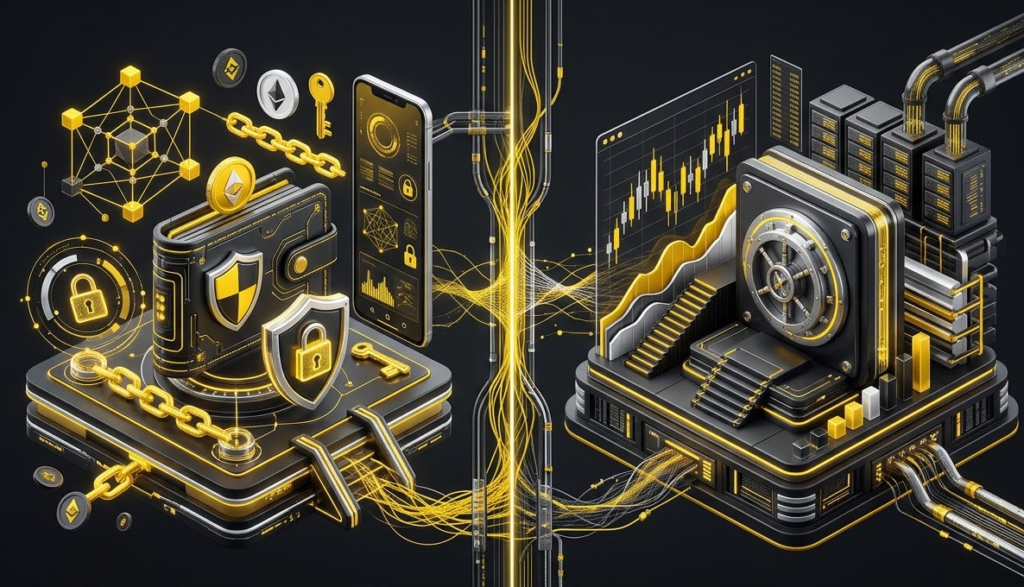
The distinction between an exchange account and a self-custody wallet is worth understanding before you deposit money. When you hold assets in a hosted exchange account, the platform manages the custody infrastructure associated with your balance. With a self-custody wallet, you control the private keys or recovery mechanism, and you take on much more responsibility for keeping them secure.
OKX’s Web3 ecosystem
OKX offers a Web3 Wallet designed to connect users with supported blockchains, decentralized applications, and on-chain services. Depending on the network and application, a user can interact with decentralized exchanges, manage tokens, and explore other blockchain-based products without treating every activity as a conventional exchange order.
That flexibility is useful if you already understand how wallets, network fees, token approvals, and blockchain confirmations work. It can also introduce new risks. A malicious decentralized application, a fraudulent token, or an unsafe contract approval can lead to losses even when the wallet software itself is functioning as intended.
If you are new to self-custody, remember that a wallet interface is not a guarantee that every token or application shown within it is trustworthy. Verify contract addresses, be cautious about signing unfamiliar messages, and never enter your recovery phrase into a website claiming to provide support.
How Bitvavo fits into a Web3 workflow
Bitvavo’s core proposition is different: it focuses on its hosted trading environment, EUR markets, and supported crypto services. Users can withdraw supported assets to an external self-custody wallet, but you should verify the current asset and network options before planning a transfer.
This can be a perfectly sensible arrangement. You might use Bitvavo to fund an account from your bank, buy an asset in a direct EUR market, and then withdraw it to a wallet you control. The fact that the exchange is less focused on an integrated Web3 environment does not prevent you from interacting with decentralized applications through a separate wallet.
The trade-off is convenience versus responsibility. An integrated Web3 wallet may make on-chain services easier to discover, but it also gives you more ways to interact with smart contracts and more opportunities to make costly mistakes. A straightforward hosted exchange can reduce complexity for a beginner, although leaving assets on an exchange introduces custodial risk.
Before choosing based on Web3 features, ask yourself whether you genuinely intend to use them. If you only want to buy and hold a small amount of crypto, you may not need a broad on-chain toolset at all.
Common Mistakes When Choosing Between OKX and Bitvavo
Mistake: Assuming Bitvavo’s highest fee applies to every customer
Bitvavo’s entry-level EUR-market fee is not the only rate in its schedule. Eligible customers can move into lower tiers as their 30-day trading volume increases, and different market categories have different fees. Review the current fee table and identify the actual trading pair before estimating your cost.
The reverse mistake is just as common: seeing a low fee tier and assuming you qualify for it. Unless your account meets the relevant criteria, use the entry-level rate or the rate shown in your account.
Mistake: Assuming every OKX European account pays 0.10% taker
As explained earlier, OKX’s European spot fee schedule varies with account configuration. The frequently quoted 0.08% maker and 0.10% taker figures apply to a particular setup, while spot-only customers may see a different schedule. Check the official EEA fee guidance before relying on a headline comparison.
Mistake: Treating “regulated in Europe” as a guarantee against loss
MiCA authorization is important, but it does not guarantee an asset’s price, eliminate cybercrime, or make every crypto service equivalent to a bank account. Nor does it mean all products offered by an international exchange are available under the same European entity.
Always identify the company that provides your account, the scope of its authorization, and the terms governing the product you intend to use.
Mistake: Forgetting the cost of converting euros
A direct EUR pair can simplify your trading workflow. If you need to convert euros to another asset before reaching your intended market, the additional transaction can introduce fees, spread, or price exposure. Conversely, a direct EUR market is not automatically the cheapest option if its liquidity is poor or its execution price is less favorable.
Compare the full route, including how you deposit, what pair you trade, and how you withdraw.
Mistake: Believing a security feature prevents every kind of loss
Proof of Reserves, asset segregation, and an account guarantee address different risks. None protects you from every possible scenario. If you approve a malicious contract, lose your recovery phrase, or send crypto to an incompatible address, you may have little or no recourse.
The best practical defense is to combine platform safeguards with careful personal security and a clear understanding of what each safeguard actually covers.
Mistake: Choosing an exchange for derivatives you cannot access
Product availability depends on location, account status, and regulatory conditions. If you want futures, options, or margin trading, confirm that the relevant product is actually available to you before moving funds. A global marketing page is not proof of eligibility for your account.
How to Transfer Crypto from Bitvavo to OKX
Moving crypto between exchanges is a routine process, but the details matter. A transfer sent over the wrong network or to an address that does not support the asset may be delayed or lost. Before you begin, verify that both exchanges support deposits and withdrawals for the exact asset and network you intend to use.
Generate a deposit address on OKX
- Sign in to your verified OKX account. Open the Assets section and choose the deposit function.
- Select the cryptocurrency. Choose the exact asset you want to receive, such as BTC, ETH, or USDT.
- Select the blockchain network. The network must be supported for deposits by OKX and must match the withdrawal network you will select on Bitvavo. Do not choose a network simply because its fee is lower.
- Copy the deposit address. Use the copy function rather than manually retyping a long address. If the deposit instructions require a memo or tag, copy that information too.
- Read the deposit conditions. Check any minimum deposit, confirmation requirement, network warning, or asset-specific instruction displayed by OKX.
Withdraw from Bitvavo
- Open the relevant asset wallet in Bitvavo. Select the withdrawal option for the cryptocurrency you want to send.
- Enter the OKX deposit address. Paste the address you copied and check the first and last characters against the address displayed by OKX.
- Choose the same network. This is one of the most important steps. If OKX’s deposit page specifies a particular network, select that same network in Bitvavo.
- Enter the amount. Review the network fee and the final amount that will arrive. If it is your first transfer to this address, consider sending a small test amount first, provided the network’s minimum deposit and fees make that practical.
- Complete the security checks. Follow Bitvavo’s current confirmation process, which may include email verification and two-factor authentication.
- Track the transaction. Use the transaction ID or transaction hash to check its progress on the relevant blockchain explorer, then wait for the required confirmations and the exchange’s deposit processing.
Before you send: a quick safety checklist
-
The asset is supported for deposits on OKX.
-
The selected blockchain network matches on both platforms.
-
The destination address has been copied and checked.
-
Any required memo or tag has been included.
-
The withdrawal amount meets the minimum deposit requirement.
-
You have reviewed the fee and final amount.
-
You understand that an on-chain transfer may not be reversible.
Don’t assume that the same ticker always means the same network. A token may exist on several blockchains, and the receiving exchange may support only some of them. If anything on the withdrawal screen differs from the deposit instructions, stop and verify the details before proceeding.
Also remember that transferring crypto between exchanges is not the same as transferring euros through a bank. A blockchain transaction is generally irreversible once confirmed, and customer support may not be able to recover funds sent to an unsupported network or incorrect address.
Frequently Asked Questions
Which exchange has lower trading fees?
OKX can have lower spot trading fees under the applicable European account schedule. For example, the 0.10% taker rate available to eligible OKX EEA accounts with a derivatives account would mean a €10 commission on a €10,000 taker order. Bitvavo’s entry EUR-market taker fee is 0.25%, which would mean €25 on the same notional value. Actual costs depend on the account configuration, trading pair, order type, and volume tier. Check the OKX EEA fee schedule and Bitvavo’s fees before trading.
Does Bitvavo offer futures and margin trading like OKX?
Bitvavo is primarily a spot-focused platform and should not be assumed to offer the same derivatives suite as OKX. OKX provides additional trading products, including derivatives in supported markets and regions. Since product availability can change, confirm the exact contracts and services shown in your verified account before depositing funds for a particular strategy.
Which platform is better for European users who want easy euro deposits?
Bitvavo is particularly worth considering if you want direct EUR trading pairs and familiar European funding methods. Its available payment methods vary by country; its official euro deposit guide lists methods, processing times, and fees. OKX also offers euro-related services in eligible European markets, so compare the methods available to your own account rather than assuming one platform is always more convenient.
Are both exchanges regulated under European standards?
Both have European regulatory frameworks. Bitvavo B.V. says it holds a MiCA authorization issued by the Dutch AFM, while OKX Europe Limited says it received a MiCA authorization from Malta’s MFSA. You should still verify the legal entity providing your account and the scope of the relevant authorization. Regulation is an important factor, but it does not eliminate crypto-market risk or guarantee that every product is available to every customer.
Which exchange is better for beginners?
Bitvavo may be the more comfortable starting point for a beginner who wants to fund an account in euros, buy supported assets on spot markets, and avoid the complexity of derivatives. OKX may be more suitable for someone who wants a wider set of trading and Web3 tools and is prepared to learn how they work. A beginner can use either platform responsibly, but should understand fees, account security, and withdrawal procedures before making a large deposit.
Is Bitvavo’s €100,000 Account Guarantee the same as deposit insurance?
No. Bitvavo’s Account Guarantee is a conditional reimbursement program for eligible cases involving unauthorized access and withdrawals. Bitvavo explicitly says the program is not part of an EU deposit-guarantee scheme. It does not cover every kind of loss, such as an unfavorable trade or a crypto transfer sent to the wrong address. Read the official guarantee terms to understand the eligibility requirements and exclusions.
Does OKX’s Proof of Reserves mean my money is completely safe?
No. Proof of Reserves can provide useful evidence that specified on-chain assets cover reported account liabilities at the time of a snapshot, but it is not a guarantee against all forms of insolvency, operational disruption, cybercrime, or market loss. It should be considered alongside the exchange’s legal structure, custody arrangements, regulatory status, and withdrawal policies.
Can I use Bitvavo outside Europe?
Bitvavo’s services are designed for supported European jurisdictions, and account registration depends on residence and verification requirements. Its supported-country guide explains which countries and payment methods are available. Check that list before attempting to open an account or transfer funds from another region.
Final Verdict
There is no need to make this comparison more complicated than it is. OKX is the stronger candidate if you want a broader trading environment and access to advanced tools in eligible markets. Bitvavo is particularly compelling if your priority is buying and selling crypto directly with euros through a European-focused platform. The right choice depends on which of those benefits matters most to you.
I would lean toward Bitvavo for a straightforward euro-based investing routine. Its direct EUR markets, European payment options, and MiCA authorization under the Dutch AFM can make it a natural fit for users who mainly want to buy, sell, and hold crypto without dealing with derivatives. Its published asset-segregation arrangements and conditional Account Guarantee are also worth examining as part of a broader security assessment.
I would investigate OKX first if I wanted a more extensive trading toolkit, supported derivatives, or an integrated Web3 environment. Its European fee schedule can be competitive, but you should verify the rate for your actual account configuration rather than assuming that a single headline figure applies to every customer.
Before making the final decision, I would compare these five things in order:
- Your actual trading fees, including the account tier, order type, and trading pair.
- The cost of funding and withdrawing, not just the commission charged on a trade.
- The product you intend to use, especially if it involves derivatives or staking.
- The legal entity and safeguards that apply to your account.
- The complexity you are comfortable managing, from a simple spot purchase to self-custody and advanced trading.
For a beginner who simply wants to invest in crypto with euros, the exchange with the clearest funding route and easiest-to-understand pricing may be the best choice—even if it is not the one with the lowest theoretical fee. For an active trader, a small fee difference can add up, but only when the relevant rates apply and the trading route remains efficient.
My final advice is to start with the workflow you will actually use, verify the live fee schedule, and make a small test deposit and withdrawal before moving a substantial balance. Compare the total cost and the protections that apply to your own account, not just the marketing claims.
The best exchange is not the one with the longest feature list. It is the one whose costs, legal terms, and risks you understand—and whose tools match the way you genuinely want to use crypto.